The relationship between the Last Planner®
1System and
collaborative planning practice in UK construction
Emmanuel Itodo Daniel, Christine Pasquire, Graham Dickens and Glenn
Ballard
Abstract
Purpose – The purpose of this study is to identify how the newly emerging UK practice of “Collaborative Planning” (CP) for construction project delivery aligns with the advocated principles of the Last Planner System (LPS) of production planning and control.
Design/methodology/approach – A mixed, qualitative, exploratory approach was adopted for the study. This entailed qualitative data through three techniques namely: semi-structured interviews, documents analysis, and structured observation. Thirty in-depth-interviews were conducted over a 12 month period with lean construction consultants, clients, main contractors, and subcontractors drawn from the building, highways and infrastructure and rail sector. Fifteen projects were visited where practices were observed.
Findings – The study reveals that the current practice of CP in the UK partially aligns with the LPS principles. Where practitioners have heard of the LPS they believe it to be the same practice as CP.
Limitation: This study is limited to 30 interviews, observation of 15 projects and document analysis. The aim of the study is not to generalise the findings, however, since the study examined top construction companies and practitioners in the UK and the findings were consistent across the sample, some conclusions could be
made. The study is also limited to examining the construction phase only, future studies should incorporate the design phase.
Practical Implication- A clear identification of the elements of current practice compared to the components of the LPS provides a contribution to the future practice of project production planning and management in the construction industry.
Social implication – The study highlights a continuing resistance to collaboration within the industry. This resistance is subtly embedded within implemented practices even though they are based on collaborative working for their success. Originality and Value – This is among the first studies in the UK that comprehensively examines and reports the application of Last Planner System/Collaborative Planning practice in construction across the major construction sectors. Future studies could build on the findings from this work to develop an approach/methodology to improve the current practice.
Paper type: Research paper
1.0 Introduction
The call for improvement in the UK construction industry and the dissatisfaction from stakeholders has been a subject of debate over many years with the first report to review the performance of the UK construction industry commissioned
back in 1929 (Cain, 2004). The Egan report, generally called Rethinking Construction, challenged the lack of collaboration in planning, designing, and executing work on site, and recommended the adoption of lean production principles to enhance the image and efficiency of the industry (Egan, 1998).As a follow up action to Egan’s challenge, the Construction Lean Improvement Programme (CLIP) was inaugurated to drive lean in the industry (BRE, 2006).
However, the prevailing approach to planning does not support lean production principles (Ballard and Howell, 1997). According to Ballard and Howell (1998), Ballard and Howell (1994) the current model used in planning and managing the execution of work in the construction industry is ‘project’ control rather than ‘production’ control which contributes to the non-achievement of task as planned. The problem with this is that planned tasks are not achieved as planned due to the lack of collaboration and involvement of stakeholders in the planning process. These stakeholders include the client, designers, subcontractors, main contractors, and site operatives among others. The impact of this is evident in the construction industry globally (Nasir et al., 2013; Cain, 2004), including the UK. For instance, it has been reported that about 50% of construction projects suffer both cost and time overrun in the UK (Crotty, 2012).
However, the Last Planner® System (a lean production approach) invented in
the 1990’s has been identified as a production planning and control technique for construction, that engenders collaboration among the project stakeholders (Ballard, 2000). Papke and Dove, (2013) described the LPS as a production planning and management (PPM) method for construction. In this study, PPM is used to describe the application of production planning and control principles in construction based on the LPS. Over the years, planning and control has been understood to be among the core management functions including construction management (Burke, 2013). However, while planning and control are separated in traditional construction project management, this is seen as an integrated process in the LPS of construction management (Ballard and Howell, 2004; Ballard, 1997). This makes the planned construction programme more predictable and reliable, thus leading to reduction in lead time in the construction phase (Alsehaimi et al., 2014; Ballard et al., 2009;Alarcón et al., 2005; Ballard and Howell, 1997). In practice, the LPS stabilises the production (construction) process on a project by identifying relationships, matching it with plans and balancing resources (Mossman, 2014; Ballard and Howell, 2003). The LPS establishes relationships between people, tasks, locations, materials, drawings, time, information, and resources, so as to develop a common understanding of the project goals among stakeholders (Pasquire, 2012;Koskela, 2000 ). This supports smooth flow of work, collaboration and commitment from all project participants, thus delivering value for all the stakeholders on the project (Koskela and Ballard, 2006).
In the UK, the term “Collaborative Planning” (Koch et al., 2015; BRE, 2006) is used to describe an approach to delivering construction projects from a PPM perspective. The term “Last Planner” and “Last Planner System” are also used (Koch et al., 2015; Johansen, 2003). It has been speculated that the application of the LPS is stalled at collaborative planning/collaborative programming and it is viewed only as a scheduling tool in the UK (Sarhan and Fox, 2013; Mossman, 2009).In order to understand the differences and similarities in these practices in the UK, a review was undertaken through literature, observed practice, and interview. The research question therefore is: The research question therefore is: How does the current understanding and application of “Collaborative Planning” (CP) for delivering construction projects in the UK from a Production Planning and Management perspective align with the advocated principles of the LPS?
Few studies have explored the practice of Last Planner System/Collaborative Planning (LPS/CP) across the major sectors of the UK construction industry. Previous studies on LPS/CP practice in the UK construction industry seem to only report pilot studies and are organisation specific (Koch et al., 2015; Drysdale, 2013; BRE, 2006; Johansen and Porter, 2003). Most of these studies are too narrow and unable to reflect the current LPS/CP across the major sectors of the UK construction industry. Also, the focus of those studies is certainly not to examine how the current CP practice aligns with the advocated LPS principles. However, the study reported here examines the current LPS/CP practice across the major construction sectors (Building, Highways & infrastructure and Rail) in the UK, thus offering a more comprehensive data on the current practice and on how it aligns with the LPS principles. Future studies could build on the robust findings from this work to develop an approach/methodology to improve the current practice.
2.0 Literature review
2.1 Last Planner System principles
The LPS developed by Ballard and Howell focuses on reducing workflow uncertainty identified as a missing component in the traditional project management kit (Ballard and Howell, 2003). The influence of the LPS in managing the production process in construction has been posteriorly rationalised through theories relating to decision-making and uncertainty in the production process (Ballard et al., 2009). These include
Transformation, Flow, Value theory (Koskela and Ballard, 2006)
The Language/action perspective (Macomber and Howell, 2003)
Hayek’s, (1945) comment about the way knowledge needed for planning is dispersed among individuals.
The underlying theories of the LPS revolve around planning, execution, and control. According to Ballard and Howell (2003), LPS focuses on planning and production control as opposed to directing and adjusting resources in the traditional project management approach (thermostat model). There are 5 key principles in the LPS (Ballard et al., 2009), and these are;
ensure tasks are planned in increasing detail the closer the task execution approaches.
identify constraints on the planned task to be removed by the team beforehand
ensure promises made are secure and reliable and
continuously learn from failures that occur when executing tasks to prevent future reoccurrence.
Ballard (2000, p. G-14) stated that “the Last Planner(s) is the person or group that make assignments to direct workers”. The LPS process is based on six components which support collaboration through social conversations (Ballard, 2000; Macomber and Howell, 2003). Social conversation here refers to the face to face discussion that occurs among the Last Planners in the planning process (Gonzalez et al., 2015; Macomber and Howell, 2003). This is opposed to the technical approach used in traditional planning (Ballard and Howell, 1997) which depends upon planning specialists and results in schedules and plans being pushed (imposed) onto the project team.
2.2 The components of the LPS
The LPS integrated components include; (1) milestone planning (2) collaborative programming or phases planning (3) look-ahead planning (4) make-ready process (5) weekly work planning (6) measurement and learning (Ballard, 2000; Ballard and Howell, 2003). These components will be discussed briefly.
The master plan or milestone planning
The master plan or milestone planning captures the entire task to be executed throughout the project and at the same time shows the length of time required for each activity to be completed. It identifies the project milestones and initiates the means for achieving them (Ballard, et al., 1997). It forms the basis for the development of the collaborative programme or phase planning.
Collaborative programming or phase planning
Collaborative programming is a process used in developing a reliable construction programme from the master or contract programme by direct involvement of the subcontractors, contractors, suppliers, designers and other stakeholders on the project including the client. It is worth noting that this process is commonly called collaborative planning or programming by practitioners in the UK, while phase scheduling is the common name used for it in Lean Construction Institute literature (Ballard, 2000; Ballard and Howell, 2003).
Look-ahead planning
complex network of flows, their sequence, matching work flow with capacity, or maintaining a backlog of workable activities (Ballard et al., 2009).
Make-ready process
The make-ready process is used to eradicate the constraints or blockers to planned activities identified in the look-ahead programme before they are passed into production on site through a constraints analysis process. Now, work needs to be considered in a greater detail as the make-ready process focuses on matching the available resources for work with the present realities on the construction site, so as to ensure production can proceed at an optimum level (Ballard, 2000; Ballard and Howell, 1998). The purpose of the make-ready process is to prepare for flow – all seven resource flows (Bertelsen et al.,2007) plus one soft flow (Pasquire 2012) need to be considered to enable the constraints to be removed and the resources and capacity balanced to enable successful production.
Weekly Work Planning
Weekly Work Plan (WWP) is done to review the task planned in the previous week in order to plan for the week ahead collaboratively with the team. At this point, only tasks that meet the four criteria of production are entered onto the WWP. These criteria require that work must be 1. well defined (detailed task breakdown), 2. sound (can be done), 3. sequenced (interdependencies assessed) and 4. properly sized (load matches capacity). Tasks meeting the four criteria but not entered onto the WWP are held in readiness as a “workable backlog” or Plan B tasks. The workable backlog enables the workforce to drop onto these tasks if for any reason they are unable to complete work on the WWP (Ballard, 2000). ‘Daily huddle’ meetings are used to monitor how activities planned for the week are performing each day (Ballard et al., 2009; Salem et al., 2006). Its focus is to guide the planned production from deviation and to re-plan when such is envisaged. This was not an initial component of the LPS (Daniel et al., 2015; Ballard et al., 2009).This practice is commonly known as ‘daily stand up’ meeting in the UK.
Measurement and learning
The key metrics measured in the LPS implementation are; the Percentage Plan Complete (PPC), the Reason for Non-Completion (RNC) and a developing Reliability Index using metrics from Tasks Made Ready (TMR) and Tasks Anticipated (TA) (Ballard, 1997; Hamzeh et al., 2015).In practice, PPC measurement, and recording of RNC not only encourage learning but also provide a clear indication of productivity (Liu and Ballard, 2008; Ballard, 2000). Evaluation and learning within a lean construction system is tightly coupled to action(Koskela et al., 2010;Lichtig, 2005; Ballard, 2000). In this way, the PPM becomes agile and responsive to uncertainty and risk in problem solving generating action in the moment – it is not enough to leave evaluation and learning until project closure.
2.3 Origin of collaborative planning
“collaborative planning” a search was done using Google Ngram2 which revealed
that publications using that phrase began to increase from the 1960’s as shown in Figure 1 (Google Ngram, 2015). The y-axis in Figure 1 shows the relative frequency, in % of the occurrence of the phrase ‘collaborative planning’ in Google books, while the x-axis shows the compendium of published information on collaborative planning available in Google books across the years searched.
Figure 1: Frequency of occurrence of the phrase “collaborative planning” in google books
Source: Google Ngram
Additional analysis of the results reveals that the earliest use of the term CP was associated with urban planning and educational planning (Perloff, 1961; Davidoff, 1965; Florida State University, 1975). However, its usage has since increased significantly, which supports the claim that the term has entered into more common language in diverse fields such as the military, manufacturing, software development and construction (Riley et al., 2006; Highsmith and Cockburn, 2001; Mokhtar et al., 2000). Gunton et al., (2003) observes that CP has its roots in UP and was developed as an alternative to the traditional rational comprehensive model (RCM) approach to planning in North America after the World War II. The RCM school of thought argued that, since planning was a technical scientific
2 Google Ngram Viewer is an online viewer, initially based on Google Books, that graphically presents the frequencies of any word or short phrase using yearly count of n-grams found in the sources printed over the selected years in American English, British English among other languages (Google Books Ngram Viewer, 2015).
Freq
u
e
n
cy
o
f o
cc
u
rr
e
n
ce
o
f the
ph
ra
se
“c
o
lla
b
o
ra
ti
ve
pla
n
n
in
g”
in
g
o
o
gl
e
bo
o
ks
discipline, planning decisions could only be performed by experts (Wondolleck and Steven, 2000). It could be argued that the current
traditional approach, used in the design, planning and execution of work in the construction industry can be likened to the rational comprehensive model (RCM) used in urban planning (Daniel et al., 2014b; Gunton, et al., 2003)”. The RCM could also be said to describe the ‘command and control’ approach used in construction management. However, in urban planning this approach was challenged in the 1960s and the concept of CP was introduced (Gunton et al., 2003). Figure 1 further confirms this assertion, as it reveals that the use of CP became prominent in the literature after the 1960s.
CP focuses on creating participative platforms for stakeholders before decisions are made. The attempt to create collective decision sharing points advocated in CP is now seen in various practices such as co-location, co-design, in the medical sciences, software development and engineering design among others (Mojir and Pilemalm, 2014; Boudreau et al., 2012). This suggests that CP is not a specific approach for managing production in the construction industry. Rather, it is a more generic term used in common language to describe shared decision making to the benefit of stakeholders. Consequently, the characterisation of the actions that occur in phase planning in the LPS can be said to entail CP in the common sense of the term.
2.4 Global perception on LPS and CP in construction
While the LPS is widening its effects on construction process improvement (Alsehaimi et al., 2014; Alarcon and Calderon, 2003), it has also been branded under other names by industry users to suit different goals in various parts of the world. For instance, in Norway Kalsaas et al., (2014) observed that companies tend to use such terms as “collaborative planning” in (Veidekke and Kruse Smith), and “Collaborative Project execution” (Nymo). Similarly, Zimina and Pasquire, (2012) observed that in the UK, the principal elements of the LPS are implemented as CP.
However, it can be argued that this different translation for the LPS has not fully supported the development of an effective production system as intended in the LPS. In Norway, Kalsaas et al., (2014) observed these different versions or translations of the LPS have not worked in supporting the full implementation of LPS on the project as only a few elements of the LPS are implemented in these approaches or translations.
3.0 Research methodology
study. It has been observed that no research method “can provide the detailed understanding that comes from directly observing people and listening to what they have to say at the scene” (Taylor and Bogdan 1984, p. 79). Therefore, the interviews were supplemented by observation of both the work environment and people working in the environment. In addition to these, related documents were examined.
The study commenced with literature review on LPS and CP. The purpose of this was to identify production planning practices and the underlying principles of LPS. Based on the literature review, an interview instrument was developed. The first section contained questions on the background of the respondents, while in section 2, the questions centred on the current views and practice of LPS and CP. The questions were open ended to allow the respondents to consider the phenomenon under investigation, to reduce bias and to improve the richness of the findings. However, the questions were structured to keep the respondents on track.
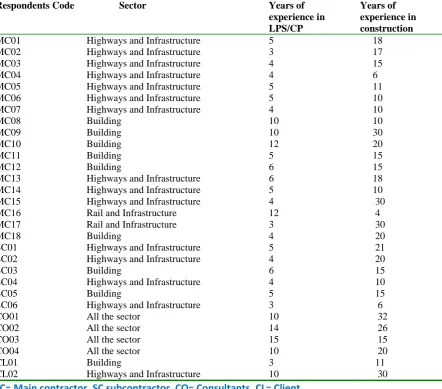
Thirty in-depth interviews were conducted over a period of 12 months comprising 18 main contractors, 2 clients, 4 lean construction consultants, and 6 subcontractors. The interviewees were drawn from across the various sectors in the UK construction specifically, 22 in England, 5 in Scotland, 3 in Wales. Majority of the respondents are in England because most of the top UK companies investigated have their head offices and major on-going projects in England. The authors were constrained and unable to interview respondent from Northern Ireland. All respondents interviewed had over 3 years’ experience in the use of LPS and CP and were drawn from building construction, highways and infrastructures and rail sectors. The duration of each interview varied from 60 to 90 minutes. Notes were taken in the interview diary, and an audio recording was also done to uphold the validity of the process. Convenience purposive sampling was adopted for the study. Convenience purposive sampling was deemed appropriate for this study as there was no formal database for lean construction practitioners in the UK (Teddie and Yu, 2007). Also, this ensured that only those with experience in production planning practice participated in the study.
In addition to the 30 interviews, 15 projects were observed comprising 8 Highways & Infrastructure projects, 5 Building, and 2 Rail projects. The observation document was developed from published implementations of the LPS on several construction projects (Bernardes and Formoso, 2002; Sterzi et al., 2007). The identified practices have been used to examine the implementation of PPM in relation to the LPS on construction projects including 12 projects in Israel (Priven and Sacks, 2015); 6 case study projects in Brazil (Bernardes and Formoso 2002) and in observing 5 projects in Brazil (Sterzi et al., 2007). These documented researches have the capacity to reveal LPS implementation efficacy (Sterzi et al., 2007;Bernardes and Formoso, 2002). The observation instrument used had three scales; full implementation, partial implementation and no implementation to capture the state of current implementation on the projects sampled (Bernardes and Formoso, 2002; Sterzi et al., 2007). The three point Likert scale was adopted as this is a snapshot study to capture production planning practices on the projects observed and to also reduce response bias. Dolnicar et al., (2011); Paulhus, (1991) observed from their study that 5-7 point Likert scale suffers from response bias. The findings from the interviews, observations, and document analysis are presented below.
4.0 Results and analysis
Except where otherwise stated “Collaborative Planning” (CP) refers to the UK PPM practice while “Last Planner System” (LPS) refers to the PPM practice in construction as evidenced from theory and practice internationally.
4.1
Background of respondents
Table 1: Descriptions and distribution of interviewees across the UK construction sector Respondents Code Sector Years of
experience in LPS/CP Years of experience in construction MC01 MC02 MC03 MC04 MC05 MC06 MC07 MC08 MC09 MC10 MC11 MC12 MC13 MC14 MC15 MC16 MC17 MC18 SC01 SC02 SC03 SC04 SC05 SC06 CO01 CO02 CO03 CO04 CL01 CL02
Highways and Infrastructure Highways and Infrastructure Highways and Infrastructure Highways and Infrastructure Highways and Infrastructure Highways and Infrastructure Highways and Infrastructure Building
Building Building Building Building
Highways and Infrastructure Highways and Infrastructure Highways and Infrastructure Rail and Infrastructure Rail and Infrastructure Building
Highways and Infrastructure Highways and Infrastructure Building
Highways and Infrastructure Building
Highways and Infrastructure All the sector
All the sector All the sector All the sector Building
Highways and Infrastructure
5 3 4 4 5 5 4 10 10 12 5 6 6 5 4 12 3 4 5 4 6 4 5 3 10 14 15 10 3 10 18 17 15 6 11 10 10 10 30 20 15 15 18 10 30 4 30 20 21 20 15 10 15 6 32 26 15 20 11 30
MC= Main contractor, SC subcontractor, CO= Consultants, CL= Client
This suggests that the respondents have some knowledge of the practice of PPM and other project control practices in UK construction. The respondents occupy various posts such as planner/programme managers, lean deployment manager, construction and operation director, project manager, site engineer and improvement managers among others.
To understand this confusion of terms, it is worth noting that majority of the respondents had received some form of support from external lean construction consultants before the application of PPM principles on their projects. These consultants do not as a rule use the term “Last Planner System” because the trademark registered in the USA by Lean Construction Institute prohibits unregistered consultants from selling LPS training and consultancy (U.S. Patent No. 3020113, 2005). However, regarding the direct impact of the US trademark on UK practitioners, the information available from the United State Patent and Trademark Office (USTPO) indicate that: a mark is only protected in the country where it is registered except if such mark is registered in another country under the international Madrid protocol (USPTO, 2016). Also, Trademark legal practitioners have also offered explanation on the impact of a mark in a country outside it registration. For instance BITLAW state that:
“A mark is infringed under U.S. trademark law when another person uses a device (a mark) so as to cause confusion as to the source or sponsorship of the goods or services involved. Multiple parties may use the same mark only where the goods of the parties are not so similar as to cause confusion among consumers. Where a mark is protected only under common law trademark rights, the same marks can be used where there is no geographic overlap in the use of the marks. Federally registered marks have a nation-wide geographic scope, and hence are protected throughout the United States” (BITLAW, 2015).
All of the above statements suggest that the direct impact of the US trademark on UK practitioners is more about perception than legally valid restriction. Also, Last Planner has a registered trademark in the EU (EU Patent No. 004516324, 2006). However, most of the practitioners interviewed were not aware of the EU trademark and only made reference to the US trademark. The impact of the trademark registered in the EU is unclear and is currently being contested by the LCI (EU Patent No. 013369863, 2014).This does not entirely explain the confusion in terms as other names such as “plan to save”, “detail planning to completion”, and “interactive planning” among others were also used. Also, some of the consultants still use the term “Last Planner”.
Furthermore, most of the respondents agreed that CP is based on the LPS, while other respondents argued that there are other practices advocated in CP in the UK that are not in the LPS. For instance, one respondent stated that: “To me LPS and CP are the same, but there is an amalgamation of other practices in CP such as the visual management that is not in the LPS” (CO02). This further underlines the confusion around the practice as visual management is an established lean production practice (Liker 2004) directly imported from the automotive sector into lean construction and can support both CP and LPS equally if required.
4.3 Time and programme compression
“The CP has been helping us to reduce our programme significantly, we enjoy twice as fast delivery of our process with CP” (MC06). Furthermore, most of the respondents interviewed indicated they used collaborative programming/phase scheduling, and Weekly Work Planning meetings. However, other elements of the LPS such as the make-ready process, look-ahead planning, constraint analysis, consideration for flow and learning with action were not mentioned or demonstrated as much. One of the respondents stated that “We are not doing all the bits, the site people are too busy, we only do high level collaborative programming” (MC05). The emphasis on time reduction in the use of CP tends to confirm the speculation by Sarhan and Fox, (2013). Limiting the use of LPS to time reduction alone is narrow and limit the benefits which could be gained from it use, since the goal of the LPS is not only programme and time compression. For instance, a review of the International Group for Lean Construction’s (IGLC) papers on LPS implementation revealed that the main focus of the LPS is reducing variability and increasing certainty in construction workflow rather than programme compression (Daniel et al., 2015). This is not to say that the implementation of the LPS does not lead to reduction in construction programme, as previous studies such as (Alarcon and Calderon, 2003) among others have reported.
4.4 Common understanding of construction programme
The study reveals that the CP process is viewed as an avenue to understand and develop a sound construction logic that is often lacking when the traditional project management approach is used. Some of the interviewees stated that: “It (CP) raises the awareness of collaboration among the supply chain. Usually, we expect the supply chain to deliver our programme even without involving them but now CP makes it better” (MC02); “We get ideas from the supply chain to develop a more workable programme” (CL01). This suggests that the CP as practiced enables the project team to develop a better understanding of the relationship between activities on the programme. According to Pasquire (2012), for construction projects to flow as expected, all stakeholders need to have a common understanding of the tasks to be executed. This implies that the conversations that occur during the CP process have the potential to develop collaborative relationships among the project stakeholders thus helping to reduce fragmentation and engender stable workflow (Gonzalez et al., 2015).
4.5 Intervention measures
4.6 Client and public sector demand as core drivers of CP in the UK
Most of the respondents interviewed stated that the demand from the client and the public sector are the major drivers for the use of CP in the UK. A respondent stated that “We are working to achieve our client’s expectations; we are required to use it on this project. Also, we have a drive for efficiency within our organisation for continuous process improvement” (MC03). The drive coming from the client and public sector in the UK seems contrary to what is commonly reported in other parts of the world such as the USA and Brazil. In those places, contractors are the active agent in initiating and deploying the LPS in their businesses (Alarcon and Calderon, 2003). It can be argued that, the slow and partial uptake of CP practice and PPM in the UK could be due to the push for the use of the system by the client and public sector rather than an internal motivation or pull from within the contractors. Although, the pace of uptake within the UK is slow, it has also been observed that the uptake of lean production principles in construction is slow globally (Stevens, 2014).
4.7 The Physical environment and document analysis
On all the projects observed, a designated meeting space is provided for CP meetings, which is usually tagged “CP” meeting room. Most of the projects observed made provision for a permanent collaborative programming or pull planning board and used either sticky-notes on the board for scheduling of activities or other temporary markers of different colours. Magnetic collaborative programming boards were used on some projects to provide a more robust working medium while other projects were working towards using electronic collaborative programming boards.
In addition to the less regular collaborative programming meetings, Weekly Work Planning meetings are also held. However, on some of the projects observed, the activities within these meetings had become fragmented to the extent that they were separated out into additional meetings with a different team of people, for example look-ahead activities taking place in a separate meeting from make-ready activities. The use of a form of visual management (VM) to communicate progress was seen on some of the projects. Document analysis revealed that the collaborative programme/phase planning is usually developed from the Primavera programme known as P6, generally considered as the contract programme.
4.6 Practices observed
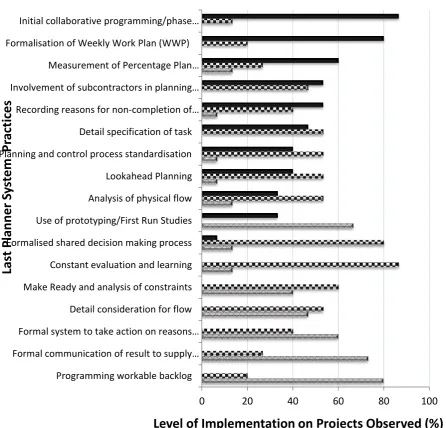
of tasks’ practice was not observed on any of the projects. It was however partially observed on 53% of the projects with 46% lacking any evidence of implementation at all.
The study also identifies other practices that were absent on 40% – 80% of the projects observed. These include ‘programming a workable backlog’; ‘a lack of consideration for flow’; ‘analysis of physical flow’, ‘use of prototype/first run study’, ‘make ready and constraint removal’ and ‘formal communication of feedback to the supply chain’. Analysis of physical flows focuses on the criteria for tasks to be included in a production plan (such as information, materials, tools, equipment, prior work, people, external conditions).
Figure 2: Level of implementation of Last Planner System principles on projects observed.
0 20 40 60 80 100
Programming workable backlog
Formal communication of result to supply… Formal system to take action on reasons…
Detail consideration for flow Make Ready and analysis of constraints Constant evaluation and learning Formalised shared decision making process Use of prototyping/First Run Studies Analysis of physical flow Lookahead Planning Planning and control process standardisation Detail specification of task
Recording reasons for non-completion of… Involvement of subcontractors in planning… Measurement of Percentage Plan…
Formalisation of Weekly Work Plan (WWP)
Initial collaborative programming/phase…
Level of Implementation on Projects Observed (%)
Las
t
Plann
er
S
ys
tem
Pr
act
ice
s
Full Implementation Partial Implementation
Detail consideration for flow focuses on what needs to be done when there is a change in the production. For instance, the respondents were asked; what do you do when a task is completed earlier than planned? Some of the respondents said (a) “we do nothing”, (b) “we re-plan”, (c) we take it as bonus. Responses (a) and (c) show that there is no detailed consideration for maintaining synchronised work flow. The respondents interviewed here failed to recognise that some changes have occurred in production which needs to be addressed either by re-planning, increasing, or decreasing resource in order to keep production stable and prevent a knock-on effect.
Although the graph shows something of all the LPS principles (except one) implemented on the projects observed, this implementation was fragmented with no single project implementing all the principles. The most comprehensive implementation observed was 60% of the principles on a single project. The degree to which the observed practices map across to components of LPS is shown in Figure 3.
P6 Contract Program me
Milestone Programme Collaborative Planning practices in
the UK
Last Planner System components
Phase planning High Level
Program me
(Collaborative programme)
Lookahead planning
Lookahead planning Constraint analysis
Make-ready Workable backlog Full consideration for flow
Weekly W ork Planning meeting
Measurement of progress
Weekly Work Plan
measurement and learning Recording of PPC & RNC
Comm. of results Acting on RNC
KEY
PPC- Percent plan complete RNC-Reasons for non-completion No clear evidence
Common practice Partial adoption
Figure 3: Comparing Collaborative Planning practice in the UK with the Last Planner System Components
elements. There is equally a strong relationship at the levels of recording PPC and RNC. However, there is partial adoption in the WWP on some of the projects observed. For instance, WWP was only supplemented with daily huddle meetings on few projects, and as observed, in these cases, the daily huddle meeting is more of activity reporting rather than an avenue to make needed adjustments to tasks that are slipping off schedule. The depth of application of the more complex attributes contained in the LPS is weak or missing. Figure 3 clearly shows that there is only partial alignment of current CP practice to the elements of the LPS on the projects observed.
5.0 Discussion
All the interviewees felt the CP approach offered benefit. In general, not formally implementing the full range of components within the LPS means maximum benefit is not being realised. The comparison of current practice of CP with the LPS components in Figure 3 partially aligns with practice elsewhere in the world. Previous studies such as (Daniel et al., 2015; Sterzi et al., 2007;Bernardes, and Formoso, 2002) show the measurement of PPC, WWP meetings (short-term planning) and collaborative programming/phase scheduling to be among the elements of the LPS most consistently reported as implemented in previous studies published by the IGLC3. However, the practices varied in detail from one
project to another. While CP was done with full involvement of the supply chain on some projects, on other projects, the supply chain were only partially involved as revealed by the interview results. For instance, a senior planner interviewed on MC03 stated that: “We only involve the principal subcontractors in the collaborative programming, we plan and give the programme to the smaller subcontractors”. This implies that not all the supply chain was involved in developing the high-level collaborative programme. Furthermore, gauging the current CP practice with the Last Planner prescriptions such as planning backwards, defining plan scope by the players involved, narrowing scope when needed to untie knots, building floats into plans and allocating them to risky and critical tasks, (Ballard, 2000), reveals they only occur partly on some of the projects observed. CP as practiced tends to only provide the platform for stakeholders to have conversations on the proposed schedule and is deficient in the process rigor as prescribed in the LPS. This is due to too much focus on the execution of tasks and the absence of robust supporting mechanisms to enable flow in the approach.
Clearly a number of key LPS elements are missing in the present approach. The most apparent of these is the lack of formal action on the RNC recorded. For example, an interviewee stated that “We used to log the reason for non-completion of task into an excel sheet but we have not developed any formal approach for analysing this data” (MC07). According to Ballard, (2000) the purpose of recording RNC in the LPS is to enable the team to collectively act to address the identified issues and to prevent future occurrence, which enhances learning. It can be argued that if no formal actions are taken to address the RNC recorded, then the recording itself becomes a waste of time and resources. Typical action on RNC should include at least a formal root cause analysis. That no collaborative actions (either formally or informally) are taken on the reason for
non-completion recorded removes the opportunity to generate innovation, provide learning, enable action and improve collaboration among the project stakeholders.
Other missing elements are the development of a workable backlog (Plan B) and the consideration for flow that form part of the make-ready process in the LPS. The lack of consideration and analysis of flow was evident on most of the projects evaluated. For instance, during the interview, one of the respondents was asked; “what action do you take when an action is completed earlier than planned?” The response is “we don’t do anything; we take it as a bonus” (MC01). This shows a lack of understanding of flow and the importance of load levelling and stability in the production process once the phase plan is agreed.Unplanned early completion is most likely to be a benefit for a contractor who is only managing the sub-contract packages but to be at least benefit neutral or a detriment to sub-contractors as it increases uncertainty across their multi-project environment. When the focus of the production system is shifted from the management of workflow to the pursuit of cost and/or time reduction, the entire production system could collapse (Conte et al., 1998).
It can be argued that the prevailing practice of CP focuses more on time reduction and programme reduction than achieving a smooth workflow across the project. Finishing early is most likely to be the result of planning too little work in the first place or from the removal of a constraint not identified in the make-ready process which has permitted work that does not meet the four criteria (sound, sized, sequenced, and detailed) into the WWP. It is clear then that a reduced make-ready process that sends work to the work phase (weekly or daily) without meeting the four criteria of production planning results in reduced productivity and associated programme and margin slippage (Court et al., 2009). It is important to note that PPC is a predictor of productivity because of the 4 requirements for a committable task; i.e., sound, sequenced, sized, and well defined (see Liu and Ballard, 2008, Ballard, 1999). However, PPC can be 100% and the project still behind schedule because work is not being made ready in the right sequence and rate (Hamzeh, et al., 2012).
Related to the make-ready process is the look-ahead process. Observation of this also indicated some limitation in practice, notably, a look-ahead window of two weeks was too short to allow sound assignments to be developed. Additionally, whilst metrics such as PPC, RNC were measured and recorded, these metrics were not formally communicated to the supply chain on some of the projects observed. For instance, one of the respondents stated “We do not publish PPC and RNC to the subcontractors, if I am showing this to the subcontractors, I am going too low. We only make this available to the senior management team. Some of the subcontractors get confrontational and defensive about this, especially if the work was delayed by the main contractors” (MC08). This is another indication of a limit to the scale of adoption of collaborative practices despite the use of the term “CP” to describe the approach. The safeguarding practices observed appear to be deeply embedded in the prevailing practice and serve as a significant barrier to collaboration (Pasquire, Sarhan and King 2015)
6.0 Conclusions
observed in the major sectors of the UK construction industry align with some of the generally advocated principles of the LPS acknowledged in the literature; specifically, the high level collaborative programming, WWP meetings, and the measurement of PPC and the charting RNC. There was no intention for this study to evaluate or measure the success or otherwise of the practices observed. However, the study reveals that the current practice of CP in the UK has not explored all components of the LPS. This situation inhibits the extent of benefit that can be realised and even the advancement of industry performance.The study reveals that the message coming from some UK lean construction consultants on LPS is mixed at best and distorted at worst, thus limiting the comprehensive adoption of the system in the UK.
The components not used include look-ahead planning; aspects of the make-ready process such as consideration for workflow and developing a workable backlog; and acting on reasons for non-completion of tasks among others. Furthermore, the absence of these elements indicates a poor understanding of construction as a production process and the importance of flow in successful project delivery and benefit realisation.
Of greater concern is evidence of a continuing subtle resistance to meaningful collaboration across the project supply chain illustrated by inadequate sharing of information and benefit. This suggests the continuing influence of the traditional project management command and control approach, in which the supply chain is not consulted or informed adequately. This influence is further evidenced by the lack of deep and systematic actions to address the reasons for non-completion which hinders innovation and learning.
The study established that CP as a means of engaging people in decision making before the fact first surfaced in the 1960s and came into more common usage not long after that. This does not have a specific process or set of processes attached to it. The LPS entered more common usage in the 1990's and has a very specific set of processes attached to it. In the UK, CP is a term used to describe partial implementations of the LPS since mid-2000 and is now unknowingly used as such. The study recommends that the current practice of CP in the UK should be extended to include other elements of the LPS to reap greater benefit. This could be achieved by gauging the current implementation against the LPS model and constant evaluation of the implementation with PPM practice checklists.
7.0 References
Alarcón, L.F. and Calderón, R. (2003), “Implementing lean production strategies in construction companies”, In Proceedings Construction Research Congress, Winds of Change: Integration and Innovation of Construction, ASCE, Honolulu, Hawaii, 19-21 March 2003, pp 1-8.
AlSehaimi, A. O, Tzortzopoulos F, P. and Koskela, L. (2014), “Improving construction management practice with the Last Planner System: a case study”. Engineering, Construction and Architectural Management, Vol.21 No.1, pp.51-64.
Ballard, G. , Hammond, J. and Nickerson, R. (2009), “Production Control Principles”, in, Cuperus, Y. and Hirota, E.H. Eds proceedings of 17th Annual Conference of the International Group for Lean Construction, Taipei, Taiwan, 15-17 July 2009, PUBLISHER, Place of Publication, pp 489-500.
Ballard, G. and Howell, G.A. (2003), “An Update on Last Planner”, in, 11th Annual Conference of the International Group for Lean Construction, Virginia, USA, Ballard, H. G. (2000), The Last Planner System of Production Control, PhD. Thesis,
University of Birmingham.
Ballard, G. (1999), “Improving Work Flow Reliability,” in, 7th Annual Conference of the International Group for Lean Construction, Berkeley, USA, 26-28 July 1999, pp. 275-286.
Ballard, G., and Howell, G. (1998), “Shielding production: essential step in production control”, Journal of Construction Engineering and Management, Vol.124 No.1, Ballard, G. and Howell, G. (1997), “Implementing lean construction: improving downstream performance,” in Alarcon, L., (Ed.), Lean Construction, Rotterdam, Balkema, pp. 111-125.
Ballard, G. (1997), “Lookahead Planning: The Missing Link in Production Control” in, Tucker, S.N., 5th Annual Conference of the International Group for Lean Construction, Gold Coast, Australia, 16-17 July, 1997, pp. 13-26.
pp.11-17.
Ballard, G., and Howell, G. (1994), “Implementing lean construction: stabilizing work flow”, in Alarcon, L., (Ed.), Lean Construction, Rotterdam, Balkema, pp.101-110.
Bernardes, M.M. and Formoso, C.T. (2002), “Contributions to the Evaluation of Production Planning and Control Systems in Building Companies” in, Formoso, C.T. and Ballard, G. (Eds.), 10th Annual Conference of the International Group for Lean Construction, Gramado, Brazil, 6-8 Aug 2002.
Bertelsen, S. , Henrich, G. , Koskela, L. and Rooke, J. (2007), “Construction Physics” in, Pasquire, C.L, and Tzortzopoulos, P.(Eds.), 15th Annual Conference of the International Group for Lean Construction, East Lansing, Michigan, USA, 18-20 July 2007, pp. 13-26.
BRE, (2006). “Profiting together from process improvement, available at:
http://www.bre.co.uk/filelibrary/pdf/CLIP/BRE-_CLIP_Vol_2_reprint_2006.pdf
(accessed 27 June 2015)
Burke, R. (2013), Project Managemen : Planning and Control techniques, Wiley, Chichester.
BITLAW, (2015), “Trademark law in the United States”, available at
http://www.bitlaw.com/trademark/, (accessed: 20 December 2015)
Cain, T. C. (2004), Profitable Partnering for Lean Construction, Blackwell Publishing, Oxford.
Court, P., Pasquire, C., Gibb, G. and Bower, D. (2009), ”Modular assembly with postponement to improve health, safety, and productivity in construction.” Practice Periodical on Structural Design and Construction, Vol.14 No.2, pp.81–89. Conte, A.S.I. (1998), “Last Planner, look ahead, planning : A driver to the site operations”, in, 6th Annual Conference of the International Group for Lean Construction, Guarujá, Brazil, 13-15 August, 1998,
Creswell, J. (2009), Research Design: Quantitative and Qualitative Approach, Sage Publication, London.
Crotty, R. (2012), The Impact of Building Information Modelling: Transforming Construction, Spon Press, Oxon.
Dainty, A.R.J. (2008), “Methodological pluralism in construction management research”. in Knight, A. and Ruddock (Eds.) , Advanced Research Methods for the Built Environment, Wiley‐Blackwell, Oxford, pp.1-13
Daniel, E.I. , Pasquire, C. and Dickens, G. (2015), “Exploring the implementation of the Last Planner® System through IGLC community: Twenty one years of experience” in, Seppänen, O., González, V.A. and Arroyo, P. (Eds.) 23rd Annual Conference of the International Group for Lean Construction, Perth, Australia, 29-31 July 2015, pp. 153-162,.
Daniel, E. I., Pasquire, C. and Dickens, G. (2014b), “Social perspective of planning in construction: The UK experience”, in Raiden, A.B. and Aboagye-Nimo, E.,(Eds) 30th Annual ARCOM Conference, Portsmouth, UK, 1-3 September 2014, pp. 1355- 1365.
Davidoff, P. (1965) "Advocacy and pluralism in planning." Journal of the American Institute of Planners, pp. 331-338.
Dolnicar, S., Grun, B.,Leisch, F. and Rossiter, J. (2011), “Three good reasons not to use five and seven point Likert items”, in, CAUTHE 2011, 21st CAUTHE National Conference, Adelaide, Australia, 8-11 February 2011
Dubois, A. and Gadde, L. E. (2002), “Systematic combining: an abductive approach to case research” Journal of Business Research, Vol.55 No.7, pp. 553–560.
Egan, J. (1998), “The Egan report rethinking construction”, report of the construction industry task force to the Deputy Prime Minister, London.
Google Ngram search, (2015),“Collaborative planning,” available at:
https://books.google.com/ngrams/graph?content=collaborative+planning&year_ start=1900&year_end=2015&corpus=15&smoothing=3&share=&direct_url=t1% 3B%2Ccollaborative%20planning%3B%2Cc0 (accessed: 29 September 2015) Google Ngram Viewer, (2015), “What does the Ngram Viewer do”?, available at :
https://books.google.com/ngrams/info (accessed: 16 December 2015)
González, V.A., Sacks, R., Pavez, I., Poshdar, M., Ben Alon, L. and Priven, V. (2015), “Interplay of Lean Thinking and Social Dynamics in Construction, in, Proc. 23rd Ann. Conf. of the Int’l. Group for Lean Construction, Perth, Australia, July 29-31, pp. 681-690.
Gunton, T. I, Day, J. C. and Williams, P. W. (2003), “The role of collaborative planning in environmental management: The North American experience”, Environments: Journal of interdisciplinary studies, Vol. 31 No.2, pp.1-4.
Hamzeh, F., Zankoul, E. and Rouhana, C. (2015), "How can ‘tasks made ready’ during lookahead planning impact reliable workflow and project duration?". Construction Management and Economics, Vol.33 No.4, pp.243-258
Hamzeh, F., Ballard, G. and Tommelein, I. (2012), “Rethinking lookahead planning to optimize construction workflow”, Lean Construction Journal, pp.15-34.
Hayek, F.A. (1945), “The use of knowledge in society”, The American economic review, Vol.35 No4, pp.519-530.
Highsmith, J., and Cockburn, A. (2001), “Agile software development: The business of innovation”, Computer, Vol.34 No.9, pp.120-127.
Johansen, E. and Porter, G. (2003), “An Experience of introducing Last Planner into a UK” Construction,11th Annual Conf. of the International Group for Lean Construction, Virginia, USA,
Kalsaas, B.T. , Grindheim, I. and Læknes, N. (2014), “Integrated Planning vs. Last Planner System,” in, Kalsaas, B.T., Koskela, L. and Saurin, T.A., 22nd Annual Conference of the International Group for Lean Construction, Oslo, Norway, 25-27 June 2014, pp. 639-650.
Koch, C., Sage, D., Dainty, A. and Simonsen, R. (2015), "Understanding operations strategizing in project-based organisations: middle managers’ interaction and strategy praxis", Engineering Project Organization Journal, Vol.5 No.2-3, pp. 106-117.
Koskela, L. , Stratton, R. & Koskenvesa, A. (2010), 'Last Planner and Critical Chain in Construction Management: Comparative Analysis' In:, Walsh, K. & Alves, T., 18th Annual Conference of the International Group for Lean Construction. Haifa, Israel, 14-16 Jul 2010. pp 538-547
Koskela, L. and Ballard, G. (2006), "Should project management be based on theories of economics or production?", Building Research and Information, Vol.34 No.2, pp. 154-163.
Köster, G (2006), “Koster Last Planner”, EU Patent NO. 004516324, available from: Office for Harmonisation in the International Market: An Agency of the European Union,
https://oami.europa.eu/eSearch/#details/trademarks/004516274 (accessed: 17 December 2015).
LCI, (2015) “The Last Planner”, available at:
http://www.leanconstruction.org/training/the-last-planner/ (accessed: 16 February 2015)
Lean Construction Institute, (2005), “Last Planner”, US Patent 3020113, available from : US Patent and Trademark Office,
http://tmsearch.uspto.gov/bin/showfield?f=doc&state=4806:91112d.2.1
(accessed: 17 December 2015)
LCI, (2014), “Last Planner”, EU Patent 013369863, available from: Office for
Harmonisation in the International Market: An Agency of the European Union,
https://oami.europa.eu/eSearch/#basic/1+1+1+1/50+50+50+50/LAST%20PLA NNER (accessed: 15 January 2016)
Lichtig, W. A. (2005), “Sutter health: Developing a contracting model to support lean project delivery”, Lean Construction Journal, Vol.2 No.1, pp.105-112.
Liker, J.K. (2004), The Toyota Way: 14 Management Principles from the World’s Greatest Manufacturer, McGraw-Hill, New York.
Liu, M. and Ballard, G. (2008), “Improving labour productivity through production control” In:, Tzortzopoulos, P. and Kagioglou, M.(Eds.),16th Annual Conference of the International Group for Lean Construction, Manchester, UK, 16-18 July, 2008, pp 657-666.
Macomber, H. and Howell, G. (2003), “Linguistic action: Contributing to the theory of lean construction”, in, Proceedings of the 11th Annual Meeting of the International Group for Lean Construction, pp.1-10.
Miles, M. B. and Huberman, A. M. (1984), Qualitative Data Analysis, Sage Publications, Beverly Hills.
Mojir, K. Y. and Pilemalm, S. (2014), “Emerging communities of collaboration: co-location in emergency response systems in the ‘Safety house’ in Sweden”, In: Hiltz,S.R., Pfaff, M.S., Plotnick, L. and Shih, P.C. (Eds.), 11th International ISCRAM Conference – University Park, Pennsylvania, USA, 14 May 2014.
Mokhtar, A., Bédard, C. and Fazio, P. (2000), “Collaborative planning and scheduling of interrelated design changes”, Journal of Architectural Engineering, Vol. 6 No.2, pp. 66-75
Mossman, A. (2014), “Last Planner: 5 + 1 crucial and Collaborative Conversations for Predictable Design & Construction Delivery,” available at http://bit.ly/LPS-5cc (accessed: 10 May 2015).
Mossman, A. (2009). “Why isn’t the UK construction industry going lean with gusto”?. Lean Construction Journal, Vol. 5 No.1, pp. 24-36.
Papke, B. and Dove, R. (2013), “Combating uncertainty in the workflow of systems engineering projects”, in INCOSE International Symposium, Philadelphia, pp.24-27.
Pasquire, C. , Sarhan, S. and King, A. (2015), “A critical review of the safeguarding problem in construction procurement: unpicking the coherent current model”, in, Seppänen, O., González, V.A. and Arroyo, P., 23rd Annual Conference of the International Group for Lean Construction, Perth, Australia, 29-31 July 2015, , pp 309-318.
Pasquire, C. (2012), “The 8th Flow – Common Understanding” in, Tommelein, I.D. and Pasquire, C.L., 20th Annual Conference of the International Group for Lean Construction, San Diego, USA, 18-20 July 2012,
Paulhus, D.L. (1991), “Measurement and control of response bias”, in J.P. Robinson, P.R.Shaver and L.S. Wrightsman, Measures of Personality and Social Psychological
Attitudes, Academic Press, San Diego,pp.17-59.
Perloff, H. (1961), Planning and the urban community, University of Pittsburgh, Press Pittsburgh.
Priven, V. and Sacks, R. (2015), "Effects of the Last Planner System on social networks among construction trade crews", Journal of Construction Engineering and Management Vol.141 No.6.
Riley, J., Endsley, M., Bolstad, C. and Cuevas, H. (2006), “Collaborative planning and situation awareness in Army command and control Ergonomics, Vol.49 No.12-13, pp.1139-1153.
Salem, O., Solomon, J., Genaidy, A. and Minkarah, I. (2006), “Lean Construction: From Theory to Implementation”, Journal of Management in Engineering, Vol.22 No.4, pp.168-175.
Sarhan, S., and Fox, A. (2013). “Barriers to Implementing Lean Construction in the UK Construction Industry”, The Built and Human Environment Review, 6.
Sober, E. (2001), Core Questions in Philosophy, Prentice Hall, Upper Saddle River, N.J. Sterzi, M.P. , Isatto, E.L. and Formoso, C.T. (2007), “Integrating Strategic Project Supply
Chain Members in Production Planning and Control,” in, Pasquire, C.L, C.L. and Tzortzopoulos, P., , 15th Annual Conference of the International Group for Lean Construction. East Lansing, Michigan, USA, 18-20 July 2007, ,. pp 159-169
Sporrong, J. and Kadefors, A. (2014), “Municipal consultancy procurement: new roles and practices”, Building Research & Information, Vol.42 No.5, pp.616-628.
Stevens, M. (2014), “Increasing Adoption of Lean Construction by Contractors”, in, Kalsaas, B.T., Koskela, L. & Saurin, T.A., 22nd Annual Conference of the International Group for Lean Construction, Oslo, Norway, 25-27 Jun 2014, pp 377-388
Teddlie, C. and Yu, F. (2007), “Mixed Methods Sampling: A Typology With Examples”, Journal of Mixed Methods Research, Vol. 1 No.1, pp.77-100.
USPTO, (2016), “U.S. Trademark law: rules of practice and federal statutes”, available at:
http://www.uspto.gov/sites/default/files/documents/tmlaw.pdf
(accessed: 28 March 2016)
Wondolleck, J M, and Steven, L Y (2000), “Making Collaboration Work: Lessons from Innovations in Natural Resource Management”, Island Press, Washington, D.C. Zimina, D., and Pasquire, C., (2012). “The Last Planner System Insights”, available at: