Reviewed v1 Review Article
A review of biodiversity-related issues and
challenges in megadiverse Indonesia and other
Southeast Asian countries
Kristina von Rintelen, Evy Arida, Christoph Häuser
‡ Museum für Naturkunde – Leibniz-Institut für Evolutions- und Biodiversitätsforschung, Berlin, Germany
§ Museum Zoologicum Bogoriense – Research Center for Biology, Indonesian Institute for Sciences (LIPI), Cibinong, Indonesia
Corresponding author: Kristina von Rintelen ([email protected])
Received: 07 Sep 2017 | Published: 11 Sep 2017
Citation: von Rintelen K, Arida E, Häuser C (2017) A review of biodiversity-related issues and challenges in megadiverse Indonesia and other Southeast Asian countries. Research Ideas and Outcomes 3: e20860. https://doi.org/10.3897/rio.3.e20860
Abstract
Indonesia is one of the ten member states of the economically and politically diverse regional organization of the Association of Southeast Asian Nations (ASEAN). Southeast Asia comprises four of the 25 global biodiversity hotspots, three of the 17 global megadiverse countries (Indonesia, Malaysia, and the Philippines) and the most diverse coral reefs in the world. All member states are Parties to the Convention on Biological Diversity (CBD). We discuss ASEAN-wide joint activities on nature conservation and sustainable use of biodiversity that do not stop at national borders.
The Indonesian archipelago comprises two of the world’s biodiversity hotspots (areas with a high degree of endemic species that are highly threatened by loss of habitats): Its insular character and complex geological history led to the evolution of a megadiverse fauna and
flora on the global scale. The importance of biodiversity, e.g., in traditional medicine and agriculture, is deep-rooted in Indonesian society. Modern biodiversity pathways include new fields of application in technology, pharmacy and economy along with environmental policies. This development occurred not only in Indonesia but also in other biodiversity-rich tropical countries.
‡ § ‡
This review summarizes and discusses the unique biodiversity of Indonesia from different angles (science, society, environmental policy, and bioeconomy) and brings it into context within the ASEAN region. The preconditions of each member state for biodiversity-related activities are rather diverse. Much was done to improve the conditions for biodiversity research and use in several countries, primarily in those with a promising economic development. However, ASEAN as a whole still has further potential for more joint initiatives. Especially Indonesia has the highest biodiversity potential within the ASEAN and beyond, but likewise the highest risk of biodiversity loss.
We conclude that Indonesia has not taken full advantage of this potential yet. A growing national interest in local biodiversity as a natural resource is a welcome development on one hand, but the risk of too many restrictions for, e.g., the science community (high level of bureaucracy at all project stages from planning phase, visa procedures, field work permits, scientific exchange and project managment issues, governmental budget cuts for basic research and restricted access to international literature for Indonesian researchers) does significantly hamper the internationalization of biodiversity-related science. In the long run, Indonesia has to find a balance between protectionism and sensible access to its national biodiversity to tackle global challenges in biodiversity conservation, health issues, food security, and climate change.
Keywords
Association of Southeast Asian Nations, Indonesian archipelago, environmental policy, conservation, biodiversity loss, access and benefit sharing, sustainable use, biodiversity research and education
Introduction
Why a focus on Indonesian biodiversity? The Indonesian archipelago comprises 17,000 islands with many different types of habitats and an extremely complicated geological history, although the latter counts not only for Indonesia but for Southeast Asia in general (Bruyn et al. 2014). Biogeographic, geological, climatic and ecological factors led to the evolution of a megadiverse fauna and flora with a high number of endemic and ecologically highly-adapted species (Lohman et al. 2011). Likewise, there is a high potential of pharmaceutical and biotechnological research opportunities. Indonesia has, for example, the second highest number of indigenous medicinal plants, after the Amazon rain forests (Elfahmi et al. 2014), 10% of the world’s flowering plant species, about 12% of the world’s mammals, about 16% of the world’s reptiles and 17% of the total species of birds (CBD Secretariat 2016b). Many if not most of these species are under a constant threat to become extinct before they are even discovered or scientifically explored. Thus, optimism about the future of Indonesia’s biodiversity and natural resources is somewhat restrained (Persoon and van Weerd 2006). We further review recent developments in terms of environmental policy, sustainable use of biodiversity and the internationalization of science and research on Indonesian biodiversity.
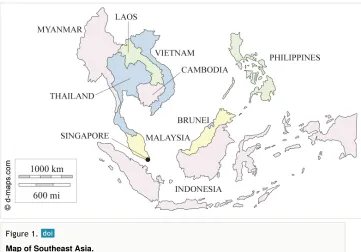
Figure 1.
Map of Southeast Asia.
The changing role and pathways of biodiversity in Indonesian
society
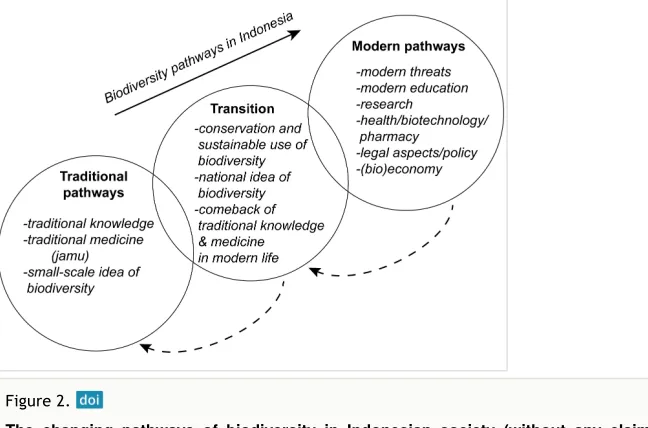
Biodiversity affects different aspects of Indonesian society. Indonesia is not only megadiverse in terms of biodiversity but also in terms of cultural diversity. The country has about 370 ethnic groups (Persoon and van Weerd 2006), i.e., the third highest cultural diversity worldwide (Mittermeier et al. 1997) associated with a long tradition of local knowledge systems of sustainable biodiversity utilization and nature conservation (BAPPENAS 2003). Therefore, we try to illustrate general traditional pathways of biodiversity into modern Indonesian life (Fig. 2) by adapting the integrative approaches and the combination of ideas of the term biodiversity from different sub-disciplines as in Pilgrim et al. 2009 and Clark et al. 2014. Additionally, we include changes to the concept of biodiversity and its perception over time (traditional – transition – modern; Fig. 2).
The traditional pathways of biodiversity (Fig. 2) represent the oldest form and the basic roots of knowledge such as traditional farming systems (e.g., Retnowati et al. 2014) or traditional medicine (e.g., Elfahmi et al. 2014), all of them on a local scale (small-scale idea of biodiversity; Fig. 2). The biodiversity pathways between “traditional” and “modern” may not be “transitional” in the scientific sense but illustrate the changing role of biodiversity in the country (Fig. 2): Starting in the early 1990s, Indonesian policymakers developed a
Figure 2.
The changing pathways of biodiversity in Indonesian society (without any claim of completeness and time scale).
national idea of biodiversity, its conservation and potential use as a national resource (Caldecott 1996). The country established a National Biodiversity Action Plan in 1993 and became Party to the Convention on Biological Diversity in 1994, followed by other measures over time (CBD Secretariat 2016a). This was an important transition from the traditional and local towards a national idea of biodiversity with various consequences for modern pathways such as research, legal aspects, and environmental policy (Fig. 2).
Apart from the national perspective, there are also rather small-scale transitional pathways: Traditional pathways can make a comeback in modern life, such as traditional medicine (jamu) (Antons 2010), and has often been handed down orally from generation to generation until today. For instance, a local community in Central Sulawesi still uses a total of 96 medical plant species (Gailea et al. 2016). However, problems may arise when traditional knowledge is not formally taught or even recorded but learned from observation and personal experience and thus difficult to communicate in modern knowledge systems (Retnowati et al. 2014).
In comparison, the modern pathways (Fig. 2) are a clearly younger development of modern society in Indonesia and beyond. Climate change and biodiversity loss are among the global challenges and modern threats, especially in megadiverse countries like Indonesia with its huge carbon storage ecosystems such as the unique peat swamps forests on the islands of Sumatra and Kalimantan. The key drivers of biodiversity loss, not only in Indonesia but in all ASEAN countries, are climate change, habitat change, invasive alien species, overexploitation, pollution and poverty (ACB 2010). Indonesia increasingly aims to take part in research on the sustainable use of natural biological resources, e.g., through science and technology and the relatively new field of bioeconomy including various developments in biotechnology, pharmacy and health issues (Fig. 2).
A biodiversity-related comparison of Indonesia and the other
ASEAN member states
We here discuss different approaches to biodiversity in Indonesia and all other ASEAN member states. The following parameters used to compare biodiversity-related data among the ASEAN member states are mainly based on the Convention on Biological Diversity (CBD) and the ASEAN Centre for Biodiversity (ACB): National biodiversity data, threatened species, invasive alien species, conservation programmes and ABS (Access and Benefit Sharing) regulations. Furthermore, we compare the research output (publications) on country-specific biodiversity, biodiversity-related infrastructure per country, general economic data, bioeconomy policy strategies and approaches for the sustainable use of biodiversity.
National biodiversity facts and figures
between 1.000 (maximum) and 0.000 (minimum) and includes some adjustment allowing for country size (Suppl. material 1).
Indonesia has the highest NBI of all ASEAN countries, Cambodia the lowest (Suppl. material 1). What causes these major differences (NBI ranging from 1.000 to 0.568) within the ASEAN member states? First of all, definitions and indicators used to value and measure biodiversity are not applied uniformly (Duelli and Obrist 2003, Halkos and Tzeremes 2010). General difficulties in establishing operational indicators are due to the complex, multi-dimensional nature of biodiversity (Noss 1990, Scholes and Biggs 2005). The criteria used by the Convention on Biological Diversity (Suppl. material 1) are sound and the CBD per se is of policy relevance (Scholes and Biggs 2005), an aspect that not all approaches share. General studies focusing on the ASEAN region come up with similar rankings (such as Persoon and van Weerd 2006). The special insular nature (isolated islands of oceanic origin), the complex geological history and the stable tropical climate of the so-called Wallacea region (insular Indonesia without land connections in the past) and the Philippines led to the development of high species richness and a high number of endemic biota (Sodhi et al. 2004).
It is essential to consider the threats to and loss of biodiversity when looking at biodiversity hotspots as defined by Myers et al. 2000 (areas with a high degree of endemic species that are highly threatened by loss of habitats): Suppl. material 1 shows the number of threatened species/animals/plants and invasive alien species per country. Generally, countries with a high NBI also show a higher number of threatened species than countries with a lower NBI. Slight deviations, such as the lower rank of Brunei in contrast to its much higher NBI rank or the high rank of Singapore despite its small area (Suppl. material 1), may be caused by the fact that the CBD definition of the NBI includes some adjustment allowing for country size whereas the IUCN Red List does not (see legend of Suppl. material 1). Slight deviations also occur when looking at the number of threatened animals and plants separately (Suppl. material 1): Indonesia shows the second highest number of all threatened species, the highest number of threatened animal species, and a lower number of threatened plant species, whereas Malaysia shows a lower number of threatened animals and the highest number of threatened plants.
Invasive species can have negative economic and environmental impacts and are also an increasing threat to biodiversity in Southeast Asia (Nghiem et al. 2013). Indonesia and the Philippines have the highest number of invasive alien species (Suppl. material 1). The special insular nature of both countries along with the high number of endemic species vs. a high number of invasive alien species makes both countries more vulnerable to negative impacts than any other ASEAN member state.
Biodiversity-related conservation programmes and ABS regulations
on ABS (Access to Genetic Resources and the Fair and Equitable Sharing of Benefits Arising from their Utilization): Abundance of biodiversity in the ASEAN region also means abundance of genetic resources. If these genetic resources and the traditional knowledge associated with them are studied and utilized abroad (e.g., from basic biological research to applied research & development), the Nagoya Protocol on ABS applies. As a supplementary agreement to the CBD “it provides a transparent legal framework for […] the fair and equitable sharing of benefits arising out of the utilization of genetic resources” (CBD Secretariat 2016c), and thus clearly identifies genetic resources as the property of the state in which they were found, e.g., in Indonesia (Latifah 2015).
Suppl. material 1 shows the number of PAs and percentage of total land and marine area covered by PAs of each ASEAN member state: Malaysia and Indonesia have the highest total number of PAs (Suppl. material 1), whereas Singapore has the lowest number. The numbers of PAs with only IUCN categories shows a slightly different picture: Indonesia has the highest number, followed by the Philippines and Malaysia. Looking at the percentage of terrestrial and marine areas (Suppl. material 1), Brunei has 47% of its territory covered by PAs (mainly forest reserves), which is more than any other ASEAN country (same source as in Suppl. material 1), whereas Indonesia falls only on rank 7 of 10 with 15%, the other countries below 10%.
However, the IUCN management categories are voluntary for countries to apply and the lack of such does not mean a lack of protected management or biodiversity conservation (UNEP-WCMC 2014). Ferraro et al. 2013 argue that strictly protected areas are not necessarily more protective and thus that strictness of protection should not necessarily be a guideline for policymakers in protected area management. Brazil, for instance, has over 2,000 PAs (with a total coverage of 31%) but only about 50% are according to IUCN categories (same source as in Suppl. material 1). Germany has over 17,000 PAs (alone 38% of terrestrial area are protected) with only 694 PAs without IUCN categories (same source as in Suppl. material 1). Thus, on a global scale, the total number and percentage of territory covered by PAs per country are higher in several countries outside than within the ASEAN.
ASEAN Heritage Parks (Suppl. material 1) are areas of conservation with unique biodiversity and ecosystem importance which all ASEAN member states agreed to effectively manage (ACB 2015). As of 2015, there are 37 AHPs altogether (Suppl. material 1), the most in the Philippines, the fewest in Brunei and Laos. In Indonesia, three of the four total AHPs are in Sumatra (tropical rainforest as refugia for orangutans, tigers, elephants, rhinoceros and leopards) and one in the remote province West-Papua (ACB 2015).
well-off countries Brunei, Malaysia and Singapore have not signed it at all and have not become parties either (Suppl. material 1). Malaysia, Singapore and Thailand nevertheless established national focal points to exchange information on access and benefit-sharing of genetic resources (ABS Clearing House 2016).
Biodiversity-related research output
Various public (partly national) and private research institutions in the ASEAN region conduct biodiversity-related research. However, there are major differences in research infrastructure and research output per country. One method to compare the research output on local biodiversity is to look at the number of scientific publications on biodiversity-related topics per country in ISI-listed journals (for details see legend of Suppl. material 1. Suppl. material 1 shows publications on national biodiversity topics – from basic to applied research – by any author worldwide until 2016. In addition, it lists the percentage of publications with at least one local author and institution per country.
Generally, the results (for details seeSuppl. material 1) suggest that the higher the National Biodiversity Index (NBI) the higher the international research output on national biodiversity: Indonesia has the highest NBI and the highest number of publications, Malaysia second and the Philippines third in both categories, the lowest record holds Laos. The ranking changes however, when we compare the percentage of local authorship to the total number of publications per country (Suppl. material 1): Singapore has the highest percentage, followed by Thailand and the Philippines. Indonesia only is on rank six. When these results are compared with those from other non-ASEAN countries with the same parameters used in Suppl. material 1, the results are surprisingly different: Germany, for example, shows 933 publications on its local biodiversity and 85% with at least one German author; Canada 1,389 results on Canadian biodiversity and 80% with at least one Canadian author; the megadiverse Brazil – unsurprisingly perhaps – ranks highest with a total of 3,372 publication and 84% with at least one local author. However, if we compare the National Biodiversity Index (Suppl. material 1) as a rough indicator of the countries’ biodiversity, the numbers for Germany and Canada are lower than in any ASEAN member state (Brazil: 0,877; Germany: 0.365; Canada: 0.299; ASEAN mean, excluding Singapore: 0.726). This simple comparison illustrates the future potential of biodiversity research within the ASEAN, especially in megadiverse countries Indonesia, Malaysia, and the Philippines.
Biodiversity-related infrastructure within the ASEAN
University of Singapore 2016). In Indonesia, the Indonesian Institute of Sciences maintains the best curated and equipped biological collections situated in West-Java (LIPI 2016a).
A possible reason for the high number of biorepositories in Thailand might the high proportion of so-called culture collections (these are repositories of cultures of microorganisms and cultured cells), i.e., 63 culture collections among a total of 86 biorepositories (Suppl. material 1). Indonesia, Malaysia, the Philippines and Vietnam also have a relatively high number of biorepositories within the ASEAN but a lower percentage of culture collections than Thailand (Suppl. material 1). The lack of biodiversity-related infrastructure together with a low economic standard (Suppl. material 1) seems to result in a generally lower research output in Laos, Myanmar and Cambodia. Brunei, despite its relative wealth, does not seem to invest too much into its biodiversity infrastructure and publication output (Suppl. material 1). In contrast, Singapore’s high number of local publications together with a relatively high number of biorepositories compared to its country size (Suppl. material 1) is not surprising as the country is known to invest a lot in its own biodiversity (e.g., National Parks Board Singapore 2016; National University of Singapore 2016).
A general problem of all biological collections within ASEAN is subtropical or tropical climate with high temperatures, high humidity and lots of potential threats like insect pests and mold. Dry and alcohol-preserved collections need to be air-conditioned and well-maintained. In Indonesia, for instance, with its thousands of islands, this certainly is a challenge, although the problem can be mitigated in important logistic hubs like the area around the capital Jakarta in West-Java with its national collections of the Indonesian Institute of Sciences (LIPI).
Bioeconomy and sustainable use of biodiversity
Bioeconomy is a relatively new field of economy. Its aim is the utilization of renewable biological resources and their transformation into sustainable products for industrial purpose, for example, biological pharmaceuticals, biofuels, biosensors (Fund et al. 2015). Not all ASEAN member states pursue bioeconomy policies Suppl. material 1): So far only Malaysia has developed a dedicated bioeconomy policy strategy, Indonesia and Thailand a bioeconomy-related policy strategy. Each country has different priority areas in their respective strategy: Indonesia (energy, agro-industry), Malaysia (agriculture, forestry,
fisheries, energy, chemicals) and Thailand (agriculture, energy, agroindustry, chemicals, health care) (Fund et al. 2015, German Bioeconomic Council 2016). Thailand’s bioeconomic development provides, for example, a holistic view of R&D on biotechnology and its application across medical, agricultural, aquatic and industrial fields (Fund et al. 2015). In this respect, the well-established culture collections in the country (Suppl. material 1) are certainly an advantage compared to other ASEAN states.
innovation” the Federal Ministry of Education and Research Germany (BMBF 2016) funded eight German-Indonesian collaborative research projects and an accompanying research scholarship programme (DAAD 2016). Among the projects funded, three combine classical primary biodiversity data from fauna, bacteria and flora in Indonesia with innovative approaches towards the discovery of sustainable bioresources for new medical products (DAAD 2016).
Biodiversity-related education and capacity building
Within the ASEAN, there are many initiatives on environmental education by schools, universities, governmental research institutions, and various NGOs. As a joint feature, the ASEAN established ASEAN Guidelines on Eco-Schools for environmentally friendly model schools in the region in order to raise environmental awareness in every aspect of the education system (The ASEAN Secretariat 2013). Indonesia has a long tradition of environmental education, dating back to the 1960s when the first nature lovers group or scout activities started with the official support of the Indonesian government (Nomura 2009).
A classical scientific approach to biodiversity is taxonomy, i.e., the identification, description and classification of organisms. It is the basic precondition for conservation and sustainable use of our biotic environment. Taxonomic capacity building is thus essential to secure biodiversity-related knowledge for future generations. Just to name one ASEAN specific initiative, the ASEAN Centre for Biodiversity is frequently holding workshops on taxonomy (ACB 2016b) and other capacity building topics in the framework of biodiversity (ACB 2016c).
In the framework of capacity building, there are a number of bilateral exchange programmes with ASEAN member states. For example, the German Academic Exchange Service (DAAD) is active in all ten countries. Currently, Indonesia started a biodiversity-related exchange programme with Germany focusing on the innovative discovery and conservation of biodiversity in the framework of “Biodiversity & Health” (DAAD 2016).
Conclusions and challenges for Indonesian and Southeast Asian
biodiversity
In terms of biodiversity conservation, Indonesia has one of the highest numbers of protected areas within the ASEAN and the highest number when applying IUCN categories. Nevertheless, compared to a global scale (for instance, this becomes already obvious when only compared to Brazil and Germany), Indonesia still has a high potential for more PAs. Another great potential is biodiversity-related research of various disciplines, from basic taxonomy (identification, description, and classification of organisms) to applied biotechnology and pharmacy. Another key factor is the sustainable use of its numerous biological resources, for example for human health, food security and bioeconomy. Indonesia is one of the few ASEAN member states that have developed a bioeconomy policy strategy. In 2015, Indonesia launched a new Indonesian Biodiversity Strategy and Action Plan (IBSAP 2015-2020; BAPPENAS 2016) to protect and sustainably use its abundant biodiversity resources to improve its economic and development opportunities (UNDP 2016).
Indonesia was one of the first countries worldwide to sign the Nagoya Protocol (NP) when it was open to signature (May 2011), ratified it in September 2013 and its party status entered into force in October 2014 (ABS Clearing House 2016). The NP not only covers genetic resources in the sense of modern science (e.g., in biotechnology) but also traditional knowledge associated with genetic resources (CBD Secretariat 2016c). As traditional knowledge is deep-rooted in Indonesian society (Fig. 2), this aspect certainly is not trivial for the implementation of the protocol. Generally, so far, Indonesia has fully adopted the NP to give legal protection for genetic resources from its national biodiversity (Latifah 2015).
The international scientific community is well aware of Indonesia’s extraordinary biodiversity and its infrastructure is generally well-suited for biodiversity-related research. A good number of comparatively well-equipped research institutions exist throughout the country for this purpose. Unsurprisingly perhaps, no other Southeast Asian country has more publications on their respective natural environment. On the other hand, Indonesia showed a higher discrepancy between international and national biodiversity-related research output (almost 60% of publications lack authors from Indonesian institutes) than other countries with a similarly rich biodiversity. In other words, there is a high potential for local researchers to get their share of the international cake. So, what is the reason for this discrepancy and what can one do to take full advantage of this potential?
Currently, there is rising concern in Indonesia’s biodiversity research community over recent financial cuts from the government as well as the fact that the application process for foreign research permits in Indonesia is complicated and time-consuming (see review in Latifah 2015). Likewise, modern biodiversity inventory techniques like DNA-sequencing and -barcoding (Miller et al. 2016, Morinière et al. 2016) are much more expensive when conducted in Indonesia than, for instance, in Europe or Singapore. Another obstacle for local researchers and research institutions can be limited access to international literature.
history collections, collaborate with museums and herbaria in western countries to get better access to historic collections by making them available online (digitization), and strengthen capacity building in taxonomy and access to international literature in science.
In conclusion, Indonesia has a very high if not the highest biodiversity potential within the ASEAN region. It needs to fully capitalize on this huge potential through targeted and strategic investments in its national scientific and educational capacities to allow long-term value out of its biodiversity for the country – time will tell if the new national biodiversity strategy and action plan might be a further step forward. Due to the highly international and globally connected research and R&D in life sciences in general, the country needs to become more open and engaging in international cooperation, as no single country will be able to successfully master this challenge on its own.
Megadiverse countries like Indonesia, the Philippines or Brazil have a worldwide effect by influencing climate, bioresources, human well-being and health on a larger scale. Generally, there is a high potential for further joint biodiversity-related activities for all ASEAN member states despite different preconditions in economy, infrastructure and environmental policies. Biodiversity does not stop at national borders and there are general environmental threats all ASEAN member states have to face. Although a lot has been done already, it is worth keeping track of biodiversity-relevant political, economic and scientific developments in the region.
Overall, Indonesia’s scientific output would greatly benefit from increased internationalization and further capacity building. The bureaucratic obstacles for foreign and local researchers in the country are still high (high level of bureaucracy at all project stages from planning phase, visa procedures, field work permits, scientific exchange and project managment issues, governmental budget cuts for basic research and restricted access to international literature for Indonesian researchers) along with a steadily growing protectionism of its national biodiversity that could hamper the internationalization of science. In the long run, Indonesia has to find a balance between protectionism and sensible access to its national biodiversity to tackle global challenges in science and technology, health issues, food security, and climate change.
Acknowledgements
Germany), Hendrik Freitag (Ateneo de Manila University, Philippines) and Andreas Wessel (Germany) for valuable comments on the manuscript.
References
• ABS Clearing House (2016) The Access and Benefit-Sharing Clearing-House (ABSCH)
by the Secretariat of the Convention on Biological Diversity. https://absch.cbd.int. Accessed on: 2016-10-06.
• ACB (2010) ASEAN Centre for Biodiversity: ASEAN Biodiversity Outlook. Dolmar Press,
Inc., Philippines, 208 pp. [ISBN 978-971-94164-4-9]
• ACB (2015) ASEAN Centre for Biodiversity: ASEAN Heritage Parks as of December
2015. http://chm.aseanbiodiversity.org. Accessed on: 2016-10-06.
• ACB (2016a) ASEAN Centre for Biodiversity: One ASEAN. One Biodiversity. http://
www.aseanbiodiversity.org. Accessed on: 2016-9-15.
• ACB (2016b) ASEAN Centre for Biodiversity: ASEAN to hold taxonomy training in
Indonesia. http://aseanbiodiversity.org/index.php?
option=com_content&view=article&id=290:asean-to-hold-taxonomy-training-in-indonesia-&catid=1:news&Itemid=109. Accessed on: 2016-11-07.
• ACB (2016c) ASEAN Centre for Biodiversity: ASEAN Biodiversity Events. http:// aseanbiodiversity.org/index.php?
option=com_content&view=category&layout=blog&id=12&Itemid=104¤t=102. Accessed on: 2016-11-07.
• Antons C (2010) The role of traditional knowledge and access to genetic resources in biodiversity conservation in Southeast Asia. Biodiversity and Conservation 19 (4): 1189‑1204. https://doi.org/10.1007/s10531-010-9816-y
• ASEAN (2015a) ASEAN Cooperation on Nature Conservation and Biodiversity. http://
environment.asean.org/asean-working-group-on-nature-conservation-and-biodiversity/. Accessed on: 2016-10-14.
• ASEAN (2015b) ASEAN Cooperation on Environmental Education. http://
environment.asean.org/asean-cooperation-on-environmental-education/. Accessed on: 2016-10-14.
• BAPPENAS (2003) Indonesian Biodiversity Strategy and Action Plan – National
Document. The National Development Planning Agency (BAPPENAS), Jakarta. https:// www.cbd.int/countries/?country=id. Accessed on: 2016-10-11.
• BAPPENAS (2016) Indonesian Biodiversity Strategy and Action Plan (IBSAP)
2015-2020. The National Development Planning Agency (BAPPENAS), Jakarta. http:// www.bappenas.go.id/id/profi l-bappenas/unit-kerja/deputi-bidang-sumber-daya-alam-dan-lingkungan-hidup/direktorat-lingkungan-hidup/contents-direktorat-lingkungan-hidup/ indonesian-biodiversity-strategy-and-action-plan-ibsap-2015-2020/. Accessed on: 2017-2-17.
• BMBF (2016) Bundesministerium für Bildung und Forschung / Federal Ministry of
Education and Research Germany (BMBF). Deutsch-indonesische Kooperation für Wirkstoffforschung. http://www.gesundheitsforschung-bmbf.de/de/5263.php. Accessed on: 2016-11-07.
• Bruyn Md, Stelbrink B, Morley RJ, Hall R, Carvalho GR, Cannon CH, den Bergh Gv,
Indochina are Major Evolutionary Hotspots for Southeast Asian Biodiversity. Systematic Biology 63 (6): 879‑901. https://doi.org/10.1093/sysbio/syu047
• Caldecott J (1996) Indonesia: Policies and Biodiversity. In: Lutz E, Caldecott J (Eds) Decentralization and Biodiversity Conservation. A World Bank Symposium. The World Bank, Washington, D.C., 43-53 pp.
• CBD Secretariat (2016a) Convention on Biological Diversity (CBD): List of Parties. https://www.cbd.int/information/parties.shtml. Accessed on: 2016-9-22.
• CBD Secretariat (2016b) Indonesia – Country Profile: Biodiversity Facts. https:// www.cbd.int/countries/profile/default.shtml?country=id#facts. Accessed on: 2016-9-22. • CBD Secretariat (2016c) About the Nagoya Protocol. https://www.cbd.int/abs/about/
default.shtml. Accessed on: 2016-10-04.
• Clark N, Lovell R, Wheeler B, Higgins S, Depledge M, Norris K (2014) Biodiversity, cultural pathways, and human health: a framework. Trends in Ecology & Evolution 29 (4): 198‑204. https://doi.org/10.1016/j.tree.2014.01.009
• DAAD (2016) Deutscher Akademischer Austauschdienst / German Academic Exchange
Service (DAAD). DAAD’s „Biodiversity & Health“ Programme. http://daadjkt.org/ index.php?daads-biodiversity-and-health. Accessed on: 2016-11-07.
• Duelli P, Obrist MK (2003) Biodiversity indicators: the choice of values and measures. Agriculture, Ecosystems & Environment 98: 87‑98. https://doi.org/10.1016/s0167-8809 (03)00072-0
• Elfahmi, Woerdenbag H, Kayser O (2014) Jamu: Indonesian traditional herbal medicine
towards rational phytopharmacological use. Journal of Herbal Medicine 4 (2): 51‑73. https://doi.org/10.1016/j.hermed.2014.01.002
• Ferraro PJ, Hanauer MM, Miteva DA, Canavire-Bacarreza GJ, Pattanayak SK, E Sims
KR (2013) More strictly protected areas are not necessarily more protective: evidence from Bolivia, Costa Rica, Indonesia, and Thailand. Environmental Research Letters 8 (2): 025011. https://doi.org/10.1088/1748-9326/8/2/025011
• Fund C, El-Chichakli B, Patermann C, Dieckhoff P (2015) Bioeconomy Policy (Part II) – Synopsis of National Strategies around the World. A report of the German Bioeconomy Council. http://biooekonomierat.de/fileadmin/international/Bioeconomy-Policy_Part-II.pdf Accessed on: 2017-2-08.
• Gailea R, Bratawinata AA, Pitopang R, Kusuma IW (2016) The use of various plant
types as medicines by local community in the enclave of the Lore-Lindu national park of Central Sulawesi, Indonesia. Global Journal of Research on Medicinal Plants & Indigenous Medicine 5 (1): 29‑40.
• German Bioeconomic Council (2016) Bioeconomy Policies around the World. http://
biooekonomierat.de/biooekonomie/international. Accessed on: 2016-10-05.
• Halkos G, Tzeremes N (2010) Measuring biodiversity performance: A conditional
efficiency measurement approach. Environmental Modelling & Software 25 (12): 1866‑1873. https://doi.org/10.1016/j.envsoft.2010.04.014
• Latifah E (2015) Access to Genetic Resources in Indonesia: Need Further Legislation? Oklahoma Journal of Law and Technology 79: 1‑19. URL: http://www.law.ou.edu/sites/ default/files/files/FACULTY/latifah%20final%20version%202.pdf
• Lee JS, Jaafar Z, Tan AK, Carrasco LR, Ewing JJ, Bickford D, Webb E, Koh LP (2016)
• LIPI (2016a) Lembaga Ilmu Pengetahuan Indonesia/Indonesian Institute of Sciences (LIPI). http://lipi.go.id. Accessed on: 2016-10-12.
• LIPI (2016b) Indonesia – Germany Agree to Enhance Cooperation on Biodiversity and
Health Sciences Sector. Lembaga Ilmu Pengetahuan Indonesia/Indonesian Institute of Sciences (LIPI), Bureau of cooperation, Law and Public Relations. http://lipi.go.id/berita/ Indonesia-Jerman-Sepakati-Tingkatkan-Kerjasama-Iptek-Bidang-Biodiversitas-dan-Kesehatan/16531. Accessed on: 2017-10-12.
• Lohman D, Bruyn Md, Page T, Rintelen Kv, Hall R, Ng PL, Shih H, Carvalho G, Rintelen
Tv (2011) Biogeography of the Indo-Australian Archipelago. Annual Review of Ecology, Evolution, and Systematics 42 (1): 205‑226.
https://doi.org/10.1146/annurev-ecolsys-102710-145001
• Miller S, Hausmann A, Hallwachs W, Janzen D (2016) Advancing taxonomy and
bioinventories with DNA barcodes. Philosophical Transactions of the Royal Society B: Biological Sciences 371 (1702): 20150339. https://doi.org/10.1098/rstb.2015.0339 • Mittermeier R, Gil P, Goettsch-Mittermeier C (1997) Megadiversity: earth’s biologically
wealthiest nations. Cemex, Prado Norte, Mexico.
• Morinière J, de Araujo BC, Lam AW, Hausmann A, Balke M, Schmidt S, Hendrich L,
Doczkal D, Fartmann B, Arvidsson S, Haszprunar G (2016) Species Identification in Malaise Trap Samples by DNA Barcoding Based on NGS Technologies and a Scoring Matrix. PLOS ONE 11 (5): e0155497. https://doi.org/10.1371/journal.pone.0155497 • Myers N, Mittermeier R, Mittermeier C, da Fonseca GB, Kent J (2000) Biodiversity
hotspots for conservation priorities. Nature 403 (6772): 853‑858. https:// doi.org/10.1038/35002501
• National Parks Board Singapore (2016) The National Parks Board: Biodiversity. https:// www.nparks.gov.sg/biodiversity. Accessed on: 2016-10-05.
• National University of Singapore (2016) Lee Kong Chian Natural History Museum,
National University of Singapore (NUS). http://lkcnhm.nus.edu.sg. Accessed on: 2016-10-05.
• Nghiem LP, Soliman T, Yeo DJ, Tan HW, Evans T, Mumford J, Keller R, Baker RA,
Corlett R, Carrasco L (2013) Economic and Environmental Impacts of Harmful Non-Indigenous Species in Southeast Asia. PLoS ONE 8 (8): e71255. https://
doi.org/10.1371/journal.pone.0071255
• Nomura K (2009) A perspective on education for sustainable development: Historical development of environmental education in Indonesia. International Journal of Educational Development 29 (6): 621‑627. https://doi.org/10.1016/
j.ijedudev.2008.12.002
• Noss RF (1990) Indicators for Monitoring Biodiversity: A Hierarchical Approach. Conservation Biology 4 (4): 355‑364. https://doi.org/10.1111/
j.1523-1739.1990.tb00309.x
• Persoon GA, van Weerd M (2006) Biodiversity and Natural Resource Management in
Insular Southeast Asia. Island Studies Journal 1 (1): 81‑108. URL: https://
www.islandstudies.ca/sites/vre2.upei.ca.islandstudies.ca/fi les/u2/ISJ-1-1-2006-Persoon-vanWeerd-pp81-108.pdf
• Retnowati A, Anantasari E, Marfai MA, Dittmann A (2014) Environmental Ethics in Local Knowledge Responding to Climate Change: An Understanding of Seasonal Traditional Calendar PranotoMongso and its Phenology in Karst Area of GunungKidul, Yogyakarta, Indonesia. Procedia Environmental Sciences 20: 785‑794. https://doi.org/10.1016/ j.proenv.2014.03.095
• Scholes RJ, Biggs R (2005) A biodiversity intactness index. Nature 434 (7029): 45‑49. https://doi.org/10.1038/nature03289
• Sodhi NS, Koh LP, Brook BW, Ng PK (2004) Southeast Asian biodiversity: an impending
disaster. Trends in Ecology & Evolution 19 (12): 654‑660. https://doi.org/10.1016/ j.tree.2004.09.006
• The ASEAN Secretariat (2013) ASEAN Guidelines on Eco-School. http://
environment.asean.org/wp-content/uploads/2015/06/ASEAN-Guidelines-on-Eco-schools.pdf. Accessed on: 2016-9-14.
• UNDP (2016) Indonesia launches national blueprint to protect its biodiversity. UNDP Press Releases. http://www.id.undp.org/content/indonesia/en/home/presscenter/ pressreleases/2016/01/21/indonesia-launches-national-blueprint-to-protect-its-biodiversity.html. Accessed on: 2017-2-17.
• UNEP-WCMC (2014) UNEP-WCMC, Cambridge, UK: Biodiversity A-Z website.
www.biodiversitya-z.org. Accessed on: 2016-10-07.
Supplementary material
Suppl. material 1: Table 1 Biodiversity-related data and economic information for the 10 ASEAN member states
Authors: Kristina von Rintelen
Data type: Microsoft Excel