IJPAR |Vol.7 | Issue 3 | July - Sep -2018
Journal Home page: www.ijpar.com
Research article Open Access
Formulation and invitro evaluation of floating matrix tablets of mitiglinide
Yenumula Nettekallu
1, Dr Rajesh Asija
2, Dr M.Purushothaman
31
Dept of Pharmaceutics, Pratishta Institute of Pharmaceutical Sciences, Suryapet, Telangana.
2
Dept of Pharmaceutics, Maharshi Arvind Institute of Pharmacy, Mansarover Jaipur.
3
Dept of Pharmaceutics, Scient Institute of Pharmacy, Ibrahimpatnam, RangaReddy
*Corresponding Author:Yenumula Nettekallu
ABSTRACT
The floating matrix tablet of MITIGLINIDE (MTG) was prepared using the combination of release controlling polymer HPMC K15M and sodium alginate. The final optimization was done by applying 32 full factorial designs, taking floating lag time (Flag), time to release 50% of drug (t50) and time to release 90% of drug (t90) as dependent factors. All the formulations were evaluated and results showed that M-3 formulation containing maximum amount of both variables gave promising results, hence was considered as optimized batch.A Gastroretentive multiparticulate system of MTG was developed as floating microsponges by quasi-emulsion solvent diffusion method. The primary screening of formulation related and process rel ated variables was done by trial and error technique. The final optimization of dosage form was done by applying 32full factorial design by taking concentrations of PVA (X1) and EUDRGIT S 100(X2) as independent factors and product yield (Y1), % entrapment efficiency (Y2), % buoyancy (Y3)
Keywords:
Anti diabetic drug, Mitiglinide, Dissolution, Gasric retention.INTRODUCTION
Meglitinide analog, Mitiglinide is a mildly acidic drug with the pKa 4.45. It remains unionized in acidic environment, hence gets absorbed from the stomach. Recently, it was found that mitiglinide is better absorbed via the stomach and the gastric absorption was delayed when the abdominal pH was higher than 5 pH[2]. Hence, it has a strong rationale for preparing the gastroretentive formulation to maintain the level of drug in the blood for improved treatment of type II diabetes mellitus.
In the present study, an attempt was made to prepare the floating matrix tablets of MTG by effervescence mechanism. The tablets were prepared using the combination of HPMC K15M with other ionic and anionic polymeric substances. The approach applied, was same as used for the formulation and optimization of floating matrix tablet of metformin. Various anionic and non-ionic polymers used in the present work are sodium alginate, Eudragit RLPO, Eudragit RSPO, xanthan gum and poloxamer 188.
EXPERIMENTAL DETAILS
Method of Preparation of MTG Floating
Matrix Tablets
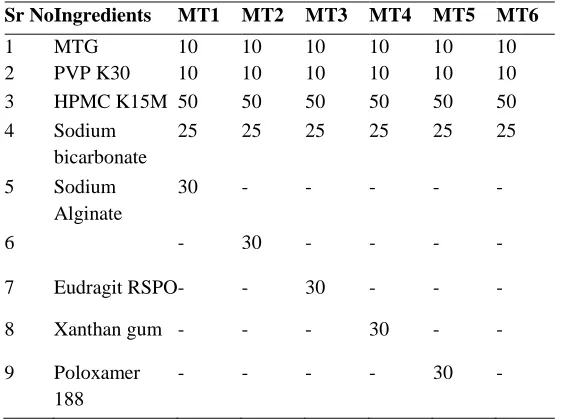
Tablets containing 10mg of mitiglinide calcium dihydrate (MTG) were made by direct compression technique [6-8]. Using the ingredients and their quantities mentioned in table 1. The required quantity of drug, cross linking polymers (HPMC K15M and sodium alginate/Eudragit RLPO/ Eudragit RSPO/ xanthan gum/ poloxamer 188) and PVP K30 (dry binder) and gas generating agent (sodium bicarbonate), were sieved through sieve number #80 to break the lumps and also for proper blending of powder. The powder blends were thoroughly mixed in a mortar by following geometric order. Then, the required quantities of microcrystalline cellulose and magnesium stearate were added and the mixture was filled in plastic bottle. These bottles were placed in double cone blender and the equipment was run for 1 minute. The powder blends were evaluated for pre-compression characteristics and finally the powder was compressed to prepare tablets, on rotary tablet compression machine using 7 mm round and flat punches with the hardness of 5 kg/sq.cm.
Preliminary Studies
Selection of a suitable polymer for the development of floating matrix drug delivery system is challenging. The polymer should have the capacity to make the tablet float over the gastric fluid. Moreover, it should be able to make a
cohesive gel barrier and also possess the power to provide the controlled release of drugs [9]. The effervescent floating system is widely being used for developing floating matrix drug delivery system [10, 11]. The matrices are made with gas generating agent, which in the presence of acidic environment, liberates carbon dioxide. Carbon dioxide gets entrapped in the gel forming hydrocolloid polymers, present in the formulation.
This produces an upward motion of the dosage form and polymeric matrix maintains its buoyancy [12]. The release of the drug, from floating matrix tablet, is controlled by the entry of water into the matrices and ability of the polymer to form cohesive gel barrier. Hydroxy propyl methyl cellulose (HPMC) has been widely used to prepare the polymeric floating matrix systems. In present research work, formulations were prepared using HPMC K15M as release retarding and gel forming polymer. The quantity of the polymer was taken based on the previous studies carried out by the researcher and the available literature review [14, 15]. The combination of HPMC K15M with other release retarding polymers (sodium alginate, Eudragit RLPO, Eudragit RSPO, xanthan gum, poloxamer 188), was tried for preparing floating matrix tablet of MTG. The composition of preliminary batches is given in table 6A.1. The prepared formulations were evaluated for post compression characteristics of floating gastroretentive matrix tablet.
TABLE 1 Composition (in mg) of preliminary batches of MTG Floating Matrix Tablets.
Sr No Ingredients MT1 MT2 MT3 MT4 MT5 MT6
1 MTG 10 10 10 10 10 10
2 PVP K30 10 10 10 10 10 10
3 HPMC K15M 50 50 50 50 50 50
4 Sodium bicarbonate
25 25 25 25 25 25
5 Sodium Alginate
30 - - - - -
6 - 30 - - - -
10 MCC 23.5 23.5 23.5 23.5 23.5 23.5
11 Mg stearate 1.5 1.5 1.5 1.5 1.5 1.5
Drug Excipient Compatibility Study [15]
There is always the possibility of drug polymer interaction in any formulation. To check any such kind of interaction, Fourier-transform infrared spectroscopy (FTIR) study was conducted. The FTIR of pure drug (MTG), polymers (HPMC
RESULTS AND DISCUSSION
Preliminary Studies
The gastroretentive floating matrix tablet of MTG was prepared with HPMC K15M as release retarding polymer in combination with other polymers. The effect of the polymer blend was checked on the floatation characteristics of the tablets and also on the release pattern of the drug from the matrix.
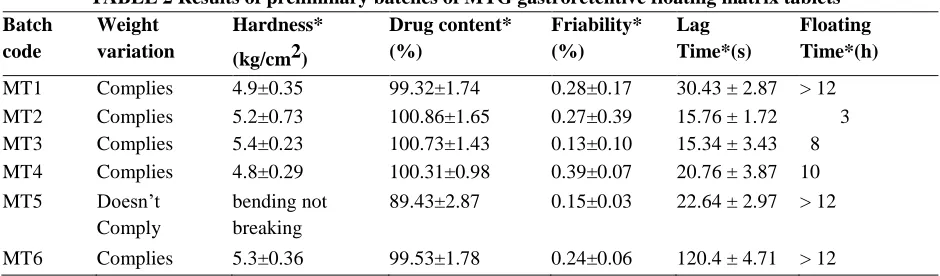
The effect of the physical evaluation of the prepared dosage forms is presented in table 5A.4. All the formulations, except MT5 complied with
the weight variation study. Formulation MT5, prepared with HPMC K15M and Poloxamer 188 was forming flakes during the punching, hence did not pass the weight variation study. Hardness of all the batches was found to be in the range of 4.8 - 5.4 kg/cm2except for MT5, which was bending during the h to 100.86%. The minimum drug content was observed in the tablet containing poloxamer 188. The friability was found to be less than 0.5% that complies the limits given in IP (Table 5A.4).
ardness testing. The drug content in all the batches was found to be in the range of 89.43%
TABLE 2 Results of preliminary batches of MTG gastroretentive floating matrix tablets Batch code Weight variation Hardness* (kg/cm2) Drug content* (%) Friability* (%) Lag Time*(s) Floating Time*(h)
MT1 Complies 4.9±0.35 99.32±1.74 0.28±0.17 30.43 ± 2.87 > 12
MT2 Complies 5.2±0.73 100.86±1.65 0.27±0.39 15.76 ± 1.72 3
MT3 Complies 5.4±0.23 100.73±1.43 0.13±0.10 15.34 ± 3.43 8
MT4 Complies 4.8±0.29 100.31±0.98 0.39±0.07 20.76 ± 3.87 10
MT5 Doesn’t
Comply
bending not breaking
89.43±2.87 0.15±0.03 22.64 ± 2.97 > 12
MT6 Complies 5.3±0.36 99.53±1.78 0.24±0.06 120.4 ± 4.71 > 12
In vitro
Floatation Studies
The in vitro floating lag time of all the
formulations was found to be in the range of 15.34±3.43 to 120.4±4.71 seconds. The formulation MT6, prepared with only HPMC K15 M, had the maximum floating lag time, probably because of delayed gel layer formation due to slow hydration of the polymer [28, 29]. All other formulations had reasonably same floating lag time.
The flotation time of all the formulations was found to be ranging from 3 hours to 12 hrs, which means that the polymers had significant effect on the floating time of tablets. The unanticipated results obtained was in the formulation MT2, prepared with HPMC K15M and Eudragit RLPO. The formulation disintegrated within 3 hours, hence could not float Formulation MT3, prepared with HPMC K15M and Eudragit RSPO could float for only 8 hours. Moreover, the tablets were sinking on and off during the study duration, which
gum) and MT6 (prepared with only HPMC K15M), gave maximum floating time of 12hrs. Overall, it was apparent from the buoyancy studies that the presence of other release retarding polymer in combination with HPMC K15M had a drastic effect on the flotation behavior of formulations, as indicated in Table 5A.4. The pictorial representation of in vitro floatation behavior of preliminary batches of MTG floating matrix tablets is shown in figure 2.1.
Drug Release Studies of Preliminary Batches
The release study of the preliminary batches of MTG floating matrix tablet, prepared with combination of polymers was performed. The release study was conducted in 500ml of 0.1N HCl under all the standard conditions prescribed by Indian Pharmacopoeia (IP).
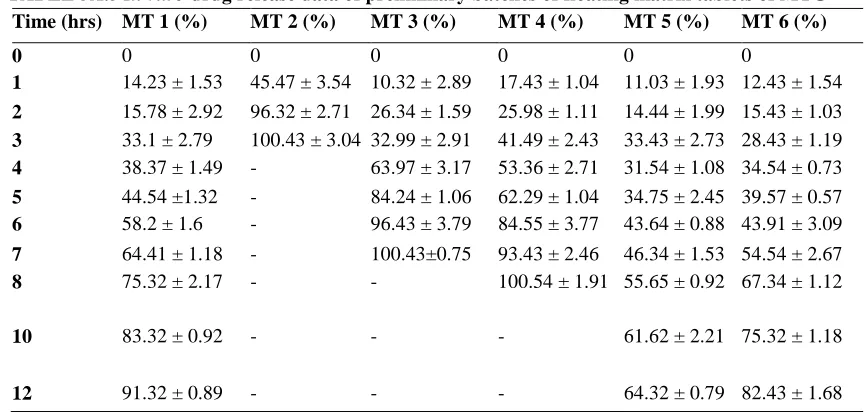
given in table 1 and the graphical representation of the same is given in Figure 2.
The results of in vitro drug release studies of MTG matrix tablet were different than the findings of floating matrix tablet of metformin, prepared using same polymer combination. This change can be attributed to the properties of drug, for which the formulation is developed. Results of formulation MT2 (formulation with HPMC K15M and Eudragit) were totally opposite to that of findings of chapter 4, where this combination of polymers showed the best floating and sustained release characters. Antagonistically, in present study, this polymer blend could not withstand the conditions of dissolution medium and got dissolved completely after first hour of drug release study. After, rigorous literature search, the reason for such findings was understood. Such outcome was
probably because of the salt form of the mitiglinide, the presence of calcium ions was responsible for this result. The literature supporting the finding has been given during the discussion of floatation studies of the same batches.
Formulation MT3 was prepared with HPMC K15M and Eudragit RSPO as literature supported the release retarding property of Eudragit RSPO [31]. During the present study the formulation could sustain the release of the drug till 7 hours. This outcome may be attributed to the gelling capacity of release retarding polymer, as the literature suggests that difference in the release pattern of the drug is because of the type and amount of the adjuvants [32]. At our experimental concentration of polymers, the MT3 could not sustain the release beyond the said duration.
TABLE 5A.5 In vitro drug release data of preliminary batches of floating matrix tablets of MTG*
Time (hrs) MT 1 (%) MT 2 (%) MT 3 (%) MT 4 (%) MT 5 (%) MT 6 (%)
0 0 0 0 0 0 0
1 14.23 ± 1.53 45.47 ± 3.54 10.32 ± 2.89 17.43 ± 1.04 11.03 ± 1.93 12.43 ± 1.54
2 15.78 ± 2.92 96.32 ± 2.71 26.34 ± 1.59 25.98 ± 1.11 14.44 ± 1.99 15.43 ± 1.03 3 33.1 ± 2.79 100.43 ± 3.04 32.99 ± 2.91 41.49 ± 2.43 33.43 ± 2.73 28.43 ± 1.19 4 38.37 ± 1.49 - 63.97 ± 3.17 53.36 ± 2.71 31.54 ± 1.08 34.54 ± 0.73
5 44.54 ±1.32 - 84.24 ± 1.06 62.29 ± 1.04 34.75 ± 2.45 39.57 ± 0.57 6 58.2 ± 1.6 - 96.43 ± 3.79 84.55 ± 3.77 43.64 ± 0.88 43.91 ± 3.09
7 64.41 ± 1.18 - 100.43±0.75 93.43 ± 2.46 46.34 ± 1.53 54.54 ± 2.67
8 75.32 ± 2.17 - - 100.54 ± 1.91 55.65 ± 0.92 67.34 ± 1.12
10 83.32 ± 0.92 - - - 61.62 ± 2.21 75.32 ± 1.18
12 91.32 ± 0.89 - - - 64.32 ± 0.79 82.43 ± 1.68
* n=3, average of three determinations±SD
Formulation, MT4, prepared with HPMC K15M and xanthan gum gave the sustained release of the drug for 8hours. The sustained release effect of the combination was better than observed for floating matrix tablets MH in chapter 4. The findings might be due to the interaction of xanthan gum with calcium ions present in the drug. The literature
CONCLUSION
The floating matrix tablets of MTG were prepared by direct compression technique. The preliminary batches were prepared using HPMC K15M, as release retarding polymer along with other ionic and anionic polymeric substances. The prepared formulations were evaluated for floatation behavior and drug release. The results revealed that tablets prepared using HPMC K15M and sodium alginate, as release retarding polymers were giving satisfactory sustained release property and acceptable floatation behavior. Hence, the final optimization of floating MTG formulation was
done by applying 32 full factorial design using sodium alginate and HPMC K15M as independent variable. The floating lag time (Flag), time to
release 50% of drug (t50) and time to release 90% of drug (t90) were taken as dependent factors. The design was employed and evaluated using the Design-Expert® Software (version- 9.0.6, Stat-Ease) by running 9 experiments. All the formulations were evaluated for their physical properties, in vitro buoyancy studies and drug release study. Results showed that M-3 formulation containing maximum amount of both variables released the MTG for the period of 12hrs and was falling in the yellow region of overlay plot. Hence, it was considered as optimized gastroretentive floating matrix tablet of MTG. The radiographic study of the barium sulphate loaded tablets of this optimized formula, confirmed the gastroretention of the developed formulation
[3]. Singh, R.P. and Prajapati, S.K. Formulation and Evaluation of Prednisolone loaded Microsponges for Colon Drug Delivery: in-vitro and Pharmacokinetic study. International Journal of Pharmaceutical Sciences and Research, 5(5), 1994, 2014.
[4]. Karthika, R., Elango, K., Ramesh Kumar, K. and Rahul, K. Formulation and evaluation of lornoxicam microsponges tablets for the treatment of arthritis. International Journal of Pharmaceutical Innovations, 3(2), 2013, 29.
[5]. Jain, V. and Singh, R., 2011. Design and characterization of colon-specific drug delivery system containing paracetamol microsponges. Archives of Pharmaceutical Research, 34(5), 733-740.
[6]. https://www.drugs.com/monograph/metformin-hydrochloride.html
[7]. https://pubchem.ncbi.nlm.nih.gov/compound/Metformin_hydrochloride#section=Top [8]. https://www.fda.gov/ohrms/dockets/dailys/02/may02/053102/800471e6.pdf
[9]. Japanese Pharmacopoeia.Society of Japanese Pharmacopoeia. Seventeenth Edition (JP XVII), 2016, 1258-1259. [10]. Jin, L. and Cao, Q. Effect of gemfibrozil on the pharmacokinetics of mitiglinide in rats. Arzneimittelforschung,
62(01), 2012, 40-45.
[11]. https://pubchem.ncbi.nlm.nih.gov/compound/6918235 [12]. https://www.drugbank.ca/salts/DBSALT001868
[13]. Mitiglinide Calcium Hydrate. Drugs of the Future, 25(10), 1034-1042.