Everant.org/AFMJ
Account and Financial Management Journal
Research Article
Audit Documentation According To The International Standards In
Slovakia
Nora Štangová1
, Agneša Víghová2
1
Professor at the Department of Small and Medium-Sized Enterprises, School of Economics and Management in Public Administration in Bratislava, Slovakia
2
Fellow lecturer at the Department of Public Administration, School of Economics and Management in Public Administration in Bratislava, Slovakia
Introduction
In the presented article, we are dealing with one of the precondition for the successful functioning of the organization, which is an information system. The Accounting is its main part. Economic, social and political changes, that Slovak Republic went through in the last decade, also require changes and developoment of the information systems, even the changes in the accounting in accordance with international standards set by the European Union. From the perspective of the state, it is important to check the accuracy of the
accounting information of the individual
organizations, as these constitute a substantial part of tax renenue in public finances. Control is provided by a financial audit, and is considered as an effective tool for verification of the accuracy and evidency.
Audit requires a methodical approach, which is
defined by the International Accounting
Standards.
We are dealing with one of the attributes of the financial audit, called the audit documentation, in this article.
1. Characteristic of Audit Documentation. Audit documentation serves for the documentation of audit evidences and confirmations, that led to the formulation of the auditor’s report. Audit
documentation is the property of the auditor and may be the subject of the quality control by Auditing Oversight Authority, it may also be an evidence in case of litigation. The form and content of audit documentation is different for every contract. Basic requirements for audit documentation are set in the Act on Auditors,
which defines the basic parts of the
documentation, including a reference to the International Standard on Auditing ISA 230- Audit documentation.
Audit documentation may be managed by computer, or by hand. Under the Act on Auditors, the audit documentation shall be kept for ten years from the date of creation of the audit report.
2. Analysis of Audit Documentation.
We are dealing with the short analyses of audit documentation in:
Business entities, Public administration.
2.1 Buseness Entities
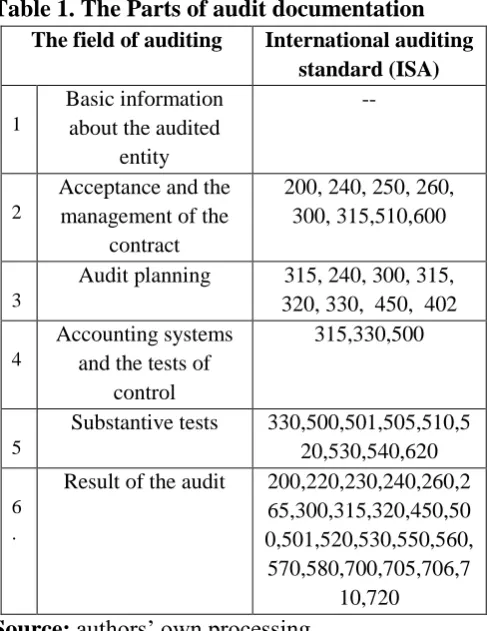
Table 1. The Parts of audit documentation The field of auditing International auditing
standard (ISA)
1
Basic information about the audited
entity
--
2
Acceptance and the management of the
contract
200, 240, 250, 260, 300, 315,510,600
3
Audit planning 315, 240, 300, 315, 320, 330, 450, 402
4
Accounting systems and the tests of
control
315,330,500
5
Substantive tests 330,500,501,505,510,5 20,530,540,620
6 .
Result of the audit 200,220,230,240,260,2 65,300,315,320,450,50 0,501,520,530,550,560, 570,580,700,705,706,7
10,720 Source: authors’ own processing
Individual areas of the audit are described as follows:
Basic information about the audited entity– auditor before acceptance of the contract obtains information about the audited entity. Information source includes: extract from Commercial Register, in the full version, register of accounts – the Internet portal of financial management. Information sources include: extract from the Commercial Register in the full version, the registry of financial statements – the financial administration web portal.
The information obtained is put in the documentation of the auditor.
A) Acceptance and the management of the
contract
Acceptance and the management of the contract is an important decision of the auditor, because at this stage the auditr decides, whether to accept, or reject the contract. Factors influencing this decision are set out in the Act on Auditors, in the
International Standards on Auditing and, as well as, in the Code of Etics.
B) Audit planning are the auditor’s
procedures, that are used to carry out the audit in order to make in efective way.
An imporant information for the auditor in planning the audit is to determjine the level of significance. Significance level chosen is different in the case of businesses, and in the case of government entities.
The activity of business entities is based on profit, so when calculating the level of significance, the auditor takes into account these three criteria, namely:
Reported revenues – 1 %
Total assets of the company - 2% Profit before tax -7 %
Information sources to calculate the level of significance for businessmen is the financial statement of the company.
From these quantities, the average is calculated, the result is the amount, that represents the level of significance, ie which business transactions are essential to the auditor when checking up the annual accounts. In practice, the author calculates significance even for the past year and then the individual results are compared.
Practical example – the businessman showed the following information in the financial statements:
Table 2. The Calculation of Significance – a business entity
The basis for calculating the level of significance
Amount in EUR – (balance
sheet informatio
n source)
Percentage The
calculated amount in
EUR
Total assets 3.567.000 1 % 35.670
Revenues 2.786.000 2 % 55.720 Profit before
tax
102.000 7 % 7.140
The calculation of significance: (35.670 + 55.720+7.140) / 3 = 32.843 EUR.
Tolerable fault represents 50% of the significance of the company, what is in our case 16,421.50 EUR. This amount means that faults in the between 16,421.50 EUR and 32,843.00 EUR there is considered their impact on the financial statements by communication with the client and faults over 32,843.00 EUR are stated in the auditor’s report.
The minimum fault of the significance is 5 %, in our case it is represented by 1,642.15 EUR, what means, that in the case of irregularity, that is not above this amount, this fact is defined as the fact of non-significant effect on the financial statements.
C) Accounting Systems and the Tests of
Control
Auditor, in order to know theoverall functioning of the audited entity, examines within the accounting systems, even the computer systems, that are used by the business entity.
The tests of control are performed in the areas of revenues, debts, income, purchases, commitments, payments, wages, because these areas provide a picture of the costs and revenues of the audited entity.
D) Substantive Tests
Substantive tests involve a detailed analyses of individual accounting lines, that are in the financial statements of the audited entity. Substantive tests are related to the following areas of lines of financial statements: long-term intangible assets, long-long-term tangible assets, inventories, receivables, short-term financial assets and pre-payments in assets, equity, liabilities, taxes, bank loans, long-term liabilities, accruals in liabilities, provisions, income, expenses.
E) The result of the audit
The result of the audit is the final phase of the audit activities. At the result of the audit, in the final phase of the audit, the auditor
summarizes identified faults and
misstatements, which were detected during the performance of the audit. Based on the faults and misstatements the auditor selects the type of auditor’s opinion (modified, or unmodified opinion).
2. 2 Public Administration Entities
For the public administration entities it is applied the same structure of the audit documentation, as for the business entities (specified in part 2.1). The same International Standards on Auditing (ISA) define the procedure of the auditor, how to perform the audit of the financial statements and of the financial management of the municipality. Because the public administration entities differ from the business entities in the way of funding and they depend on the resources that flow from the state budget, except for those prescribed in paragraph 2.1, the documentation also include the following to the law 583/2004 on financial rules of the local governments, as amended, because municipalities and higher territorial units, pursuant to 16.3§ of the Financial Regulation, are required to have audited financial statemements and budgetary management.
The Audit Documentation Includes The Following Information:
Decision making processes in the village- communication between the mayor an the municipal council.
Control processes in the village- the level of
existence and application of international
The Verification of Management According to Law No. 583/2004, As Amened, On Financial Rules of Local Governments
Examination of the financial statements and of the management under the relevant provisions of the Act:
A) The verification of management according
to the budget include following findings, that are made pursuant to the law on budgetary rules of local governments, as amended.
B) The verification of the state and
development of the debt contains an analyses under the law on budgetary rules of local governments, as amended.
C) The verification of compliance with the rules used for repayable sources of financing under the law on budgetary rules of local governments, as amended.
Government entities differ from businesses in management and in the way they manage the funds.
The basic document declaring the management – is a budget, that inclues a budgeted revenues and expenses for the period of a calendar year. The budget is approved by the council.
From the above mentioned rules it also follows, that there is a different methodology to calculate the level of significance for these entities.
The criterion for calculating the level of significance are the actual budgeted revenues from the previous period.
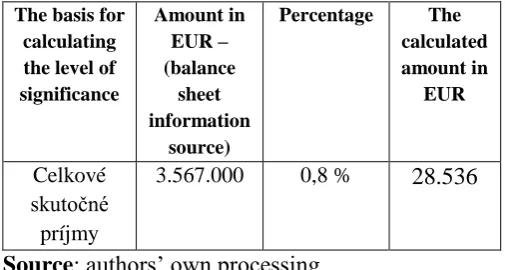
In practice, the auditor shall determine the significance level of 0.8% of actual budgeted revenue from the previous period.
Example of the selected municipality:
Public administration unit – the municipality reported following details, seen in the Table 3
Table 3. Calculation of importance for public administration entities
The basis for calculating the level of significance
Amount in EUR – (balance
sheet information
source)
Percentage The
calculated amount in
EUR
Celkové skutočné príjmy
3.567.000 0,8 % 28.536
Source: authors’ own processing
The calculation of significance: 3.567.000 0,8 % = 28.536 Eur.
Tolerable fault represents 50% of the significance of the company, what is in our case 14,268 EUR. This amount means that faults in the between 14,268 Eur and 28,536 EURthere is considered their impact on the financial statements by communication with the client and faults over 28,536 EURare stated in the auditor’s report. The minimum fault of the significance is 5 %, in our case it is represented by 1,426.80 EUR – what means, that in the case of irregularity, that is not above this amount, this fact is defined as the fact of non-significant effect on the financial statements.
The quality control of auditor’s work is very important. The control is performed by the inspectors of the Slovak Chamber of Auditors. The aim of the control of auditor’s work is improving the quality of auditors in the Slovak Republic. Slovak Chamber of Auditors publishes, in advance, a list of to be controlled entities on the website of the Chamber, so that the auditing companies, as well as, the individuals can be prepared for inspection.
In Slovakia quality control of the auditor’s work is governed by international standards ISQC1 and by the Act on Auditors.
YEAR 2014 YEAR 2015 The total
number of inspections carried out
152 117
Control of the work of auditors - companies
60 – of it properly maintained audit
documentation 42
62 – of it properly maintained
audit documentation:
49 Control of the
work of auditors - individuals
92 – of it properly maintained audit
documentation: 45
55 – of it properly maintained
audit documentation:
25
Source: authors‘ own processing on the basis of reports on the results of the quality assurance of the audit for 2014 and 2015
Inspections were conducted in randomly selected audits of different organizations from various regions of Slovakia. The most frequently detected deficiencies in the audit documentation during the period were asfollows:
- In the contract on audit, the auditor did not state an obligation of confidentiality on the facts he has learned during the audit, - The contract did not contain the name of
the assistant auditor, who participated in the audit,
- The auditor’s documentation did not
include a declaration of independence of
auditor, including a declaration of
independence of auditor’s assistants at a given audit.That declaration must be signed by the auditor and by the assistant auditor, there must be given a date, that is before the date of the contract.
- The auditor’s documentation did not
contain the calculation of the level of significance – the amount by which the auditor considered the faults to be
significant, which had an impact on the outcome of the audit.
Conclusion.
The analyses carried out shows, that the number of inspections carried out, comparing to the 2014, declined, while from the partial monitoring of the reporting of the auditors’ work we can see, that almost 50% of audits were made in compliance with regulations. The faults found by the control are often caused by lack of communication between auditors who audit (in case of legal entity) and lack of time (in case of individuals) and there were mainly the irregularities which were formal, but the professional aspect – especialy observance of international standards was in compliance with regulations.
However, the inspections have their unique place in this areas and they give a presumption of compliance with laws and the regulations, thereby they are contributing to a true picture of the state functioning in the structure of individual organizations.
Bibliography
1. International Federation oF Accountants (IFAC), 2014. Guide of international guidelines on Quality Control, Auditing,
Review, Other Assurance Services.
2014.ISBN: 978-1-60815-185-1
2. Kareš, L. 2015. The Theory of Audit. Bratislava : Wolters Kluwer.2015. ISBN 978-80-8168-149-3
3. Kareš, L. 2010. Auditing. Bratislava : Iura Edition. 2010. ISBN 978-80-8078-334-1 4. Štangová, N, Víghová, A, Kirsanov, S,
Safonov, E., 2016. The application of international standards of quality control of audit. Bratislava :,The school of Economics and Management of Public Aministration in Bratislava, 2016. ISBN 978-80-89654-27-7
5. Act no. 431/2002,on accounting, as
6. Act no.369/1990, on Municipalities, as amended
7. Act no. 583/2004,on financial rules of