PREVENTIVE MEDICINE: URGENT ASPECTS OF RISK ANALYSIS
UDC 614.3:342.9
SCIENTIFIC APPROACHES TO THE CLASSIFICATION OF ECONOMIC ENTITIES
IN TERMS OF HEALTH RISKS FOR THE PURPOSES OF CONTROL AND
SUPER-VISORY ACTIVITIES
А.Ju. Popova1, N.V. Zaitseva2, I.V.May2, D.А. Kiriyanov2, А.S. Sboyev3
1Federal Service for Supervision of Consumer Rights Protection and human well-being, Russia, 127994, Moscow,
Vadkovskiy pereulok, 18, bldg 5 and 7,
2Federal Budgetary Scientific Institution “Federal Scientific Center for Medical and Preventative Health Risk
Man-agement Technologies” Russia, 614045, Perm, ul. Monastyrskaya, 82
3
The Federal Service for Supervision of Consumer Rights Protection
and human well-being, Perm Krai Directorate, Russia, 614016, Perm, ul. Kuibysheva, 50
4The Federal Service for Supervision of Consumer Rights Protection
and human well-being, Moscow Directorate, Russia, 129626, Moscow, Grafskiy per., 4/9
________________________________________________________________________________ The article suggests approaches to the classification of economic entities involved in economic activities that are sub-ject to sanitary-epidemiological and product safety requirements. The risks presented by the entity is determined by the possi-bility of violation of the sanitary legislation, severity of consequences of the violation for public health, and amount of people (employees, consumers) under exposure. The risk is assessed on the basis of available information. The risk assessment method for all the economic entities is transparent and reproducible.
The article identifies four classes of hazard in terms of potential health risks (extreme hazard, high hazard, moderate (average) hazard and low hazard). The class of hazard determines the frequency and amount of planned supervisory activities. Reconnaissance assessment of potential risk for 6400 subjects of sanitary-epidemiological supervision in Perm Krai showed that almost 70% of economic entities are not sources of high and average health risks. There is no need for close supervision of such entities; instead, the focus can be moved to the entities of high and extreme hazard. The article also describes the criteria that can be used to increase or decrease the frequency of planned inspections.
The suggested approaches are aimed at stimulating the economic entities to follow the current legislation. Key words. risk of harm, sanitary and epidemiological supervision, classification of the subjects of supervision _____________________________________________________________________________________________.
Increased health risks and hazards is a global process typical of Russia. Stochastic appear-ance and launch into circulation of newly synthe-sized chemicals, the emergence and spread of new species and strains of microorganisms, expanded range of the physical factors of public exposure, economic globalization and the opening of borders for goods and human resources - all this has nega-tive consequences for public health [5, 9,10].
In this situation, the Federal Service for Su-pervision of Consumer Rights Protection aims to prevent and mitigate the negative impact on public health created by the economic activities.
The Decree of the RF President of May 15, 2008 №797 “On Emergency Measures to Eliminate Administrative Restrictions When Exercising En-trepreneurial Activities”, a number of amendments
____________________
Popova A.Yu., Zaitseva N.V., May I.V., Kiryanov D.А., Sboev A.S., 2014
Popova Anna Urievna – MD in Medicine, Professor, Head of the Federal Supervision Agency for Customer Protection and Human Welfare, Chief State Medical Officer of the Russian Federation (е-mail: [email protected]; tel.: +7 (499)973-26-90).
Zaitseva Nina Vladimirovna – Academician of the Russian Academy of Medical Sciences, MD, Professor, Director (e-mail: [email protected]; tel.: +7 (342)237-25-34).
MayIrina Vladislavovna – DBS, Professor, Deputy Director for Science (e-mail: [email protected]; tel.: 8(342)237-25-47).
Kiryanov DmitryAleksandrovich – PhD in Engineering, Head of Department of Systems and Processes Mathematical Mod-eling (e-mail: [email protected]; tel.: +7 (342) 237-18-04).
added and planned to the RF Federal Laws № 294-FZ of December 26, 2008 “On Protection of Rights of Legal Entities and Individual Entrepreneurs When Exercising State Control (Supervision) and Municipal Control”; №242-FZ of July 18, 2011 “On Making Changes to Some RF Legislative Acts on State Control (Supervision) and Municipal Con-trol”; №210-FZ of July 27, 2010 “On Provision of State and Municipal Services” – stipulate, among other things, the introduction of health assessment and management methodology tailored to specific economic activities into the system of state super-vision. The importance of such activities is em-phasized in the draft Concept of improving the ef-fectiveness of inspection and enforcement activi-ties of state bodies and local self-government in 2014-2015 [3].
Following the federal policy, the Federal Service for Supervision of Consumer Rights Pro-tection and human well-being sets an objective to introduce risk-based supervision into the activities aimed at providing sanitary and epidemiological well-being of the population and consumer right protection aimed at:
- Ensuring the proportionality of the control and supervisory activities to the level of public health and property damage risk;
- Focusing the supervisory efforts on the entities that present the biggest health risk (to the public, employees, and consumers) and decreasing the number of inspections at the entities of low risk; - Rational and effective use of the funds allocated for the supervision over the execution of the state function;
- Improving the quality of the environment, workplace conditions, and product safety by pre-venting the violations of the sanitary legislation by the entities that present the biggest health risk; - Stimulating the subjects of supervision to follow the legislative requirements by the incentive of decreased frequency of planned inspections; - Increasing the efficiency of control and supervi-sory activities aimed at providing sanitary and epi-demiological well-being [5-7].
To achieve the above objectives, methodological approaches to the classification of the economic entities were developed using the criteria of poten-tial public health risk. The classification of the economic entities, in its turn, serves as a basis for determining the frequency of planned inspections and scheduling the inspections for the coming year with the account for the resources at Rospotreb-nadzor and expenses on the supervisory activities.
The level of health risk is determined based on the following principles:
- Health risk emerges when an economic entity violates the legislative requirements in the area of the sanitary and epidemiological well-being of the public and consumer right protection;
- Violations in the area of the sanitary and epide-miological well-being of the public and consumer right protection determine the probability of health risks to the public, employees, and consumers un-der exposure to the activities of the economic enti-ty;
- Risk assessment is an objective and transparent procedure based on verified available data;
- The level of potential risk associated with the entities subject to the federal state sanitary and ep-idemiological supervision depends on the type of economic activities conducted by the entity. Public health risk assessment is carried out in regards to a specific type of activity of a legal entity or individ-ual entrepreneur;
- On the basis of the conducted analysis, a classifi-er of risk entities is developed by the method of one-time reference of an economic entity (unit) to a certain risk group (statistical assessment of the risk levels);
- An economic entity is referred to a specific health risk class based on its most hazardous economic activity;
- The reference of an economic entity to a specific class of hazard serves as a basis for determination of the frequency of planned inspections; the diffe-rentiation of the units of supervision at the eco-nomic entity serves a s a basis for planning the amount and content of the supervisory activities; - Procedure and criteria used to refer an economic entity to a specific class of hazard in terms of health risks are consistent for all the legal entities and individual entrepreneurs regardless the type of economic activity or form of ownership;
- The reference of an economic entity to a specific class of hazard in terms of health risks at the re-gional level is carried out based on the results of control and supervisory activities for the period of at least 3 years, with the account for the available information about the entity (complains, occupa-tional diseases, acute poisoning, accidents, regis-tered infectious diseases, population under expo-sure);
islative requirements in the area of sanitary and epidemiological well-being of the population. Law violations determine the probability of damage to public health, the health of employees, and con-sumers under exposure.
The economic entities listed in the Uniform State Register of Legal Entities or the Uniform State Register of Individual Entrepreneurs and sub-ject to the sanitary and epidemiological supervision and supervision in the sphere of consumer right protection are subject to the classification, with the account for their activities as listed in the Russian National Classifier of Economic Activities or the All-Russia Classifier of Services Rendered to the Public compared against the activity control form 1 “Information about the results of the state inspec-tion by the local Rospotrebnadzor office”.
Primary rating of an economic entity in terms of potential risk to public health is carried out on the basis of a comprehensive analysis, in-cluding expert analysis, of longitudinal statistical information on the situation in the RF in general and in some subjects in particular, using the fol-lowing formula (1).
(
k k)
k
R
=
∑
p u
⋅ ⋅
M
, (1)where
p
k– probability of violation of the sanitary legislation under the k-th article FZ “About the sanitary and epidemiological well-being of the population” and FZ “On protection of consumer rights” and other legislation on consumer rights protection;uk – an indicator that describes the health ha-zard under the violation of the k-th article of the legislation;
M – an indicator that describes the size of the population group under exposure to the activities of an economic entity (scale of exposure).
The probability of violation of the sanitary legislation (
p
k) is characterized by the frequency of violation of each (k-th) article of the sanitary legislation and legislation on consumer rights pro-tection in the industries subject to the sanitary in-spection, on the basis of the inspection results for at least 3 years, using the formula (2):k k
m p
n
= , (2)
where pk – frequency of violations of the sanitary
legislation or legislation on consumer rights pro-tection under the k-th article for each of the eco-nomic activities;
mk – number of registered violations of the
sanitary legislation or legislation on consumer rights protection under the k-th article for each of the economic activities;
n – total number of inspections of a separate economic activity.
The frequency of violations of separate ar-ticles of the sanitary legislation (mean value and 95th percentile) in the Russian Federation is calcu-lated on the results of the inspection activities of all the RF subjects for the last three years; it de-termines the current situation around compliance of the economic entities with the sanitary legisla-tion and legislalegisla-tion on consumer rights proteclegisla-tion.
For each separate economic activity, we identified the hazard factors associated with a spe-cific type of violations of the sanitary legislation under the specific articles of the law № 52-FZ, and the law “On protection of the legal entities”. For each type of hazard, we determined the type of health damage (type of diseases and/or cause of death) based on the analysis of the domestic and international relevant information sources and da-tabases.
The calculation of a relative health damage caused by the violation of the sanitary legislation and legislation on consumer rights protection (uk) is carried out on the basis of a comprehensive analysis, including expert analysis, of the causal relationships between the frequency of the law vi-olations and prevalence of health damages includ-ing the death rate and primary disease incidence, taking into account the severity of a health dam-age.
The calculations are made using the follow-ing formula (3):
k ik i
i
u
=
∑
α
⋅
g
, (3)
lation in the field of consumer protection by specif-ic economspecif-ic activity;
ik
α
– an indicator of the change in the fre-quency of morbidity and mortality with increasing frequency by one violation of the legislation on the k-th article;gi– severity of the i-th health damage, meas-ured in the range from 0 to 1.
Value
α
ik is determined based on a regres-sion analysis according to the state statistical re-porting forms (Form №12, "Information on the number of diseases revealed in patients residing in the service area of the medical organizations", the form №1 "Information on infectious and parasitic diseases", form C51 "Distribution of deaths by sex, age groups and causes of death”, Form № 29-09 “Information on outbreaks of infectious diseases ") by the subjects of the Russian Federation for 3 years and expert evaluation of the hazards of each economic activity and related health problems.The regression equation in the standard form looks as follows (4):
0
i i ik k
k
y
=
α
+
∑
α
p
, (4)
where yi – dependent variable;
i-ый – health indicator (certain types of the morbidity and death rates);
pk– independent variable– frequency of vi-olation of the k-th article of the legislation.
Determination of the coefficients α was per-formed with the help of the step-by-step regression analysis using special certified software for statis-tical data processing.
Health disorders were differentiated by se-verity. The severity of a disease was evaluated in the range from 0 to 1, where 0 - full health, 1 - death. Such approaches are generally accepted, quantitative characteristics of the severity are con-sistent with the values adopted in the documents of the World Health Organization. The severity of health problems by classes of diseases was calcu-lated based on the severity of the individual nosol-ogy and structure of each class of diseases in the Russian Federation over the past three years.
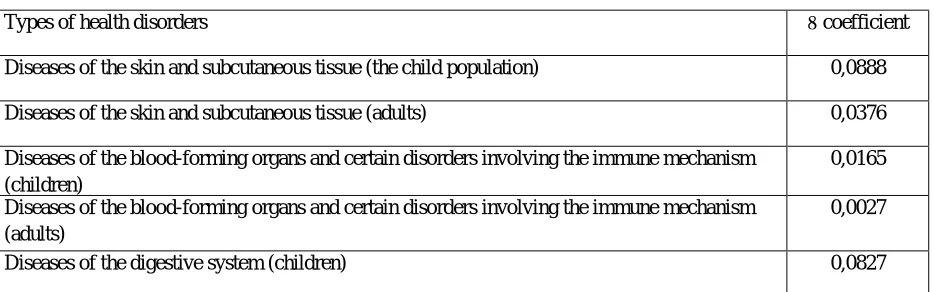
Examples of the revealed causal relation-ships between the violation of articles of legisla-tion and health disorders (in terms of specific dis-eases and disease classes) described with the help of reliable models, and parameters
α
ik of these models are given in Table 1. In practical calcula-tions, it is possible to use the values of this para-meter that are common for the Russian Federation.Table 1 Examples of α coefficient (Violations of Article 19 “Sanitary and epidemiological requirements to the quality of drinking water, drinking and potable water supply” FZ 30.03.1999 N 52-FZ “On Sanitary
and epidemiological well-being of the population” by the economic entities)
Types of health disorders α coefficient
Diseases of the skin and subcutaneous tissue (the child population) 0,0888
Diseases of the skin and subcutaneous tissue (adults) 0,0376
Diseases of the blood-forming organs and certain disorders involving the immune mechanism (children)
0,0165
Diseases of the blood-forming organs and certain disorders involving the immune mechanism (adults)
0,0027
Diseases of the digestive system (adults) 0,0248
Diseases of the digestive system (population at large) 0,0364
Liver conditions (adults) 0,0005
Liver conditions (population at large) 0,0006
Diseases of the pancreas (population at large) 0,0012
Diseases of the gallbladder, biliary tract (adults) 0,0028
Gastritis and duodenitis (population at large) 0,0054
Endocrine, nutritional and metabolic diseases (children) 0,0171
Endocrine, nutritional and metabolic diseases (adults) 0,0094
Endocrine, nutritional and metabolic diseases (population at large) 0,0114
Thyroid diseases (children) 0,0049
Thyroid diseases (adults) 0,0033
Diseases of the genitourinary system (population at large) 0,0505
Kidney stone disease (children) 0,0001
Kidney stone disease adults) 0,0018
Kidney stone disease (population at large) 0,0015
Diseases of the eye and adnexa (adults) 0,0311
Diseases of the nervous system (adults) 0,0104
New growths (adults) 0,0124
Congenital abnormalities of the blood circulatory system (children) 0,0041
Congenital abnormalities of the blood circulatory system (population at large 0,0008
Congenital abnormalities (developmental defects), deformations and chromosomal abnormali-ties (children)
0,0126
Congenital abnormalities (developmental defects), deformations and chromosomal abnormali-ties (population at large)
0,0024
The indicator that describes the scale of im-pact of the economic entities (scale coefficient) takes into account the amount of people that can suffer as a result of a sanitary violation or violation of the consumer rights legislation, and the contact time with the hazard typical of the entity.
The indicator is calculated using the average values typical of the economic entity (for example, number of employees, number of hospital beds, number of students at preschools and secondary schools, shopping space, production volumes at food industry enterprises, volume of extracted and
treated water for the drinking water supply, etc.) and distribution coefficients that help convert the statistical indicators into the number of people un-der exposure (for example: length of hospital stay, specific consumption of food products, specific water consumption, etc.) using the following for-mula (5):
M = ⋅V K V( ), (5)
V – an indicator that quantitizes an economic entity and determines the number of people under exposure;
K(V) – a coefficient of nondimensionalized
Vк.
For convenience of the practical calculation of the scale of exposure, reduction coefficients by different type of economic activity are enclosed in Appendix 8.
The indicator is flat for all types of economic entities; at the same time, it is aimed at using available statistical data that describes various eco-nomic entities and their activities.
The indicator, along with others used in risk evaluation, has a period of one year; respectively, the scale coefficient also describes the scale of ex-posure during a year.
In order to classify the economic entities and their activities by the level of health risk related to the sanitary violations and violations of the con-sumer rights legislation, we sued a scale that breaks down the risks of health damage into four classes:
1) an extremely high level of potential ha-zard (I class of haha-zard);
2) a high level of potential hazard (II class of hazard);
3) an average level of potential hazard (III class of hazard);
4) a low level of potential hazard (IV class of hazard).
Classification of the economic entities in terms of risk of health damage (level of potential hazard) is presented in Table 2.
Table 2. Classification of the economic entities by the level of risk of health damages
Class of potential hazard of an economic entity and type of activity (unit of supervision)
Characteristics of the potential risk
of health hazard Risk of health hazard
I class of hazard Extremely high More than10-1
II class of hazard High 10-1 - 10-3
III class of hazard Average 10-3 - 10-5
IV class of hazard Low Less than 10-5
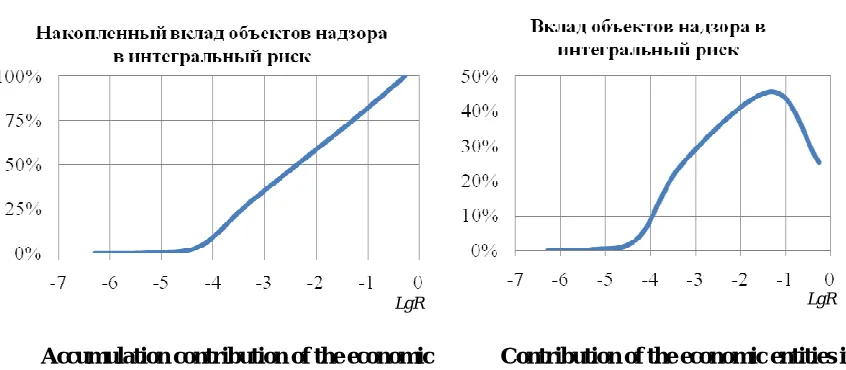
The classification scale was obtained on the basis of distribution analysis of the values of health damage risk for all the RF units of supervi-sion (at large) included in the state industrial statis-tics. It was determined that the distribution falls under the Poisson's law. The values of the risk of
LgR LgR
Accumulation contribution of the economic entities into the total risk
Contribution of the economic entities into the total risk
Figure. Density (a) and function (b) of health damage risk distribution* Density (а) – share of the nomic entities with a certain value of health damage risk **Distribution function (b) – share of the
eco-nomic entities with a certain range of health damage risk According to the scale, the first class of
ha-zard has a very insignificant amount of economic entities. Most economic entities fall under the third and fourth classes of hazard.
The suggested methodology helps develop a federal classifier of economic entities by the level of potential risk to public health. Placing an eco-nomic entity into a specific class of hazard serves as a basis for scheduling planned supervisory ac-tivities. In such a way, the economic entities in the first class of hazard (extremely high level of poten-tial risk to public health) can be recommended con-tinuous supervision (once a quarter); the entities in the second class of hazard (high risk) – once a year at most, with a possibility of increasing the fre-quency; the entities in the third class of hazard (av-erage risk) – once every three years at most; the entities in the fourth class of hazard – once every five years, or exemption from inspections, with a possibility of regular inspections of once every five years or exemption.
The frequency of planned inspections at the economic entities in the first and second classes of hazard can be changed in the following way:
– if the site inspections for the last three year show that the relative frequency of the sanitary violations and violations of the consumer rights legislation is lower as compared to the average Russian level for the same period, then the period between the planned inspections increases by one year in regards to the current frequency;
– if the site inspections for the last three year show that the relative frequency of the sanitary
violations and violations of the consumer rights legislation is lower as compared to the average Russian level for the same period, then the period between the inspections decreases to the standard period;
– the period between the planned inspections can be increased only twice meaning that the max-imum period may differ from the standard period by 2 years at most.
The economic entities in the fourth class of hazard may be exempt from the planned inspec-tions subject to the following terms:
- no violations of the sanitary legislation re-vealed during the last inspection;
- no validated complaints about the activities of the economic entity from the public, other legal entities, governmental agencies, and local authori-ties;
The following factors will be taken into ac-count when planning inspection activities: the level of law-obedience which is characterized by the ratio of the number of violations of the sanitary legislation and the consumer rights legislation and the number of conducted inspections; complete-ness and timely performance of the orders and in-structions; the share of non-standard samples col-lected in the course of laboratory studies.
The economic entities with the worst indic-tors within one class of hazard will be subject to priority supervision.
violations is lower than the country’s average for that type of economic entities.
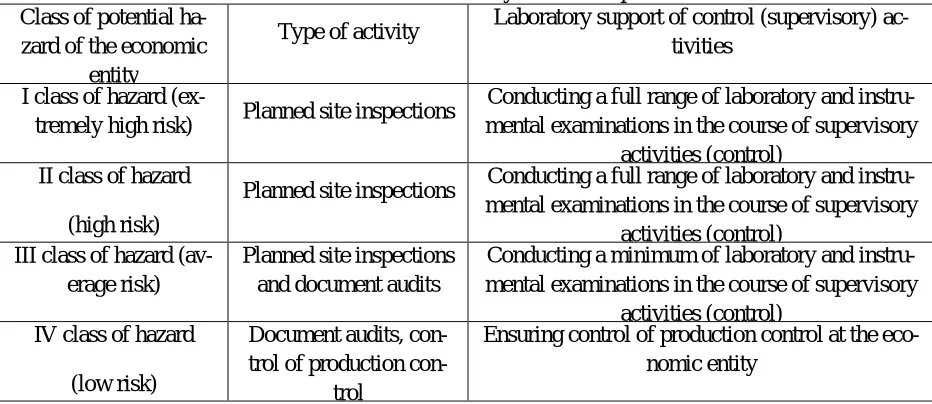
The classification of the type of activities within one economic entity serves as a ground for the development of the content and volume of the supervisory activities in the course of comprehen-sive inspections of compliance with the sanitary legislation (Table 3).
The maximum allowable frequency of planned supervisory activities is determined by the RF laws and regulations. The content of supervi-sory activities for the entities in various classes of hazard and health risk is determined by the Admin-istrative regulations and other normative docu-ments adopted by the authority in the sphere of compliance with the sanitary and epidemiological legislation.
Table 3. Organization of the federal state sanitary and epidemiological supervision (control) depending on
the class of hazard of an economic entity in terms of public health risk Class of potential
ha-zard of the economic entity
Type of activity Laboratory support of control (supervisory) ac-tivities
I class of hazard
(ex-tremely high risk) Planned site inspections
Conducting a full range of laboratory and instru-mental examinations in the course of supervisory
activities (control) II class of hazard
(high risk)
Planned site inspections Conducting a full range of laboratory and instru-mental examinations in the course of supervisory
activities (control) III class of hazard
(av-erage risk)
Planned site inspections and document audits
Conducting a minimum of laboratory and instru-mental examinations in the course of supervisory
activities (control) IV class of hazard
(low risk)
Document audits, trol of production
con-trol
Ensuring control of production control at the eco-nomic entity
The testing of the approaches in Perm Krai showed that among all the facilities involved in wastewater disposal (discharge of sewage waters) into the natural aquifers, only one economic entity was referred to the first class of hazard – the larg-est water treatment facilities in the region that dis-charge the sewage water from the city of one mil-lion people into the river upstream in regards to other towns using the same draining system. 20% of the entities involved in the same economic ac-tivity were referred to the group of high risk enti-ties; 51% - to the group of average risk entienti-ties; 48% - to the group of low risk entities.
Among the studied entities involved in food trade, no entity was referred to the class of
extremely high and high hazard risk; 25% of the entities were referred to the group of moderate (av-erage) risk – mainly, large retail store chains that serve a large population group; 75% of the retail units were referred to the group of low hazard risk.
Reconnaissance assessment of the potential hazard risk of 6400 entities of sanitary and epide-miological supervision in Perm Krai showed that almost 70% of the economic entities do not present high or average risk to public health. The level of supervision of such entities can be weakened, and the focus of the control efforts can be transferred to the entities of extremely high and high risk.
Surprise inspections based on complaints from the public and other legal entities, detected violations of the hygienic requirements and stan-dards, etc. are still relevant and must be performed along with planned inspections and other supervi-sory activities regardless the class of hazard of an economic entity.
References
1. Kvasov I.А. A new object-based approach to decision-making. //Scientific works of the Free Economic Society of Russia. 2013. Vol. 170. p. 293-310.
2. Control and supervisory activities in the Russian Federation. Analytical Report. - 2013. - М.: MAKS Press, 2014. - 272 p.
3. A draft concept of improving the efficiency of control and supervisory activities of the state
and local authorities for 2014-2018. /Electronic resource
ar.gov.ru/.../450_koncepciya_revised_as_of_8_26_2013_(2).doc-d [датаобращения 10.10.2014] 4. Kuzmin S.V., Gurvich V.B., Yarushin S.V., Malykh О.L., Kuzmina Е.А. Managing the sani-tary and epidemiological situation with the help of sanisani-tary-hygienic monitoring and health assessment methodology / Zdorovie naseleniya Ii sreda obitaniya. 2010. № 11. P. 16-19.
5. About the sanitary and epidemiological well-being in the Russian Federation in 2013: A State Report. —М.: Federal Service for Supervision of Consumer Rights Protection and Human Well-Being, 2014.—215 p
6. Onischenko G.G. A concept of risk and its place in the course of sanitary and epdemiological monitoring. //Digest of the Russian Academy of Medical Sciences, № 11, 2005.- P. 27-33
7. Onischenko G.G., Simkalova L.М., Tebiyev S.А. About the measures on the realization of the Federal Law “On protection of legal entities and individual entrepreneurs when carrying out state control (supervision) and municipal control” // Public Health in the Russian Federation. 2013. № 6. P. 5-8.
8. Hampton P. Reducing administrative burdens: effective inspection and enforcement / Elec-tronic resource www.hm-treasurear.gov.ru/hampton [access date: 12.10.2014]
9. Leeves G.D., Herbert R.D. Economic and environmental impacts of pollution control in a systemof environment and economic interdependence Chaos, Solitons& Fractals. 2002. Vol. 13. № 4. P. 693-700.