The Open Journal of Occupational Therapy
The Open Journal of Occupational Therapy
Volume 3
Issue 4 Fall 2015 Article 6
October 2015
The Future in Their Hands: The Perceptions of Practice Educators
The Future in Their Hands: The Perceptions of Practice Educators
on the Strengths and Challenges of “Generation Y” Occupational
on the Strengths and Challenges of “Generation Y” Occupational
Therapy Students
Therapy Students
Caroline Hills
National University of Ireland, Galway, [email protected]
Kobie Boshoff
University of South Australia, [email protected]
Susan Gilbert-Hunt
University of South Australia, [email protected]
Susan Ryan
University of Newcastle - Australia, [email protected]
Derek R. Smith
University of Newcastle - Australia, [email protected]
Follow this and additional works at: https://scholarworks.wmich.edu/ojot
Part of the Medicine and Health Sciences Commons
Recommended Citation Recommended Citation
Hills, C., Boshoff, K., Gilbert-Hunt, S., Ryan, S., & Smith, D. R. (2015). The Future in Their Hands: The Perceptions of Practice Educators on the Strengths and Challenges of “Generation Y” Occupational Therapy Students. The Open Journal of Occupational Therapy, 3(4). https://doi.org/10.15453/ 2168-6408.1135
This document has been accepted for inclusion in The Open Journal of Occupational Therapy by the editors. Free, open access is provided by ScholarWorks at WMU. For more information, please contact
The Future in Their Hands: The Perceptions of Practice Educators on the The Future in Their Hands: The Perceptions of Practice Educators on the Strengths and Challenges of “Generation Y” Occupational Therapy Students Strengths and Challenges of “Generation Y” Occupational Therapy Students
Abstract Abstract
Those born between 1982 and 2002 are termed “Generation Y”. This younger generation is thought to have unique characteristics, due to the societal and technological influences that they experienced in their formative years. In occupational therapy, this group has been found to have unique attributes that have impacted on practice education. This study replicated an earlier study to affirm or refute the existence of the Generation Y student in occupational therapy from practice educator perspectives. An Australian university previously developed and administered tthe survey tool. In this current study, the electronic survey was sent to all practice educators listed on the database of another Australian university. Of the 54 respondents, most considered that there is a Generation Y student. Using summative content analysis, categories were generated, which were collapsed into four main themes: (a) self-assured, go getters that are team players and easily bored; (b) demanding and motivated learners; (c) technologically savvy; and (d) no difference. Practice educators viewed Generation Y students as possessing unique attributes that may contribute significantly to the profession but that also present challenges in practice education. Acknowledgment of generational differences and the value of mentorship from older generations are indicated to maximize this generation’s potential.
Keywords Keywords
Millennials, Students, Fieldwork, Clinical education
Credentials Display
Caroline Hills MSc, GCTE, BSc (Hons), Dip.COT; Kobie Boshoff B Occ Thy, B Sc Psyc (Hons), MA, PhD.; Susan Gilbert-Hunt MAppSc (OT), DipCOT; Susan Ryan PhD, MSc, BAppSc (OT); Derek R. Smith PhD, MPH, Professor
Copyright transfer agreements are not obtained by The Open Journal of Occupational Therapy (OJOT). Reprint permission for this Topics in Education should be obtained from the
corresponding author(s). Click here to view our open access statement regarding user rights and distribution of this Topics in Education.
DOI: 10.15453/2168-6408.1135
Several authors have reflected on the
history of the occupational therapy (OT)
profession by grouping decades of the
profession’s history to describe its evolution and
identify key periods in its trajectory. For example,
from the 1940s to the 1960s, there was a focus on
cottage craft. Because of the influence of
medicine in the 1970s and 1980s, there was an
increased focus on therapy to improve specific
skills and functions (Wilson & Gerber, 2008).
Members of a family that includes three
generations of occupational therapists have
reported changes in OT approaches throughout
their three careers as well as in their own
individual professional journeys (Matuska, 2010).
These reflections acknowledge the impact of the
social, economic, and political influences of each
time period, or “generation,” in the practice of
OT.
Generational theorists and social
commentators consider those born to specific time
periods as both shaped by and contributing to the
shape of the cultural ideas, political processes, and
physical environments that underpin the
organization of any society (Twenge, 2006).
German sociologist Karl Mannheim (1952)
proposed the core tenets of generational theory
and introduced the concepts of social class,
location, and generation as the greatest
determinants of knowledge. Generational groups
in westernized countries include the “GI
Generation” (1901 to 1924); the “Silent
Generation” (1925 to 1942); the “Baby Boomers”
(1943 to 1960); “Generation X” (1961 to 1981);
“Generation Y” or “Millennials” (1982 to 2002);
and “Generation Z” (2003 onwards) (Pendergast,
2009). Pendergast (2009) explained that each
generational group has shared a set of experiences
during their formative years, including a particular
set of social and economic conditions. Supporters
of generational perspectives have argued that each
generation’s personality has a unique set of
characteristics comprised of beliefs, values,
attitudes, and expectations that influence their
behavior generally and specifically in the
workplace (Boudreau, 2009; Howe & Strauss,
2000; Huntley, 2006; Twenge, 2006). There is a
wide variety of views on Generation Y
characteristics and behaviors, which includes
describing them as over-confident, independent,
flexible, entrepreneurial, hard-working, proficient
at multitasking, easily bored, demanding,
self-focused, and needing constant feedback and praise
(Crampton & Hodge, 2009; Kelly, 2010; Tulgan
& Martin, 2001; Twenge, 2009). It must be noted,
however, that many of these commentators are
American, Canadian, and Australian, and
therefore the Generation Y phenomenon may be
unique to these continents or be culturally
specific. Indeed, it has been argued that
generalizations have led to a form of “moral
panic” in universities as they try to accommodate
these students (Bennett, Maton, & Kervin, 2008;
Sternberg, 2012). These authors mention that the
stereotype does little to inform universities of the
needs of a student body that is varied in age,
culture, and socioeconomic status.
Commentators report that the most
common characteristic of the Generation Y group
characteristic is due to the assimilation of new
technologies, including computers, the internet,
mobile phones, and social networking, into their
lives from an early age (Oblinger & Oblinger,
2005; Twenge, 2006). While people of all ages
use technology, it is purported that this group has
grown up with technology. Technology use,
therefore, is not a change from a previous way of
life but is as integral to their lives as breathing
(Nimon, 2007; Tapscott, 2009). Their skills and
confidence in using technology and engaging in
multimedia online environments have led to
claims that members of this group are skilled
multi-taskers, have short attention spans, are
easily bored, and prefer to work collaboratively in
groups (Arhin & Cormier, 2007; Kelly, 2010;
Oblinger & Oblinger, 2005; Sandars & Morrison,
2007).
A prominent American generational
researcher, Jean M. Twenge (2006), has argued
that in addition to their familiarity with
technology, this generation’s personality has been
shaped by societal influences during their
formative years, as this generation has
experienced prosperous times. Twenge also
contends that because of the introduction of
legalized abortion, they are the most wanted
generation of children of all time. As a
consequence, the generational personality includes
being optimistic but also focused and
self-entitled. Furthermore, they have been raised in a
society with threats of “stranger danger,” and their
lives have been micromanaged by their parents,
termed “helicopter parents” (Elam, Stratton, &
Gibson, 2007; Rickes, 2009; Wilson & Gerber,
2008). Conversely, they have also witnessed their
parents working long hours, so they are ambitious
and career minded but also family centered, with
some suggesting they will choose family and
friends over work (Twenge & Campbell, 2008).
Further, they have been termed the “trophy
generation,” as they have experienced educational
and parenting approaches referred to as “praise for
anything so everyone gets a trophy” (Crampton &
Hodge, 2009). Researchers report that this has
resulted in a self-confident and narcissistic
generation (Twenge, 2006).
Of course, any stereotype is dangerous,
and conventional wisdom has always
acknowledged a culture gap between older and
younger generations (Crampton & Hodge, 2009;
Mackay, 2007). There is, however, growing
evidence of the existence of Generation Y
characteristics in health professionals (Borges,
Manuel, Elam, & Jones, 2006; Jamieson, Kirk, &
Andrew, 2013; Lavoie-Tremblay, Leclerc,
Marchionni, & Drevniok, 2010). Hills, Ryan,
Smith, and Warren-Forward (2012) found in a
survey of OT practice educators (n = 62) from one
Australian university that some aspects of the
Generation Y attitudes and behaviors have been
observed in OT students. In particular, over
self-confidence in their skill level, being easily bored,
and being casual communicators. Concerns were
also reported regarding Generation Y students’
standards of professional behavior, and practice
educators reported they had observed this group as
having shallow clinical reasoning. Additionally,
in a survey of managers (n = 30) of occupational
that their Generation Y staff were hard working
but needed positive feedback and demanded more
professional development opportunities than staff
from older generations (Hills, Ryan,
Warren-Forward, & Smith, 2013). While a small
convenience sampling limited this study,
managers also considered that this group would be
a challenge to retain in work positions, but that
their “positive energy” was refreshing. The most
positive attribute of Generation Y students and
staff reported by both managers and practice
educators in these studies was their confidence
with technology.
Other OT authors have also discussed
generational issues impacting the profession.
Boudreau (2009), in Canada, raised issues of
generational differences in the workplace. In the
US, Kowalski (2010) identified some challenges
of supervising Generation Y students on
placements. In a British editorial, Gray (2008)
challenged the profession to consider meeting this
generation’s preference for technology by
developing new approaches to placement learning.
These articles indicate that generational issues
exist in current practice internationally, therefore
warranting investigation into these contemporary
issues.
Furthermore, Baptiste (2011) suggested
that it is time to take stock of where the profession
is in order to explore options for the future.
Despite this, only one study has been completed
on the existence of Generation Y OT students
(Hills et al., 2012). This study, however, lacked
external validity due to the local sample. As the
future of the profession is in the hands of this
younger group of current and future therapists,
this present study aimed to “take stock” of the
younger students by replicating the Hills et al.
(2012) study in another Australian university. The
aim was to confirm or refute the existence of the
stereotypical Generation Y OT student from the
perceptions of practice educators, as well as to
describe their attributes to the profession. The
findings will inform university academics,
practice educators, and employers on the issues,
both positive and negative, that Generation Y
students may bring to contemporary 21st century
practice.
Method
Design
The pragmatic paradigm underpins this
research. Therefore, the methods applied to this
study focused on the practical approach to answer
the research questions. Pragmatism supports the
use of qualitative and quantitative research
methods in the same research design. This
research, therefore, replicated the mixed-method
survey used by Hills et al. (2012). The rationale
for this approach is that it is a basic requirement
for scientific inquiry to replicate research.
Surveys are also convenient for respondents as
they remove interviewer effects and social
desirability bias (Bryman, 2008; Burman, Reed, &
Alm, 2010). Replication is a process of repeating
a study using the same methods with different
participants, thereby increasing the
generalizability of findings. The reliability and
validity of the original survey tool and its findings
were reviewed using the “Integrative Framework”
Teddlie, 2008). The inference quality and
credibility was considered acceptable for a
replication study. To ensure population
transferability, the survey was replicated without
amendments. The survey was conducted online to
enable ease of dissemination and was divided into
four sections.
Section 1. Demographic information.
This included a series of fixed-choice questions on
the practice educators’ demographics, including
generation; age; qualifications; country of
qualification; length of time in practice; area of
practice; age groups of clients; models of
supervision; whether a generalist, specialist, or
expert practitioner; and number of students
supervised by the practice educator in the past five
years.
Section 2. Knowledge of the Generation
Y phenomenon. This section included two
fixed-answer questions on the practice educators’
familiarity with the term Generation Y and
practice educators’ views on whether there is a
Generation Y OT student.
Section 3. Characteristics of Generation
Y. This section included a list of Generation Y
characteristics created from the literature. The
practice educators were asked to choose multiple
characteristics that they associated with a
Generation Y OT student. This list was followed
by four open-ended questions asking for the
practice educators’ views on the most common
positive and negative attributes that Generation Y
students have brought to practice education and to
the profession.
Section 4. Educating the Generation Y
student in practice. This section included four
open-ended questions. The first three asked for
the practice educators’ views on successful
education strategies they have used and their main
challenges in educating this group of students.
The fourth question asked what they believe
Generation Y students offer the future of the
profession.
Participants
Using purposeful sampling, 66 invitations
were sent to all of the practice educators listed as
current main contacts for their organization on the
university database. Snowball sampling was
applied as main contacts were encouraged to
forward the invitation to all practice educators in
their service. The university granted ethical
approval for this study. The participants gave
implied consent when they completed the
anonymous online survey.
Data Analysis
Fixed-choice answers were analyzed using
descriptive statistics. This publication specifically
focuses on the responses related to the following
three open-ended questions:
In your experience, what are the most positive attributes Generation Y students bring to the profession and/or practice education?
In your experience, what are the most negative attributes Generation Y students bring to the profession and/or practice education?
In your opinion, what do Generation Y students offer the future of the
The data was then analyzed using
qualitative content analysis, as this process
quantifies content in a systematic and replicable
manner (Bryman, 2012). Responses were coded
into Generation Y (GY) and “Older Generations”
(OG) based on the ages of the respondents (“Older
Generations” included Generation X, Baby
Boomer, and Silent Generation). Using
summative content analysis as defined by Hsieh
and Shannon (2005), the responses were initially
coded in categories in an Excel worksheet to
maintain frequency numbers. In developing these
categories, it was ensured that: (a) each category
was mutually exclusive, so that a single response
could be coded into one category only; and (b) all
responses could be coded into a category. The
second cycle of coding included forming patterns
and creating themes while retaining frequencies of
responses. To ensure the validity of the
categories, the second author reviewed all of the
responses and full consensus was reached. This
content analysis resulted in the development of
four themes.
Results
The total number of responses was 54,
indicating a response rate to the initial main
contacts as 82%. This response rate cannot be
confirmed due to snowball sampling. The
majority of the respondents were female (83%)
and OG (78%). Most of the respondents reported
that their professional qualification was a degree
(74%) or a degree with honors (9%); some
reported having a master’s degree (13%), and a
few reported having a diploma (4%). Many had
practiced for over 10 years (44%), a number had
practiced for 6-10 years (30%), and the remainder
had practiced for 0-5 years (26%).
All of the respondents were very familiar
(46%) or familiar (54%) with the Generation Y
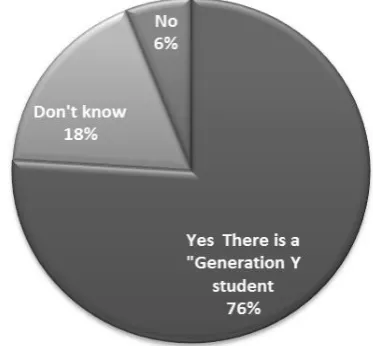
label. Of the Generation Y respondents, most
(75%) did consider that there is a Generation Y
student (see Figure 1). All of the respondents had
taken students in the past five years: 0-3 students
(42%), 4-6 students (29%), and over six students
(29%).
Figure 1. Respondents’ views on the existence of
a Generation Y student (n = 54).
In Table 1, a summary of the content
analysis and resulting themes is provided. This
numerical analysis quantifies the results by
reporting on the number of responses in each
theme. The corresponding percentages delineate
the percentage of responses in each subtheme.
This analysis provides a clear breakdown of the
type and frequency of responses in relation to the
Table 1
Themes Generated from Practice Educators’ Views of Generation Y Students
Subthemes
Total responses n = 79 Theme 1
Enthusiastic and articulate: 37%
Self-focused and easily bored: 30% Self-assured “go-getters” that
Self-assured, assertive, confident, team players: 33% are team players but easily bored.
Total: 100%
Total responses n = 54 Theme 2
Ambitious, quick learners: 46%
Eagerness to try new things: 26% Demanding, motivated learners.
More demanding with high expectations: 28%
Total: 100%
Total responses n = 57 Theme 3
Skilled with technology: 53%
Confident in evidence-based practice: 31%
Creative use of technology: 16% Technologically savvy
Total: 100%
Total responses n = 16 Theme 4
It is personality not generation: 25%
They are all individuals: 37%
Generation Y traits not seen: 38%
Total: 100%
Theme One: Self-assured “Go-Getters” that
are Team Players and Easily Bored
In this prominent theme, the respondents
considered that Generation Y students are
enthusiastic, go-getters, and team players that
have the potential to bring new ideas to the
profession. Students were seen as innovative,
adaptive to change, and willing to try new things.
The respondents also reported students as
articulate, assertive, and confident, who will both
defend and develop the profession. For example,
one respondent described Generation Y students
as having “energy, enthusiasm, and passion; an
ability to drive change” (OG 49), and another
respondent described them as “keen and
ambitious—keen to raise the profile of OT” (GY
9).
Conversely, some respondents reported the
students as over confident, easily bored, and
arrogant. Some concerns were expressed about
professional behaviors, including being casual
communicators, wearing inappropriate or casual
clothes, and only acting proactively in areas that
they deem important. For example, one
respondent wrote that the students are “easily
bored and can be a bit self-focused, i.e., more
focused on their own needs rather than on those of
the organization; more likely to ring in sick, etc.”
(OG 10). The Generation Y students also are seen
as having difficulty with time management and
understanding that the requirements of the service
override their own personal needs. This includes
managing part-time work with study, as students
need a higher income to survive.
The respondents reported that these
attributes could create an impression of being
self-entitled. The respondents also reported that the
students are energetic, innovative, ambitious, and
career driven, wanting promotion or leadership
roles early. Some concern was expressed that
they may have more than one career in their
lifetimes.
Theme Two: Demanding, Motivated Learners
In Theme Two, the respondents reported
that students were self-directed, motivated, fast
learners who were good at multi-tasking. Their
approach to learning was seen to indicate that they
wanted to be an expert too quickly, that they did
not want to slow down and learn gradually and
engage in deep learning. They were seen as
goal-orientated solution seekers with a preference for a
hands-on approach to learning. For example, one
respondent wrote that the students seem to “like
tasks that can be completed quickly and can be
seen” (OG 42); another viewed the students as “not always wanting to slow down and learn
gradually. Prefer to jump in and 'do' straight
away” (GY 40).
The respondents also commented on a
skimming approach to information gathering, a
lack of effective clinical reasoning, and poor
reflection. The eagerness for learning was
perceived as demanding, as they have high
expectations of both themselves and their
educators. The respondents interpreted this as a
lack of respect for their educators. For example,
one described them as “demanding, self-focused,
and don’t show enough respect to their teachers or
reported that students have difficulty accepting
criticism and feedback, and that they lack
attention to detail.
Theme Three: Technologically Savvy
This theme related to the students’
familiarity with and confidence in using
technology in various formats. The respondents
quoted various examples of the application of the
students’ skills with and knowledge of technology
in OT practice, such as data management,
documentation, use in therapy, IT systems, use in
training, database searching and research, assistive
technology, use for communication purposes,
sharing information, and networking. For
example, a respondent noted the students’ “greater
use of technology in both direct client care,
study/further learning, and networking” (OG 5).
In particular, a commonly reported
positive consequence of these technological skills
was the participation in research and the
application of evidence-based practice. Also,
many respondents commented that another benefit
of the students’ use of technology was
participation in worldwide collaborations and
creatively applying new technologies with clients.
For example, a respondent identified “Creativity.
An appreciation of technologies that could be
applied to assist patient care” (OG 27).
However, the respondents also commented
on associated challenges that arise from the
students’ use of technology, including a reliance
on Internet sources, as well as the inappropriate
use of mobile phones and Internet at work. For
example, “social etiquette relating to the use of
mobile phones, i.e., using when not an appropriate
time to do so” (OG 32). Further challenges
reported were the students’ poor documentation or
writing skills as a result of reliance on technology
for communication.
Theme Four: No Difference
While most of the respondents (76%)
indicated quantitatively that they think there is a
Generation Y student, a relatively small number of
qualitative comments were received indicating
that Generation Y traits have not been seen in
students, and that students are all individuals. For
example, one respondent noted that “students are
all individuals—some have some of the
characteristics you have described above, but not
all” (OG 8).
Some of the respondents reported that
characteristics, such as confidence, were more
attributed to students’ personality traits, rather
than a generational persona. For example,
I think individual personality traits and
characteristics are as diverse and prevalent in
Generation Y as in preceding generations. It is
very difficult to characterize any of these traits to
the generation. We have had some outstanding,
self-motivated, well-rounded and caring
individuals and some vice-versa (OG 49).
Discussion
This study contributes to our
understanding of the characteristics and
challenges of Generation Y OT students as
perceived by practice educators from one
Australian university. Overall, the findings are
strongly comparable with the Hills et al. (2012)
study conducted at another Australian university,
respondents in the Hills et al. study and 54 in the
current study). The majority of the participants
from both universities was female and from older
generations, with more Generation Y participants
in the Hills et al. study (32% compared to 22%).
The majority of the respondents from both
universities reported their professional
qualification as a degree in OT, having qualified
in Australia and having practiced more than 10
years.
Analysis of the quantitative and qualitative
data provides evidence of similarities in the
findings obtained from both universities. Similar
themes arose from the independent analyses
conducted at both sites. First, the majority of
practice educators at both universities (76% in the
Hills et al. [2012] study and 70% in the current
study) indicated quantitatively that they perceive
the existence of a Generation Y student. Again,
similar findings between the studies were found in
that a small number of the respondents reported
that, in their experience, there is no difference
between students and that characteristics that may
be found in individual students cannot be
generalized to a Generation Y cohort. Second, all
four themes that emerged from this current study
were reflected in the previous study. Practice
educators at both universities identified many
positive attributes and challenges of Generation Y
students.
While homogeneity is never present in any
generation, it is important to have an awareness of
the challenges that could be attributed to this
cohort of students, but it is also essential to view
each student as an individual and to adopt a
customized approach. Nevertheless, practice
educators viewed this younger population of
students as possessing a unique set of attributes
that in turn may contribute significantly to shaping
the future of OT practice. However, the extent to
which practice educators’ views have been
influenced by the media and popular culture,
especially as most were familiar with the
Generation Y stereotype, is unclear.
A prevalent positive characteristic reported
by practice educators at both universities was this
younger generation’s level of comfort with, and
expertise in, the use of technology. Gray (2008)
reported students’ skills in technology as a
particular strength of Generation Y. Information
technology is changing the world and its use is
becoming integral to the everyday occupations of
all age groups (Brown, 2011). In this current
study, students are reported to be proficient in its
daily use in the workplace in a range of relevant
practice tasks. The practice educators also
reported on students’ use of technology in areas
such as research and evidence-based practice.
Nonetheless, practice educators reported some
frustration with this younger group’s inappropriate
use of mobile technologies, especially their
mobile phones. It must be acknowledged that
methods of communication in society are
changing, and mobile phones have become
integrated into 21st-century living. Mobile
technologies may become an important aspect of
21st-century practice since there is some evidence
in literature of mobile technologies, including
Apple iPad applications, being used in
living programs (Hyzny, 2010). With this in
mind, practice educators may need to consider the
opportunities of integrating mobile phones and
technologies into daily practice, as they give the
opportunity to access immediate information
relevant to student learning. Furthermore, with
the use of blogging and social networking for
students in practice education, it seems a logical
progression to permit professionally appropriate
mobile technology use as an important aspect of
support for professional development (Wiid,
McCormack, Warren, Buckley, & Cahill, 2013).
In addition, authors Kashani, Burwash, and
Hamilton (2010) have suggested that new
technologies, including social media, are
opportunities to establish communities of practice
and further the profession. They also have the
potential, when used ethically, for inclusion in
client interventions, and therefore may be a
mechanism of innovation for occupational
therapists.
While the use of technology is a reported
skill of Generation Y, the participants in this study
raised concerns about poor documentation skills,
which may be a consequence of changing societal
expectations related to communication due to
technology use. This concern was supported by
the Hills et al. (2012) study. Gleeson (2007),
writing in a physical therapy journal, stated that
this generation needs to be taught how to write in
a professional manner, as less emphasis is placed
on accurate grammar and punctuation in social
media. Despite this, it is important for the
profession that OT documentation capture the full
scope and effectiveness of the profession;
therefore, documentation skills may need to be
targeted by university programs as an essential
competence requirement of practice (Clark, 2012).
The participants of the study also praised
Generation Y students for exploring the
effectiveness of interventions using
evidence-based practice, which adds to our understanding of
the attributes of this new generation of students.
This was a new finding from the original study
and may be due to a number of factors, including
a difference in content of university curriculums.
With information being more portable, accessible,
and interactive than ever before, the immediacy of
information via the Internet, used wisely and
judiciously, is a contemporary reality (Clark,
2012). This attribute, therefore, could be a
significant benefit to the profession if they apply
research evidence in practice. Gleeson (2007), on
the other hand, advocated that it is important to
balance the contributions that the new generation
of therapists bring in evidence-based decision
making, while acknowledging the foregoing
generations’ knowledge and wisdom developed
through work or clinical experience. In
contradiction to this positive attribute, practice
educators also criticized this generational groups’
over-reliance on Internet resources.
With regard to being career driven, the
practice educators reported that this generation
focuses on their career development, wanting
promotion early, and therefore they have a
penchant for professional development. This
concurs with the views of OT managers reported
by Hills et al. (2013) in their Australian survey.
identified that this generation’s need for rapid
career development may result in them ultimately
leaving the profession. This may indicate a need
to consider this thirst for advancement positively
by facilitating professional development
opportunities in practice education and in work.
To this end, Greene (2005) recommended
employers of nurses implement mentoring and
training programs for new graduates as a serious
attempt at staff retention rates. Clark (2012)
recommended that the OT profession needs to
have an “attitude adjustment” and not view
“power” as a dirty word. The profession needs
movers and shakers, leaders and advocates,
political voices, and innovators. According to the
practice educators’ views in this current study, this
generation, with their energy, enthusiasm, and
confidence, may have the characteristics to meet
this challenge. The challenge in managing this
generation on placement and in employment,
therefore, may be to accept their need for
self-development and support their progress while
providing them with the wisdom of older
generations in order to facilitate their passage
within the profession rather than career
progression elsewhere.
Nevertheless, concerns were identified in
both studies regarding the depth of students’
clinical reasoning and self-reflection, their poor
communication skills, skimming work, and
preparation for sessions. Christiansen, Jones,
Edwards, and Higgs (2008) suggested that the
development of reasoning in health professionals
is based on the “luck of the draw,” as not all
students benefit from educators who can make
their reasoning explicit for students. A substantial
body of literature exists to provide guidance on
the facilitation of clinical reasoning, including the
study by Mattingly and Hayes Fleming (1994);
however, it may be that these understandings and
strategies may need to be adapted for this new
generation’s learning and reasoning styles.
Further research is therefore warranted on the
optimum educational approaches for the
development of these essential practice skills and
how practice educators can ensure that students
complete work to the required depth. In the
meantime, university programs may need to focus
on students’ preparedness to self-reflect and
reason in practice and on effective feedback to
students on their performance.
Feedback is fundamental to the effective
education and supervision of students. At both
universities, practice educators reported that this
younger generation does not easily accept critical
feedback and this characteristic has been
documented in generational literature as well as in
allied health literature (Gleeson, 2007). In a
recent Australian study of four health science
disciplines, including OT, more than 55% of
students reported that feedback should be timelier
and there should be more of it (Strong et al.,
2012). Given that practice educators report that
this generation does not easily accept critical
feedback, further research is needed to build our
understanding of how best to accommodate their
feedback preferences while ensuring effective
learning on placement.
Both universities’ practice educators
an informal communication style and casual dress
code, being overly confident, being easily bored,
having inadequate time management skills,
experiencing difficulty with managing
commitments, and disliking mundane tasks.
These challenges have been reported as
Generation Y characteristics by generational
theorists and researchers such as Twenge and
Campbell (2008). Generational theorists would
advocate that these characteristics are due to their
“Generational personality,” which is comprised of
a different skill set and work style, as well as
different values, from that of the older
generations. Equally, though, these characteristics
could be attributed to the reality of youth and may
be a normal part of their life stage. Nonetheless,
one agreement between generational theorists and
non-generational supporters is that history has
shown us that we influence and are influenced by
societal, economic, and political changes. For this
reason, regardless of the Generational Y
stereotype, the future of the profession is
dependent on this younger generation, and this
current research suggests that they certainly have
the attributes of being self-confident, energetic,
and enthusiastic to expand the scope of the
profession—especially in regard to the use of
technology and evidence-based practice.
Limitations and Future Research
Recommendations
The results of this study should be
considered in light of certain limitations. The
sampling size was limited to educators on the
database of one university and some selection bias
may have been present. The study is limited to
providing findings on the perceptions of practice
educators, and their perceptions may be strongly
based on their experiences of specific students.
This study provides a snapshot only of the current
cohorts of students and practice educators at the
time the studies were conducted. Further research
into the feedback preferences, as well as effective
strategies for providing feedback and facilitation
of clinical reasoning, is recommended.
Conclusion
This research aimed to explore practice
educators’ views of Generation Y students by
replicating a study from another university.
Overall, the findings concur with the findings of
the original study by Hills et al. (2012), adding the
use of evidence-based practice to their
documented set of attributes. While some
challenges were identified, the identified strengths
far outweigh the reported challenges, and it is
believed that, similar to other new generations
entering the profession, Generation Y will benefit
from and uniquely shape the future of the
profession. The challenge may be for older
generations to mentor these future leaders of the
profession and to maximize their potential to
advance the profession through using
evidence-based practice combined with global connectivity
and entrepreneurial endeavors, so that the
traditional values of OT are retained for future
References
Arhin, A. O., & Cormier, E. (2007). Using deconstruction to educate Generation Y nursing
students. Journal of Nursing Education, 46(12), 562-567.
Baptiste, S. (2011). Occupational therapy: The foundations, the changes, the future.
Occupational Therapy Now, 13(1), 3-5.
Bennett, S., Maton, K., & Kervin, L. (2008). The ‘digital natives’ debate: A critical review of
the evidence. British Journal of Educational Technology, 39(5), 775-786.
http://dx.doi.org/10.1111/j.1467-8535.2007.00793.x
Borges, N. J., Manuel, R. S., Elam, C. L., & Jones, B. J. (2006). Comparing Millennial and
Generation X medical students at one medical school. Academic Medicine, 81(6),
571-576. http://dx.doi.org/10.1097/01.ACM.0000225222.38078.47
Boudreau, M. L. (2009). Is there a generation gap in occupational therapy? Occupational
Therapy Now, 11(2), 16-18.
Brown, T. (2011). Are you a digital native or a digital immigrant? Being client centred in the
digital era. British Journal of Occupational Therapy, 74(7), 313.
http://dx.doi.org/10.4276/030802211X13099513660992
Bryman, A. (2008). Social Research Methods (3rd ed.). Oxford, England: Oxford University
Press.
Bryman, A. (2012). Social Research Methods (4th ed.). Oxford, England: Oxford University
Press.
Burman, L. E., Reed, W. R., & Alm, J. (2010). A call for replication studies. Public Finance
Review, 38(6), 787-793. http://dx.doi.org/10.1177/1091142110385210
Christiansen, N., Jones, M. A., Edwards, I., & Higgs, J. (2008). Helping physiotherapy
students develop clinical reasoning capability. In J. Higgs, M. A. Jones, S. Loftus, &
N. Christensen (Eds.), Clinical reasoning in the health professions (pp. 389-396, 3rd
ed.). Sydney, Australia: Elsevier.
Clark, F. (2012). Beyond high definition: Attitude and evidence bringing OT in HD-3D.
American Journal of Occupational Therapy, 66(6), 644-651.
http://dx.doi.org/10.5014/ajot.2012.666002
Crampton, S. M., & Hodge, J. W. (2009). Generation Y: Uncharted territory. Journal of
Business and Economics Research, 7(4), 1-6.
Elam, C., Stratton, T., & Gibson, D. D. (2007). Welcoming a new generation to college: The
Gleeson, P. B. (2007). Understanding generational competence related to professionalism:
Misunderstandings that lead to a perception of unprofessional behavior. Journal of
Physical Therapy Education, 21(3), 23-28.
Gray, P. (2008). Placement Educators: Are you ready for the net-ready generation? British
Journal of Occupational Therapy, 71(5), 175.
http://dx.doi.org/10.1177/030802260807100501
Greene, J. (2005). What nurses want. Different generations. Different expectations. Hospitals
& Health Networks, 79(3), 34-38.
Hills, C., Ryan, S., Smith, D. R., & Warren-Forward, H. (2012). The impact of "Generation
Y" occupational therapy students on practice education. Australian Occupational
Therapy Journal, 59(2), 156-163.
http://dx.doi.org/10.1111/j.1440-1630.2011.00984.x
Hills, C., Ryan, S., Warren-Forward, H., & Smith, D. R. (2013). Managing "Generation Y"
occupational therapists: Optimising their potential. Australian Occupational Therapy
Journal, 60(4), 267-275. http://dx.doi.org/10.1111/1440-1630.12043
Howe, N., & Strauss, W. (2000). Millennial’s rising: The next great generation. New York,
NY: Vintage Books.
Hsieh, H. F., & Shannon, S. E. (2005). Three approaches to qualitative content analysis.
Qualitative Health Research, 15(9), 1277-1288.
http://dx.doi.org/10.1177/1049732305276687
Huntley, R. (2006). The world according to Y: Inside the new adult generation. Sydney,
Australia: Allen & Unwin.
Hyzny, J. (2010). Technology and iPod applications for occupational therapy consideration.
Communique, 2010(4), 1-13.
Jamieson, I., Kirk, R., & Andrew, C. (2013). Work-life balance: What Generation Y nurses
want. Nurse Leader, 11(3), 36-39. http://dx.doi.org/10.1016/j.mnl.2013.01.010
Kashani, R., Burwash, S., & Hamilton, A. (2010). To be or not to be on Facebook: That is the
question. Occupational Therapy Now, 12(6), 19-22.
Kelly, P. J. (2010). Age of entitlement: How does physician assistant education change to
accommodate the generation Y student? The Journal of Physician Assistant
Education, 21(4), 47-51. http://dx.doi.org/10.1097/01367895-201021040-00007
Kowalski, K. Z. (2010). Fieldwork issues. Bridging the gap: Multi generational fieldwork
Lavoie-Tremblay, M., Leclerc, E., Marchionni, C., & Drevniok, U. (2010). The needs and
expectations of Generation Y nurses in the workplace. Journal for Nurses in Staff
Development, 26(1), 2-8. http://dx.doi.org/10.1097/NND.0b013e3181a68951
Mackay, H. (2007). Advance Australia . . . Where? Sydney, Australia: Hachette.
Mannheim, K. (1952). Essays on the sociology of knowledge. London, England: Routledge &
Kegan Paul.
Mattingly, C., & Hayes Fleming, M. (1994). Clinical reasoning. Forms of inquiry in a
therapeutic practice. Philadelphia, PA: F. A. Davis.
Matuska, K. (2010). 3 generations of occupational therapy: One family's evolution. OT
Practice, 15(21), 8-12.
Nimon, S. (2007). Generation Y and higher education: The other Y2K. Journal of
Institutional Research, 13(1), 24-41.
Oblinger, D. G., & Oblinger, J. L. (Eds.). (2005). Educating the net generation. Washington,
DC: EDUCAUSE.
Pendergast, D. (2009). Generational theory and home economics: Future proofing the
profession. Family and Consumer Sciences Research Journal, 37(4), 504-552.
http://dx.doi.org/10.1177/1077727X09333186
Rickes, P. C. (2009). Make way for millennials! How today's students are shaping higher
education space. Planning for higher education, 37(2), 7-17.
Sandars, J., & Morrison, C. (2007). What is the Net Generation? The challenge for future
medical education. Medical Teacher, 29(2/3), 85-88.
http://dx.doi.org/10.1080/01421590601176380
Sternberg, J. (2012). "It's the end of the university as we know it (and I feel fine)": The
Generation Y student in higher education discourse. Higher Education Research &
Development, 31(4), 571-583. http://dx.doi.org/10.1080/07294360.2011.559193
Strong, J., Hughes, C., Wilson, W., Arnott, W., Isles, R., & Bennison, A. (2012). Perceptions
of feedback among undergraduate and postgraduate students of four health science
disciplines. Internet Journal of Allied Health Sciences & Practice, 10(4).
Tapscott, D. (2009). Grown up digital: How the Net Generation is changing your world. New
York, NY: McGraw-Hill.
Tashakkori, A., & Teddlie, C. (Eds.). (2003). Handbook of mixed methods in social and
Tashakkori, A., & Teddlie, C. (2008). Quality of inferences in mixed methods research:
Calling for an integrative framework. In M. M. Bergman (Ed.), Advances in mixed
methods research: Theories and applications (pp. 101-119). London: SAGE.
Tulgan, B., & Martin, C. A. (2001). Managing Generation Y: Global citizens born in the late
seventies and early eighties. Amherst, MA: HRD Press.
Twenge, J. M. (2006). Generation me: Why today's young Americans are more confident,
assertive, entitled--and more miserable than ever before. New York, NY: Free Press.
Twenge, J. M. (2009). Generational changes and their impact in the classroom: Teaching
Generation Me. Medical Education, 43(5), 398-405.
http://dx.doi.org/10.1111/j.1365-2923.2009.03310.x
Twenge, J. M., & Campbell, S. M. (2008). Generational differences in psychological traits
and their impact on the workplace. Journal of Managerial Psychology, 23(8),
862-877. http://dx.doi.org/10.1108/02683940810904367
Wiid, C., McCormack, C., Warren, A., Buckley, S., & Cahill, M. (2013). Public and private
blogging during placements: Perspectives of occupational therapy students.
International Journal of Therapy & Rehabilitation, 20(2), 79-85.
http://dx.doi.org/10.12968/ijtr.2013.20.2.79
Wilson, M., & Gerber, L. E. (2008). How generational theory can improve teaching:
Strategies for working with the Millennials. Currents in Teaching and Learning, 1(1),