Volume 2009, Article ID 191940,10pages doi:10.1155/2009/191940
Research Article
SynFace—Speech-Driven Facial Animation for
Virtual Speech-Reading Support
Giampiero Salvi, Jonas Beskow, Samer Al Moubayed, and Bj¨orn Granstr¨om
KTH, School of Computer Science and Communication, Deptarment for Speech, Music, and Hearing, Lindstedtsv¨agen 24, SE-100 44 Stockholm, Sweden
Correspondence should be addressed to Giampiero Salvi,[email protected]
Received 13 March 2009; Revised 23 July 2009; Accepted 23 September 2009
Recommended by G´erard Bailly
This paper describes SynFace, a supportive technology that aims at enhancing audio-based spoken communication in adverse acoustic conditions by providing the missing visual information in the form of an animated talking head. Firstly, we describe the system architecture, consisting of a 3D animated face model controlled from the speech input by a specifically optimised phonetic recogniser. Secondly, we report on speech intelligibility experiments with focus on multilinguality and robustness to audio quality. The system, already available for Swedish, English, and Flemish, was optimised for German and for Swedish wide-band speech quality available in TV, radio, and Internet communication. Lastly, the paper covers experiments with nonverbal motions driven from the speech signal. It is shown that turn-taking gestures can be used to affect the flow of human-human dialogues. We have focused specifically on two categories of cues that may be extracted from the acoustic signal: prominence/emphasis and interactional cues (turn-taking/back-channelling).
Copyright © 2009 Giampiero Salvi et al. This is an open access article distributed under the Creative Commons Attribution License, which permits unrestricted use, distribution, and reproduction in any medium, provided the original work is properly cited.
1. Introduction
For a hearing impaired person, and for a normal hearing person in adverse acoustic conditions, it is often necessary to be able to lip-read as well as hear the person they are talking with in order to communicate successfully. Apart from the lip movements, nonverbal visual information is also essential to keep a normal flow of conversation. Often, only the audio signal is available, for example, during telephone conversations or certain TV broadcasts. The idea behind SynFace is to try to recreate the visible articulation of the speaker, in the form of an animated talking head. The visual signal is presented in synchrony with the acoustic speech signal, which means that the user can benefit from the com-bined synchronised audiovisual perception of the original speech acoustics and the resynthesised visible articulation. When compared to video telephony solutions, SynFace has the distinct advantage that only the user on the receiving end needs special equipment—the speaker at the other end can use any telephone terminal and technology: fixed, mobilem, or IP-telephony.
Several methods have been proposed to drive the lip movements of an avatar from the acoustic speech signal with varying synthesis models and acoustic-to-visual maps.
Tamura et al. [1] used hidden Markov models (HMMs) that
are trained on parameters that represent both auditory and visual speech features. Similarly, Nakamura and Yamamoto
[2] propose to estimate the audio-visual joint probability
using HMMs. Wen et al. [3] extract the visual information
from the output of a formant analyser. Al Moubayed et al.
[4] map from the lattice output of a phonetic recogniser
to texture parameters using neural networks. Hofer et al.
[5] used trajectory hidden Markov models to predict visual
speech parameters from an observed sequence.
(a) (b)
Figure1: One of the talking head models used in SynFace, to the right running on a mobile device.
approach has proved to be more appropriate when the focus is on a real-life application, where additional requirements are to be met, for example, speaker independence, and
low-latency. Ohman and Salvi [6] compared two examples of
the two paradigms. A time-delayed neural network was used to estimate the face parameter trajectories from spectral features of speech, whereas an HMM phoneme recogniser was used to extract the phonetic information needed to drive the rule-based visual synthesis system. Although the results are dependent on our implementation, we observed that the first method could learn the general trend of the parameter trajectories, but was not accurate enough to provide useful visual information. The same is also observed
in Hofer et al. [5] and Massaro et al. [7]. (Although some
speech-reading support was obtained for isolated words from a single speaker in Massaro’s paper, this result did
not generalise well to extemporaneous speech from different
speakers (which is indeed one of the goals of SynFace).) The second method resulted in large errors in the trajectories in case of misrecognition, but provided, in general, more reliable results.
As for the actual talking head image synthesis, this can be produced using a variety of techniques, typically
based on manipulation of video images [8,9] parametrically
deformable models of the human face and/or speech organs
[10,11] or as a combination thereof [12]. In our system we
employ a deformable 3D model (seeSection 2) for reasons of
speed and simplicity.
This paper summarises the research that led to the development of the SynFace system and discusses a number of aspects involved in its development, along with novel experiments in multilinguality, dependency on the quality of the speech input, and extraction of nonverbal gestures from the acoustic signal.
The SynFace architecture is described for the first time
as a whole in Section 2; Section 3describes the additional
nonverbal gestures. Experiments in German and with
wide-band speech quality are described in Section 4. Finally,
Section 5discusses and concludes the paper.
2. SynFace Architecture
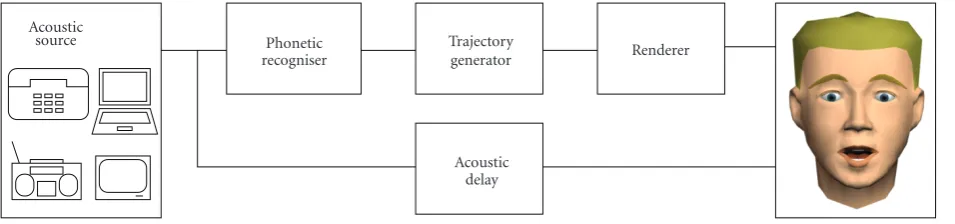
The processing chain in SynFace is illustrated in Figure 2.
SynFace employs a specially developed real-time phoneme recognition system, that delivers information regarding the speech signal-to-a speech animation module that renders the talking face on the computer screen using 3D graphics. The total delay from speech input to animation is only about 200 milliseconds, which is low enough not to disturb the flow
of conversation, (e.g., [13]). However, in order for face and
voice to be perceived coherently, the acoustic signal also has
to be delayed by the same amount [14].
2.1. Synthesis. The talking head model depicted in Figures
1 and2 includes face, tongue, and teeth, and is based on
static 3D-wireframe meshes that are deformed using direct parametrisation by applying weighted transformations to their vertices according to principles first introduced by
Parke [15]. These transformations are in turn described by
high-level articulatory parameters [16], such as jaw opening,
lip rounding and bilabial occlusion. The talking head model is lightweight enough to allow it to run at interactive rates
on a mobile device [17]. A real-time articulatory control
model is responsible for driving the talking head’s lip, jaw and tongue movements based on the phonetic input derived by the speech recogniser (see below) as well as other facial motion (nodding, eyebrow movements, gaze, etc.) further
described inSection 3.
The control model is based on the rule-based look-ahead
model proposed by Beskow [16], but modified for
low-latency operation. In this model, each phoneme is assigned a target vector of articulatory control parameters. To allow the targets to be influenced by coarticulation, the target vector may be under-specified, that is, some parameter values can be left undefined. If a target is left undefined, the value is inferred from context using interpolation, followed by smoothing of the resulting trajectory. As an
example, consider the lip rounding parameter in aV1CCCV2
utterance whereV1is an unrounded vowel,CCCrepresents
a consonant cluster andV2 is a rounded vowel. According
to the rules set, lip rounding would be unspecified for the consonants, leaving these targets to be determined from the vowel context by linear interpolation from the unrounded
V1, across the consonant cluster, to the roundedV2.
To allow for low-latency operation, the look-ahead model has been modified by limiting the look-ahead time window (presently a value of 100 milliseconds is used) which means that no anticipatory coarticulation beyond this window will occur.
For comparison, the control model has also been
eval-uated against several data-driven schemes [18]. In these
experiments, different models are implemented and trained
to reproduce the articulatory patterns of a real speaker, based on a corpus of optical measurements. Two of the models, (Cohen-Massaro and Ohman) are based on coar-ticulation models from speech production theory and one
uses artificial neural networks (ANNs). The different models
Acoustic
source Phonetic
recogniser
Trajectory
generator Renderer
Acoustic delay
Figure2: Illustration of the signal flow in the SynFace system.
Table1: Summary of intelligibility test of visual speech synthesis control models, from Beskow [18].
Control model % keywords correct
Audio only 62.7
Cohen-Massaro 74.8
Ohman 75.3
ANN 72.8
Rule-based 81.1
the rule-based model as well as an audio-alone condition. In order to only evaluate the control models, and not the recognition, the phonetic input to all models was generated
using forced alignment Sjolander [19]. Also, since the intent
was a general comparison of the relative merits of the control models, that is, not only for real time applications, no low-latency constraints were applied in this evaluation. This means that all models had access to all segments in each
utterance, but in practise the models differ in their use of
look-ahead information. The “Cohen-Massaro” model by design always uses all segments; the “Ohman” model looks ahead until the next upcoming vowel; while the ANN model, which was specially conceived for low-latency operation, used a constant look-ahead of 50 milliseconds.
Table 1 summarises the results; all models give sig-nificantly increased speech intelligibility over the audio-alone case, with the rule-based model yielding the highest intelligibility score. While the data-driven models seem to provide movements that are in some sense more naturalistic, the intelligibility is the single most important aspect of the animation in SynFace, which is why the rule-based model is used in the system.
2.2. Phoneme Recognition. The constraints imposed on the phoneme recogniser (PR) for this application are speaker independence, task independence and low latency. However, the demands on the PR performance are limited by the fact that some phonemes map to the same visemes (targets) for synthesis.
The phoneme recogniser used in SynFace, is based on a hybrid of recurrent neural networks (RNNs) and hidden
Markov models (HMMs) [20]. Mel frequency cepstral
coefficients (MFCCs) are extracted on 10 milliseconds spaced
frames of speech samples. The neural networks are used
to estimate the posterior probabilities of each phonetic
class given a number of feature vectors in time [21]. The
networks are trained using Back Propagation through time
[22] with a cross-entropy error measure [23]. This ensures an
approximately linear relation between the output activities of the RNN and the posterior probabilities of each phonetic
class, given the input observation. As in Strom [24], a
mixture of time delayed and recurrent connections is used. All the delays are positive, ensuring that no future context is used and thus reducing the total latency of the system at the cost of slightly lower recognition accuracy.
The posterior probabilities estimated by the RNN are fed into an HMM with the main purpose of smoothing the results. The model defines a simple loop of phonemes, where each phoneme is a left-to-right three-state HMM. A slightly modified Viterbi decoder is used to allow low-latency
decoding. Differently from the RNN model, the decoder
makes use of some future context (look-ahead). The amount of look-ahead is one of the parameters that can be controlled in the algorithm.
During the Synface project (IST-2001-33327), the recog-niser was trained and evaluated on the SpeechDat recordings
[25] for three languages: Swedish, English and Flemish.
In Salvi [20, 26], the effect of limiting the look-ahead in
the Viterbi decoder was studied. No improvements in the results were observed for look-ahead lengths greater than 100 milliseconds. In the SynFace system, the look-ahead length was further limited to 30 milliseconds, resulting in a relative 4% drop in performance in terms of correct frames.
3. Nonverbal Gestures
While enhancing speech perception through visible artic-ulation has been the main focus of SynFace, recent work has been aimed at improving the overall communicative experience through nonarticulatory facial movements. It is well known that a large part of information transfer in face-to-face interaction is nonverbal, and it has been
shown that speech intelligibility is also affected by nonverbal
actions such as head movements [27]. However, while there
of nonverbal movements that have found to play important roles in communication and that also may be driven by acoustic features that can be reliably estimated from speech. The first category is speech-related movements linked to emphasis or prominence, the second category is gestures related to interaction control in a dialogue situation. For the time being, we have not focused on expressiveness of the visual synthesis in terms of emotional content as in Cao et al.
[28].
Hadar et al. [29] found that increased head movement
activity co-occurs with speech, and Beskow et al. [30] found,
by analysing facial motion for words in focal and nonfocal
position, thatprominenceis manifested visually inallparts
of the face, and that the particular realisation chosen is dependent on the context. In particular these results suggest
that there is not oneway of signalling prominence visually
but it is likely that several cues are used interchangeably or in combination. One issue that we are currently working on is how to reliably extract prominence based on the audio signal alone, with the goal of driving movements in the talking head. In a recent experiment Al Moubayed et al.
[4] it was shown that adding small eyebrow movements
on syllables with large pitch movements, resulted in a significant intelligibility improvement over the articulation-only condition, but less so than a condition where manually labelled prominence was used to drive the gestures.
When people are engaged in face-to-face conversation, they take a great number of things into consideration in order
to manage the flow of the interaction. We call thisinteraction
control—the term is wider than turn-taking and does not presuppose the existence of “turns.” Examples of features that play a part in interaction control include auditory cues such as pitch, intensity, pause and disfluency, hyper-articulation; visual cues such as gaze, facial expressions,
gestures, and mouth movements (constituting theregulators
category above) and cues like pragmatic, semantic, and syntactic completeness.
In order to investigate the effect of visual interaction
control cues in a speech driven virtual talking head, we conducted an experiment with human-human interaction over a voice connection supplemented by the SynFace talking head at each end, where visual interaction control gestures were automatically controlled from the audio stream. The goal of the experiment was to find out to what degree subjects
were affected by the interaction control cues. In what follows
is a summary, for full details see Edlund and Beskow [31].
In the experiment, a bare minimum of gestures was implemented that can be said to represent a stylised version
of the gaze behaviours observed by Kendon [32] and recent
gaze-tracking experiments [33].
(i) A turn-taking/keeping gesture, where the avatar makes a slight turn of the head to the side in combination with shifting the gaze away a little, signalling a wish to take or keep the floor.
(ii) A turn-yielding/listening gesture, where the avatar looks straight forward, at the subject, with slightly raised eyebrows, signalling attention and willingness to listen.
(iii) A feedback/agreement gesture, consisting of a small nod. In the experiment described here, this gesture is never used alone, but is added at the end of the listening gesture to add to its responsiveness. In the following, simply assume it is present in the turn yielding/listening gesture.
The audio-signal from each participant was processed by a voice activity detector (VAD). The VAD reports a change to the SPEECH state each time it detected a certain number of consecutive speech frames whilst in the SILENCE state, and vice-versa. Based on these state transitions, gestures were triggered in the respective SynFace avatar.
To be able to assess the degree to which subjects were influenced by the gestures, the avatar on each side could work in one of two modes: ACTIVE or PASSIVE. In the ACTIVE mode, gestures were chosen as to encourage one party to take and keep turns, while PASSIVE mode implied the opposite—to discourage the user to speak. In order to collect balanced data of the two participants behaviour, the modes were shifted regularly (every 10 turns), but they were always complementary—ACTIVE on one side and PASSIVE on the other. The number 10 was chosen to be small enough to make sure that both parties got exposed to both modes several times during the test (10 minutes), but large enough to allow subjects to accommodate to the situation.
The subjects were placed in separate rooms and equipped with head-sets connected to a Voice-over-IP call. On each side, the call is enhanced by the SynFace animated talking head representing the other participant, providing real-time lip-synchronised visual speech animation. The task was to speak about any topic freely for around ten minutes. There were 12 participants making up 6 pairs. None of the participants had any previous knowledge of the experiment setup.
The results were analysed by counting the percentage of times that the turn changed when a speaker paused. The percentage of all utterances followed by a turn change is larger under the PASSIVE condition than under the ACTIVE condition for each participant without exception.
The difference is significant (P < .01), which shows that
subjects were consistently affected by the interaction control
cues in the talking head. As postinterviews revealed that most subjects never even noticed the gestures consciously, and no subject connected them directly to interaction control, this result shows that it is possible to unobtrusively influence the interaction behaviour of two interlocutors in a given direction—that is to make a person take the floor more or less often—by way of facial gestures in an animated talking head in the role of an avatar.
4. Evaluation Experiments
In the SynFace application, speech intelligibility enhance-ment is the main function. Speech reading and audio-visual speech intelligibility have been extensively studied by many researchers, for natural speech as well as for visual speech synthesis systems driven by text or phonetically transcribed
input. Massaro et al. [7], for example, evaluated
system on isolated words. To date, however, we have not seen any published results on speaker independent speech driven facial animation systems, where the intelligibility enhancement (i.e., audiovisual compared to audio-only condition) has been investigated. Below, we report on two experiments were audiovisual intelligibility of SynFace has
been evaluated for different configurations and languages.
The framework adopted in SynFace allows for evaluation
of the system at different points in the signal chain shown in
Figure 2. We can measure accuracy
(i) at the phonetic level, by measuring the phoneme (viseme) accuracy of the speech recogniser,
(ii) at the face parameter level, by computing the distance between the face parameters generated by the system and the optimal trajectories, for example, trajectories obtained from phonetically annotated speech, (iii) at the intelligibility level, by performing listening
tests with hearing impaired subjects, or with normal hearing subjects and a degraded acoustic signal.
The advantage of the first two methods is simplicity. The computations can be performed automatically, if we assume that a good reference is available (phonetically annotated speech). The third method, however, is the most reliable
because it tests the effects of the system as a whole.
Evaluating the Phoneme Recogniser. Measuring the perfor-mance at the phonetic level can be done in at least two ways: By measuring the percentage of frames that are correctly classified, or by computing the Levenshtein (edit) distance
Levenshtein [34] between the string of phonemes output
by the recogniser and the reference transcription. The first method does not explicitly consider the stability of the results in time and, therefore, may overestimate the perfor-mance of a recogniser that produces many short insertions. These insertions, however, do not necessarily result in a degradation of the face parameter trajectories, because the articulatory model, the face parameter generation is based on, often acts as a low-pass filter. On the other hand, the Levenshtein distance does not consider the time alignment of the two sequences, and may result in misleading evaluation in the case that two phonetic subsequences that are not co-occurring in time are aligned by mistake. To make the latter measure homogeneous with the correct frames %, we express
it in terms of accuracy, defined as (1−l/n)×100, wherelis
Levenshtein (Edit) distance andnthe length of the reference
transcription.
Intelligibility Tests. Evaluating the intelligibility is performed by listening tests with a number of hearing impaired or normal hearing subjects. Using normal hearing subject and distorting the audio signal has been shown to be a viable
simulation of perception by hearing impaired [35,36]. The
speech material is presented to the subjects in different
conditions. These may includeaudio alone,audio and natural
face,audio and synthetic face. In the last case, the synthetic
face may be driven by different methods (e.g., different
versions of the PR that we want to compare). It may also
−2
−1 0 1
Delta
S
R
T
(dB)
50 55 60 65 70
Correct frames (%)
SRT versus % correct frames (5 subjects)
Figure 3: Delta SRT versus correct frames % for three different recognisers (correlationr= −0.89) on a 5-subject listening test.
be driven by carefully obtained annotations of the speech
material, if the aim is to test the effects of the visual synthesis
models alone.
Two listening test methods have been used in the current experiments. The first method is based on a set of carefully designed short sentences containing a number of key-words. The subject’s task is to repeat the sentences, and intelligibility is measured in terms of correctly recognised key-words. In case of normal hearing subjects, the acoustic signal may be degraded by noise in order to simulate hearing impairment. In the following, we will refer to this methodology as “key-word” test.
The second methodology Hagerman and Kinnefors [37]
relies on the adaptive use of noise to assess the level of intelligibility. Lists of 5 words are presented to the subjects in varying noise conditions. The signal-to-noise ratio (SNR dB) is adjusted during the test until the subject is able to correctly report about 50% of the words. This level of noise is referred to as the Speech Reception Threshold (SRT dB) and indicates the amount of noise the subject is able to tolerate before the intelligibility drops below 50%. Lower values of SRT correspond to better performance (the intelligibility is more robust to noise). We will refer to this methodology as “SRT” test.
Table2: Number of connections in the RNN and correct frames % of the SynFace RNN phonetic classifiers.
Language Connections Correct frames %
English 184,848 46.1
Flemish 186,853 51.0
German 541,430 61.0
Swedish 541,250 54.2
These include the newly developed German recogniser, wide-versus narrow-band speech recognition experiments and cross-language tests. All experiments are performed with the real-time, low-latency implementation of the system, that is, the phoneme recogniser uses 30 milliseconds look-ahead length, and the total delay of the system in the intelligibility tests is 200 milliseconds.
4.1. SynFace in German. To extend SynFace to German, a new recogniser was trained on the SpeechDat German recordings. These consist of around 200 hours of telephone speech spoken by 4000 speakers. As for the previous languages, the HTK-based RefRec recogniser Lindberg et al.
[38] was trained and used to derive phonetic transcriptions
of the corpus. Whereas the recogniser for Swedish, English and Flemish, was trained exclusively on the phonetically rich sentences, the full training set, also containing isolated words, digits, and spellings, was used to train the German
models.Table 2shows the results in terms of correct frames
% for the different languages. Note however that these results
are not directly comparable because they are obtained on
different test sets.
The same synthesis rules used for Swedish are applied to the German system, simply by mapping the phoneme (viseme) inventory of the two languages.
To evaluate the German version of the SynFace system, a small “key-word” intelligibility test was performed. A set of twenty short (4–6 words) sentences from the G¨ottinger
satsztest set [39], spoken by a male native German speaker,
were presented to a group of six normal hearing German listeners. The audio presented to the subjects was degraded in
order to avoid ceiling effects, using a 3-channel noise excited
vocoder shannon et al. [40]. This type of signal degradation
has been used in the previous audio-visual intelligibility
experiments Siciliano et al. [41] and can be viewed as a
way of simulating the information reduction experienced by cochlear implant patients. Clean speech was used to drive SynFace. 10 sentences were presented with audio-only and 10 sentences were presented with SynFace support. Subjects were presented with four training sentences before the test started. The listeners were instructed to watch the screen and write down what they perceived.
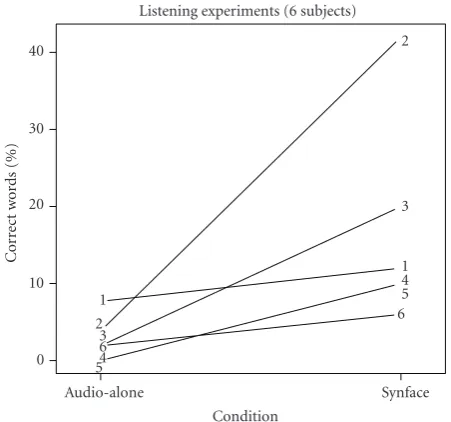
Figure 4 summarises the results for each subject. The mean score (% correctly recognised key-words) for the audio only condition was extremely low (2.5%). With SynFace support, a mean score of 16.7% was obtained. While there was a large intersubject variability, subjects consistently showed to take advantage of the use of SynFace. An ANOVA
0 10 20 30 40
Cor
re
ct
w
ord
s
(%
)
Audio-alone Synface
Condition
Listening experiments (6 subjects) 2
3
1 4 5 6 1
2 3 6 4 5
Figure 4: Subjective evaluation results for German version of SynFace (% correct word recognition).
analysis shows significant differences (P < .01) between the
audio-alone and SynFace conditions.
4.2. Narrow- Versus Wide-Band PR. In the Hearing at Home project, SynFace is employed in a range of applications that
include speech signals that are streamed through different
media (Telephone, Internet, TV). The signal is often of a higher quality compared to the land-line telephone settings. This opens the possibility for improvements in the signal processing part of the system.
In order to take advantage of the available audio band in these applications, the SynFace recogniser was trained
on wide-band speech data from the SpeeCon corpus [42].
SpeeCon contains recordings in several languages and
con-ditions. Only recordings in office settings of Swedish were
chosen. The corpus contains word level transcriptions, and annotations for speaker noise, background noise, and filled pauses. As in the SpeechDat training, the silence at the boundaries of every utterance was reduced, in order to improve balance between the number of frames for the
silence class and for any other phonetic class. Differently
from the SpeechDat training, NALIGN Sjolander [19] was
used in order to create time aligned phonetic transcriptions of the corpus based on the orthographic transcriptions.
The bank of filters, used to compute the MFCCs that are input to the recogniser, was defined in a way that the filters between 0 and 4 kHz coincide with the narrow-band filter-bank definition. Additional filters are added for the upper
4 kHz frequencies offered by the wide-band signal.
Table 3shows the results for the network trained on the SpeeCon database. The results obtained on the SpeechDat material are also given for comparison. Note, however, that these results cannot be compared directly because the tests
Table 3: Comparison between the SpeechDat telephone quality (TF), SpeeCon narrow-band (NB) and SpeeCon wide-band (WB) recognisers. Results are given in terms of correct frames % for phonemes (ph) and visemes (vi), and accuracy.
Database SpeechDat SpeeCon
Data size (ca. hours) 200 40
Speakers (#) 5000 550
Speech quality TF NB WB
Sampling (kHz) 8 8 16
Correct frames (% ph) 54.2 65.2 68.7 Correct frames (% vi) 59.3 69.0 74.5 Accuracy (% ph) 56.5 62.2 63.2
−11
−10
−9
−8
−7
SR
T
(dB)
Audio-alone Narrow-band Wide-band Condition
Listening experiments (5 subjects) 2
2
2 5
5 5
1
1 4
3
3
3 1
4
4
Figure 5: Speech Reception Threshold (SRT dB) for different conditions and subjects.
In order to have a more controlled comparison between the narrow- and the wide-band networks for Swedish, a network was trained on a downsampled (8 kHz) version of
the same SpeeCon database. The middle column ofTable 3
shows the results for the networks trained and tested on the narrow-band (downsampled) version of the SpeeCon database. Results are shown in terms of % of correct frames for phonemes, visemes, and phoneme accuracy.
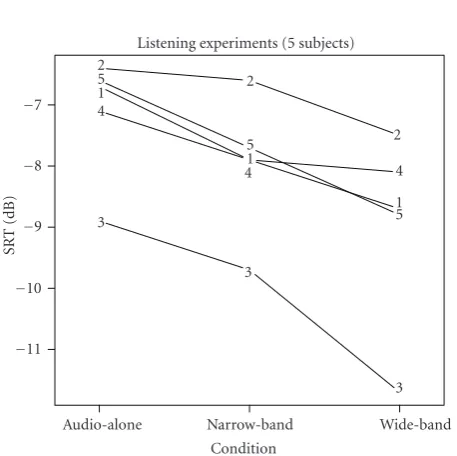
Finally, a small-scale “SRT” intelligibility experiment, was performed in order to confirm the improvement in performance that we see in the wide-band case. The
con-ditions include audio alone and SynFace driven by different
versions of the recogniser. The tests were carried out using five normal hearing subjects. The stimuli consisted of lists of 5 words randomly selected from a set of 50 words. A training session was performed before the real test to control
the learning effect.Figure 5shows the SRT levels obtained
in the different conditions, where each line corresponds
to a subject. An ANOVA analysis and successive multiple comparison analysis confirm that there is a significant
b a
c
d e
b c d
f g
(a)
b a
c
d
e
b c
d e p
t
(b)
p(b) p(c) p(d) p(e)
p(b) p(c) p(d)
p(f) p(g)
(c)
Figure6: Structure of the language models mappers. (a) Phonetic mapper: only identical phonemes are matched between the two languages, (b) best match mapper: the phoneme are blindly matched in a way that recognition results are maximised, (c) linear regression mapper: posterior probabilities for the target language are estimated from the outputs of the phonetic recogniser.
Table 4: correct frames % for different languages (columns) recognised by different models (rows). The languages are: German (de), English (en), Flemish (fl) and Swedish (sv). Numbers in parentheses are the % of correct frames for perfect recognition, given the mismatch in phonetic inventory across languages.
de sv fl en
de 61.0 (100) 30.3 (82.6) 27.1 (73.5) 26.2 (71.6) sv 31.5 (86.2) 54.2 (100) 26.3 (72.1) 23.5 (74.2) fl 34.2 (85.7) 31.6 (77.9) 51.0 (100) 26.9 (69.8) en 24.5 (74.6) 23.7 (72.3) 21.5 (66.8) 46.1 (100)
decrease (improvement) of SRT (P < .001) for the
wide-band recogniser over the narrow-wide-band trained network and the audio-alone condition.
4.3. Multilinguality. SynFace is currently available in Swedish, German, Flemish and English. In order to investigate the possibility of using the current recognition models on new languages, we performed cross-language evaluation tests.
Each language has its unique phonetic inventory. In order to map between the inventory of the recognition model and that of the target language, we considered three
different paradigms illustrated inFigure 6. In the first case
(Figure 6(a)) we relay on perfect matching of the phonemes. This is a very strict evaluation criterion because it does not take into account the acoustic and visual similarities between
phonemes in different languages that do not share the same
phonetic code.
0 10 20 30 40 50 60
C
o
rr
ec
t
fra
m
e
ra
te
(%
)
German PR Flemish PR English PR
Phoneme mapper Best match mapper
Linear regression (NN) Swedish PR
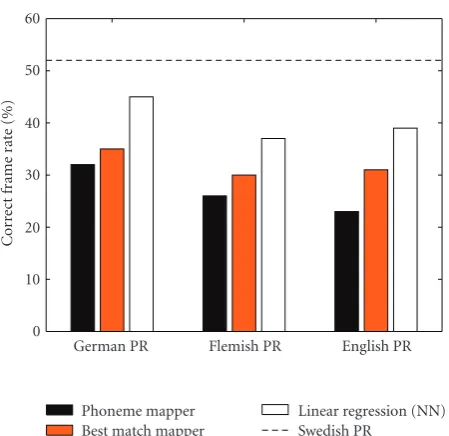
Figure7: correct frames % for the three mappers when the target language is Swedish. The dashed line represents the results obtained with the Swedish phoneme recogniser (language matching case).
The second mapping criterion depicted inFigure 6(b),
considers as correct the association between model and target phonemes that was most frequently adopted by the recognition models on that particular target language. If we consider all possible maps between the set of model phonemes and the set of target phonemes, this corresponds to an upper bound of the results. Compared to the results inTable 4, this evaluation method gives about 10% increased correct frames in average. In this case, there is no guarantee that the chosen mapping bares phonetic significance.
The previous mappings were introduced to allow for simple cross-language evaluation of the phonetic recognisers.
Figure 6(c)shows a mapping method that is more realistic in terms of system performance. In this case we do not map between two discrete sets of phonemes, but, rather, between the posterior probabilities of the first set and the second set. This way, we can, in principle, obtain better results than the above upper bound, and possibly even better results than for the original language. In the experiments the probability mapping was performed by a one-layer neural
network that implements linear regression. Figure 7shows
the results when the target language is Swedish, and the phoneme recognition (PR) models were trained on German, English and Flemish. Only 30 minutes of an independent training set were used to train the linear regression mapper. The performance of this mapper is above the best match results, and comes close to the Swedish PR results (dashed line in the figure) for the German PR models.
5. Conclusions
The purpose of SynFace is to enhance spoken communi-cation for the hearing impaired, rather than solving the acoustic-to-visual speech mapping per se. The methods
employed here are, therefore, tailored to achieving this goal
in the most effective way. Beskow [18] showed that, whereas
data-driven visual synthesis resulted in more realistic lip movements, the rule-based system enhanced the intelligi-bility. Similarly, mapping from the acoustic speech directly into visual parameters is an appealing research problem. However, when the ambition is to develop a tool that can be applied in real-life conditions, it is necessary to constrain the problem. The system discussed in this paper
(i) works in real time and with low latency, allowing real-istic conditions for a natural spoken communication, (ii) is light-weight and can be run on standard
commer-cially available hardware,
(iii) is speaker independent, allowing the user to commu-nicate with any person,
(iv) is being developed for different languages (currently,
Swedish, English, Flemish, and German are avail-able),
(v) is optimised for different acoustic conditions, ranging
from telephone speech quality to wide-band speech available in, for example, Internet communications and radio/TV broadcasting,
(vi) is being extensively evaluated in realistic settings, with hearing impaired subjects or by simulating hearing impairment.
Even though speech intelligibility is the focus of the SynFace system, extra-linguistic aspects of speech commu-nication have also been described in the paper. Modelling nonverbal gestures proved to be a viable way of enhancing the turn-taking mechanism in telephone communication.
Future work will be aimed at increasing the generality of the methods, for example, by studying ways to achieve language independence or by simplifying the process of optimising the system to a new language, based on the preliminary results shown in this paper. Reliably extracting extra-linguistic information, as well as synthesis and evalu-ation of nonverbal gestures will also be the focus of future work.
Acknowledgments
The work presented here was funded in part by European Commission Project IST-045089 (Hearing at Home) and Swedish Research Council Project 621-2005-3488 (Mod-elling multimodal communicative signal and expressive speech for embodied conversational agents).
References
[1] M. Tamura, T. Masuko, T. Kobayashi, and K. Tokuda, “Visual speech synthesis based on parameter generation from hmm: speech-driven and text-and-speechdriven approaches,” in Pro-ceedings of the Auditory-Visual Speech Processing (AVSP ’98), pp. 221–226, 1998.
Systems for Signal, Image, and Video Technology, vol. 27, no. 1-2, pp. 119–126, 2001.
[3] Z. Wen, P. Hong, and T. Huang, “Real time speech driven facial animation using formant analysis,” inProceedings of the IEEE International Conference on Multimedia and Expo (ICME ’01), pp. 817–820, 2001.
[4] S. Al Moubayed, M. De Smet, and H. Van Hamme, “Lip synchronization:from phone lattice to PCA eigenprojections using neural networks,” inProceedings of the Biennial Con-ference of the International Speech Communication Association (Interspeech ’08), Brisbane, Australia, 2008.
[5] G. Hofer, J. Yamagishi, and H. Shimodaira, “Speech-driven lip motion generation with a trajectory hmm,” inProceedings of the Biennial Conference of the International Speech Communi-cation Association (Interspeech ’08), Brisbane, Australia, 2008. [6] T. Ohman and G. Salvi, “Using HMMs and ANNs for mapping
acoustic to visual speech,”TMH-QPSR, vol. 40, no. 1-2, pp. 45–50, 1999.
[7] D. Massaro, J. Beskow, M. Cohen, C. Fry, and T. Rodgriguez, “Picture my voice: audio to visual speech synthesis using artificial neural networks,” inProceedings of the International Conference on Auditory-Visual Speech Processing (ISCA ’99), 1999.
[8] T. Ezzat, G. Geiger, and T. Poggio, “Trainable videorealistic speech animation,” in Proceedings of the 29th Annual Con-ference on Computer Graphics and Interactive Techniques, pp. 388–398, ACM, New York, NY, USA, 2002.
[9] K. Liu and J. Ostermann, “Realistic facial animation system for interactive services,” inProceedings of the Biennial Conference of the International Speech Communication Association (Inter-speech ’08), Brisbane, Australia, 2008.
[10] M. Cohen and D. Massaro, “Models and techniques in computer animation,” inModeling Coarticulation in Synthetic Visual Speech, vol. 92, Springer, Tokyo, Japan, 1993.
[11] M. ˇZelezn´y, Z. Kr ˇnoul, P. C´ısaˇr, and J. Matouˇsek, “Design, implementation and evaluation of the Czech realistic audio-visual speech synthesis,”Signal Processing, vol. 86, no. 12, pp. 3657–3673, 2006.
[12] B. J. Theobald, J. A. Bangham, I. A. Matthews, and G. G. Cawley, “Near-videorealistic synthetic talking faces: imple-mentation and evaluation,”Speech Communication, vol. 44, no. 1–4, pp. 127–140, 2004.
[13] N. Kitawaki and K. Itoh, “Pure delay effects on speech quality in telecommunications,” IEEE Journal on Selected Areas in Communications, vol. 9, no. 4, pp. 586–593, 1991.
[14] M. McGrath and Q. Summerfield, “Intermodal timing rela-tions and audio-visual speech recognition by normal-hearing adults,”Journal of the Acoustical Society of America, vol. 77, no. 2, pp. 678–685, 1985.
[15] F. I. Parke, “Parameterized models for facial animation,”IEEE Computer Graphics and Applications, vol. 2, no. 9, pp. 61–68, 1982.
[16] J. Beskow, “Rule-based visual speech synthesis,” inProceedings of the European Conference on Speech Communication and Technology (Eurospeech ’95), pp. 299–302, Madrid, Spain, 1995.
[17] T. Gjermani,Integration of an animated talking face model in a portable device for multimodal speech synthesis, M.S. thesis, Department for Speech, Music and Hearing, KTH, School of Computer Science and Communication, Stockholm, Sweden, 2008.
[18] J. Beskow, “Trainable articulatory control models for visual speech synthesis,”International Journal of Speech Technology, vol. 7, no. 4, pp. 335–349, 2004.
[19] K. Sjolander, “An HMM-based system for automatic segmen-tation and alignment of speech,” inProceedings of Fonetik, pp. 93–96, Ume˚a, Sweden, 2003.
[20] G. Salvi, “Truncation error and dynamics in very low latency phonetic recognition,” inProceedings of the Non Linear Speech Processing (NOLISP ’03), Le Croisic, France, 2003.
[21] A. J. Robinson, “Application of recurrent nets to phone probability estimation,”IEEE Transactions on Neural Networks, vol. 5, no. 2, pp. 298–305, 1994.
[22] P. J. Werbos, “Backpropagation through time: what it does and how to do it,”Proceedings of the IEEE, vol. 78, no. 10, pp. 1550– 1560, 1990.
[23] H. Bourlard and N. Morgan, “Continuous speech recognition by connectionist statistical methods,” IEEE Transactions on Neural Networks, vol. 4, no. 6, pp. 893–909, 1993.
[24] N. Strom, “Development of a recurrent time-delay neural net speech recognition system,”TMH-QPSR, vol. 26, no. 4, pp. 1– 15, 1992.
[25] K. Elenius, “Experiences from collecting two Swedish tele-phone speech databases,” International Journal of Speech Technology, vol. 3, no. 2, pp. 119–127, 2000.
[26] G. Salvi, “Dynamic behaviour of connectionist speech recog-nition with strong latency constraints,”Speech Communica-tion, vol. 48, no. 7, pp. 802–818, 2006.
[27] K. G. Munhall, J. A. Jones, D. E. Callan, T. Kuratate, and E. Vatikiotis-Bateson, “Visual prosody and speech intelligibility: head movement improves auditory speech perception,” Psy-chological Science, vol. 15, no. 2, pp. 133–137, 2004.
[28] Y. Cao, W. C. Tien, P. Faloutsos, and F. Pighin, “Expressive speech-driven facial animation,”ACM Transactions on Graph-ics, vol. 24, no. 4, pp. 1283–1302, 2005.
[29] U. Hadar, T. J. Steiner, E. C. Grant, and F. C. Rose, “Kinematics of head movements accompanying speech during conversa-tion,”Human Movement Science, vol. 2, no. 1-2, pp. 35–46, 1983.
[30] J. Beskow, B. Granstr¨om, and D. House, “Analysis and synthesis of multimodal verbal and non-verbal interaction for animated interface agents,” in Proceedings of the Inter-national Workshop on Verbal and Nonverbal Communication Behaviours, vol. 4775 ofLecture Notes in Computer Science, pp. 250–263, 2007.
[31] J. Edlund and J. Beskow, “Pushy versus meek-using avatars to in uence turn-taking behaviour,” in Proceedings of the Biennial Conference of the International Speech Communication Association (Interspeech ’07), Antwerp, Belgium, 2007. [32] A. Kendon, “Some functions of gaze-direction in social
interaction,”Acta Psychologica, vol. 26, no. 1, pp. 22–63, 1967. [33] V. Hugot,Eye gaze analysis in human-human commuication, M.S. thesis, Department for Speech, Music and Hearing, KTH, School of Computer Science and Communication, Stockholm, Sweden, 2007.
[34] V. I. Levenshtein, “Binary codes capable of correcting dele-tions, insertions and reversals,”Soviet Physics Doklady, vol. 10, p. 707, 1966.
[35] L. E. Humes, B. Espinoza-Varas, and C. S. Watson, “Modeling sensorineural hearing loss. I. Model and retrospective evalua-tion,”Journal of the Acoustical Society of America, vol. 83, no. 1, pp. 188–202, 1988.
[37] B. Hagerman and C. Kinnefors, “Efficient adaptive methods for measuring speech reception threshold in quiet and in noise,”Scandinavian Audiology, vol. 24, no. 1, pp. 71–77, 1995. [38] B. Lindberg, F. T. Johansen, N. Warakagoda, et al., “A noise robust multilingual reference recogniser based on Speech-Dat(II),” in Proceedings of the International Conference on Spoken Language Processing (ICSLP ’00), 2000.
[39] M. Wesselkamp,Messung und modellierung der verstandlichkeit von sprache, Ph.D. thesis, Universitat Gottingen, 1994. [40] R. V. Shannon, F.-G. Zeng, V. Kamath, J. Wygonski, and M.
Ekelid, “Speech recognition with primarily temporal cues,”
Science, vol. 270, no. 5234, pp. 303–304, 1995.
[41] C. Siciliano, G. Williams, J. Beskow, and A. Faulkner, “Evalu-ation of a multilingual synthetic talking face as a communica-tion aid for the hearing impaired,” inProceedings of the 15th International Conference of Phonetic Sciences (ICPhS ’03), pp. 131–134, Barcelona, Spain, 2003.