J. Byrne, P. Calais, M. Anda, K. Mathew and G. Ho
Institute for Environmental ScienceMurdoch University. WA 6150 AUSTRALIA
Ph: 08 9360 2896; Fax: 08 9310 4997 [email protected]
Abstract
Environmental Technology Centres (ETCs) have a key role to play in the development and diffusion of renewable energy technology into the wider community. In the Metropolitan region of Perth, Western Australia, there are a number of community education centres that provide active demonstrations of renewable energy systems as well as energy efficient principles. The Murdoch University ETC is a regional leader in this area, with a number of innovative integrated energy technologies on display, short courses offered for the general public, research and development conducted, and innovative new buildings under construction that will be climate sensible, energy efficient and powered by renewable energy. The role of the ETC in the diffusion of environmental technology has been recognised in 2000 with the award of Centre of Excellence by the Western Australian Government and its selection as the first partner centre in the world of the United Nations Environment Program - International Environmental Technology Centre based in Japan.
1. Introduction
The United Nations Environmental Programme’s International Environmental Technology Centre (UNEP – IETC), based in Japan, has developed as an organisation with a philosophy based primarily on Agenda 21 which emerged from the 1992 United Nations Conference on Environment and Development. Since its inception, the IETC has become part of a growing network of organisations whose collaborative approach is aiding the dissemination of environmentally sound technologies (EST) globally.
The Environmental Technology Centre at Murdoch University in Perth was inaugurated in 1994 by the Remote Area Developments Group (RADG) of the Institute of Environmental Science to display and research technologies that are compatible with the concept of Sustainable Development (Anda & Ho, 1994). The Centre arose out of a concern by RADG to be able to physically demonstrate its research and development proposals to remote Aboriginal communities. While the capacity of the Centre has developed over recent years to become much broader, the focus of its operations still remain in demonstrating appropriate environmental technologies that support the major human needs of water, energy, food and shelter. The Murdoch ETC officially became a member of the UNEP – IETC in 1997 (Ho et al, 1997). In 2000 the successful role of the Murdoch University ETC in the diffusion of environmental technology was recognised with the award of Centre of Excellence by the Western Australian Government and its selection as the first partner centre of the UNEP-IETC.
2.
The Role of Renewable Energy Demonstration Centres
It is widely understood that global energy systems need to be sustainable in two main dimensions: environmentally and socio-economically. The issues and consequences associated with the generation, transmission, distribution, access, availability and use of energy all need to be considered in the pursuit of global sustainable development (Mathew, 1988). With the global energy demand rising at approximately 2% per year (Dallas et al, 1998), it is essential that the long-term environmental consequences of how countries meet this demand is considered. A reduction in the dependence of non-renewable fuels such as oil and coal would clearly alleviate one of the main causes of pollution and environmental degradation. Three strategies to designed to achieve this goal are:
1. changing lifestyle and work practices;
2. improving energy efficiency;
3. developing and using renewable energy sources (Mathew, 1998).
Environmental technology education centres have a vital role to play in the demystification and diffusion of renewable technology by providing an opportunity for people to see such technologies in operation. There is also the opportunity for ETCs to actively demonstrate techniques for improving energy efficiency as well as promoting changes in lifestyle and work practices through raising awareness.
3.
Renewable Energy at the Murdoch Environmental Technology Centre
The Murdoch ETCs main energy supply is provided by a locally designed and manufactured 20 kWh/day ‘Survivor’ wind turbine. The turbine is part of a Remote Area Power Supply (RAPS) system which also includes a battery bank of forty eight 2 V cells, a 6 kVA sine-wave inverter and a diesel genset backup. The addition of a 640 W photovoltaic (PV) array will soon provide for a complete hybrid RAPS system for research and demonstration. A smaller 5 kWh/day Survivor wind turbine drives a DC submersible groundwater pump capable of up to 60 L/min. Additionally a small tracking PV array (120 W) drives a novel positive displacement pump that can be easily removed and serviced by one person and is capable of pumping 10 L/min on a typical day. These two renewable energy powered pumps meet all the Centre’s irrigation water supply needs.
In addition to the research and development of renewable energy systems is the simultaneous need for effective energy efficient strategies if the reliance on non-renewable forms of energy is to be reduced. A range of energy efficient principles aimed at the community level are promoted at the Murdoch ETC and include solar passive building design, low-embodied energy building materials and energy efficient household appliances. Also on display are solar thermal technologies such as solar box cookers, food driers and solar hot water heaters. A recent development has been the installation of a 200 litre anaerobic digester which produces methane from vegetable scraps. The methane will be captured, stored and fed to the Centre’s gas cooking facility. Other renewable energy cooking technologies include a range of efficient wood burning stoves and ovens which are fuelled by biomass produced from on-site revegetation programs.
Currently under construction at the ETC is a group of new buildings which will include a main office/reception with services, sampling laboratory, analysis laboratory and 100 square meters of covered courtyard area exhibition space. The design approach by Earth House (1999) is given below.
Two frameworks have been used to ensure the design is firmly based on ecologically sustainable principles:
The Environment Design Guide of the RAIA;
A “whole building” strategy developed by Earth House.
carefully responding to the local climate and using energy-efficient materials, this strategy embraces the benefits of using advanced technologies in building design, construction and operation.
The performance requirements of the brief have been addressed by the design of three freestanding buildings, three separate covered exhibition areas, and several covered walkways between the buildings. The buildings have been carefully located with respect to the existing Seminar Building. The concept also locates a existing transportable building in a way which relates well to the other buildings and site uses and offers a logical site for an additional novel composting toilet (being above ground). The arrangement of the buildings creates a number of valuable external courtyards, with ongoing flexibility in the way they are used.
The local climate was a primary design consideration. The arrangement of the new buildings on the site and their orientations were chosen with regard to seasonal winds and temperatures, and the changing path of the sun.
Window sizes and positioning were determined by considering cross-ventilation as well as concern for excessive heat gains or losses through large glazed areas. Integrated landscaping and cooling ponds are used to cool breezes, create shade and visually soften the courtyards and buildings. Natural lighting from the south is proposed for the main building. Such diffuse and uniform light avoids the glare caused by direct solar penetration, and is ideal for office activities especially where people are spending considerable time in front of computer monitors. The laboratories will enjoy high levels of natural lighting from the glazed areas on the south and north. Shading devices will be used to limit heat gains in the summer and to allow exposure and heating during the winter. These include solar pergolas on the north, deciduous trees to the east, evergreen trees on the west and possibly some floating sails over the external exhibition spaces. The concept drawings include operable walls to the west of the main courtyard, designed to control the wind regime in the courtyard and also the cross ventilation of the buildings.
Collectively the above strategies will minimize the need for active heating or cooling in order to maintain comfort levels.
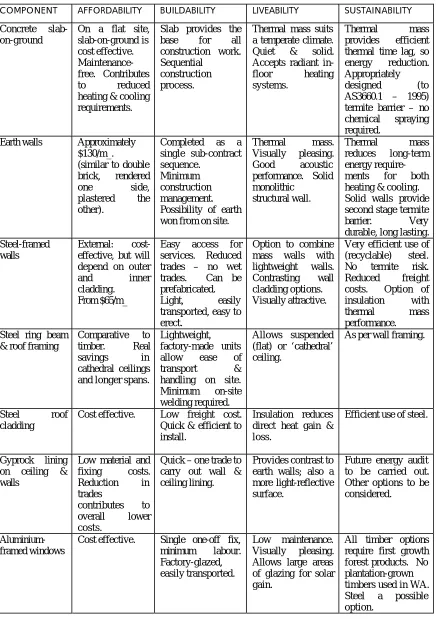
The use of Energy Efficient Materials and other building components are summarised in Table 1.
The footings and floors are to be concrete slab-on-ground. Not only is concrete cost effective, it provides thermal mass that can be used to effect for the temperature performance of the building. Walls will be a combination of stabilised recycled earth (which has low embodied energy) where thermal mass is appropriate, and lightweight insulated walls, where high insulation or very low thermal lag is appropriate. The roof structure will be from pre-fabricated light-gauge structural steel. The roof form will be ideally suited to the integration of PV panels. Roof cladding will be light-gauge steel and integrated structural PV panels. Judicious use of roof and/or ceiling insulation is expected, subject to thermal performance analyses to be run during design development. Interior linings will not be required where stabilised earth or floor-to-ceiling glazing is used. Elsewhere these will be kept simple.
The concept allows for the following technologies to be incorporated into the facility;
An energy audit of intended user demands to plan-in maximum use of energy-saving appliances Simulation and optimisation of the buildings’ energy performance using state-of-the-art software developed by Dr Andrew Marsh of the UWA School of Architecture.
Power input from the hilltop wind generator. Power input from rooftop PV panels.
Battery and inverter systems for energy storage and grid-interactivity.
Energy monitoring & control systems to optimise the comfort levels and energy usage of the facility in operation, including linkage to the University BMS.
Connection to on-site sewerage treatment systems. Low-energy active heating/ventilation controls. Solar hot water system.
Table 1. Earth House materials and component selection
COMPONENT AFFORDABILITY BUILDABILITY LIVEABILITY SUSTAINABILITY
Concrete slab-on-ground
On a flat site, slab-on-ground is cost effective. Maintenance-free. Contributes to reduced heating & cooling requirements.
Slab provides the base for all construction work. Sequential
construction process.
Thermal mass suits a temperate climate. Quiet & solid. Accepts radiant in-floor heating systems.
Thermal mass provides efficient thermal time lag, so energy reduction. Appropriately designed (to AS3660.1 – 1995) termite barrier – no chemical spraying required.
Earth walls Approximately $130/m_.
(similar to double brick, rendered one side, plastered the other).
Completed as a single sub-contract sequence.
Minimum construction management. Possibility of earth won from on site.
Thermal mass. Visually pleasing. Good acoustic performance. Solid monolithic
structural wall.
Thermal mass reduces long-term energy require-ments for both heating & cooling. Solid walls provide second stage termite barrier. Very durable, long lasting. Steel-framed
walls
External: cost-effective, but will depend on outer and inner cladding.
From $65/m_
Easy access for services. Reduced trades – no wet trades. Can be prefabricated. Light, easily transported, easy to erect.
Option to combine mass walls with lightweight walls. Contrasting wall cladding options. Visually attractive.
Very efficient use of (recyclable) steel. No termite risk. Reduced freight costs. Option of insulation with thermal mass performance. Steel ring beam
& roof framing
Comparative to timber. Real savings in cathedral ceilings and longer spans.
Lightweight, factory-made units allow ease of transport & handling on site. Minimum on-site welding required.
Allows suspended (flat) or ‘cathedral’ ceiling.
As per wall framing.
Steel roof cladding
Cost effective. Low freight cost. Quick & efficient to install.
Insulation reduces direct heat gain & loss.
Efficient use of steel.
Gyprock lining on ceiling & walls
Low material and fixing costs. Reduction in trades contributes to overall lower costs.
Quick – one trade to carry out wall & ceiling lining.
Provides contrast to earth walls; also a more light-reflective surface.
Future energy audit to be carried out. Other options to be considered.
Aluminium-framed windows
Cost effective. Single one-off fix, minimum labour. Factory-glazed, easily transported.
Low maintenance. Visually pleasing. Allows large areas of glazing for solar gain.
As a demonstrational facility, the Murdoch ETC provides an operational display to a wide range of visitors from international, remote, rural and urban settings. Many architects, landholders, homebuyers and community representatives seeking to install renewable energy equipment and undertake energy efficiency measures have visited the Murdoch ETC prior to technology selection. The Centre is also active in conducting industry training, community workshops and undergraduate teaching.
4.
Other Perth Metropolitan Community Demonstration Centres
In the Perth Metropolitan area a number of other community education centres have developed an ‘environmental technology’ capacity, often with a focus on renewable energy as well as on other specific areas of sustainable technology.
4.1 MUERI
The Murdoch University Energy Research Institute (MUERI) developed when Murdoch University assumed responsibility of the State Government funded Solar Energy Research Institute of Western Australia (SERIWA) in the 1980s.
The primary goals of MUERI includes renewable energy research and the teaching of postgraduate courses in renewable energy. However Federal and State Government grants allowed the Institute to build a ‘display home’ which is fully equipped with three RAPS systems.
These three systems are specifically designed to allow members of the community to examine and learn about RAPS and associated technologies. The smallest system consists of two 84 W PV modules and a single battery and would be typical for camping trailers, mobile homes and vehicles. The next system has 300 W of single crystal PV panels, a 300 W wind turbine, 10.8 kWh of battery storage and a 2.4 kVA modified square wave inverter, making it well suited to a small household or holiday cottage. The largest system consists of a 1.23 kW multi-crystalline PV array, a 1.8 kW wind turbine, 17.7 kWh of batteries and a 2 kW sine-wave inverter and is suited to larger houses such as are generally found on farms and cattle stations.
A grant from the Western Australian Renewable Energy Development Board (AEDB) allowed an educational package to be written and a RAPS system to be interfaced to the WWW. The package and system can be viewed on-line at http://wwwphys.murdoch.edu.au/WebRAPS/
4.2 CRESTA
The Centre for Renewable Energy and Sustainable Technologies, Australia (CRESTA) is part of the Curtin University School of Computer and Electrical Engineering in Perth. Primarily a research and teaching institute, the Centre offers doctorates and masters degrees, project work for final year undergraduate students and foreign visiting students as well as a number of short training courses for industry.
In addition, a 720 W grid-interactive PV system is used for undergraduate student projects and this is also available for viewing by members of the public.
4.3 Rockingham Regional Environment Centre
The Rockingham Regional Environment Centre, which is currently nearing completion, features a passive solar and climate-sensible building which used recycled materials wherever possible. Power is from a grid-interactive wind-solar energy system which consists of a 2.5 kW triple-layer amorphous PV array, a locally made 2.5 kW wind turbine and a 5 kVA inverter.
Unlike the previously mentioned centres, the Rockingham Centre is run by a local community group and funded by government grants (such as from the AEDB), by donations and is largely staffed by volunteers.
4.4 APACE
Located in Fremantle, the port district of Perth, APACE is another community run centre but which specialises in community gardening and revegetation projects. In addition to a nursery which supplies local indigenous plants, APACE also has a grid-interactive energy system which consists of a 450 W PV array, two 360 W wind turbines and a 3 kVA inverter. This system is also available for viewing by members of the public.
More recently, APACE has installed a number of relatively inexpensive and small (100 watt) grid-interactive systems in local schools. While perhaps not making a significant contribution to the schools’ energy needs, these systems play an important role in the science and technology curriculum and allow students to gain first-hand experience with the design, use and control of renewable energy systems. It is hoped that, with the soon to be implemented Federal Government PV rebate scheme, schools and other community groups will be able to install larger (0.5 - 1.5 kW) systems which will also provide the benefit of significant power generation.
4.5 Other Centres
Other demonstration and educational ETC’s have also been set up, or are planned on being set up, within Western Australia. The planned Piney Lakes Environment Centre, located in a suburban area, will be fitted with a stand-alone RAPS system and will feature solar passive buildings.
At the Perth Zoological Gardens, a small, unstaffed centre called ‘Harmony Farm’ was built in the early 1990s. This site demonstrates solar-passive building design, permaculture and also has a stand-alone solar-wind energy system. However this system also demonstrates what not to do. The PV array was mounted such that tree growth soon shaded the panels. The wind turbine failed due to lack of maintenance causing the somewhat undersized battery bank to be regularly over-discharging and subsequently the entire system failed.
Located on the outskirts of Perth, the Swan Valley Community’s has also experienced difficulties with their system and this highlights many of the problems faced by operators of renewable energy systems.
Co-ordinated by CASE, the International Centre for Applications of Solar Energy, the system was installed at the Swan Valley Nyungar community. The Nyungar are the indigenous people of the South-West of Australia. With 0.75 kW of PV, two 10 kW wind turbines and a 30 kVA inverter, the system was to power the community and feed excess energy into the grid. It was planned that one of the roles of this system was to provide a demonstration example to other indigenous communities around the State.
The main problem experienced arose from the lack of monitoring of the site prior to installation. Wind data from a location several kilometres away was used and this led to a gross over-estimation of the wind speeds at the site. Even with exceptionally high towers (30 m), output from the turbines is less than 10% of what was expected, leading to energy import rather than energy export. (Lang, 1999)
Additional problems have been in the monitoring of the system and the lack of information availability to the owners which has limited the usefulness of the system as a display site to other indigenous communities.
5.
Conclusion
Because of the diversity of environmental technologies, even in a single city there can be room for a number of centres to exist side by side with each centre displaying various aspects such as different system types and technologies.
As well as demonstrating applications of environmental technologies to members of the public, schools and community groups, some of these systems also have valuable lessons for members of the industry and the professional renewable energy community.
6.
References
Anda M & Ho G (eds) (1994). National Conference on Technology Transfer in Remote Communities – Proceedings. April 6 – 7. Remote Area Developments Group. Murdoch University, Perth.
Dallas S, Anda M, Mathew K, Ho G (1998). Environmental Technology Centres: Contribution to Renewable Energy Technology Diffusion and Sustainable Development.
Earth House (2000), Murdoch University ETC Research Facility and Exhibition Complex -Concept Design, Perth
Ho G, Dallas S, Anda M, Mathew K (1999). Renewable Energy in the Context of Environmentally Sound Technologies – Training and Research Programs at the Environmental Technology Centre, Murdoch University. World Renewable Energy Congress. 10 – 13 February. Perth Western Australia.
Lang, K. (1999). Data Monitoring and Evaluation Report of the Renewable Energy Power System located at the Swan Valley Nyungar Community. CASE, Perth.
Mathew K (1998). Renewable Energy, in Ho G (ed). Environmental Technology for Sustainable Development. Study Guide and Unit Materials. Murdoch University, Perth.