ISSN (Online): 2320-9364, ISSN (Print): 2320-9356
www.ijres.org Volume 2 Issue 12
ǁ
December. 2014
ǁ
PP.10-17
Experimental Study of Sulphate Attack on Neutralized Red Mud
Mr. A. B. Sawant
1, Mr. S. K. Patil
2, Mr. P. G. Koli
31
Assistant
Professor, Civil Engineering Department, KIT’s College of Engineering, Kolhapur
2
Assistant Professor, Civil Engineering Department, SVERI's College of Engineering, Pandharpur
3
PG Student, Civil Engineering Department, Ashokrao Mane Group of Institutions, Hatkanangale, Dt
: Kolhapur
ABSTRACT :
Concrete exposed to sulfate solutions can be attacked and suffer deterioration by expansion. The deterioration of reinforced concrete by sulfate attack causes the reinforcing steel to be exposed to the action of aggressive agents starting the corrosion of the reinforcement. It is known that the concrete resistance to sulfates can be significantly improved producing a dense waterproof concrete. Both the physical resistance of concrete to the penetration and capillary-induced migration of aggressive agents and the chemical resistance of the concrete to the deleterious reactions described above are important attributes of sulfate resisting concrete. Thus factors influencing the permeability and surface porosity of the concrete and the chemical resistance of cement are prime performance parameters of concrete exposed to sulphate attack. In this project physical resistance of concrete is traditionally achieved by specifying mix design parameters such as maximum water– cement ratio and minimum cement content, while the chemical resistance is by the use of sulphate resisting cement.Keywords
–
Sulphate Attack, NRM ConcreteI.
INTRODUCTION
1.1.
G
ENERALSulphate attack or commonly known as acid attack is having adverse effects on conventional concrete. Sulphate attack reduces the compressive strength of concrete and thereby it affects its durability. In practice to avoid sulphate attack effect on conventional concrete generally use of sulphate resisting cement is preferred. With reference to literatures listed below, red mud is a waste of aluminum industry and posses binding properties as cement, we have replaced cement partially (15% of cement by weight) by red mud and concrete specimens are casted for M30 & M40 grade. Curing is done for 28 days in normal condition and for acidic condition some specimens are cured for 28 days & others are cured for 90 days, this helped us to distinguish the short term & long term effects of sulphate attack on NRM concrete. As red mud is aluminum waste, available cheaply and in ample quantity, NRM concrete is economical as compared to the concrete which is used as sulphate resisting concrete. Red mud is an industrial waste so use of it as binding material in construction practices will help to reduces hazards effect on environment.
1.2.
W
HAT ISS
ULPHATEA
TTACK?
The deterioration of concrete exposed to sulfate is the result of the penetration of aggressive agents into the concrete and their chemical reaction with the cement matrix. The three main reactions involved are:
Enttringite formation- Conversion of hydrated calcium aluminates to calcium sulphoaluminate,
Gypsum formation- Conversion of calcium hydroxide to calcium sulphate, and
Decalcification- Decomposition of the hydrated calcium silicate.
These chemical reactions can lead to expansion and cracking of concrete, and/or the loss of strength and elastic properties of concrete. The form and extent of damage to concrete will depend on the sulfate concentration, the type of cations (e.g. sodium or magnesium) in the sulfate solution, the pH of the solution and the microstructure of the hardened cement matrix. Some cement is more susceptible to magnesium sulfate than sodium sulphate; the key mechanism is the replacement of calcium in calcium silicate hydrates that form much of the cement matrix. This leads to a loss of the binding properties.
II.
EXPERIMENTAL
STUDY
With the above objectives and aim, a comparative study on strength parameters is done against conventional concrete to study the behavior of cement concrete with neutralized red mud.
The experimental tests carried out on parameters are:
2. With constant water/cement ratio two concrete design mix of grade M30 & M40 was prepared, cured normal condition for 28 days & acid curing for some specimens is done for 28 days and for other specimens acid curing is done for 90 days and each concrete design mix was studied for Compressive, Flexural and Split Tensile Strength. iii) Comparison of conventional concrete and NRM concrete by observing change in dimensions and weight loss due to acid curing.
The concrete design mixes are used for general reinforced concrete works such as beams, slabs, columns and panels, walls etc. It has been studied for compressive as well as flexural and split tensile strength. The cement is replaced 15% by NRM. The compressive strength, flexural and split tensile test are done after curing periods of 28 days and 90 days.
1. For concrete design mix of grade M 30 the w/c ratio was 0.39 2. For concrete design mix of grade M 40 the w/c ratio was 0.32
For compressive strength test specimens of size 150mm × 150mm × 150mm were used, for flexural strength tests beam specimens of size 100mm × 100mm × 500mm were used and for split tensile strength cylinders of size 100mm dia. and 200mm height were prepared for each water- (cement + NRM) ratio for every mix and for one curing period cement is replaced by 15% on weight basis. In all concrete mix designs ultra-tech 43 grade cement, locally available river sand and course aggregate (12.5 mm and down size) were used.
III.
MIX
DESIGN
Following is the mix proportion for M30 grade concrete and concrete design mix ratio for both conventional concrete and NRM concrete.
TABLE 1: Proportion of M 30 Grade Conventional and NRM concrete design mix
Cement Sand Coarse
Aggregate Water Chemical
310 Kg/m3 889.9 Kg/m3 1428.6 Kg/m3 120.9 Kg/m3 1.3 % of Cement
Concrete Design Mix Ratio
1 2.8709 4.6085 0.39 1.3 %
0.15 0.85 0.15 2.8709 4.6085 1.3 %
IV.
RESULT
ANALYSIS
4.1.
G
ENERALDifferent tests are carried out on M30 and M40 grade conventional as well as NRM concrete. In this chapter results obtained from the different tests are tabulated along with the graphs.
4.2.
R
ESULTA
NALYSIS WITHR
ESPECT TOD
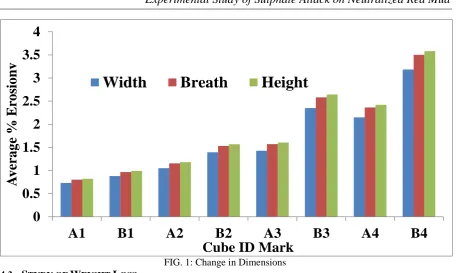
IMENSIONSThe dimensions of M30 & M40 grade concrete (Conventional and NRM) specimens were measured before placing the specimens for 28 days & 90 days normal & acid curing. After the curing period of 28 days & 90 days again the dimensions were checked and tabulated below. The purpose for this dimensions study was to check the effect of acid curing on the concrete specimens.
Table 2: Change in Dimensions (in %)
ID
Width Breadth Height
Erosion in MM
Erosion in %
Erosion in MM
Erosion in %
Erosion in MM
Erosion in %
28 Days Normal Curing
A1-1 1.13 0.761 1.26 0.838 1.29 0.857
A1-2 1.13 0.753 1.23 0.823 1.27 0.845
A1-3 1.02 0.679 1.12 0.745 1.15 0.766
ID
Width Breadth Height
Erosion in MM
Erosion in %
Erosion in MM
Erosion in %
Erosion in MM
Erosion in %
B1-2 1.31 0.872 1.44 0.954 1.47 0.978
B1-3 1.38 0.917 1.52 1.01 1.56 1.038
90 Days Normal Curing
A2-1 1.58 1.053 1.73 1.156 1.77 1.179
A2-2 1.41 0.952 1.55 1.044 1.61 1.07
A2-3 1.72 1.147 1.9 1.266 1.94 1.292
B2-1 2.03 1.349 2.23 1.482 2.29 1.517
B2-2 2.09 1.382 2.25 1.516 2.35 1.552
B2-3 2.18 1.45 2.4 1.595 2.46 1.634
28 Days Acid (H2SO4) Curing
A3-1 2.04 1.348 2.23 1.487 2.3 1.519
A3-2 2.19 1.453 2.4 1.595 2.47 1.629
A3-3 2.23 1.478 2.44 1.627 2.49 1.662
B3-1 3.41 2.25 3.74 2.475 3.8 2.533
B3-2 3.51 2.348 3.88 2.584 3.97 2.644
B3-3 3.69 2.45 4.05 2.692 4.14 2.755
90 Days Acid (H2SO4) Curing
A4-1 3.34 2.247 3.68 2.473 3.79 2.53
A4-2 3.24 2.149 3.56 2.363 3.65 2.42
A4-3 3.08 2.049 3.4 2.258 3.48 2.309
B4-1 4.74 3.152 5.24 3.466 5.38 3.545
B4-2 4.92 3.251 5.39 3.576 5.52 3.656
0
0.5
1
1.5
2
2.5
3
3.5
4
A1
B1
A2
B2
A3
B3
A4
B4
A
v
erag
e %
Er
o
sio
nv
Cube ID Mark
Width
Breath
Height
FIG. 1: Change in Dimensions
4.3.
S
TUDY OFW
EIGHTL
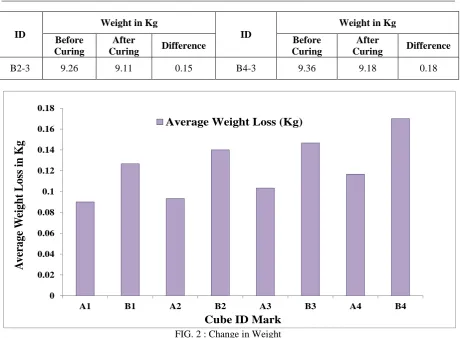
OSSThe weight of M30 & M40 grade concrete specimens (conventional & NRM) were measured before placing the specimens for 28 days & 90 days normal & acid curing. After the curing period of 28 days & 90 days again the weights were checked and tabulated below. The purpose for this study was to check the effect of acid curing on the concrete specimen with respect to weight.
Table 3: Weight loss study
ID
Weight in Kg
ID
Weight in Kg
Before Curing
After
Curing Difference
Before Curing
After
Curing Difference
28 Days Normal Curing [M30] 28 Days Acid (H2so4) Curing [M30]
A1-1 9.23 9.14 0.09 A3-1 9.32 9.22 0.1
A1-2 9.15 9.05 0.1 A3-2 9.32 9.21 0.11
A1-3 9.03 8.95 0.08 A3-3 9.3 9.2 0.1
B1-1 9.13 9.02 0.11 B3-1 9.3 9.17 0.13
B1-2 8.92 8.79 0.13 B3-2 9.06 8.91 0.15
B1-3 9.12 8.98 0.14 B3-3 9.01 8.85 0.16
90 Days Normal Curing [M30] 90 Days Acid (H2so4) Curing [M30]
A2-1 9.13 9.04 0.09 A4-1 9.01 8.9 0.11
A2-2 9.02 8.92 0.1 A4-2 9.38 9.25 0.13
A2-3 9.07 8.98 0.09 A4-3 9.41 9.3 0.11
B2-1 9.39 9.26 0.13 B4-1 9.44 9.29 0.15
ID
Weight in Kg
ID
Weight in Kg
Before Curing
After
Curing Difference
Before Curing
After
Curing Difference
B2-3 9.26 9.11 0.15 B4-3 9.36 9.18 0.18
0 0.02 0.04 0.06 0.08 0.1 0.12 0.14 0.16 0.18
A1 B1 A2 B2 A3 B3 A4 B4
A
vera
ge
W
ei
gh
t
Loss
in Kg
Cube ID Mark
Average Weight Loss (Kg)
FIG. 2 : Change in Weight
4.4.
R
ESULTA
NALYSIS WITHR
ESPECT TOC
OMPRESSIVES
TRENGTHThe Compressive strength of concrete mix design was checked by casting and testing of concrete cube specimens of size 150mm × 150mm × 150mm after 28 days & 90 days normal curing & acid curing as well. Obtained results are tabulated below.
Table 4: Test Results of Compressive Strength
Cube ID Mark
Length Breadth Area in
mm2
Load in KN
Compressive Strength in
N/mm2
Average Compressive
Strength in
N/mm2
28 Days Normal Curing [M30]
A1-1 148.4 150.4 22328 1175 52.63
51.94 A1-2 149.5 149.4 22338 1155 51.71
A1-3 150.1 150 22524 1160 51.5
B1-1 150.2 150 22543 1110 49.24
48.84 B1-2 150.3 150.4 22603 1115 49.33
B1-3 150.1 150 22517 1080 47.96
90 Days Normal Curing [M30]
A2-1 150.1 149.9 22500 1210 53.78
Cube ID Mark
Length Breadth Area in
mm2
Load in KN
Compressive Strength in
N/mm2
Average Compressive
Strength in
N/mm2
A2-3 149.9 150 22496 1200 53.34
B2-1 150.3 150.2 22577 1125 49.83
49.95 B2-2 150.1 148.3 22257 1120 50.32
B2-3 150.1 156.2 23441 1165 49.7
28 Days Acid (H2so4) Curing [M30]
A3-1 150.3 150.3 22586 1110 49.15
49.46 A3-2 150.2 150.3 22582 1110 49.16
A3-3 149.8 149.9 22466 1125 50.08
B3-1 150.8 149.8 22592 1005 44.49
44.32 B3-2 149.9 149.8 22461 990 44.08
B3-3 150.2 150 22530 1000 44.39
90 Days Acid (H2so4) Curing [M30]
A4-1 148.7 149.8 22265 1075 48.28
47.85 A4-2 150.5 150.5 22648 1085 47.91
A4-3 150.2 150.4 22597 1070 47.35
B4-1 150.2 150.9 22652 1025 45.25
45.92 B4-2 150.4 150.7 22676 1035 45.64
0 10 20 30 40 50 60
A1 B1 A2 B2 A3 B3 A4 B4
A
verag
e
Co
mpr
essi
ve
Str
enght
(N
/m
m2)
Cube ID Mark
Average Compressive Strength
FIG. .3: Average Compressive Strength
V.
CONCLUSION
From the above result analysis, following comments are concluded;
1. For 28 days normal curing the percentage reduction in dimensions of M30 grade conventional concrete and NRM concrete are varies in between 0.77 % to 1.05 %.
2. For 28 days Acid curing the percentage reduction in dimensions of M30 grade conventional concrete and NRM concrete are varies in between 1.37 % to 2.83 %.
3. For 90 days normal curing the percentage reduction in dimensions of M30 grade conventional concrete and NRM concrete are varies in between 1.05 % to 1.66 %.
4. For 90 days Acid curing the percentage reduction in dimensions of M30 grade conventional concrete and NRM concrete are varies in between 2.29 % to 3.67 %.
Form the present experimental study results & observations, it is cleared that construction work where the concrete is exposed to sulphate attack NRM concrete is not that much suitable than conventional concrete.
REFERENCES
Journal Papers:
[1] A M Dunster et al (2005) Development of sites containing expansive ferrous slags. BRE Information Paper, IP 8/05.
[2] A.M. Cody, H. Lee, R.D. Cody, P.G. Spry, The effects of chemical environment on the nucleation, growth, and stability of ettringite [Ca3Al(OH)6]2(SO4)326H2O, Cement and Concrete Research 34 (2004) 869–889.
[3] A.B. Yimaz, B. Yazici, M. Erbil, The effect of sulphate ion on concrete and reinforced concrete, Cement and Concrete Research 27 (1997) 1271–1279.
[4] Pauri, M. and Collepardi M., "Thermo - hydrometrical stability of thaumasite and ettringite", Il Cemento, No.86, 1989, pp. 177-184.
[5] PARKER C. D. The isolation of species of bacterium associated with the corrosion of concrete exposed to atmospheres containing hydrogen sulphide. Australian Journal of Experimental Biology and Medical Science, 1945, 23, 81–90.
Books:
[6] British Standards Institution (2006) BS 8500: 2002 Concrete. Complementary British Standard to BS EN 206-1: [7] British Standards Institution. BS 1881:1988: Part 124: Testing concrete: Methods for analysis of hardened concrete.
[8] Building Research Establishment (2005). BRE Special Digest 1: Concrete in Aggressive Ground Third Edition. CRC, London. [9] Building Research Establishment (2007). Radon: guidance on protective measures for new buildings. BR 211.
[10] Commentary on the Building Regulations 1965.
[11] Energy Saving Trust (2006). Practical refurbishment of solid-wall houses. Guide CE 184.
[12] Environment Agency (2003). Hazardous Waste: Interpretation of the definition and classification of hazardous waste. Technical Guidance WM2, Second Edition.
[13] Environment Agency (2007). What is Hazardous Waste? A guide to Hazardous Waste Regulations and a List of Waste Regulations in England and Wales. Guide HWR01.
[15] Office of the Deputy Prime Minister (2004). Building Regulations 2000: Approved Document C. Site preparation and resistance to contaminants and moisture.
[16] Office of the Deputy Prime Minister (2006). Approved Document L1B: Conservation of fuel and power in existing dwellings, 2006 Edition.
[17] ACI Committee 201, "Guide to Durable Concrete", ACI Manual of Concrete Practice, Part 1, Detroit, Mich., 1994.
Proceedings Papers:
[18] Al-Amoudi, O.S.B., Sulphate attack and reinforcement corrosion in plain and blended cements exposed to sulphate environments, Building and Environment, 33(1998) 53-61.
[19] ATTIOGBE K. E. and RIZKALLAH H. S. Response of concrete to sulphuric acid attack. ACI Materials Journal, 1988, 85, No. 6, 481–488.
[20] Basista, M. (2001). Micromechanical and Lattice Modeling of Brittle Dam- age, IFTR Reports, Warsaw.
[21] Basista, M., Weglewski, W. (2008). Chemically-assisted damage of concrete: a model of expansion under external sulphate attack, International Journal of Damage Mechanics, (in press)
[22] BRONGERS M., KOCH G. and THOMPSON N. Corrosion Costs and Preventive Strategies in the United States. Federal Highway Administration, Washington, DC, 2001, Report FHWA-RD- 01-156.
[23] Diamond, S., "Delayed Ettringite Formation - Process and Problems", Cement and Concrete Composites, Vol. 18, 1996, pp. 205-215.
[24] Hime, W.G., "Clinker Sulfate: A Cause for Distress and a Need for Specification", Concrete in the Service of Manking, Concrete for Environmenta, Earthqeeument and Protection, E.& F.N. Spoon, 1996, pp. 387-395.
[25] Concrete Research, 1978, 30, No. 102, 11–18. 17.
[26] HEWAYDE E. Investigation on Degradation of Sewer Concrete Pipes by Sulphuric Acid Attack. PhD thesis, The University of Western Ontario, London, Ontario, 2005.