R E S E A R C H
Open Access
Regression model to predict thread consumption
incorporating thread-tension constraint: study on
lock-stitch 301 and chain-stitch 401
Ranga Prasad Abeysooriya and Ganemulle Lekamalage Dharmasri Wickramasinghe
** Correspondence:[email protected] Department of Textile and Clothing Technology, University of Moratuwa, 10400 Moratuwa, Sri Lanka
Abstract
Prediction of sewing thread consumption requires an accurate method of calculation since it relates to the cost of manufacturing and distribution of apparel products. Previous researchers highlighted problems in existing thread consumption calculation methods; i.e. limitations in existing formulae which cause inaccurate predictions of thread amount needed for sewing operations. The existing methods of consumption calculations exhibit significant error percentages due to the ignorance of important parameters which affect on thread consumption. This paper investigates on correlation of thread tension to thread consumption of lock-stitch 301 and chain-stitch 401. The existing thread consumption formulae are optimized by considering a new parameter; thread tension, using regression analysis and geometrical modeling techniques. For the chain-stitch 401, results indicate that the thread tension significantly affects in determination of the thread consumption. The error analysis of proposed formulae was performed to indicate that the proposed formulae more accurate compared to the available methods of predicting sewing thread consumption. In addition, there are combined effects of thread tensions together with parameters such as fabric thickness and stitch density which
determines accurate consumption values considering the properties of the stitch. In comparison, inclusion of the proposed thread tension variable depicts reduction in error percentages, so that the proposed formulae are expected to be a better approach to calculate thread consumption of lock-stitch 301 and chain-stitch 401.
Keywords:Sewing thread consumption; Thread tension; Stitch density; Fabric thickness; Stitch type; Regression analysis
Introduction
Prediction of sewing thread consumption is one of the significant factors in thread pro-curement. In apparel industry both garment manufacturers and thread suppliers pre-dict thread consumption per unit length of stitch for their thread purchasing and logistics processes. Inaccurate thread consumption predictions lead to inaccurate cost-ing and reduction of warehouse utilization for both garment manufacturers and sewcost-ing thread manufacturers. Purchase of excess or shortage quantities of thread cones make suppliers to endure those excess or shortage thread quantities, so that both parties undergo inflexible logistic process (Jaouadi et al. 2006). In this context sewing thread manufacturers and garment manufacturers are looking for accurate method
predicting sewing thread consumption for given stitch lengths so that wastages could be minimized.
Therefore, objective of this paper is to review theoretical and practical approaches of sewing thread consumption prediction methods based on the literature and to propose new method incorporating thread tension parameter. Thread consumption formulae were derived by investigating the effect of thread tension for two basic types of stitches namely lock-stitch 301 and chain-stitch 401. Accuracy of those optimized formulae was measured through an error analysis by comparing theoretical and actual thread con-sumption values. The error percentage values of the newly developed formulae were compared with the other methodologies developed by other researchers and sewing thread manufacturers for calculating sewing thread consumption.
Literature review
Researchers and sewing thread manufacturers had different approaches in developing thread consumption calculations. Thread length required for a unit length of a stitch is the most frequent measurement (Ukponmwan et al. 2000) which provides flexibility to calculate the thread consumption for a given length of stitch. Measuring the actual length of threads in the stitch is one prominent method which gives correct results if measuring standards are properly followed. Actual lengths of thread are measured by unraveling the formed stitch carefully under correct tension of threads. Unraveled threads are measured following standard testing methods since they are in-build with crimp. As an example, the French standard NF G07 101 is used to determine the unraveled thread lengths (Jaouadi et al. 2006). Though unraveling method gives an accurate value, the stitching operation has to be performed several attempts to improve the accuracy by optimizing sewing pa-rameters. The measuring process is time consuming and it requires testing cost for mater-ial, and equipment and people. Test operator should be highly skilled person to obtain exact values of yarn lengths without exposing them to excessive tensions or distortions.
With these drawbacks of the actual measurement of thread consumption, researchers approached on prediction techniques applicable to determine thread consumption as quick and viable solution. Value prediction charts, mathematical formulae, thread length ratios, predictive algorithms based on past data, learning algorithms and software solu-tions (Jaouadi et al. 2006) are several methods available in literature which use to predict the thread consumption. When analyzing the prediction values of each techniques for a given stitch length with same input parameters in same stitch configuration, it has shown a significant scattered behavior as well.
Introduction of consumption ratios is another prediction technique which decides ra-tio of thread amount with respect to the geometry of the stitch. Different rara-tios were derived as per the stitch types though these ratios have limited to one stitch density value. To overcome these disadvantages, thread suppliers subsequently developed con-sumption ratios for selected stitches which facilitate calculation of thread concon-sumption for given set of stitch densities and fabric thickness values (Amann Group 2010; Ameri-can & Efird Inc 2007).
Most of leading thread suppliers currently uses software packages to improve the effi-ciency of thread consumption calculation with different formulae and ratios. These software packages are capable on calculating thread consumption for varying parame-ters such as stitch lengths, stitch densities, fabric thickness etc. Majority of stitch-classes used in the apparel sector have been defined in these systems. Parameters such as seam widths are also included with the appropriate stitch type. Unlike previous tech-niques, thread consumptions are calculated separately for needle threads, bobbin threads and looper threads. Though certain software solutions address thread proper-ties such as ticket number for thread consumption calculations, majority of solutions have not addressed some critical physical properties which associates stitch formation.
Previous studies specify parameters such as stitch type, stitch density, fabric thick-ness, and seam width determine correlation to the thread consumption as per the stitch type being considered (Samuel & Poojitha 2010; Jaouadi et al. 2006). Experimental study of Jaouadi et al. (2006) on cloth thickness and stitch density revealed a significant effect on thread consumption with a positive correlation for stitch types 301, 401, 504 and 516. In addition to fabric thickness and stitch density, yarn count of the thread has influenced on thread consumption. Further, they revealed that fabric type do not have a statistically significant effect on thread consumption (Jaouadi et al. 2006).
In previous studies by Rengasamy and Samuel (2011) on needle thread tension for lock-stitch 301, four tension peaks have been signified by measuring the online tension of stitch formation. They reported that the threads are extended dynamically at the ten-sion peaks mainly when needle descends and penetrate through the fabric during the stitch formation (Rengasamy & Samuel 2011). Especially in stitch tightening; the last step of the stitch formation produces highest tension peak also apply an extension to the sewing thread (Weimer & Mitschang 2001; Rengasamy & Samuel 2011). Thread tension was identified as one of the important parameters which influence the quality of the seam in garment construction. Krishnan and Kumar (2010) have attempted de-veloping reliable tension measuring devices to measure on-line tension of the running thread. Ferreira et al. (1994a, b, c) have studied thread tension on lock stitch sewing machine and investigated the tension behavior of both the needle-thread and bobbin-thread.
However, thread tension has not been taken as a parameter for any of the above stud-ies. This study investigates the influence of thread tension to the thread consumption of lock-stitch 301 and chain-stitch 401 while incorporating the parameters which had been already been examined by previous authors (Jaouachi et al. 2012; Rasheed et al. 2014; Ghosh & Chavhan 2014).
Methods
Experiments were designed to evaluate the variation of thread consumption with re-spect to the considered parameters; stitch density (SPI), thickness of the fabric, yarn count and tension of the thread. The experiments were conducted using 100% cotton woven fabrics and the fabric type remained constant though Jaouadi et al. (2006) re-vealed that the fabric type has no significant effect on sewing thread consumption. Stitch quality was always one of major concerns when accepting a certain result as a data point and which was evaluated by quality control experts with reference to the stitched quality standard ASTM D6193, standard practice for stitches and seams (ASTM International 2011).
As per the stitches selected; lock-stitch 301 and chain-stitch 401, recommended thread types of poly/poly core-spun threads (with polyester continuous filament core and polyester staple wrap) were used. Yarn count of the thread was taken instead of the thread ticket number value to minimize the approximation errors occurring in ticket number calculations. Fabric thickness was measured following the test standard of BS2544, methods for determination of thickness of textile materials (British standards institution 1987). Yarn counts of threads were measured using ASTM D1907, standard method of test for yarn number by the skein method (ASTM International 1997). Thread consumption and average thread tension were measured using MLT Wesco tension and length meter with the accuracy up to 1 mm and 0.1 cN respectively. Con-sumption values measured using length meter were verified through stitch unraveling method. Actual thread lengths were measured using crimp tester adhering to the pro-cedures in the test standard ASTM D3883, standard test method for yarn crimp and yarn take-up in woven fabrics (ASTM International 2012). All the tension values were measured at the positions closer the needle as specified in the tension meter manual.
All experiments were designed by selecting different value ranges of concerned pa-rameters. The value ranges of stitch density, yarn count and fabric thickness were se-lected in a manner that as they enable a balance stitch in all the sewn specimens. Table 1 includes these input parameters and the set up values for each experiment. Each stitch was sewn as 50 cm burst lengths and three equal segments were then cut from each 50 cm specimen to measure the length. In here, authors set their test speci-mens as 10 cm length stitch segments, ignoring the start and end segments to avoid
Table 1 Experimental parameters
Variable Values used
Stitch density (n stitches per inch) 8, 10, 12
Yarn count of threads (c Tex) 18.24, 37.12, 42.27
Fabric plies thickness (e mm) 0.3, 0.6, 0.9
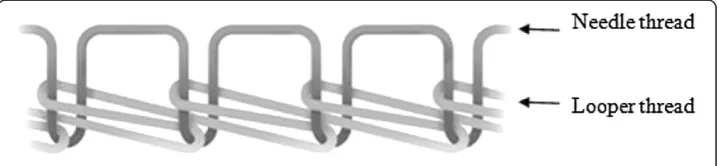
the error of tension fluctuations occur in acceleration and deceleration in each burst of stitching. In this study, authors used 80 and 70 test specimens for lock-stitch 301 (figure 1) and chain-stitch 401 (figure 2) respectively under different combinations of input variables (see Table 1) to satisfy the correct balance and quality appearance.
Curve fitting techniques and multiple linear regression analysis were conducted using SPSS16 16 statistical package to evaluate the influence of thread tension for thread con-sumption. All the regression models were accepted only when following conditions were satisfied. 1) R2> 0.75, 2) significance of the model is accepted through the p value < 0.05 at 95% confidence level, 3) Corresponding coefficient for the variables should be individually significant at 95% confidence level, 4) VIF values for checking multi-collinearity of independent variables should be greater than 5 to decide that variables got multi-collinearity effect, and 5) acceptance from the residual analysis for the model fitted. The study was carried out to analyze the correlation between thread tension and thread consumption of two different stitches. The thread consumption was denoted as D in millimeters per 10 cm stitching length for a given thread in a given stitch. As ex-ample, D301, needledenotes the consumption (in millimeters) of needle thread for
lock-stitch 301 once it has been made 10 cm lock-stitch length.
Results and discussion
Results of multiple linear regression analysis displayed significant effect from tension of the needle thread as a combinatorial effect of tension together with another input vari-able. A fine and strongly significant model was possible with R2= 0.94, when the vari-able thread tension incorporated with another varivari-able as in equation 1. The derived formula for lockstitch 301 is denoted in equation 1.
D301;needle¼0:281nþ0:001cTþ2:041eþ6:42 ð1Þ
Where:
D = Thread consumption in millimeters per 10 cm stitching length n = Stitch density measured in stitches per inch
Figure 1Lock-stitch 301 (ASTM International 1991).
c = Linear density of sewing thread measured in Tex e = Thickness of the fabric measured in millimeters T = Tension measured in cN
Since lock-stitch 301 is a well-balanced stitch in nature (Figure 1), theoretically both needle and bobbin threads have to be equal in length and average tension values. How-ever, previous studies states that practically the average tension values of needle and bobbin threads are not equal, where the average tension of needle thread is slightly higher than the bobbin thread (Dorkin & Chamberlain 1962). In calculations, the con-sumption value and tension value of bobbin thread was considered as equal as needle thread due to the limitations of measuring consumption and tension values of bobbin thread.
In case of chain-stitch 401, results depicted that tension of needle thread and looper thread can influence on the consumption values. Equation 2 and 3 summarize the ex-perimental data values for chain-stitch 401 threads with corresponding R2values 0.894 and 0.906 respectively.
Needle-thread consumption of chain-stitch 401:
D401;needle¼0:25nTþ4:137cþ4:836eT−4:154Tþ61:027 ð2Þ
Looped-thread consumption of chain-stitch 401:
D401;looper¼2:312nþ2:623cþ2:53Tþ351:32 ð3Þ
If chain-stitch 401 is well balanced, as figure illustrates, the needle-thread consump-tion would be defined by the fabric thickness, where the looper-thread consumpconsump-tion would not be affected by the fabric thickness since looper thread is formed under the bottom ply of the seam. According to the results, thread tension has significant effect on thread consumption for chain-stitch 401.
Based on these formulae in equation 1, 2 and 3, the average error percentages were calculated for each thread of each stitch and Table 2 depicts the error percentages of new formulae with respect to the available techniques. Results show that the new de-rived formula has less error percentage compared to the previous studies and commer-cial thread demand software.
When the multi co-linearity effect was analyzed, it was observed that there are inter-relationships between the following variables. 1) stitch density and tension in lock-stitch 301 needle-thread, chain-lock-stitch 401 needle-threads and chain-lock-stitch 401 looper-thread, and 2) fabric thickness and tension in lock-stitch 301 needle-thread and chain-stitch 401 needle-thread.
Conclusions
comparison, inclusion of proposed thread tension variable depicts reduction in error percentages, so that the proposed formulae are expected to be a better approach to cal-culate thread consumption of lock-stitch 301 and chain-stitch 401. Once tension par-ameter is included in the formulae, apparel manufacturers need to optimize and measure the tension during garment pre-production stage as specified for the geomet-ric requirement of the stitch. The average tension value set for a given stitch under se-lected stitch density can be measured using MLT Wesco tension meter and that figure need to be substituted in calculating the thread consumption. If researchers are able to introduce a standard table which represents average tension values which determine the correct geometry of the stitches under different stitch density levels, industry personnel or software system can easily refer such table and substitute the tension values to the proposing formulae.
The proposed investigation is limited only for two basic types of stitches and usage only those two is not adequate to apply them in apparel business environment where several types of stitches are used. The investigation need to be extended for all 6 classes of stitches so that industry will be able to use deriving formulae in an effective way. For instance, the proposed formulae will perform under the defined value ranges of corre-sponding parameters and further analysis would minimize these constrains. Investiga-tion of learning algorithm such as neural network analysis, forecasting mechanism with more parameters such as thread tension, fabric tension, and thread elongation will be the suggesting areas to explore as future methods of sewing thread consumption predictions.
Competing interests
The authors declare that they have no competing interests.
Authors’contributions
RPA and GLDW conceived and designed the experiments. RPA performed the experiments and analyzed the data. Both authors contributed to the writing of the manuscript. Both authors read and approved the final manuscript.
Received: 9 April 2014 Accepted: 20 August 2014 Published: 22 August 2014
References
Amann Group. (2010).Determining your Sewing Thread Requirements. Retrived December 23, 2010. from http://www.amann. com/fileadmin/download/naehfaden/b_naehfadenbedarf_EN.pdf.
American & Efird Inc. (2007).Technical Bulletin Estimating Thread Consumption. Retrived October 15, 2010. from http://www.amefird.com/wp-content/uploads/2009/10/Stitch-Type-Matrix.pdf estthrd consumption. Amirbayat, J, & Alagha, MJ. (1993). Further studies on balance and thread consumption of lockstitch seams.
International Journal of Clothing Science & Technology, 5(2), 26–31.
ASTM International. (1991).ASTM D6192: Reference Guide of Most Common Stitch Types. Philadelphia, USA: American Society for Testing and Materials.
ASTM International. (1997).ASTM D1907: Standard Method of Test for Yarn Number by the Skein Method. Philadelphia, USA: American Society for Testing and Materials.
ASTM International. (2011).ASTM D6193: Standard Practice for Stitches and Seams. Philadelphia, USA: American Society for Testing and Materials.
Table 2 Comparison of error percentages with current study and previous studies
Method Lock-stitch 301 Chain-stitch 401
Geometric Method (Jaouadi et al.2006) 34.54% 14.51%
Commercial thread consumption software (American & Efird Inc.) 13.10% 12.71%
Statistical model used in previous research (Jaouadi et al.2006) 7.98% 6.78%
Derived Formulae (current study) 5.72% 4.85%
ASTM International. (2012).ASTM D3883: Standard Test Method for Yarn Crimp and Yarn Take-Up in Woven Fabrics. Philadelphia, USA: American Society for Testing and Materials.
British Standards Institution. (1987).BS2544: Methods for determination of thickness of textile materials. London: British Standards Institution.
Carr, H, & Latham, B. (1994).The Technology of Clothing Manufacture(2nd ed.). Oxford: Wiley-Blackwell. Dorkin, CMC, & Chamberlain, NH. (1962).Technological Report no. 11. London: Clothing Institute.
Ferreira, FBN, Harlock, SC, & Grosberg, P. (1994a). A study of thread tensions on a lockstitch sewing machine (part I).
International Journal of Clothing Science and Technology, 6(1), 14–19.
Ferreira, FBN, Harlock, SC, & Grosberg, P. (1994b). A study of thread tensions on a lockstitch sewing machine (part II).
International Journal of Clothing Science and Technology, 6(5), 26–29.
Ferreira, FBN, Harlock, SC, & Grosberg, P. (1994c). A study of thread tensions on a lockstitch sewing machine (part III).
International Journal of Clothing Science and Technology, 6(5), 39–42.
Ghosh, S, & Chavhan, MV. (2014). A geometrical model of stitch length for lockstitch seam.Indian Journal of Fibre & Textile Research, 39, 153–156.
Hayes, SG. (2001). The effects of check-spring travel on lockstitch sewing.Research Journal of Textile and Apparel, 5(2), 54–64.
Jaouachi, B, Khedher, F, & Mili, F. (2012). Consumption of the sewing thread of jean pant using taguchi design analysis.
AUTEX Research Journal, 12(4), 81–86.
Jaouadi, M, Msahli, S, Babay, A, & Zitouni, B. (2006). Analysis of the modeling methodologies for predicting the sewing thread consumption.International Journal of Clothing Science and Technology, 18(1), 7–18.
Kennon, WR, & Hayes, SG. (2000). The effects of feed retardation on lockstitch sewing.Journal of the Textile Institute, 91(4), 509–522.
Krishnan, ANS, & Kumar, LA. (2010). Design of sewing thread tension measuring device.Indian Journal of Fibre and Textile Research, 35(1), 65–67.
O'Dwyer, U, & Munden, DL. (1975). A study of the factors effecting the dimensions and thread consumption in 301 seams - part I.Clothing Research Journal, 3(1), 3–32.
Rasheed, A, Ahmad, S, Mohsin, M, Ahmad, F, & Afzal, A. (2014). Geometrical model to calculate the consumption of sewing thread for 301 lockstitch.The Journal of The Textile Institute. doi:10.1080/00405000.2014.886366. Rengasamy, RS, & Samuel, WD. (2011). Effect of thread structure on tension peaks during lock stitch sewing.AUTEX
Research Journal, 11(1), 1–5.
Samuel, WD, & Poojitha, V. (2010). A simple system for the online detection of skip/loop stitches in single needle lockstitch machines.AUTEX Research Journal, 10(3), 69–72.
Ukponmwan, JO, Mukhopadhyay, A, & Chatterjee, KN. (2000).Sewing threads(Textile Progress). Manchester: Textile Institute.
Weimer, C, & Mitschang, P. (2001). Aspects of stitch formation process of the quality of sewn multi-textile-performs.
Composites Part A: Applied Science and Manufacturing, 32, 1477–1484.
doi:10.1186/s40691-014-0014-5
Cite this article as:Abeysooriya and Wickramasinghe:Regression model to predict thread consumption incorporating thread-tension constraint: study on lock-stitch 301 and chain-stitch 401.Fashion and Textiles
20141:14.
Submit your manuscript to a
journal and benefi t from:
7Convenient online submission
7Rigorous peer review
7Immediate publication on acceptance
7Open access: articles freely available online 7High visibility within the fi eld
7Retaining the copyright to your article