Please cite this article as: M. Mansoursamaei, A. Hadighi, N. Javadian, A new approach applying multi-objective optimization using a Taguchi Fuzzy-based for tourist satisfaction management , International Journal of Engineering (IJE), IJE TRANSACTIONS C: Aspects Vol. 32, No. 3, (March 2019) 405-412
International Journal of Engineering
J o u r n a l H o m e p a g e : w w w . i j e . i rA New Approach Applying Multi-objective Optimization using a Taguchi
Fuzzy-based for Tourist Satisfaction Management
M. Mansoursamaei*, A. Hadighi, N. Javadian
Mazandaran University of Science and Technology, Department of Industrial Engineering, Iran
P A P E R I N F O
Paper history:
Received 10 November 2017
Received in revised form 23 December 2017 Accepted 04 Januray 2018
Keywords:
Multi-objective Optimization Taguchi Fuzzy-based Tourism Industry Satisfaction
A B S T R A C T
The paper describes the usage of the fuzzy Mamdani analysis and Taguchi method to optimize the tourism satisfaction in Thailand. The fuzzy reasoning system is applied to pursue the relationships among the options of a tour company in order to be used in Taguchi experiments as the responses. In this research, tourism satisfaction is carried out using L18 Taguchi orthogonal arrays on parameters such as budget, duration, hotel-choices, travel-options inside the country and theme of the travel are analyzed for one output objective as satisfaction. The output of the fuzzy reasoning system is used as an input in the response of each experiment in Taguchi method. But, the improvement is used for the mean de-fuzzified output in the same experiment. The result is estimated using Taguchi-Fuzzy application and if companies focus on the selected options, it is most probable to achieve more than 90 percent of satisfaction.
doi: 10.5829/ije.2019.32.03c.08
1. INTRODUCTION1
Tourism industry is one of the most serious sources of income for Thai people that can get the other currencies and establish lots of job opportunities in the country. Hence, feeling a satisfaction in connection with the service jobs, for the individuals who pay to have a great time is an important issue. Thus, the countries which have the capacity to attract the people from whole over the world require a great strategy to preserve and improve the satisfaction of tourists. These days, the tourism industry in Thailand faces a challenge to the ASEAN countries. It seems mandatory that the government and tour companies must modify the standards of their service system. The leading countries in this industry have continues improvements in their systems; so that the quality measurements are of the important issues for their service systems. Management of these systems requires new methods for improving the productivity and lessening the costs. The service quality is straightly related to the satisfaction on facilities and service administered by organs and employees during the travel
*Corresponding Author Email: [email protected]
(M. Mansoursamaei)
time. Nice memories cause highly pleased tourists and an interest to revisit the country or recommend the special tourist destination to other people [1]. The competition in terms of tourism is an essential objective for ASEAN member nations, so improvement of hotel and tourism industry in Thailand in terms of standard quality has become the most important priority of them [2].
first after London and NewYork in Euro monitor International's list of "Top City Destinations" with 21 million visitors.
Optimal Management of tourism industry provides considerable benefits. Hence, trying to optimize the industry using the quality tools is attractive. Traditionally, tourism satisfactions are principally set relied on the trial and error experiment of the tour companies. This approach is neither affordable nor helpful for quality control. Hence, Taguchi method using the orthogonal arrays designs an efficient table that includes the best sets of experiment that must be practiced elsewhere [4]. Nevertheless, most recent usages of Taguchi methods support only on individual quality characteristic and, in contrast, paid little attention on Multiple Performance Characteristics (MPCs) [5-9].
However, the MPCs of a service are such applications which still have not been paid attention efficiently by researchers. Investigation on MPCs of a service would be interesting studies in sight of customers either job owners. To optimize an operation with MPCs, the goal is determining the best process parameters that will concurrently optimize all the quality characteristics of interest to the designer. Assigning a weighting amount for each response is a common method. Nevertheless, determining an exact weighting amount to each response in a real practice is a problematic task. In fact, the weighting procedure applies specialists' judgment together considering the past experiences, is a simple method to optimize MPCs that is not always accurate and reliable [10]. Consequently, results often contain some uncertainties in the decision-making process. Taguchi’s quality loss function is applied in some of the applications including the concurrent optimization of MPCs [11]; As practical engineering projects, the optimization technique for face milling stainless steel with MPCs [12], and the investigation of the multiple surface quality characteristics of weld pool geometry in the tungsten inert gas welding process [13] had been executed. Nevertheless, the common results from the mentioned-above practical researches have increased the uncertainties because of the complex computational process, and ambiguous correlations among the MPCs. It is also noticeable that different performance characteristics have different relative weightings for tuning MPCs. A method is offered to optimize MPCs problems applying the fuzzy multiple attribute decision-making process [14]. This procedure can lessen the uncertainties but requires sort of complicated mathematical computations and is consequently not easy to implement by individuals who have no sufficient mathematical knowledge. Applying the fuzzy logic analysis, the MPCs can be easily dealt by setting up a reasoning procedure for each performance characteristic and change them into a single value of the multiple performance characteristic indices (MPCIs). The
flexibility, hastiness and effectively response to the ever-changing demands of customers are increased by the developed method.
2. METHODOLOGY
2. 1. Taguchi Methods A statistical method was
introduced by Taguchi and Konishi which is called Taguchi method [15]. At first it was outspreaded to amend the quality of goods manufactured, and then its usage was developed to many other majors in engineering, such as Biotechnology, etc [16]. Professional statisticians have confirmed Taguchi’s attempts chiefly in the advancements of statistical designs for studying variation. Selection of control factors in Taguchi method must be made in conditions that it nullifies the effect of noise factors. To achieve the desired results successfully, it requires a careful selection of process parameters, and should be paid in two items as called noise and control factors. Selection of control factors must be made such that it nullifies the effect of noise factors. The noise factors are the factors that there is not any control on them, and mostly are the undesirable factors of all. Taguchi Method identifies appropriate control factors to achieve the optimum results of the process. Setting the complex of experiments requires a table which is filled by Orthogonal Arrays (OA). Results of these experiments are applied to analyze the data and anticipate the quality of components produced [17].
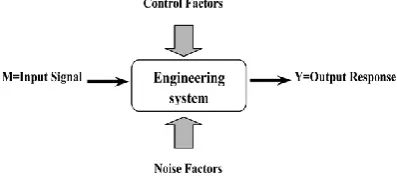
Any system built by human is observed by Taguchi methods as an engineered system that contains four main parts as presented in Figure 1. By applying energy transformation, it is designed to convert input signal into specific function desired by customers using the laws of physics. Taguchi methods guarantee that the proper design of the control factors will be derived from the system very efficiently. Noise factors or unwanted effects that there is not support control on them can be minimized in Taguchi method. Generally, the ideal function of a system is made when all the applied input is converted into producing its own desired performance without any disturbing unwanted item [18].
The Taguchi robust design basically uses matrix experiments. The classical experimental design procedures are too complicated and are not easy to apply.
If the number of parameters increases, a lot of experiments have to be carried out. Taguchi method by using a special design of orthogonal arrays (OA) has solved this problem. It attempts to analyze the all leading existing parameters with only a small number of practical tests. There is a capability in the method that for more accuracy in the study, the repetition for each experimental design is available which lessen the variations in the quality characteristic or response. It is done by converting the repetition data to another value, which is a measure of variation present in the scattered response data. This conversion includes the yield of signal-to-noise (S/N) ratio (η) that unifies several repetitions into one performance measure which reflects the amount of variation present. The growth of the proportion of signal to noise ratio concurrently optimizes the response and weakens the effect of noise factors which are the uncontrollable items [19]. Afterwards, the noise factors can be easily identified. The Minitab 17 software [20] is used to analyze the data. In tourism satisfaction, upper values of the satisfaction are desirable for maintaining high tourism quality, so that larger the better S/N ratio can be calculated as follows:
S/N = -10*log(S(1/Y2)/n) (1)
where Y is the value of the result derived from the executed experiment, and n is the number of observations in a test. Using analysis of means (ANOM) and analysis
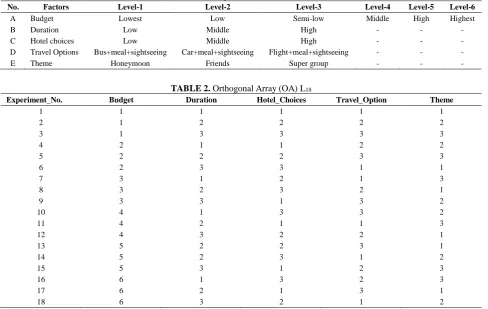
of variance (ANOVA), the signal to noise ratios are analyzed. The ANOM is applied to determine the optimal factor level combinations and to estimate the main effects of each factor, whereas the ANOVA is applied to estimate the error variance for the effects and variance of the prediction error. The calculations of ANOM and ANOVA are explained in detail in literature [21]. In this paper, the control factors are selected by experts the five known tour parameters (which are derived from most common tour booking websites) Budget ($), Duration (Nights), Hotel choices (Star), Travel Options inside the country ($) and Theme of the travel (people). The mention-above factors and their levels respectively are presented in Table 1.
2. 1. 1. Selection of Orthogonal Array The
orthogonal arrays are used so that the interactions between control factors are almost evenly distributed to other columns of the orthogonal arrays and confounded to various main effects [22]. To select a proper orthogonal array for leading the experiments, the degrees of freedom are to be computed. Due to several processes that can be occurred, the most optimal table should be carried out [23].
The most appropriate orthogonal array for this experimentation is L18 array which has been chosen from Mixed Level Design (61×34) as shown in Table 2.
TABLE 1. Tour parameters and their levels
No. Factors Level-1 Level-2 Level-3 Level-4 Level-5 Level-6
A Budget Lowest Low Semi-low Middle High Highest
B Duration Low Middle High - - -
C Hotel choices Low Middle High - - -
D Travel Options Bus+meal+sightseeing Car+meal+sightseeing Flight+meal+sightseeing - - -
E Theme Honeymoon Friends Super group - - -
TABLE 2. Orthogonal Array (OA) L18
Experiment_No. Budget Duration Hotel_Choices Travel_Option Theme
1 1 1 1 1 1
2 1 2 2 2 2
3 1 3 3 3 3
4 2 1 1 2 2
5 2 2 2 3 3
6 2 3 3 1 1
7 3 1 2 1 3
8 3 2 3 2 1
9 3 3 1 3 2
10 4 1 3 3 2
11 4 2 1 1 3
12 4 3 2 2 1
13 5 2 2 3 1
14 5 2 3 1 2
15 5 3 1 2 3
16 6 1 3 2 3
17 6 2 1 3 1
One factor has six levels and four factors have three levels. Thus, according to the suggested arrays from the Taguchi tables, a total eighteen experiments are to be carried out that is the appropriate table for this study.
2. 2. Fuzzy Method Fuzzy reasoning is an approach
which is based on "degrees of truth" rather than the usual "true or false". This is a mathematical view of inexact reasoning that models the reasoning process of human in linguistic terms which makes the numbers into a tangible phrase [24]. The method is very appropriate in defining the relationship between inputs and desired outputs of a system. The fuzzy logic has simplified so many complicated analyses of industrial and manufacturing systems that cannot be modeled exactly even under various conditions and assumptions. A system which follows the fuzzy logic is formed of a fuzzifier, an inference engine, a data base, a rule base, and defuzzifier. In this paper, the fuzzifier initially uses triangular membership functions to transform the crisp inputs into fuzzy sets, and then the inference engine performs a fuzzy reasoning on fuzzy rules to produce fuzzy values, finally the defuzzifier transforms the values into the crisp outputs. Mamdani fuzzy rules are derived from the experts of tourism industry who are familiar with the behavior of the passengers and their desires. Membership functions as a basic structure determine the fuzzy values and interpret the inputs and cover the mutual areas of ranges [25]. Nevertheless, already there has been no fixed procedure of selecting the best shape of the membership functions for the fuzzy sets of the control variables. Trial and error for choosing the best shape are chiefly practiced. According to Mamdani method, there are some rules that the data must be applied under their functions. The circumstance of a rule is described as follow:
Ri : If x1 is Ai1; x2 is Ai2; . . . ; and xs is Ais;
then yi is Ci; i = 1, 2, . . . , M (2)
where M is the last number of fuzzy rules, xj (j = 1, 2, . . . , s) are the input variables, yi are the output variables, and Aij and Ci are fuzzy sets modeled by membership functions µAij(xj) and µCj(yj), respectively. According to the Mamdani conception method of inference reasoning for a complex of differentiate rules, the finalized output for the M rules is stated as follows:
µCj(yj)=max{min[µAi1(x1), µAi2(x2),…, µAis(xs)]
i = 1, 2, . . . , M (3)
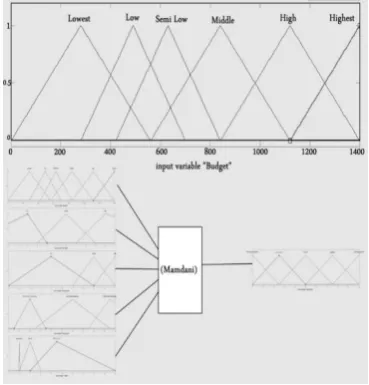
In composing the rules, all possible intermediate relationships between inputs and outputs are taken into consideration. The rules are embedded in the Mamdani box illustrated in Figure 2. After assignment of the memberships the rule base is formed. In the rule base, totally 40 rules are defined between the five tour parameters and satisfaction. For instant, “If (Budget is
highest) and (Duration is Low) and (Hotel choices is Low) and (Theme is not honeymoon) THEN Satisfaction is dissatisfied” Figure 3.
Fuzzy Inference Motor Unit is an engine that provides a single response of all the processes. It is done by considering all of the relationships between the input and output embedded in the fuzzy rules. The engine gathers all of inferences and gives out an accurate output which is based on the mentioned-above rules. The Centroid method is applied to combine and defuzzify the results of the rules. The output unit declares the output value yielded at the end of the interaction [26]. In this study, the output is the range of satisfaction that comes out from the data and Mamdani rules.
Figure presents the fuzzy reasoning process for the forty rules, with five input variables that uses the triangular shape membership functions. All of the ranges in the triangular shapes are carried out from the common amounts of Asian tours. For combining the fuzzy values into a single crisp output a defuzzification method is applied. The center of gravity as called Centroid method, one of the most favorite methods for defuzzifying fuzzy output functions, is used in the research. The formula to carry out the centroid of the combined outputs, ŷi, is obtained as follows:
ŷi = ∫ yi µCi(yi)dy
∫ µCi(yi)dy (4)
The single crisp value which is produced by the above-mentioned formula is the final output value yielded from the input variables.
The 40 questionnaires are presented to Thailand tour professionals from Iran, India and Tajikistan who have at least 15 years of experience in this industry. The professionals are asked to choose one of the satisfaction levels randomly, and then select the levels of the service factors.
Figure 3. Mamdani conception methods with fuzzy controller operations
The 40 rules are based on these 40 questionnaires to create the fuzzy inference engine. Afterward, according to the service factors, 50 random tourism cases are produced by "rand" function. Considering that the membership functions do not produce an exact result; therefore, the average of them is mandatory. The results average of the 50 tourism cases do play role as the inputs of Taguchi table.
2. 3. Taguchi and Fuzzy Combination The
defuzzified outputs of the fuzzy system that are the average of multiple cases are used as the response for Taguchi system.
In recent researches, the fuzzy and Taguchi method are used separately, that the data are been analyzed with and without fuzzy assumptions [19]. However, in the current paper, they are applied simultaneously, which the outputs of the fuzzy system are devoted as the inputs for the Taguchi system, respectively.
3. RESULTS AND DISCUSSION
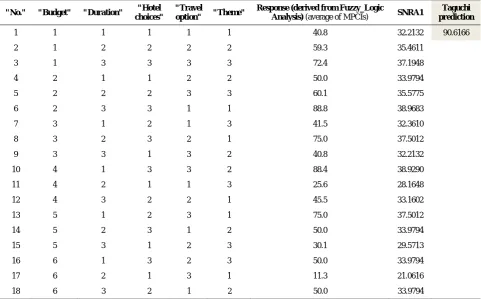
Table 3 illustrates the entire experimental results through Taguchi dynamic S/N ratio. The values of the tour products are yielded to be between 21.06 and 38.96 db. It is noticeable that trials 6 and 10 have the highest dimensional accuracy over 38 db. The S/N ratio is applied to assess the effectiveness of a system. Furthermore, Taguchi method uses the system not only for diagnosis but also for anticipating/predicting system, which makes the best percentage of productivity of a complicated system [27].
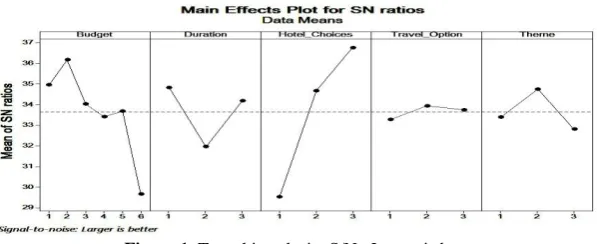
This is attributed to the fact that Asian people desire to consider about 280-700 US dollars, Stay up to four Nights, choose a hotel that has got Four Stars and more, spend about 25-95 dollars for internal travel which includes meal and sightseeing, and the favorite theme is between 2 to 6 friends as illustrated in Fig. 4. If tour companies focus on these options and become more flexible, it is most probably to achieve more than 90 percent of satisfaction.
TABLE 1. Taguchi orthogonal arrays and the SNRA
"No." "Budget" "Duration" choices" "Hotel "Travel option" "Theme" Response (derived from Fuzzy_Logic Analysis) (average of MPCIs) SNRA1 prediction Taguchi
1 1 1 1 1 1 40.8 32.2132 90.6166
2 1 2 2 2 2 59.3 35.4611
3 1 3 3 3 3 72.4 37.1948
4 2 1 1 2 2 50.0 33.9794
5 2 2 2 3 3 60.1 35.5775
6 2 3 3 1 1 88.8 38.9683
7 3 1 2 1 3 41.5 32.3610
8 3 2 3 2 1 75.0 37.5012
9 3 3 1 3 2 40.8 32.2132
10 4 1 3 3 2 88.4 38.9290
11 4 2 1 1 3 25.6 28.1648
12 4 3 2 2 1 45.5 33.1602
13 5 1 2 3 1 75.0 37.5012
14 5 2 3 1 2 50.0 33.9794
15 5 3 1 2 3 30.1 29.5713
16 6 1 3 2 3 50.0 33.9794
17 6 2 1 3 1 11.3 21.0616
18 6 3 2 1 2 50.0 33.9794
4. CONCLUSION
This study represents that the usage of a fuzzy logic analysis and Taguchi experiment altogether is a simple, efficient, and effective method in developing the subject of tourism industry. Optimization of MPCIs in the process was obtained through the proper system model simulation which met more requirements of desired demands by the customers. Taguchi’s Method can design optimal number of experiments that is adequate for selection of the best practice. Furthermore, Taguchi’s method also can be used for analyzing any other type of studies to optimize the processes without any additional useless expenses.
According to the experimental results, the following conclusions can be drawn:
This paper develops a new approach towards optimizing the subject of Tourism industry using the Average of MPCIs in Taguchi experiments in order to optimize the mentioned factors and choose the best level of each factor. The five options of common tourism industry booking menus are divided into separated levels for more accurate research in Mamdani fuzzy logic either Taguchi experiment designs. The fuzzy rules are formulated to base the decision making process and the Taguchi method is used to fine tune the rules for optimal performance. Taguchi derives the selected level of each
option, then suggests how manage the options to gain the maximum satisfaction. The experimental design is performed and simulations are conducted to compare the Taguchi method to other earlier reported methods.
5. REFERENCES
1. Jariyachamsit, S., "An investigation of safety in tourism: An experience of young tourists in bangkok, thailand",
Procedia-Social and Behavioral Sciences, Vol. 197, (2015), 1931-1935.
2. Choovanichchannon, C., "Satisfaction in thai standard of tourism quality", Procedia-Social and Behavioral Sciences, Vol. 197, (2015), 2110-2114.
3. Chaitip, P. and Chaiboonsri, C., "International tourists arrival to thailand: Forecasting by non-linear model", Procedia Economics
and Finance, Vol. 14, (2014), 100-109.
4. Ross, P.J. and Ross, P.J., "Taguchi techniques for quality engineering: Loss function, orthogonal experiments, parameter and tolerance design, McGraw-Hill New York, (1988). 5. Yu, J. and Chang, C., "Characteristic analysis of the edmed
surface of tungsten carbide using taguchi method", in International conference on precision engineering. Vol. 97, (1997), 657-663.
6. Alsaran, A., Çelik, A. and Çelik, C., "Determination of the optimum conditions for ion nitriding of aisi 5140 steel", Surface
and Coatings Technology, Vol. 160, No. 2-3, (2002), 219-226.
electrodes", International Journal of Machine Tools and
Manufacture, Vol. 40, No. 2, (2000), 153-164.
8. Babu, M.V., Kumar, R.K., Prabhakar, O. and Shankar, N.G., "Simultaneous optimization of flame spraying process parameters for high quality molybdenum coatings using taguchi methods",
Surface and Coatings Technology, Vol. 79, No. 1-3, (1996),
276-288.
9. Yang, L., "Plasma surface hardening of assab 760 steel specimens with taguchi optimisation of the processing parameters", Journal
of Materials Processing Technology, Vol. 113, No. 1-3, (2001),
521-526.
10. Elsayed, E. and Chen, A., "Optimal levels of process parameters for products with multiple characteristics", The International
Journal of Production Research, Vol. 31, No. 5, (1993),
1117-1132.
11. Antony, J., "Simultaneous optimisation of multiple quality characteristics in manufacturing processes using taguchi's quality loss function", The International Journal of Advanced
Manufacturing Technology, Vol. 17, No. 2, (2001), 134-138.
12. Lin, T.-R., "Optimisation technique for face milling stainless steel with multiple performance characteristics", The International
Journal of Advanced Manufacturing Technology, Vol. 19, No.
5, (2002), 330-335.
13. Juang, S. and Tarng, Y., "Process parameter selection for optimizing the weld pool geometry in the tungsten inert gas welding of stainless steel", Journal of Materials Processing
Technology, Vol. 122, No. 1, (2002), 33-37.
14. Tong, L.I. and Su., C.T., "Optimizing multi‐response problems in the taguchi method by fuzzy multiple attribute decision making",
Quality and Reliability Engineering International, Vol. 13, No.
1, (1997), 25-34.
15. Taguchi, G. and Konishi, S., "Taguchi methods, orthogonal arrays and linear graphs, tools for quality american supplier institute",
American Supplier Institute, (1987), 8-35.
16. Sreenivas, R., Ganesh Kumar, C., Prakasham, S. and Hobbs, P., "The taguchi methodology as a statistical tool for biotechnological applications: A critical appraisal",
Biotechnology Journal, No. 4, (2008), 510-523.
17. Athreya, S. and Venkatesh, Y., "Application of taguchi method for optimization of process parameters in improving the surface roughness of lathe facing operation", International Refereed
Journal of Engineering and Science, Vol. 1, No. 3, (2012),
13-19.
18. Tzeng, Y.-f. and Chen, F.-c., "Multi-objective optimisation of high-speed electrical discharge machining process using a taguchi fuzzy-based approach", Materials & Design, Vol. 28, No. 4, (2007), 1159-1168.
19. Koyee, R.D., Eisseler, R. and Schmauder, S., "Application of taguchi coupled fuzzy multi attribute decision making (fmadm) for optimizing surface quality in turning austenitic and duplex stainless steels", Measurement, Vol. 58, (2014), 375-386. 20. Alimirzaloo, V. and Modanloo, V., "Investigation of the forming
force in torsion extrusion process of aluminum alloy 1050",
International Journal of Engineering, Vol. 30, No. 6, (2017),
920-925.
21. Ozel, T. and Davim, P., "Intelligent machining, Wiley-IEEE Press, (2009).
22. Hadighi, S.A., Sahebjamnia, N., Mahdavi, I., Asadollahpour, H. and Shafieian, H., "Mahalanobis-taguchi system-based criteria selection for strategy formulation: A case in a training institution", Journal of Industrial Engineering International, Vol. 9, No. 1, (2013), 26.
23. Alimirzaloo, V., Modanloo, V. and Babazadeh Asbagh, E., "Experimental investigation of the effect of process parameters on the surface roughness in finishing process of chrome coated printing cylinders", International Journal of Engineering,
Transactions C: Aspects, Vol. 29, No. 12, (2016), 1775-1782.
24. Ross, T.J., "Fuzzy logic with engineering applications, John Wiley & Sons, (2005).
25. Cherkassky, V. and Mulier, F.M., "Learning from data: Concepts, theory, and methods, John Wiley & Sons, (2007).
26. Yel, E. and Yalpir, S., "Prediction of primary treatment effluent parameters by fuzzy inference system (FIS) approach", Procedia
Computer Science, Vol. 3, (2011), 659-665.
A New Approach Applying Multi-objective Optimization using a Taguchi
Fuzzy-based for Tourist Satisfaction Management
M. Mansoursamaei, A. Hadighi, N. Javadian
Mazandaran University of Science and Technology, Department of Industrial Engineering, Iran
P A P E R I N F O
Paper history:
Received 10 November 2017
Received in revised form 23 December 2017 Accepted 04 Januray 2018
Keywords:
Multi-objective Optimization Taguchi Fuzzy-based Tourism Industry Satisfaction
هدیکچ
نیا رد هلاقم شیامزآ یحارط نینچمه و ینادمم یزاف شور زا هدافتسا اب نیب نارگشدرگ یدنمتیاضر حطس یچوگات یاه
یللملا
هتفرگ رارق یبایزرا دروم دنلیات روشک زا :زا نیصصختم طسوت یتحایس یاهروت نویساورزر یارب هدش نییعت یاهروتکاف .تسا
هتفرگ رظنرد هجدوب هام(رفس عون ،یرهش نیب یاهرفس رد هیلقن هلیسو ،)هراتس(لته هبتر ،تماقا تدم ،رفس یارب هدش
هدش لیکشت )هوبنا هورگ،هناتسود،لسع اهروتکاف ریاس و هقبط شش هب لوا روتکاف ،ینادمم یزاف شور زا هدافتسا اب .تسا
هدش یدنب هتسد یزاف هقبط هس هب مادکره تم رظن زا هدافتسا اب .دنا
نارگشدرگ یدنمتیاضر یارب یلک نیناوق ،نیصصخ
یددع اعطق هک ،نآ یاهرتماراپ و صخش نآ رفس لدم نتفرگرظنرد اب ،یصصخت تارظن نیا رب هیکت اب .دش هتفرگرظنرد هنومن ،تسا یزافریغ یم یسررب یزاف متسیس کی رد اه
یجورخ هکیئاجنآزا .دندرگ ینادمم یزاف لیلحت هدش یزافید یاه
امازلا نیگنایم لصاح جیاتن زا ،دوب دنهاوخن ناسکی یم یریگ
حطس رد هتشذگ تاقیقحتزا کی چیه رد نونکات دتم نیا( .دوش
نیب هتفرگن ماجنا للملا لانگوتروا هیارآ زا هدافتسا اب ).تسا دوخ عون رد یروآون کی نیا هک ،تسا
L18
لوا روتکاف هکیروطب ،
هس اهروتکاف ریاس و حطس شش یاراد یحطس
یم یجورخ نیگنایم لصاح ،دنشاب شیامزآ خساپ لولس رد هدش یزافید یاه
یاه
یم دراو یچوگات مرن طسوت لیلحت زا سپ .ددرگ
ار للاتخا هب لانگیس تبسن رادقم نیرتشیب روتکاف ره زا هک یحطس ،رازفا
یم ییاسانش ،تشاد شیپ زا هدافتسا اب نایاپ رد .دوش
حوطس نداد رارق اب ،یچوگات ینیب یجیاتن ،اهروتکاف زا هدش هدیشک نوریب
یم تسدب ات ار مسیروت یدنمتیاضر حطس تسا رداق هک دیآ 90
.دهد شیازفا دصرد
doi: 10.5829/ije.2019.32.03c.08