Volume 02, No. 4, April 2016
P
age
110
Multi-Objective Optimization of EDM Process Parameters Using
Fuzzy Based Taguchi Approach
Chitrasen Samantra*, Sumit Satyaranjan**, Anant Kumar***
*Assistant Professor, Department of Mechanical Engineering, Gandhi Institute of Engineering and Technology, Gunupur, India
**B.Tech Mechanical Students, Department of Mechanical Engineering, Gandhi Institute of Engineering
and Technology, Gunupur, India
***B.Tech Mechanical Students , Department of Mechanical Engineering, Gandhi Institute of Engineering
and Technology, Gunupur, India
ABSTRACT
Electrical discharge machining (EDM) is one of the earliest non-traditional machining processes. EDM process is based on thermo electric energy between the work piece and an electrode. There are different input parameters which influence on the outputs such as MRR, TWR and SR. Optimization is one of the techniques used in manufacturing sectors to arrive at the best manufacturing conditions, which is an essential need for industries towards manufacturing of quality products at lower cost. This paper deals with the optimization model to investigate the effects of peak current, duty cycle and pulse on time in Electrical Discharge Machining (EDM) process. In this experiment, Material Removal Rate (MRR) and Tool Wear Rate (TWR) of mild steel utilizing copper as Tool electrode with positive polarity have been calculated. Based on the experiments conducted on L9 orthogonal array, analysis has been carried out using Taguchi’s technique and conducted by taking three levels of the peak current, duty cycle and pulse on time on mild steel. Fuzzy based model is implemented to correlate the influences of the three independent variables and the response variables as MRR and TWR. Response tables and graphs are used to find the optimal levels of parameters in EDM process. Thus, the objective of this experiment is to find out the optimum combination of process parameters in EDM process so that material removal rate reaches a maximum value and tool wear rate reaches a minimum value.
Keywords: Electrical Discharge Machining, Fuzzy Logic, Taguchi Approach
1.
INTRODUCTION
Volume 02, No. 4, April 2016
P
age
1
11
for an optimum machining performance. Different author use different combination of process parameters. They analyse the experimental data by plotting Interaction graphs, Residual plots for accuracy and Response curves. Some other methods used by different author for analysis of Taguchi’s DOE data related to Electrical Discharge Machining (EDM) and Wire Electrical Discharge Machining (WEDM) are Regression analysis, Response Surface Methodology, Central Composite Design (CCD), Feasible-Direction Algorithm, SA algorithm, Pareto, Artificial Bee Colony (ABC), Grey Relational Analysis, Genetic Algorithm, Fuzzy clustering, Artificial Neural Network, Tabu-Search Algorithm, Principle component method etc.
Fig. 1: Tool and work piece setup in Die sinking EDM process (Source: CTTC Bhubaneswar)
Dr. Genichi Taguchi’s approach or DOE is highly effective wherever and whenever it is suspected that the performance of a part or process is controlled by more than one factor. The Taguchi parameter design had been done in order to identify the optimum MRR and TWRwith a particular combination of input process parameters in an EDM operation. Taguchi optimization methodology was employed to optimize input process parameters in EDM while machining mild steel with copper tool considering the input process parameters – peak current, duty cycle and pulse on time. Fuzzy based Taguchi approach combined the orthogonal array (OA), design of experiments (DOE) with fuzzy logic, which enabled the determination of the optimal combination of input process parameters for multiple process responses. ANOVA was performed to investigate the more influencing parameters on the multiple performance characteristics.
2.
LITERATURE REVIEW
Kumar and Singh [1] compared the performance of copper-chromium alloy with copper and brass as EDM electrode materials for machining OHNS die steel using kerosene and distilled water as dielectric media. Keeping all other machining parameters same, the hardened work material was machined with the three electrodes at different values of discharge current. It was found that copper-chromium alloy shows better results than copper and brass in terms of material removal rate, dimensional accuracy (lateral overcut) and surface finish in both the dielectric media. Tool wear rate of this alloy was lower which results in better accuracy and trueness of the machined profiles because the mirror image of the tool electrode was
Volume 02, No. 4, April 2016
P
age
112
parametric interactions between the three controllable variables on the material removal rate (MRR) using RSM method. Experiments were conducted on AISI D2 tool steel with copper electrode and three process variables (factors) as discharge current, pulse duration, and pulse off time. To study the proposed second-order polynomial mode for MRR, the authors used the central composite experimental design to estimation the model coefficients of the three factors, which are believed to influence the MRR in EDM process. The response was modelled using a response surface model based on experimental results. The significant coefficients were obtained by performing analysis of variance (ANOVA) at 5% level of significance. It was found that discharge current, pulse duration, and pulse off time
significant effect on the MRR.Reddy et al. [3] studied that influence by design four factors
such as current, servo control, duty cycle and open circuit voltage over the outputs on MRR, TWR, SR and hardness on the die-sinker EDM of machining AISI 304 SS. They had been employed DOE technique with mixed level design and analyze for performing a minimum number of runs. They achieved that for higher MRR, the current, servo and duty cycle should be fixed as high levels and 95% confidence level with descending order in case of TWR with
same factors. Dewangan [4] investigated the effect of machining parameter settings like
pulse on time, discharge current and diameter of tool of AISI P20 tool steel material using U-shaped copper electrode with interior flushing technique. Experiments were conducted with the L18 orthogonal array based on the Taguchi method. Moreover, the signal-to-noise ratios associated with the observed values in the experiments were determined by which factor is most affected by the Responses of Material Removal Rate (MRR), overcut (OC) and Tool
Wear Rate (TWR).Iqbal and Khan [5] optimized the machining process parameters for the
EDM milling operation of a stainless steel work piece with copper tools. Input parameters are RPM of tool, feed rate and voltage while the outputs are MRR, TWR and Ra. Central composite design is utilized for optimization to get higher MRR, TWR and Ra. From the results the machining settings for optimal condition are done at 1200 RPM, voltage 120V and
feed rate 4μm/Sec. Abbas et al. [6] reviewed the trends of various research on EDM such as
ultrasonic vibration assisted EDM, dry EDM, powder mixed EDM, water based EDM and various modelling techniques of EDM to precise and accurately EDM performance. They found that ultrasonic vibration assisted EDM is suited for micro machining, dry EDM is cost effective, water based EDM provides safe and conductive working environment, powder
mixed EDM provides increasing surface quality, MRR and TWR. Kumar et al. [7] reviewed
on the new uses of electrical discharge machining (EDM) process, with certain prominence on the prospective of this process for surface alteration. Above and beyond removal of work material during machining, the fundamental nature of the process results in erosion of tool material also. Creation of the plasma passage containing of material vapours from the eroding work material and tool electrode; and pyrolysis of the dielectric affect the surface composition after machining and hence, its properties. Deliberate material transfer may be carried out under specific machining conditions by using either composite electrodes or by a break up metallic powders in the dielectric or both.
From the exhaustive literature review, it has been observed that there is a need of finding the optimal machining parameter setting at which the MRR is maximum and tool wear rate is minimum for machining of mild steel using EDM process. Therefore, in this analysis, an attempt has been made to optimize the EDM process parameters using fuzzy based Taguchi approach.
The objectives of this analysis are:
Volume 02, No. 4, April 2016
P
age
113
2. To optimize the input process parameters of EDM process to determine the optimal values of MRR and TWR.
3.
EXPERIMENTATION
To start machining having discussion of an investigational work designed earlier just before the implementation of machining. This one concerns a L9 orthogonal array by using design of experiments from Taguchi’s method, choice of work piece, selection of tool, investigational set-up then by using the data of experiments calculation made for Material Removal Rate (MRR) and Tool wear rate (TWR). The machining is carried out by selecting proper peak current, duty cycle and pulse on time during each experimentation as per OA selected. Taguchi's designs aimed to allow greater understanding of variation than did many of the traditional designs. Taguchi contended that conventional sampling is inadequate here as there is no way of obtaining a random sample of future conditions. Taguchi projected extending experimentation with an outer array or orthogonal array should simulate the random atmosphere. In the present work the experiments have been performed on the combinations of levels of factors defined by L9 orthogonal array. It considers three process parameters (without interaction) to be varied in three discrete levels. The experimentations be there performed by operating on Electric Discharge Machine classified as (die-sinking type) ELECTRONICA
EMS-5535 whose polarization on the electrode be located as negative whereas that of work piece be located as positive. The dielectric liquid recycled was EDM30 having specific gravity 0.81. The EDM machine contains with the following measures:
1) For circulation of dielectric there is reservoir at base, pump and valves for passage. 2) Power supply unit and CNC functions.
3) Leak-proof tank along with tool fixing chuck. 4) Two dimension movable table by lever. 5) Tool holding device.
6) Servo control unit for vertical movement of the tool
3.1Design of Experiment
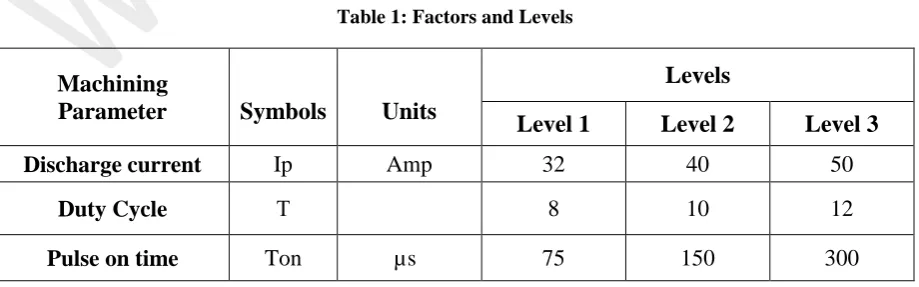
In this work, three levels and three factors such as peak current, duty cycle and pulse on time are considered for the experiment. The factors and levels are shown in Table 1.
Table 1: Factors and Levels
Machining
Parameter Symbols Units
Levels
Level 1 Level 2 Level 3
Discharge current Ip Amp 32 40 50
Duty Cycle Τ 8 10 12
Volume 02, No. 4, April 2016
P
age
114
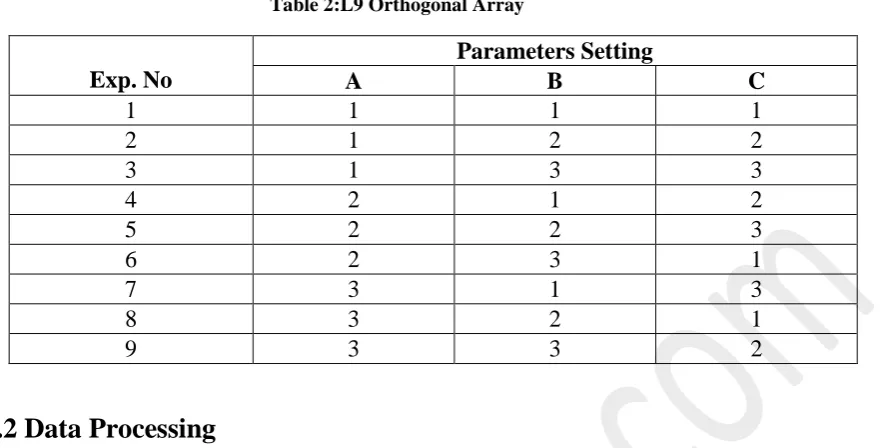
Table 2:L9 Orthogonal Array
Exp. No
Parameters Setting
A B C
1 1 1 1
2 1 2 2
3 1 3 3
4 2 1 2
5 2 2 3
6 2 3 1
7 3 1 3
8 3 2 1
9 3 3 2
3.2 Data Processing
MRR is calculated as the proportion of the change of weight of the work piece before and after machining to the product of machining period and density of the material.
MRR = (Wbm-Wam) / (t×ρ)
Whereas:
Wbm = Weight of work piece before machining.
Wam = Weight of work piece after machining.
t = Machining period
ρ = Density of work piece material
TWR is calculated as the proportion of the change of weight of the tool before and after machining to the product of machining period and density of the tool material.
TWR = (Wbm-Wam) / (t×ρ)
Whereas:
Wbm = Weight of tool before machining.
Wam = Weight of tool after machining.
t = Machining period
Volume 02, No. 4, April 2016
P
age
115
4.
RESULTS AND ANALYSIS
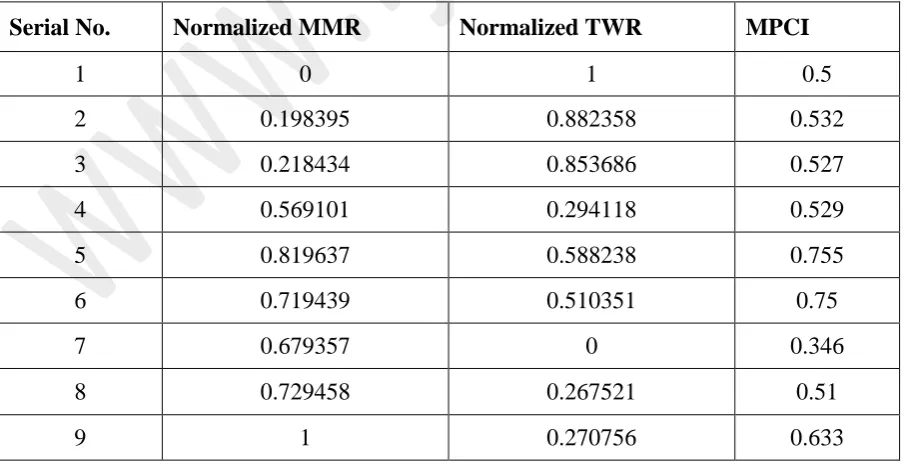
The following results have been obtained using fuzzy based Taguchi approach. Table 3 shows the computed values of MRR and TWR. Table 4 shows the Normalized values for MRR and TWR.
Table 3: Experimental runs for Taguchi L9 Orthogonal Array with MRR and TWR
Experimental run
Process Parameters Responses
Peak Current
Duty Cycle
Pulse On Time
MRR (mm3/min)
TWR (mm3/min)
1 32 8 75 2.802547 0.111735
2 32 10 150 7.006369 0.186219
3 32 12 300 7.430997 0.204373
4 40 8 150 14.861995 0.558659
5 40 10 300 20.169851 0.372439
6 40 12 75 18.046709 0.421753
7 50 8 300 17.197452 0.744878
8 50 10 75 18.259027 0.575499
9 50 12 150 23.991507 0.573451
Table 4: Normalized values with the MPCI values for all the experimental runs
Serial No. Normalized MMR Normalized TWR MPCI
1 0 1 0.5
2 0.198395 0.882358 0.532
3 0.218434 0.853686 0.527
4 0.569101 0.294118 0.529
5 0.819637 0.588238 0.755
6 0.719439 0.510351 0.75
7 0.679357 0 0.346
8 0.729458 0.267521 0.51
Volume 02, No. 4, April 2016
P
age
116
Fig. 2: Membership function for MRR
Fig.2 represents the membership function for MRR, which is one of the input variable forMamdani fuzzy controller.
Volume 02, No. 4, April 2016
P
age
117
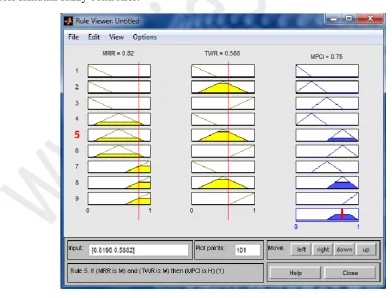
Fig. 3 shows the fuzzy rule viewer for fifth rule, where the normalized values of MRR and TWR are 0.82 and 0.588 respectively
Fig. 4: Surface plot
Fig. 4 shows the surface plot graph between MRR, TWR and MPCI. From the fig. it is observed that, when MRR increases TWR also increases and also it is observed that with the increase in MRR and TWR, MPCI also increases.
Taguchi Analysis: MPCI versus A, B, C
Linear Model Analysis: Means versus A, B, C
Estimated Model Coefficients for MeansTerm Coef SE Coef T P Constant 0.564667 0.03288 17.174 0.003 A 1 -0.045000 0.04650 -0.968 0.435 A 2 0.113333 0.04650 2.437 0.135 B 1 -0.106333 0.04650 -2.287 0.149 B 2 0.034333 0.04650 0.738 0.537 C 1 0.022000 0.04650 0.473 0.683 C 2 -0.000000 0.04650 -0.000 1.000
Analysis of Variance for Means
Volume 02, No. 4, April 2016
P
age
118
C 2 0.002904 0.002904 0.001452 0.15 0.870 Residual Error 2 0.019459 0.019459 0.009729
Total 8 0.133988
S = 0.09864 R-Sq = 85.5% R-Sq(adj) = 41.9%
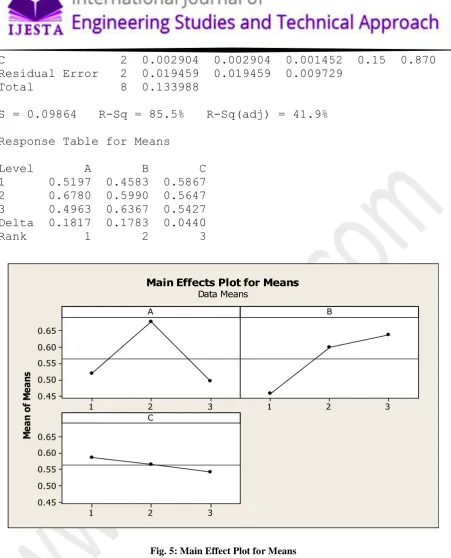
Response Table for Means
Level A B C 1 0.5197 0.4583 0.5867 2 0.6780 0.5990 0.5647 3 0.4963 0.6367 0.5427 Delta 0.1817 0.1783 0.0440 Rank 1 2 3
3 2
1 0.65
0.60 0.55
0.50 0.45
3 2
1
3 2
1 0.65
0.60
0.55
0.50
0.45
A
M
ea
n
of
M
ea
ns
B
C
Main Effects Plot for Means Data Means
Fig. 5: Main Effect Plot for Means
From the main effect plot (Fig. 5), it can be observed that the optimal parameters setting for machining of mild steel is found out at level combination (3, 2, 1) that means peak current at 50 Amp, duty cycle at 10 and pulse on time at 75 micro second. The above parametric combination must give the optimal value of MRR as well as TWR.
4. CONCLUSIONS
Volume 02, No. 4, April 2016
P
age
119
this project, the effect of input parameters of EDM machining process such as peak current, duty cycle and pulse on time on the output parameters like MRR and TWR of machining of mild steel is studied. The technique used in this study is Taguchi Method in order to obtain the process responses. It was demonstrated in this research that the most significant & effective factors in the MRR of mild steel work piece machined by copper tool are the peak current and pulse on time, whose increase increases the MRR. With the increase of pulse on time & pulse current, tool wear increase. Optimum parameters of input factors are as follows: Ip= 50 Amp, τ= 12 and Ton= 150µs. In Taguchi L9 orthogonal matrix experiment, no interactions between the input factors are considered. But some interaction effect may be present during the experiment. This may result in some observations which do not go with the theoretical belief. Fuzzy model was developed based on Experimental results obtained from the DOE. Fuzzy model selects more precise selection of EDM process parameters the system is easy to use, provide compact selection and enables the un skilled user to select the necessary process parameters which leads better MRR and TWR.
From the main effect plot (Fig. 5), it can be observed that the optimal parameters setting for machining of mild steel is found out at level combination (3, 2, 1) that means peak current at 50 Amp, duty cycle at 10 and pulse on time at 75 micro second. The above parametric combination must give the optimal value of MRR as well as TWR. From the analysis of variance (ANOVA), the obtained value of R-Sq is 85.5% and the residual error is 0.01945, which shows that this analysis is a better analysis.
REFERENCES
i. S Kumar, TP Singh (2007), “A comparative study of the performance of different EDM electrode material in two dielectric media”, (IE) (I) Journal- PR, Vol. 8, pp. 38.
ii. MK Pradhan, CK Biswas (2008), “Modelling of machining Parameters for MRR in EDM using response surface methodology”, Proceedings of NCMSTA’ 08 Conference (National Conference on Mechanism Science and Technology, from Theory to Application), NIT Harripur, India.
iii. Reddy Sidda B., Rao PS, Kumar JS and Reddy KVK (2010), Parametric study of electric discharge machining of AISI 304 stainless steel, International journal of engineering science and technology, Vol. 2, No. 8, pp. 3535-3550.
iv. Dewangan S.K. (2010), Experimental Investigation of Machining parameters for EDM using U-shaped Electrode of AISI P20 tool steel, M-Tech Thesis.
v. Iqbal AKM A. and Khan A.A. (2011), Optimization of process parameters on EDM milling of stainless steel AISI 304, Advanced Materials Research, pp. 979-984.
vi. Abbas Md. N., Solomon D.G. and Bahari Md. F. (2007), A review on current research trends in electrical discharge machining (EDM), International Journal of Machine Tool and Manufacture, pp. 1214-1228.