Modern Journal of Language
Teaching Methods
(MJLTM)
ISSN: 2251 – 6204
www.mjltm.org
Editor – in – Chief
Hamed Ghaemi, Assistant Professor in TEFL, Islamic Azad
University (IAU)
Editorial Board:
1. Abednia Arman, PhD in TEFL, Allameh Tabataba’i University, Tehran, Iran 2. Afraz Shahram, PhD in TEFL, Islamic Azad University, Qeshm Branch, Iran 3. Amiri Mehrdad, PhD in TEFL, Islamic Azad University, Science and research
Branch, Iran
4. Azizi Masoud, PhD in Applied Linguistics, University of Tehran, Iran 5. Basiroo Reza, PhD in TEFL, Islamic Azad University, Bushehr Branch, Iran 6. Dlayedwa Ntombizodwa, Lecturer, University of the Western Cape, South Africa 7. Doro Katalin, PhD in Applied Linguistics, Department of English Language Teacher
Education and Applied Linguistics, University of Szeged, Hungary
8. Dutta Hemanga, Assistant Professor of Linguistics, The English and Foreign Languages University (EFLU), India
9. Elahi Shirvan Majid, PhD in TEFL, Ferdowsi University of Mashhad, Iran 10. Fernández Miguel, PhD, Chicago State University, USA
11. Ghaemi Hamide, PhD in Speech and Language Pathology, Mashhad University of Medical Sciences, Iran
12. Ghafournia Narjes, PhD in TEFL, Islamic Azad University, Neyshabur Branch, Iran 13. Grim Frédérique M. A., Associate Professor of French, Colorado State University,
USA
14. Izadi Dariush, PhD in Applied Linguistics, Macquarie University, Sydney, Australia 15. Kargozari Hamid Reza, PhD in TEFL, Payame Noor University of Tehran, Iran 16. Kaviani Amir, Assistant Professor at Zayed University, UAE
17. Kirkpatrick Robert, Assistant Professor of Applied Linguistics, Shinawatra International University, Thailand
18. Mehrani Mehdi, PhD in TEFL, University of Neyshabur, Neyshabur, Iran 19. Morady Moghaddam Mostafa, PhD in TEFL, University of Tabriz, Iran 20. Mouton Nelda, PhD in Education Management, North-West University
(NWU), South Africa
21. Najafi Sarem Saeid, PhD Candidate in TEFL, Islamic Azad University, Science and Research Branch, Tehran, Iran
22. Naicker Suren, Department of Linguistics and Translation, University of South Africa
23. Ndhlovu Finex, PhD, Linguistics Programme, University of New England, Australia 24. Raddaoui Ali Hechemi, PhD, Associate Professor of Applied Linguistics, University
of Wyoming in Laramie, USA
25. Rezaei Saeed, PhD in TEFL, Sharif University of Technology, Tehran, Iran
26. Rolstad Kellie, PhD, Associate Professor of Education, University of Maryland, USA 27. Roohbakhshfar Hamid, PhD in TESOL, Islamic Azad University, Neyshabur Branch,
Iran
28. Sanatifar Mohammad Saleh, PhD in Translation Studies, Tabaran Institute of Higher Education, Mashhad, Iran.
29. Shafiee Sajad, Department of English, Shahrekord Branch, Islamic Azad University, Shahrekord, Iran
30. Stobart Simon, PhD, Dean of Computing, Teesside University, UK
31. Suszczynska Malgorzata, Senior Assistant Professor, University of Szeged, Hungary 32. Tabeifard Sayed Javad, PhD in ELT, University of Tehran, Kish International
Campus, Iran
33. Weir George R. S., PhD in Philosophy of Psychology, University of Strathclyde, Glasgow, UK
34. Zabihi Reza, PhD in TEFL, University of Neyshabur, Neyshabur, Iran 35. Zegarac Vladimir, PhD, University of Bedfordshire, UK
ABSTRACTing/Indexing
Index Copernicus 2011
Linguistics ABSTRACT
EBSCO Publication
Lulu Publication
ProQuest
Modern Language Association
Cabell's Directories
COPE
Directory of Research Journal Indexing (DRJI)
Indian Citation Index
International Society of Universal Research in Sciences
Ulrich's
Table of Contents
EXPERIMENTAL STUDY OF SOCIAL AND PSYCHOLOGICAL CORRECTION OF THE TEENAGE PERONALITY’S VALUES AND MOTIVATION SPHERE WHO IS PRONE TO DEVIANT BEHAVIOR
Valentina B. Salakhova, Anna I. Tashcheva, Svetlana V. Gridnevа, Igor E. Zhmurin, Mikhail N. Mikhaylovsky
DIDACTIC POSSIBILITIES OF INTERACTIVE TECHNOLOGIES IN TEACHING A FOREIGN LANGUAGE AT THE UNIVERSITY
Maria V. Nazarova and Agzam A. Valeev
QUALITY AS A FACTOR OF SOCIAL RESPONSIBILITY OF EDUCATION
Elena Y. Levina, Larisa A. Apanasyuk, Sergey A. Yakovlev, Irek M. Faizrakhmanov, Oksana A. Revzon and Aleksei I. Seselkin
ORGANIZATION TECHNIQUES OF PROBLEM DIALOGUE AT ELEMENTARY SCHOOL LITERATURE LESSONS
Venera G. Zakirova,Leysan R. Kayumova and Elvira G. Sabirova
METHOD OF RIDDLES AS A MEANS OF THE LINGUOCULTURALOGICAL KNOWLEDGE FORMATION AMONG PRIMARY SCHOOL CHILDREN
Irina V. Khairova
STUDY OF SPIRITUAL AND MORAL QUALITIES OF STUDENTS RUSSIAN AND TATAR NATIONALITY WITHIN THE EDUCATION ENVIRONMENT
Milyausha R. Khairutdinova
CURRENT STATE AND FORMATION PROBLEMS OF ELEMENTARY SCHOOL TEACHERS’ READINESS TO USE INTERACTIVE TECHNOLOGIES
Venera G. Zakirova, Elvira G. Sabirova& Leysan R. Kayumova
A CASE-STUDY OF PREVENTING STUDENT’ ACADEMIC PROCRASTINATION Laysan A. Rybakova and Roza A. Valeeva
PEDAGOGICAL POTENTIALITY OF INFORMATIONAL AND EDUCATIONAL ENVIRONMENT IN RESEARCH ACTIVITY OF JUNIOR PUPILS
Elvira G. Sabirova, Venera G. Zakirovaand Leysan R. Kayumova
THE USE OF INTERACTIVE LEARNING TECHNOLOGIES IN MATH CLASSES Nadezhda V. Telegina, Elvira G. Galimova and Svetlana G. Dobrotvorskaya
FORMATION TECHNIQUE OF THE WOMEN POSITIVE SELF Tatiana P. Sharay
SELF-EVALUATION AND INTER-EVALUATION AS EFFECTIVE WAYS OF IMPROVING THE PERFORMANCE OF PRIMARY SCHOOL LEARNERS
Ranija R. Khamatvalieva and Venera G. Zakirova
PEDAGOGICAL METHODS OF SYSTEM AND CRITICAL THINKING AS A STRATEGY OF THE PERSONAL SELF-ADAPTIVITY
Julia V. Andreeva, Ilmira A. Raskhodovа and Eugenia N. Lyashko
INVESTIGATING THE EFFECT OF VARYING TEXT DIFFICULTY LEVELS ON LEARNERS’ READING COMPREHENSION
M.Rahim Bohlooli Niri
THE EFFECTS OF USING BLENDED LEARNING STRATEGY ON ACHIEVEMENT AND ATTITUDE OF LAW STUDENTS IN TEACHING ESP Ahmad Mohseni, Mozhgan Fathi
EFFICACY STUDIES AND ENGLISH LANGUAGE LEARNERS’ SELF-EFFICACY
HONG SHI
THE SELECTION OF FORMULAIC EXPRESSIONS BY EFL STUDENTS IN APPLIED LINGUISTICS: THE CASE OF LEXICAL BUNDLES
Hassan Jalali Gholam Reza Zarei
THE EFFECT OF INSTRUCTION TYPE AND PUSHED OUTPUT TASKS ON YOUNG IRANIAN EFL LEARNERS' PRAGMATIC AWARENESS
Mehrdad Amiri Toofan Javanshir
THE STATUS OF E.L.DOCTOROW’S BILLY BATHGATE IN AMERICAN BILDUNGSROMAN TRADITION: A SEMIOTIC ANALYSIS
Mehrzad Mostofi, Behzad Barekat
TRADITIONAL AND MODERN ELEMENTS OF ETHICS IN POETRY OF NIMA YUSHIJ
Mohammad Hossein Nikdarasl Davoud Ramezani Parsa
THEORETICAL ALTERNATIVES OF CREATION OF A TERMINOLOGY AND EXPLANATORY DICTIONARY OF SCHOOL MANAGEMENT
Mária Pisoňová, Adriana Nagyová, Jana Bírová, Farida Sh. Mukhametzyanova, Elena V. Makarova
THE EFFECT OF DYNAMIC VERSUS NON-DYNAMIC ASSESSMENT ON THE USE OF RESULTIVE CONJUNCTIONS IN CAUSE EFFECT PARAGRAPH PATTERN OF WRITING
Bahar Rabi, Seyed Abdolmajid Tabatabaee, Mohammad Attarzadeh
CULTURAL CONCEPTUALIZATION OF DAST 'HAND' IN PERSIAN Elaheh Rahimi
THE EFFECTS OF KEEPING VOCABULARY NOTEBOOKS ON INTERMEDIATE EFL LEARNERS’ VOCABULARY ACQUISITION
Leila Roshan Shahin Sheikh Hoda Divsar
THE EFFECT OF COLLOCATIONS ON IRANIAN MALE AND FEMALE LEARNERS' VOCABULARY KNOWLEDGE
Fatemeh Sabounchi
LISTENING STRATEGIES USED BY IRANIAN EFL LEARNERS IN LISTENING COMPREHENSION OF TOEFL ACADEMIC LECTURES: FOCUS ON GENDER Seyyed Taghi Yaghoubi
Fatemeh Seyyedi
STUDENTS‘ ATTITUDES TOWARDS THE USE OF REGULATED LEARNING AND CORRECTIVE FEEDBACK IN DIALOGIC INTERACTIONS IN EFL CLASSES
Farangis Shahidzade
EFFECT OF PHONETIC PROGRAMMING ON NORMAL VARIABILITY IN LANGUAGE DEVELOPMENT
Fateme Sayyahi, Zahra Soleymani, Noureddin Nakhostin Ansari
STUDENTS’ MOTIVATION IN LEARNING ENGLISH USING ONLINE GAMES Siti Hajar Halili, Rafiza Abdul Razak & Hamidah Sulaiman
BOOK REVIEW: INPUT, INTERACTION, AND CORRECTIVE FEEDBACK IN L2
LEARNING Ali Taghinezhad
THE IMPACT OF DIALOGUE COMPLETION TASK (DCT) ON VOCABULARY LEARNING AMONG IRANIAN INTERMEDIATE EFL LEARNERS
Esmaeel Vaziri
METHODOLOGICAL ASPECTS OF FOREIGN LANGUAGE TEACHING IN THE PREPARATION OF THE TOUR GUIDES
Natalia A. Zaitseva, Anna A. Larionova, Nataliya S. Yakimova, Maria G. Leukhova, Oksana I. Radina
CROSS-CULTURAL ADAPTATION OF PROFILING ELEMENTS OF PROSODY IN SPEECH_COMMUNICATION: VALIDITY AND RELIABILITY IN PERSIAN Elnaz Ghorbani, Seyyedeh Maryam Khoddami, Zahra Soleymani, Shohreh Jalaie, Mojtaba khodadadi
EXPERIMENTAL STUDY OF SOCIAL AND
PSYCHOLOGICAL CORRECTION OF THE
TEENAGE PERONALITY’S VALUES AND
MOTIVATION SPHERE WHO IS PRONE TO
DEVIANT BEHAVIOR
Valentina B. Salakhova 1*, Anna I. Tashcheva 2, Svetlana V. Gridnevа 3, Igor E.
Zhmurin 4 and Mikhail N. Mikhaylovsky 5
1 Faculty of Humanities, Ulyanovsk State University, Ulyanovsk, Russia. E-mail: [email protected].
2 Department of Social Psychology and Personality Psychology, Academy of
Psychology and Pedagogy, Southern Federal University, Rostov-on-Don, Russia. E-mail: [email protected].
3 Department of Social Psychology and Personality Psychology, Academy of
Psychology and Pedagogy, Southern Federal University, Rostov-on-Don, Russia. E-mail: [email protected].
4 Faculty of Psychology, Moscow Region State University, Moscow, Russia. E-mail: [email protected].
5 The Department of management of nursing activities and social work, The
Sechenov First Moscow State Medical University, Moscow, Russia. E-mail:
*corresponding author email: [email protected]
Abstract
The importance of the problem considered is stipulated by dynamic transformations of society values reflected in teenagers’ consciousness and which are manifested in various forms of deviant behavior. The purpose of the article is to study the influence of the system of values on teenagers’ motivation which is expressed in refocusing behavior on a normative or a deviant orientation. For this purpose we have conducted experimental research of the influence of the social and psychological correction which is carried out as the program of developing values and motivation on the system of teenagers’ values and on the change of behavior. As a result of such experiment we have revealed a positive action of internal motivation that helps to uncover true meanings of his(her) own activity which, in its turn, has a positive effect on the orientation of behavior towards normative. The materials of the article can be of use to school psychologists in their practical work while solving the problems connected with deviant behavior of teenagers.
Keywords: personality, value orientations, motivation, teenagers, deviant behavior.
Introduction
In contemporary society with the interrelation system getting more and more complicated and owing to which the transformation of interaction structure takes
place, the acquisition of the reference frame is becoming more important with which a person could make sense of his life activity and prospects of his future. From this perspective, the role of the values system which a person is motivated by, undoubtedly, rises and they serve as conscious reference points in forming the attitude towards the world and to himself. Such problem setting becomes especially important regarding the manifestation of various forms of deviant behavior. Deviations in a person’s behavior are manifested in a majority of forms both traditional – aggression and autoaggression, alcoholism and drug addiction, offences and crimes, and also connected with the new forms of society development such as, for example, Internet-addiction. Deformation of the personality’s normative and values system (“nuclear formation of the personality” A.N. Leontyev, 1977) under the influence of external effects in the process of socialization determines the formation of deviant behavior (Ovsyanik et al., 2016; Salakhova et al., 2016a). The problem of forming the system of values is touched upon in а vast array of contemporary scientists’ works. Т.V. Vasilyeva (2014) thinks that under contemporary conditions of rethinking and reconsidering the values the topic of value orientations of the personality acquires a special significance because it is they that determine the functioning and development of a man (Vasilyeva, 2014). In К.М. Sabirova and N.V. Tekhteleva’s (2014) opinion, political, social and economic changes in our country led to the destruction of the customary system of values such as homeland, the family, friendship, communication (Sabirova & Tekhteleva, 2014). F.S. Kudzieva (2014) is of the same opinion considering that contemporary fundamental transformations of Russian society are characterized by a shift of emphasis in the system of interaction "society- family – an individual" from society to an individual (Kudzieva, 2014). О.V. Zakrevskaya’s (2013) work says that in society there is a deficiency of principles and rules consciously accepted by the majority of citizens and lack of creational reference points is observed. Values are formed spontaneously.
Society transformations exert a special influence, first of all, on the system of value orientations in the younger generation (Kalinina et al., 2016). So, in Е.P. Savrutskaya’s (2014) work the conducted monitoring of value orientations of young people helped to reveal the tendencies of changes in values and priorities of contemporary, youth, mass consciousness. The growth of interethnic tension is becoming one of the negative changes among the others (Savrutskaya & Ustinkin, 2014). О.V. Zakrevskaya (2013) also believes that the formation of value orientations takes place throughout the whole life of a man, but it is manifested more systematically, consistently and profoundly in the period of growing up. That is why the period of the personality’s formation in a younger age is very important in view of his (her) value and normative orientation , and in case of a negative development it may lead to the deviant behavior orientation (Rean, Belinskaya & Narovsky, 2013; Lipatova et al., 2015).
V.A. Yadov’s (2013) concept provisions are consonant with it which develop the idea that value orientations based on the system of values being one of the central, personal formations, express a conscious attitude to social reality and in this quality determine wide motivation of his behavior and exert a substantial influence on all
aspects of his activity. The system of values is directly connected with the personality’s orientation, determines a substantive aspect of the personality and represents the foundation of the person’s world outlook, his views on the environment, attitude to other people, to himself, the core of motivation. Value orientations formed at a youth age on the basis of the system of values that formed in young people determine peculiarities and character of the personality’s relations with the real world and thus determine behavior in a certain degree.
Thus the problem of studying the personality’s value and motivation sphere of young people under contemporary conditions in Russia takes on a special significance in view of its direct connection with a young man’s behavior and its manifestation in activity. It is very important for the personality’s value and motivation system of contemporary young people to gain a normative character. In this regard, the development of methods for forming the system of value orientations of young people directed towards not deviant but normative behavior seems to be productive, which is in accord with our previous study (Oschepkov, 2013; Afanasenko et al., 2015; Efimova et al., 2015; Silantiev & Mikhaylova, 2012; Enyashina & Mitin, 2011).
This range of problems determined the direction of empirical research. In view of the above-mentioned, we put forward the following hypothesis – making a social and psychological impact on the value and motivation sphere of the teenage personality leads to the change of the system of values and refocusing behavior from a deviant orientation to a normative. The specified range of problems and the hypothesis, in its turn, outlined the objectives set for our study:
1. To carry out empirical research of the personality’s value and motivation domains and level of proneness to deviant behavior in teenagers.
2. To conduct an experimental study of implementing the program of social and psychological correction of deviant behavior directed towards the development of values and motivation in the teenage personality.
3. To prepare a comparative analysis of the proneness level to deviant behavior in the control and experimental sample groups of teenagers before and after social and psychological correction .
Research Methodology
We used the author’s program compiled on the basis of V.A. Klimchuk’s (2005) developments as the teenage personality’s value and motivation development program in our experimental research. In empirical research we used S. Shwarts’s (1992, 1994) values questionnaire oriented to the measurement of motivation domains that specify the most significant value reference points of the person’s life activity (Shapar, 2005), and diagnostics technique of proneness to deviant behavior (PDB) (the author – А. N. Oryol (2002) which is a standardized test questionnaire intended for measuring the inclination of teenagers towards various forms of deviant behavior (Shapar, 2005).
Experimental research was conducted at the Children’s Academy of Humanities of Pedagogical lyceum in the town of Dimitrovgrad of the Ulyanovsk region. Twenty teenagers aged 14-16 participated in the experiment, 10 young boys and 10 girls. The major criterion of separating tested teenagers in sample groups was participation in
the program of social and psychological correction. The comparative analysis of the system of values and proneness to various forms of deviant behavior was carried out in sample groups formed in such manner. Forms of deviant behavior were identified with the help of the values questionnaire and technique of identifying proneness to deviant behavior.
Results
For the purpose of conducting experimental research two groups of teenagers were formed - the control (10 people) and experimental (10 people). The groups had the similar gender composition: the control group - 5 boys and 5 girls, the experimental - 5 boys and 5 girls. Psychological testing was carried out in the groups with the use of S. Shwarts’s value questionnaire and A.N. Oryol’s (2002) technique of identifying the inclination towards deviant behavior. Testing was done in a classroom of the school where members of the group were seated separately and introductory briefing was used which had a positive effect on the validity and reliability of the study. Psychological testing was carried out before and after the implementation of the teenage personality’s values and motivation development program.
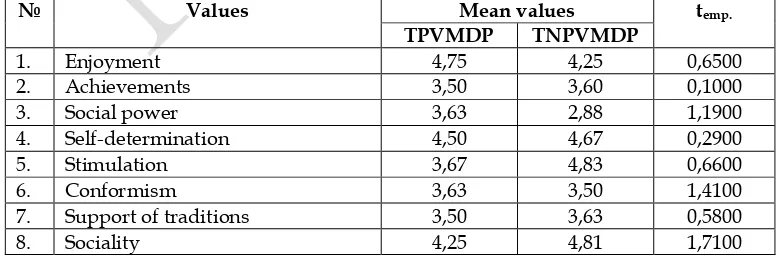
For the purpose of analyzing the teenagers’ systems of values who participated in the values and motivation development program (TPVMDP) and teenagers who did not participate in the above mentioned program we made a comparison of the mean values of the system of values in the groups before and after the implementation of the social and psychological correction with the use of Student’s statistical t-criterion. Special attention was paid to significant differences in moral values of the studied teenage groups that could testify to the influence of the social and psychological impact on the personality of a teenager. At the same time, as we can see from table 1, statistically significant differences of the systems of moral values were not found in the analyzed sample groups of teenagers before the experimental study. For convenience of stating the material the following abbreviations will be used further: TPVMDP – teenagers, participating in the values and motivation development program, TNPVMDP – teenagers who did not participate in the values and motivation development program.
Table 1. Comparison of the mean values in teenagers’ values participating in the
program of developing values and motivation, and teenagers not participating in the values and motivation development program before the experimental study
№ Values Mean values temp.
TPVMDP TNPVMDP
1. Enjoyment 4,75 4,25 0,6500
2. Achievements 3,50 3,60 0,1000
3. Social power 3,63 2,88 1,1900
4. Self-determination 4,50 4,67 0,2900
5. Stimulation 3,67 4,83 0,6600
6. Conformism 3,63 3,50 1,4100
7. Support of traditions 3,50 3,63 0,5800
8. Sociality 4,25 4,81 1,7100
9. Security 4,17 4,75 1,2200
10. Maturity 4,14 4,36 0,4000
11. Social culture 3,14 3,86 1,0200
12. Spirituality 3,80 4,50 0,9300
These results show a relative homogeneity of the values systems of the teenage personality which can be characterized as usual. In the usual system of a teenager’s values the values of enjoyment, self-determination, sociality and security are more significant which characterizes specific features of the personality development in teens. So, teenagers are in search of new feelings, new impression, along with the orientation to social contacts. Yet, teenagers did not grow into an independent, self-sufficient personality that is why their need for security and self-determination was also very significant.
Further analysis was devoted to the comparison of the groups’ mean values in the proneness level to deviant behavior in the teenagers who participated and did not participate in the values and motivation development program before the experimental study. As a result, a statistically significant difference was found in the proneness level to self-destructive behavior (temp=2,3249 when ρ≤0,01), the
significance of which was higher in the group of teenagers who later participated in the values and motivation development program (table 2).
Table 2. Comparison of the mean values in teenagers’ values participating in the
program of developing values and motivation, and teenagers not participating in the values and motivation development program before the experimental study
№
п/п Proneness TPVMDP Mean values TNPVMDP temp.
1. to disobeying norms and rules 51 42 1,0607
2. to addictive behavior 45 38,5 1,4444
3. to self-destructive behavior 50 37,5 2,3249**
4. to aggressive behavior 49 38,5 1,2025
5. to delinquent behavior 36,5 36 0,1373
** - significant differences when 0,01
Such result, not in accord with a customary image, nonetheless it can be explained by the fact that the teenagers were grouped on a voluntary basis and that is why, the group, which was given the personality development, became more attractive for teenagers who have some personality problems - in our case, proneness to self-destructive behavior.
After conducting the experimental study a subsequent analysis of the values system and proneness level to deviant behavior was carried out in the sample groups of teenagers who participated in the values and motivation development program and teenagers who did not participate in the values and motivation development program. As a result, statistically significant differences were found in the values of “enjoyment” (temp=4,90 when ρ≤0,01) “achievements” (temp=8,01 when ρ≤0,01) and
“spirituality” (temp=2,83 when ρ≤0,01), the significance of which was higher in the
group of teenagers who participated in the values and motivation development program and, the value “sociality” (temp=5,66 when ρ≤0,01), the significance of
which was higher in the group of teenagers who did not participate in the values and motivation development program (table 3).
Table 3. Comparison of the mean values in teenagers’ values participating in the
program of developing values and motivation, and teenagers not participating in the values and motivation development program after conducting the experimental
study
№ Values Mean values temp.
TPVMDP TNPVMDP
1. Enjoyment 5,75 4,25 4,9000**
2. Achievements 4,90 3,20 8,0100**
3. Social power 5,13 4,25 1,0100
4. Self-determination 5,17 5,17 0,0000
5. Stimulation 4,33 4,50 0,3300
6. Conformism 3,88 3,75 0,3400
7. Support of traditions 3,63 3,75 0,1600
8. Sociality 4,06 4,75 5,6600**
9. Security 3,71 4,07 0,8700
10. Maturity 4,79 4,07 1,4200
11. Social culture 4,14 3,71 0,5200
12. Spirituality 4,20 3,80 2,8300**
** - significant differences when 0,01
The differences revealed can be considered as a result of influence of the social and psychological impact made during the implementation of the values and motivation development program. Thus one can consider that in the personality of teenagers who participated in the experimental program of the values and motivation development the following changes happened. Teenagers demonstrated the significance increase of enjoyment values, values of achievement and spirituality but decreased the significance of sociality value. This is explained by the influence of the program specificity directed to uncovering the internal motivation which is expressed in search of such motives of activity that motivated a person by themselves, in comparison with external motivation consisting in aspiration to external stimuli related to the personality. That is why the significance of spirituality and aspiration to achievements rises. Internal motivation helps a person to find true meanings and objectives in life that uncovers a tremendous internal potential - the activity of a person becomes as a flow which brings enjoyment in internal perfection. This explains the increase of the value of enjoyment and, in its turn, is explained by the decrease of the value of sociality because external social reference points are replaced by internal ones agreed with their own system of values.
Statistically significant differences were not found while analyzing the proneness level to deviant behavior in the teenage groups participating in the values and motivation development program and teenagers who did not participate in the same program after conducting the experimental research. Moreover, the established difference in the proneness level to self-destructive behavior in the analyzed teenage groups before conducting the experimental study was also not
found (table 4).
Table 4. Comparison of mean values in the groups of the proneness level to deviant
behavior in teenagers who participated in the values and motivation development program and teenagers who did not participate in the program after conducting the
experimental study
№ Proneness Mean values in the groups temp.
TPPVMD TNPVMD
1. to disobeying norms and rules 48 45 0,3163
2. to addictive behavior 49 41,5 1,2127
3. to self-destructive behavior 47,5 51 0,1000
4. to aggressive behavior 49 50 0,0620
5. to delinquent behavior 44 45 0,1240
These results also testify to a positive influence of the values and motivation development program on a teenager’s behavior the implementation of which led to a decrease in the level of proneness to self-destructing behavior. This can be explained by the fact that the internal motivation development made it possible to bring out potential resources of the teenager’s personality blocked by some personal problems. Such disclosure helps to relieve tension that breeds proneness to self-destructing behavior which is manifested in refocusing behavior on a normative one.
Discussion
The conducted empirical research allowed us to analyze the significance change of the teenage personality’s values as a result of the experimental implementation of the values and motivation development program. This experiment made it possible to demonstrate a positive influence of the internal motivation development which is significant in revealing the internal potential of the personality as a result of uncovering the true meaning of his(her) own activity. Positive changes in the system of values of the teenage personality have a positive effect on behavior through the elimination of intrapersonal barriers refocusing him on a normative orientation.
Conclusion and Recommendations
On the basis of the abovementioned one can make the following conclusions.
1. A dynamic transformation of the contemporary society is manifested in the values system deformation – individualism succeeds collectivism, common human and universal values of the family, friendship and honesty are subject to change. The changes that take place, first of all, are reflected in consciousness of the younger generation which is expressed in the deformation of the personality’s values systems and leading to the manifestation of various forms of deviations in behavior. 2. The conducted experimental research enabled us to confirm the point that value orientations based on the system of values which is one of the central personal new formations, express a conscious attitude of a teenager to social reality and in this quality they determine a wide motivation of his behavior and have a substantial influence on all aspects of his(her) activity.
3. The results of the study can be of practical use to psychologists, social workers and specialists in the field of education who work with deviant teenagers.
Acknowledgements
The study is conducted with the financial support of Grant of Presidency within scientific-research project "Integrative resources of the individual in the context of the modes of human existence", project N МК-1562.2017.6
References
Afanasenko, I.V., Tashcheva, A.I., and Gabdulina, L.I. (2015). System of Values of the Youth in the Light of its Social Frustration. The Social Sciences, 10, 1287-1290.
Afanasenko, I.V., Tashcheva, A.I., Gabdulina, L.I. (2015). Value orientations in connection with the social frustration of students and working young men and women. Humanities and Social Sciences, 4, 172-183.
Bedredinova, S.V., Danchenko, A.I., Tashcheva, A.I. (2015). Features of dysfunctional relationships in families with a special psychological status. Izvestiya Southern Federal University. Pedagogical sciences, 4, 119-124.
Efimova, О.I. Salakhova, V.B., Mikhaylova I.V., Gnedova, S.B., Chertushkina, T.A. & Agadzhanova, E.R. (2015). Theoretical review of scientific approaches to understanding crisis psychology. Mediterranean Journal of Social Sciences, 2, 3-11.
Efimova, О.I., Oschepkov, А.А. & Salakhova, V.B. (2015). Personality and deviations:
values and meanings. Ulyanovsk: USU.
Enyashina, N.G., Mitin, S.N. (2011). The phenomenon of a game and its psychology and pedagogical resources. Bulletin of the Ekaterininky institute, 3, 11-15.
Kalinina, N.V., Kalinin, I.V., Oschepkov, A.A., Salahova, V.B. & Simanovskaja M.A. (2016). The Use of Social Resources of Inclusive Educational Environment to Cope Difficult Situations by Adolescents. IEJME-Mathematics Education, 11(7), 2527-2536.
Klimchuk, V.А. (2005). Internal motivation training. St. Petersburg: Speech.
Kudzieva, F.S. (2014). The mechanisms of forming value orientations in the rising generation in the context of the family transformation. News of Saratov University. New series. Sociology. Politology, 2, 61-65.
Leontyev, A.N. (1977). Activities. Consciousness. Personality. M.: Politizdat.
Lipatova, N.V. Salakhova, V.B., Chertushkina, T.A., Ermolayeva, S.V., Mikhaylova, I.V., Shrol, O.Y., Panteleev, S.V. (2015). An adaptive man: hardiness resources in the conditions of system crises at the turn of the xix-xx and the xx-xxi centuries. Mediterranean Journal of Social Sciences, 6. (2) S3, 136-141.
Oryol, A.N. (2002). Determination of tendency to deviant behavior / Fetiskin NP, Kozlov VV, Manuilov G.M. Socio-psychological diagnosis of personality development and small groups. Moscow: Publishing House of the Institute of Psychotherapy.
Oschepkov, А.А. (2013). Psychosemantic space peculiarities of the teenage personality’s self-consciousness prone to suicidal behavior. Bulletin of Moscow State Regional University. Series: Psychological sciences, 4, 86-92.
Ovsyanik, O.A. Belinskaya, D.B., Kochetkov, I.G. and Deberdeeva, N.A. (2016). Specific Features of Value Orientations and Social Mindsets of Deviant Teenagers. International journal of environmental & science education, 11(18), 12327-12336.
Rean, A.A., Belinskaya, D.B., Narovsky, V.M. (2013). Problems of school students’ social adaptation of the “Risk group” of children – orphans. Bulletin of Moscow University of the Ministry of Internal Affairs of Russia, 5, 235-239.
Sabirova, К.М., Tekhtekeva, N.V. (2014). To the problem of forming orphans’ value orientations in an orphanage setting. Bulletin of the Samara Municipal Institute of Management, 3, 169-175.
Salakhova, V.B., Oschepkov, A.A., Lipatova, N.V., Popov, P.V. & Mkrtumova, I.V. (2016a). Features of Social Attitudes and Value Orientations of Youths and Adolescents Prone to Auto-Aggressive Behavior. International journal of environmental & science education, 11(16), 9017-9025.
Savrutskaya, Е.P., Ustinkin, S.V. (2014). Dynamic patterns of youth value orientations: an interethnic aspect. Power, 10, 123-128.
Schwartz, S.H. (1992). Universals in the content and structure of values: Theory and empirical tests in 20 countries. In M. Zanna (Ed.), Advances in experimental
social psychology, 25, 1-65. Schwartz, S.H. (1994). Are there universal aspects in
the content and structure of values? Journal of Social Issues, 50, 19-45.
Shapar, V.B. (2005). Practical psychology. Analytical tools. Rostov on/D.: Phoenix. Silantiev, M.S., Mikhaylova, I.V. (2012). Cognitive processes of understanding and
interpretation of behavior in a life situation. In the book: Fifth International Conference on Cognitive Science, abstracts in 2 volumes. Interregional Association of Cognitive Studies, Center for the Development of Interpersonal Communications, Baltic FederaMil University Immanuel Kant, Government of the Kaliningrad region. 619-621.
Vasilyeva, T.V. (2014). The problem of forming students’ value orientations. Bulletin of Kemerov State University, 2, 87-91.
Yadov, V.А. (2013). Self-regulation and forecasting the personality’s social behavior: A dispositional concept. М.: Center for Social forecasting and marketing. Zakrevskaya, О.V. (2013). Specific features of senior teenagers’ value orientations.
The contemporary society’s system of values, 29, 97-103.
DIDACTIC POSSIBILITIES OF INTERACTIVE
TECHNOLOGIES IN TEACHING A FOREIGN
LANGUAGE AT THE UNIVERSITY
Maria V. Nazarova1* and Agzam A. Valeev2
1Department of Foreign Languages for Natural Sciences, Institute of International
Relations, History and Oriental Studies, Kazan (Volga region) Federal University, Kazan, Russia. E-mail: [email protected]
2Department of Foreign Languages for Natural Sciences, Institute of International
Relations, History and Oriental Studies, Kazan (Volga region) Federal University, Kazan, Russia. E-mail: [email protected]
*corresponding author email: [email protected]
Abstract. Modern higher education is focused today on the use of such teaching technologies that would effectively ensure the process of intensifying higher education, in particular, in the field of foreign languages. This is connected, for example, with the use of interactive technologies that are aimed at achieving the necessary level of efficiency and quality of instruction and ensuring that each student has the opportunity to study according to an individual program. In this regard, the article reveals and justifies the following: The didactic possibilities of using interactive technologies in teaching a foreign language at the university; The use of multimedia teaching aids in the context of the formation of communicative competence; Ways to apply interactive projects for teaching a foreign language; Efficiency of complex types of interactive teaching methods. In the course of the study, the results of the experimental work showed the effectiveness of methodological support for the development of the ability to learn a foreign language and to develop communicative competences, as well as orientation to communicatively oriented learning in order to prepare students for professional, cultural and personal communication with representatives of a different social and social organization.
Keywords: educational technologies, interactive technologies, foreign languages, language training, language and communication competencies, multimedia teaching tools, interactive projects, quality of teaching.
Introduction
Actualizing the problem
The Russian education system is undergoing great changes, which is connected with the process of Russia's integration into the world community, including in the educational sphere. At the same time, the modernization of the national education system, among other things, is aimed at the following: Teaching students of an independent selection of teaching aids, for example, in mastering a foreign language; The creative rethinking of the content of their own education; The competent use of methods and technologies in the study of a foreign language (Moreva, 2007). To do this, it is necessary to create a favorable atmosphere of the
educational process in the university in order to increase interest in the studied language and develop the desire for its practical use. And these goals, one way or another, can be achieved through the use of interactive technologies, which represent an important educational resource. The wide use of interactive technologies allows us to modify the nature of the development, acquisition and dissemination of knowledge; Opens up opportunities for updating the content of teaching and teaching methods; Expands access to general and vocational education; Changes the role of teachers in the learning process (a constant dialogue that transforms information into knowledge and understanding). This is the relevance and complexity of this problem, since it requires the development and introduction of new ideas and approaches in the educational process related to innovative teaching methods. As practice shows, the development of interactive technologies opens new perspectives for the teaching of foreign languages, helping to intensify and individualize learning (Sizova, 2014). On this basis, the use of interactive technologies should contribute to the main goal of the modernization of Russian education: improving the quality of education aimed at ensuring the comprehensive development of the individual with an information culture who can be guided in the information space and have experience in using modern educational technologies in the course of his professional development in the context of mastering foreign languages. Thus, the use of various interactive technologies is an integral part of teaching a foreign language; a lot of modern teachers in their practice apply innovative methods of teaching in cooperation with new technical means in practical exercises.
Explore importance of didactic possibilities of interactive technologies in teaching a foreign language at the university
The use of interactive technologies in teaching a foreign language at the university (for example, trainings, business games, discussions, mini-studies, Internet projects, authentic audio recordings, etc.), shows, first of all, the strengthening of the communicative orientation of the educational process. This means orientation to communicatively oriented learning, which prepares students for the use of a foreign language in real life, i.e. to professional, cultural and personal communication with representatives of different social and public structures (Skorina, 2004; Valeeva et al., 2016). To achieve this goal, it is necessary to implement the following tasks in the university:
- Implementation of an innovative approach within the framework of training in order to develop the ability of students to learn new experiences, both in the application of computer technology and in a foreign language;
- Maximum use of interactive technologies with an emphasis on their information and communication component;
- The organization of independent cognitive activity of students with the purpose of expanding their opportunities for improving the process of self-education and, in general, the overall development of their personality;
- Providing conditions for combining individual work, group work and joint work of all participants in the training session, connected to a single network of both the faculty and the university;
- The use of computer servers in all forms and types of educational activities in order to create conditions for the formation of positive motivation for learning foreign languages;
- Training students in competent work on the computer in order to create opportunities for detailed monitoring of their own training activities;
- Creating conditions for modeling social interactions that arise in different types of activities and on this basis the development of the ability to reflect accumulated cognitive and life experience;
- Providing students with such knowledge that would help determine their free, meaningful choice of future professional activities.
Thus, traditional classes should give way to a variety of interactive teaching methods, from role-playing games to computerized seminars (Tyshchenko, 2003). That is why today new didactic possibilities of interactive technologies appear that arise as a result of such factors as the possibility of situational information interaction among participants in the learning process; implementation of the process of communication at a distance; the possibility of using educational information through various information technologies, etc.
Didactic possibilities of interactive technologies in teaching a foreign language at the university
Proceeding from the understanding of didactic possibilities as prerequisites for the qualitative formation of subject knowledge and skills, we understand the didactic possibilities of using interactive technologies in terms of methods, techniques and means of instruction aimed at the specific management of the teacher by the cognitive activity of students with the aim of mastering the latter knowledge and skills in the field of foreign language. The didactic possibilities of using interactive technologies presuppose the following: The possibility of simultaneous direct dialogue mode on the basis of synchronous interaction; Reliance on group experience and the presence of mandatory feedback; Activation of the student as the main character in the educational process; Providing independent work on the language at the level of intellectual and emotional capabilities of the student, which ensures the differentiation and individualization of the learning process; Taking into account the interests and needs of each student; Involvement of any form of work in the group (individual, group, collective) in order to stimulate the activity of students; Providing interactive learning on the basis of a specially created learning environment; The possibility of forming educational and cognitive competencies taking into account professionally oriented activities; Formation of communicative skills and culture communication among students; Formation of the ability to extract information from various sources and process it using computer technologies. Taking into account that the didactic possibilities of using interactive technologies presuppose the possibilities of information technologies, we primarily include the following: we can transfer information of any volume and any form of representation to any distance; The ability to access various sources of information, including remote and distributed data; The possibility of dialogue with any partner; The possibility to transfer received materials to your carrier and work with them at any convenient time; The ability to use e-mail (allows teachers and students to
exchange text and picture messages); The possibility of organizing "virtual classrooms" (for example, on the Internet the software allows for the joint communication of groups of users); The possibility of holding a seminar on the scheme of seminar-mutual learning, a seminar-discussion; Conducting an electronic lecture; The possibility of holding an electronic conference (computer conferences, during which participants who are at different distances from one another exchange message texts); The possibility of using a video-telephone (ensuring the possibility of two-way communication between the teacher and students); The possibility of organizing news broadcasts (in the USENET newsgroups mode), operating in real time; The possibility of using electronic libraries (the use of services such as video libraries, music libraries, toy libraries, electronic textbooks, copying technology). Status of a problem
The carried out analysis of scientific and pedagogical literature, the study of the practice of teaching foreign languages in the university revealed the urgency of using the following methodological concepts presented by domestic and foreign experts in interactive technologies: interactive methods of teaching a foreign language in research of M.S. Skorina (2007); D. Brown (2001); O.V. Skvortsova (2009); E.V. Chereshneva (2008); Information technologies in teaching a foreign language in research of M.E. Sergeeva (2005); T.N. Sergeyeva (1991); Z.R. Devterova (2007); The use of multimedia teaching aids in research of O.I. Barmenkova (1999); M. Sсhittek (2001); A.A. Mirolyubov (2003); Formation of communicative competence in the studies of I.A. Zimnay; I.A. Mazaeva (2002); Y.Y.Kim (1991); Methodology of communicative learning in research of Ch. Brumfit & K. Johnson (1979); K. Johnson & D. Porter (1983); E.I. Passov (1989); The use of interactive projects in teaching a foreign language in the studies of E.S. Polat (2000); V.V. Yakovlev (2008); O.A. Vladyko (2007); Intensification of the process of teaching a foreign language in research of N.N. Serostanov (2015); A. Bleakly (1994); N. Garret (2009); L. Alekseeva et al. (2015); Organizational forms in the information environment of training in the studies of G.D. Pankova (2003); I.V. Robert (1994); S.V. Titov (2004); The use of educational technologies that allow to optimize the creative potential of future specialists in the research of S.G. Vershlovskiy (2002); L.I. Gurie (2008); L.F. Mikhaltsova (2011); The theory of information modeling in the studies of Ya.A. Branovsky (2002); B.Е. Vagramenko (1994); B.Е. Starichenko & S.S. Arbuzov (2014); The theory of management of the process of learning and the use in it information technology are researched by A.A. Kuznetsov (1986); E.G. Malinochka (1989); N.F. Talyzina (1985); teaching technology in collaboration with the method of projects in research of D. Johnson (1988); R. Johnson (1995); V.K. Kilpatrick (1918); The technology of personality-oriented training in research of A.A. Valeev & I.G. Kondratieva (2015); S. Crumly (2014); G.B. Wright (2011).
Hypothesis
The didactic possibilities of interactive technologies in teaching a foreign language at the university can be successfully realized if the following educational methods are implemented in the educational process of the university: If there are specified the appropriate role and place of interactive technologies in the educational process of the university; If there is created a rich multi-environment in the educational
space of the university, which involves various channels of perception of information - text, visual, audio information; If there are determined pedagogical bases of using interactive technologies: diagnostics of students' abilities to study a foreign language and the technological organization of this process; If communicative oriented learning is provided in the study of a foreign language.
Materials and Methods
The tasks of the research
The tasks of the research are: 1) To substantiate the use of interactive projects when teaching students a foreign language; 2) To justify the didactic possibilities of using interactive technologies; 3) To summarize the use of multimedia teaching tools in the context of the formation of communicative competence; 4) To justify the use of certain groups of interactive teaching methods.
Theoretical and empirical methods
At various stages of the study, the following methods were used: Theoretical methods - understanding of the problem and the subject of research; modeling of the pedagogical process; theoretical generalization of the results of the work performed, taking into account specific conditions and new facts; Empirical methods - relatively comparative analysis of the results of the experiment; observation; interviews; questioning; pedagogical experiment; Mathematical methods - registration, mathematical and statistical processing of the results.
The trial infrastructure and stages of the research
The basis of the study was The Institute of Fundamental Medicine and Biology and The Institute of Management, Economics and Finance of Kazan (Volga region) Federal University. The study was conducted within the framework of training students specializing in "Foreign Language". The study was carried out in two stages: At the first stage (September 2015) students were formed with the following perceptions: the idea of multimedia teaching a foreign language; Didactic possibilities of using the Internet; Possibilities to extract foreign information from various sources and process it using computer technology; Interrelation of language competences with professionally oriented activities. The state of this problem was studied in university teaching practice; Empirical material was collected; Attitude of students towards technical means in the process of studying languages and, in general, cognitive activity has been studied. At the second stage (May 2016), management techniques and guidelines for the study of didactic possibilities of using interactive technologies were developed in teaching a foreign language at the university; There was carried out the experimental verification of the realization of the possibilities of using interactive technologies in the study of a foreign language and on this basis the formation of foreign language skills, as well as the skills of using the language in various spheres and situations of communication; The registration of research results was carried out.
Types of interactive projects
Based on the tasks of teaching a foreign language, in order to intensify the process of its study, it seems expedient to use the following types of interactive projects: I. Language interactive projects: 1) Teaching projects aimed at mastering the language material and developing speech skills; 2) Linguistic projects: the study of
linguistic features and language realities (neologisms, phraseological units, sayings); 3) Philological projects: the study of the etymology of words including various literary studies.
II. Cultural projects (regional-based interactive projects): 1) historical projects: studying the history of the country, the city; 2) geographical projects: the study of the geography of the country; 3) ethnographic projects: the study of traditions and life of the people, folk art; 4) political and economic projects: acquaintance with the state structure of countries, with public organizations; 5) art criticism projects : they are associated with problems of art, literature, culture of the country of the studied language.
III. Gaming interactive projects: 1) Social projects (students perform different social roles); 2) Business projects (modeling of professional situations); 3) Dramatized projects (the study of literary works in game situations where students act as characters); 4) Projects of imaginary travel (learning speech structures, cliches, specific terms, dialogues, descriptions, reasoning, etc.).
Basic groups of interactive teaching methods
Considering the question of teaching students a foreign language in the context of the use of interactive technologies, it should be noted that, as a rule, the following main groups of interactive teaching methods are distinguished: Methods without using technical means; Methods with partial use of technical means; Methods with the use of technical means (audiovisual). So, the first group of methods (without the use of technical means) is usually referred to dialogues, polylogue, the organization of reflexive activity, the creation of productive communication, the use of the method of changing activities; Intellectual, imitative exercises; Problem technologies (heuristic conversation, method of organized strategies, heuristic questions, a bank of ideas, a method of activation of creative thinking). The second group includes methods of independent study of a foreign language on the basis of communication with the native speaker of the studied language, for example, the so-called "tandem method", when students get acquainted with the identity of a specific native speaker, the mentality of his country, culture in real or virtual communication. The essence of this method consists in oral or written informal communication (it is assumed the use of a computer with connection to the Internet). Tandem participants, or tandem partners, are selected by the international network of the International Tandem Network.
From the point of view of the problem under consideration, the third group of methods for teaching foreign languages, which includes the use of audio-visual teaching aids, is relevant to us. It is one of the types of technical means of teaching, representing a variety of modern technical devices and information carriers at all stages of the educational process. The effectiveness of teaching students a foreign language in the context of the use of interactive technologies involves the use of certain technical means of instruction, depending on the type of activity that is carried out with their help during the functioning of information, namely: Information interactive technologies that provide direct information; Management interactive technologies, allowing to organize a cycle of management of the educational process; Additional information technical means, including devices,
instruments, tools used to improve the work of the teacher, the student and their interaction during the training; Controlling information technology that provides feedback information (Brown, 2001). At the same time, the effectiveness of interactive technologies is determined by their compliance with specific educational objectives, tasks, specificity of the educational material, forms and methods of organizing the work of the teacher and students, material and technical conditions and opportunities.
Results
The use of multimedia teaching aids in the context of the formation of communicative competence
The main and leading goal of using interactive technologies, in particular multimedia teaching tools, is the formation of communicative competence, which is an integral personal quality that provides situational adaptability and freedom of possession of verbal and non-verbal means of communication. The structure of this competence includes the following components: Communicative knowledge (knowledge of communicative methods and techniques, what action they have, what are their capabilities and limitations); Communicative skills (the ability to organize the message text in an adequate form, the ability to receive feedback, the ability to overcome communication barriers, the ability to organize cooperation); Communicative abilities (individual psychological characteristics of the personality, contributing to the rapid and successful implementation of communicative activities). At the same time, communicative competence presupposes the following: Knowledge of the necessary languages; Skills and techniques of using the language in various spheres and situations of communication; The ability to understand the similarities and differences in the language of science, art, foreign languages; The ability to determine one’s own success in interacting with the world and surrounding people. And, proceeding from the subject of our research, we are turning to the help of modern interactive technologies, among which an important place is occupied by multimedia teaching aids. Interest in multimedia learning tools, for example, the Internet, has grown very much today. As the university practice shows, modern computer programs make it possible to master the foreign language as effectively as possible, presenting a complete educational and methodical complex. This type of interactive technology creates the illusion of being in a language environment; it gives the opportunity to form the ear-pronunciation of speech, the assimilation of lexical and grammatical material, etc. (Barmenkova, 1999). It is also important to note that the use of interactive technologies when teaching students a foreign language allows one to individually structure different levels of complexity that can be chosen by students and that can allow to realize one of the basic principles - from simple to complex,. The undoubted advantage of using interactive technologies in a foreign language is the ability to differentiate the actual information (for example, in the form of video, photo, audio, text, etc.). It is used with taking into account the set of methodological and didactic tasks and allows unlimited adaptation of such materials for the needs of not only a particular occupation, but even for the needs of individual students. Currently, the following training programs are used in the class: "Living English", "Frankly Speaking",
"Discovering the World", "Professor Higgins", "English Platinum", British English course "REWARD". There are also used different social services such as the Internet, Blog, Twitter, Wiki, podcast, Flickr, YouTube, etc., which can be used in teaching a foreign language allowing students to contact the network in the studied language. The procedure and results of the experiment
Organizing in the experimental work the learning process of students towards the use of interactive technologies in view of updating the knowledge and skills of the use of multimedia in the future profession, we have tried to make in this process the most efficient conversion. According to the study, to evaluate the effectiveness of didactic possibilities of using interactive technology in teaching a foreign language it is advisable using diagnostic procedures. In this regard, we have used such forms of diagnosis as polls, surveys of students and test their knowledge and skills in the field of interactive technologies. The diagnostic step in the experiment was of particular importance since it helped to identify students' current level of knowledge of multimedia training tools and skills they use. Continuously during the experiment there was carried out the analysis and synthesis of the results of the intermediate measurements of the levels of development of the parameters of the ability to learn a foreign language, carried out in order to clarify the program of pedagogical experiment. This allowed making adjustments in the course of experimental work to identify the best prospects for the use of interactive technologies. In the course of the experimental work there was carried out validation studies of the hypothesis. Using multimedia teaching aids in teaching a foreign language allowed us to allocate one more object of verification - professional orientation of using these aids in one’s activities. Monitoring was carried out orally and in written form. Diagnostic data are adequately static treatment. The results pointed out the growth rates for the selected parameters of the ability to learn a foreign language. The experimental results showed a rising trend of indicators monitored parameters in the extended use of interactive technologies. Providing communicatively oriented training in the study of a foreign language and implementation of interactive learning based on a specially designed learning environment, as well as the possibility of the formation of educational and cognitive competences based professionally oriented activities have been pilot tested.
Experimental work took place on the 2 course of The Institute of Fundamental Medicine and Biology and the 2 course of The Institute of Management, Economics and Finance of Kazan (Volga region) Federal University. Two groups of students participated in the experiment: the experimental group (18 students) and the control group (20 students). The control group of The Institute of Management, Economics and Finance was trained by the traditional method of learning a foreign language. The experimental group of The Institute of Fundamental Medicine and Biology was offered the entire complex of interactive technologies with the introduction of such organizational forms as problematic lecture, debate, seminar-discussion, seminar mutual learning, project work, the electronic conference, videophone, etc. During the control part of the experiment there was carried out the analysis of parameters such as: Formation of foreign language skills to extract information from different sources and process it using computer technologies; Formation of foreign language
speaking skills and abilities; Formation of linguistic competence taking into account professionally-oriented activities; Forming students' communicative skills and culture of dialogue; Skills and abilities of language use in various fields and communication situations. In the course of experimental research work the following stages were performed: Stage 1: Determine the starting level of the parameters of the ability to learn a foreign language; Stage 2: Using the main types of interactive technologies by the experimental group during the study of discipline "Foreign language"; Stage 3: Analysis of changes in the values above mentioned parameters before and after the experiment. The study showed that taking into account the possibilities of using interactive teaching technologies in teaching a foreign language at the university the highest rates were demonstrated by parameters such as: Formation of students’ communication skills and culture of dialogue; Formation of foreign language speaking skills and abilities; Skills and abilities of language use in various fields and communication situations. Diagnosis of parameters ability to learn a foreign language based on multimedia teaching aids has shown the effectiveness of the use of interactive technologies. Analysis results are shown in Table 1..
Table 1. Developing the ability to study a foreign language through the use of interactive technologies
Parameters of the ability to learn a foreign language in the application of interactive technologies
Formation of linguistic competence with considering professionally oriented activities
Forming students' communication skills and communication culture
Formation of the ability to extract foreign language information from various sources and process it using computer technologies
Formation of foreign language speech skills
Skills and abilities of language use in different spheres and situations of communication
The control group (in %) 15 20 10 18 15
The experimental group (in %)
45
60
48
62 65
Analysis and evaluation of the results of experimental work allow us to conclude that the indicators of the ratio of students to the studied subject and the level of development of language competencies, taking into account the didactic possibilities of using interactive technologies in teaching a foreign language in the Experimental group is higher than the values obtained in the Control group.
Discussions
So, as practice shows, today it is practically it is impossible to fully implement the training of students in a foreign language without the use of interactive technologies, as they create an innovative educational environment in which students have to develop professional and personal attitudes, position their interests and represent themselves in poly-linguistic space. And here we are talking about the fact that when teaching a foreign language, along with education and development, it is necessary to develop communicative competence among young people in all the diversity of its components (linguistic, discursive, sociocultural, compensatory, educational and cognitive). This circumstance is determined by the contemporary reality, when foreign language communication becomes an essential component of the future professional activity of a specialist and when the possession of a foreign language remains one of the elements of its relevance. In the context of the issue under discussion (teaching a foreign language at the university in the context of the use of interactive technologies), the level of the formation of the communicative competence of future specialists will be determined not only by the ability to communicate in a foreign language with the personal presence of participants in communication, but also by the ability to communicate through all kinds of the Internet network services. In this regard, the role of interactive technologies in the framework of, for example, the academic subject "Foreign language" in non-linguistic faculties of higher education institutions significantly increases, as the goal is to achieve a level sufficient for the practical use of foreign languages in future professional activities. This leads to a factor in the successful study of any subject (including a foreign language) as students’ need for their self-education. And here the study of a foreign language with the help of interactive technologies can be viewed not only as an instrument of communication, but also as a means to stimulate the process of cognition. Thus, there is no doubt that interactive technologies contain enormous didactic potential. But it should not be forgotten that even the most perfect and newest interactive technologies do not replace the teacher; they serve only as a means of optimizing and intensifying the learning process, a successful organization of which depends on many factors, such as: The availability of the necessary set of interactive programs of various types; Educational quality of the used training programs; Teachers’ proficiency in the integration of various types of programs in the educational process, etc.
Conclusion
In conclusion, we note that the most important characteristics of interactive technologies can be attributed also to the fact that interactive training will always be a special form of cognitive activity, which has very specific and predictable goals, for example, in the following: creating a comfortable learning environment, where students feel themselves successful with their intellectual solvency and the productivity of the learning process. Moreover, the essence of interactive technologies is that during the learning process all students are involved in the learning process, having the following opportunity: To understand and reflect on what they know and think; To see what individual contribution they make; To feel in which mode there is the exchange of knowledge, ideas and methods of activity. Thus, interactive technologies bring to the training session a certain improvisation,
which has an unconventional structure, when the use of interactive technologies in teaching a foreign language significantly improves the quality of the teaching material and the effectiveness of the learning of this material by students. And, as practice shows, the use and implementation of modern educational technologies, multimedia equipment enriches the content of the educational process, increases students’ motivation to learn English, while creating favorable conditions for close cooperation between the teacher and students. In th