Sara Heydari1 , Mojtaba Fattahi Ardakani2* , Elham Jamei2, Soheila Salahshur2
1. Department of Medical Education, Medical Education Research Center, Isfahan University of Medical Sciences, Iran. 2. Department of Health Education, School of Public Health, Shahid Sadoughi University of Medical Sciences, Yazd, Iran.
* Corresponding Author:
Mojtaba Fattahi Ardakani, PhD.
Address: Department of Medical Education, Medical Education Research Center, Isfahan University of Medical Sciences, Iran. Phone: +98 (913) 3566877
E-mail: [email protected]
Research Paper:
Determinants of Completing the
Medication Reconciliation Form Among Nurses
Based on Diffusion of Innovation Theory
Background: Patients afety is a global medical concern with remarkable influence on the health of patients. Studies have suggested that treatment-related damages occur in approximately 10% of patients at variable degrees, and more than a quarter of these damages are associated with medication errors. Medication errors could be diminished during patient hospitalization and transferusing integrated medication reconciliation. This study aimed to evaluate the determinants of completing integrated medication reconciliation forms based on the theory of diffusion of innovations among the nurses of Ziaei Hospital of Ardakan City and Imam Jafar Sadegh Hospital of Meybod City, Yazd.
Materials and Methods: In this study, required data were collected from the nurses engaged in the admission centers of the selected hospitals using researcher-made questionnaires. Data analysis was performed in SPSS v. 19 using Spearman’s correlation-coefficient and Mann-Whitney U test.
Results: Findings of this study regarding different structures of integrated medication reconciliation forms were as follows: relative advantage (86.5 of the maximum score), perceived compatibility (40.75), perceived complexity (44.3), visibility (83.6), and testability (79.8). Moreover, significant correlations were observed between the structures of comparative advantage, perceived compatibility, testability, and visibility.
Conclusion: According to the results of this study, promoting the knowledge and professional attitude of nurses could increase their compatibility regarding the implementation of integrated medication reconciliation. In addition, elaboration on the proper principles of the completion of this form could reduce the mean score of the perceived complexity structure.
A B S T R A C T
Keywords:
Innovation diffusion, Management, Medication reconciliations, Nurse, Patient safety
Citation Heydari S, Fattahi Ardakani M, Jamei E, Salahshur S. Determinants of Completing the Medication Reconciliation Form Among Nurses Based on Diffusion of Innovation Theory. Journal of Research & Health. 2020; 10(3):151-158. http:// dx.doi.org/10.32598/JRH.10.3.1491.1
:
: http://dx.doi.org/10.32598/JRH.10.3.1491.1
Use your device to scan and read the article online
Article info:
Received: 13 Jan 2018
Accepted: 23 May 2018
Introduction
atient safety is a global medical con -cern in all areas of healthcare services in developed and developing countries. Statistically, it has been found that treat-ment-borne damages occur in approxi-mately 10% of all hospitalized patients at variable degrees [1].
Based on studies conducted in Australia, 16.6% of hos-pitalized patients experience adverse events, which may lead to temporary disabilities (77%), permanent disabili-ties (15%), and death (5%) [2].
Recent reports have confirmed that medication errors account for more than a quarter of problems affecting patients during hospitalization and treatment [3, 4].
Medication errors mostly occur during the processes of preparation, prescription, distribution, and monitoring of therapeutic drugs. Time of admission has been recent-ly proposed as a significant factor in the occurrence of treatment-related complications. More than 50% of pa-tients had been subjected to medication errors at the time of admission due to errors in their medical history [5].
Medication errors can lead to several problems, includ-ing high hospitalization costs, increased mortality rate, and lack of patients’ trust and satisfaction with hospital services [6]. In Iran, the Ministry of Health and Educa-tion allocates billions of dollars every year to
compen-sate for the cost of medication and admission errors [7].
However, many medication errors are preventable and can be corrected with efficient management. Base on a study, 48% of these errors are preventable [1]. Accord-ing to the results of another study, two-thirds of patients’ complications upon admission were reported to be pre-ventable with efficient management [8]. Incompatibility in prescribed drugs after discharge plays a critical role in the occurrence of adverse medical events. Discharged patients are at a higher risk of complications caused by medication incompatibility as they return to normal
so-cial life [9,10]. In this regard, the findings of Forrest-er indicate that 23% of the patients discharged from a teaching hospital in Canada experienced unwanted side effects, 72% of which were associated with drug
admin-istration [11].
Medication reconciliation is an effective strategy to re-duce medication errors and several studies have proved its effectiveness [12]. For instance, the results of a re-port confirmed that integrated medication reconciliation
could reduce medical errors by 70% within 7 months
[13]. Medication reconciliation is mainly based on pro -viding a complete medical history, which differs from the routine medical record of the patient [1]. The required medical history is provided through a systematic pro-cess of interviewing the patient and referring to credible sources (e.g., pharmacies and physicians) [14]. Howev-er, since the patient’s interview may be time-consuming, healthcare providers tend to neglect this process, which exposes patients to a higher risk of unexpected medica-tion and treatment-related errors [15]. Furthermore, inte-grated medication reconciliation is widely used for pa-tients who are unfamiliar with prescription medications.
Diffusion of innovations is a theory of the main princi-ples used to facilitate the adaption of healthcare provid-ers with a specific procedure. The proper implementation of this theory requires a suitable setting and the aspect of innovation highlights the ideas, issues, and functions that are considered unprecedented by another individual. In this context, the term “unprecedented” refers to the situation in which a potential recipient has had no previ-ous contact with the other applications of a certain new product or idea [16].
In applying the diffusion of innovations theory, health authorities are faced with unestablished interventions
and their impact on a certain process [17]. For a new
approach to become established and widely practiced, three main components are required: the new idea must be accepted by influential people, the new idea must be of great quality or with notable characteristics to encour-age people to follow the idea, and the new idea must have remarkable environmental and social impacts [18].
In a study, Forster et al. measured the acceptance rate of preventive pharmaceutical procedures in a medical high school in 2002. According to the findings, the two structures of relative advantage and perceived compat-ibility were most effective in the adaption of new
pro-cesses [19].
In this regard, another research was conducted by McGa et al. to evaluate the role of a multi-team approach in patient transfer in 2007, emphasizing the safety of pa-tients. According to the findings, more than 90% of dis-charged patients had at least one potential exposure to medication side effects. In their study, adequate training of nurses and improvement of nursing skills in medica-tion assessment reduced the risk of mortality by at least 78%. Furthermore, less than 28% of the patients required follow-up and revisits which ultimately reduced
Considering the importance of medication
reconcilia-tion and the creareconcilia-tion of an appropriate framework for
the proper acceptance of this process, the researchers tried to investigate the determinants of using medication reconciliation in nurses based on diffusion of innovation
theory.
Methods
This cross-sectional study was conducted on 91 nurses engaged in intensive care units, internal medicine de-partments, surgery wards, cardiac care units, gynecolo-gy, and pediatric wards in two general hospitals in Arda-kan and Meybod Cities of Yazd Province, in May 2016. The participants completed a researcher-made question-naire designed based on the diffusion of innovations theory. The validity of the questionnaire was reviewed by a panel of experts and its content validity ratio and content validity index were examined and approved. To remove any ambiguity in understanding each item, the questionnaire was sent to 10 nurses and their comments were taken. The reliability of the questionnaire was also evaluated by conducting a pilot study on 15 nurses who were later excluded from the study. The final question-naire included the following subscales:
1. Relative advantage: This construct contains 6 items and the acquired score ranges from 6 to 35. In this con-struct, the positive results of the reconciliation form are questioned. Its reliability is 0.87 calculated by the Cron-bach α coefficient.
2: Perceived compatibility: This construct includes 4 items to measure the compatibility of integrated medica-tion with professional requirements (α=0.59).
3. Visibility: It includes two items scoring based on a 5-point Likert scale from completely correct to com-pletely wrong. The possible scores ranged from 2-10 (α=0.74).
4. Testability: This construct is measured with 2 items based on a 5-point Likert scale. The possible score for the construct ranged from 2-10 (α=0.62).
5. Perceived complexity: In this structure, 4 items are scored inversely. If the completion or learning of the form is considered hard, it will gain lower scores. The acquired score ranged from 4-20 (α=0.56). Subjective norms (with six items) (α=0.75) and intention (with three items) (α=0.65) are the other constructs.
The collected data were entered into SPSS v.13. One-sample Kolmogorov-Smirnov test showed that the data were non-normally distributed. Thus, the Spearman rank correlation coefficient was used to determine the correlation between variables and the Mann-Whitney U test was used to compare the groups (significance level at <0.05).
Results
In total, 91 nurses were enrolled in this study, selected via census sampling. They were assured of the confiden-tiality of the information, and then the questionnaires were provided to them to complete.
The participants’ Mean±SD of age was 34.36±7.25 years. In terms of educational status, 10 participants had a diploma in paramedical sciences and 57 nurses a BA in nursing. Their Mean±SD clinical experience was 10±8.15 years (range: 1-26 years). Besides, 30 partici-pants were male (33.3%) and 60 were female (65.9%).
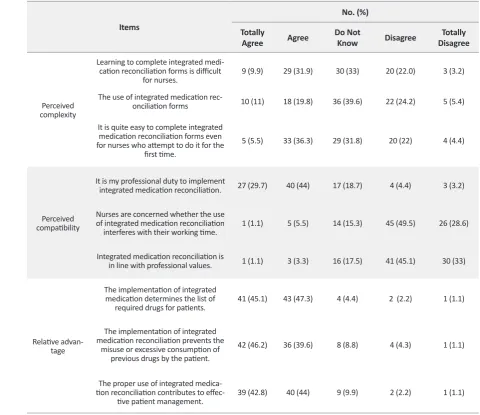
According to Table 1, 40% of the nurses found it dif-ficult to complete integrated medication reconciliation forms, and 80% did not consider this healthcare strategy to be in line with clinical professional values. Moreover, 78% of the participants were concerned that the
imple-mentation of the integrated medication program might interfere with their working time frame.
Concerning the structure of relative advantage, the majority of the nurses agreed with the benefits of the integrated medication reconciliation. As such, 82% of nurses believed that the use of this healthcare strategy contributed to effective patient management.
As revealed in Table 2, two structures of perceived complexity (44.3%) and relative advantage (40.75%) received the lowest scores obtained by the participants, while the structures, intention (91.83%) and relative ad-vantage (86.5%) had the highest scores obtained by the
participants.
The mean score of relative advantage was higher among male participants, and there was a significant difference in this regard (P=0.034). Furthermore, the mean scores of the structures, perceived complexity (P=0.001), and intention (P=0.013) were higher among male participants, and significant differences were ob-served in this regard.
complete the integrated medication reconciliation forms.
Therefore, a higher mean score of relative advantage resulted in the increased mean score of the intention structure; however, this correlation was not significant. Moreover, the correlations between the constructs of testability and visibility were not statistically significant.
Discussion
In the present study, the mean scores of different struc-tures of diffusion of innovations theory were evaluated among the nursing staff of two public hospitals. Accord-ing to the findAccord-ings, the highest scores belonged to the structures of perceived relative advantage, testability, and visibility, while the lowest scores belonged to the structures of perceived compatibility and complexity. Therefore, the majority of nurses believed that the
com-pletion of integrated medication reconciliation forms is
difficult or interferes with their professional values and
working timeframe.
As shown in Table 1, 40% of the nurses found it dif-ficult to complete the forms of integrated medication reconciliation; 80% did not believe this strategy to be in line with professional values, and nearly 78% were
concerned that this program might interfere with their
working time frame. Furthermore, the results of the pres-ent study indicated that the structures of relative advan-tage, perceived compatibility, and perceived complexity of social networks were positively correlated with the tendency of nursing staff toward using these networks. In other studies, the lack of dissemination and accep-tance of the innovation has been due to the complexity
of health systems [21, 22].
Table 1. Distribution of responses to items of relative advantage, perceived compatibility, and perceived complexity
Items
No. (%) Totally
Agree Agree Do Not Know Disagree DisagreeTotally
Perceived complexity
Learning to complete integrated medi-cation reconciliation forms is difficult
for nurses. 9 (9.9) 29 (31.9) 30 (33) 20 (22.0) 3 (3.2) The use of integrated medication
rec-onciliation forms 10 (11) 18 (19.8) 36 (39.6) 22 (24.2) 5 (5.4)
It is quite easy to complete integrated medication reconciliation forms even for nurses who attempt to do it for the
first time.
5 (5.5) 33 (36.3) 29 (31.8) 20 (22) 4 (4.4)
Perceived compatibility
It is my professional duty to implement
integrated medication reconciliation. 27 (29.7) 40 (44) 17 (18.7) 4 (4.4) 3 (3.2)
Nurses are concerned whether the use of integrated medication reconciliation
interferes with their working time. 1 (1.1) 5 (5.5) 14 (15.3) 45 (49.5) 26 (28.6)
Integrated medication reconciliation is
in line with professional values. 1 (1.1) 3 (3.3) 16 (17.5) 41 (45.1) 30 (33)
Relative advan-tage
The implementation of integrated medication determines the list of
required drugs for patients. 41 (45.1) 43 (47.3) 4 (4.4) 2 (2.2) 1 (1.1)
The implementation of integrated medication reconciliation prevents the
misuse or excessive consumption of previous drugs by the patient.
42 (46.2) 36 (39.6) 8 (8.8) 4 (4.3) 1 (1.1)
The proper use of integrated medica-tion reconciliamedica-tion contributes to
The complexity of systems can be related to the struc-ture, process, and patterns. For example, to change the method of drug delivery in a hospital, there needs to be a change in the real environment. In a system, individual factors, patterns of relationships, and beliefs should be considered. Overlooking these factors can cause more complexity of the system, as observed in the present study [21]. The findings of the current study confirmed
the correlation between the tendency towards the ap -plication of the innovation theory and the use of social
networks.
With respect to the relative advantage construct, 82.2% of the nurses believed that the implementation of inte-grated medication reconciliation contributed to effec-tive patient management. In this regard, a study was conducted by Abdullah Al-Mubariz Saud et al. [23] in
which the rate of the internet acceptance was measured based on Roger’s diffusion of innovations theory, and recipients were categorized into innovators, early ma-jority, late mama-jority, delayed recipients, and survivors. According to the results of multiple regression analysis, the researchers concluded that the innovation structures, including relative advantage, perceived complexity,
testability, perceived compatibility, and visibility were effective in the acceptance of the internet by the partici-pants. Furthermore, they reported that the structure of relative advantage had the most significant effect on the
rate of internet acceptance compared to the other aspects
of innovation. In the present study, the relative advantage structure was positively correlated with the intention of nursing personnel to complete integrated medication
reconciliation forms [24].
Compatibility is another key element of innovation dif-fusion, which can influence the reception and the use of innovation. In the current study, the majority of the nurses were concerned that the implementation of
in-tegrated medication reconciliation might interfere with
their working time frame, suggesting that this healthcare strategy has not been considered by nursing personnel. Therefore, nurses should be assured that the implementa-tion of this program helps with their professional values. This finding was consistent with the results obtained by Forster et al. that evaluated the attitude towards preven-tive procedures in a medical high school in 2002 [19].
According to their findings, the two structures of relative advantage and perceived compatibility were essentially Table 2. The tendency of nursing staff towards the completion of integrated medication reconciliation forms based on gender in the model of diffusion of innovations
Construct Mean±SD Total Score(%) Sig.
Male Female Total
Relative advantage 27.2±2.74 4.07±25.36 3.75±25.95 86.5 0.034
Perceived compatibility 2.15±8.40 1.85±8.06 1.96±8.15 40.75 0.621
Perceived complexity 1.83±9.60 1.99±8.50 1.99±8.86 44.3 0.010
Testability 1.28±7.83 5.36±8.06 4.42±7.98 79.8 0.332
Visibility 1.14±8.70 1.22±8.16 1.22±8.36 83.6 0.060
Subjective Norm 3.91±24.13 7.69±23.63 6.62±23.80 79.33 0.301
Intention 2.25±11.86 2.07±10.60 2.19±11.02 91.83 0.013
Table 3. Correlations between intention and the structures of the diffusion of innovations theory based on the Spearman cor-relation coefficient
Construct Relative Advantage Compatibility Complexity Testability Visibility
Intention 0.325** 0.171 0.231* 0.405** 0.299**
P 0.002 0.12 0.02 0.001> 0.001>
correlated with the tendency of healthcare staff towards
the use of new pharmaceutical approaches [19].
Vedela et al. study results indicate that in individuals with a lower perception of the complexity of clinical sys-tems, there is a direct correlation between comprehended simplicity and reduced perceived complexity [25]. More -over, the perception of the functionality of the system is correlated with the relative advantage structure, and con-cerns regarding the patient-physician relationship are as-sociated with the compatibility of the system. According-ly, the higher perception of the functionality of the system is correlated with the structure of relative advantage [26].
The findings of the current study indicate a direct corre-lation between the structures of testability and visibility and the structure of tendency to complete the forms of integrated medication reconciliation among nurses. This finding was in line with the results obtained by Khalesi et al. assessing the users of hospital information systems
[27]. Furthermore, the authors stated that visibility had a significant effect on the tendency of hospital staff to-wards the use of information systems. In this regard, the findings of Pankratz et al. revealed that in the proposed diffusion of innovations theory, innovation structures (visibility, perceived compatibility, professional rela-tions, and internal and external environment) were sig-nificant predictors of the attitude of healthcare profes-sionals towards the use of smartphones [28].
In other related studies, factors such as the reception of consumption management systems, human and ergo-nomics factors in the hospital, and different structures of innovation in rehabilitation management had significant associations with relative advantage, perceived compat-ibility, and perceived complexity. These findings are consistent with the results of the present study [29, 30].
Therefore, it is suggested that the modified version of the diffusion of innovations theory is adopted as a proper measure for clinical data collection to predict and com-prehend the use of social networks.
Conclusion
The results of the current study indicated that ac-ceptance of innovation in the completion of integrated medication reconciliation forms requires the increasing of nursing staff knowledge, as well as the reduction of the complexity of this strategy to help with the nursing profession. The researcher pointed out that the study
lacked any impact on the performance of the personnel
and their perception could affect the process of complet-ing the questionnaire.
Ethical Considerations
Compliance with ethical guidelines
This study is a part of a protocol approved by the Ethics Committee of Shahid Sadoughi University of Medical Sciences, Yazd, Iran (Code: IRSSU.SPH.REC.1395.76).
Funding
This research did not receive any specific grant from funding agencies in the public, commercial, or
non-prof-it sectors.
Authors' contributions
Conceptualization and Writing – Original Draft: Mo-jtaba Fattahi Ardakani; Methodology and Writing – Review & Editing: Sara Heydari sharifabad, Mojtaba Fattahi Ardakani; Investigation: all author; Funding Ac-quisition and Supervision: Sara Heydari sharifabad.
Conflict of interest
The authors declared no conflict of interest.
Acknowledgments
The authors appreciate the people who participated in this work, including the managers and nurses of Imam Jafar Sadegh Hospital of Meybod and Ziaee Hospital of Ardakan.
Refrences
[1] Brennan TA, Leape LL, Laird NM, Hebert L, Localio AR, Lawthers AG, et al. Incidence of adverse events and neg-ligence in hospitalized patients: Results of the Harvard Medical Practice Study I. N Engl J Med. 1991; 324(6):370-6. [DOI:10.1056/NEJM199102073240604] [PMID]
[2] Kohn LT, Corrigan JM, Donaldson MS. To err is hu-man: Building a safer health system. Washington: Na-tional Academies Press; 2000. https://books.google.com/ books?id=8r1QAQAAIAAJ&q
[3] Wachter R. Understanding patient safety. New York: McGraw Hill Professional; 2012. https://books.google.com/ books?id=9BuLAwAAQBAJ&dq
adverse events among hospital patients in Canada. CMAJ. 2004; 170(11):1678-86. [DOI:10.1503/cmaj.1040498] [PMID] [PMCID]
[5] Wilson RM, Runciman WB, Gibberd RW, Harrison BT, Newby L, Hamilton JD. The quality in Austral-ian health care study. Med J Aust. 1995; 163(9):458-71. [DOI:10.5694/j.1326-5377.1995.tb124691.x] [PMID]
[6] Vozikis A. Information management of medical errors in Greece: The MERIS proposal. Int J Inf Manage. 2009; 29(1):15-26. [DOI:10.1016/j.ijinfomgt.2008.04.012]
[7] Moghaddasi H, Sheikhtaheri A, Hashemi N. [Reducing med-ication errors: Role of computerized physician order entry system (Persian)]. J Health Adm. 2007; 10(27):57-67. http:// jha.iums.ac.ir/browse.php?a_id=74&sid=1&slc_lang=en
[8] Akhlaghi M, Towfighi ZH, Samadi F. Analysis of medical malpractice complaints in gynecology and obstetric reffered to the medical commission of L.M.O in Tehran from 2001-2002: Causes & preventative resolutions. Sci J Forensic Med. 2004; 10(34):4-70. https://www.sid.ir/en/Journal/ViewPa-per.aspx?ID=80357
[9] Toufighi H, Shirzad J, Ghadipasha M. Assessment of medi-cal negligence leading to death in legal medicine organiza-tion sessions between 1995 and 1999. Sci J Forensic Med. 2002; 8(27):5-8. https://www.sid.ir/en/journal/ViewPaper. aspx?id=74677
[10] Naghibi K, Montazari K, Khalifeh Soltani SS. [Investigation of medical complaint files in Medical Affairs Organization (Persian)]. J Isfahan Med Sch. 2011; 29(157):1542-53. http:// jims.mui.ac.ir/index.php/jims/article/view/1436
[11] Reason JT. Managing the risks of organizational acci-dents. Farnham: Ashgate; 1997. https://books.google.com/ books?id=ZnhRAAAAMAAJ&q
[12] Pronovost P, Weast B, Schwarz M, Wyskiel RM, Prow D, Milanovich SN, et al. Medication reconciliation: A practical tool to reduce the risk of medication errors. J Crit Care. 2003; 18(4):201-5. [DOI:10.1016/j.jcrc.2003.10.001] [PMID]
[13] Leape LL, Brennan TA, Laird N, Lawthers AG, Localio AR, Barnes BA, et al. The nature of adverse events in hos-pitalized patients: Results of the Harvard Medical Practice Study II. N Engl J Med. 1991; 324(6):377-84. [DOI:10.1056/ NEJM199102073240605] [PMID]
[14] Tam VC, Knowles SR, Cornish PL, Fine N, Marchesano R, Etchells EE. Frequency, type and clinical importance of medi-cation history errors at admission to hospital: A systematic review. CMAJ. 2005; 173(5):510-5. [DOI:10.1503/cmaj.045311] [PMID] [PMCID]
[15] Kohn LK, Corrigan JM, Donaldson MS. To Err Is Human: Building a safer health system. Committee on Quality of Health Care in America: Institute of Medicine. In: (US) IoM, editor. Washington: National Academy Press; 1999.
[16] Sanghera IS, Franklin BD, Dhillon S. The attitudes and be-liefs of healthcare professionals on the causes and reporting of medication errors in a UK intensive care unit. J Anaesth Great Britain and Ireland. 2007; 62:53-61. [DOI:10.1111/j.1365-2044.2006.04858.x] [PMID]
[17] Abir O, Kanaan, Jennifer L, Donovan, Nerissa P, Duchin B, et al. Adverse drug events after hospital discharge in older
adults. J Am Geriatr Soc. 2013; 61(11):1894-9. [DOI:10.1111/ jgs.12504] [PMID] [PMCID]
[18] Winterstein AG, Sauer BC, Hepler CD, Poole C. Prevent-able drug-related hospital admissions. Ann Pharmacother. 2002; 36(7-8):1238-48. [DOI:10.1345/aph.1A225] [PMID]
[19] Forster AJ, Murff HJ, Peterson JF. The incidence and severi-ty of adverse events affecting patients after discharge from the hospital. Ann Intern Med. 2003; 138:161-7. [DOI:10.7326/0003-4819-138-3-200302040-00007] [PMID]
[20] Rozich JD, Resar RK. Medication safety: One organiza-tion’s approach to the challenge. J Clin Outcomes Manag. 2001; 8:27-34. https://scinapse.io/papers/2340290816
[21] Whittington J, Cohen H. OSF healthcare’s journey in patient safety. Qual Manag Health Care. 2004; 13(1):53-9. [DOI:10.1097/00019514-200401000-00005] [PMID]
[22] Rozich JD, Howard RJ, Justeson JM, Macken PD, Lindsay ME, Resar RK. Standardization as a mechanism to improve safety in health care. Jt Comm J Qual Saf. 2004; 30(1):5-14. [DOI:10.1016/S1549-3741(04)30001-8]
[23] Almobarraz A. Perceived attributes of diffusion of inno-vationtheory as predictors of internet adoption among the faculty members of Imam Mohammed Bin Saud University [PhD dissertation]. Denton: University of North Texas; 2007. https://digital.library.unt.edu/ark:/67531/metadc3710/)
[24] Institute for Healthcare Improvement Preventing adverse drug events through medication reconciliation. 2009 [Version current January 20, 2009]; Available from: http://www.ihi. org/IHI/Programs/AudioAndWebPrograms/WebandAC-TIONMedReconciliation.htm.
[25] Vedela I, Lapointe L, Lussierc MT, Richard C, Goudreauc J, Lalondec L, et al. Healthcare professionals’ adoption and use of a clinical information system (CIS) in primary care: Insights from the Da Vinci study. Jt Comm J Qual Saf. 2012; 81(2):73-87. [DOI:10.1016/j.ijmedinf.2011.11.002] [PMID]
[26] Safari M. Theories, models and methods of health educa-tion and health promoeduca-tion. Tehran: Sobhan works; 2011.
[27] Khalesi N, Ahmadi M. A study on the attitudes of users about application of admission discharge system-9 (ADS-9) software in Iran and Shahid Beheshti Universities teaching hospitals, 2002. Hakim Res J. 2003; 6(3):45-53.
[28] Pankratz M, Hallfors D, Cho H. Measuring perceptions of innovation adoption: The diffusion of a federal drug preven-tion policy. Health Educ Res. 2002; 17(3):315-26. [DOI:10.1093/ her/17.3.315] [PMID]
[29] McGaw J, Conner DA, Delate TM, Chester EA, Barnes CA. A multidisciplinary approach to transition care: A patient safety innovation study. Perm J. 2007; 11(4):4-9. [DOI:10.7812/ TPP/07-012] [PMID] [PMCID]