EFFECTIVENESS OF INTERACTIVE
MULTIMEDIA PROGRAM ON LEARNING IN
ENGLISH GRAMMAR AMONG SECONDARY
SCHOOL STUDENTS IN RELATION TO
LEARNING STYLES
Naresh Kumar
Assistant Professor, Lala Lajpat Rai Memorial College of Education, V.P.O Dhudike, Tehsil & District Moga, Punjab
Abstract:
The main objective of the present study was to investigate the effectiveness of Interactive Multimedia Program on learning in English grammar among secondary school students in relation to learning styles. The present study was experimental in nature and two groups randomized Pre-test Post-test design was used. The study was conducted on the final sample N=352. 2×4 Analysis of Variance (ANOVA) was used to interpret the results. The results of the study revealed that the mean gain scores of learning in English grammar of the group taught through Interactive Multimedia Program was higher than the group taught trough Conventional Mode of Instructions. In the present study further it was found that students with different learning styles i.e. Converging, Diverging, Assimilating and Accommodating differ significantly on learning in English grammar. The students with accommodating learning style learn English grammar better than others (Converging, Diverging and Assimilating). Further there was a significant interactional effect of instructional strategies and learning styles on learning in English grammar of
secondary school students.
Key Words: Interactive Multimedia Program, Learning, Learning Styles, English
Grammar & Secondary School Students
Introduction:
In the present scenario we cannot talk about high quality learning environment, when we talk about the use of paper, pencil and books. If we want to create high quality learning environment we have to include "interactive multimedia" in it. In today's information and communication technology (ICT) age, interactive multimedia has the potential to create high quality learning environment for everyone. The key elements of interactive multimedia and user's control over the delivery of information and interactivity can be used to enhance the learning process through creating integrated learning environment. When something is explained, we can combine the explanation with illustrative examples, we can give feedback to the online assignments and the user can be provided with opportunities to practice and experiment. A range of interactive multimedia elements can be used to convey a given message and the user can study at a time and place convenient to them, taking time as long or as little they need (Cairncross and Mannion, 2001). The most challenging in instructing technical training or any other discipline, is to meet the needs of a variety of students. As Kolb (1981) discovered, learners use different learning styles in their learning process. Learning is the process whereby knowledge is created through the transformation of experience. Knowledge results the combination of grasping experience and transforming it. Learning theory given by Kolb sets out four distinct learning styles or preferences, viz. converging, diverging, assimilating and accommodating which are based on a four-stage learning cycle (Kolb, 1984).
EFFECTIVENESS OF INTERACTIVE
MULTIMEDIA PROGRAM ON LEARNING IN
ENGLISH GRAMMAR AMONG SECONDARY
SCHOOL STUDENTS IN RELATION TO
LEARNING STYLES
Naresh Kumar
Assistant Professor, Lala Lajpat Rai Memorial College of Education, V.P.O Dhudike, Tehsil & District Moga, Punjab
Abstract:
The main objective of the present study was to investigate the effectiveness of Interactive Multimedia Program on learning in English grammar among secondary school students in relation to learning styles. The present study was experimental in nature and two groups randomized Pre-test Post-test design was used. The study was conducted on the final sample N=352. 2×4 Analysis of Variance (ANOVA) was used to interpret the results. The results of the study revealed that the mean gain scores of learning in English grammar of the group taught through Interactive Multimedia Program was higher than the group taught trough Conventional Mode of Instructions. In the present study further it was found that students with different learning styles i.e. Converging, Diverging, Assimilating and Accommodating differ significantly on learning in English grammar. The students with accommodating learning style learn English grammar better than others (Converging, Diverging and Assimilating). Further there was a significant interactional effect of instructional strategies and learning styles on learning in English grammar of
secondary school students.
Key Words: Interactive Multimedia Program, Learning, Learning Styles, English
Grammar & Secondary School Students
Introduction:
In the present scenario we cannot talk about high quality learning environment, when we talk about the use of paper, pencil and books. If we want to create high quality learning environment we have to include "interactive multimedia" in it. In today's information and communication technology (ICT) age, interactive multimedia has the potential to create high quality learning environment for everyone. The key elements of interactive multimedia and user's control over the delivery of information and interactivity can be used to enhance the learning process through creating integrated learning environment. When something is explained, we can combine the explanation with illustrative examples, we can give feedback to the online assignments and the user can be provided with opportunities to practice and experiment. A range of interactive multimedia elements can be used to convey a given message and the user can study at a time and place convenient to them, taking time as long or as little they need (Cairncross and Mannion, 2001). The most challenging in instructing technical training or any other discipline, is to meet the needs of a variety of students. As Kolb (1981) discovered, learners use different learning styles in their learning process. Learning is the process whereby knowledge is created through the transformation of experience. Knowledge results the combination of grasping experience and transforming it. Learning theory given by Kolb sets out four distinct learning styles or preferences, viz. converging, diverging, assimilating and accommodating which are based on a four-stage learning cycle (Kolb, 1984).
EFFECTIVENESS OF INTERACTIVE
MULTIMEDIA PROGRAM ON LEARNING IN
ENGLISH GRAMMAR AMONG SECONDARY
SCHOOL STUDENTS IN RELATION TO
LEARNING STYLES
Naresh Kumar
Assistant Professor, Lala Lajpat Rai Memorial College of Education, V.P.O Dhudike, Tehsil & District Moga, Punjab
Abstract:
The main objective of the present study was to investigate the effectiveness of Interactive Multimedia Program on learning in English grammar among secondary school students in relation to learning styles. The present study was experimental in nature and two groups randomized Pre-test Post-test design was used. The study was conducted on the final sample N=352. 2×4 Analysis of Variance (ANOVA) was used to interpret the results. The results of the study revealed that the mean gain scores of learning in English grammar of the group taught through Interactive Multimedia Program was higher than the group taught trough Conventional Mode of Instructions. In the present study further it was found that students with different learning styles i.e. Converging, Diverging, Assimilating and Accommodating differ significantly on learning in English grammar. The students with accommodating learning style learn English grammar better than others (Converging, Diverging and Assimilating). Further there was a significant interactional effect of instructional strategies and learning styles on learning in English grammar of
secondary school students.
Key Words: Interactive Multimedia Program, Learning, Learning Styles, English
Grammar & Secondary School Students
Introduction:
It would be helpful for educators and curriculum developers to know whether a specific learning style will benefit or be hindered by computer-based learning systems. One way to reach many students individually and effectively is by using multimedia training and instructional systems such as interactive multimedia. It is reported by Gallagher (2010) that student’s performance improves when learning styles are taken into consideration. It also contributes to the effects of interactive multimedia on learning and extends the longitudinal theoretical base of evidence on its effectiveness. Further results of studies by Shiang (2012), Zeynel and Kaya (2013), Unal (2014), Herman (2015) and Kuo-Kuang, Peng-Wei and Chung-Ho (2015) showed that learning styles can be considered as good predictors of learning of the students. Based on the theoretical explanations on interactive multimedia program and learning styles and findings of previous studies, it is therefore aimed to find out the effectiveness of interactive multimedia program on learning of students in relation to their learning styles.
Interactive Multimedia:
Interactive multimedia has been called a "hybrid technology." Interactive Multimedia is the package of material that includes some combination of texts, graphics, still images, animations, video and audio. In the Interactive Multimedia the material is packaged, integrated and linked together in some way that offers users the ability to browse, navigate and analyse these materials through various searching and indexing features as well as the capacity to annotate or personalize these materials. Interactive multimedia is always "reader-centred." In interactive multimedia, the reader controls the experience of reading the material by being able to select among multiple choices, choosing unique paths and sequences through the materials. One of the key features of interactive multimedia is the ability to navigate through material in whatever ways are most meaningful for individual users (Bass, 1994).
Learning
Learning occupies a very important place in human life. It is a cognitive process of acquiring knowledge or skill. It is a lifelong process. Learning is the acquisition of habits, knowledge and attitudes. It involves new ways of doing things and it operates in an individual’s attempt to overcome obstacles or to adjust to new situations. It represents progressive change in behaviour. It enables to satisfy interests to attain goals (Crow and Crow, 1973). In the present study learning is considered as achievement in English grammar.
Learning Styles
The way a person prefers to learn is called his/her learning style. It is a set of factors, behaviours and attitudes that facilitates learning for a student in a given situation (Reiff, 1992). There is no right or wrong/good or bad learning style. It has everything to do with the way a person's brain works to learn and store information efficiently. This approach to learning emphasizes the fact that an individual perceive and process information in very different ways. Kolb's learning theory (1974) sets out four distinct learning styles, which are Converging, Diverging, Accommodating and Assimilating.
Here is the brief description of four Kolb's learning styles:
Diverging (Feeling and Watching - CE/RO): These people are able to look at
in situations that require ideas-generation, for example, brainstorming. People with a diverging learning style have broad cultural interests and like to gather information.
Assimilating (Watching and Thinking - AC/RO): The Assimilating learning
preference is for a concise, logical approach. Ideas and concepts are more important than people. These people require good clear explanation rather than practical opportunity. They excel at understanding wide-ranging information and organizing it in a clear logical format. People with an assimilating learning style are less focused on people and more interested in ideas and abstract concepts. People with this style are more attracted to logically sound theories than approaches based on practical value.
Converging (Doing and Thinking - AC/AE):People with a converging learning
style can solve problems and will use their learning to find solutions to practical issues. They prefer technical tasks and are less concerned with people and interpersonal aspects. People with a converging learning style are best at finding practical uses for ideas and theories. They can solve problems and make decisions by finding solutions to questions and problems.
Accommodating (Doing and Feeling - CE/AE): The Accommodating learning
style is 'hands-on', and relies on intuition rather than logic. These people use other people's analysis and prefer to take a practical, experiential approach. They are attracted to new challenges and experiences and to carrying out plans.
Review of Related Literature:
Studies Related to Interactive Multimedia and Learning:
Sharma (2013) studied the role of interactive multimedia for enhancing student's achievement and retention and found that achievement and retention in English of the group taught through interactive multimedia is significantly higher than the group taught through conventional method of teaching.
Sasikala (2014) studied effectiveness of interactive multimedia based learning for teaching zoology at higher secondary level and found that the students taught through interactive multimedia based learning have greater achievement than the students taught through traditional method of teaching.
Zacal (2014) studied the effect of interactive multimedia teaching to the achievement of junior high school students in trigonometry and found that interactive multimedia instructions led to higher improvement of teaching trigonometry than the conventional method adopted by the control group.
Bannon (2015) studied interactive multimedia texts increase achievement of pre-service teachers and found that a significant difference in the achievement of students who received instructions through the use of the interactive multi-touch text-book versus those who received lecture instructions.
Studies Related to Learning Styles and Learning:
Tight (2010) investigated perceptual learning style matching and second Language (L2) vocabulary acquisition. Findings indicated that learners of different style preferences are equally successful at L2 vocabulary acquisition and that instructions through multiple modalities may be even more beneficial than matching individual preferences.
Chermahini, Ghanbari and Talab (2013) studied learning styles and academic performance of students in English as a second-language class in Iran and found that learning styles can be considered as a good predictor of any second language academic performance and it should be taken into account to enhance the student's performances specifically in learning and teaching the second language and also showed that individual differences in learning styles play an important role in this domain.
Unal (2014) analysed the effect of learning styles and study habits of distance learners on learning performances: a case of an introductory programming course. Results revealed that significant relationship exists between learning styles, study habits, and learning performances of the students.
Operational Definitions:
Interactive Multimedia Program (IMP):
In the present study Interactive Multimedia Program is considered as a package of materials that includes some combination of texts, graphics, still images, animation, video, and audio. The material is packaged, integrated, and linked together in some ways that offer to user the ability to browse, navigate and analyse these materials through various searching and indexing features, as well as the capacity to annotate or personalize these materials. A Compact Disc (CD) was prepared by investigator in Hyper Text Mark-up Language (HTML) on the selected topics of English Grammar by creating above said features to conduct the experiment. The program prepared by investigator is totally "reader-centred." In the present study Interactive Multimedia Program is abbreviated as IMP.
Conventional Mode of Instructions (CMI):
In Conventional Mode of Instructions, the investigator taught the students in normal class room with the help of Black Board. No specific teaching aid was used by the investigator in the class. The investigator used inductive method of teaching grammar to teach the selected topics of English grammar and little attention was paid to eagerness, curiosity and capabilities of students. In the present study, Conventional Mode of Instructions is abbreviated as CMI.
Learning:
Learning is operationally defined as what a student is expected to know, understand or be able to demonstrate at the end of the experimental treatment. In the present study, learning means the same as achievement in English grammar. It was measured immediately after the completion of experiment through the mean gain scores (Post -test Scores - Pre-test Scores) obtained on the achievement test prepared by the investigator.
Learning Styles:
The way a person prefers to learn is called his/her learning style. This approach to learning emphasizes the fact that individuals perceive and process information in very different ways. Here learning style of students was measured by Kolb's Learning Style Inventory (2007) as Converging, Diverging, Assimilating and Accommodating.
Objectives of the Study:
The study was carried out with the following objectives:
To develop and validate Interactive Multimedia Program on selected topics of
English grammar for secondary school students.
To construct and validate the unit tests on the selected topics of English
To construct and validate the test of achievement on the selected topics of
English grammar to assess the learning of secondary school students.
To compare the learning in English grammar of secondary school students
taught through Interactive Multimedia Program and Conventional Mode of Instructions.
To compare the learning in English grammar of secondary school students with
different Learning Styles.
To investigate the interactional effect of Instructional Strategies and Learning
Styles on learning in English grammar of secondary school students.
Hypotheses:
The study was carried out to test the following hypotheses:
H01:There exists no significant difference in the mean gain scores of learning in English
grammar of the groups taught through Interactive Multimedia Program and Conventional Mode of Instructions.
H02:There exists no significant difference in the mean gain scores of learning in English
grammar of secondary school students with different Learning Styles.
H03: There exists no significant interactional effect of Instructional Strategies and
Learning Styles on learning in English grammar of secondary school students.
Delimitations of the Study:
The present study was delimited to the following areas:
The study was delimited to Moga District of Punjab
Population of the present study was delimited to learners studying in four
Government Senior Secondary Schools of Moga District of Punjab.
The present study was delimited to 400 students only. Study was restricted to IX class students only.
Study was restricted to twelve topics of English Grammar from the syllabus of
Punjab School Education Board, Mohali (PSEB) only.
Method:
Keeping in view the nature of the study, the experimental method of research was used in the present study.
Design:
In the present study two groups randomized Pre-test - Post-test design was used.
Sample:
The sample was selected randomly from four Government senior secondary schools of Moga district of Punjab. The study was conducted on 400 students of IX class.
Tools Used:
In the present study the following tools were used to collect the data:
Interactive Multimedia Program on selected topics of English grammar for IX
class was developed and validated by the investigator.
An achievement test in English grammar for IX class was developed and
validated by the investigator to check the learning of the students before and after the treatment.
Unit tests were developed and validated by the investigator for the purpose of
formative evaluation.
Learning Style Inventory (2007) by Kolb.
Group Test of Intelligence (2012) by Ahuja for the formation of two equivalent
groups.
Phase-I:In this phase the investigator developed the Interactive Multimedia Program, Unit Tests and Achievement Test.
Phase-II:In this phase the investigator formed two identical groups (experimental and
control group) on the basis of intelligence. The experimental group was taught through Interactive Multimedia Program and control group was taught through Conventional Mode of Instructions. After the formation of two identical groups, Kolb's learning style inventory was administered on both the groups and students were classified into four learning styles viz. Converging, Diverging, Accommodating and Assimilating. When the investigator matched both the groups in terms of equal learning styles, each group comprised 44 students of each learning style viz. Converging, Diverging, Accommodating and Assimilating. 48 students from both the groups were eliminated and the final sample comprised of 352 students. So, the experiment was conducted on final sample of (N=352).
Phase-III:In this phase the achievement test prepared by investigator administered on
both the groups (experimental and control group) as Pre-Test.
Phase-IV: In this phase the investigator conducts the experiment. Investigator taught
both the groups by himself. Experimental group was taught through Interactive Multimedia Program and Control group was taught through Conventional Mode of Instructions.
Phase-V:In this phase the investigator administered the achievement test on both the
groups (experimental and control group) as Post-Test.
Statistical Techniques Used:
In the present study the following statistical techniques were used to analyse the data:
Descriptive statistics such as Mean, Median, Standard Deviation, Skewness and
Kurtosis were used to check the nature of data.
t-test was employed to estimate the significance of difference in mean gain
scores of learning in English grammar of the groups taught through Interactive Multimedia Program and Conventional Mode of Instructions.
One way Analysis of Variance (ANOVA) was employed to test the significance of
difference in mean gain scores of learning in English grammar of secondary school students with different Learning Styles.
2×4 Analysis of Variance (ANOVA) was employed to ascertain the significance of
difference in mean gain scores of learning in English grammar of the groups taught through Interactive Multimedia Program and Conventional Mode of Instructions due to interaction between different Learning Styles (Converging, Diverging, Accommodating and Assimilating).
Analysis and Interpretation:
The results of the present study are elucidated as below:
(a) Significance of Difference in Learning of English grammar of the Groups taught through Interactive Multimedia Program and Conventional Mode of Instructions:
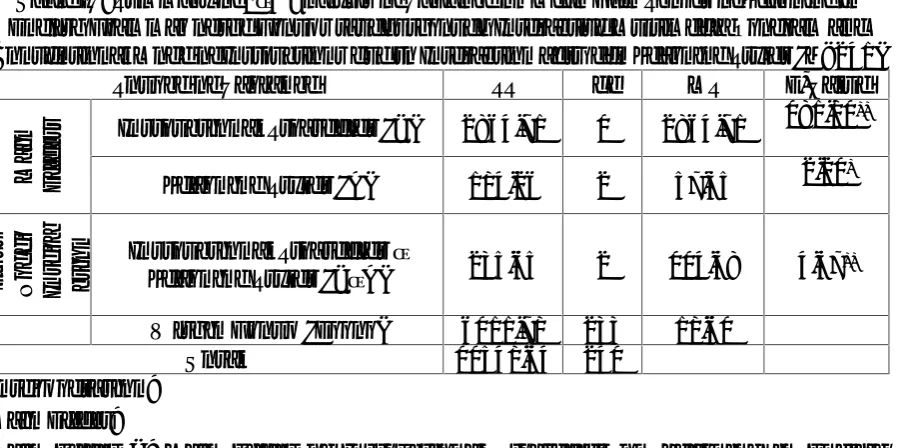
For testing the significance of difference in learning of English grammar of the groups taught through Interactive Multimedia Program and Conventional Mode of Instructions, t-test was employed on gain scores (= Post-test scores - Pre-test scores). The value of ‘t’ has been placed in the table no. I.
Table I: Significance of Difference in Mean Gain Scores of Learning in English Grammar of the Groups taught through Interactive Multimedia Program and Conventional Mode
of Instructions (N=352)
Groups N Mean SD SEM SED t-ratio
Control Group 176 12.20 4.91 0.37
Table No. I reveal that the value of ‘t’ is 13.44, which is significant at 0.01 level of significance. It indicates that there exists a significant difference in mean gain scores of learning in English grammar between the groups taught through Interactive Multimedia Program and Conventional Mode of Instructions.
Therefore H01 stating "There exists no significant difference in the mean gain
scores of learning in English grammar of the groups taught through Interactive Multimedia Program and Conventional Mode of Instructions" stands rejected.
Further as the mean gain scores of the group taught through Interactive Multimedia Program was found to be significantly higher than that of the group taught through Conventional Mode of Instructions. It may also be concluded that the learning in English grammar of the group taught through Interactive Multimedia Program is higher than that the group taught through Conventional Mode of Instructions.
(b) Significance of Difference in Learning of English grammar of the Secondary School Students with different Learning Styles:
For testing the significance of difference in learning of English grammar of the secondary school students with different Learning Styles i.e. Converger, Diverger, Accommodator and Assimilator (=4 Styles), One-way ANOVA was employed on gain scores (= Post-test scores - Pre-test scores). The summary of One-way ANOVA has been depicted in the table no. II.
Table II: Summary of One-way ANOVA on Mean Gain Scores of Learning in English Grammar of the Secondary School Students with different Learning Styles (N=352)
Source of Variation SS df MSS F-value
Between Groups 305.37 3 101.79
3.12*
Within groups 11345.38 348 32.60
Total 11650.75 351
Table II depicts the F-value after comparing mean gain scores of learning in English grammar of the secondary school students with different Learning Styles i.e. Converger, Diverger, Accommodator and Assimilator (=4 styles). The value of F is 3.12, which is significant at 0.05 level of significance. This indicates that the gain scores of learning in English grammar of secondary school students with different Learning Styles i.e. Converger, Diverger, Accommodator and Assimilator differ significantly.
Therefore H0 2 stating "There exists no significant difference in the mean gain
scores of learning in English grammar of secondary school students with different Learning Styles" stands rejected.
In order to find which learning style is more effective in learning of English grammar, the results of F-test were verified by t-test. The values of t-ratios for different learning styles have been placed in the table no. III.
Table III: t-ratios for Different Combinations of Learning Styles on Learning in English Grammar of Secondary School Students (N=352)
Variables N MeanConvergerSD
88 16.22 6.24
Diverger
N Mean SD 88 14.42 5.80
Accommodator
N Mean SD 88 16.30 5.58
Assimilator
N Mean SD
88 15.31 5.27
Converger
N Mean SD
88 16.22 6.24 - 2.08* 0.09 1.05
Diverger
N Mean SD
88 14.42 5.80 - - 2.17* 1.03
Accommodator
N Mean SD
Assimilator
N Mean SD
88 15.31 5.27 - - -
-Table III shows that
The gain in learning of English grammar of the secondary school students with
converging learning style is significantly higher than the diverging learning style (t=2.08).
The gain in learning of English grammar of the secondary school students with
accommodating learning style is significantly higher than the diverging learning style (t=2.17).
However no significant difference exists between gain in learning of English
grammar of the students with converging and accommodating learning style (t=0.09); converging and assimilating learning style (t=1.05); diverging and assimilating learning style (t=1.03) and accommodating and assimilating learning styles (t=1.14).
Again as the mean gain score of secondary school students with accommodating learning style is highest on the variable of learning in English grammar followed by the students with converging style, whereas the students with divergent learning style scored least in learning in English grammar.
(c) Significance of Difference in Learning of English grammar of the Groups taught through Interactive Multimedia Program and Conventional Mode of Instructions due to interaction with different Learning Styles:
To find out the significance of difference in the mean gain scores of learning in English grammar of the groups taught through Interactive Multimedia Program and Conventional Mode of Instructions (= 2 groups) due to interaction between different Learning Styles i.e. Converger, Diverger, Accommodator and Assimilator (=4 styles, 2×4 Analysis of Variance was employed on gain scores (= Post-test scores - Pre-test scores). The summary of 2×4 Analysis of Variance has been presented in table no. IV.
Table IV: Summary of 2×4 Analysis of Variance on Mean Gain Scores of Learning in English Grammar of the Groups taught through Interactive Multimedia Program and Conventional Mode of Instructions due to Interaction between Learning Styles (N=352)
Source of Variance SS df MS F-Value
M
ai
n
Ef
fec
ts Instructional Strategies (A) 3975.82 1 3975.82 192.01**
Learning Styles (B) 205.37 3 68.46 3.31*
Fi
rst
O
rd
er
In
ter
a
ct
ion Instructional Strategies ×Learning Styles (A×B) 346.76 3 115.59 5.58**
Within Group (Error) 7122.80 344 20.71
Total 11650.75 351
Interpretation: Main Effect:
Main Effect A: Main Effect of Instructional Strategies on Learning in English Grammar of Secondary School Students (N=352)
Conventional Mode of Instructions differs significantly on the variable of learning in English grammar.
These results are in tune with the results as indicated in the table no. I confirming the rejection of H01 stating ‘There exists no significant difference in the
mean gain scores of learning in English grammar of the groups taught through Interactive Multimedia Program and Conventional Mode of Instructions.
Main Effect B: Main Effect of Learning Styles on Learning in English Grammar of the Secondary School Students (N=352)
Table IV reveals that F-ratio for the difference in mean gain scores of learning in English grammar of secondary school students with different learning styles i.e. Convergent, Divergent, Accommodator and Assimilator is 3.31, which is significant at 0.05 level. This indicates that the secondary school students with different learning styles i.e. Convergent, Divergent, Accommodator and Assimilator learning styles differ significantly on the variable of learning in English grammar.
These results are in tune with the results as indicated in the table nos. II & III confirming the rejection of H02 stating "There exists no significant difference in the
mean gain scores of learning in English grammar of secondary school students with different Learning Styles".
First Order Interactions: Interactional Effect (A×B):
First order Interactional Effect of Instructional Strategies and Learning Styles on Learning in English Grammar of Secondary School Students (N=352)
Table IV reveals that F-ratio for the difference in mean gain scores of learning in English grammar of secondary school students due to interaction between Instructional Strategies (Interactive Multimedia Program and Conventional Mode of Instructions) and Learning Styles (Convergent, Divergent, Accommodator and Assimilator) is 5.58 which is significant at 0.01 level. This reveals that there exists a significant interactional effect of Instructional Strategies and Learning Styles on learning in English grammar of secondary school students.
Therefore H04 stating "There exists no significant interactional effect of
Instructional Strategies and Learning Styles on learning in English grammar of secondary school students" stands rejected.
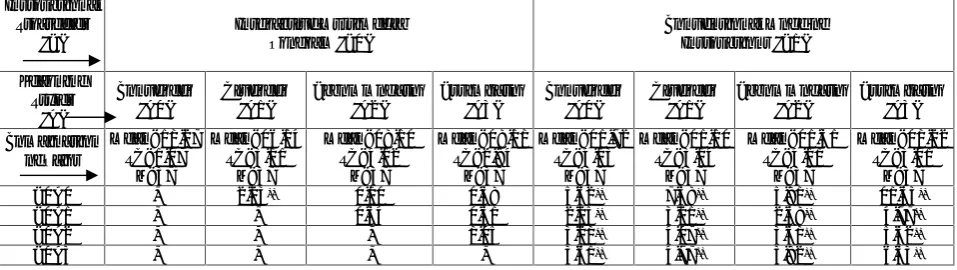
In order to probe deeper, the results of F-test were verified through test. The t-ratios for different combinations of Instructional Strategies (Interactive Multimedia Program and Conventional Mode of Instructions) and Learning Styles (Convergent, Divergent, Accommodator and Assimilator) on mean gain scores of learning in English grammar have been depicted in the table no. V.
Table V: t-ratios for Different Combinations of Instructional Strategies and Learning Styles on Learning in English Grammar
Instructional Strategies
(A) Interactive MultimediaProgram (A1) Conventional Mode ofInstructions (A2)
Learning Styles
(B)
Converger
(B1) Diverger(B2) Accommodator(B3) Assimilator(B4) Converger(B1) Diverger(B2) Accommodator(B3) Assimilator(B4) Combination
of Pairs Mean=20.38SD=2.18 N=48
Mean=17.25 SD=4.02
N=48
Mean=19.21 SD=5.23
N=48
Mean=19.00 SD=3.95
N=48
Mean=12.83 SD=5.04
N=48
Mean=12.21 SD=4.05
N=48
Mean=12.42 SD=5.22
N=48
Mean=10.33 SD=4.12
N=48 A1B1 - 3.34** 1.01 1.49 6.73** 8.69** 6.90** 10.54**
A1B2 - - 1.45 1.52 3.36** 4.32** 3.59** 5.88**
A1B3 - - - 0.16 4.30** 5.18** 4.50** 6.53**
A2B1 - - - 0.47 0.28 1.88
A2B2 - - - 0.15 1.59
A2B3 - - - 1.54
A2B4 - - -
-**Significant at 0.01 level of significance *Significant at 0.05 level significance
Table V shows that
The learning in English grammar of the students with converging learning style
taught through Interactive Multimedia Program is better than the same taught through Conventional Mode of Instructions in all the four learning styles viz. converging (t=6.73), diverging (t=8.69), accommodating (t=6.90) and assimilating (t=10.54).
The learning in English grammar of the students with diverging learning style
taught through Interactive Multimedia Program is better than the same taught through Conventional Mode of Instructions in all the four learning styles viz. converging (t=3.36), diverging (t=4.32), accommodating (t=3.59) and assimilating (t=5.88).
The learning in English grammar of the students with accommodating learning
style taught through Interactive Multimedia Program is better than the same taught through Conventional Mode of Instructions in all the four learning styles viz. converging (t=4.30), diverging (t=5.18), accommodating (t=4.50) and assimilating (t=6.53).
The learning in English grammar of the students with assimilating learning style
taught through Interactive Multimedia Program is better than the same taught through Conventional Mode of Instructions in all the four learning styles viz. converging (t=4.72), diverging (t=5.88), accommodating (t=4.93) and assimilating (t=7.44).
This indicates that the learning in English grammar of the students taught through Interactive Multimedia Program is higher than that taught through Conventional Mode of Instructions with respect to style of learning.
In case of learning in English grammar of the students taught through Interactive
Multimedia Program is concerned, converging style of learning is found to be significantly better than diverging style (t=3.34). However no significant difference was found in learning in English grammar of the students taught through Interactive Multimedia Program amongst any style of learning.
In case of learning in English grammar of the students taught through
Conventional Mode of Instructions is concerned, no significant difference was found in learning in English grammar of the students amongst any style of learning.
Findings:
In the present study, on the basis of interpretation of hypotheses the following findings have been drawn:
2. The gain scores of learning in English grammar of secondary school students with different Learning Styles i.e. Converger, Diverger, Accommodator and Assimilator differ significantly.
The gain in learning of English grammar of the secondary school students with
converging learning style is significantly higher than the diverging learning style (t=2.08).
The gain in learning of English grammar of the secondary school students with
accommodating learning style is significantly higher than the diverging learning style (t=2.17).
However no significant difference exists between gain in learning of English
grammar of the students with converging and accommodating learning style (t=0.09); converging and assimilating learning style (t=1.09); diverging and assimilating learning style (t=1.03) and accommodating and assimilating learning styles (t=1.14).
The mean gain score of secondary school students with accommodating learning style is highest on the variable of learning in English grammar followed by the students with convergent style whereas the students with divergent learning style scored least in learning in English grammar.
3. There exists a significant interactional effect of Instructional Strategies and Learning Styles on learning in English grammar of secondary school students.
The learning in English grammar of the students with converging learning style
taught through Interactive Multimedia Program is better than the same taught through Conventional Mode of Instructions in all the four learning styles viz. converging (t=6.73), diverging (t=8.69), accommodating (t=6.90) and assimilating (t=10.54).
The learning in English grammar of the students with diverging learning style
taught through Interactive Multimedia Program is better than the same taught through Conventional Mode of Instructions in all the four learning styles viz. converging (t=3.36), diverging (t=4.32), accommodating (t=3.59) and assimilating (t=5.88).
The learning in English grammar of the students with accommodating learning
style taught through Interactive Multimedia Program is better than the same taught through Conventional Mode of Instructions in all the four learning styles viz. converging (t=4.30), diverging (t=5.18), accommodating (t=4.50) and assimilating (t=6.53).
The learning in English grammar of the students with assimilating learning style
taught through Interactive Multimedia Program is better than the same taught through Conventional Mode of Instructions in all the four learning styles viz. converging (t=4.72), diverging (t=5.88), accommodating (t=4.93) and assimilating (t=7.44).
This indicates that the learning in English grammar of the students taught through Interactive Multimedia Program is higher than that taught through Conventional Mode of Instructions with respect to style of learning.
In case of learning in English grammar of the students taught through Interactive
In case of learning in English grammar of the students taught through
Conventional Mode of Instructions is concerned, no significant difference was found in learning in English grammar of the students amongst any style of learning.
Discussion of Results:
In the present study it was found that the learning in English grammar of the group taught through Interactive Multimedia Program is higher than the group taught trough Conventional Mode of Instructions. The reason behind that Interactive Multimedia learning is an active process; the participants are in control of their own responses and behaviours in the sense they can choose when and how to participate. It is also a multisensory process. According to Edgar Dale's Cone of Experience students learn 10% of what they read, 20% of what they hear, 30% of what they see, 50% of what they see and hear, 70% of what they say and write, 90% of what they do as they perform a task. In Interactive Multimedia there is use of more than one sense and students directly interact with the program; that's why students learn and retain maximum.
Further the features of Interactive Multimedia like animations, sounds, graphics, navigational control, interactivity and knowledge of self learning creates keen interest of the students in the learning process. The present Interactive Multimedia Program is totally reader cantered and is available in off line mode in Compact Disc (CD). The reader can use it anywhere. On the other hand in the Conventional Mode of Instructions there is only one way of interaction. In the traditional class room students can only listen to the teacher. So due to minimum use of senses and lack of interactivity the students learn less in traditional class room. These results are supported by the studies conducted by Chang and Lehman (2002) and Sharma (2013) in the area of English directly supports the findings of the present study who found that Interactive Multimedia helps in the learning of English among the students greater than conventional mode of instructions.
In the present study further it was found that students with different learning styles i.e. Convergent, Divergent, Assimilator and Accommodator differ significantly on learning in English grammar. The mean gain scores of secondary school students with accommodating learning style is highest on the variable of learning in English grammar followed by the students with converging style whereas the students with divergent learning style scores least in English grammar. The reason behind that every individual has unique approach to learning based on strengths, weaknesses and preferences.
Studies conducted by Tight (2010), Chermahini, Ghanbari and Talab (2013) and Gokhan and Omer (2013) in the area of English directly supports the findings of the present study who were found that students with different learning styles remarkably differ in learning and retention in English.
In the present study there exists significant interactional effect of Instructional Strategies and learning styles on learning in English grammar of secondary school students. These results were supported by the study of Ranu and Aulakh (2012) examined the effect of web-based instructions on achievement in physics of eleventh grade students in relation to learning styles and found that there was significant interactional effect of instructional strategies and learning styles on achievement in physics.
Conclusion:
higher than the group taught trough conventional method of teaching. In the present study further it was found that students with different learning styles i.e. Convergent, Divergent, Assimilator and Accommodator differ significantly on learning in English grammar. The students with accommodator learning style learn English grammar higher than the students with convergent, divergent and assimilator learning styles. Further there existed a significant interactional effect of instructional strategies and learning styles on learning in English grammar of secondary school students.
Educational Implications:
In the present study, students taught through Interactive Multimedia Program exhibited better gain in learning in English grammar as compared to students taught through Conventional Mode of Instructions. Following are the educational implications of the present study:
Interactive Multimedia Program instructional strategy should be utilized to
enhance the quality of education at all school levels (Primary, Secondary and Senior Secondary).
The centre/state Government should establish research and development wings
in which educators, project managers, subject experts, computer specialists and evaluators can be engaged in the develop Interactive multimedia Programs in all subjects.
The centre or state Government should provide in-service teacher training
programs to Government school teachers for the development and utilization of Interactive Multimedia Programs in the class rooms.
As the development of such packages involve huge investment of resources i.e.
time, money, energy and technicality, the Government should setup special departments or regional centres for development of Interactive Multimedia Programs in the centre and state capitals so that each subject area can be covered. The software hubs should also be opened at the block levels in ordered to reduce the gap between urban-rural divisions.
In the present study, there exists a significant interactional effect among
instructional strategies and learning styles on the variable of learning in English grammar. These results will give immense help to teachers, parents, guidance workers, curriculum developers in the development of novel methods of teaching in English grammar as well as in other subjects also. During teaching the teachers should keep in mind the learning styles of the students so that they can achieve maximum and they should encourage learning according to their own learning styles.
References:
1. Abidin, M. J. Z., Rezaee, A. A., Abdullah, H. N., Kaur, K., & Singh, B. (2011). Learning styles and overall academic achievement in a specific educational system. International Journal of Humanities and Social Science, 1 (10), 143-152.
2. Bannon, B. (2015). Interactive multimedia texts increase achievement of pre-service teachers. In D. Slykhuis & G. Marks (Eds.), Proceedings of Society for Information Technology & Teacher Education International Conference March 02, 2015 (pp. 2481-2490). Chesapeake, VA: Association for the Advancement of Computing in Education (AACE).Retrieved from http://www.editlib.org/p/ 150554/ on November 11, 2015.
4. Cairncross, S., & Mannion, M. (2001). Interactive multimedia and learning: Realizing the benefits. Innovations in Education and Teaching International, 32 (2), 154-164. Retrieved from personal.tsss.edu.hk/kem/msc/6025/ 5446424.pdf on December 26, 2013.
5. Chermahini, S. A., Ghanbari, A., & Talab, M. G. (2013). Learning styles and academic performance of students in English as a second-language class in Iran. Bulgarian Journal of Science and Education Policy, 7 (2), 322-333.
6. Crow, L. D., & Crow, A. (1973). Educational psychology. New Delhi: Eurasia Publishing House.
7. Gallagher, K. P. (2010). The impact of learning style on learning outcomes in an interactive multimedia instruction program. Ph.D. Thesis, Cypress California: TUI University, UMI Number: 3435219. Retrieved from eric.ed.gov/?id=ED521943 on January 1, 2014.
8. Gokhan, B., & Omer, B. (2013). Effects of learning styles based instruction on academic achievement, retention level and attitudes towards English course. Journal of Faculty of Educational Sciences, 46 (2),133. Retrieved from http://connection.ebscohost.com/ c/articles/94957810/ effects-learning-styles- based-instruction-academic-achievement-retention-level-attitudes-towards-English-course on December 12, 2015.
9. Golden, S. A. R. (2011). Problems and Prospectus of Distance Learning. Bharathidhasan University, 343, 344.
10. Herman, D. S. (2015). The effects of multimedia and learning style on student achievement in online electronics course. Turkish Online Journal of Educational Technology, 14 (1), 116-122. Retrieved from http://eric.ed.gov/?q=Kolb%27s+ Learning+Styles%2c+ Achievement%2c+retention&pg=5&id=EJ1057334 on October 28, 2015.
11. Kolb, D. (1984). Experiential learning: experience as the source of learning and development. Englewood Cliffs, New Jersey: Prentice Hall. Retrieved from http://www.nwlink.com/~donclark/hrd/styles/kolb.html on December 3, 2015.
12. Kolb, D. A. (1974). Toward an applied theory of experiential learning. MIT Alfred P. Sloan School of Management.
13. Kolb, D. A. (1981). Experimental learning. Retrieved from http://infed.org/ mobi/david-a-kolb-on-experiential-learning on January 1, 2014.
14. Kuo-Kuang, F., Peng-wei, X., & Chung-Ho, S. (2015). The effects of learning styles and meaningful learning on the learning achievement of gamification health education curriculum. EURASIA Journal of Mathematics, Science & Technology Education, 11 (5), 1211-1229. Retrieved from http://eric.ed.gov /?q=kolb%27s+learning+styles+academic+achievement%2c+retention&id=EJ10 74038 on October 27, 2015.
15. Ranu, S. K., & Aulakh, J. K. (2012). Effect of web based instruction on achievement in physics of eleventh grade students in relation to learning styles. Researcher's Tandem, 3 (12), 41-47.
16. Reiff, J. C. (1992). Learning Styles: what research says to the teacher. Washington, D.C.: National Education Association.
18. Sharma, P. (2013). Role of interactive multimedia for enhancing student's achievement and retention. International Women Online Journal of Distance Education, 2 (3), 12-22. Retrieved from www.wojde.org/FileUpload/ bs295854/ File/02_23.pdf on December 31, 2013.
19. Shiang, R. S. (2012). A study of the relationships among learning styles, participation types, and performance in programming language learning supported by online forums. Computers & Education, 58 (1), 111-120. Retrieved from http://eric.ed.gov/? q=Kolb%27s+Learning+Styles%2c+Achievement% 2c+retention&pg=2&id=EJ947424 on October 28, 2015.
20. Tight, D. G. (2010). Perceptual learning style matching and l2 vocabulary acquisition. Language Learning, 60 (4), 792-833. Retrieved from eric.ed.gov/?q=Tight + Daniel & id= EJ905238 on December 31, 2013.
21. Unal, C. (2014). Analyzing the effect of learning styles and study habits of distance learners on learning performances: a case of an introductory programming course. International Review of Research in Open and Distance Learning, 15 (4), 161-185. Retrieved from http://eric.ed.gov/?q= kolb%27s+learning+ styles + academic + achievement%2c + retention & id= EJ1039811 on October 27, 2015.
22. Unal, C. (2014). Analyzing the effect of learning styles and study habits of distance learners on learning performances: a case of an introductory programming course. International Review of Research in Open and Distance Learning, 15 (4), 161-185. Retrieved from http://eric.ed.gov/?q=kolb%27s+ learning + styles + academic + achievement%2c + retention & id = EJ1039811 on October 27, 2015.
23. Zacal, S. G. (2014). The effect of multimedia teaching to the achievement of junior high school students in trigonometry. JPAIR International Peer Reviewed Journal, 3 (1). DOI: http://dx.doi.org/10.7719 /irj.v3i1.289. Retrieved from http://philair.ph/ publication/index.php/irj/article/view/289 on November 11, 2015.