The effect of task-based instruction on reading comprehension
of Iranian EFL learners
Azizeh Chalak
(Assistant Professor, Isfahan (Khorasgan) Branch, Islamic Azad University, Iran) [email protected]
(Received: 2015/01/31, Accepted: 2015/03/19)
Abstract
Developing reading comprehension ability is an important aspect in acquisition of a language. The present study focused on improving reading comprehension ability through Task-based Instruction (TBI). TBI is a methodology that develops from a focus on classroom tasks. The participants of the study were 135 Iranian female students at different levels selected from high schools in Isfahan, Iran, through a quasi-experimental design. The participants were divided into four groups, two control groups (CGs) and two experimental groups (EGs). They received a pre-test, the instruction, and a post-test. The participants in EGs were taught through TBI, whereas CGs were exposed to a traditional method. The comparison between CGs and EGs were made through paired sample t-tests. The results revealed that the students in EGs outperformed CGs. The difference between the two grades was also investigated by independent sample t-test. The results showed that students at first-grade outperformed fourth-graders. The findings suggest that using flexible and interactive tasks in English classes improves reading comprehension ability of Iranian EFL learners. This study may have pedagogical implications for practitioners in the field and for syllabus designers to include appropriate tasks in English textbooks.
Keywords: Task, reading comprehension, task-based instruction, language learning
Introduction
The role of reading comprehension ability and its constituent components - especially vocabulary in Second/Foreign Language (SL/FL) acquisition - has long been neglected, but currently, it is again receiving attention in the language teaching curriculum. As Nunan (1999) claims, this is due to several reasons, including the influence of comprehension-based approaches to the development of language, the role of applied linguists, and the development of computer-based language corpora. Developing reading comprehension ability is an important aspect in acquisition of a language.
Reading is a dialogue between the reader and the writer and comprehension is a
It is claimed that language learning will result from creating the right kinds of interactional processes in the classroom, and the best way is using specially designed instructional and functional tasks. Advocates of TBI believe that communicative competence can be developed through engagement of learners in interactive tasks. TBI makes strong claim for using tasks in planning teaching and also in classroom teaching. In TBI, students employ Target Language (TL) to do tasks which are meaningful and authentic.
Task, as an activity which is performed through using language, ends in a predictable product to which learners try to reach. Communicative task engages learners in comprehending, employing, or producing in TL while focusing on meaning rather than on form.
Over the years, different approaches, methods, and procedures have been developed to help learners learn English. In some methods, attention is on teaching and teacher-centeredness and the focus on grammar and vocabulary learning is at level of making the drills possible. The traditional methods focus on the idea that once students learn grammatical structures, they acquire vocabulary. Most of students and teachers in Iran know that vocabulary is important for reading comprehension. However, most of the techniques teachers use to teach reading comprehension in Iran (especially at high schools) are still traditional. Teachers mostly focus on translation of units, practice of grammar, and memorization of long lists of vocabulary items and their meanings without concentration on authentic tasks. Only recently, some changes are being made to reform methods of teaching to Iranian high school learners. Therefore, this study was an attempt to examine the effect of task-based instruction on reading comprehension
of Iranian EFL learners
Literature review
Second language and foreign language teachers both seek to find the means, activities, and tasks to help language learners achieve their goals in learning languages. Thus, task holds a central role in language pedagogy and SL/FL language research because it is used to assess what learners can do in the L2.
The definition of the concept of task can predetermine language use. As Nunan (2004) claims, the concept of task has made its way in syllabus design, classroom teaching, and learner assessment. It has also influenced pedagogical policies in ESL/EFL classrooms. Task has been defined differently by different experts in the field (Lee, 2000; Long, 1985; Prabhu, 1987; Skehan, 1996).
Ellis (2003) claims that the definitions of task have addressed different dimensions such as (a) the scope of a task, (b) the perspective from which a task is viewed, (c) its authenticity, (d) linguistic skills required to perform a task, (e) psychological and cognitive processes involved in performance of a task, and (f) the outcome of a task.
Willis (1996, p. 23) defines task as “an activity where the TL is used by the learner for a communicative purpose in order to achieve an outcome.” For Richard and Rodgers (2014), a task is an activity carried out as the outcome of processing or understanding language. Tasks may end in production of language. Using different tasks can make language teaching more communicative.
problem-solving tasks, decision-making tasks, opinion exchange task, etc. They are generally divided into pedagogical tasks and real-world tasks. Nunan (1989) believes that task is an activity which necessarily includes language. It involves learners in comprehending, manipulating, producing, or interacting in TL while they focus on meaning rather than form. For Ellis (2003, p.16) a pedagogical task is “a work plan that requires learners to process language pragmatically in order to achieve an outcome that can be evaluated in terms of whether the correct or appropriate propositional content has been conveyed.” The focus is on meaning even if the design of the task affects learners’ choice of a particular form. A task can refer to receptive skills (listening and reading) or productive skills (speaking and writing). Knowing the definition and the dimensions can differentiate TBI from traditional teaching methods.
TBI emphasizes on conveying meaning with a proposed product where learners can learn and practice the forms of TL while paying attention to meaning. Tasks are activities that engage the participants to be language users because tasks improve learners’ ability to communicate in real-world.
As Schmitt (2008) stated, an important part of mastering a SL is learning understanding reading passages. L2 learners need a lot of words to successfully read and understand. Vocabulary is a powerful carrier of comprehension. However, there is no agreement over the best resources of vocabulary learning/teaching. In line with new developments in language teaching methodology, some researchers (e.g. De La Fuente, 2006; Keating, 2008) have argued that integrating tasks in reading classes can increase engagement and facilitate learning and teaching. As Nation (2001) claimed, L2
learners usually know that their limitations in their vocabulary knowledge affect their communication skills, especially reading comprehension because lexical items bear the basic information for comprehension.
To increase reading comprehension ability, different teachers employ different methods, ranging from traditional ones to alternative, communicative one. TBI as a substitute method to traditional language teaching method in teaching English is suggested because it supports a method in which functional communicative language use is expected. Ellis (2009) believes that TBI can be both input-providing and output-prompting. It is a refinement of CLT and takes a fairly strong view of CLT (Skehan, 1996). It can be regarded as an opportunity to return to the conceptual foundations of CLT (Samuda & Bygate, 2008). In TBI learning environment, learners are open to choose and use the TL to accomplish communicative goals. As Carless (2002, p. 389) claims, TBI has become “an orthodoxy in contemporary EFL teaching and in recent years has been exported to many countries around the globe.”
In the literature, two early programs within a communicative framework have used TBI. They were the Malaysian Communicational Syllabus (1975) and the Bangalore Project (Prabhu, 1987). Although these two instructional projects and programs were used for a short time, they got significant attention in language teaching community.
comprehension (Chodkieiwicz, 2001; Ellis, 2000; Skehan, 1998; Wallace, 2001; Willis, 1996). Some of them have shown interest in using authentic materials to improve reading comprehension ability of the EFL learners.
However, as Carless (2012) claims, most of the contributions on TBI, focus on young adults, mainly in university settings. He claims that the literature on TBI in relation to schooling remains comparatively modest. Three noteworthy research studies on implementation of TBI on the school sector in Asian contexts are Sasayama and Izumi (2012) with Japanese high school students, Chan (2012) with primary school learners in Hong Kong, and Park (2012) who focused on data from a Korean secondary school.
Sasayama and Izumi (2012) investigated the effect of TBI on Japanese high school students through an experimental design, but, the main focus of the study was on task complexity and pre-task planning on learners’ oral production. Chan (2012) analyzed 20 lessons in Hong Kong primary schools facilitated by TBI by focusing on the way teachers manage the linguistic, cognitive, and interactional demands of tasks. Park’s (2012) study highlighted the relative scarcity of research on TBI at high schools and claimed that although TBI “has attracted considerable attention since the 1980s, little research has been conducted on its actual implementation in secondary EFL contexts” (p. 215). Through an experimental design, he implemented computer assisted TBI in Korean secondary EFL context and concluded that TBI can be effective in Korean schools. He also stated that both teachers and students found task-based lessons effective and motivating. In Iran, the employment of TBI in teaching English has also been investigated by some researchers on topics such as the impact of TBI, task performance, TBI in ESP courses,
motivating characteristics of tasks, or integration of TBI as an alternative approach (Hayati & Jalilifar, 2010; Hokmi, 2005; Iranmehr, Erfani, & Davari, 2011; Poorahmadi, 2012). Although some studies have been conducted on TBI in Iran, little research has been done to evaluate actual tasks in teaching English at high schools and with school sector.
Due to the scarcity of research studies in Iran especially at high schools, the present study intended to examine the effect of integration of TBI in teaching reading comprehension to Iranian high school students. In doing so, the following research questions were posed:
1. Are there any differences between the achievements of Iranian female high school students taught through TBI with those taught by traditional method?
2. Are there any significant differences between the achievements of junior and senior Iranian female high school learners taught through TBI?
Methodology
The present study was a quasi-experimental research based on quantitative data gathered from administering English reading comprehension pre-tests and post-tests during 2014-2015 in Isfahan, Iran. The data were collected during normal class time in English classes at high school.
Participants
fourth-graders were 17-18 years old. The mean scores of the two groups were used in order to place them into two groups at each level. Each grade was divided into two experimental groups and two control groups (EG1, and EG2; CG1, and CG2).
Instruments: Pre-test and post-test
Before the treatment, two tests on reading comprehension ability were given to the participants in both CGs and EGs as the research pre-tests. After the treatment, two post-tests measured their reading comprehension ability. Each pre-test and post-test consisted of four passages and 20 questions which were administered to the students to test their ability in reading comprehension at two levels and at two stages before and after the treatment. Both
pre-tests and post-tests were selected from supplementary books that the Ministry of Education had published for first and fourth graders. The grades were calculated out of 20 for both pre-tests and post-tests for both CGs and EGs.
Treatment
EGs received a treatment consisting of different tasks such as group discussion, role play, interview, information gap, group
work, mystery task, simulations, and
journalist task while the CGs received only traditional teaching activities with no focus on tasks or TBI. The tasks for the EGs were borrowed from Ozonder (2010) with modifications. The instructions on completing the tasks were given in detail to the EGs (see Table1).
Table 1: Tasks for EGs
Task types Purpose Description
Group discussion
Students state their ideas Students tell different opinions
Role play Raising students’ consciousness
about topic
Students play different roles and defend their viewpoints
Simulations Creating the atmosphere of a real world
Students given different roles in a changed environment
Interview Students know each other by
getting information
Students prepare some questions about topics
Information gap Students guess their partners’ information
Each student tells something about different situations
Mystery task Students give 1-word answers to mini-questions
Students draw a picture and colour parts of it
Journalist task Students read texts with
unscrambled pictures
Students cut and stick different pictures
Group work Students practice learned words in groups
Students fill the blanks in different sentences
Data collection and analysis procedures First, four intact classes of junior and senior high school female students were selected and divided into two EGs and two CGs. After conducting the pre-tests, the EGs received treatment based on TBI and the
answering non-task-based reading comprehension questions, the EGs received TBI and completed tasks such as group discussion, role play, interview, information gap, group work, mystery task, simulations, and journalist task (see Table 1). Teaching time was divided into three phases: pre-task, task, and post-task. In each phase, learners received information on how to complete the tasks.
In order to analyze the data, paired sample t-tests were run to examine whether there were any significant differences in the means of reading comprehension in CGs and EGs for each grade. The independent sample t-tests were also used to compare the means of post-tests of EGs to find the probable differences in the means of juniors and seniors.
Results
The students’ reading comprehension ability before and after the treatment was examined through pre-tests and post-tests, and the data were analyzed in terms of descriptive and inferential statistics.
To guarantee that there were no statistically significant differences between the means of CGs and EGs on the pre-test, a paired sample t-test was run at the very beginning of the experiment. Table 2 shows the results of the inferential statistics employed.
As presented in Table 2, no statistically significant differences between the means of CGs and EGs were observed. In other words, the control and experimental groups
were homogeneous in terms of reading comprehension ability before the treatment.
To determine if there were any statistically significant differences between the means of CGs and EGs on the post-tests, a paired sample t-test was run after the treatment. Table 3 presents the results of the inferential statistics employed.
It can be inferred from Table 3 that there were statistically significant differences between the means of CGs and EGs after the treatment. In other words, the participants in the EGs outperformed meaningfully those in the CGs.
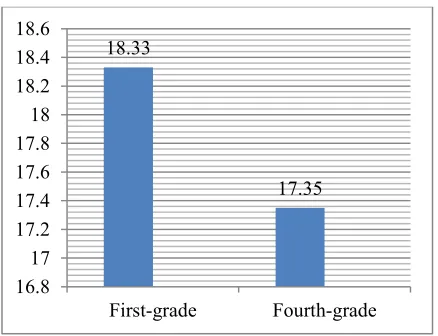
Moreover, the results of the descriptive statistical analyses of the scores of the participants in ECs showed that the mean score of first-graders was higher than that of fourth-graders. Figure 1 depicts this difference.
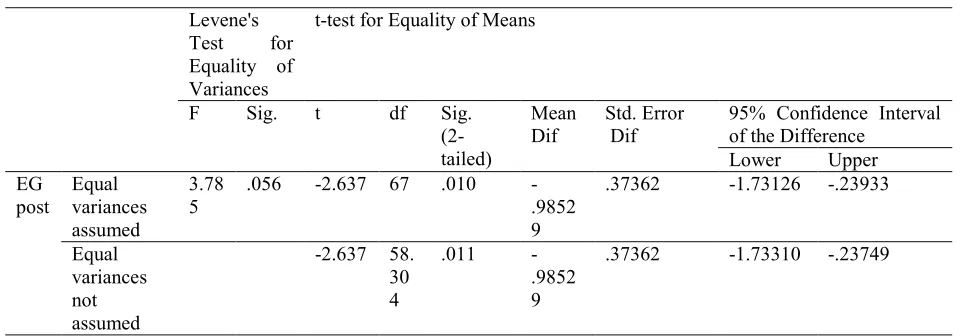
To examine whether the difference observed between the means of the two EGs was statistically significant, an independent sample t-test was run. Table 4 displays the results of the inferential statistics used.
Table 2: Paired Sample t-test between Means of CGs and EGs on pre-test
Paired Differences t df Sig. (2-tailed)
Mean Std.
Deviation Std. Error Mean 95% Confidence Interval of the Difference Lower Upper
.86765 3.10500 .53250 -.21574 1.95103 1.629 66 .113
.35294 3.83471 .65765 -.98505 1.69093 .537 67 .595
Table 3: Paired Sample t-test between Means of CGs and EGs on post-test
Pair
1 CG1 and EG1 Paired Differences Mean t df Sig. tailed)
(2-Difference Std. Deviation Std. Error Mean
95% Confidence Interval of the Difference Pair
2
CG4 and EG4
Lower Upper
-1.25000 3.75025 .64316
-2.55852 .05852 -1.944 66 .061 -.76471 3.36928 .57783 -1.9403 .4108 -1.323 67 .195
Figure 1: Means of EGs on post-tests
18.33
17.35
16.8 17 17.2 17.4 17.6 17.8 18 18.2 18.4 18.6
Table 4: Independent Sample t-test between Means of EG1 and EG4 on post-test
Levene's Test for Equality of Variances
t-test for Equality of Means
F Sig. t df Sig.
(2-tailed)
Mean
Dif Std. Error Dif 95% Confidence Interval of the Difference Lower Upper EG
post
Equal variances assumed
3.78 5
.056 -2.637 67 .010 -.9852 9
.37362 -1.73126 -.23933
Equal variances not assumed
-2.637 58. 30 4
.011
-.9852 9
.37362 -1.73310 -.23749
Discussion
In answering the questions concerning the effect of TBI on reading comprehension ability of Iranian high school female students, the data were analyzed through statistical procedures. The results showed that the role of task was an attention injector for Iranian high school students. They became involved in the class works by sharing answers, trying to participate, paying attention, giving answers, encouraging others to participate in the activities and tasks, participating as volunteers, working on the exercises, and so on.
The results of the study also revealed that the participants in the EGs, who were asked to do the tasks, improved their performance. The student-to-student interaction while performing the tasks provided opportunities for them to talk about vocabularies and monitor the language they used. TBI improved their interaction skills and maximized their use of TL. During the tasks, the students in EGs exchanged their ideas and negotiated to learn their peers’ ideas, attitudes, or beliefs on certain issues, and became familiar with a lot of words related to the topic. Of course, the students in EGs had the chance to receive feedback from their teacher and also their classmates. The
existence of such a feedback provided a more relaxing and less threatening condition for them and created a collaborative learning experience. Yet, the exercises in the CGs did not stimulate the appropriate processes very much to bring the EFL learners to the level of fully learning the words. They did not receive any feedback from their peers, and the only authority for judging the accuracy of exercises was the teacher. Therefore, the traditional approach was not very successful in helping the students work collaboratively.
level engagements of first-graders made greater group cohesiveness. When grade differences were taken into consideration, however, fourth-graders appeared to be affected negatively by their anxiety.
Conclusion
The results of this study are in line with Hokmi (2005) who claimed that teachers can adapt teaching materials in such a way as to create a situation which helps meaningful engagement of the learners, and, as a result, successful completion of the tasks. The results are also in agreement with Iranmehr et al. (2011) who supported the implementation of tasks and presented the significant advantage of teaching through TBI. This study also supports the findings of Poorahmadi (2012) who believed that TBI was very effective in improving reading comprehension ability of Iranian EFL students.
The results of this study can offer pedagogical implications at macro and micro levels. At the macro level, decision-makers, policy-decision-makers, and curriculum developers can make use of the findings of this research in designing much more adequate and efficient syllabi which is more adaptable with TBI, and more communicative approaches. Implementation of TBI as an alternative teaching method, can be a part of the teacher training or in-service programs.
At the micro-level and in practice, the research results could benefit the teachers, evaluators, test-developers, and the students in the field of EFL in different academic contexts. Practitioners in the field can employ tasks and activities based on TBI to teach reading comprehension, its different aspects and components, or other skills to Iranian EFL learners. For this purpose, language teaching programs should
familiarize teachers with TBI, its basic principles and techniques, and its implementation within current approaches. Teachers can also evaluate their students’ performances by using different tasks rather than traditional paper-and-pencil exams. Moreover, studies like the present one, can raise the awareness of the students about the positive role and effects of tasks in learning English, and can encourage them to demand for alternative methods from their teachers, books, and educational system.
The results of the present study hopefully will stimulate teachers to alter their reading classes from traditional atmosphere to more dynamic and communicative situations. Through implementation of TBI, they can facilitate and improving reading comprehension of Iranian EFL learners. As Basturkmen (2006, p. 125) claimed, TBI “will provide room for the teacher to predict the learners’ potentiality of their future performance in their professional, academic or work place where better performance is considered respected.”
of tasks and TBI.
References
Basturkmen, H. (2006). Ideas and options in English for specific purposes. New Jersey: Lawrence Erlbaum Associates.
Carless, D. (2012). TBLT in EFL settings: Looking back and moving forward. In A. Shehadeh & C. A. Coombe (Eds.), Task-based language
teaching in foreign language
contexts: Research and
implementation. Amsterdam/
Philadelphia: JBP Company.
Carless, D. (2002). Implementing task-based learning. ELT Journal, 56(4), 389-396.
Chan, S. P. (2012). Qualitative differences in novice teachers’ enactment of task-based language teaching in Hong Kong primary classrooms. In A. Shehadeh & C. A. Coombe (Eds.), Task-based language
teaching in foreign language
contexts: Research and
implementation. Amsterdam
/Philadelphia: JBP Company.
Chodkieiwicz, H. (2001). The acquisition of word meaning while reading in English as a foreign language.
EUROSLA Yearbook, 1, 29-49.
De La Fuente, M. J. (2006). Classroom L2 vocabulary acquisition: Investigating the role of pedagogical tasks and form-focus-instruction. Language Teaching Research, 10(3), 263-295. Ellis, R. (2000). Task-based research and
language pedagogy. Language Teaching Research, 4(3), 193-220. Ellis, R. (2003). Task-based language
learning and teaching. Oxford:
Oxford University Press.
Ellis, R. (2009). Task-based language teaching: sorting out them is understandings. International
Journal of Applied Linguistics, 19(3), 221–246.
Hayati, M. & Jalilifar, A. (2010). Task-based teaching of micro-skills in an EAP situation. Taiwan International ESP Journal, 2(2), 49-66.
Hokmi, M. (2005). Iranian ESP students’ reading comprehension in task-based language teaching approach. Roshd FLT, 19, 64-58.
Iranmehr, A., Erfani, S. M. & Davari, H. (2011). Integrating task-based instruction as an alternative approach in teaching reading comprehension in English for special purposes. Theory and Practice in Language Studies, 1(2), 142-148.
Keating, G. (2008). Task effectiveness and word learning in second language: The involvement load hypothesis on trial. Language Teaching Research, 12(3), 365-386. Retrieved from http://www.sagpublication.com Lee, J. F. (2000). Tasks and communicating
in language classrooms. United
States of America: McGraw Hill. Long, M. H. (1985). A role for instruction in
second language acquisition: task-based language teaching. In K. Hyltenstam & M. Pienemann (Eds.), Modelling and assessing second
language acquisition (pp.77-99).
Clevendon Avon: Multilingual Matters.
Long, M. H. (2015). Second language acquisition and task-based language teaching. UK: John Wiley & Sons Ltd.
Nation, P. (2001). Learning vocabulary in
another language. Cambridge: CUP.
University, 2, 1-17.
Nunan, D. (1989). Designing tasks for the
communicative classroom.
Cambridge: CUP.
Nunan, D. (1999). Second language
teaching and learning. Boston:
Heinle and Heinle Publishers.
Nunan, D. (2004). Task-based language teaching. Cambridge: CUP.
Özönder, Ö. (2010). Students' perceptions of the motivating characteristics of tasks in a commonly used EFL course book. Unpublished master’s thesis, Bilkent University, Ankara, Istanbul.
Park, M. (2012). Implementing computer-assisted task-based language teaching in the Korean secondary EFL context. In A. Shehadeh & C. A. Coombe (Eds.), Task-based
language teaching in foreign
language contexts: Research and
implementation. Amsterdam/
Philadelphia: JBP Company.
Poorahmadi, M. (2012). Investigating the efficiency of task-based instruction in improving reading comprehension ability. Journal of Language and Translation, 3(1). 29-36.
Prabhu, N .S. (1987). Second language
pedagogy. Oxford: Oxford
University Press.
Richards, J. C., & Rodgers, T. (2014).
Approaches and methods in
language teaching (3rd ed.),
Cambridge: Cambridge University Press.
Samuda, V., & Bygate, M. (2008). Tasks in second language learning. Hound mills: Palgrave Macmillan.
Sasayama, S. & Izumi, S. (2012). Effects of task complexity and pre-task planning on Japanese EFL learners’ oral production. In A. Shehadeh & C. A. Coombe (Eds.), Task-based
language teaching in foreign
language contexts: Research and implementation.
Amsterdam/Philadelphia: JBP Co. Schmitt, N. (2008). Instructed second
language vocabulary learning. Language Teaching Research, 12 (3), 229-363.
Skehan, P. (1996). A framework for the implementation of TBI instruction. Applied Linguistics, 17, 38-62. Skehan, P. (1998). Task-based instruction.
Annual Review of Applied
Linguistics, 18, 268-286.
Wallace, C. (2001). Reading. In R. Carter, & D. Nunan (Eds.), The Cambridge guide to teaching English to speakers of other languages (pp. 7-13). Cambridge: Cambridge University Press.