Journal of Theoretical and Applied Vibration and Acoustics 1 (1) 1-9 (2015)
I S A V
Journal of Theoretical and Applied
Vibration and Acoustics
journal homepage: http://tava.isav.ir
Robust Identification of Smart Foam Using Set Membership
Estimation in a Model Error Modelling Framework
Ali Reza Seyed Kanani, Abdolreza Ohadi
*
Acoustics Research Laboratory, Department of Mechanical Engineering, Amirkabir University of Technology, 424 Hafez, Tehran, Iran
K E Y W O R D S
A B S T R A C T
Smart foam
Set membership Estimation
Model error
Robust identification
The aim of this paper is robust identification of smart foam, as an electroacoustic transducer, considering un modelled dynamics due to nonlinearities in behaviour at low frequencies and measurement noise at high frequencies as existent uncertainties. Set membership estimation combined with model error modelling technique is used where the approach is based on worst case scenario with unknown but bounded uncertainties. The outcome is a robust identified model which consists of a nominal model with its uncertainty bounds that fits exactly the H∞ robust control scheme which has been utilized in active noise control in recent years. While the nominal model has the desired physical characteristics as cut-off frequency and the anticipated slope and flatness before and after this frequency, respectively, it is maintained in the acceptably tight uncertainty upper and lower limits, thus validating the identification procedure. Looseness and tightness of uncertainty strip has also been discussed regarding nonlinearities and measurement noise in low and high frequency regions. Meanwhile the identified nominal model can also be utilized in non-robust noise control methods due to its lower order, reflecting the advantage of the applied identification approach
.
©2015 Iranian Society of Acoustics and Vibration, All rights reserved
1.
Introduction
Although different approaches have been introduced for robust identification process in frequency domain and/or in time domain, these methods can be classified into three major algorithms, namely Stochastic Embedding (SE), Model Error Modelling (MEM) and Set Membership Estimation (SME) [1]. In Stochastic Embedding, as a frequency domain method, both noise and un modelled dynamics are treated as stochastic processes in which their variance increases with frequency [2]. Modelling un modelled dynamics as multiplicative uncertainty using random walk process to simplify the estimation of parameters has been investigated [3]. Although Model Error Modelling is actually a model validation tool, it is also utilized in robust identification by inspecting residual dynamics. Separations between un modelled dynamics and noise is an advantage of Model Error Modelling, as a general time domain method, and thus has been attracting some interests [4, 5]. Set Membership Estimation, which was first used for state estimation, is based on deterministic assumptions on model’s uncertainties, and thus has gained more popularity compared to statistical approaches such as SE. Though in the first studies on this method contributions from un modelled dynamics and noise were not separated and just parametric uncertainties were considered [6, 7], in the later works errors due to under-modelling and nonparametric uncertainties have been accounted for explicitly [8-12]. For better dealing with this separation, combining SME with MEM has been introduced in [1]. Doing so not only is a fairly general strategy for error contributions obtained, but also a frequency domain model validation tool for Set Membership Identification is provided. Using this approach for some practical applications has led to better estimation of uncertainty bounds [1, 13]. More recently SME have been utilized for nonlinear identification and fault detection purposes [14, 15].
ANC is one of the practical areas that robust identification and control have been used in recent years. Most widely used approaches for ANC like Feed forward, Feedback and Hybrid control structures in practical applications depend on accurate path identifications and thus due to spill over effect ,that is the degradation of controller’s performance with excitation of un modelled dynamics, unfortunately provide poor broadband noise attenuation. On the other hand plant uncertainties caused by under-modelling, measurement errors and even perturbations in physical parameters reduce the robustness of the ANC systems in their stability and performance. These are all the reasons that have paved the road for utilizing robust control algorithms in ANC systems [16, 17]. In order to use robust control techniques in ANC applications, robust identification of primary and secondary paths with the involved electro acoustic transducers is required.
In recent decades, hybrid active-passive control techniques have gained interest in noise cancellation setups where the primary high frequency attenuation has been done by sound absorbing materials as passive devices while electro dynamic loudspeakers have been conventionally utilized as active components to reduce the low frequency region. Thus the efficiency of the control system have been increased over a broader frequency range. One of the outcomes of researches on this topic is a new class of electro acoustic actuators called smart foams which consist of an active PVDF layer and a passive foam structure [18, 19]. Later the implementation of smart foam in practical applications like control of aircraft interior broadband noise, active sound absorbing and transmission loss has been studied [20-22]. Alongside the noise control applications, vibration energy harvesting capability of smart foam to supply power to small electronic components has also been investigated in recent years [23].
Concluding the above discussion, robust identification of smart foam as an electro acoustic transducer is a necessity to apply robust control techniques in mentioned active-passive sound control systems and to the best of the authors’ knowledge, there is no reported work on the robust identification of smart foam. In this paper robust identification formulation using set membership estimation with a model error modelling framework is discussed first. The next step begins with a quick look to the structure of the smart foam. Then, explaining experimental setup, mentioned identification method is applied to the fabricated smart foam and nominal model with uncertainty bounds is identified.
2.
Robust identification problem formulation
For a real system, 𝐺(𝑞), with input-output data, [𝑢, 𝑦], we have:
𝑦 = 𝐺(𝑞)𝑢 + 𝜈 (1)
‖𝜈‖𝛽≤ 𝛿, 𝛿 ≥ 0 (2)
The real system can be presented as:
𝐺(𝑞) = 𝐺0(𝑞, 𝜃) + ∆𝐺(𝑞), 𝜃 ∈ ℝ𝑛 (3)
where 𝐺0(𝑞, 𝜃) is the nominal model and 𝜃 is a vector of unknown parameters. ∆𝐺(𝑞) represents the associated uncertainty caused by unmodeled dynamics which is also bounded by a suitable norm in the space of transfer functions. In order to specify this bound we have [9]:
∆𝐺(𝑞) ∈ ℬ1(𝛾) (4)
in which ℬ1(𝛾) is a ball of radius 𝛾 in normed function space that can be specified as :
ℬ1(𝛾) = {𝑓: ‖𝑓‖1= ∑|𝑓(𝑘)|
∞
𝑘=1
≤ 𝛾} (5)
With Eq. (3) in mind, the input-output relation of Eq. (1) can be represented as:
𝑦 = [𝐺0(𝑞, 𝜃) + ∆𝐺(𝑞)]𝑢 + 𝜈 (6)
𝑦 − 𝐺0(𝑞, 𝜃)𝑢 = ∆𝐺(𝑞)𝑢 + 𝜈 (7)
Transferring Eq. (7) into a suitable normed space and utilizing norm properties we have [13]:
‖𝑦 − 𝐺0(𝑞, 𝜃)𝑢‖∞= ‖∆𝐺(𝑞)𝑢 + 𝜈‖∞ (8)
‖𝑦 − 𝐺0(𝑞, 𝜃)𝑢‖∞≤ ‖∆𝐺(𝑞)‖1‖𝑢‖∞+ ‖𝜈‖∞ (9)
‖𝑦 − 𝐺0(𝑞, 𝜃)𝑢‖∞≤ ‖∆𝐺(𝑞)‖1‖𝑢‖∞+ ‖𝜈‖∞ (10)
where
‖∆𝐺(𝑞)‖1≤ 𝛾, ‖𝑢‖∞≤ 𝑢̅, ‖𝜈‖∞≤ 𝛿 (11)
The specified nonparametric and parametric uncertainty bounds in Eq. (11) can be calculated using a priori information on unmodelled dynamics/measurement noise and a posteriori information on the input-output data. Integrating Eqs. (10) and (11) we have:
‖𝑦 − 𝐺0(𝑞, 𝜃)𝑢‖∞≤ 𝛾𝑢̅ + 𝛿 = Γ (12)
Eq. (12) represents a set membership inequality in which the structure of the nominal model, 𝐺0(𝑞, 𝜃), has to be determined. Several model structures can be used, among them Output Error (OE) model with linear combination of orthonormal basis functions has gain much more popularity [1, 13]. Thus the nominal model can be represented as follows:
𝐺0(𝑞, 𝜃) = ∑ 𝜃𝑖𝜓𝑖(𝑞)
𝑛
𝑖=1
where 𝑛 is the order of the nominal model and the 𝜓𝑖(𝑞) are the user defined basis functions, such as FIR, Laguerre, Kautz filters or any other generalized orthonormal functions.
Using linear sum of orthonormal basis functions for output error model structure not only results in lower computational complexity but also much more priori information can be imported to the identification problem, for instance resonant nature and determined natural frequencies of a system can be used as a priori information when tuning two parameter Kautz functions as the basis functions [24].
Using Eqs. (12) and (13), the set membership inequality can be expressed as:
‖𝑦 − ∑ 𝜃𝑖𝜓𝑖(𝑞)
𝑛
𝑖=1
𝑢‖
∞
≤ Γ (14)
where Feasible Parameter Set (FPS) of Θ, which is the set of all parameters compatible with the input-output data, priori and posteriori information on the system and the uncertainty bounds, can be obtained in such a way that the set membership inequality if (14) is satisfied. This can be shown as:
Θ = {θ: ‖𝑦 − ∑ 𝜃𝑖𝜓𝑖(𝑞)
𝑛
𝑖=1
𝑢‖
∞
≤ Γ} , 𝜃 = [𝜃1 … 𝜃𝑛]𝑇 (15)
The aim of the set membership estimation here is to find the appropriate FPS, which is a polytope in the space of nominal model’s parameters for the case of linear inequalities, and the optimal point in this set which is interpreted as the nominal model. The optimal point can be calculated as follows [1]:
θ∗= arg inf
θ∈ℝ𝑛 ‖𝑦 − ∑ 𝜃𝑖𝜓𝑖(𝑞)
𝑛
𝑖=1
𝑢‖
∞
(16)
With this choice linear programming can be easily applied to obtain the θopt. Then the optimal nominal model can be expressed as follows:
G0= 𝐺0(𝑞, 𝜃∗) (17)
Assumptions on uncertainty bounds caused by unmodelled dynamics can usually not be made readily. This motivates the use of MEM technique alongside with the SME to obtain uncertainties caused by under-modelling. Using the nominal model calculated in Eq. (17), the error system can be modelled as:
𝑒 = 𝑦 − 𝐺0(𝑞, 𝜃∗)𝑢 (18)
where 𝑒 is residual. Assuming a new system in which 𝑢 is the input and 𝑒 is the output, an error model, 𝐺𝑒, can be expressed as:
𝑒 = 𝐺𝑒(𝑞)𝑢 + 𝜈 (19)
3
. Experimental results
In this section the explained robust identification procedure is used to robustly identify electroacoustic smart foam. The smart foam used here was fabricated by Vahid Dabbagh in Acoustics Research Lab, Department of Mechanical Engineering, Amirkabir University of Technology [25] and is shown in Fig. 1. This electroacoustic transducer consists of a passive melamine foam material which is covered by a curved piezoelectric polyvinyl lidene fluoride (PVDF) membrane of 28 𝜇𝑚 thickness hold in a plexiglass frame and is utilized in active-passive sound cancellation systems. The foam is cut with a radius of curvature of 10 𝑐𝑚 and a curvature angle of 63°.
The identification experiment begins with a white noise input to the smart foam and the output is the pressure measured by Beranger C-2 stereo microphone at a distance of 2 𝑐𝑚 from the surface of the foam. The DC voltage amplifier of Piezo Systems is utilized to drive the PVDF layer. While the data acquisition rate is 4 𝐾𝐻𝑧, an antialiasing filter is used to increase the quality of this process. The schematic of this experimental setup is shown in Fig. 2.
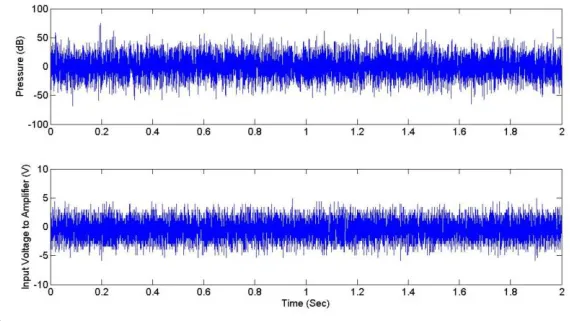
Applying Fast Fourier Transform (FFT), the frequency response of the smart foam is obtained and shown in Fig. 3 along with the raw input-output data. According to Fig. 3b, frequency response of the smart foam reveals a high pass filter behaviour with a cut-off frequency of about 400 𝐻𝑧. This is an expected behaviour for usual electroacoustic transducers where the radiated sound below the cut-off frequency is diminished. On the other hand nonlinear behaviour is seen below the cut-off frequency where the intense fluctuations are present. The main source of this nonlinearity may be large amplitude vibrations of PVDF skin in low frequency region.
These nonlinearities along with measurement noise are main sources of uncertainty in the plant. Such uncertainties and incapability of classical identification algorithms to reach a lower order model are the main motivations to implement robust identification algorithms to identify smart foam with its uncertainty bounds.
Fig 2. Schematic of Experimental Setup
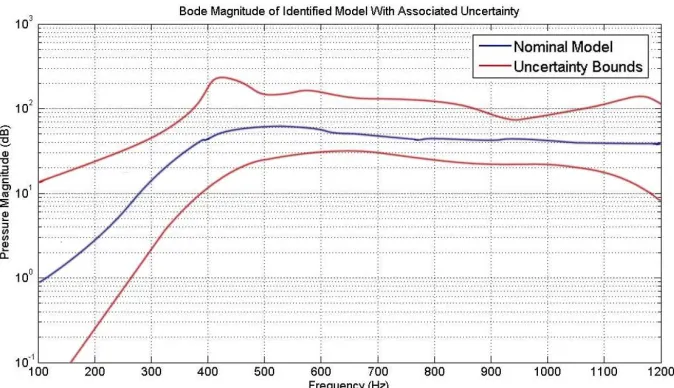
Using the robust identification procedure explained in previous section, robust identified model of smart foam is obtained. The measurement noise is a collection of environmental acoustic noise and the electrical noise of measuring instruments. Thus in order to suppose a bound on noise, the sound pressure level was once measured with zero input voltage to the smart foam indicating just existent noise of environment and measuring instruments. Choosing a flexible output error structure of 12th order for nominal model and model error model, uncertainty bounds due to unmodelled dynamics and measurement noise along with an optimal nominal model has been obtained and shown in Fig. 4 in frequency domain.
Although the orders of the nominal model and model error model have been chosen using a trial and error procedure, two main concepts have been taken care of. First, the uncertainty bounds shall be as tight as possible for conservativeness issues. Second, the identified nominal model should not be falsified by the uncertainty regions, in other words, the nominal model has to be maintained in the uncertainty strip.
a
b
Fig 3. a: Input-Output Identification Data, b: FRF of the Smart Foam
According to Fig. 4, while the nominal model has the desired physical characteristics as cut-off frequency of about
400 𝐻𝑧 and the anticipated slope and flatness before and after this frequency, respectively, it is maintained in the
acceptably tight un certainty upper and lower limits. Uncertainty bounds are loose in lower frequencies as nonlinearities and un modelled dynamics show up in this region. Measurement noise again at higher frequencies tend to loosen the uncertainty strip. Although the identified model can be used in robust control design for stability/performance issues in ANC systems, because of its good physical conformity, it is believed the lower order nominal model can itself be utilized in various non-robust noise control algorithms.
4. Conclusion
Robust identification of smart foam as an electroacoustic transducer considering unmodeled dynamics due to nonlinearities in behaviour at low frequencies and measurement noise at high frequencies as existent uncertainties has been investigated. Set membership estimation combined with model error modelling technique has been used where the approach is based on worst case scenario with hard bounds, namely with unknown but bounded uncertainties. The outcome is a robust identified model
which consists of a nominal model with its uncertainty bounds that fits exactly the 𝐻∞ robust control scheme which has been utilized in active noise control in recent years. Not only is the nominal model maintained in the acceptably tight uncertainty upper and lower limits, validating the method, but also it is compatible with the physics of the problem. Accounting for the nonlinearities and measurement noise in low and high frequency regions, looseness and tightness of the uncertainty strip has been interpreted. With lower order, the nominal identified model can also be utilized in non-robust control techniques, revealing another advantage of applied identification procedure
.
References
1. Reinelt, W, A. Garulli, and L. Ljung, Comparing different approaches to model error modeling in robust identification. Automatica, 38(5) (2002)787-803.
2. Goodwin, G.C. and M.E. Salgado, A stochastic embedding approach for quantifying uncertainty in the estimation of restricted complexity models. International Journal of Adaptive Control and Signal Processing, 1989. 3(4): p. 333-356.
3. Goodwin, G.C., J.H. Braslavsky, and M.M. Seron, Non-stationary stochastic embedding for transfer function estimation. Automatica,. 38(1) (2002) 47-62.
4. Ljung, L. Model validation and model error modeling. in The Åström symposium on control. Lund, Sweden: Studentlitteratur. 1999.
5. Garulli, A. and W. Reinelt. On model error modeling in set membership identification. in Proc. of the System Identification Symposium SYSID. 2000.
6.Livstone, M.M. and M.A. Dahleh, A framework for robust parametric set membership identification. Automatic Control, IEEE Transactions on, 40(11) (1995)1934-1939.
7. Vicino, A. and G. Zappa, Sequential approximation of feasible parameter sets for identification with set membership uncertainty. Automatic Control, IEEE Transactions on, 41(6) (1996)774-785.
8. Kosut, R.L., M.K. Lau, and S.P. Boyd, Set-membership identification of systems with parametric and nonparametric uncertainty. Automatic Control, IEEE Transactions on, 37(7) (1992) 929-941.
9. Vicino, A. and G. Zappa. Sequential approximation of parameter sets for identification with parametric and nonparametric uncertainty. in Decision and Control, 1993., Proceedings of the 32nd IEEE Conference on. 1993. IEEE.
10. Giarre, L., M. Milanese, and M. Taragna, H∞ identification and model quality evaluation. Automatic Control, IEEE Transactions on, 42(2) (1997) 188-199.
11. Giarré, L. and M. Milanese. SM identification of approximating models for H∞ robust control. in Decision and Control, 1996., Proceedings of the 35th IEEE Conference on. 1996. IEEE.
12. Reinelt, W., On model error modeling in set membership identification. 1999.
14. Fernandez-Canti, R.M., J. Blesa, and V. Puig. Set-membership identification and fault detection using a bayesian framework. in Control and Fault-Tolerant Systems (SysTol), 2013 Conference on. 2013. IEEE.
15. Fernández-Cantí, R.M., S. Tornil-Sin, J. Blesa, and V. Puig. Nonlinear set-membership identification and fault detection using a Bayesian framework: Application to the wind turbine benchmark. in Decision and Control (CDC), 2013 IEEE 52nd Annual Conference on. 2013. IEEE.
16. Sánchez Peña, R., M. Cugueró, A. Masip, J. Quevedo, and V. Puig, Robust identification and feedback design: An active noise control case study. Control Engineering Practice, 16(11) (2008)1265-1274.
17. Wu, J.-D. and T.-H. Lee, Application of H-infinity hybrid active controller for acoustic duct noise cancellation. International Journal of Vehicle Noise and Vibration,. 1(3) (2005) 183-193.
18. Gentry, C., C. Guigou, and C. Fuller, Smart foam for applications in passive–active noise radiation control. The Journal of the Acoustical Society of America,. 101(4) (1997) 1771-1778.
19. Guigou, C. and C. Fuller, Adaptive feedforward and feedback methods for active/passive sound radiation control using smart foam. The Journal of the Acoustical Society of America, 104(1) (1998) 226-231.
20. Guigou, C. and C. Fuller, Control of aircraft interior broadband noise with foam-PVDF smart skin. Journal of Sound and Vibration, 220(3) (1999) 541-557.
21. Leroy, P., A. Berry, P. Herzog, and N. Atalla, Experimental study of a smart foam sound absorber. The Journal of the Acoustical Society of America, 129(1) (2011) 154-164.
22. Kundu, A. and A. Berry, Active control of transmission loss with smart foams. The Journal of the Acoustical Society of America,. 129(2) (2011) 726-740.
23. Anton, S., K. Farinholt, and A. Erturk, Piezoelectret foam–based vibration energy harvesting. Journal of Intelligent Material Systems and Structures, (2014) .
24. Wahlberg, B., System identification using Kautz models. Automatic Control, IEEE Transactions on, 39(6) (1994) 1276-1282.
![Fig 1. Fabricated smart foam [25]](https://thumb-us.123doks.com/thumbv2/123dok_us/25115.2002777/5.612.190.452.381.578/fig-fabricated-smart-foam.webp)