• No results found

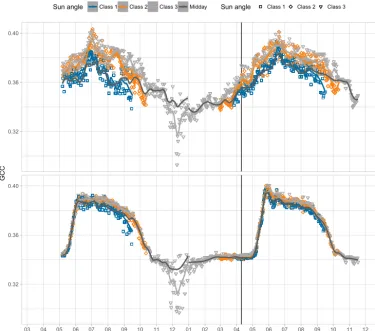
Webcam network and image database for studies of phenological changes of vegetation and snow cover in Finland, image time series from 2014 to 2016

N/A
N/A
Protected

Academic year: 2020

Share "Webcam network and image database for studies of phenological changes of vegetation and snow cover in Finland, image time series from 2014 to 2016"

Copied!
12
0
0

Loading.... (view fulltext now)

Full text

(1)

https://doi.org/10.5194/essd-10-173-2018

© Author(s) 2018. This work is distributed under

the Creative Commons Attribution 4.0 License.

Webcam network and image database for studies of

phenological changes of vegetation and snow cover in

Finland, image time series from 2014 to 2016

Mikko Peltoniemi

1

, Mika Aurela

2

, Kristin Böttcher

3

, Pasi Kolari

4

, John Loehr

5

, Jouni Karhu

6

,

Maiju Linkosalmi

2

, Cemal Melih Tanis

2

, Juha-Pekka Tuovinen

2

, and Ali Nadir Arslan

2

1

Natural Resources Institute Finland (Luke), Latokartanonkaari 9, 00790, Helsinki, Finland

2

Finnish Meteorological Institute, Erik Palménin aukio 1, 00560 Helsinki, Finland

3

Finnish Environment Institute (SYKE), Mechelininkatu 34a, 00251 Helsinki, Finland

4

Department of Physics, University of Helsinki, P.O. Box 68, 00014 Helsinki, Finland

5

Lammi Biological Station, University of Helsinki, Pääjärventie 320, 16900 Lammi, Finland

6

Natural Resources Institute Finland (Luke), Paavo Havaksen tie 3, 90014 Oulun yliopisto, Finland

Correspondence:

Mikko Peltoniemi ([email protected])

and Ali Nadir Arslan ([email protected])

Received: 30 June 2017 – Discussion started: 10 August 2017

Revised: 27 November 2017 – Accepted: 29 November 2017 – Published: 25 January 2018

Abstract.

In recent years, monitoring of the status of ecosystems using low-cost web (IP) or time lapse

eras has received wide interest. With broad spatial coverage and high temporal resolution, networked

cam-eras can provide information about snow cover and vegetation status, serve as ground truths to Earth

ob-servations and be useful for gap-filling of cloudy areas in Earth observation time series. Networked

cam-eras can also play an important role in supplementing laborious phenological field surveys and citizen

sci-ence projects, which also suffer from observer-dependent observation bias. We established a network of

dig-ital surveillance cameras for automated monitoring of phenological activity of vegetation and snow cover in

the boreal ecosystems of Finland. Cameras were mounted at 14 sites, each site having 1–3 cameras. Here,

we document the network, basic camera information and access to images in the permanent data repository

(http://www.zenodo.org/communities/phenology_camera/). Individual DOI-referenced image time series consist

of half-hourly images collected between 2014 and 2016 (https://doi.org/10.5281/zenodo.1066862). Additionally,

we present an example of a colour index time series derived from images from two contrasting sites.

1

Introduction

Year-to-year variation in the phenological cycle of seasonal

ecosystems is large. The snow cover and the timing of

snowmelt vary considerably from year to year. For

exam-ple, in northern and high-elevation ecosystems, vegetation

follows the temporal variation of temperatures, and budburst

dates can vary by 40 days (Häkkinen, 1999), but our ability to

predict this variation is limited (Basler, 2016). Consequently,

phenology remains among the key components causing

un-certainties in our estimates of vegetation carbon balances

(Richardson et al., 2013). Obviously, more monitoring data

are required for improving the understanding of the sources

of phenological variation and to directly support its

monitor-ing, as present methods for monitoring plant phenology and

snow cover in the field are laborious and costly.

Consumer-grade cameras provide an interesting opportunity to monitor

the seasonal cycle of ecosystems because they record

struc-tural information at high spatial and temporal resolution, and

in doing so, time series of images can provide useful

infor-mation about temporal changes in ecosystems at a low cost.

(2)

typi-cally some sub-regions are used to track colour changes in

time, using indices representing chromatic changes in the

target scene, which are related to phenological changes of

leaf colour, quantity (emergence and abscission),

morphol-ogy and prevailing conditions at the site. Analyses of

chro-matic changes and associated phenological transition dates

can be easily automated by using statistical methods that

identify break points in time series (Elmore et al., 2012;

Klosterman et al., 2014; Wingate et al., 2015). Although

colours of the images in the time series are affected by

il-lumination angle, cloud cover and camera type, much of the

potential problems in phenological time series can be largely

avoided by using images from similar environmental

condi-tions, and by selecting a subset of images for analyses and

applying colour index appropriately. Green chromatic

coor-dinate, GCC

=

G

/

(R

+

B

+

G), on the other hand, is a fairly

robust index of colours, because the opposing changes in red

and blue partially balance each other out over the course of

the day (Wingate et al., 2015). GCC has been used in

pheno-logical analyses by estimating a mean using midday images

and then averaging the estimates over 1–3 days (e.g.

Sonnen-tag et al., 2012; Linkosalmi et al., 2016).

Cameras have been deployed on a range of ecosystems,

in-cluding deciduous and mixed species ecosystems

(Richard-son et al., 2007; Ahrends et al., 2009; Sonnentag et al., 2012;

Mizunuma et al., 2013), grasslands (e.g. Migliavacca et al.,

2011), peatlands (Westergaard-Nielsen et al., 2013; Peichl

et al., 2015; Linkosalmi et al., 2016) and coniferous forests

(Nagai et al., 2012; Linkosalmi et al., 2016). Budburst and

leaf senescence of deciduous species and their relationship

with CO

2

exchange have been a focus in a number of studies

(Richardson et al., 2007; Ahrends et al., 2009; Sonnentag et

al., 2012; Mizunuma et al., 2013; Wingate et al., 2015).

Rea-sons for plant colour changes have been related to the

vari-ation of green biomass, and also to changes in the

biochem-ical properties of leaves occurring over the season (Keenan

et al., 2014; Yang et al., 2014). While more detailed

radia-tive transfer analyses may be required to confirm the

conse-quences of pigment and other changing properties of leaves

on the colours (Wingate et al., 2015), the clearest phenomena

such as budburst and autumn colour peaks can already be

ex-tracted with simple time series and break point analyses with

fairly good accuracy (e.g. Sonnentag et al., 2012; Klosterman

et al., 2014; Wingate et al., 2015; Peltoniemi et al., 2018).

Besides vegetation monitoring, time lapse images have been

used in snow cover monitoring. Salvatori et al. (2011)

devel-oped a method for analysing snow cover changes based on

the thresholding of blue channel histograms. The method has

been recently tested also in northern boreal Finland (Arslan

et al., 2017). Perhaps the most obvious use of camera time

series stems from the possibility of using image archives for

documenting the site history. As such, they provide

support-ive information on the ambient conditions, i.e. information

about weather, vegetation and unexpected disturbances.

Given the wealth of features that can be extracted from

im-age time series, it is not surprising there is a large interest in

using them as ground references for Earth observation (EO)

products. A particular benefit of cameras is that they can

provide a continuous time series of reference observations,

as they are not or are rarely occluded by clouds. Previous

research has already shown good correspondence between

the camera-based and EO phenology products (Zhang et al.,

2006; Morisette et al., 2009; Elmore et al., 2012; Hufkens at

al., 2012; Klosterman et al., 2014).

The full benefits of using cameras in ecosystem

moni-toring are reached when information from multiple cameras

are analysed together, and thus many of the cameras have

been set up in smaller or larger networks of sites. In the

US, PhenoCam network has collected time lapse images for

several years (Richardson et al., 2009; http://phenocam.sr.

unh.edu). In Japan, researchers have collected images from

atmosphere–ecosystem carbon flux sites within the

frame-work of the Japan Phenological Eyes Netframe-work (PEN;

Nasa-hara and Nagai, 2015; http://pen.agbi.tsukuba.ac.jp) with the

aim of linking them to other remote sensing and field

obser-vations. The European network of carbon flux sites operate

cameras at least in 50 sites (Wingate et al., 2015).

Phenolog-ical camera monitoring is being more widely implemented

within the framework of the US National Ecological

Ob-servatory Network (NEON) and the European Union’s

Inte-grated Carbon Observation System (ICOS). Many networks

(e.g. Australian Phenocam Network, http://www.phenocam.

org.au) and ICOS are providing data online by request and/or

have plans for open distribution of images (Brown et al.,

2016).

(3)

2

Network of cameras

2.1

Cameras and camera configurations

All cameras are set to a fixed white balance and

auto-matic exposure, targeted northwards where feasible

depend-ing on the view and mountdepend-ing options, and triggered for

half-hourly submission of snapshots to an FTP server, excluding

the night hours. Images are taken at maximum resolution

allowed by the camera (2594

×

1944), except in Hyytiälä

where they are taken at quarter of the maximum

resolu-tion allowed by the camera (1024

×

768). Image JPEGs are

of highest possible quality. Most of the sites and analyses

of this study used image time series acquired with StarDot

NetCam SC5 cameras, while more recently also an AXIS

P1357E camera was installed at one of the sites (Paljakka).

We did not expect colour reproduction of cameras to be

stan-dardized and calibrated, i.e. comparable across cameras, so

we allowed some variation in the camera settings by

lo-cal conditions. In StarDot cameras, we modified the R, G

and B channel amplification settings from the default

set-tings for local scenes so that cameras produced visually

ap-proximately realistic colours. These settings were kept fixed

thereafter, and they are reported in the camera datasheet

(https://doi.org/10.5281/zenodo.1066862; Peltoniemi et al.,

2017). In AXIS P1357E, white balance was set to fixed

(“Fixed outdoor 1” in the camera menu). Pixel digital

num-bers are not thus directly comparable across cameras, but

al-low camera-specific analyses of, for example, the temporal

development of digital numbers and indices based on them.

Iris and zoom were fixed to camera specific values

depend-ing on the view of the camera. Cameras adjust for brightness

of the images automatically. Selected cameras also have grey

reference plates to monitor the stability of colour

reproduc-tion of the cameras.

2.2

Sites

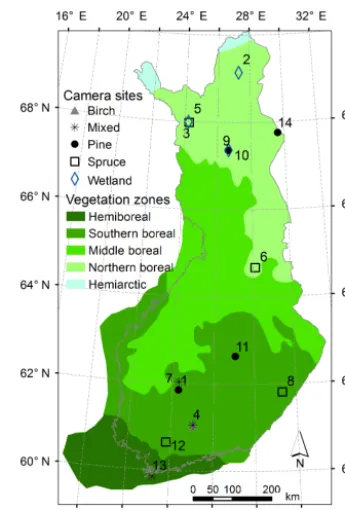
The locations of camera monitoring sites ranged from the

hemiboreal (Tvärminne) to the northern boreal (Kaamanen)

phytogeographical zone (Fig. 1, Table 1). All sites belong to

the subarctic climate zone (Dfc) according to Köppen’s

cli-mate classification, except the Tvärminne site, which is

sit-uated in the warm-summer humid continental climate zone

(Dfb). The start and duration of continuous snow cover varies

along the climate gradient from southwest to north in

Fin-land. Permanent snow cover arrives on average (normal

pe-riod 1981–2010) in October and January and melts in May

and March for the Kaamanen and Tvärminne sites,

respec-tively. The thermal growing season begins when mean daily

temperatures exceed 5

C at the end of April in southern

Fin-land and at the end of May in northern LapFin-land.

Tempera-tures decrease below 5

C ending the thermal growing season

at the end of September in the north and in late October or

the beginning of November in southwestern Finland.

Figure 1.

Sites in the phenological camera network, status end of

2016. Numbers refer to sites in Table 1. Data sources: Country

bor-der © ESRI, Vegetation zones © SYKE, 2015.

The camera monitoring sites include ICOS and other

eddy-covariance sites, LTER (Long-Term Ecosystem Research)

and ICP Forests Level II sites, and other sites with

previ-ous phenological monitoring. Some sites are highly

instru-mented and intensively monitored ecosystem research sites

such as Hyytiälä SMEAR II, Värriö SMEAR I and

So-dankylä eddy covariance sites, while others are less

inten-sively monitored. For most of the sites there is at least a

me-teorological station, and varying number and types of

ancil-lary monitoring measurements. Data from the Finnish

Me-teorological Institute (FMI) meMe-teorological stations can be

freely downloaded from the FMI open data portal (https:

//en.ilmatieteenlaitos.fi/open-data), e.g. by using a user

in-terface “FMI weather data downloader” (https://github.com/

Tumetsu/FMI-weather-downloader).

(4)

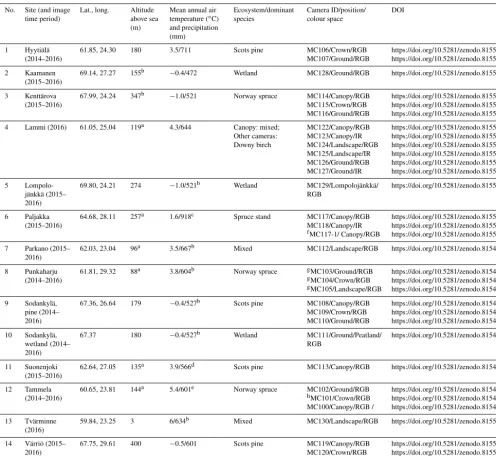
Table 1.

Basic information about the camera sites, targets and the availability of images. Additional information of camera network and

images from 2014 to 2016 can be found in Zenodo collection (https://doi.org/10.5281/zenodo.1066862). Coordinates are in decimal degrees

WGS84.

No.

Site (and image

time period)

Lat., long.

Altitude

above sea

(m)

Mean annual air

temperature (

C)

and precipitation

(mm)

Ecosystem/dominant

species

Camera ID/position/

colour space

DOI

1

Hyytiälä

(2014–2016)

61.85, 24.30

180

3.5/711

Scots pine

MC106/Crown/RGB

MC107/Ground/RGB

https://doi.org/10.5281/zenodo.815559

https://doi.org/10.5281/zenodo.815557

2

Kaamanen

(2015–2016)

69.14, 27.27

155

b

0.4/472

Wetland

MC128/Ground/RGB

https://doi.org/10.5281/zenodo.815553

3

Kenttärova

(2015–2016)

67.99, 24.24

347

b

1.0/521

Norway spruce

MC114/Canopy/RGB

MC115/Crown/RGB

MC116/Ground/RGB

https://doi.org/10.5281/zenodo.815519

https://doi.org/10.5281/zenodo.815523

https://doi.org/10.5281/zenodo.815521

4

Lammi (2016)

61.05, 25.04

119

a

4.3/644

Canopy: mixed;

Other cameras:

Downy birch

MC122/Canopy/RGB

MC123/Canopy/IR

MC124/Landscape/RGB

MC125/Landscape/IR

MC126/Ground/RGB

MC127/Ground/IR

https://doi.org/10.5281/zenodo.815538

https://doi.org/10.5281/zenodo.815540

https://doi.org/10.5281/zenodo.815542

https://doi.org/10.5281/zenodo.815544

https://doi.org/10.5281/zenodo.815546

https://doi.org/10.5281/zenodo.815548

5

Lompolo-jänkkä (2015–

2016)

69.80, 24.21

274

1.0/521

b

Wetland

MC129/Lompolojänkkä/

RGB

https://doi.org/10.5281/zenodo.815555

6

Paljakka

(2015–2016)

64.68, 28.11

257

a

1.6/918

c

Spruce stand

MC117/Canopy/RGB

MC118/Canopy/IR

f

MC117-1/ Canopy/RGB

https://doi.org/10.5281/zenodo.815529

https://doi.org/10.5281/zenodo.815527

https://doi.org/10.5281/zenodo.815525

7

Parkano (2015–

2016)

62.03, 23.04

96

a

3.5/667

b

Mixed

MC112/Landscape/RGB

https://doi.org/10.5281/zenodo.815487

8

Punkaharju

(2014–2016)

61.81, 29.32

88

a

3.8/604

b

Norway spruce

g

MC103/Ground/RGB

g

MC104/Crown/RGB

g

MC105/Landscape/RGB

https://doi.org/10.5281/zenodo.815460

https://doi.org/10.5281/zenodo.815462

https://doi.org/10.5281/zenodo.815464

9

Sodankylä,

pine (2014–

2016)

67.36, 26.64

179

0.4/527

b

Scots pine

MC108/Canopy/RGB

MC109/Crown/RGB

MC110/Ground/RGB

https://doi.org/10.5281/zenodo.815479

https://doi.org/10.5281/zenodo.815481

https://doi.org/10.5281/zenodo.815483

10

Sodankylä,

wetland (2014–

2016)

67.37

180

0.4/527

b

Wetland

MC111/Ground/Peatland/

RGB

https://doi.org/10.5281/zenodo.815485

11

Suonenjoki

(2015–2016)

62.64, 27.05

135

a

3.9/566

d

Scots pine

MC113/Canopy/RGB

https://doi.org/10.5281/zenodo.815489

12

Tammela

(2014–2016)

60.65, 23.81

144

a

5.4/601

e

Norway spruce

MC102/Ground/RGB

h

MC101/Crown/RGB

MC100/Canopy/RGB /

https://doi.org/10.5281/zenodo.815456

https://doi.org/10.5281/zenodo.815454

https://doi.org/10.5281/zenodo.815450

13

Tvärminne

(2016)

59.84, 23.25

3

6/634

b

Mixed

MC130/Landscape/RGB

https://doi.org/10.5281/zenodo.815550

14

Värriö (2015–

2016)

67.75, 29.61

400

0.5/601

Scots pine

MC119/Canopy/RGB

MC120/Crown/RGB

MC121/Ground/RGB

https://doi.org/10.5281/zenodo.815532

https://doi.org/10.5281/zenodo.815534

https://doi.org/10.5281/zenodo.815536

a

Altitude was determined from digital elevation model with a grid size of 10 m

×

10 m provided by the National Land Survey of Finland.

b

Pirinen et al. (2012).

c

Weather station “Puolanka Paljakka” data 2009–2017.

d

FMI Precipitation station “Suonenjoki Iisvesi” data 2015–2016, temperature station measured at the site 1999–2010.

e

Mean air temperature at weather station “Somero Salkola”, 2011–2017; precipitation sum 1981–2010

(http://www.metla.fi/metinfo/forest-condition/programmes/intensive-monitoring.htm).

f

Replaces MC117 11 February 2016 onwards.

g

Re-positioned and refocused August 2016 after damage in June 2016.

h

Short period available from 2014 before camera damage.

2.2.1

Hyytiälä

The Hyytiälä site is situated at the University of Helsinki’s

Hyytiälä Forestry Field Station in an even-aged Scots pine

(

Pinus sylvestris

) stand with scattered spruce and deciduous

(5)

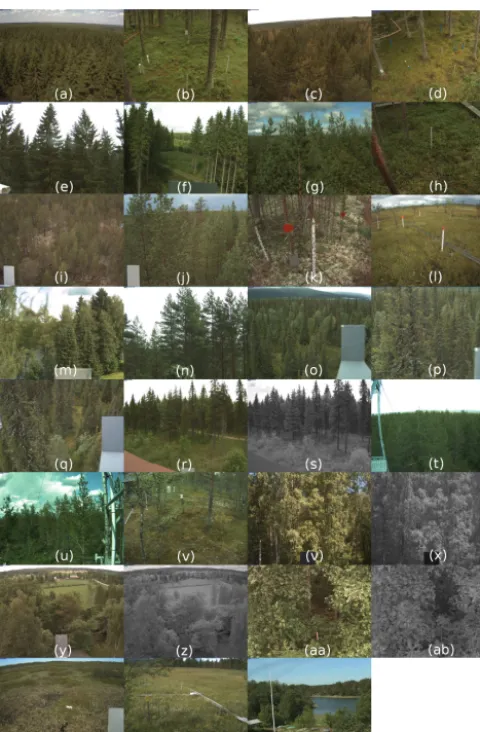
Figure 2.

Camera views: MC100

(a)

, MC101

(b)

, MC102

(c)

,

MC103

(d)

, MC104

(e)

, MC105

(f)

, MC106

(g)

, MC107

(h)

,

MC108

(i)

, MC109

(j)

, MC110

(k)

, MC111

(l)

, MC112

(m)

,

MC113

(n)

, MC114

(o)

, MC115

(p)

, MC116

(q)

, MC117

(r)

,

MC118

(s)

, MC119

(t)

, MC120

(u)

, MC121

(v)

, MC122

(w)

,

MC123

(x)

, MC124

(y)

, MC125

(z)

, MC126

(aa)

, MC127

(ab)

,

MC128

(ac)

, MC129

(ad)

, MC130

(ae)

. Abbreviations refer to

camera ID in Table 1.

exchange, tree ecophysiology and soil at the SMEAR II

research station (Hari and Kulmala, 2005; http://www.atm.

helsinki.fi/SMEAR). These data are available at AVAA

por-tal (https://avaa.tdata.fi/web/smart/smear/).

2.2.2

Kaamanen

The Kaamanen wetland is an open mesotrophic fen in

north-ern Finland, with surface pattnorth-ern consisting of wet flarks and

drier strings. Most of the time the flarks are inundated, but the

strings with a height of approximately 0.8 m are constantly

above the water table covering about 40 % of the fen surface.

The site has no permafrost, but thin lenses of ice may remain

in the well-insulated strings until late summer. The flarks are

covered by different sedges (

Carex

spp.) and moss species,

while the higher strings are dominated by various shrubs,

such as

Ledum palustre

,

Empetrum nigrum

,

Rubus

chamae-morus

and

Betula nana

. The CO

2

and CH

4

fluxes between

the fen and the atmosphere, as well as a variety of

environ-mental parameters (air and soil meteorology together with

different radiation components), are continuously measured

at the site (Aurela et al., 2009).

2.2.3

Kenttärova

The Kenttärova site is situated in a

Norway-spruce-dominated forest at Pallas with a small number of

Be-tula pubescent

also present, and is operated in conjunction

with the Pallas–Sodankylä Global Atmosphere Watch

sta-tion. The main species of the ground floor are

Vaccinium

myr-tillus, Empetrum nigrum

,

Vaccinium vitis-idaea

and the

for-est mosses

Pleurozium schreberi

,

Hylocomium splendens

and

Dicranum polysetum

. Carbon dioxide fluxes together with an

extensive set of meteorological parameters are measured at

the site. Kenttärova is an associated site within the ICOS flux

network.

2.2.4

Lammi

The Lammi site is situated at University of Helsinki’s Lammi

Biological Station (LBS) which belongs to the Finnish

Long-Term Socio-Ecological Research network (FinLTSER). The

station is located in a region characterized by boreal forest,

lake and agricultural landscapes. Three cameras are present

(ground, crown and landscape) including deciduous species

Betula pubescens

,

Acer platanoides

,

Ulmus glabra

,

Prunus

padus

,

Tilia cordata

and

Ribes alpinum

. The FMI weather

station “Hämeenlinna Lammi Pappila” is located at LBS.

LBS also maintains a photosynthetically active radiation

sen-sor (data available upon request from LBS).

2.2.5

Lompolojänkkä

The Lompolojänkkä site is located on an open, mesotrophic

sedge fen. The field layer vegetation in the wetter parts of the

fen is dominated by sedges, while drier parts are

character-ized by fairly dense stands of

Betula nana

. Low shrubs can

be found across the fen with relatively low coverages. For a

more detailed description of Lompolojänkkä, see Aurela et

al. (2009) and Lohila et al. (2010). The camera has a general

view on the drier part of the fen. The CO

2

and CH

4

fluxes

together with a set of environmental parameters (air and soil

meteorology together with different radiation components)

are continuously measured at the site. Kenttärova is a Class 2

site within the ICOS flux network.

2.2.6

Paljakka

(6)

where seasonal development of main tree species in Finland

is monitored. The camera is located on the station roof, and

is focused on a Norway spruce stand. Image view includes

small birch trees that are monitored for phenology. The FMI

weather station “Puolanka Paljakka” is located in the

imme-diate vicinity of the camera.

2.2.7

Parkano

Paljakka is a phenology monitoring site in southern Finland,

belonging to the same network of sites as Paljakka site. The

camera is located at the station roof, and is focused on a

mixed forest landscape including trees that are monitored for

phenology, and a lake behind the trees. The FMI weather

sta-tion (“Karvia Alkkia”) is within approximately 20 km of the

camera.

2.2.8

Punkaharju

The Punkaharju site is a mature spruce (

Picea abies

)

stand on mesic soil. It hosts three cameras at different

heights, one taking images of the ground, one at the crown

level, and one taking images of the surrounding landscape.

The nearest FMI weather station “Savonlinna Punkaharju

Laukansaari” is within 3 km. The Punkaharju site belongs

to the ICP Forests (International Cooperative Programme

on the Assessment and Monitoring of Air Pollution Effects

on Forests) level II monitoring site for long-term

ecosys-tem monitoring. A diverse set of ecosysecosys-tem monitoring is

conducted at the site; see ICP Forests manual for details

and monitoring information collected (http://icp-forests.net/

page/icp-forests-manual; Merilä et al., 2013).

2.2.9

Sodankylä forest

The Scots pine (

Pinus sylvestris

) forest site in Sodankylä is

situated within the Arctic Research Centre of the FMI. The

sparse ground vegetation consists of lichens (73 %), mosses

(12 %) and ericaceous shrubs (15 %). There are three

cam-eras at this site, with views on the forest canopy, crown and

the ground. Carbon dioxide fluxes together with an extensive

set of meteorological parameters are measured at the site.

The Sodankylä forest is a Class 1 site within the ICOS flux

network.

2.2.10

Sodankylä wetland

The Sodankylä wetland (Halssiaapa) is an open fen in the

vicinity of the Sodankylä forest flux site. It is dominated by

large, treeless flarks with abundant sedge vegetation,

com-plemented by fairly low and narrow ridges with birch trees

(of 5–7 m in height). CO

2

and CH

4

fluxes as well as basic

meteorological parameters are measured at the site.

2.2.11

Suonenjoki

The Suonenjoki site has a Scots pine (

P. sylvestris

) stand

on sub-xeric soil. There is a weather station maintained by

the Natural Resources Institute Finland at the site (data on

request from the corresponding author). The nearest FMI

weather station “Suonenjoki Iisvesi” is within 3 km distance.

No other monitoring actions are conducted at this site.

2.2.12

Tammela

The site presently hosts two cameras, one taking images

of the ground and another taking images of the

surround-ing landscape. The Tammela site has a mature spruce (

P.

abies

) stand on mesic soil. It belongs to the network of

ICP Forests level II sites. Consult ICP II Forests manual for

permanent monitoring data collected (http://icp-forests.net/

page/icp-forests-manual). The FMI weather station “Somero

Salkola” is also at the site.

2.2.13

Tvärminne

The Tvärminne site belongs to the Finnish Long-Term

Socio-Ecological Research network (FinLTSER) and is located at

the western Gulf of Finland at the University of Helsinki’s

Tvärminne Zoological Station. The area was post-glacially

uplifted above the sea level and is characterized by a mix of

bedrock and clay soil material and herb-rich forest (nemoral)

forest. One camera is installed on the roof of the station’s

main building viewing the landscape at the shoreline of the

archipelago (Fig. 2ae). The camera allows the monitoring of

the tree phenology, the seasonal development of reeds and

the evolution of sea ice. The tree species in the camera’s field

of view include elm (

Ulmus glabra

), maple (

A. platanoides

),

downy birch (

B. pubescens

), ash (

Fraxinus excelsior

),

com-mon alder (

Alnus glutinosa

) and Scots pine (

P. sylvestris

L.).

The FMI weather station “Hanko-Tvärminne” is located at

the site and provides measurements of air temperature,

pre-cipitation, humidity and snow depth.

2.2.14

Värriö

(7)

3

Examples of processed image data

Here we show examples of the data collected within our

net-work, focusing on the effect of systematic change in

illu-mination conditions during the annual cycle of solar

eleva-tion known to influence colour spectra of incoming

radia-tion, which potentially affects the calculated colour ratios in

images. The analyses were done for five regions of interest

(ROI) of camera views at two contrasting sites separated by

10

latitude (Fig. 3).

Mean green fraction of regions of interest (vegetation) in

images has been found to vary by illumination conditions

(Ahrends et al., 2009). It has been reported that the

system-atic changes of image-based colour indices during the season

can be largely omitted by focusing the analyses on midday

images (Ahrends et al., 2009), possibly by aggregating

in-formation from nearby days (Sonnentag et al., 2012), and by

selecting a robust estimator that is aggregated, e.g. median.

Colour changes in deciduous vegetation and snow cover over

the season are distinctive enough to be clearly depicted

be-hind the day-to-day variation due to clouds and irradiation

(Peltoniemi et al., 2018; Arslan et al., 2017), but in wetlands

and coniferous trees these differences can be more obscure.

We

calculated

mean

green

chromatic

coordinates

(GCC

=

G

/

(R

+

G

+

B), for pixels in the region of

inter-est (ROI). Individual pixels were accepted for the mean

calculation if exposure was sufficient – i.e. pixels were not

poorly exposed or overexposed (Sonnentag et al., 2012).

We required that pixel digital numbers for R, G and B were

all in the range [30, 254]. Daily images were classified to

classes 1, 2 and 3, based on Sun elevation angles falling

into categories > 30

[20, 30

), (0, 20

), respectively. Daily

medians of GCC in these groups were calculated. Sun

elevation angles were calculated using coordinates and time

of day. In addition to these Sun elevation class medians, we

also calculated daily median from midday images between

10:00 and 14:00 UTC

+

2. Daily time series of GCC were

subsequently smoothed with loess regression so as to present

interpolated daily estimates because the number of the

images for median calculation was small.

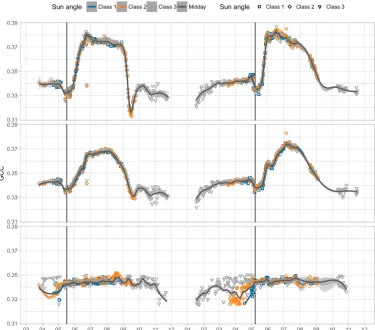
As Kaamanen is a northern site with no daylight during

the winter time, there is a long gap in image data (Fig. 4).

The overall trend in the phenological development of the

birch (

B. pubescens

) and other wetland vegetation (mosses,

sedges, shrubs) is very similar among the Sun elevation

cat-egories. The differences between these classes are clearly

smaller than any changes related to phenological greening

up of mosses and other wetland vegetation and even more

limited than the increase of GCC due to budburst of dwarf

birches (mid-May to early July). The effect of snowmelt is

seen as a quick decline of GCC in Birch and Wetland GCC

in early May of 2015 and 2016. A reference panel shows

vari-able response during the time period of November to April.

The panel was not snow covered in April (inspected visually

from images), which implies that the variable response of the

Figure 3.

Regions of interest used in GCC time series

construc-tion.

(a)

Kaamanen wetland site (camera MC128), with Sphagnum

spp and grasses (Wetland ROI), shrubs like pubescent birch (Betula

pubescens

subsp. Czerepanovii) (birch), and reference grey plate.

(b)

Parkano site (camera MC112), with silver birches (Betula

pen-dula) ROI distributed in three separated polygons (birch), and

Nor-way spruce (Picea abies

L. Karst) ROI.

panel’s colour index may reflect the profound change of the

light environment due to snow melt of the surroundings and

multiple reflections.

(8)

Birch

W

etland

Ref

erence

03

04

05

06

07

08

09

10

11

12

01

02

03

04

05

06

07

08

09

10

11

12

0.31

0.33

0.35

0.37

0.39

0.31

0.33

0.35

0.37

0.39

0.31

0.33

0.35

0.37

0.39

Month, first day (years 2015–2016)

GCC

Sun angle

Class 1

Class 2

Class 3

Midday

Sun angle

Class 1

Class 2

Class 3

Figure 4.

Daily GCC time series of ROI in Kaamanen site by solar elevation category – class 1: > 30

; class 2: (20, 30

); class 3: (0,

20

) – and as daytime averages (midday: 10:00–14:00 UTC

+

2) and smoothed development of GCC over the years. Vertical line shows the

snowmelt date, i.e. the first day without any snow.

that differences in GCC due to Sun angle could be sensitive

to these configurations. Overall, our results confirm the

ear-lier conclusions recommending the use of midday images for

daily aggregation and filtering of phenological time series by

several authors (Sonnentag et al., 2012; Wingate et al., 2015;

Filippa et al., 2016).

4

Data availability

To distribute images, we established a community (

Pheno-logical time lapse images and data from Monimet EU Life

+

project (LIFE12 ENV/FI/000409)

, https://www.zenodo.org/

communities/phenology_camera/) in Zenodo repository

ser-vice (https://www.zenodo.org/) maintained by CERN. The

service was established in the EU OpenAIRE project (https:

//www.openaire.eu/) and is meant for permanent archiving

and distribution of research materials.

The images from each camera covers the period

be-tween 2014 and 2016 or parts of it (Fig. 6). Images

are in their original quality, and have not been

qual-ity checked. Only known major status issues influencing

analyses are reported in the associated camera datasheet

(https://doi.org/10.5281/zenodo.1066862; Peltoniemi et al.,

2017). Users are welcomed to report new status issues with

the images to their contact persons (see camera datasheet).

Temporal coverage of images varies by site and camera,

de-pending on the mounting date, and data connection

variabil-ity at the sites, which occasionally terminates half-hourly

submissions of the images to the FTP server in remote

lo-cations when cameras are on a mobile phone network.

(9)

Spr

uce

Birch

03

04

05

06

07

08

09

10

11

12

01

02

03

04

05

06

07

08

09

10

11

12

0.32

0.36

0.40

0.32

0.36

0.40

Month, first day (years 2015–2016)

GCC

Sun angle

Class 1

Class 2

Class 3

Midday

Sun angle

Class 1

Class 2

Class 3

Figure 5.

Daily GCC time series of ROI in Parkano site by solar elevation category – class 1: > 30

; class 2: (20, 30

); class 3: (0, 20

) – and

as daytime averages (midday: 10:00–14:00 UTC

+

2) and smoothed development of GCC over the years. Vertical line shows the snowmelt

date, i.e. the first day without any snow. In 2015 snow had melted before the camera was installed.

image is captured in IR format it is indicated by an additional

tag <_IR> before the date and time.

Camera-specific information is available in the camera

datasheet also stored in Zenodo. For the present submission

of 2014–2016 images of cameras in the Table 1, see the

camera datasheet (https://doi.org/10.5281/zenodo.1066862).

We plan to update the collection of images in the future, by

adding new versions of the image datasets. For newer images

not yet uploaded to Zenodo, please contact camera contact

persons in the datasheet, and metadata of present camera

im-age uploads.

Material in the database is published under Creative

Com-mons Attribute 4.0 license.

5

Conclusions

Digital cameras have shown their value in various

phenolog-ical applications. They gather valuable information, which

can be analysed for scientific purposes, particularly for those

addressing changes in time. Here, we have presented a

cam-era network opcam-erating in Finland, with camcam-eras mounted in

sites ranging from hemiboreal to subarctic regions. So far, we

have used the cameras in the analyses of latitudinal trends of

birch phenology (Peltoniemi et al., 2018), snow cover

(Ar-slan et al., 2017), and analyses of Scots pine and wetland

CO

2

fluxes (Linkosalmi et al., 2016) with encouraging

re-sults. Several possibilities for further research exist,

particu-larly associated with temporal changes of colours in conifer

canopies, and changes of snow cover.

Figure

Figure 1. Sites in the phenological camera network, status end of2016. Numbers refer to sites in Table 1
Table 1. Basic information about the camera sites, targets and the availability of images
Figure 2. Camera views: MC100MC103MC108MC113MC118MC123MC128 (a), MC101 (b), MC102 (c), (d), MC104 (e), MC105 (f), MC106 (g), MC107 (h), (i), MC109 (j), MC110 (k), MC111 (l), MC112 (m), (n), MC114 (o), MC115 (p), MC116 (q), MC117 (r), (s), MC119 (t), MC120
Figure 3. Regions of interest used in GCC time series construc-tion. (a) Kaamanen wetland site (camera MC128), with Sphagnumspp and grasses (Wetland ROI), shrubs like pubescent birch (Betulapubescens subsp
+3

References

Related documents

On their front or longitudinal sides, the bus bars 2, 3 also present connection tabs 6, 7 which are disposed such as to be also fixed to the edge of the printed circuit board1.

(Although basic math facts include addition, subtraction, multiplication, and division, this study tested multiplication only.) The students’ fluency was then related to their

Rather, it merely acknowledges that any conceptual mapping of the ICL field would be incomplete without featuring the prosecutors belonging to the International

Growth and yield of cotton in response to a free-air carbon dioxide enrichment (FACE) environment. and Forest

19% serve a county. Fourteen per cent of the centers provide service for adjoining states in addition to the states in which they are located; usually these adjoining states have

This essay asserts that to effectively degrade and ultimately destroy the Islamic State of Iraq and Syria (ISIS), and to topple the Bashar al-Assad’s regime, the international

Our Corporate Banking Sector delivered strong growth in 2011, with business customers showing trust in the Bank’s solid foundations and stability.. Lending to companies increased