journal homepage: http://civiljournal.semnan.ac.ir/
Embedded Crack Identification in Beam-Column
Structures under Axial Load Using an Efficient Static
Data Based Indicator
O. Yazdanpanah1, R.A. Izadifard2* and M. Abdi Moghadam1
1. Ph.D. Student, Faculty of Engineering, Imam Khomeini International University, Qazvin, Iran 2. Assistant Professor, Faculty of Engineering, Imam Khomeini International University, Qazvin, Iran
*
Corresponding author:[email protected]
ARTICLE INFO ABSTRACT
Article history:
Received: 02 January 2017 Accepted: 14 February 2017
A triangular model base on an investigation which has done by Sinha et al. has been developed for evaluating embedded crack localization in beam-column structures. In the assessment of this member’s behavior, the effects of displacement slope are necessary. In order to propose a crack localization method for embedded crack, an efficient static data based indicator is proposed for this crack in Euler-Bernoulli beam-columns under axial load effect. A finite element procedure is implemented for calculating the Static responses. Then, base on a central finite difference method, the slope and curvatures of horizontal displacements are evaluated. For this purpose, a simply supported beam-column and a two-span beam-beam-column areconsidered and two different scenarios base on the damage of one element (single damage) and multiple elements (multiple damages) by considering the noise have been assessed. The numerical results have shown that this crack localization method has considerable accurate.
Keywords: Crack modeling,
Embedded crack detection, Beam-column structure, Axial load,
Static responses.
1. Introduction
The recent decades have experienced a rise in the importance of damage detection. Nearly all of the structures are at the expose of local damage during their lifetime. The total age of the structure, if the local damage can be detected and rehabilitated in an appropriate time, is more likely to rise. Health
monitoring and structural damage
In the first step, the presence of damage in the structure is determined. The second level includes locating the damage, while the third level quantifies the severity of the damage is evaluated. In the final step, the previous information is implemented to predict the remaining service life of the structure. Although, all maintained steps are really important, the second step is the most important part of the damage studies. In the last years, many global monitoring techniques based on changes in the vibration characteristics of structures have been developed. For instance, procedures based on natural frequencies and mode shape characteristics were used to identify damage by researchers [2-6]. Numerous methods have been proposed for accurately locating structural damage. Structural damage detection by a hybrid technique consisting of a grey relation analysis for damage localization and an optimization algorithm for damage quantification has been proposed by He and Hwang [7]. Yang et al. used an improved Direct Stiffness Calculation (DSC) technique for damage detection of the beam in beam structures. In this study a new damage index, namely Stiffness Variation Index (SVI) was proposed based on the modal curvature and bending moments using modal displacements and frequencies extracted from a dynamic test and it was shown that this damage index has more accurate in comparison whit other indexes [8]. Damage identification methods based on the use of the modal flexibility of a structure were utilized [9-14]. Techniques based on frequency response functions (FRFs) of a system were adopted [15-17]. Spanos et al. utilized a spatial wavelet transform (WT) for damage detection in Euler–Bernoulli beams under static loads. The result showed that using the WT and via difference between the
change of strain energy based on noisy static data (SSEBI).The acquired results crystal clearly showed that the proposed indicator could precisely locate the damaged elements. The previous research works did not investigate a beam column element under axial load effects, and they did not consider embedded crack; the main purpose of this study, therefore, is the investigation and detection the embedded cracks in beam columns elements under axial load effects. For this aim, an efficient damage indicator is extended to estimate the embedded crack locations in beam-column structures proposing by the author for beam-like structures (Yazdanpanah et al. [24]). Numerical results demonstrate that the proposed index can well determine the locations of single and multiple embedded damage cases whit different characteristics.
2. Embedded damage (crack)
modeling in beam-column
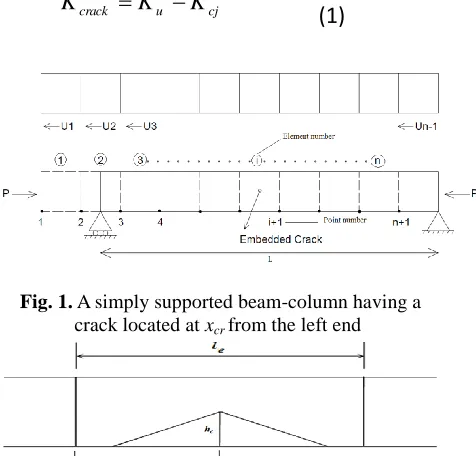
In this study, it is assumed that damage occurs by a transverse surface crack located at xcr from the left end of a beam-column as shown in Fig. 1. For crack modeling, a fully open transverse surface crack model, illuminated by Sinha et al. [25], is adopted. The effect of the crack on the mass is small and can be neglected. The crack only leads to local stiffness reduction in a specified length adjacent to the crack. It is assumed that the reduction of stiffness due to the crack is inside one element. Considering one cracked element as shown in Fig. 2, the flexural rigidity EI of the cracked element varies linearly from the cracked position towards both sides in an effective length lc. The stiffness matrix of the damaged element can be represented as:
e e
crack u cj
K K K
(1)
Fig. 1. A simply supported beam-column having a crack located at xcrfrom the left end
Fig. 2. Variation of EI due to the crack in an element with length le
Where Kue represents the element stiffness
matrix of the intact element; Kcj is the stiffness reduction on the intact element stiffness matrix due to the jth crack. According to Euler–Bernoulli beam-column element, the element stiffness matrix of the intact beam-column is expressed as [26]:
0 0 0 0
(1 ) (1 )
0 0
(1 ) (1 )
0 0
0 0 0 0
(1 ) (1 )
0 0
(1 ) (1 )
0 0
e e
e e
e e
e u
e e
e e
e e
EA EA
L L
k c k c
q q
L L
k c k c
k kc
L L
K
EA EA
L L
k c k c
q q
L L
k c k c
kc k
L L
2 3 2 2 tan( ) 2
( ) 1 ,
tan( ) ( )
2 2
tan( )
(1 ) ( ) 2
, 2 tan( ) ( )
2 2
( ) ( ) cos ( ) 1 , 2 tan( ) ( )
2 2
( ) 1 ( ) cot ( ) 2 tan( ) ( )
2 2 e e e e e l EI q l l l L l
k c EI l
l l
L L
EI l l ec l
kc
l l
L
EI l l g l
k l l L 2 2 ,
, c
c e P EI l P P L (3)
By using the linear variation of EI as proposed by Sinha et al. [25], the reduction on the beam-column element stiffness matrix can be obtained as:
14
11 12 11
24 22 12 14 11 44 symmetric cj K
K K K
K K K K K K K (4)
where the stiffness factors are given by
2 311 4 2
3 2
12 3 2 2
3 2
14 3 2 2
2 3
22 2 2
12 2 2
3 1 ,
12 7 6
2 ,
12 5 6
1 ,
2 3 3
2 2
o c c c
c
e e e
o c c c c
c
e e e e
o c c c c
c
e e e e
o c c c
c
e e e
E I I L x
K L
L L L
E I I L x x
K L
L L L L
E I I L x x
K L
L L L L
E I I L x
K L
L L L
3 224 2 2 2
2 3
44 2 2
,
2 3 9 9
2 2 ,
2 3 3
2 1 .
o c c c c
c
e e e e
o c c c
c
e e e
E I I L x x
K L
L L L L
E I I L x
K L
L L L
(5)
the reduction stiffness matrix on the beam element can be extended for a beam-column element as:
11 12 11 14
22 12 24
11 14
44
0 0 0 0
0 0 0 0 symmetric a a cj a K K
K K K K
K K K
K K K K K (6) where the Ka factor is given by
( o c)
a
e
E A A
K
L
(7) Where xc is the crack location in the local
coordinate, le is the length of the element and
Young’s modulus, Io wh3 12,
c c
A w hh and Ic w h h
c
3 12 are the moment of inertia of the intact and cracked cross sections, respectively, w and hare the width and height of the intact beam-column and is the crack depth. For cases of more than one cracked elements, the same procedure can be followed. The global stiffness matrix of the beam-column Kc is obtained by assembling the element stiffness matrices including those of cracked elements.
3. The proposed damage detection
method
In this paper, embedded damage detection of a prismatic beam-column with a specified length is studied. First, the beam-column is divided into a number of finite elements. Then, the horizontal displacement of the healthy beam-column in measurement points is evaluated using the finite element method. A MATLAB (R2010b [27]) code is prepared here for this purpose. Henceforward, consider the nodal coordinates (
1 ..., , 2 , 1
,q n
xq ) and displacement (
( ), 1, 2, ..., 1 h q
u q n
) obtained for the healthy beam-column as follows:
( ) 1 1 2 2 i hi 1 ( 1)
, ( , ), ( , ),. . .,( , ),. . ., ( , )
q h q h h n h n
x u x u x u x u x u
(8) Now by having the horizontal displacements, the horizontal displacements slope (the first derivative of horizontal displacements,
du d u x
) of the healthy beam can be achieved using the central finite difference approximation as:
( 1) ( 1)
( )
2
h q h q
h q e u u u l
(9)
Where le is the distance between the measurement co-ordinates or it can be the element length. Also, represents the displacement at the measurement co-ordinate
q.
Also, the horizontal displacement curvature (the second derivative of horizontal displacements) of healthy beam-column can now be determined using the central finite difference approximation as:
( 1) ( ) ( 1)
( ) 2
2
h q h q h q
h q
e
u u u
u
l
(10)
Also, the horizontal displacement curvature of damaged beam-column can now be approximated as:
( 1) ( ) ( 1)
( ) 2
2
d q d q d q
d q
e
u u u
u
l
(11) Finally, using the static responses (horizontal displacement, slope and curvature of horizontal displacement) obtained for two above states, static responses based indicator (SRBI) is proposed here as:
2
2, ( ) ( ) ( ) ( ) ( ) ( ) hd q d q h q dq d q hq hq
SRBI u u u u u u
(12) Assuming that the set of the SRBIhd of all points(SRBIhd q, , hdhorizontal displacemen qt, 1, 2,...,n1
) represents a sample population of a normally distributed variable, a normalized form of SRBI can be defined as follows:
, ,
,
,
mean( )
max 0 , , 1, 2,..., 1
std( )
hd q hd q
hd q
hd q
SRBI SRBI
nSRBI q n
Where SRBIhd,q is defined by Eq. (12). Also, mean (SRBIhd,q) and std (SRBIhd,q) represent the mean and standard deviation of (
, , 1, 2,..., 1 hd q
SRBI q n ), respectively.
5. Numerical examples
In order to assess the efficiency of the proposed method for embedded damage detection under axial load, an example including a simply supported beam-column is considered. Various scenarios together with noise effect are studied.
5.1 Example 1: a simply supported beam-column
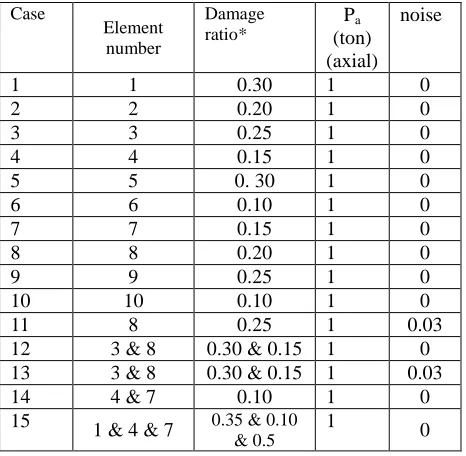
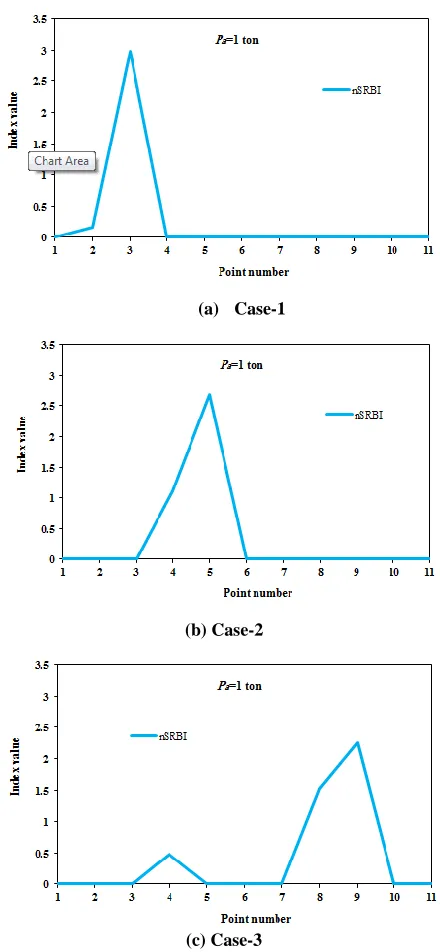
A simply supported beam-column with span L=1 (m) shown in Fig. 3 is selected as the sample. The beam-column has a cross-section with dimensions of 0.04×0.05 m. Modulus of elasticity is E 2.1 10 7 ton m/ 2. As shown in Table 1, for assessment of the method, fifteen different damage scenarios are considered. The first ten scenarios (cases 1-10), consist of a single damage under axial load. The twelfth-fifteenth scenarios (cases 12-15), include multiple damage cases with different intensity. Measurement noise cannot be avoided. Hence, the effect of noise is considered to perturb the responses of the damaged structure. In this example, 3% noise is assumed in scenarios 11 and 13, respectively.
fig. 3. (a) Geometry of the simply supported beam-column (b) Cross-section of the beam-beam-column
Table 1. Fifteen different damage scenarios induced in simply supported beam-column
Case
Element number
Damage ratio*
Pa
(ton) (axial)
noise
1 1 0.30 1 0
2 2 0.20 1 0
3 3 0.25 1 0
4 4 0.15 1 0
5 5 0. 30 1 0
6 6 0.10 1 0
7 7 0.15 1 0
8 8 0.20 1 0
9 9 0.25 1 0
10 10 0.10 1 0
11 8 0.25 1 0.03
12 3 & 8 0.30 & 0.15 1 0 13 3 & 8 0.30 & 0.15 1 0.03 14 4 & 7 0.10 1 0 15 1 & 4 & 7 0.35 & 0.10
& 0.5
1 0
*Damage ratio is hc
h where hcis the crack depth
(a) Case-1
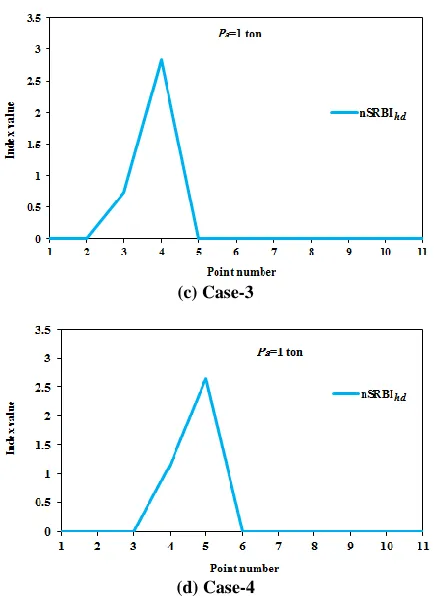
(c) Case-3
(d) Case-4
Fig. 4. Damage identification of simply supported beam-column for cases 1-4
(e) Case-5
(f) Case-6
(g) Case-7
(h) Case-8
Fig. 4. Damage identification of simply supported beam-column for cases 5-8
(i) Case-9
(k) Case-11
(l) Case-12
Fig. 4. Damage identification of simply supported beam-column for cases 9-12
(m) Case-13
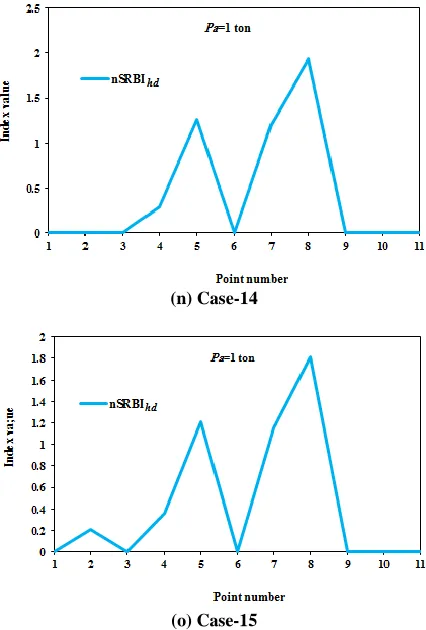
(n) Case-14
(o) Case-15
Fig. 4. Damage identification of simply supported beam-column for cases 13-15
noise and there are reasonable correlations between ones. In other words, the noise has a negligible effect on the performance of
nSRBIhd.
5.2 Example 2: a two-span beam-column
An indeterminate beam-column with two spans with span L=1 (m) shown in Fig. 5 is considered as the second example. The beam-column has a cross-section with dimensions of 0.04×0.05 m. Modulus of elasticity is E 2.1 10 7 ton m/ 2. As shown in Table 2, for assessment of the method, three different damage scenarios are considered. The effect of noise is considered to perturb the responses of damaged structure. In this example, 3% noise is assumed in scenarios 3.
Fig. 5. (a) Geometry of the two-span continuous beam-column. (b) Cross-section of the beam-column
Table 2. Three different damage scenarios induced in two-span continuous beam-column
Case Element number
Damage ratio*
Pa
(ton) (axial)
noise
1 2 0.30 1 0
2 4 0.20 1 0
3 3 & 8 0.30 & 0.15 1 0.03 *Damage ratio is where hcis the crack depth
(a) Case-1
(b) Case-2
(c) Case-3
Fig. 6. Damage identification of two-span continuous beam -column for cases 1-3
Damage identification charts of the two spans beam-column for cases 1 to 3 listed in Table 2 have been shown in Fig. 5, respectively. As can be observed in the figures, the proposed indicator is capable of identifying all damage cases correctly
c
6. Conclusions
In this paper, the embedded cracks identification in beam columns elements under axial load effects has been investigated. A damaged indicator proposed for modal analysis (by the authors) has been extended for static data (nSRBI). In order to be sure about the accuracy of the proposed damage detection method, some illustrative damaged scenarios, including different characteristics which may affect the efficiency of the damage indicators, have been studied with considering a simply supported and two spans beam-column as a test example. The nSRBI is sensitive to the stiffness reduction (moments of inertia) and as in the identification charts has been presented, the proposed indicator could identify all damage scenarios properly. Moreover, measurement noise has a negligible effect on the efficiency of the proposed method for damage assessment.
References
[1] Rytter, A. (1993), “Vibration Based Inspection of Civil Engineering Structures”. Ph.D. Thesis, Aalborg University, Denmark. [2] Cawley, P., Adams, R.D. (1979), “The location of defects in structures from measurements of natural frequency”, The Journal of Strain Analysis for Engineering Design, Vol.14(2), pp.49-57.
[3] Koh, B.H., Dyke, S.J. (2007), “Structural health monitoring for flexible bridge structures using correlation and sensitivity of modal data”, Computers & Structures, Vol.85(3-4), pp.117-130.
[4] Messina, A., Jones, I.A., Williams, E.J. (1992), “Damage detection and localization
using natural frequency changes”, Proceedings of the Conference on Identification in Engineering System, Cambridge, UK, Vol.1, pp.67-76.
[5] Doebling, S.W., Farrar, C.R., Prime, M.B., Shevits, D.W. (1996), “Damage identification and health monitoring of structural and mechanical systems from changes in their vibration characteristics: A literature review”, Los Alamos National Laboratory, USA, Vol.1, pp.1–136.
[6] Abdel Wahab, M.M., De Roeck, G. (1999), “Damage detection in bridges using modal curvatures: application to a real damage scenario”, Journal of Sound and Vibration, Vol.226(2), pp.217–235.
[7] Rong-Song He. R-S., Hwang S-F. (2007). “Damage detection by a hybrid real-parameter genetic algorithm under the assistance of grey relation analysis”, Engineering Applications of Artificial Intelligence, Vol. 20 (7), pp. 980–992.
[8] Yang, Y., Liu, H., Mosalam, K.M., Huang, S. (2013). “An improved direct stiffness calculation method for damage detection of beam structures”. Structural Control and Health Monitoring, Vol.20 (5), pp.835-851.
[9] Nobahari, M., Seyedpoor, S.M. (2013), “An efficient method for structural damage localization based on the concepts of flexibility matrix and strain energy of a structure”, Structural Engineering and Mechanics, Vol.46(2), pp.231-244.
[11] Seyedpoor, S.M., Montazer, M. (2013), “A damage identification method for truss structures using a flexibility-based damage probability index and differential evolution algorithm”, Inverse Problems in Science and Engineering, Vol.24(8), pp.1303-1322.
[12] Jaishi, B., Ren, W.X.. (2006). “Damage detection by finite element model updating using modal flexibility residual”. Journal of Sound and Vibration. Vol. 290, pp.369–387. [13] Miguel, L.F.F., Miguel, L.F.F., Riera, J.D., Menezes, R.C.R. (2007). “Damage detection in truss structures using a flexibility based approach with noise influence consideration”. Structural Engineering and Mechanics, Vol.27, pp.625–638.
[14] Li, J., Wu, B., Zeng, Q.C., Lim, C.W. (2010). “A generalized flexibility matrix based approach for structural damage detection”. Journal of Sound and Vibration, Vol.329, pp.4583–4587.
[15] Wang, Z., Lin, R., Lim, M. (1997). “Structural damage detection using measured FRF data”. Computer Methods in Applied Mechanics and Engineering,Vol.147, pp.187– 197.
[16] Huang, Q., Xu, Y.L., Li, J.C., Su, Z.Q., Liu, H.J. (2012). “Structural damage detection of controlled building structures using frequency response functions”. Journal of Sound and Vibration, Vol. 331, pp.3476– 3492.
[17] Z. Wang, R. Lin, M. Lim (1997). “Structural damage detection using measured FRF data”. Computer Methods in Applied Mechanics and Engineering, Vol.147, pp.187–197.
[18] Spanos, P. D., Giuseppe F., Adolfo S., Massimiliano P. (2006). “Damage detection
in Euler–Bernoulli beams via spatial wavelet analysis”, Structural Control and Health Monitoring, Vol.13(1), pp.472-487.
[19] Naderpour H., Fakharian P. (2016). “A synthesis of peak picking method and wavelet packet transform for structural modal identification”. KSCE Journal of Civil Engineering, Vol. 20 (7), pp. 2859–2867. doi:10.1007/s12205-016-0523-4.
[20] Bakhtiari-Nejad, F., A. Rahai, Esfandiari, A. (2005). “A structural damage detection method using static noisy data”. Engineering Structures, Vol.27, pp.1784-1793.
[21] Caddemi, S., Morassi, A. (2007). “Crack detection in elastic beams by static measurements”. International Journal of Solids and Structures, Vol.44, pp.5301–5315. [22] Abdo, M.A.-B and Hori, M. (2002). “A numerical study of structural damage detection using changes in the rotation of mode shapes”. Journal of Sound and Vibration, Vol.251(2), pp.227–239.
[23] Seyedpoor, S.M., Yazdanpanah, O. (2013). “An efficient indicator for structural damage localization using the change of strain energy based on static noisy data”. Appl. Math. Modelling, Vol38(9-10), pp.2661-2672.
[24] Yazdanpanah O., Seyedpoor S.M., Akbarzadeh Bengar H. (2015). “A new damage detection indicator for beams based on mode shape data”. Structural Engineering and Mechanics, Vol. 53, pp.725-744.
[26] Yoo, C.H., Lee, S.C. (2011). “Stability of Structures: Principles and Applications”.
Butterworth-Heinemann, Burlington, MA, USA, pp.171-179.