Earth Syst. Sci. Data, 11, 1239–1262, 2019 https://doi.org/10.5194/essd-11-1239-2019 © Author(s) 2019. This work is distributed under the Creative Commons Attribution 4.0 License.
A machine-learning-based global
sea-surface iodide distribution
Tomás Sherwen1,2, Rosie J. Chance2, Liselotte Tinel2, Daniel Ellis2, Mat J. Evans1,2, and Lucy J. Carpenter2
1National Centre for Atmospheric Science, University of York, York, YO10 5DD, UK 2Wolfson Atmospheric Chemistry Laboratories, University of York, York, YO10 5DD, UK
Correspondence:Tomás Sherwen ([email protected])
Received: 4 March 2019 – Discussion started: 26 March 2019 Revised: 24 July 2019 – Accepted: 25 July 2019 – Published: 21 August 2019
1 Introduction
Iodine in seawater exists in two major forms, iodide (I−) and iodate (IO−3). Total inorganic iodine (I−+IO−3) remains ap-proximately constant across most of the oceans, but the ratio of iodide to iodate varies. Chance et al. (2014) have shown that the ratio will vary with latitude, depth, and oxygen level. A small amount of iodine (<10 %) is thought to be present in organic forms in the open ocean (e.g. Wong, 1991); however, this may be a larger fraction in coastal waters (e.g. Wong and Cheng, 1998). The processes controlling the distribution of the ratio between iodide and iodate remain poorly under-stood (Chance et al., 2014).
A reason for gaps in our understanding is that the observa-tional dataset of iodide and iodate remains relatively sparse (Chance et al., 2014, 2019a). Despite this paucity in observa-tions, iodine’s role in the Earth system has driven multidis-ciplinary interest in the distribution of iodine compounds in seawater from a number of different research communities, including paleoceanography (e.g. Lu et al., 2016, 2018; Zhou et al., 2015), atmospheric composition (e.g. Ganzeveld et al., 2009; Saiz-Lopez et al., 2014; Sherwen et al., 2016a), and air-quality prediction (e.g. Luhar et al., 2017, 2018; Sarwar et al., 2015; Sherwen et al., 2017b).
The atmospheric science community has seen a particu-larly large growth in interest in iodine chemistry in the at-mosphere and at the sea-surface, as sea-surface I− is be-lieved to be the main driver of atmospheric iodine emis-sions. The reaction of I− with ozone in the sea-surface micro-layer removes ozone from the atmosphere (dry de-position) (Ganzeveld et al., 2009) and results in the emis-sion of inorganic iodine (HOI and I2) into the atmosphere (Carpenter et al., 2013), which can subsequently catalyti-cally destroy ozone (Chameides and Davis, 1980). Models have shown this can then lead to a feedback mechanism be-tween the increased ozone from pre-industrial and present day, counteracting human-driven increases in tropospheric ozone (Prados-Roman et al., 2015; Sherwen et al., 2017a). A number of model studies have discussed the impact of ocean-sourced iodine on atmosphere composition in the context of air quality (Gantt et al., 2017; Sarwar et al., 2016; Sherwen et al., 2017b), climate (Sherwen et al., 2017b; Saiz-Lopez et al., 2012), aerosols (Sherwen et al., 2017a), and strato-spheric ozone (Saiz-Lopez et al., 2015). These atmostrato-spheric modelling studies have used relatively simple parameterisa-tions for predicparameterisa-tions of sea-surface iodide.
Early parameterisations for sea-surface iodide were based on limited datasets and used either an observed range of iodide concentrations (Coleman et al., 2010; Chang et al., 2004) or a reported relationship with biogeochemical param-eters (e.g. chlorophyll in Oh et al., 2008, or nitrate Ganzeveld et al., 2009). However, more recent attempts (Chance et al., 2014; MacDonald et al., 2014) have focused on using corre-lation analysis to fit compicorre-lations of observed iodide concen-trations to a variety of commonly measured sea-surface
vari-ables, notably sea-surface temperature, but also chlorophyll, salinity, and nitrate. A summary of parameterisations that have been used in previous studies is given in Appendix Ta-ble A1. Compilation of all availaTa-ble observations confirmed a strong latitudinal gradient and identified sea-surface temper-ature as the strongest single predictor of iodide concentra-tion (Chance et al., 2014). This approach has led to Eq. (1) from Chance et al. (2014) and Eq. (2) from MacDonald et al. (2014).
I−aq(nM)=0.225·T(◦C)2+19 (1)
I−aq(nM)=1.46×10⁶·exp
−9134
T(◦K)
·1×10⁹ (2)
Figure 1 shows the global annual mean distribution of sea-surface iodide calculated using these parameterisations (Eqs. 1 and 2) and sea-surface temperature fields (Locarnini et al., 2013). Although both equations predict a similar dis-tribution (higher concentrations in tropical waters and lower in polar waters), Eq. (1) generally predicts iodide concentra-tions 2–4 times higher than Eq. (2). In developing Eq. (1), Chance et al. (2014) compiled iodide observations from both coastal and non-coastal sites. However, Eq. (2) used a rela-tively small subset (14 %) of these observations, which did not include coastal sites, which may explain the lower con-centrations. Equation (2) also has an Arrhenius form, which could be interpreted to suggest that iodide concentrations are controlled by abiotic reaction kinetics. However, this has not been demonstrated, and Chance et al. (2014) discussed how microbiological activity and oceanic mixing are currently thought to be the primary controls. The choice of parameter-isation (Eq. 2 versus Eq. 1) results in a difference of 50 % in the calculated global emissions of iodine into the atmosphere (Sherwen et al., 2016a).
T. Sherwen et al.: A machine-learning-based global sea-surface iodide distribution 1241 Table 1.Ancillary variables extracted onto a global 0.125◦×0.125◦(∼12.5 km×12.5 km) grid on a monthly basis.
Field Abbreviation Resolution (space, time) Reference
Sea-surface temperature TEMP 0.25◦×0.25◦, monthly WOA; Locarnini et al. (2013) Salinity SAL 0.25◦×0.25◦, monthly WOA; Zweng et al. (2013) Dissolved oxygen O2 1◦×1◦, monthly WOA; Garcia et al. (2010)
Bathymetric ocean depth DEPTH 9 km (∼0.08◦), n/a GEBCO; Becker et al. (2009), Smith and Sandwell (1997) Nitrate NO3 1◦×1◦, monthly WOA; Garcia et al. (2014)
Phosphate Phos 1◦×1◦, monthly WOA; Garcia et al. (2014) Silicate SIL 1◦×1◦, monthly WOA; Garcia et al. (2014)
Chlorophyll ChlrA 9 km, monthly SeaWIFS; OBPG (2014)
Mixed layer depth MLD* 1◦×1◦, monthly WOA; Monterey and Levitus (1997) Shortwave radiation SWrad 1.9◦×1.9◦, monthly NOAMADS; Large and Yeager (2009)
Expansion of Acronyms. WOA: World Ocean Atlas, SeaWIFS: Sea-Viewing Wide Field-of-View Sensor, GEBCO: General Bathymetric Chart of the Oceans, NOAMADS: NOAA National Operational Model Archive and Distribution System. (*) Three available mixed layer depth (MLD) definitions in WOA (vd: variable potential density, pt: potential temperature, pd: potential density) were processed from comma-separated value (CSV) to NetCDF files and extracted. Following Chance et al. (2014), the monthly sum and maximum MLD was also computed (vd, pt, pd) and used for building predictions of iodide. When just the variable MLD is shown, it is MLD as defined by potential temperature. n/a – not applicable
Figure 1. Annual average sea-surface iodide concentrations pre-dicted by (a) Eq. (1) from Chance et al. (2014) and(b) Eq. (2) from MacDonald et al. (2014). Temperature fields used to make spa-tial predictions were from the World Ocean Atlas (Locarnini et al., 2013). Earth raster and vector map data used are freely available from Natural Earth (http://www.naturalearthdata.com/, last access: 23 July 2019).
Gaussian process emulation to explore model biases on a global scale (Lee et al., 2011; Revell et al., 2018).
Here, we use a recently expanded compilation of sea-surface iodide observations (Chance et al., 2019a) to build a new sea-surface iodide parameterisation using a data-driven machine learning approach. We choose to use the random forest regressor (RFR) algorithm (Breiman, 2001; Pedregosa et al., 2011), which is relatively simple and produces
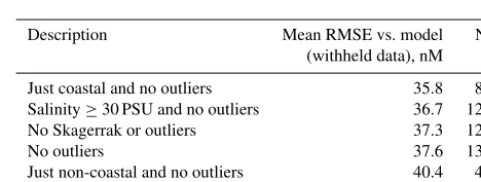
re-Table 2.Splits of dataset used to evaluate outliers and their per-formance against the withheld data. The root mean square error (RMSE) statistic given as the mean of the performance against the withheld data for 20 different models built from 20 different pseudo-random initialisations (Sect. 3.2). The model used here in-cludes ancillary variables of temperature, depth, and salinity which were thought to intuitively give a reasonable result. “No.” gives the number of samples in each dataset.
Description Mean RMSE vs. model No.
(withheld data), nM
Just coastal and no outliers 35.8 819
Salinity≥30 PSU and no outliers 36.7 1278
No Skagerrak or outliers 37.3 1293
No outliers 37.6 1306
Just non-coastal and no outliers 40.4 487
All 95.1 1342
2 Input datasets
Chance et al. (2019a) provides a compilation of the avail-able 1342 sea-surface (<20 m depth) iodide observations between 1967 and 2018. The dataset is available from the British Oceanographic Data Centre (BODC, Chance et al., 2019b; https://doi.org/10/czhx). It includes 45 % more data points, and has greater spatial coverage, than the previ-ous compilation of 925 observations (Chance et al., 2014). Observations are categorised in Chance et al. (2019a) as “coastal” or “non-coastal”, according to the designation of their static Longhurst biogeochemical province (Longhurst, 1998). We adopt the same categorisation here. This sea-surface iodide dataset then forms the dependent variable for our regression. We assume no inter-annual variability and use all data from all years (1967–2018) in this work.
We require a number of physical, chemical, and biolog-ical parameters as the independent variables in our regres-sion models. Consistent in situ measurement of these param-eters are not available for the iodide observations. Thus we have used a number of ancillary datasets (Table 1) to pro-vide this information. There are a number of criteria for these datasets: they need to be available at an appropriately sim-ilar resolution as a gridded product to the desired resolu-tion of the predicted fields, they need to represent potential processes that could control iodide concentrations, and they need to be in some way orthogonal to the other independent variables. Gridded datasets of dissolved organic carbon (e.g. Roshan and DeVries, 2017) and phytoplankton primary pro-ductivity (e.g. Behrenfeld and Falkowski, 1997) may have some usefulness, but they themselves are built using statis-tical models with other variables and thus we do not use those here. The selected ancillary variables (Table 1) were first extracted from their native resolution using the nearest-neighbour method onto a consistent high-resolution monthly grid (0.125◦×0.125◦,∼12.5 km×12.5 km). This horizon-tal resolution was used as this is the highest resolution of the current generation of global atmospheric chemistry simula-tions (Hu et al., 2018) and is also used for regional-scale air-quality studies (e.g. Li et al., 2019). We calculate monthly means because the chemical lifetime of iodide in the sur-face oceans is thought to be at least several months (Campos et al., 1996; Žic et al., 2013), and possibly years (Edwards and Truesdale, 1997; Tsunogai and Henmi, 1971). Indeed, the lifetime of iodide is thought to be sufficiently long that, where deep vertical mixing occurs on a seasonal timescale, this may be the dominant loss process from surface waters (e.g. Chance et al., 2010). The values for bathymetric ocean depth were set to a minimum depth of 2 m, to remove terres-trial locations, and the same value was used for all months.
For each iodide observation, the nearest point in space and time was extracted from the high-resolution gridded ancil-lary data. For the 31 iodide observations where a month was not available (Luther and Cole, 1988; Tsunogai and Henmi, 1971; Wong and Cheng, 1998), an arbitrary month was
cho-sen (of March for northern hemispheric observations and September for southern hemispheric observations). Outliers within the observations are removed as described in Sect. 3.3. A further single dataset (Truesdale et al., 2003) was also excluded from this analysis. This is discussed in Appendix Sect. A1.
3 Methods
Here we first explain the way in which we use the ma-chine learning algorithm (Sect. 3.1). We then explain how we have calculated uncertainty (Sect. 3.2), how observa-tions considered outliers have been removed from the data (Sect. 3.3), and how we have decided which ancillary ables (temperature, salinity, etc.) to use as independent vari-ables for an ensemble prediction (Sect. 3.4). Finally we de-scribe the interpretable ensemble prediction model that re-sults from this methodology in both numerical and graphical terms (Sect. 3.5).
3.1 Random forest regressor algorithm
As the aim here is to predict a continuous numerical value for sea-surface iodide, a regression approach is taken. As dis-cussed in the introduction, previous approaches have been made to parameterise sea-surface iodide, and the most com-monly used relationships employ sea-surface temperature as the predictor variable. Here we take a different multivari-ate and non-parametric approach, using the computationally cheap and interpretable random forest regressor (RFR) algo-rithm (Breiman, 2001; Pedregosa et al., 2011).
Random forest regression is based on finding a number of decisions trees, which predict the dependent variable. All of the trees contribute to the prediction, and they are collectively referred to as a “forest”. These trees can be explained as a record of the way the algorithm has linearly traversed a sub-set of the training data, splitting the data into two parts at each decision point or “node” in a way that minimised the inter-nal differences of the parts. The best split is chosen between the available variables based on an error metric (e.g. mean square error), and this process is continued until a criterion of purity is reached or a minimum number of data points are left from a split. This is essentially a classification problem. The prediction of the forest is the mean value of the predic-tion of all of the different decision trees, which attempts to make the results more of a regression problem. More details of this approach can be found in Friedman et al. (2009).
T. Sherwen et al.: A machine-learning-based global sea-surface iodide distribution 1243 the rest (or withheld set) is then used to test the performance
of the model. Here we use 80 % of the data for the train-ing set and use the remaintrain-ing 20 % as the withheld set (also commonly referred to as the “testing set”).
To ensure that the models built are generalisable and miti-gate overfitting, the random forest approach used here artifi-cially increases the randomness within the forest (Pedregosa et al., 2011). This is done by randomly combining single decision trees by an approach referred to as “bootstrap ag-gregation” or “bagging” (Breiman, 2001; Tong et al., 2003). This additional bagging approach randomly samples obser-vations within the training dataset and so mitigates overfit-ting of the trees to the dataset (Friedman et al., 2009). Fur-thermore, a stratified sampling approach was taken. Specifi-cally, the overall dataset was split into quartiles according to iodide concentration value, and training data were randomly selected from each quartile. This approach was used to main-tain the same statistical distribution in the training/testing data as the overall dataset.
Machine learning algorithms can generally be tuned to in-crease performance using settings called hyperparameters. However, random forests are known to generally perform well without tuning. The default hyperparameters were there-fore used here (Pedregosa et al., 2011), except for increas-ing the number of trees (“n_estimators”) from 10 to 500. Mean square error (MSE) was used as the criterion for eval-uating each split (also referred to as a “node”). The maxi-mum number of “features” (the ancillary variables provided to the algorithm, such as temperature or nitrate concentra-tion) considered when looking for the best split is set to the number provided to the algorithm. The number of splits a tree is allowed to make (“max_depth”) is not restricted, and further nodes are made until leaves contain less than two samples (“min_samples_split”) and a minimum of one (“min_samples_leaf”). All the random forest models are built using bootstrapping.
3.2 Error and uncertainty calculations
Understanding the errors and uncertainties in the global io-dide distribution is important due to any sensitivities to this value within the modelled Earth system. We consider three sources of error in our predictions: the “dataset selection” error due to the splitting of the dataset into training and with-held parts, the “model selection error” due to the choice of dependent variables, and the “observational error” on the io-dide measurements.
To quantify the range of the dataset selection error, we construct models from 20 pseudo-random splits of the dataset into training and withheld parts. The hyperparameters and in-put ancillary variables are kept the same for the generation of the 20 models, so that the only difference between the models is the training dataset. These 20 models are then used to pre-dict the withheld data. Performance metrics (e.g. root mean square error (RMSE) and average absolute prediction) can
then be calculated for each model. This gives a range of 20 values, which can then be converted to a percentage range as the error. This is done by dividing the largest range in pre-dicted values for a model by the minimum prepre-dicted value, to give a maximum value for the range of error, and then tak-ing the smallest range in the predicted values and dividtak-ing this by the maximum value, to give a minimum value for the error range. Significant differences between the model’s per-formance metrics would suggest important sensitivity to the training/withheld dataset splits.
We define the “model selection” error as the uncertainty resulting from the choice of input ancillary variables. A num-ber of combinations of input variables are possible in gener-ating the models, and each will generate a different predic-tion. We quantify this error as the difference in performance against the withheld dataset and prediction value (e.g. aver-age global value). Similarly to our calculation of the dataset selection error, this can be converted to percentage error by considering the range in these values and dividing them by minimum and maximum values.
For the observational error we refer to Chance et al. (2019a), who provide individual error estimates for each of the iodide observations in the data compilation. Over half (51 %) of the data points have an error of 5 % or less, and a further∼25 % have an uncertainty in the range of 5 %–10 %. We therefore use a value of 10 % as a conservative estimate of the observational error.
3.3 Outlier identification and removal
Our dataset consists of values for ancillary variables and io-dide concentration for all of the 1342 measurement loca-tions in the observational dataset (Sect. 2). As discussed in Sect. 3.1, we split this dataset into two parts: (i) a training set for use in building and optimising models, and (ii) a withheld set to evaluate the models built. Particular care was taken to ensure the withheld and training datasets were representative of the entire dataset in the way the models are built, there-fore improving performance and generalisability to unseen data (see Sect. 3.1).
We take a random forest regressor model built with vari-ables that were intuitively assumed to give a reasonable abil-ity to differentiate the observations (using depth, tempera-ture, and salinity as the independent variables – abbrevi-ated to “RFR(DEPTH+TEMP+SAL)” following Table 1). The RFR(DEPTH+TEMP+SAL) model was then used to ex-plore the variation of error in the predictions using the dataset selection error approach described in Sect. 3.2. This builds multiple versions of the same model with different splits of training and test data and yields a distribution of root mean square error in the predicted iodide for withheld data as sum-marised in the final column of Table 2 and shown graphically in Appendix Fig. A1.
1989). Removing these 49 values categorised as outliers (>309.5 nM) leads to a vast improvement in the RMSE error in the ensemble prediction from 95.1 to 37.6 nM (Table 2). This is shown graphically in Appendix Fig. A1, with the other subsets of the data explored (Table 2). This demon-strates that the high values are not well enough represented by the dataset to be able to be captured by the RFR approach. The removal of these high values from the dataset can also be justified as the driver for these concentrations is not yet well understood (Chance et al., 2014, 2019c; Cutter et al., 2018).
Removing these outliers reduces RMSE in the prediction with the 20 independent model builds from 48.2 to 2.3 nM (third quartile–first quartile). Once these outliers are ex-cluded, more modest changes in average RMSE are then seen if models are built only using coastal or non-coastal data. Fig-ure A1 also shows this is seen when removing lower salinity data (“Salinity≥30 PSU and no outliers”), which is indica-tive of estuarine water. This highlights the strength in this approach’s ability to predict iodide in different biogeochem-ical regions (i.e. not just coastal or non-coastal locations).
An additional removal of a single dataset of 19 observa-tions from the Skagerrak strait (Truesdale et al., 2003) was made due to it exerting a disproportionate influence on iodide prediction in high northern latitudes (≥65◦N), an area that is almost entirely unconstrained by local observations. We note that the Skagerrak is relatively unusual oceanographi-cally, being an estuarine location with high ship traffic, and is considered unlikely to be an analogue for iodine speciation in the Arctic. This is decision is discussed further in the Ap-pendix (Sect. A1), and the predictions made including this dataset are also provided in the shared output (Sect. 5).
From here, only the 1293 observational points excluding outliers and the data from the Skagerrak strait (Truesdale et al., 2003) are used.
3.4 Selection of ancillary variables and building an ensemble prediction
To decide which ancillary variables (temperature, salinity, etc.; see Table 1 and Sect. 2) should be used to predict sea-surface iodide concentration, RFR models were built and evaluated with different combinations of variables. Thirty eight combinations were considered (see first column of Ap-pendix Table A2).
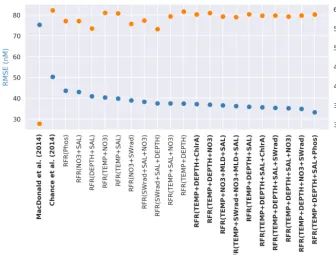
The top 20 performing models, based on their root mean square error against the withheld data, are plotted in Fig. 2, alongside existing parameterisations. The standard deviation for all predicted values is also shown to illustrate variation in the predictions. A complete list of the performance and of all models built here and their performance is given in the appendix (Table A2).
The RMSE values in Fig. 2 show the increased skill present in the new predictions compared to the existing pa-rameterisations. The RMSE improves from the 75.3 and 50.2 nM found for the Chance et al. (2014) and MacDonald
et al. (2014) parameterisations, respectively, to 33.2–37.4 nM for the top 10 models created here. Only modest gains are seen in RMSE between models with three variables or more. The best-performing model in the list is only marginally better than the 10th best-performing one; therefore there is not an obvious “best” performing set of ancillary variables. Thus going forward we use an ensemble prediction approach based on the mean value from an ensemble of the 10 top-performing models.
3.5 Model descriptions
Unlike many machine learning approaches, the random for-est regressor algorithm is interpretable. The decision trees can be visualised to explain the main features driving the splits. Figure 3 shows schematically the whole regression ap-proach taken here. Panel (a) shows single trees, of which 500 are built with the same input variables and then combined into forest (b). Then this forest is combined with the nine other top-performing models (made from different combina-tions of ancillary variables) to make an ensemble (c). The 10 predictions of (c) are then arithmetically averaged into a sin-gle prediction, which thus includes the predictions of 5000 trees with 10 different combinations of input variables. In Fig. 3a, the colour of a limb or “branch” following a node is given by the variable driving that split within the training dataset. For Fig. 3b and c it shows the percent of times that a variable drives that node within the forest. The value of the ancillary variable that sets the split is shown inside the circle (a, b, c). The thickness of the branch scales to the throughput of training dataset samples contained within that split. The trees are shown to a depth of five nodes for aesthetic reasons and due to increased divergence of the trees within a forest the deeper you go. However the trees themselves are unlim-ited in the depth they can reach.
The first and larger splits in the data at decision nodes in the models can be simply read, which can provide under-standing of the main variables driving the initial and largest splits in the prediction. For all models in the ensemble, the initial split is driven by temperature, with a split occurring at around 21.1◦C (with a standard deviation of 1.2◦C). The data are then split by two further nodes from this, a left-and right-hleft-and split (e.g. Fig. 3b). If depth or temperature is present as a variable, then they drive the majority of the next splits. If depth is not present as a variable, then either nitrate or mixed layer depth (MLD) is the most common variable to dictate the split in the data at the next node in the tree. Thus a qualitative way of interpreting the initial splits of the dataset would be to say that the model is primarily differentiating between warmer and shallower locations.
4 Results
T. Sherwen et al.: A machine-learning-based global sea-surface iodide distribution 1245
Figure 2.Random forest regression (RFR) model performance (root mean square error (RMSE), blue) against the withheld data for the top 20 models on the left-handyaxis, along with values from the parameterisations from Chance et al. (2014) and MacDonald et al. (2014). The right-handyaxis is standard deviation of the prediction for the withheld data (orange). The top 10 performing models and the two exiting parameterisations considered here (Chance et al., 2014; MacDonald et al., 2014) are shown in bold. Parameterisations are ordered by their RMSE. Abbreviations are given in Table 1.
explore the predicted global monthly surface concentrations (Sect. 4.2).
4.1 Prediction of iodide at observational locations Figure 4 shows a point-by-point comparison between param-eterised and observed iodide for the entire dataset, the with-held dataset, and the withwith-held coastal dataset and withwith-held non-coastal dataset. Predictions are shown for the ensemble random forest regressor approach described here and for both the Chance et al. (2014) and MacDonald et al. (2014) pa-rameterisations. The root mean square errors of observed and predicted values are given in Fig. 4 and in Table 3.
The new ensemble prediction is the best performing, with a lower RMSE (35 nM) compared to the existing parameter-isations (75 and 50 nM for the MacDonald et al., 2014, and Chance et al., 2014, respectively) for the withheld data. Both the new parameterisation and Chance et al. (2014) parameter-isation are relatively unbiased (both have best-fit-line slopes of 0.84, against the withheld data), but the new parameteri-sation shows less noise than Chance et al. (2014). MacDon-ald et al. (2014) shows a significant low bias and significant noise. The improved skill from the RFR ensemble is consis-tent for both coastal and non-coastal observations.
Figure 5 shows comparisons between the probability dis-tribution functions (PDFs) of the observed iodide and the
pre-dictions, together with the PDFs of the biases for the entire, coastal, and non-coastal withheld datasets. The PDF of the new parameterisation shows the greatest similarity to the ob-servations. The PDF from Chance et al. (2014) shows a sim-ilar range to the observations and structure to the observa-tions, whereas the PDF from MacDonald et al. (2014) shows again a significant underestimate. The bias plots show the new predictions are generally clustered around zero with a relatively narrow peak. Chance et al. (2014) is again roughly clustered around zero but shows a wider peak. The largest biases are found from MacDonald et al. (2014), which sys-tematically underestimates observed iodide concentrations.
The dataset selection error range, which shows the in-fluence of the choice of how the dataset is split into train-ing and withheld data on model prediction, is described in Sect. 3.2. Within the 20-member ensemble of different test-ing/withdrawn choices, the average variation in RMSE was 8.4 nM (5.9–11.02 nM), and in the range of average pre-dicted values it was 6.1 nM (5.4–6.6 nM). This translates to a percentage error range of 13.9 %–36.3 % on the RMSE and 5.4 %–7.3 % on the average predicted value.
T. Sherwen et al.: A machine-learning-based global sea-surface iodide distribution 1247
Figure 4.Regression plots showing comparisons between predicted values and observations in the entire (blue,N=1293) and withheld data (orange,N=259), withheld data classed as coastal (green,N=157), and the withheld data classed as non-coastal (pink,N=102). Solid lines give the orthogonal distance regression line of best fit. The dashed grey line gives the 1:1 line. Root mean square error for each line is annotated by subplot in nanomolar (nM).
Table 3.Statistics for observations and predictions by the ensemble prediction (RFR(ensemble)) and existing parameterisations against the entire dataset of observations. The root mean square error is shown against the entire and the withheld data.
Mean SD 25 % median 75 % RMSE RMSE
nM nM nM nM nM (withheld), nM (entire), nM
Observations 94.8 67.2 36.8 85 140 – –
RFR(Ensemble) 95.6 60.3 41.5 89.4 139.1 34.7 23
Chance et al. (2014) 93.7 60 38.3 86.2 149.8 50.2 49.2
MacDonald et al. (2014) 39.7 30.5 13.1 32.1 66.1 75.3 75
in model performance is 3.9 nM (33.2–37.2 nM). As a per-centage this model selection translates to a perper-centage uncer-tainty on the RMSE of 10.6 %–11.9 % and on the average of 1.8 %–1.9 %.
The dataset selection and model selection compare to an error on the observations of ∼10 %. Uncertainty from dataset selection has a far greater effect on the prediction error than model selection. This is expected due to the small dataset size. The combined error in the prediction (dataset selection + model selection error) is either compara-ble to (7.2 %–9.2 % in terms of average prediction) or greater (24 %–48 % in terms of RMSE) than the observational error. From this analysis we have shown that the new ensemble RFR model performs significantly better than those currently in the literature. We now turn to explore the predicted global distribution of sea-surface iodide using our ensemble model.
4.2 Global sea-surface iodide distribution
From the ensemble prediction system we calculate monthly global grids (0.125◦×0.125◦,∼12.5 km×12.5 km) of sea-surface iodide using the gridded ancillary data (Sect. 2).
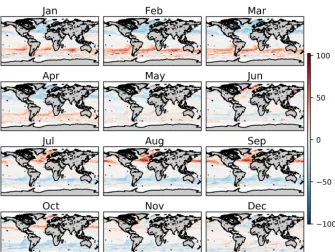
The annual average spatial predictions are shown in Fig. 6 with the observations overlaid in circles. Similar to previous work, annual average maximum concentrations of 220 nM are found in tropical and coastal regions (e.g. Oceania and in the Caribbean/Gulf of Mexico), with the lowest concentra-tions in mid-latitude waters (22.4 nM). Seasonal variability is also seen within the monthly prediction (Appendix Fig. A3). However, this spatial and temporal variability is not well con-strained by observations. For example, some of the highest concentrations are predicted for the South China Sea, a re-gion without any observations (Fig. 6). Some features visible in the concentration field appear to be associated with deep bathymetric features (e.g. the higher concentrations over the Mid-Atlantic Ridge – Fig. 6), even though a physical expla-nation for such a link seems unlikely.
Figure 5.Probability density function (bars) and Gaussian kernel density (lines) estimate of observations and predicted concentrations (left), and bias (right, model minus observations) in entire withheld dataset (upper,N=259), the withheld coastal dataset (middle,N=157), and the withheld non-coastal dataset (lower,N=102).
Figure 6.Annual average predicted sea-surface iodide by the 10-member ensemble of models (RFR(Ensemble)), overlaid with io-dide observations from Chance et al. (2019a) without outliers. Out-liers are defined here as values greater than the third quartile plus 1.5 times the interquartile range (Frigge et al., 1989). Only locations that are entirely water are included in the spatial average. Earth raster and vector map data used are freely available from Natural Earth (http://www.naturalearthdata.com/, last access: 23 July 2019).
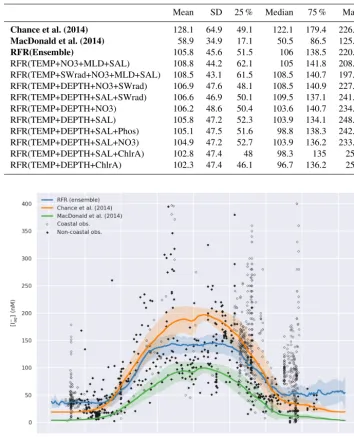
existing parameterisations ranging from 58.9 (MacDonald et al., 2014) to 128.1 nM (Chance et al., 2014).
The annual latitudinal average of these fields, together with predictions from Chance et al. (2014) and MacDon-ald et al. (2014), and the observations are shown in Fig. 7.
Far greater structure is seen compared to the two existing parameterisations (Fig. 7) due to the multivariate and non-parametric ensemble approach used here. All parameterisa-tions capture the broad observed feature of decreasing iodide from lower to higher latitude. The new predicted values lie between Chance et al. (2014) and MacDonald et al. (2014) in the tropics; however, within the polar regions, the new prediction is significantly higher than both of the previous parameterisations. The lower concentrations in the predicted values from MacDonald et al. (2014) for most of the global sea surface are clear.
phys-T. Sherwen et al.: A machine-learning-based global sea-surface iodide distribution 1249 Table 4.Statistics on predicted global annual sea-surface values from new and existing parameters at a horizontal resolution of 0.125◦× 0.125◦. Existing parameterisations (Chance et al., 2014; MacDonald et al., 2014) and the ensemble prediction are shown in bold.
Mean SD 25 % Median 75 % Max
Chance et al. (2014) 128.1 64.9 49.1 122.1 179.4 226.2 MacDonald et al. (2014) 58.9 34.9 17.1 50.5 86.5 125.7 RFR(Ensemble) 105.8 45.6 51.5 106 138.5 220.4 RFR(TEMP+NO3+MLD+SAL) 108.8 44.2 62.1 105 141.8 208.6 RFR(TEMP+SWrad+NO3+MLD+SAL) 108.5 43.1 61.5 108.5 140.7 197.3 RFR(TEMP+DEPTH+NO3+SWrad) 106.9 47.6 48.1 108.5 140.9 227.3 RFR(TEMP+DEPTH+SAL+SWrad) 106.6 46.9 50.1 109.5 137.1 241.3 RFR(TEMP+DEPTH+NO3) 106.2 48.6 50.4 103.6 140.7 234.5 RFR(TEMP+DEPTH+SAL) 105.8 47.2 52.3 103.9 134.1 248.4 RFR(TEMP+DEPTH+SAL+Phos) 105.1 47.5 51.6 98.8 138.3 242.7 RFR(TEMP+DEPTH+SAL+NO3) 104.9 47.2 52.7 103.9 136.2 233.5
RFR(TEMP+DEPTH+SAL+ChlrA) 102.8 47.4 48 98.3 135 256
RFR(TEMP+DEPTH+ChlrA) 102.3 47.4 46.1 96.7 136.2 254
Figure 7. Predicted annual average sea-surface iodide plotted against latitude (lines), overlaid with observed concentrations (diamonds). Solid lines give mean values and shaded regions give (±) the average standard deviation. The standard deviation is the monthly standard deviation across a latitude between all 10 ensemble members (RFR(Ensemble)) or within a single prediction for existing parameterisations (Chance et al., 2014; MacDonald et al., 2014). Filled diamonds show non-coastal observations and non-filled ones show coastal values. Extent ofxaxis is shown for grid boxes that are entirely water.
ical regimes compared to the subset of sampled locations within the observations.
The model selection error due to variability within ensem-bles’ 10 members, generated with different independent vari-ables, gives a global average surface concentration between 102.3 and 108.8 nM. This range in prediction gives a model selection error of 6.45 nM, which equates to 6.0 %–6.3 %. Like with the global uncertainty from dataset selection, the
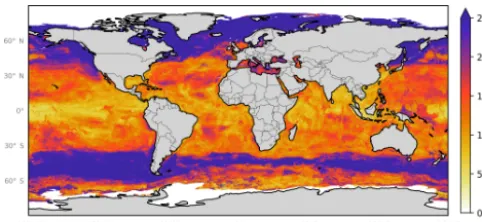
Figure 8.Annual average spatial percent uncertainty in predicted sea-surface iodide for the ensemble of models. Percent spatial un-certainty was calculated as the standard deviation in monthly av-erage values for all models, divided by the annual mean. Values are limited to 25 % for contrast, but the maximum plotted value is 77 % in the northern high latitudes. Only locations that are en-tirely water are included in the spatial average. Earth raster and vector map data used are freely available from Natural Earth (http: //www.naturalearthdata.com/, last access: 23 July 2019).
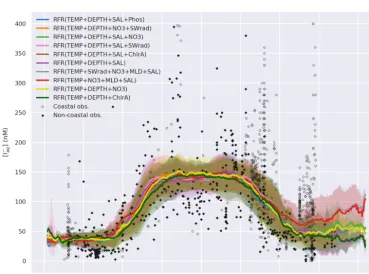
Within members of the ensemble, variation is modest ex-cept for two ensemble members which diverge north of ≥ 65◦N (Appendix Fig. A2). As noted earlier (Sect. 2), the val-ues in this region are very poorly constrained by the observa-tional dataset (Fig. 6).
In addition to the three errors described above, we also at-tempt to gain an understanding of the spatial uncertainty in the 10-model ensemble prediction. We do this by calculating the differences in the predicted spatial fields from the 10 en-semble members. Figure 8 shows the monthly average of the standard deviation of the 10 model ensemble as a percentage of the annual mean of the ensemble prediction. This is also shown in absolute terms in the Appendix (Fig. A4). Relative uncertainties are largest at the poles where predicted concen-trations are lowest and where (at least in the Northern Hemi-sphere) very few observations are available to constrain the system. The southern oceans show an distinct pattern, where values close to coastal Antarctica appear well constrained but values further north appear poorly constrained.
5 Data availability
The monthly ensemble mean and standard deviation be-tween ensemble members for the main prediction pre-sented here (RFR(Ensemble)), along with the individ-ual ensemble members, are archived at the United King-dom’s Centre for Environmental Data Analysis (CEDA) as monthly files in NetCDF-4 format (Sherwen et al., 2019; https://doi.org/10/gfv5v3). To enable use in atmospheric and oceanic models, we have additionally bilinearly re-gridded the outputted fields onto common model grids (Appendix Table A4) using the open-source Python xESMF package (Zhuang, 2018). Values are provided for all locations glob-ally and indices of land–water–ice cover are provided to
al-low data users to choose how to treat locations where water meets ice or land; however, we would not recommend the use of predicted values where ice or land are present. We recommended use of the standard output provided but have also provided the predictions made by the model with the Skagerrak dataset (Truesdale et al., 2003) included (which was excluded from the analysis presented here, as discussed further in Appendix Sect. A1).
Ancillary data extracted for observation locations and used to predict spatial fields are available from sources stated in Table 1. Iodide observations are described by Chance et al. (2019a) and made available by the British Oceanographic Data Centre (BODC, Chance et al., 2019b; https://doi.org/10/czhx).
6 Code availability
Data analysis and processing used open-source Python packages, including Pandas (McKinney, 2010), Xarray (Hoyer and Hamman, 2017), and Scikit-learn (Pedregosa et al., 2011). Spatial re-gridding used the xESMF package (Zhuang, 2018). Plots presented here were created using the Matplotlib (Hunter, 2007), Seaborn (Waskom et al., 2017), and Cartopy (Elson et al., 2018) Python packages. The spe-cific routines used for this work are archived within the sparse2spatial package (Sherwen, 2019), with the exception of the decision tree figures (Figs. 3 and A5), which were made using the TreeSurgeon package (Ellis and Sherwen, 2019).
7 Discussions and conclusions
Here we have explored the ability of an algorithmic ap-proach combined with various physical and chemical vari-ables to predict sea-surface iodide, without aiming to repre-sent the biogeochemical or abiotic processes occurring. This approach instead gives a data-driven best guess at concen-trations and an ability to quantify where the greatest uncer-tainty lies. However, certain features such as prediction of an apparent relationship between ocean bathymetry and sea-surface iodide concentrations, where the ocean is very deep (e.g. over the Mid-Atlantic Ridge), are unlikely to have a plausible physical explanation (Fig. 6).
(Sher-T. Sherwen et al.: A machine-learning-based global sea-surface iodide distribution 1251 wen et al., 2016a). A higher iodide sea-surface
concentra-tion would also result in a greater calculated ozone deposi-tion (Ganzeveld et al., 2009; Luhar et al., 2017; Sarwar et al., 2016).
We have calculated the errors in sea-surface iodide con-centrations at observational locations due to the dataset se-lection of 13.9 %–36.3 % and due to the model sese-lection of 1.8 %–1.9 % (Sect. 4.1 and 4.2). These error estimates can be compared to an approximated error in the observations of∼10 % (Chance et al., 2019a). Considering that the aver-age predicted global concentration here is 106 nM (Sect. 4.2), these errors are notable. The greatest driver in error is the dataset selection. More observations, and particularly obser-vations representative of under-sampled areas (e.g. Arctic) and seasons, will be required to reduce this error. The error caused by dataset selection is also reduced when the predic-tions are considered spatially over the global sea surface.
The choice of the algorithm used here is subjective and nu-merous other options are available. The random forest regres-sor was chosen due to its appropriateness for the continuous regression task performed here, its relatively cheap compu-tation cost, and its interpretability. Considering the greatest uncertainty is driven by the paucity and sparsity of obser-vations, using more complex techniques would not be ex-pected to yield particularly different or drastically better re-sults, considering other trade-offs.
Appendix A
A1 Removed Skagerrak dataset
Ideally with sparse datasets as much data as possible would be included for training the regression models used. If a fea-ture in the data is different enough to the rest of the dataset and not sufficiently represented for the regressor model to characterise it, then it has the potential to introduce a large dataset error (see Sect. 3.2 for details). This was shown when the iodide values above the outlier threshold were included (Sect. 3.2). There could be many other effects of including data that are significantly different to the rest of the dataset.
The data from the Skagerrak strait (Truesdale et al., 2003), which are included in the (Chance et al., 2019a) compilation of iodide data, were excluded from this analysis. This is be-cause, upon inclusion, high iodide at high latitudes (≥65◦N) is calculated (Appendix Fig. A6). An increasing trend is seen with latitude, reaching values comparable to the highest pre-dicted values in the tropics. This region has a paucity of ob-servations within the Chance et al. (2019a) compilation and there are none further north than Iceland. This means that any prediction in this region would be unconstrained by observa-tions. Exclusion of these data leads to Fig. 7 where iodide is generally constant above 65◦N.
The Skagerrak strait data (Truesdale et al., 2003) are also from a region where the observed ancillary variables com-pare poorly with those extracted from ancillary datasets. Ob-served salinity is between 24.0 and 33.5 PSU, whereas the climatological value is 31.7 to 35.8 PSU. This equates to a bias of the climatology versus the in situ observations of up to 9.6 PSU or 40 %. The Skagerrak is biogeochemically dif-ferent from the Arctic, and its large influence on predicted values in the Arctic may arise simply from its latitudinal proximity, given the lack of observations from the regions themselves.
The area this dataset is sampling in is also unusual in the Chance et al. (2019a) compilation due to its estuarine na-ture. However, this cannot entirely explain its behaviour as their are other estuarine datasets included (such as those from around the Chesapeake Bay, Luther and Cole, 1988; Wong and Cheng, 1998, 2008) which do not cause the same issue.
T. Sherwen et al.: A machine-learning-based global sea-surface iodide distribution 1253
Figure A1.Combined kernel density and violin plots showing the distribution of the root mean square error (RMSE) for 20 different models built from 20 different pseudo-random initialisations for a different selection of the dataset as described in Table 2 and Sect.3.2. Models built using the whole dataset (“all”), including outliers, show a significantly higher RMSE due to observations with higher iodide concentrations. The model used here includes ancillary variables of temperature, depth, and salinity which were thought to intuitively give a reasonable result.
Figure A3.Percentage difference in monthly sea-surface iodide from the annual mean field predicted by the 10-model member ensemble. Only locations that are entirely water are included. Earth raster and vector map data used are freely available from Natural Earth (http: //www.naturalearthdata.com/, last access: 23 July 2019).
T. Sherwen et al.: A machine-learning-based global sea-surface iodide distribution 1255
Figure A5.Representation of all forests within the 10-member ensemble (also shown as thumbnails in Fig. 3c). The branches are coloured by percentage of each variable that drives the decision at a given node. The thickness of branches gives the average throughput of the dataset through a given node. Variable names are coloured as per the following coloured text: temperature (blue,◦C), depth (orange,metres), chlorophylla(green, mg m−3), salinity (pink, PSU), nitrate (brown, µg m−3), mixed layer depth (MLD; purple, metres), phosphate (red, µg m−3), and shortwave radiation (grey, W m−2)
Table A1.Summary of sea-surface iodide parameterisations in global and regional atmospheric models.
Model Parameterisation Refs
CMAQ Observed range Chang et al. (2004)
CMAQ Linearly fitting chlorophyllato[I−aq]<range of 100–400 nM Oh et al. (2008)
REMOTE Observed range Coleman et al. (2010)
MESSy-ECHAM5 Campos NO−
3 relationships Ganzeveld et al. (2009)
CAM-Chem Eq. (2) Prados-Roman et al. (2015), Saiz-Lopez et al. (2014)
CMAQ Eq. (2) Gantt et al. (2017), Sarwar et al. (2016, 2015)
GEOS-Chem Eq. (1) Sherwen et al. (2016a)
GEOS-Chem Eq. (2) Sherwen et al. (2016b, c, 2017a, b)
T. Sherwen et al.: A machine-learning-based global sea-surface iodide distribution 1257
Table A2.Statistics on observations and predicted values from the new ensemble and existing parameterisations at locations of observations. Root mean square error (RMSE) is shown against the withheld data and the entire dataset of observations. Ensemble members, ensemble prediction (RFR(Ensemble)), and existing parameterisations shown in bold. Values are shown for all 38 models built, including those not included in the ensemble.
Mean SD 25 % Median 75 % RMSE (withheld) RMSE (entire)
Observations 94.8 67.2 36.8 85 140 – –
MacDonald et al. (2014) 39.7 30.5 13.1 32.1 66.1 75.3 75 Chance et al. (2014) 93.7 60 38.3 86.2 149.8 50.2 49.2 RFR(Ensemble) 95.6 60.3 41.5 89.4 139.1 34.7 23 RFR(TEMP+DEPTH+SAL+Phos) 95.4 60.8 41.3 89.2 139.9 33.2 22.6 RFR(TEMP+DEPTH+NO3+SWrad) 95.5 60.4 40.8 89.2 139.8 34.9 23.3 RFR(TEMP+DEPTH+SAL+NO3) 95.5 60.6 41.8 89 140.2 35.2 23.3 RFR(TEMP+DEPTH+SAL+SWrad) 95.3 60.6 41.7 89.5 138.7 35.3 23.4 RFR(TEMP+DEPTH+SAL+ChlrA) 95.7 60.5 41.7 89.4 138.1 35.6 23.4 RFR(TEMP+DEPTH+SAL) 95.5 60.6 41.3 89.4 137.9 35.9 23.7 RFR(TEMP+SWrad+NO3+MLD+SAL) 95.6 60.7 41.1 89.4 140.9 36.2 24.1 RFR(TEMP+NO3+MLD+SAL) 95.8 60.6 41.3 88.9 140.9 36.6 24.3 RFR(TEMP+DEPTH+NO3) 95.6 60.5 41 89.3 140.4 36.9 24 RFR(TEMP+DEPTH+ChlrA) 95.8 60.3 41.3 89.4 139.9 37.2 24.3
RFR(TEMP+DEPTH) 95.6 60.6 41.1 88.6 139.2 37.4 24.4
RFR(TEMP+SAL+NO3) 95.6 60.6 42 89.3 141 37.5 24.6
RFR(SWrad+SAL+DEPTH) 95.5 58.2 46.3 89.4 135.5 37.5 24.7
RFR(SWrad+SAL+NO3) 95.7 59.8 42.7 90.4 137.4 38.3 25.2
RFR(NO3+SWrad) 95.6 58.8 41.8 94.6 136.9 38.9 27.9
RFR(TEMP+SAL) 95.5 60.5 41.4 88.7 140.2 39.8 25.6
RFR(TEMP+NO3) 96 60.5 41.5 88.1 139.9 40.3 25.9
RFR(DEPTH+SAL) 95.6 57.6 47.7 90.2 134.6 40.9 26.7
RFR(NO3+SAL) 95.6 58.9 42.7 90.3 138.9 43 27.5
RFR(Phos) 95.4 57.6 44.1 92.2 141.1 43.6 31.3
RFR(O2) 95.7 60.5 40.2 89.3 141.9 43.7 30.1
RFR(SWrad+SAL) 95.2 59 46.2 89.4 136.6 43.8 27.3
RFR(TEMP) 95.7 60.1 42.3 89.2 139.3 45.2 28.6
RFR(NO3) 95.6 58.6 43.5 90.2 141.1 46.6 32.1
RFR(MLDpd_max) 95.2 56.1 47 100.3 138.3 47.1 36.2
RFR(MLDpt_max) 95.1 54.4 45.6 100.3 138.3 47.2 38.5
RFR(SWrad) 95.7 58.7 47.2 89.4 137.5 47.5 32
RFR(MLDpd_sum) 95.3 57.2 47.6 93.9 141.2 48.3 34.3
RFR(MLDpt_sum) 95.7 57.6 46.5 94.3 140.2 49.1 34.5
RFR(MLDvd_sum) 95.2 55.8 47.9 91.8 139.6 49.1 35.4
RFR(Sil) 95.4 57.6 45.2 90.4 140 49.5 33
RFR(MLDvd_max) 94.9 52.5 47.9 99.1 134.1 51.5 40.8
RFR(MLDpt) 95.4 53.9 49.7 94.3 134 54.9 40.9
RFR(MLDpd) 95.8 52.2 55.5 91.7 126.4 55.2 41.8
RFR(SAL) 95.9 56.1 52.1 89.3 132.7 56.8 34.6
RFR(DEPTH) 96.5 53 51.7 90.8 135.3 57 39.6
RFR(MLDvd) 95.8 49.2 53.9 87.4 134.1 57.4 45.2
RFR(ChlrA) 95.6 53.4 53.9 89.6 131.6 59.6 36.1
Table A3.Statistics on observations and predicted values by ensemble and existing parameterisations at locations of observations but just for the withheld dataset locations. Table 3 shows the values for both the withheld and entire dataset.
Mean SD 25 % Median 75 % RMSE
Observations 94.3 67.4 36.9 84 138.6 –
RFR(Ensemble) 96.7 57.8 47.2 93.1 137.4 34.7
Table A4.Spatial and temporal resolutions of global monthly iodide fields available for download from the United Kingdom’s Centre from Environmental Data Analysis (Sherwen et al., 2019; https://doi.org/10/gfv5v3). Re-gridding was performed in Python using the open-source xESMF package (Zhuang, 2018).
Resolution Bottom-left grid edge
Lat.×long. Model/description Long. Lat.
0.125◦×0.125◦ GEOS-Chem in GEOS5 (Hu et al., 2018) −180.0625 −90.0625
0.25◦×0.25◦ Centred on 0.125◦ −180 −90
0.5◦×0.5◦ Centred on 0.25◦ −180 −90
1◦×1◦ Centred on unit degrees −180.5 −90.5
1◦×1◦ Centred on 0.5◦ −180 −90
2◦×2.5◦ GISS ModelE (Miller et al., 2014) −178.75 −90 2◦×2◦ ACCMIP (Lamarque et al., 2013) −180 −90 2◦×2.5◦ GEOS-Chem (Bey et al., 2001) −181.25 −91 2.5◦×3.75◦ UKCA (O’Connor et al., 2014) −180 −90 4◦×5◦ GEOS-Chem (Bey et al., 2001) −182.5 −92
Latitudes less than−90◦indicate half-boxes at poles. Acronyms expand to United Kingdom Chemistry and Aerosols
T. Sherwen et al.: A machine-learning-based global sea-surface iodide distribution 1259 Author contributions. LJC, MJE, and TS conceived the work.
TS developed the code, built the models, and performed the analy-sis. DE and TS wrote the code to make Fig. 3 and Appendix Fig. A5. TS wrote the paper with contributions from RJC, MJE, LT, and LJC.
Competing interests. The authors declare that they have no con-flict of interest.
Acknowledgements. We all thank those who have provided their published and unpublished data to the Chance et al. (2019a) dataset and the British Oceanographic Data Centre (BODC) for hosting this, as well as all support staff involved.
We gratefully acknowledge those who have worked to compile and make available the ancillary datasets used here (Table 1). These include the World Ocean Atlas (WOA), Ocean Biology Processing Group (OBPG) at NASA’s Goddard Space Flight Center, and the General Bathymetric Chart of the Oceans (GEBCO) teams.
We thank Tim Jickells, Peter Liss, David Stevens, and Martin Wadley for their useful conversations on and comments about this work.
We gratefully acknowledge funding from Natural Environ-ment Research Council (NERC) through grants “Iodide in the ocean: distribution and impact on iodine flux and ozone loss” (NE/N009983/1) and “Big data for atmospheric chem-istry and composition: Understanding the Science (BACCHUS)” (NE/L01291X/1).
Financial support. This research has been supported by the Nat-ural Environment Research Council grants “Iodide in the ocean: distribution and impact on iodine flux and ozone loss” (grant no. NE/N009983/1) and “Big data for atmospheric chemistry and composition: Understanding the Science (BACCHUS)” (grant no. NE/L01291X/1).
Review statement. This paper was edited by Scott Stevens and reviewed by Peer Johannes Nowack and Laurens Ganzeveld.
References
Becker, J. J., Sandwell, D. T., Smith, W. H. F., Braud, J., Binder, B., Depner, J., Fabre, D., Factor, J., Ingalls, S., Kim, S.-H., Ladner, R., Marks, K., Nelson, S., Pharaoh, A., Trimmer, R., Rosenberg, J. V., Wallace, G., and Weatherall, P.: Global Bathymetry and Elevation Data at 30 Arc Sec-onds Resolution: SRTM30_PLUS, Mar. Geod., 32, 355–371, https://doi.org/10.1080/01490410903297766, 2009.
Behrenfeld, M. J. and Falkowski, P. G.: Photosynthetic rates de-rived from satellite-based chlorophyll concentration, Limnol. Oceanogr., 42, 1–20, https://doi.org/10.4319/lo.1997.42.1.0001, 1997.
Bey, I., Jacob, D. J., Yantosca, R. M., Logan, J. A., Field, B. D., Fiore, A. M., Li, Q., Liu, H. Y., Mickley, L. J., and Schultz, M. G.: Global modeling of tropospheric chemistry with assimilated meteorology: Model
descrip-tion and evaluadescrip-tion, J. Geophys. Res., 106, 23073–23095, https://doi.org/10.1029/2001JD000807, 2001.
Breiman, L.: Random forests, Mach. Learn., 45, 5–32, 2001. Campos, M., Farrenkopf, A., Jickells, T., and Luther, G.: A
com-parison of dissolved iodine cycling at the Bermuda Atlantic Time-series Station and Hawaii Ocean Time-series Station, Deep Sea Res. Pt. II, 43, 455–466, https://doi.org/10.1016/0967-0645(95)00100-X, 1996.
Carpenter, L. J., MacDonald, S. M., Shaw, M. D., Kumar, R., Saunders, R. W., Parthipan, R., Wilson, J., and Plane, J. M. C.: Atmospheric iodine levels influenced by sea sur-face emissions of inorganic iodine, Nat. Geosci., 6, 108–111, https://doi.org/10.1038/ngeo1687, 2013.
Chameides, W. L. and Davis, D. D.: Iodine: Its possible role in tro-pospheric photochemistry, J Geophys. Res.-Oceans, 85, 7383– 7398, https://doi.org/10.1029/JC085iC12p07383, 1980. Chance, R., Baker, A. R., Carpenter, L., and Jickells, T. D.: The
distribution of iodide at the sea surface, Environ. Sci.-Proc. Imp., 16, 1841–1859, https://doi.org/10.1039/C4EM00139G, 2014. Chance, R., Tinel, L., Sherwen, T., Baker, A., Bell, T., Brindle, J.,
Campos, M., Croot, P., Ducklow, H., He, P., Hoogakker, B., Hop-kins, F., Hughes, C., Jickells, T., Loades, D., Macaya, D., Maha-jan, A., Malin, G., Phillips, D., Sinha, A., Sarkar, A., Roberts, I., Roy, R., Song, X., Winklebauer, H., Wuttig, K., Yang, M., Zhou, P., and Carpenter, L.: Global sea-surface iodide observa-tions, 1967–2018, in review, 2019a.
Chance, R., Tinel, L., Sherwen, T., Baker, A., Bell, T., Brindle, J., Campos, M., Croot, P., Ducklow, H., He, P., Hoogakker, B., Hop-kins, F., Hughes, C., Jickells, T., Loades, D., Macaya, D., Maha-jan, A., Malin, G., Phillips, D., Sinha, A., Sarkar, A., Roberts, I., Roy, R., Song, X., Winklebauer, H., Wuttig, K., Yang, M., Zhou, P., and Carpenter, L.: Global sea-surface iodide observa-tions, 1967–2018, https://doi.org/10.5285/7e77d6b9-83fb-41e0-e053-6c86abc069d0, 2019b.
Chance, R., Tinel, L., Sarkar, A., Sinha, A. K., Mahajan, A., Jick-ells, T. D., Stevens, D., Wadley, M., Chacko, R., Sabu, P., and Carpenter, L. J.: Surface inorganic iodine speciation in the In-dian Ocean and InIn-dian Ocean sector of the Southern Ocean, in preparation, 2019c.
Chance, R. J., Shaw, M., Telgmann, L., Baxter, M., and Carpenter, L. J.: A comparison of spectrophotometric and denuder based approaches for the determination of gaseous molecular iodine, Atmos. Meas. Tech., 3, 177–185, https://doi.org/10.5194/amt-3-177-2010, 2010.
Chang, W., Heikes, B. G., and Lee, M.: Ozone deposi-tion to the sea surface: chemical enhancement and wind speed dependence, Atmos. Environ., 38, 1053–1059, https://doi.org/10.1016/j.atmosenv.2003.10.050, 2004.
Coleman, L., Varghese, S., Tripathi, O. P., Jennings, S. G., and O’Dowd, C. D.: Regional-scale ozone deposition to North-East Atlantic waters, Adv. Meteorol., 2010, 243701, https://doi.org/10.1155/2010/243701, 2010.
Cutter, G. A., Moffett, J. W., Nielsdóttir, M. C., and Sa-nial, V.: Multiple oxidation state trace elements in sub-oxic waters off Peru: In situ redox processes and advec-tive/diffusive horizontal transport, Mar. Chem., 201, 77–89, https://doi.org/10.1016/J.MARCHEM.2018.01.003, 2018. Edwards, A. and Truesdale, V.: Regeneration of Inorganic Iodine
Shelf S., 45, 357–366, https://doi.org/10.1006/ECSS.1996.0185, 1997.
Ellis, D. and Sherwen, T.: wolfiex/TreeSurgeon: Wollemia, https://doi.org/10.5281/zenodo.3346817, 2019.
Elson, P., Andrade, E. S. de, Hattersley, R., Campbell, E., Daw-son, A., May, R., Little, B., Pelley, C., Blay, B., Donkers, K., Killick, P., Marqh, L., Peglar, P., Wilson, N., Kirkham, D., Bosley, C., Signell, J., Filipe, Krischer, L., Eriksson, D., Smith, A., Carlos, McDougall, D., Crosby, A., and Herzmann, D.: scaine1, Greg and munslowa: SciTools/cartopy: v0.17.0, https://doi.org/10.5281/ZENODO.1490296, 2018.
Friedman, J. H., Hastie, T., and Tibshirani, R.: The elements of statistical learning: data mining, inference, and prediction, 2nd Edn., Springer, New York, NY, 2009.
Frigge, M., Hoaglin, D. C., and Iglewicz, B.: Some im-plementations of the boxplot, Am. Stat., 43, 50–54, https://doi.org/10.1080/00031305.1989.10475612, 1989. Gantt, B., Sarwar, G., Xing, J., Simon, H., Schwede, D.,
Hutzell, W. T., Mathur, R., and Saiz-Lopez, A.: The im-pact of iodide-mediated ozone deposition and halogen chem-istry on surface ozone concentrations across the continen-tal United States, Environ. Sci. Technol., 51, 1458–1466, https://doi.org/10.1021/acs.est.6b03556, 2017.
Ganzeveld, L., Helmig, D., Fairall, C. W., Hare, J., and Pozzer, A.: Atmosphere-ocean ozone exchange: A global modeling study of biogeochemical, atmospheric, and waterside turbu-lence dependencies, Global Biogeochem. Cy., 23, GB4021, https://doi.org/10.1029/2008GB003301, 2009.
Garcia, H. E., Boyer, T. P., Locarnini, R. A., Antonov, J. I., Mis-honov, A. V., Baranova, O. K., Zweng, M. M., Reagan, J. R., Johnson, D. R., and Levitus, S.: World Ocean Atlas 2013. Vol. 3: Dissolved Oxygen, Apparent Oxygen Utilization, and Oxygen Saturation, edited by: Levitus, S. and Mishonov, A., NOAA Atlas NESDIS 75, 27 pp., https://doi.org/10.7289/V5XG9P2W, 2010. Garcia, H. E., Locarnini, R. A., Boyer, T. P., Antonov, J. I., Bara-nova, O. K., Zweng, M. M., Reagan, J. R., Johnson, D. R., Mis-honov, A. V., and Levitus, S.: World Ocean Atlas 2013. Vol. 4: Dissolved Inorganic Nutrients (phosphate, nitrate, silicate), edited by: Levitus, S. and Mishonov, A., NOAA Atlas NESDIS 76, 25 pp., 2014.
Gardner, M. and Dorling, S.: Artificial neural networks (the multilayer perceptron) – a review of applications in the atmospheric sciences, Atmos. Environ., 32, 2627–2636, https://doi.org/10.1016/S1352-2310(97)00447-0, 1998. Hoyer, S. and Hamman, J.: xarray: N-D labeled arrays
and datasets in Python, J. Open Res. Softw., 5, 10, https://doi.org/10.5334/jors.148, 2017.
Hu, L., Keller, C. A., Long, M. S., Sherwen, T., Auer, B., Da Silva, A., Nielsen, J. E., Pawson, S., Thompson, M. A., Trayanov, A. L., Travis, K. R., Grange, S. K., Evans, M. J., and Ja-cob, D. J.: Global simulation of tropospheric chemistry at 12.5 km resolution: performance and evaluation of the GEOS-Chem chemical module (v10-1) within the NASA GEOS Earth sys-tem model (GEOS-5 ESM), Geosci. Model Dev., 11, 4603–4620, https://doi.org/10.5194/gmd-11-4603-2018, 2018.
Hunter, J. D.: Matplotlib: A 2D graphics environment, Comput. Sci. Eng., 9, 90–95, https://doi.org/10.1109/MCSE.2007.55, 2007. Keller, C. A. and Evans, M. J.: Application of random forest
regres-sion to the calculation of gas-phase chemistry within the
GEOS-Chem chemistry model v10, Geosci. Model Dev., 12, 1209– 1225, https://doi.org/10.5194/gmd-12-1209-2019, 2019. Lamarque, J.-F., Shindell, D. T., Josse, B., Young, P. J., Cionni, I.,
Eyring, V., Bergmann, D., Cameron-Smith, P., Collins, W. J., Do-herty, R., Dalsoren, S., Faluvegi, G., Folberth, G., Ghan, S. J., Horowitz, L. W., Lee, Y. H., MacKenzie, I. A., Nagashima, T., Naik, V., Plummer, D., Righi, M., Rumbold, S. T., Schulz, M., Skeie, R. B., Stevenson, D. S., Strode, S., Sudo, K., Szopa, S., Voulgarakis, A., and Zeng, G.: The Atmospheric Chemistry and Climate Model Intercomparison Project (ACCMIP): overview and description of models, simulations and climate diagnostics, Geosci. Model Dev., 6, 179–206, https://doi.org/10.5194/gmd-6-179-2013, 2013.
Large, W. G. and Yeager, S. G.: The global climatology of an inter-annually varying air–sea flux data set, Clim. Dynam., 33, 341– 364, https://doi.org/10.1007/s00382-008-0441-3, 2009. Lee, L. A., Carslaw, K. S., Pringle, K. J., Mann, G. W., and
Spracklen, D. V.: Emulation of a complex global aerosol model to quantify sensitivity to uncertain parameters, Atmos. Chem. Phys., 11, 12253–12273, https://doi.org/10.5194/acp-11-12253-2011, 2011.
Li, Q., Borge, R., Sarwar, G., de la Paz, D., Gantt, B., Domingo, J., Cuevas, C. A., and Saiz-Lopez, A.: Impact of halogen chem-istry on air quality in coastal and continental Europe: application of CMAQ model and implication for regulation, Atmos. Chem. Phys. Discuss., https://doi.org/10.5194/acp-2019-171, in review, 2019.
Locarnini, R. A., Mishonov, A. V., Antonov, J. I., Boyer, T. P., Garcia, H. E., Baranova, O. K., Zweng, M. M., Paver, C. R., Reagan, J. R., Johnson, D. R., Hamilton, M., and Sei-dov, D.: World Ocean Atlas 2013, Volume 1: Temperature, https://doi.org/10.1182/blood-2011-06-357442, 2013.
Longhurst, A.: Ecological geography of the sea, Academic Press, San Diego, 1998.
Lu, W., Ridgwell, A., Thomas, E., Hardisty, D. S., Luo, G., Al-geo, T. J., Saltzman, M. R., Gill, B. C., Shen, Y., Ling, H.-F., Edwards, C. T., Whalen, M. T., Zhou, X., Gutchess, K. M., Jin, L., Rickaby, R. E. M., Jenkyns, H. C., Lyons, T. W., Lenton, T. M., Kump, L. R., and Lu, Z.: Late inception of a resiliently oxygenated upper ocean, Science, 361, 174–177, https://doi.org/10.1126/science.aar5372, 2018.
Lu, Z., Hoogakker, B. A. A., Hillenbrand, C.-D., Zhou, X., Thomas, E., Gutchess, K. M., Lu, W., Jones, L., and Rick-aby, R. E. M.: Oxygen depletion recorded in upper waters of the glacial Southern Ocean, Nat. Commun., 7, 11146, https://doi.org/10.1038/ncomms11146, 2016.
Luhar, A. K., Galbally, I. E., Woodhouse, M. T., and Thatcher, M.: An improved parameterisation of ozone dry deposition to the ocean and its impact in a global climate–chemistry model, At-mos. Chem. Phys., 17, 3749–3767, https://doi.org/10.5194/acp-17-3749-2017, 2017.
Luhar, A. K., Woodhouse, M. T., and Galbally, I. E.: A revised global ozone dry deposition estimate based on a new two-layer parameterisation for air–sea exchange and the multi-year MACC composition reanalysis, Atmos. Chem. Phys., 18, 4329–4348, https://doi.org/10.5194/acp-18-4329-2018, 2018.
T. Sherwen et al.: A machine-learning-based global sea-surface iodide distribution 1261 MacDonald, S. M., Gómez Martín, J. C., Chance, R., Warriner, S.,
Saiz-Lopez, A., Carpenter, L. J., and Plane, J. M. C.: A labo-ratory characterisation of inorganic iodine emissions from the sea surface: dependence on oceanic variables and parameterisa-tion for global modelling, Atmos. Chem. Phys., 14, 5841–5852, https://doi.org/10.5194/acp-14-5841-2014, 2014.
McKinney, W.: Data Structures for Statistical Computing in Python, in: Proceedings of the 9th Python in Science Conference, edited by: van der Walt, S. and Millman, J., 51–56, 2010.
Miller, R. L., Schmidt, G. A., Nazarenko, L. S., Tausnev, N., Bauer, S. E., Delgenio, A. D., Kelley, M., Lo, K. K., Ruedy, R., Shin-dell, D. T., Aleinov, I., Bauer, M., Bleck, R., Canuto, V., Chen, Y., Cheng, Y., Clune, T. L., Faluvegi, G., Hansen, J. E., Healy, R. J., Kiang, N. Y., Koch, D., Lacis, A. A., Legrande, A. N., Lerner, J., Menon, S., Oinas, V., Pérez García-Pando, C., Perl-witz, J. P., Puma, M. J., Rind, D., Romanou, A., Russell, G. L., Sato, M., Sun, S., Tsigaridis, K., Unger, N., Voulgarakis, A., Yao, M. S., and Zhang, J.: CMIP5 historical simulations (1850–2012) with GISS ModelE2, J. Adv. Model. Earth Syst., 6, 441–478, https://doi.org/10.1002/2013MS000266, 2014.
Monterey, G. and Levitus, S.: Seasonal Variability of the Global Ocean Mixed Layer Depth, US Department of Commerce, Na-tional Oceanic and Atmospheric Administration, 1997.
Nowack, P., Braesicke, P., Haigh, J., Abraham, N. L., Pyle, J., and Voulgarakis, A.: Using machine learning to build temperature-based ozone parameterizations for climate sensitivity simulations, Environ. Res. Lett, 13, 104016, https://doi.org/10.1088/1748-9326/aae2be, 2018.
OBPG: NASA Goddard Space Flight Center, Ocean Biol-ogy Processing Group: Sea-viewing Wide Field-of-view Sensor (SeaWiFS) Ocean Color Data, NASA OB.DAAC, Greenbelt, MD, USA, Maintained by NASA Ocean Biology Distributed Active Archive Center (OB.DAAC), Goddard Spa, https://doi.org/10.5067/ORBVIEW-2/SEAWIFS_OC.2014.0, 2014.
O’Connor, F. M., Johnson, C. E., Morgenstern, O., Abraham, N. L., Braesicke, P., Dalvi, M., Folberth, G. A., Sanderson, M. G., Telford, P. J., Voulgarakis, A., Young, P. J., Zeng, G., Collins, W. J., and Pyle, J. A.: Evaluation of the new UKCA climate-composition model – Part 2: The Troposphere, Geosci. Model Dev., 7, 41–91, https://doi.org/10.5194/gmd-7-41-2014, 2014. Oh, I.-B., Byun, D. W., Kim, H.-C., Kim, S., and Cameron,
B.: Modeling the effect of iodide distribution on ozone depo-sition to seawater surface, Atmos. Environ., 42, 4453–4466, https://doi.org/10.1016/J.ATMOSENV.2008.02.022, 2008. Pedregosa, F., Varoquaux, G., Gramfort, A., Michel, V., Thirion, B.,
Grisel, O., Blondel, M., Prettenhofer, P., Weiss, R., Dubourg, V., and Others: Scikit-learn: Machine learning in Python, J. Mach. Learn. Res., 12, 2825–2830, 2011.
Prados-Roman, C., Cuevas, C. A., Fernandez, R. P., Kinnison, D. E., Lamarque, J.-F., and Saiz-Lopez, A.: A negative feed-back between anthropogenic ozone pollution and enhanced ocean emissions of iodine, Atmos. Chem. Phys., 15, 2215–2224, https://doi.org/10.5194/acp-15-2215-2015, 2015.
Revell, L. E., Stenke, A., Tummon, F., Feinberg, A., Rozanov, E., Peter, T., Abraham, N. L., Akiyoshi, H., Archibald, A. T., Butchart, N., Deushi, M., Jöckel, P., Kinnison, D., Michou, M., Morgenstern, O., O’Connor, F. M., Oman, L. D., Pitari, G., Plummer, D. A., Schofield, R., Stone, K., Tilmes, S.,
Vi-sioni, D., Yamashita, Y., and Zeng, G.: Tropospheric ozone in CCMI models and Gaussian process emulation to understand bi-ases in the SOCOLv3 chemistry–climate model, Atmos. Chem. Phys., 18, 16155–16172, https://doi.org/10.5194/acp-18-16155-2018, 2018.
Roshan, S. and DeVries, T.: Efficient dissolved organic carbon pro-duction and export in the oligotrophic ocean, Nat. Commun., 8, 2036, https://doi.org/10.1038/s41467-017-02227-3, 2017. Saiz-Lopez, A., Lamarque, J.-F., Kinnison, D. E., Tilmes, S.,
Or-dóñez, C., Orlando, J. J., Conley, A. J., Plane, J. M. C., Mahajan, A. S., Sousa Santos, G., Atlas, E. L., Blake, D. R., Sander, S. P., Schauffler, S., Thompson, A. M., and Brasseur, G.: Estimating the climate significance of halogen-driven ozone loss in the trop-ical marine troposphere, Atmos. Chem. Phys., 12, 3939–3949, https://doi.org/10.5194/acp-12-3939-2012, 2012.
Saiz-Lopez, A., Fernandez, R. P., Ordóñez, C., Kinnison, D. E., Gómez Martín, J. C., Lamarque, J.-F., and Tilmes, S.: Iodine chemistry in the troposphere and its effect on ozone, Atmos. Chem. Phys., 14, 13119–13143, https://doi.org/10.5194/acp-14-13119-2014, 2014.
Saiz-Lopez, A., Baidar, S., Cuevas, C. A., Koenig, T. K., Fernan-dez, R. P., Dix, B., Kinnison, D. E., Lamarque, J.-F., Rodriguez-Lloveras, X., Campos, T. L., and Volkamer, R.: Injection of io-dine to the stratosphere, Geophys. Res. Lett., 42, 6852–6859, https://doi.org/10.1002/2015GL064796, 2015.
Sarwar, G., Gantt, B., Schwede, D., Foley, K., Mathur, R., and Saiz-Lopez, A.: Impact of Enhanced Ozone Deposition and Halogen Chemistry on Tropospheric Ozone over the Northern Hemisphere., Environ. Sci. Technol., 49, 9203–9211, https://doi.org/10.1021/acs.est.5b01657, 2015.
Sarwar, G., Kang, D., Foley, K., Schwede, D., Gantt, B., and Mathur, R.: Technical note: Examining ozone de-position over seawater, Atmos. Environ., 141, 255–262, https://doi.org/10.1016/j.atmosenv.2016.06.072, 2016.
Sherwen, T.: tsherwen/sparse2spatial: sparse2spatial v.0.1.1 – Predictions for iodide, CH2Br2 and CHBr3, https://doi.org/10.5281/zenodo.3349646, 2019.
Sherwen, T., Evans, M. J., Carpenter, L. J., Andrews, S. J., Lid-ster, R. T., Dix, B., Koenig, T. K., Sinreich, R., Ortega, I., Volka-mer, R., Saiz-Lopez, A., Prados-Roman, C., Mahajan, A. S., and Ordóñez, C.: Iodine’s impact on tropospheric oxidants: a global model study in GEOS-Chem, Atmos. Chem. Phys., 16, 1161– 1186, https://doi.org/10.5194/acp-16-1161-2016, 2016a. Sherwen, T., Evans, M. J., Spracklen, D. V., Carpenter,
L. J., Chance, R., Baker, A. R., Schmidt, J. A., and Breider, T. J.: Global modelling of tropospheric io-dine aerosol, Geophys. Res. Lett., 43, 10 012–10 019, https://doi.org/10.1002/2016GL070062, 2016b.
Sherwen, T., Schmidt, J. A., Evans, M. J., Carpenter, L. J., Groß-mann, K., Eastham, S. D., Jacob, D. J., Dix, B., Koenig, T. K., Sinreich, R., Ortega, I., Volkamer, R., Saiz-Lopez, A., Prados-Roman, C., Mahajan, A. S., and Ordóñez, C.: Global impacts of tropospheric halogens (Cl, Br, I) on oxidants and composi-tion in GEOS-Chem, Atmos. Chem. Phys., 16, 12239–12271, https://doi.org/10.5194/acp-16-12239-2016, 2016c.
Sherwen, T., Evans, M. J. J., Sommariva, R., Hollis, L. D. J., Ball, S., Monks, P., Reed, C., Carpenter, L., Lee, J. D., Forster, G., Bandy, B., Reeves, C., and Bloss, W.: Effects of halo-gens on European air-quality, Faraday Discuss., 200, 75–100, https://doi.org/10.1039/C7FD00026J, 2017b.
Sherwen, T., Chance, R., Tinel, L., Ellis, D., Evans, M., and Carpen-ter, L.: Global predicted sea-surface iodide concentrations v0.0.1, https://doi.org/10.5285/6448e7c92d4e48188533432f6b26fe22, 2019.
Smith, W. H. F. and Sandwell, D. T.: Global Sea Floor Topogra-phy from Satellite Altimetry and Ship Depth Soundings, Science, 277, 1956–1962, https://doi.org/10.1126/science.277.5334.1956, 1997.
Tong, W., Hong, H., Fang, H., Xie, Q., and Perkins, R.: Deci-sion Forest: Combining the Predictions of Multiple Indepen-dent Decision Tree Models, J. Chem. Inf. Model., 43, 525–531, https://doi.org/10.1021/ci020058s, 2003.
Truesdale, V. W., Danielssen, D. S., and Waite, T. J.: Summer and winter distributions of dissolved iodine in the Skagerrak, Estuar. Coast. Shelf S., 57, 701–713, https://doi.org/10.1016/S0272-7714(02)00412-2, 2003.
Tsunogai, S. and Henmi, T.: Iodine in the surface wa-ter of the ocean, J. Oceanogr. Soc. Jpn., 27, 67–72, https://doi.org/10.1007/BF02109332, 1971.
Waskom, M., Botvinnik, O., O’Kane, D., Hobson, P., Lukauskas, S., Gemperline, D. C., Augspurger, T., Halchenko, Y., Cole, J. B., Warmenhoven, J., de Ruiter, J., Pye, C., Hoyer, S., Vander-plas, J., Villalba, S., Kunter, G., Quintero, E., Bachant, P., Mar-tin, M., Meyer, K., Miles, A., Ram, Y., Yarkoni, T., Williams, M. L., Evans, C., Fitzgerald, C., Fonnesbeck, C. B., Lee, A., and Qalieh, A.: mwaskom/seaborn: v0.8.1 (September 2017), https://doi.org/10.5281/ZENODO.883859, 2017.
Wong, G. T. and Cheng, X. H.: Dissolved inorganic and organic iodine in the Chesapeake Bay and adjacent Atlantic waters: Spe-ciation changes through an estuarine system, Mar. Chem., 111, 221–232, https://doi.org/10.1016/j.marchem.2008.05.006, 2008. Wong, G. T. F.: The marine geochemistry of iodine, Rev. Aquat.
Sci., 4, 45–73, 1991.
Wong, G. T. F. and Cheng, X. H.: Dissolved organic iodine in ma-rine waters: Determination, occurrence and analytical implica-tions, Mar. Chem., 59, 271–281, https://doi.org/10.1016/S0304-4203(97)00078-9, 1998.
Zhou, X., Jenkyns, H. C., Owens, J. D., Junium, C. K., Zheng, X.-Y., Sageman, B. B., Hardisty, D. S., Lyons, T. W., Ridgwell, A., and Lu, Z.: Upper ocean oxygenation dynamics from I/Ca ratios during the Cenomanian-Turonian OAE 2, Paleoceanography, 30, 510–526, https://doi.org/10.1002/2014PA002741, 2015. Zhuang, J.: JiaweiZhuang/xESMF: v0.1.1,
https://doi.org/10.5281/ZENODO.1134366, 2018.
Žic, V., Cari´c, M., and Cigleneˇcki, I.: The impact of natural water column mixing on iodine and nutrient speciation in a eutrophic anchialine pond (Rogoznica Lake, Croatia), Estuar. Coast. Shelf S., 133, 260–272, https://doi.org/10.1016/j.ecss.2013.09.008, 2013.