Tech Transfer Summaries
Institute for Transportation
7-2014
Structural Characterization of UHPC Waffle
Bridge Deck and Connections
Sriram Aaleti
Iowa State University
Ebadollah Honarvar
Iowa State University, [email protected]
Sri Sritharan
Iowa State University, [email protected]
Jon Matthews Rouse
Iowa State University, [email protected]
Terry J. Wipf
Iowa State University, [email protected]
Follow this and additional works at:
http://lib.dr.iastate.edu/intrans_techtransfer
Part of the
Civil Engineering Commons
This Report is brought to you for free and open access by the Institute for Transportation at Iowa State University Digital Repository. It has been accepted for inclusion in Tech Transfer Summaries by an authorized administrator of Iowa State University Digital Repository. For more information, please [email protected].
Recommended Citation
Aaleti, Sriram; Honarvar, Ebadollah; Sritharan, Sri; Rouse, Jon Matthews; and Wipf, Terry J., "Structural Characterization of UHPC Waffle Bridge Deck and Connections" (2014).Tech Transfer Summaries. 40.
Structural Characterization of UHPC Waffle Bridge Deck and
Connections
Abstract
The AASHTO strategic plan in 2005 for bridge engineering identified extending the service life of bridges and accelerating bridge construction as two of the grand challenges in bridge engineering. These challenges have the objective of producing safer and more economical bridges at a faster rate with a minimum service life of 75 years and reduced maintenance cost to serve the country’s infrastructure needs. Previous studies have shown that a prefabricated full-depth precast concrete deck system is an innovative technique that accelerates the rehabilitation process of a bridge deck, extending its service life with reduced user delays and community disruptions and lowering its life-cycle costs. Previous use of ultra-high performance concrete (UHPC) for bridge applications in the United States has been considered to be efficient and economical because of its superior structural characteristics and durability properties. Full-depth UHPC waffle deck panel systems have been developed over the past three years in Europe and the United States. Subsequently, a single span, 60-ft long and 33-ft wide prototype bridge with full-depth prefabricated UHPC waffle deck panels has been designed and built for a replacement bridge in Wapello County, Iowa. The structural performance characteristics and the constructability of the UHPC waffle deck system and its critical connections were studied through an experimental program at the structural laboratory of Iowa State University (ISU). Two prefabricated full-depth UHPC waffle deck (8 feet by 9 feet 9 inches by 8 inches) panels were connected to 24-ft long precast girders, and the system was tested under service, fatigue, overload, and ultimate loads. Three months after the completion of the bridge with waffle deck system, it was load tested under live loads in February 2012. The measured strain and deflection values were within the acceptable limits, validating the structural performance of the bridge deck. Based on the laboratory test results, observations, field testing of the prototype bridge, and experience gained from the sequence of construction events such as panel fabrication and casting of transverse and longitudinal joints, a prefabricated UHPC waffle deck system is found to be a viable option to achieve the goals of the AASHTO strategic plan.
Keywords
Bridge construction, Bridge decks, Load tests, Precast concrete, Ultra high performance concrete, Wapello County (Iowa), Accelerated bridge construction, Bridge deck connections, Highways for LIFE, Waffle deck
Disciplines Civil Engineering
Comments
The related full report, under the same title, can be found in: http://lib.dr.iastate.edu/intrans_reports/
tech transfer summary
Structural Characterization
of UHPC Waffle Bridge
Deck and Connections
A precast UHPC waffle deck with enhanced durability properties is shown to be an effective alternative to a routinely used concrete bridge deck needing frequent maintenance.
RESEARCH PROJECT TITLE
Structural Characterization of UHPC Waffle Bridge Deck and Connections
SPONSORS
Iowa Highway Research Board (TR-614) Iowa Department of Transportation (InTrans Project 09-362 )
PRINCIPAL INVESTIGATOR
Sri Sritharan, Wilson Engineering Professor
Civil, Construction, and Environmental Engineering (CCEE), Iowa State University 515-294-5238 [email protected]
CO-PRINCIPAL INVESTIGATOR
Terry J. Wipf, Professor and Chair CCEE, Iowa State University Jon Matt Rouse, Assistant Professor CCEE, Iowa State University
RESEARCH ASSOCIATE
Sriram Aaleti, Research Assistant Professor CCEE, Iowa State University
(Currently assistant professor at University of Alabama)
RESEARCH ASSISTANT
Ebadollah Honarvar CCEE, Iowa State University
MORE INFORMATION
www.intrans.iastate.edu
July 2014
Research Objectives
• Contribute to design an innovative and durable precast deck alternative using ultra-high performance concrete (UHPC) for accelerated bridge construction
• Evaluate the structural characteristics of the UHPC waffle deck, critical connections, and system performance using large-scale tests for implementation in a replacement bridge in Wapello County, Iowa • Perform live load testing of the Wapello County, Iowa Bridge with
waffle deck panels to validate the expected performance of the waffle deck panel system under moving loads
Problem Statement
Today there are more than 147,000 bridges in the United States that are structurally deficient or obsolete, with more bridges added to this list each year. Deterioration of the bridge decks is a leading cause for the obsolete and/or deficient inspection ratings of the bridges. The Departments of Transportation (DOTs) are challenged with replacing critical bridge components, particularly rapidly deteriorating bridge decks, during limited or overnight road closure periods.
To address this issue, a recent analytical study by the Federal Highway Administration developed a durable, prefabricated full-depth waffle deck system concept using UHPC. However, there were no experimental studies completed to characterize the system performance and
constructability. Therefore, large-scale testing of the UHPC waffle deck concept was needed prior to deploying this new bridge deck in the field.
Research Methodology
The research methodology for this project included full-scale laboratory testing followed by live load testing of a completed full-scale bridge and the work was completed in two phases. In Phase I, design and large-scale testing of a mock-up bridge section with connections was performed for verification of design assumptions, as well as verification of the feasibility of manufacturing and installation of the deck elements. In Phase II, construction process monitoring and live load performance evaluation of the completed demonstration bridge were completed in Wapello County.
Design
A full-depth UHPC waffle deck panel was designed by the Office of Bridges and Structures of the Iowa DOT in collaboration with Coreslab Structures (OMAHA) Inc., Iowa State University, and Wapello County for a single-span, 60 ft long and 33 ft wide bridge as a replacement for an existing bridge in Wapello County.
Bridge Engineering Center Iowa State University
2711 S. Loop Drive, Suite 4700 Ames, IA 50010-8664
515-294-8103 www.bec.iastate.edu The Bridge Engineering Center (BEC) is part of the Institute for Transportation (InTrans) at Iowa State University. The mission of the BEC is to conduct research on bridge technologies to help bridge designers/owners design, build, and maintain long-lasting bridges.
The sponsors of this research are not
• The UHPC waffle deck panel was 8 inches thick and consisted of a 2.5-inch thick slab cast integrally with 5.5 inch deep concrete ribs spanning in transverse and longitudinal directions.
• The waffle deck panel was designed according to the current guidelines of the American Association of State Highway and Transportation Officials (AASHTO). This resulted in grade 60, No. 7 (db = 0.875 inch, where db = diameter of the reinforcement) and No. 6 (db = 0.75 inch) bars as bottom and top reinforcement, respectively, placed along both the transverse and longitudinal ribs (see Figure 1a).
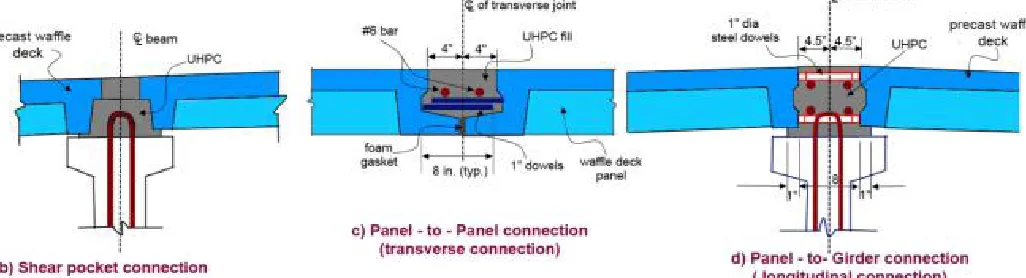
• The waffle deck panel system was designed to act fully composite with the prestressed concrete girders using three different connections, namely, shear pocket connection at the girder locations (see Figure 1b); panel-to-panel transverse connection, located between the panels (see Figure 1c); and panel-to-girder longitudinal connection (see Figure 1d) at the girder located at the center of the bridge cross section.
Laboratory Testing
Prior to field implementation, the structural performance characteristics and the constructability of the UHPC waffle deck system and its critical connections were studied through large-scale laboratory testing at the structural laboratory of Iowa State University.
• The test specimen (see Figure 2) consisted of two
prefabricated full-depth UHPC waffle deck (8 foot by 9 foot 9 inches by 8 inches) panels, connected to 24-foot long precast girders (Iowa standard LXA 42 girder) using cast-in-place connections with field cast UHPC (see Figure 2). This test setup closely replicated the critical regions of the field structure in the laboratory.
[image:4.612.41.571.110.467.2]• The two test waffle deck panels were fabricated by Coreslab using commercially available standard Ductal mix and special forms designed for this project. The test panels were cast in an upside position using a displacement method, to facilitate a flat finish for the driving surface and easy placement and removal of the voids.
[image:4.612.55.568.334.473.2]Figure 2. Laboratory test specimen construction and setup
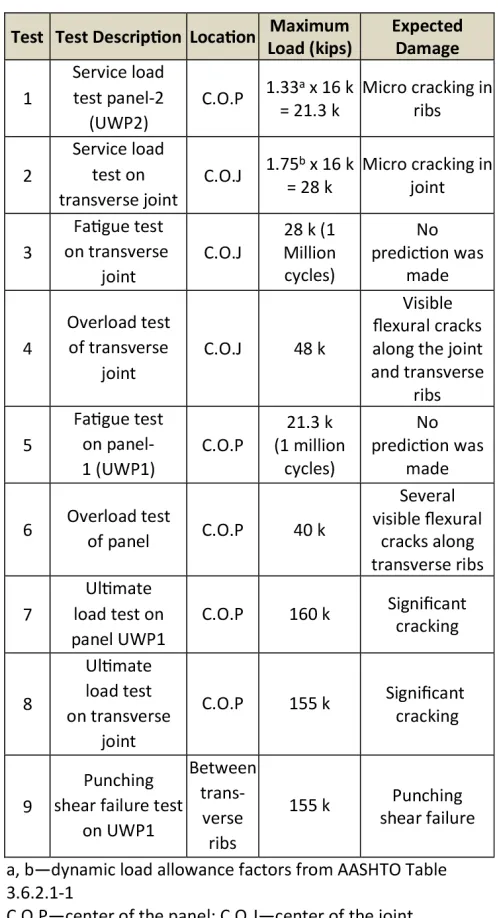
Table 1. Sequence and details of the tests conducted on the waffle deck system
• The performance of the UHPC waffle deck system, including the UHPC joints, was examined using nine different tests (see Table 1) and a single wheel truck load placed at the center of the deck panel and center of the transverse joint between the deck panels. A large number of instrumentations, including string pots and strain gages, were used to measure critical parameters.
• Under the maximum service load of 21.3 kips, measured deflection and critical tensile strains in the bottom
transverse reinforcement of the waffle deck panel were 0.03 inch and 0.000375 inch/inch, respectively (see Figure 3). These measured deflection values are around 18% of the specified AASHTO serviceability limits. A single hairline crack (width < 0.002 inch) was observed at the center of the transverse rib under the load.
• A maximum deflection of 0.022 inch and a maximum strain of 0.000170 inch/inch were measured when a service level load of 28 kips was applied at the center of the transverse joint. The measured deflection values is 20% of the allowable limit, whereas the measured strain is 8% of the yield value.
• Both the panel and the transverse joint were subjected to 1,000,000 service level load cycles. Neither the UHPC Figure 3. Waffle deck panel response under service load of 21.3 kips
waffle panel nor the UHPC joints experienced any fatigue damage under service loads.
• At ultimate loads, the deck panel and transverse joints experienced significant cracking. The measured maximum strains in transverse reinforcement were within 76% of the yield value. The bottom No. 7 reinforcement can be changed to No. 6 reinforcement to simplify the construction without having an effect on design capacity. • The panel experienced a sudden punching shear failure
at a maximum load of 155 kips, using a 6 inch by 8 inch plate between the ribs. The measured average punching strength is 1.068 ksi, which is significantly higher than the previously measured value in the literature.
[image:5.612.40.291.276.416.2]Field Construction and Live Load
Testing
Following the successful laboratory testing, a demonstration bridge on Dahlonega Road in Wapello County was
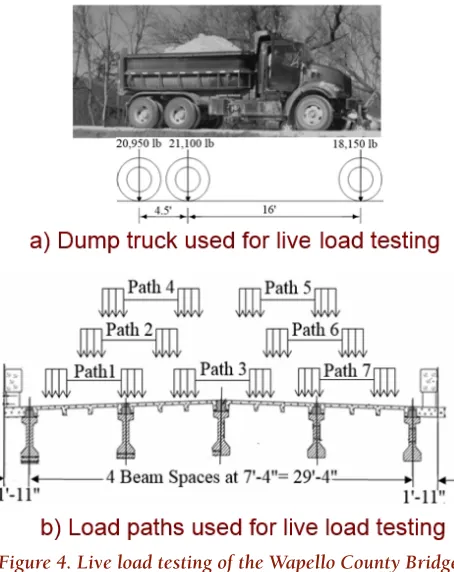
constructed using prefabricated UHPC waffle deck panels. Based on the experimental investigation, No. 6 reinforcement was used for both top and bottom deck reinforcement in transverse and longitudinal directions. The 16 ft 2.5 inch long and 8 foot wide UHPC waffle deck panels were cast at the precast plant (Coreslab) and placed on the girders during the week of September 12, 2011. The deck joints were casted using field cast UHPC during the last week of September, and the bridge was open to traffic in November 2011. Field testing of the bridge was performed in February 2012 using a standard dump truck weighing 60,200 pounds (Figure 4). As shown in Figure 4, seven load paths—including two load paths at 2 feet from the barrier rails, load paths at the centerline of traffic lanes, 2 feet offset from the centerline of the bridge, and a load path straddling the centerline of the bridge—were used to evaluate the live load performance.
Key Findings
• None of the strain gages spanning the interface between prefabricated deck panels and their adjacent UHPC infill joints indicated opening of the interface.
[image:6.612.55.282.45.331.2]• Preexisting flexural cracks on the bottom ribs of the UHPC waffle slab panel adjacent to the abutment were observed prior to live load testing. Finite element analysis indicated that these cracks were likely caused during storage, shipping, or erection rather than due to vehicular loads.
Figure 4. Live load testing of the Wapello County Bridge
• Only two strain gages on the deck panels adjacent to the abutment registered strains greater than the expected cracking strain of the UHPC. Because these strains were not excessive (i.e., less than those measured at service load levels during laboratory testing) and were located on the underside of the deck, no negative impacts to the performance and durability are expected for the waffle deck panels. • The maximum live load distribution factor for the interior girder was computed to be 0.51, which is lower than the AASHTO-recommended value of 0.63. • The maximum dynamic amplification factor for the
bridge girders was computed to be nearly 1.4, which is close to the AASHTO-recommended value of 1.33.
Implementation Benefits
The use of a prefabricated UHPC waffle deck system in the Wapello County Bridge was a first for the United States and is one of many concepts being employed to reduce road closure time as part of the development of Accelerated Bridge Construction practices to be used throughout the country. The reduced weight and improved durability of the deck panel compared to the traditional precast concrete full-depth panel will increase the longevity and help in decreasing the maintenance. The simple deck panel connections developed and tested as part of this project can be used in conjunction with a traditional full-depth precast deck panel to minimize the joint widths, improving the durability of the joints. A design guide (Aaleti et al. 2013) developed based on analytical studies, supported by the experimental data from this project, also helps in usage of the waffle deck panel in a variety of new and existing bridges.
Recommendations for Further
Research
• In this completed prototype bridge, the UHPC waffle deck panel was used in a single span, straight simply supported bridge. For a broader use of this concept, the applicability of the current concept and the connection details for curved and skewed bridges needs to be investigated.
• The performance of connections and deck panels at the pier location in a continuous bridge needs to be investigated.
• Given the low strain demand, it may be possible to optimize the rib spacing to make the waffle deck system more economical.