294
Wilczyński Jacek, Karolak Przemysław, Karolak Joanna, Grzanka Katarzyna, Wilczyński Igor. The differences in anthropometric variables and in the body composition between 7 and 8-year-olds with scoliotic changes. Journal of Education, Health and Sport. 2018;8(4):294-307. eISNN 2391-8306. DOI http://dx.doi.org/10.5281/zenodo.1226570
http://ojs.ukw.edu.pl/index.php/johs/article/view/5426
The journal has had 7 points in Ministry of Science and Higher Education parametric evaluation. Part b item 1223 (26/01/2017). 1223 Journal of Education, Health and Sport eissn 2391-8306 7
© The Authors 2018;
This article is published with open access at Licensee Open Journal Systems of Kazimierz Wielki University in Bydgoszcz, Poland
Open Access. This article is distributed under the terms of the Creative Commons Attribution Noncommercial License which permits any noncommercial use, distribution, and reproduction in any medium, provided the original author (s) and source are credited. This is an open access article licensed under the terms of the Creative Commons Attribution Non commercial license
(Http://creativecommons.org/licenses/by-nc/4.0/) which permits unrestricted, non commercial use, distribution and reproduction in any medium, provided the work is properly cited. This is an open access article licensed under the terms of the Creative Commons Attribution Non commercial License (http://creativecommons.org/licenses/by-nc/4.0/) which permits unrestricted, non commercial
use, distribution and reproduction in any medium, provided the work is properly cited. The authors declare that there is no conflict of interests regarding the publication of this paper.
Received: 05.03.2018. Revised: 10.03.2018. Accepted: 21.04.2018.
The differences in anthropometric variables and in the body
composition between 7 and 8-year-olds with scoliotic changes
Jacek Wilczyński
1, Przemysław Karolak
2, Joanna Karolak
2,
Katarzyna Grzanka
2, Igor Wilczyński
21 Department of Posturology, Hearing and Balance Rehabilitation, Institute of Physiotherapy,
Faculty of Medicine and Health Sciences, Jan Kochanowski University in Kielce
2PhD student, Faculty of Medicine and Health Sciences, Jan Kochanowski University in Kielce
Corresponding author:
1Head of the Department of Posturology, Hearing and Balance Rehabilitation, Institute of
Physiotherapy, Faculty of Medicine and Health Sciences, Jan Kochanowski University in Kielce, Tel.: 603-703-926; [email protected], w.w.w.jacekwilczynski.com.pl
Summary
The aim of the study was to determine the differences between the anthropometric variables
and body composition between 7 and 8-year-olds with scoliotic changes. The shape of the spine
was assessed using optoelectronic Diers formetric III 4D. Body composition was assessed by a
bioelectrical impedance. The study was conducted between November 2016 and July 2017 in
Posture Laboratory at the Faculty of Medicine and Health Sciences UJK in Kielce. The largest
absolute value of variation in 7-year-olds from scoliosis occurred for a variable BMR (kJ) (S =
598.5), the same group of posture in idiopathic scoliosis BMR (kJ) (S = 425) and standard BMR
(kJ) (S = 666). In 8-year-olds in the group of scoliosis the differences were also observed in the
largest absolute value of the variable BMR (kJ) (S = 639) and in the attitudes scoliotic group (S
295
differences between 7 and 8 year-olds in the group of scoliosis in the measurement of body
height (cm), weight (kg), FFM (kg) of muscle mass (kg) TBW (kg), BMR (kJ), BMR (kcal),
bone mass (kg) and protein (kg) (p <0.05). In the scoliotic group attitudes significant differences
occurred in the body height (cm) weight (kg) BMI, fat mass (kg), FFM (kg) and muscle mass
(kg) TBW (kg), BMR (kJ) BMR (kcal), bone weight (kg) and the amount of protein (kg) (p
<0.05).
Keywords: Anthropometric variables, body composition of children, scoliosis, idiopathic
scoliosis attitude, children of 7 and 8 years old
Introduction
Scoliosis is a systemic disease that causes secondary changes in the organ movement and a
circulatory and respiratory systems [1]. Scoliosis is accompanied by biochemical changes,
which reflect metabolism of bone, cartilage and nerve tissue [2]. Curvature of the spine and its
rotation are secondary, and reducing the thoracic kyphosis is original, leading to the progression
of scoliosis [3]. Another issue is the attitude of idiopathic scoliosis, which is the tendency to
diverge from the straight axis of the spine. [4] It is rather associated with the wrong posture
habit [5]. Each developing spontaneously scoliosis even idiopathic scoliosis is an idiopathic
scoliosis attitude at the very beginning, and only then reveals its actual trends [6]. Causes of
idiopathic scoliosis have not been clarified yet [7]. There is no commonly accepted theory of
aetiopathogenesis of scoliosis [8]. There is an agreement that idiopathic scoliosis is determined
by many factors [9]. In the terminology, becoming common to describe phenomena associated
with the aetiology, pathogenesis and pathomechanism scoliosis, word scoliogeny is used, which
consists of all these processes [10]. An extensive literature describes the irregularities at the
level systems, organs, tissues, cells and genes, without prejudice to their primary or secondary
nature [11]. A mathematical chaos theory has become very popular recently to explain the
phenomenon of scoliosis [12,13]. This theory assumes imperceptible change to the modern
researcher of the biological parameters in the body causing a cascade of slow but consistent
changes. This is illustrated by generally known, so-called. butterfly effect – a small butterfly's
wing movement may result in such an impact that eventually in another area causes a hurricane.
Many physiological systems, including postural are partly chaotic systems [14].The
296
pathology that can occur at any spine and age of the child [15-18]. Although, scoliosis is clearly
the attitude of distortion, it is at the same time a result of the ability of the compensation body,
allowing you to set the behavior of the head and shoulder girdle over the pelvis [19-22]. The
final shape of the body is the result of the deforming process and compensation response, so
that the body at the expense of a huge own disorders form maintains the general orientation of
the body [23]. In the present state of knowledge, it is reasonable to speak about rather etiological
factors, not the theory (genetic, metabolic, etc.) of scoliosis formation [24]. Currently, the most
supportive concept is a multifactorial including genetic (gene CHD7) determined by the
pathology of the central nervous system, causing changes in the postural system [25]. The aim
of the study was to determine the differences between the anthropometric variables and body
composition between 7 and 8-year-olds with scoliotic changes.
Material and methods
The study involved 251 children, including 113 girls (45.02%) and 138 boys (54.98%). The
study included children aged 7 and 8 years, with the świętokrzyskie primary school. Numerous
group were children aged 7 years, of which there were 130 (51.79%) of all respondents. Among
them there were 63 (48.46%) and 67 girls (51.54%) boys. Eight-year children there were 121
(48.21%) of the total. In this age girls were 50 (41.32%), while 71 boys (58.68%). The selection
of respondents was mixed, after having established the criteria to be met by each group. The
study was conducted between November 2016 and July 2017 in Posturology Laboratory at the
Faculty of Medicine and Health Sciences UJK in Kielce. All test procedures were performed
according to the Helsinki declaration in force in 1964 and with the approval of the Bioethics
Committee of the University of Jan Kochanowski University in Kielce (Resolution No. 5/2015).
Body height tested was determined using a tape centimeter accuracy of 1 cm. Body weight and
BMI were calculated using a body composition analyzer TANITA MC 780M. Body
composition was assessed by bioelectrical impedance (bioelectrical impedance analysis -BIA),
which consists of assessing the resistance of flowing electric current. As a research tool used in
body composition analyzer Tanita MC 780 MA. During the study, they were used with three
frequency: 5 kHz, 50 kHz and 250 kHz, so that an accurate analysis of the composition of the
body [24]. As a result of measurement, the following variables Body composition: Body Mass
(kg) Body Mass Index, Fat Mass (%) Fat Mass (kg) Fat Free Mass (kg) Muscle Mass (kg) Total
Body Water (kg) , Total Body Water (%). BMR (kJ), BMR (kcal) Bone Mass (kg) Proteins
(kg). The shape of the spine was assessed using optoelectronic Diers formetric III 4D.
297
raster. On the basis of the data there was created precise, three-dimensional model of the spine.
Taking into account the anatomical and biomechanical assumptions of the model, it was
possible to calculate the fixed points anatomical curves of the spine and torso forms of spatial
parameters. Method Diers formetric III 4D is non-contact and, above all nonradioactive way of
body posture measurment. The room, in which the measurement was performed posture was
dimmed so that the sun's rays not fall directly on the body. The examined was stripped to the
waist and stood back to a device consisting of a digital video camera and projector. The
projector emits parallel measurement lines on the back surface, and a digital video camera
three-dimensional image conveyed to the computer. The study was conducted in the DiCAM by
measuring Average, consisting in the execution sequence of twelve pictures, that by creating
the average value of the variances reduced the attitudes and thereby improve the value of
clinical research. According to the manufacturer the camera Diers formetric III 4D presence of
scoliosis and scoliotic attitudes was observed by considering the values of three parameters: the
pelvic skewness (mm) lateral deviation (mm) and a surface of rotation (°). Idiopathic scoliosis
attitude occurred when the pelvic skewness was less than 5 mm, lateral deviation was less than
5 mm and a surface of rotation was less than 5 degrees. In contrast, when the scoliosis occurred
when the pelvic skewness was greater than 5 mm, lateral deviation was larger than 5 mm, and
the rotation surface was greater than 5 degrees. To assess the incidence of idiopathic scoliosis
or scoliosis posture all three conditions had to be met. Before starting the analytical process
performed Kolmogorov-Smirnov test to determine the normality of distribution. This served to
pursue a parametric statistical methods. Differences in anthropometric variables, the
composition and posture between 7 and 8-year-olds determined way ANOVA. As the level of
statistical significance was p <0.05.
Results
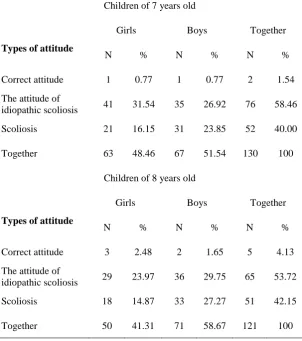
The test spine by Diers formetric III 4D showed scoliosis in 103 children (41%). Among the
7-year-olds with scoliosis was 21 (16.15%) girls and 31 (23.85%) boys. Among 8-7-year-olds with
scoliosis was 18 (14.88%) girls and 33 boys (27.27%). Attitude idiopathic scoliosis diagnosed
in 141 (56.17%) children. Among the 7-year-olds with an attitude idiopathic scoliosis was 41
(31.54%) and 35 girls (26.92%) boys. Among 8-year-olds with the attitude of idiopathic
scoliosis was 29 (23.97%) and 36 girls (29.75%) boys. With the proper attitude was only 7
(3.0%) children. Of 7-year-olds in the proper attitude was 2 (1.54%) children in this 1 (0.77%),
a girl, and 1 (0.77%) boy, and of 8-year-olds were 5 (4.13%) children, 3 (2.48%) girls and 2 (
298
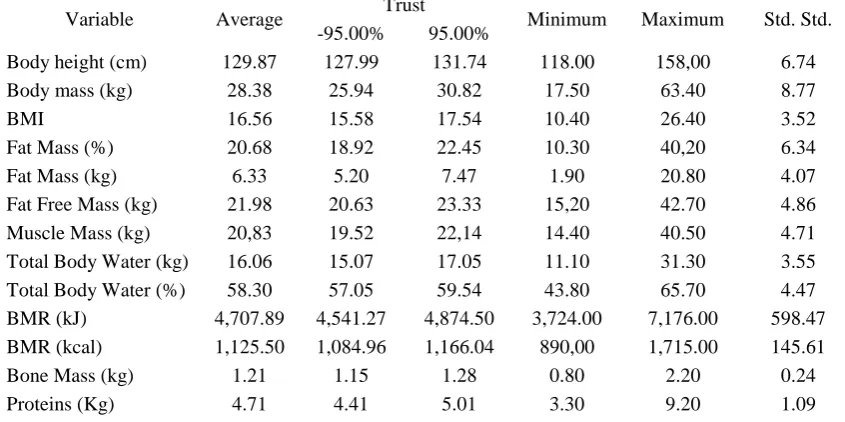
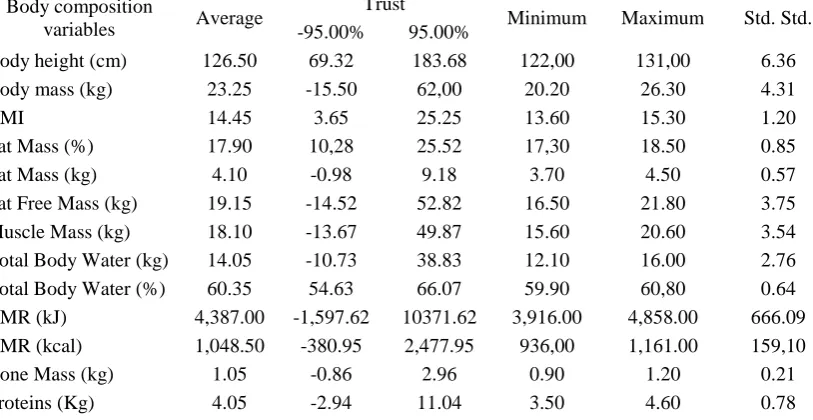
variables and body composition variables have different schedules in 7-year-olds, and 8 groups
of scoliotic attitudes, scoliosis and normal. The largest absolute value of variation in a
7-year-olds from scoliosis occurred for a variable BMR (kJ) (S = 598.5), the same group of posture in
idiopathic scoliosis BMR (kJ) (S = 425) and standard BMR (kJ) (S = 666). In 8-year-olds in the
group of scoliosis it was also observed differences in the largest absolute value of the variable
BMR (kJ) (S = 639) and in the scoliotic attitudes group (S = 602) and standard (S = 483) (Tab.
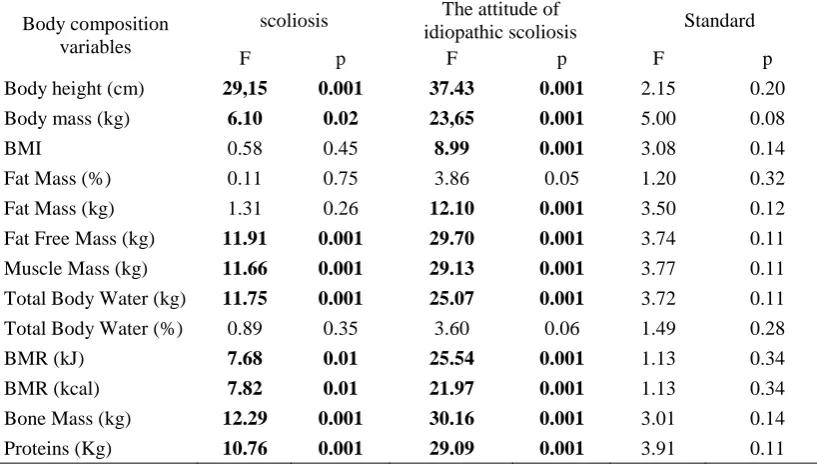
2,3,4). The univariate analysis of variance showed significant differences between the
7-year-olds and 8-year-7-year-olds in the group of scoliosis in the measurement of body height (cm), weight
(kg), FFM (kg) and muscle mass (kg) TBW (kg), BMR (kJ) BMR (kcal), bone mass (kg) and
protein (kg) (p < 0.05). In the group scoliotic attitudes significant difference occurred in the
measurements of variables: body height (cm), weight (kg) BMI, fat mass (kg), FFM (kg) and
muscle mass (kg) TBW (kg), BMR (kJ), BMR (kcal), bone mass (kg) and protein (kg) (p <0.05).
Other anthropometric variables and body composition in groups of scoliosis, scoliotic attitudes
standard and did not differ significantly between the 7 and 8-year-olds (Tab. 5).
Discussion
Idiopathic scoliosis are associated with the transmission of genetic metabolic disorders. Gene
defect as described CHD7 leads to single-arched or double- arched scoliosis [25]. It is expected
that soon will be discovered other genes responsible for the development of scoliosis. CHD7
gene is thought to play a key role in many basic functions in the cell. It was found that the
absence or failure occurs in a rare syndrome called Charge. Babies born with this syndrome
often die in infancy. Those who survive have, among others, a defect myocardial infarction,
developmental delay, problems with genital and urinary and abnormalities of the inner ear [26].
They develop in them also late-onset scoliosis. Mild changes in CHD7 are associated with
scoliosis. After analyzing the genetic code in family members suffering from scoliosis, it turned
out that they have a defect in the non-coding region of the gene CHD7. This mutation probably
alters the binding of a molecule that controls whether a gene is turned on or not. In this case
CHD7 gene is turned off more often than it should, which reduces the number of CHD7 protein
produced. Changing the amount of protein produced is very small, however, is associated with
the onset scoliosis, that progresses gradually [27]. The discovery of the gene responsible for
scoliosis, will in the future detect the disease at birth and even in the fetal period. This will
299
Conclusions
The largest absolute value of variation in a 7-year-olds from scoliosis occurred for a variable
BMR (kJ), the same group of idiopathic scoliosis and standard attitude. In 8-year-olds in the
scoliosis group also we observed the most absolute diversity values for the variable BMR (kJ)
and group scoliotic attitudes and standard. The univariate analysis of variance showed
significant differences between 7 and 8-year-olds in the group of scoliosis in the measurement
of body height (cm), weight (kg), FFM (kg) of muscle mass (kg) TBW (kg), BMR (kJ), BMR
(kcal), bone mass (kg) and protein (kg). In the group scoliotic attitudes significant differences
occurred in the body height (cm) weight (kg) BMI, fat mass (kg), FFM (kg) and muscle mass
300
References
1. Kontodimopoulos N, Damianou K Stamatopoulou E, Kalampokis A Loukos
I.Children'S and parents' perspectives of health-related quality of life in newly diagnosed
adolescent idiopathic scoliosis.J Orthop. 2018; 19, 15 (2): 319-323. doi: 10.1016 /
j.jor.2018.02.003.
2. Burwell RG, Dangerfield PH, Freeman BJ. Etiologic theories of idiopathic scoliosis.
Somatic nervous system and the Notom escalator concept as one component in the Pathogenesis
of adolescent idiopathic scoliosis. Stud Health Technol Inform. 2008; 140: 208-17.
3. Burwell RG, RK Aujla, Kirby AS, Dangerfield PH Moulton A Cole AA Pole FJ Pratt
RK, Webb JK. Body mass index of girls in health influences menarche and skeletal maturation:
leptin and the sympathetic nervous system-focus on the trunk with asymmetric hypothalamic
dysfunction in the Pathogenesis of adolescent idiopathic scoliosis?Stud Health Technol Inform.
2008; 140: 9-21.Tarrant RC Queally JM, Moore DP, Kiely PJ.Prevalence and impact of low
body mass index on outcomes in patients with adolescent idiopathic scoliosis: a systematic
review.Eur J Clin Nutr. 2018; 12. doi: 10.1038 / s41430-018-0095-0.
4. Fadzan M Bette-Saltikov J. Etiological Theories of Adolescent Idiopathic Scoliosis:
Past and Present.Open J. Orthop 2017; 11: 1466-1489. doi: 10.2174 / 1874325001 11011466
7.
5. Tilley MK, Justice CM, Swindle K Marosy B, Wilson IA, Miller NH. CHD7 gene
polymorphisms and familial idiopathic scoliosis.Spine 2013; 15; 38 (22): E1432-6. doi:
10.1097 / BRS.0b013e3182a51781.
6. Kulkarni S, P Nagarajan, Wall J, DJ Donovan, Donell RL, Ligon AH, Venkatachalam
S Quade BJ. Disruption of chromodomain helicase DNA binding protein 2 (CHD2) Causes
scoliosis.Am J Med Genet A. 2008, 1, 146A (9): 1117-1127. doi: 10.1002 / ajmg.a.32178.
7. Yu WS Chan KY, FW Yu, Yeung HY Ng BK, Lee KM, Lam TP Cheng JC. Abnormal
bone quality versus low bone mineral density in adolescent idiopathic scoliosis: a case-control
study with in vivo high-resolution peripheral quantitative computed tomography. Spine J 2013;
13 (11): 1493-9. doi: 10.1016 / j.spinee. 2013.05.018.
8. Weiss HR. Current knowledge on physiotherapy for scoliosis. Orthopäde; 2016 45 (6):
549-50.
9. Dayer R Haumont T Belaieff W, et al. Idiopathic scoliosis: etiological hypotheses and
concepts. J Child Orthop. 2013; 7 (1): 11-6.
10. Girardo M, N Bettini, Demos E, et al. The role of melatonin in the Pathogenesis of
301
11. Putzier M, Gross C., Zahn RK, et al. Characteristics of neuromuscular scoliosis. Orthopäde. 2016 45 (6): 500-8.
12. Porte M, K Patte, Dupeyron A, et al. Exercise therapy in the treatment of adolescent
idiopathic scoliosis: Is it useful? Arch Pediatr. 2016 23 (6): 624-8.
13. Calloni SF Huisman TA Poretti A, et al. Back pain and scoliosis in children: When this
image, what to Consider. J. Neuroradiol 2017; 30 (5): 393-404.
14. JC de Mauroy. Idiopathic scoliosis and chaos.Stud Health Technol Inform. 2008; 135:
53-7.
15. Mayes T Anadio JM, Sturm PF. Prevalence of Vitamin D Deficiency in Pediatric
Patients With Spinal Scoliosis Preparing for Surgery. Deform spine. 2017; 5 (6): 369-373.
16. Margalit A, G McKean, Constantine A, et al. Body Mass Hides the Curve: Thoracic
Scoliometer Readings Vary by Body Mass Index Value. J Pediatr Orthop. 2017; 37 (4):
E255-E260.
17. Clark EM Taylor HJ, and Harding, et al. Association between components of body
composition and scoliosis: a prospective cohort study reporting identifiable differences before
the onset of scoliosis. J Bone Miner Res. 2014; 29 (8): 1729-1736. doi: 10.1002 / jbmr.2207.
18. Goodbody CM Asztalos IB Sankar WN, et al. It's not just the big kids: both high and
low BMI impact success bracing for adolescent idiopathic scoliosis. J Child Orthop. 2016 10
(5): 395-404.
19. Wang W, Wang Z, Zhu Z, et al. Body composition in males with adolescent idiopathic
scoliosis: a case-control study with a dual-energy X-ray absorptiometry. BMC Musculoskelet
Disord. 2016 29 (17): 107.
20. Wyszyńska J Podgórska-Cooper J, Drzał Grabiec-J, et al. Analysis of the Relationship
between Body Mass Composition and Physical Activity with Body Posture in Children. Biomed
Res Int. 2016; 185,167.
21. Barczyk K Skolimowski T Anwajler J, et al. Somatic features and parameters of the
anterior-posterior spinal curvature in 7-year-olds with Particular types posture. Orthop
Traumatol Rehabil. , 2005; 30, 7 (5): 555-62.
22. Barczyk-Pawelec K Dziubek W, Walker JR, et al. Correlations between somatic
features, anteroposterior spinal curvatures and trunk muscle strength in schoolchildren. Acta
Bioeng Biomech. 2017; 19 (1): 133-139.
23. There EM, Liu Z, Lam TP, et al. Lower Muscle and Body Fat Mass in Adolescent
Idiopathic Scoliosis Are Associated With Abnormal Leptin Bioavailability. Spine. 2016 41
302
24. Wilczynski J Lipińska Stańczak M, Dworakowska D, et al. Somatic features and body
posture in children with scoliosis and scoliotic posture. Journal of Education, Health and Sports.
2017; 7 (8): 1352-1368.
25. Gao X, Gordon D, Zhang D, R Browne, Helms C, Gillum J, Weber S, Devroye S, S
Swaney, Dobbs M, J Morcuende, Sheffield V, Lovett M, Bowcock A, J Herring, C. Wise CHD7
gene polymorphisms are associated with susceptibility is idiopathic scoliosis.Am J Hum Genet.
2007; 80 (5): 957-65.
26. García-Giménez JL, Rubio-Belmar PA, Peiró FAM-L Hervás D, Gonzalez-Rodriguez
D-Ibanez Cabellos JS, Bas-Hermida P, Mena minor S, García-López EM Pallardó FV, Bas T.
Circulating miRNAs as diagnostic biomarkers for adolescent idiopathic scoliosis.Sci Rep.
2018; 8; 8 (1): 2646th doi: 10.1038 / s41598-018-21146-x.
27. Xu Y, Kang QL, Zhang ZL. A mutation MYH3 Identified for the first time in a Chinese
family with Sheldon-Hall syndrome (DA2B).Neuromuscul Disord. 2018; 8. PII: S0960-8966
303
Table 1. Characteristics of respondents posture
Children of 7 years old
Types of attitude
Girls Boys Together
N % N % N %
Correct attitude 1 0.77 1 0.77 2 1.54
The attitude of
idiopathic scoliosis 41 31.54 35 26.92 76 58.46
Scoliosis 21 16.15 31 23.85 52 40.00
Together 63 48.46 67 51.54 130 100
Children of 8 years old
Types of attitude
Girls Boys Together
N % N % N %
Correct attitude 3 2.48 2 1.65 5 4.13
The attitude of
idiopathic scoliosis 29 23.97 36 29.75 65 53.72
Scoliosis 18 14.87 33 27.27 51 42.15
304
Table 2. Distribution of anthropometric variables and body composition in children of 7 and 8 years old with scoliosis in age groups
Distribution of anthropometric variables and body composition in 7-year-olds with scoliosis
Variable Average Trust Minimum Maximum Std. Std.
-95.00% 95.00%
Body height (cm) 129.87 127.99 131.74 118.00 158,00 6.74
Body mass (kg) 28.38 25.94 30.82 17.50 63.40 8.77
BMI 16.56 15.58 17.54 10.40 26.40 3.52
Fat Mass (%) 20.68 18.92 22.45 10.30 40,20 6.34
Fat Mass (kg) 6.33 5.20 7.47 1.90 20.80 4.07
Fat Free Mass (kg) 21.98 20.63 23.33 15,20 42.70 4.86
Muscle Mass (kg) 20,83 19.52 22,14 14.40 40.50 4.71
Total Body Water (kg) 16.06 15.07 17.05 11.10 31.30 3.55
Total Body Water (%) 58.30 57.05 59.54 43.80 65.70 4.47
BMR (kJ) 4,707.89 4,541.27 4,874.50 3,724.00 7,176.00 598.47
BMR (kcal) 1,125.50 1,084.96 1,166.04 890,00 1,715.00 145.61
Bone Mass (kg) 1.21 1.15 1.28 0.80 2.20 0.24
Proteins (Kg) 4.71 4.41 5.01 3.30 9.20 1.09
Distribution of anthropometric variables and body composition in 8-year-olds with scoliosis
Variable Average
Trust
Minimum Maximum
Std. Std.
-95.00% 95.00%
Body height (cm) 137.82 135.53 140.12 122,00 152.00 8.17
Body mass (kg) 32.79 30.16 35.43 20,10 66.10 9.38
BMI 17,10 16.05 18.16 11.20 30.20 3.76
Fat Mass (%) 21.08 19.37 22.78 10.00 42.80 6.06
Fat Mass (kg) 7.32 6.00 8.65 2.00 28.30 4.71
Fat Free Mass (kg) 25,42 23.94 26.90 17.70 41,00 5.26
Muscle Mass (kg) 24,10 22,70 25.51 16.60 38.90 5.01
Total Body Water (kg) 18.58 17.48 19.67 12.60 30.00 3.89
Total Body Water (%) 68.27 46.83 89.70 41.90 601,00 76.23
BMR (kJ) 5,045.71 4,866.09 5,225.33 4,142.00 7,058.00 638.64
BMR (kcal) 1,207.43 1,164.74 1,250.12 990,00 1,687.00 151.79
Bone Mass (kg) 1.38 1.31 1.45 1.00 2.10 0.25
Proteins (Kg) 5.44 5.11 5.77 3.60 8.90 1.17
305
Table 3. Distribution of anthropometric variables and body composition in children of 7 and 8 years old with the attitude of idiopathic scoliosis in age groups
Distribution of anthropometric variables and body composition in 7-year-olds with an attitude of idiopathic scoliosis
Body composition
variables Average
Trust
Minimum Maximum Std. Std.
-95.00% 95.00%
Body height (cm) 129.21 127.71 130.71 112.00 148,00 6.57
Body mass (kg) 26.68 25,40 27.95 17,10 43.20 5.58
BMI 15.81 15,33 16,30 12.00 20.20 2.14
Fat Mass (%) 19,79 18.76 20,83 12.80 30.40 4.52
Fat Mass (kg) 5.45 4.93 5.97 2.40 11.10 2.26
Fat Free Mass (kg) 21.21 20.39 22.03 14.00 33.50 3.58
Muscle Mass (kg) 20.06 19,27 20.85 13.20 31.70 3.44
Total Body Water (kg) 15.63 15,02 16.24 10.20 24.50 2.66
Total Body Water (%) 58.69 57.91 59.47 50.60 63.80 3.41
BMR (kJ) 4,538.95 4,441.86 4,636.04 3,615.00 6,071.00 424.87
BMR (kcal) 1,089.53 1,064.98 1,114.08 864,00 1,451.00 107.43
Bone Mass (kg) 1.16 1.12 1.20 0.80 1.80 0.18
Proteins (Kg) 4.52 4.34 4.71 3.00 7.20 0.80
Distribution of anthropometric variables and body composition in 8-year-olds with the attitude of idiopathic scoliosis
Body composition
variables Average
Trust
Minimum Maximum
Std. Std.
-95.00% 95.00%
Body height (cm) 136.54 134.64 138.44 118.00 158,00 7.66
Body mass (kg) 32.16 30,24 34,09 19.50 63.40 7.77
BMI 17,10 16.37 17.82 13.10 25,40 2.93
Fat Mass (%) 21.46 20.08 22.83 11.70 38.50 5.55
Fat Mass (kg) 7.20 6.30 8.10 3.10 20,70 3.64
Fat Free Mass (kg) 24.97 23.83 26.11 15.60 42.70 4.60
Muscle Mass (kg) 23.62 22.53 24.70 14.80 40.50 4.38
Total Body Water (kg) 18.20 17.35 19.04 11.40 31.30 3.42
Total Body Water (%) 57.50 56.49 58.50 45,10 64.80 4.06
BMR (kJ) 4,977.71 4,828.62 5,126.80 3,766.00 7,176.00 601.69
BMR (kcal) 1,188.89 1,153.26 1,224.52 900,00 1,715.00 143.79
Bone Mass (kg) 1.35 1.29 1.41 0.80 2.20 0.23
Proteins (Kg) 5.34 5.09 5.59 3.40 9.20 1.00
306
Table 4. Distribution of anthropometric variables and body composition in children of 7 and 8 years old with the correct attitude in the age groups
Distribution anthropometric variables and body composition in 7-year-olds with correct attitude
Body composition
variables Average
Trust
Minimum Maximum Std. Std.
-95.00% 95.00%
Body height (cm) 126.50 69.32 183.68 122,00 131,00 6.36
Body mass (kg) 23.25 -15.50 62,00 20.20 26.30 4.31
BMI 14.45 3.65 25.25 13.60 15.30 1.20
Fat Mass (%) 17.90 10,28 25.52 17,30 18.50 0.85
Fat Mass (kg) 4.10 -0.98 9.18 3.70 4.50 0.57
Fat Free Mass (kg) 19.15 -14.52 52.82 16.50 21.80 3.75
Muscle Mass (kg) 18.10 -13.67 49.87 15.60 20.60 3.54
Total Body Water (kg) 14.05 -10.73 38.83 12.10 16.00 2.76
Total Body Water (%) 60.35 54.63 66.07 59.90 60,80 0.64
BMR (kJ) 4,387.00 -1,597.62 10371.62 3,916.00 4,858.00 666.09
BMR (kcal) 1,048.50 -380.95 2,477.95 936,00 1,161.00 159,10
Bone Mass (kg) 1.05 -0.86 2.96 0.90 1.20 0.21
Proteins (Kg) 4.05 -2.94 11.04 3.50 4.60 0.78
Distribution anthropometric variables and body composition in 8-year-olds in the correct attitude
Body composition
variables Average
Trust
Minimum Maximum
Std. Std.
-95.00% 95.00%
Body height (cm) 135.00 126.22 143.78 130.00 145.00 7.07
Body mass (kg) 31.24 25.95 36.53 27.00 36.50 4.26
BMI 17.16 14.71 19.61 15.70 20.50 1.98
Fat Mass (%) 21.28 16:19 26.37 17,10 27.80 4.10
Fat Mass (kg) 6.70 4.42 8.98 4.60 9.60 1.84
Fat Free Mass (kg) 24.54 20,55 28.53 21.40 29.70 3.22
Muscle Mass (kg) 23.22 19.44 27.01 20.30 28,10 3.05
Total Body Water (kg) 17.96 15.07 20.85 15.70 21.70 2.33
Total Body Water (%) 57,62 53.93 61.31 52.90 60.70 2.97
BMR (kJ) 4,853.20 4,253.30 5,453.11 4,393.00 5,648.00 483.15
BMR (kcal) 1,160.00 1,016.59 1,303.41 1050.00 1350.00 115.50
Bone Mass (kg) 1.32 1.10 1.54 1.10 1.60 0.18
307
Table 5. ANOVA analysis of differences for the anthropometric variables and body composition between 7 and 8-year-olds
Differences in anthropometric variables and body composition between 7 and 8-year-olds
Body composition variables
scoliosis The attitude of
idiopathic scoliosis Standard
F p F p F p
Body height (cm) 29,15 0.001 37.43 0.001 2.15 0.20
Body mass (kg) 6.10 0.02 23,65 0.001 5.00 0.08
BMI 0.58 0.45 8.99 0.001 3.08 0.14
Fat Mass (%) 0.11 0.75 3.86 0.05 1.20 0.32
Fat Mass (kg) 1.31 0.26 12.10 0.001 3.50 0.12
Fat Free Mass (kg) 11.91 0.001 29.70 0.001 3.74 0.11
Muscle Mass (kg) 11.66 0.001 29.13 0.001 3.77 0.11
Total Body Water (kg) 11.75 0.001 25.07 0.001 3.72 0.11
Total Body Water (%) 0.89 0.35 3.60 0.06 1.49 0.28
BMR (kJ) 7.68 0.01 25.54 0.001 1.13 0.34
BMR (kcal) 7.82 0.01 21.97 0.001 1.13 0.34
Bone Mass (kg) 12.29 0.001 30.16 0.001 3.01 0.14
[image:14.595.101.510.149.381.2]