in the population sciences published by the Max Planck Institute for Demographic Research Konrad-Zuse Str. 1, D-18057 Rostock · GERMANY www.demographic-research.org
DEMOGRAPHIC RESEARCH
VOLUME 19, ARTICLE 6, PAGES 85-138
PUBLISHED 01 JULY 2008
http://www.demographic-research.org/Volumes/Vol19/6/ DOI: 10.4054/DemRes.2008.19.6
Research Article
Overview Chapter 4:
Changing family and partnership behaviour:
Common trends and persistent diversity
across Europe
Tomáš Sobotka
Laurent Toulemon
This publication is part of Special Collection 7: Childbearing Trends and Policies in Europe (http://www.demographic-research.org/special/7/)
© 2008 Sobotka & Toulemon.
1 Introduction 86
2 North-South contrasts in home-leaving patterns 88
3 The gradual retreat of marriage 91
3.1 The end of universal marriage 92
3.2 Long-lasting postponement of marriages 95
4 The rise of cohabitation and the diversity of cohabiting unions 97
5 Changes in living arrangements of young adults and the delayed entry into first union
103
5.1 Living arrangements of young adults 103
5.2 Delayed entry into first union 108
6 Rising divorce rates: Large differences in Central and Eastern Europe
109
7 The declining importance of marriage for childbearing and childrearing
112
7.1 Marriage is no longer a precondition to childbearing and the key step in the transition to adulthood
112
7.2 More children born outside marriage, to an unmarried couple or to a single mother
116
8 Concluding discussion: marriage, living arrangements, and fertility 124
References 130
Overview Chapter 4:
Changing family and partnership behaviour:
Common trends and persistent diversity across Europe
Tomáš Sobotka 1 Laurent Toulemon 2
Abstract
Following the era of the ‘golden age of marriage’ and the baby boom in the 1950s and 1960s, marriage has declined in importance, and its role as the main institution on which family relations are built has been eroded across Europe. Union formation most often takes place without a marriage. Family and living arrangements are currently heterogeneous across Europe, but all countries seem to be making the same shifts: towards fewer people living together as a couple, especially in marriage; an increased number of unmarried couples; more children born outside marriage; and fewer children living with their two parents. The relationship between these changing living arrangements, especially the decline of marriage, on the one hand, and the overall level of fertility, on the other, is not straightforward. In most countries, marriage rates and fertility declined simultaneously. However, the aggregate relationship between marriage and fertility indices has moved from negative (fewer marriages imply fewer births) to positive (fewer marriages imply more births). Thus, the decline of marriage, which is a part of the second demographic transition (see Overview Chapter 6), cannot be considered an important cause of the current low fertility level in many European countries. On the contrary, in European countries where the decline of marriage has been less pronounced, fertility levels are currently lower than in countries where new living arrangements have become most common.
1. Introduction
Families and living arrangements in developed countries have changed dramatically since the 1960s. The major features of this change, such as the gradual decline of marriage and the growth of cohabitation, the postponement of union formation and childbearing, the rise in union instability, and the disconnection between marriage, sex, and reproduction, have been observed in all regions of Europe, and have been analysed in detail in dozens of publications and research articles (e.g., Kuijsten 1996, Lesthaeghe and Moors 2002, Billari 2005, Prioux 2006). These developments also constitute major behavioural landmarks of the second demographic transition, discussed in depth in Overview Chapter 6, and they are widely reflected in different country chapters in this volume.∗ Family life and the meaning of family have undergone a profound change.
Intimate partnerships and sexuality, but also the relationships between parents and their children, have moved away from the realm of normative control and institutional regulation, giving rise to the new ideal of reflexive ‘pure relationships’ based on mutual consent and the recognition of individual autonomy (Giddens 1992). As noted in the France chapter, family has become “less of a place to reproduce generational and gender hierarchies, andmore of a special space where individuals forge their identity” (Toulemon et al. 2008:524).
The ongoing transformation of the family is evidenced by the spread of family forms and living arrangements other than the nuclear families of (married) couples with children. Cohabiting unions, ‘living apart together’ partnerships, same-sex partnerships, one-parent families, and single living have increased in prominence. The boundaries between family and non-family life have become less clear-cut; Ahlburg and de Vita (1992: 2) observed that family patterns in the United States are so fluid that “the U.S. Census Bureau has difficulty measuring family trends.” Legislative changes are also beginning to reflect the new family landscape. New laws and regulations on registered partnerships (of both homosexual and heterosexual couples), same-sex marriages, and, in the case of the Netherlands, the option of a ‘flash annulment’ of marriage without a prior divorce procedure (see the Netherlands chapter), further contribute to the diversity in family patterns. Arguably, the perception of what constitutes a family has changed as well. Kiernan’s (2004) analysis of 1998 Eurobarometer data shows that children, rather than partnership status, appear to be more salient in defining families: according to the survey results, 59 percent of respondents consider a cohabiting couple with children to be a family, whereas 48 percent consider a married couple without children as a family.
∗ All overview and country chapters referred to herein are part of Special Collection 7: Childbearing Trends
On the other hand, just 27 percent of respondents consider a childless cohabiting couple to be a family. In line with this distinction, research on family change in Germany often focuses on the issue of ‘polarisation’ between family life and other forms of private life (Schulze and Tyrell 2002), whereby family is usually defined on the basis of the presence of children in the household (see Germany chapter).
The pace of change in family life and living arrangements varies across countries, cohorts, and social groups. Thus, the catchphrase ‘convergence to diversity’ best characterises the situation in which most countries follow a similar trajectory of family changes, but at the same time retain many distinct patterns of family behaviour (Kuijsten 1996). The increase in diversity is also manifested in the timing and sequencing of early life transitions. Events like home leaving, marrying, and becoming a parent often do not conform to the norms regarding the ‘proper’ sequence of events, and take place outside the previously accepted boundaries between youth and adulthood (Rindfuss 1991, Corijn and Klijzing 2001, Heinz and Krüger 2001).3
This contribution reviews trends and cross-country diversity in family, partnership behaviour, and living arrangements in contemporary Europe. Given the wide scope of this topic, we paint this picture with a broad brush, referring the reader to country-specific chapters and other studies for more details. Discussion of the roots of the observed changes in family behaviour is kept to a minimum; some of these factors are mentioned in Overview Chapter 6, which examines the concept of the second demographic transition and reviews changes in family-related values and attitudes in Europe. This study first outlines trends and regional differences in home-leaving patterns. Section 3 examines the evidence on the gradual retreat of marriage, especially from the lives of young adults. Section 4 discusses the rising importance of unmarried cohabitation, its diverse forms, and legislative responses to it. Section 5 summarises the evidence on the rise of other living arrangements, especially single living and ‘living apart together’ relationships, and discusses the increase in age at union formation. Section 6 analyses the rising rates of divorce and union dissolution, while Section 7 outlines the declining role of marriage for childbearing, highlights the broad diversity in non-marital childbearing in Europe, and notes the surprisingly widespread incidence of single motherhood. In conclusion, Section 8 discusses the relevance of family changes to fertility rates.
Tables and graphs in our study draw from a number of different data sources, including official statistics and published expert estimates and analyses. We focus especially on the countries covered in this collection, but selected figures and tables also show data for other countries and for broader European regions. This selection, as well as the choice of countries, was in part determined by the limited data availability, especially with respect to long-term time series and specific topics that are not commonly reported in the official vital statistics, such as living arrangements, cohabitation, and leaving the parental home. The Fertility and Family Surveys, FFS (see http://www.unece.org/pau/ffs/; Macura and Beets 2002), constitute a unique source of comparable data on living arrangements of adults and children, and on fertility, in Europe. The major drawback of using the FFS lies in their age: Most of the surveys were conducted in 1992-1997, and the collected data thus typically provide a picture of family change and living arrangements up to the late 1980s and the early 1990s. The Gender and Generation Surveys currently being conducted (http://www.unece.org/pau/ggp/) will provide more comparable and updated figures (Vikat et al. 2007). The results presented in this chapter, which are based on the FFS, illustrate well the ongoing family transformations, but they may not fully reflect the actual patterns of living arrangements. Specifically for Central and Eastern Europe, the Fertility and Family Surveys often reflect the household and family patterns prevailing in the late stages of state socialism, i.e., before 1990, and do not capture the rapid transformation in living arrangements in the 1990s.
2. North-South contrasts in home-leaving patterns
post-communist countries did not display a particularly early or late home-leaving pattern at the time of the FFS, but ages at leaving home were more diverse in these countries, as many men and women continued to reside with their parents until their early thirties (Corijn and Klijzing 2001).
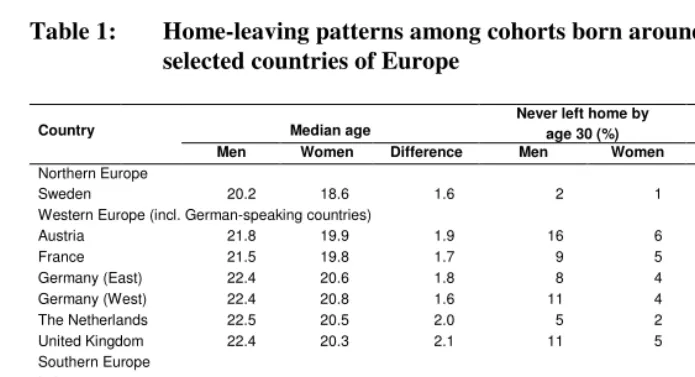
Table 1: Home-leaving patterns among cohorts born around 1960; selected countries of Europe
Country Median age
Never left home by age 30 (%)
Percentage leaving home after first union Men Women Difference Men Women Men Women Northern Europe
Sweden 20.2 18.6 1.6 2 1 6 6
Western Europe (incl. German-speaking countries)
Austria 21.8 19.9 1.9 16 6 28 20
France 21.5 19.8 1.7 9 5 5 3
Germany (East) 22.4 20.6 1.8 8 4 19 28
Germany (West) 22.4 20.8 1.6 11 4 11 11
The Netherlands 22.5 20.5 2.0 5 2 NA NA
United Kingdom 22.4 20.3 2.1 11 5 NA NA
Southern Europe
Italy 26.7 23.6 3.1 32 20 8 9
Spain 25.7 22.9 2.8 25 14 11 11
Central and Eastern Europe
Czech Republic 23.8 21.2 2.6 18 16 31 34
Hungary 24.8 21.3 3.5 27 17 32 35
Lithuania 20.3 19.8 0.5 20 22 28 32
Poland 25.8 22.5 3.3 37 23 27 29
Slovenia 20.9 20.5 0.4 15 13 23 27
Source: Billari, Philipov, and Baizán 2001 (based on the FFS data).
proportion fell below 12 percent for other countries shown in Table 1 (especially in France and Sweden, where this pattern was an exception, experienced by three and six percent of women, respectively).4
Differences in welfare regimes, combined with long-term cultural differences between the East and the West (Hajnal 1965), and between the North and the South of Europe (Reher 1998), also explain many cross-country differences in European home-leaving patterns (Billari 2004). Besides the availability of housing, specific institutional and economic factors, such as employment, income, and spatial distribution of tertiary education, are often identified as important determinants of home leaving (e.g., Holdsworth 2000; Billari, Philipov, and Baizán 2001; Aassve et al. 2002; Mulder, Clark, and Wagner 2002). Dense regional networks of universities in Italy and Spain enable many young people to pursue studies while remaining with their parents, whereas in the Netherlands, a generous student loan system, combined with relatively long distances to higher educational institutions, mean that many young people leave the parental home at a younger age in order to attend university (the Netherlands chapter). Interestingly, employment and earnings are particularly important in the late-leaving and weak welfare state countries of Southern Europe, where young adults who have a job and a higher income leave the nest earlier. These factors do not play any significant role for home leaving in the early-leaving and ‘Social Democratic’ welfare countries of Northern Europe, where young adults leave home irrespective of their employment status and personal income. In Northern Europe, young people thus often experience poverty, even if only for a short period, after leaving home (Aassve et al. 2002).
In addition to these factors, young adults (‘mama’s boys’) in Italy and Spain often prefer to stay in the parental home, even when they have gained economic independence (Italy chapter, Dalla Zuanna 2001), and this prolonged ‘cohabitation’ is willingly accepted by their parents (Manacorda and Moretti 2006). The Spain chapter notes that “…the greater freedom of movement enjoyed by adult children (…) and growing household welfare, along with the social differentiation between sexuality and procreation, have weakened the pressures for leaving the parental home at an early age” (Delgado et al. 2008:1086). The progressively postponed departure of children from the parental home in Mediterranean countries has been often interpreted as an outcome of economic insecurity, prolonged education, and limited availability of affordable housing, combined with the persistence of strong family ties between generations; but also as a problematic manifestation of a general ‘delay syndrome,’ and an unwillingness
of young adults to assume adult roles and responsibilities (Dalla Zuanna 2001). Delayed home leaving in these countries is intrinsically linked to delayed union formation and delayed parenthood (e.g., Billari 2004), which may eventually have a negative effect on completed fertility rates (Kohler, Billari, and Ortega 2002).
Countries also differ greatly in the extent to which home leaving is coupled with union formation. For the cohorts born around 1960, these two events were most closely related in Belgium (Flanders) and Southern Europe (especially for women; 76 percent of Spanish and Italian women left home at the time they married). In Norway and Sweden, but also in the Baltic countries (data available for Latvia and Lithuania), the timing of leaving home and union formation did not overlap for a large majority of young adults (Billari, Philipov, and Baizán 2001). In the Nordic countries, but also in the Netherlands and the United Kingdom, leaving the parental home remains a mark of independence and signifies the transition to adulthood (e.g., Holdsworth 2000). Consequently, many young people leave home early simply to achieve independence through residential autonomy (the Netherlands chapter, Sweden chapter). It is also important to note that in many countries where late home leaving is common the patterns of departure of young adults from the parental home are more fuzzy and less easily measurable, as many young men and women experience spells of living independently and returning to their parents. These moves are often related to migration for employment or education, but also to changes in income or partnership status.
3. The gradual retreat of marriage
become less sacred, being increasingly viewed as a secular rather than religious institution.” Clearly, the character and the meaning of marriage have undergone a remarkable transformation. Most people still perceive marriage as an ideal and as the most desirable living arrangement (see Overview Chapter 6), but they marry for different reasons, and at different points in their lives, than in the past. This is well illustrated by changes in the sequencing of early life course events, and the changing relationship between cohabitation, pregnancy, marriage, and childbearing, which is briefly analysed in Section 7. As in the case of home-leaving patterns and other living arrangements, the diversity in Europe is enormous, and our overview only scratches the surface of some region-specific peculiarities. Our main focus is on the decline in marriage rates, the rapid trend towards postponement of marriages, and the diminishing prevalence of marriage among young adults.
3.1 The end of universal marriage
The near-universal decline in first marriage rates in Europe, and the increase in the proportion of people who never marry, can be documented by diverse indicators. We focus on the period indicator of the total first marriage rate, and the cohort indicator of the proportion of women who have never married by the age of 50. The former indicator is based on period age-specific first marriage rates (‘incidence rates’), which are computed for all women, irrespective of their current family status. It is not an accurate indicator of the intensity of first marriages, as it is distorted by the changes in the age-specific composition of population by marital status (see also Appendix). However, as a simple measure readily available for most countries in Europe, it provides a rough evaluation of marriage trends over time.
already begun in 1980, a few years after long-lasting cohabiting unions were made de facto equalised with marriage (the change took place in 1976, see Slovenia chapter). A
more gradual decline also took place in Hungary and East Germany. A recent slight rise in first marriage rates, observed in many countries, is not necessarily linked to the underlying increase in first marriage intensity, but may rather be a consequence of a slowdown in the pace of first marriage postponement.
Figure 1: Period total first marriage rates in different regions of Europe, 1950-2005
0.0 0.2 0.4 0.6 0.8 1.0 1.2
1950 1955 1960 1965 1970 1975 1980 1985 1990 1995 2000 2005 Year
T
o
ta
l
fi
rs
t
m
a
rr
ia
g
e
r
a
te
Northern Europe Western Europe Southern Europe Central Europe South-eastern Europe Russia
Sweden
1.508
Source:Council of Europe (2006), Sardon (1991 and 1993), Eurostat 2008. Notes:Data are not weighted by the population size of given countries and regions.
The ‘marriage-boom’ in Sweden in 1989 is related to changes in public pensions for widows, effective from 1990 (see Sweden chapter, Andersson 1998).
Countries are grouped into regions as follows:
Western Europe: Austria, France, Western Germany, the Netherlands, Switzerland, and the United Kingdom; Northern Europe: Denmark (data available from 1955), Finland (from 1955), Norway, and Sweden; Southern Europe: Italy, Portugal, and Spain;
Central Europe: Croatia (from 1960), Czech Republic, Eastern Germany (from 1960), Estonia (from 1970), Hungary, Latvia (from 1970), Lithuania (from 1970), Poland, Slovakia (from 1960), and Slovenia (from 1970)
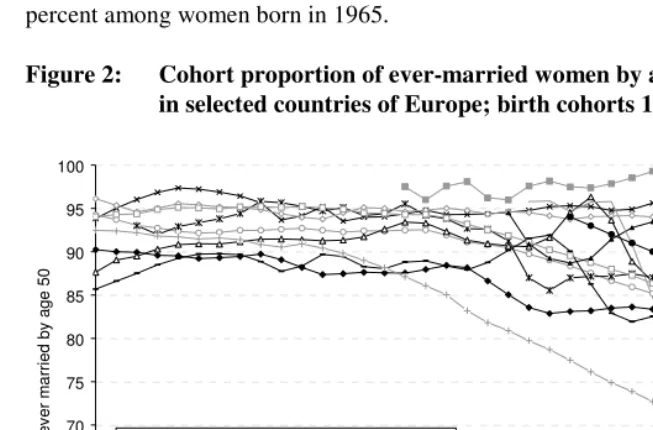
This recent convergence in period total first marriage rates is not yet visible in the cohort proportion of women ever married by age 50. However, with the exception of several post-communist societies, there was a steep increase in the proportion of never-married women among the late 1950s and the early 1960s cohorts (see Figure 2 for the trend in the proportion of ever married in the countries included in this collection). Thus, the near universality of marriage, typical for the 1930s and 1940s cohorts, has been replaced by a more diverse pattern, whereby a large and gradually increasing fraction of women remain unmarried throughout their reproductive lives. For those born in 1945, between 89 and 96 percent of women have been married at least once in most countries shown in Figure 2 (Sweden has the lowest proportion of ever married, 87 percent). For those born in 1965, the estimated proportion of ever married by age 50 exceeds 90 percent only in Bulgaria and the Czech Republic, whereas it falls below 75 percent for France, Slovenia, and Sweden (see also Prioux 2006). Sweden displays the most pronounced rise in the proportion of never married at age 50, estimated at 37 percent among women born in 1965.
Figure 2: Cohort proportion of ever-married women by age 50 in selected countries of Europe; birth cohorts 1930-1966
50 55 60 65 70 75 80 85 90 95 100
1930 1935 1940 1945 1950 1955 1960 1965
Birth cohort
P
e
rc
e
n
t
e
v
e
r
m
a
rr
ie
d
b
y
a
g
e
5
0
Austria Bulgaria Czech Republic France Germany Hungary Italy The Nethelrands Poland Slovenia Spain Sweden United Kingdom
Source:Council of Europe (2006).
3.2 Long-lasting postponement of marriages
The trend in the mean age at first marriage evolved in parallel with the trend in period first marriage rates. Marriage postponement started shortly after the onset of the decline in first marriage rates; countries that experienced this decline first were also the first to experience delayed marriages. The rapid increase in the mean age at first marriage is a clear marker of a disconnection between sex, marriage, and reproduction (see also Section 7.2 below). Sweden, where first marriage postponement started in the late 1960s, can again be considered a ‘forerunner’ of new family behaviour. In contrast to the TFMR, the mean age at first marriage still remains widely differentiated in Europe, especially along the ‘East-West divide’. Most post-communist countries, which were characterised by an early marriage pattern until the 1980s, experienced an intensive postponement of marriages only after 1990. Consequently, they still have a younger age at marriage (typically between age 23 and 26 for women) than the countries of Western and Southern Europe (typically, at age 27 to 29 years) and the Nordic countries (mean age 29 to 31 years). However, Central and Eastern Europe has also become heterogeneous in this respect, with the countries of the former Soviet Union (except the Baltic countries) retaining the lowest mean age of women at first marriage, at around 23 years in 2004 (see also Ukraine chapter); and several countries of Central Europe (Czech Republic, Hungary and Slovenia) exceeding age 26, with Slovenia reaching 27.8 in 2004. In some parts of Eastern Europe, prevailing social norms still encourage early marriage. In the Ukraine, participants of focus group discussions “felt pressure from parents and peers to marry and have at least one child early rather than risk becoming an ‘old maid’” (Perelli-Harris 2008:1151).
Due to a combination of marriage decline and marriage postponement, the proportion of married people has declined rapidly, especially among men and women under age 30. This shift was particularly pronounced in the post-communist countries of Central and Eastern Europe, where early marriages remained common until the early 1990s (e.g., the Czech Republic and Slovakia chapters). At present, marriage has almost disappeared from the lives of young adults in many parts of Europe. In fact, Figure 4 shows that there has been a remarkable convergence in the proportion of people married at young ages, especially for men. For instance, the proportion of men married at age 22 fell to six percent in Romania, and to one to three percent in six other countries analysed in Figure 4 (the Czech Republic, France, Hungary, Italy, the Netherlands, and Sweden)5
. Similarly, the proportion of women married by age 20 fell to 16 percent in Romania, and to two to four percent in the latter six countries, while in 1980 it was as
high as 49 percent in Hungary and Romania. Except in Romania, relatively few men (less than 15 percent) and women (13-31 percent) were married by age 25; again, a clear convergence occurs across countries. A marked decline in the proportion married is also observed at age 30, although considerable cross-country differences prevail: only 21 percent of Swedish men and 32 percent of Swedish women were married at that age, compared with 60 percent of Romanian men and 72 percent of Romanian women.
As the universality of marriage declines, marriage becomes more a manifestation of individual values and preferences, but is also subject to pragmatic decision-making, as unmarried people react more sensitively to macro-level policies and other factors that can facilitate or hinder marriage. This ‘instrumentalization of marriage’ (Salles 2006) can lead to distinct marriage booms and busts that occur in reaction to the actual or expected changes in public pensions, taxation, or marriage allowances. Such distinct marriage booms took place in Sweden in 1989 (Figure 1, see Sweden chapter and Andersson 1998), and in Austria in 1972, 1983, and 1987 (Austria chapter, Prioux 1993) In addition, short-term marriage booms may also be caused by such factors as ‘lucky’ dates in the calendar, like, for example, July 7, 2007 (07-07-07).
Figure 3: Period mean age at first marriage for women, 1960-2004
20 22 24 26 28 30 32
1960 1965 1970 1975 1980 1985 1990 1995 2000
Year
M
e
a
n
a
g
e
a
t
fi
rs
t
m
a
rr
ia
g
e
i
n
y
e
a
rs
(
w
o
m
e
n
)
Austria France Germany United Kingdom Sweden Italy
Spain Czech Republic Hungary Poland Slovak Republic Slovenia Bulgaria Romania Lithuania Russia
4. The rise of cohabitation and the diversity of cohabiting unions
The substantial rise in unmarried cohabitation, noted in most country chapters, constitutes a hallmark of the ongoing changes in family life in most developed countries. The unexpected spread of cohabitation and its diversity were initially neglected in sociological literature (Smock 2000). In recent decades these issues have been the subject of extensive demographic research in Europe (e.g., Trost 1979 and 1981, Hoem and Rennermalm 1985, Hoem 1986, Leridon and Villeneuve-Gokalp 1989, Liefbroer 1991, Blom 1994, Manting 1994, Blossfeld 1995, Prinz 1995, Toulemon 1997, Kiernan 1999 and 2004, Haskey 1999, Mills 2000, Murphy 2000, Nazio and Blossfeld 2003, Kasearu 2007) as well as in the United States (e.g., Bachrach 1987, Bumpass and Sweet 1989, Rindfuss and VandenHeuvel 1990, Smock 2000, Bumpass and Lu 2000, Heuveline and Timberlake 2004, Thornton, Axinn, and Xie 2007). Contemporary research shows that the character and stability of cohabitation vary greatly between individuals, between countries, and over time. In this section, we provide a rough outline of cohabitation in contemporary Europe, and refer the reader for more detail to the more specific literature listed above.
Figure 4: Proportion of women and men married at ages 20 (22), 25, and 30 in selected countries of Europe
Czech Republic France Hungary Italy Netherlands Romania Sw eden
0 10 20 30 40 50
1975 1980 1985 1990 1995 2000 2005
P e rc e n t m a rr ie d
Men: age 22
0 10 20 30 40 50
1975 1980 1985 1990 1995 2000 2005
P e rc e n t m a rr ie d
Women: age 20
0 10 20 30 40 50 60 70 80 90
1975 1980 1985 1990 1995 2000 2005
P e rc e n t m a rr ie d
Men: age 25
0 10 20 30 40 50 60 70 80 90
1975 1980 1985 1990 1995 2000 2005
P e rc e n t m a rr ie d
Women: age 25
0 10 20 30 40 50 60 70 80 90
1975 1980 1985 1990 1995 2000 2005
P e rc e n t m a rr ie d
Men: age 30
0 10 20 30 40 50 60 70 80 90
1975 1980 1985 1990 1995 2000 2005
P e rc e n t ma rr ie d
Women: age 30
Usually, cohabitation first spreads as a rather marginal phenomenon of relatively short duration, either among divorced and separated people, or as a short pre-marital experience—a sort of a ‘trial marriage,’ or as a part of the courtship process. During that first phase, marriage intensity may increase due to shotgun marriages (Munoz-Pérez and Prioux 2005). In this stage, cohabitation is not ‘competing’ with marriage, and is usually not seen as an appropriate arrangement for childbearing. Over time, cohabitation becomes increasingly popular and accepted by the society. It becomes a habitual or even a ‘normative’ form of entry into union for those who eventually plan to get married, but it also serves as a substitute for marriage: it lasts longer, becomes widely adopted among young adults (e.g., Toulemon 1997, Nazio and Blossfeld 2003) and “enters the arena of reproduction” (Smock 2000). Although unmarried cohabitation may eventually become a ‘marriage-like’ relationship, it is still not a complete substitute for marriage. First, unmarried partnerships remain more fragile than marriages (Prinz 1995, Smock 2000), even when children are born (Toulemon 1995, Andersson 2002 and 2003); and, second, the degree of legal recognition of cohabiting couples and their children differs widely across countries: as the registration of fathers is not compulsory in all countries, some children born to cohabiting mothers do not have a ‘legal father.’ Furthermore, in most societies, long-term cohabitation is more typical of economically disadvantaged couples, as individuals in an economically secure position are more likely to convert their cohabitation into marriage (Kravdal 1999, Oppenheimer 2003, Kiernan 2004).
Many European countries partly deviate from the general picture sketched above. But trends over time comprise three main stages, which are widely shared across countries (e.g., Blossfeld 1995, Toulemon 1997, Haskey 1999, Bumpass and Lu 2000, Mills 2000, Murphy 2000, Nazio and Blossfeld 2003, Steele et al. 2006, see also Russia chapter):
1) Diffusion: An increasing proportion of young adults enter a consensual union
at the beginning of a partnership, and this eventually becomes a majority practice;
2) Permanency: Cohabitation lasts longer and is less frequently converted into
marriage;
3) Cohabitation as a family arrangement: Pregnancy gradually ceases to be a
very strong ‘determinant’ of marriage among cohabiting couples, and, as a result, childbearing among cohabiting couples becomes common.
reduced the couples’ risk of separation, suggesting that the presence of children ‘cements’ cohabiting partnerships. On the other hand, when cohabitation is widespread, couples married without prior cohabitation become more selected, and their risk of dissolution is smaller (Liefbroer and Dourleijn 2006).
In many countries, in the space of a few decades, cohabitation has almost completely replaced marriage as a normative choice of a first union (e.g., Sweden chapter). In France, a massive rise in cohabitation occurred between 1965 and 1995, when the proportion of couples starting their union by cohabitation soared from 10 to 90 percent (Toulemon 1997). In Austria and the Netherlands, the rule, ‘cohabitation first, marriage later or never,’ was widely embraced by the cohorts born in the 1960s and later (Austria and the Netherlands chapters). In Russia, the rise of cohabitation was dramatic among the cohorts born after 1960 (Russian Federation chapter), whereas in Hungary, a similar change occurred among the cohorts born between 1965 and 1975 and in the Czech Republic among the 1970s cohorts that reached adulthood after the political regime change in 1989 (Hungary and the Czech Republic chapters). Until recently it appeared that some countries, especially in Southern Europe, but also Poland or Romania, were relatively ‘immune’ to the erosion of marriage and the spread of cohabitation. Recent evidence, however, indicates that cohabitation is now spreading in these societies as well. For instance, Rosina and Fraboni (2004) found evidence of a “progressive diffusion” of cohabitation among younger generations of Italians, especially those living in Central and Northern Italy, and with higher levels of education. Cohabitation also spread rapidly in the 1990s in Spain, although the incidence of cohabitation remains limited there (Spain chapter). The Bulgaria chapter points out that the rise in cohabitation became particularly pronounced after the mid-1990s, i.e., some years after the start of the political transition. In Slovakia, where cohabitation remains less common among young adults, there was a marked rise during the 1990s in the proportion of women cohabiting in their twenties (Slovakia chapter). In some other post-communist countries, including Poland, Romania and Ukraine, cohabitation remains rather limited, and its prevalence is increasing only gradually (Poland, Romania, and Ukraine chapters). Albania, where the new living arrangements have not gained any significance yet, constitutes a notable exception: according to the 2005 data, only 0.2 percent of people aged 15-29 cohabited there (Gjonca et al. 2008:278).
of a relatively short duration, and with a low frequency of childbearing), a stage in the marriage process (i.e., usually leading to marriage, but often after a birth of a child or
children), an alternative to being single (i.e., of relatively short duration and frequently
ending in a separation rather than marriage), an alternative to marriage (i.e., of longer
duration and frequently involving childbearing), and a status indistinguishable from marriage. Such a categorisation ignores the huge diversity of cohabiting couples in
each country, and neglects rapid changes over time. Despite these limitations, cross-country contrasts remain large enough to justify this crude differentiation. Table 2 reproduces selected life table indicators estimated from another study based on the FFS (Andersson and Philipov 2002) for women in thirteen European countries and the United States, using the typology of countries proposed by Heuveline and Timberlake. Southern European countries (Italy and Spain), together with Poland, appear on the ‘marginal’ side of the cohabitation spectrum, with rather traditional Poland showing the highest resistance to cohabitation: only four percent of women were experiencing cohabitation as a first union by age 28, and only two percent of children were born to cohabiting couples (see also Poland chapter).
Sweden is the only society where cohabitation as a family-building institution evolves to be indistinguishable from marriage, and where children are born to cohabiting parents almost as frequently as to married parents (Heuveline and Timberlake 2004, see also Thomson 2005). Almost nine out of 10 Swedish women entered cohabitation as a first union by age 28, and 45 percent of all children were born to cohabiting couples. However, even in Sweden, childbearing intensities are still higher in marriage than in cohabitation, cohabiting unions are of a shorter duration, and many cohabiting unions are typically transformed into marriages, especially after the birth of the first or the second child (Sweden chapter). Cohabitation as an alternative to marriage was typical for France, and, outside of Europe, for Canada; whereas
cohabitation as an alternative to single living was typical only for two non-European
societies: New Zealand and the United States (Heuveline and Timberlake 2004). All the remaining European countries analysed by Heuveline and Timberlake belonged to the two categories in which cohabitation typically leads to marriage (prelude to marriage
and stage in marriage process).
Table 2: Selected life table estimates of cohabitation experience among women, based on the FFS analysis and the typology of cohabitation developed by Heuveline and Timberlake (in percent)
Role of cohabitation Country
Period of estimation
Incidence by age 28
Ending in marriage within 5 years
Ending in separation
within 5 years
Children born to cohabiting
parents
Marginal Poland 1986-91 4 46 5 2
Italy 1990-95 8 43 32 4
Spain 1989-95 17 31 40 4
Belgium (Flanders)
1985-92 28 53 17 4
Prelude to marriage
Czech Republic 1992-97 46 59 20 7
Hungary 1988-93 27 47 32 6
Austria 1990-96 67 43 24 19
Finland 1979-92 76 48 25 13
Stage in marriage process
West Germany 1986-92 48 46 29 11
Latvia 1989-95 51 48 34 11
Slovenia 1989-95 50 52 14 16
Alternative to single United States 1989-95 52 46 45 11
Alternative to
marriage France 1988-94 71 38 28 23
Indistinguishable from
marriage Sweden 1978-93 87 31 34 45
Sources:Data estimated by Andersson and Philipov (2002: Tables 4, 20, 21, and 30) on the basis of the FFS surveys. The typology of cohabitation was developed by Heuveline and Timberlake (2004: Table 4).
Notes:Most of the life table estimates of the incidence of cohabitation, conversion of cohabitation to marriage and the percentage of children born to cohabiting couples by Andersson and Philipov come very close to similar estimates provided by Heuveline and Timberlake (2004: Table 4). Data by Andersson and Philipov shown in this table are computed with the competing-risks life table method.
partnership registration also widely differ in the number of rights and benefits, including parental rights, granted to registered couples (Waaldijk 2005, Festy 2006). Belgium and the Netherlands grant access to marriage, as well as to partnership registration, to both same-sex and opposite-sex couples; whereas France does not authorize gay marriage, but provides access to ‘civil registration’ to all couples. According to Barlow (2004: 65-66), French and Belgian civil partnerships come closest to recognising cohabitation as a specific family life arrangement that is distinct from marriage, and that endows couples with increased family-style rights and obligations.
In countries where opposite-sex couples were also allowed to register their partnerships, such as France and the Netherlands, they soon outnumbered same-sex couples seeking registration. In France, the new form of civil union, called Pacte civil de solidarité (PACS), became relatively popular soon after it was introduced in 1999
(France chapter). In 2005, a record number of 59,800 PACS were registered, compared with 271,600 marriages (see Prioux 2006 and France chapter). This evidence suggests that there is a substantial demand among cohabiting couples to obtain legal recognition of their partnership without getting married. The new forms of registered partnerships and their variety across countries also blur some of the boundaries between marriage and cohabiting union, and constitute a challenge for demographic research on union formation.
5. Changes in living arrangements of young adults and the delayed
entry into first union
5.1 Living arrangements of young adults
In addition to unmarried cohabitation, other living arrangements have become more widespread. This section, dealing with living arrangements of young adults, is further complemented with an analysis of living arrangements of ‘younger’ parents (under age 45) in Section 7.3. There is lack of coherent data that would allow us to easily analyse and compare recent changes in the importance of various living arrangements for young adults across Europe. To provide at least a broad snapshot, we employ two different data sources for a number of countries grouped into broader regions: census data showing household arrangements of men and women in 2000 or 2001 (Eurostat 2008, see Table 3);6 and the period life tables, estimated by Andersson and Philipov (2002) on
the basis of the FFS data, and pertaining to the 1980s and the early 1990s (Appendix Table A1). Census data, presented in Table 3, distinguish between the three main types of living arrangements of young adults (living with parents, living single, living with a partner). For those who live with a partner, we also show the percentage cohabiting and the percentage with children.
Regional contrasts in the fraction of young adults still living in the parental home are broadly consistent with the analysis of home-leaving patterns in Section 2, although the percentages are higher than would correspond to the median age at home leaving for the 1960 cohort, reported in Table 1. This indicates that the ‘nest-leaving’ has been generally postponed in most countries during the last two decades. Northern Europe, especially Denmark, and parts of Western Europe (especially for women) continue to display a rather low percentage of young adults living with parents. Particularly for men, living in the parental home often becomes a permanent living arrangement throughout their young adult years. In Southern Europe, between 48 percent (Portugal) and 60 percent (Italy) of men aged 20-34 still live with their parents. This finding is consistent with the FFS life table analysis, according to which young adult men in Italy and Spain spend around a half of their time between ages 15 and 39 living with their parents. A high percentage of young adults, especially men, in Central and Eastern Europe also co-resided with their parents around 2000; this proportion equals that observed in Southern Europe for men in the Czech Republic, Poland, Slovakia, and Slovenia; and for women in Slovenia.
In countries with an early home-leaving pattern and larger availability of affordable housing, especially in Northern and Western Europe, many young adults who have left the parental home live alone or share a household with their friends or age-mates for longer periods of time (the Netherlands chapter). In all analysed countries, living single is more common among young men than among women, which is also shown in the FFS data: in Nordic countries, men spend between 12 and 15 percent of time between ages 15 and 39 living single, and as much as 19 percent in West Germany (Table 3; see also Germany chapter). In Southern Europe, Ireland, and most of Central and Eastern Europe, living single is still a rather marginal experience, especially for women. There are, however, signs that more young adults now live single in some Central European countries than was common in the past (the Czech Republic, Estonia, and Slovakia in Table 3, see also the Czech Republic chapter). Low affordability of housing remains a paramount factor, limiting a faster spread of this living arrangement (the Czech Republic and Slovenia chapters).
adult men live in union in Greece, Italy, Slovenia, and Spain. Central and Eastern European countries are characterised by a high percentage of unions with children, suggesting that many couples still have children soon after they start living together. This region is also most diverse with respect to the percentage of couples who cohabit (see also Overview Chapter 6), although a word of caution is warranted here: Many young adults do not register changes in their address when they move out of the parental home to live single or to cohabit, and they also tend to report their official place of residence in the census, especially if they come back to the parental nest from time to time. This leads to a potential over-reporting of living in the parental home, and underreporting of living single and of unmarried cohabitation in the census data.7
Many young adults who live with their parents or as singles have a steady partner living at a different address. This arrangement, frequently called ‘living apart together’ (LAT), has in part substituted postponed union formation. It is commonly perceived as an intermittent relationship, which is “monogamous in nature and an arrangement that is more than a temporary, fleeting, or casual relationship.” (Haskey 2005:36; see also Villeneuve-Gokalp 1997). LAT often comes close to ‘steady dating,’ which was also commonly practised in the past, but LAT is usually considered as a more stable and lasting situation, in which partners perceive themselves as living as a couple, although not in the same dwelling. It may also involve shorter spells of co-residence (‘semi-cohabitation,’ ‘weekend couples’). Because of their unclear definition and diverse character, LAT relationships have not been extensively studied to date (Haskey 2005 lists studies conducted in different developed countries). Haskey’s estimates for the United Kingdom show that LAT is particularly common among men and women in their early twenties. Of those who are unmarried, four out of ten people aged 20-24 are in an LAT relationship, as are one-quarter of those aged 25-34. Pinnelli’s (2001: 61-62) analysis of the FFS data shows that, in a typical European country, 12-13 percent of women aged 20-39 are in an LAT relationship, with Poland having the lowest proportion, 2.8 percent; and Italy having the highest proportion, 20.5 percent. Different definitions, however, may yield different estimates of the prevalence of this phenomenon (Haskey 2005).
For many couples, a LAT arrangement was chosen as a (temporary) solution dictated by their current circumstances, most frequently housing constraints (Villeneuve-Gokalp 1997, Pinnelli 2001). Nevertheless, in some countries living apart together is seen as a desirable way to live by an increasing share of the population (the
Netherlands chapter). Sobotka and Testa (2008) have found that LAT was most frequently preferred as a living arrangement by younger men and women in Germany: in Western Germany, 12 percent of childless women and 14 percent of childless men aged 18-39 expressed preference for an LAT relationship. It is plausible that LAT arrangements are on the rise, especially in Southern Europe and Central and Eastern Europe, owing to the expansion of higher education and the low affordability of housing. In the case of Southern Europe, where more young adults co-reside with their parents, cultural preferences may also play a role. LAT provides young adults with some advantages of cohabitation, especially of having a sexual relationship, without a need to establish their own household. In countries with progressively delayed home leaving patterns, parents have increasingly accommodated the rising demand for privacy on the part of their adult children, and commonly allow their children to pursue a sexual relationship with their partners in the parental home (see Dalla Zuanna 2001: 146 for Italy; the increased freedom and autonomy of adult children living with parents is also noted in the Spain chapter).
Table 3: Living arrangements among women and men aged 20-34, in percent (2000-2001)
Of those in union
WOMEN
In parental home
Single, no
children In union Other Cohabiting With children Northern Europe
Denmark 5.2 26.9 61.3 6.6 50.3 60.4
Finland 11.0 17.8 58.3 12.8 48.8 57.1
Norway 19.8 15.5 53.6 11.1 45.4 72.8
Western Europe
Ireland 31.9 3.7 38.6 25.8 31.0 59.4
The Netherlands 14.6 17.4 61.3 6.7 39.3 52.7
United Kingdom 15.9 8.0 52.4 23.7 38.5 58.6
German-speaking countries
Austria 23.3 12.7 51.2 12.8 27.5 72.4
Germany 18.1 17.2 56.6 8.1 26.6 63.3
Switzerland 15.5 17.4 53.0 14.1 23.8 57.8
Southern Europe
Greece 34.3 5.2 47.3 13.3 6.7 74.6
Italy 45.6 4.8 42.7 6.9 8.5 68.6
Portugal 34.1 4.0 54.6 7.3 12.3 74.6
Spain 45.9 4.4 37.7 12.0 15.6 62.3
Central and Eastern Europe
Czech Republic 28.7 8.3 47.5 15.5 9.2 85.6
Estonia 16.0 10.6 52.9 20.5 40.8 81.7
Hungary 25.8 5.6 55.1 13.6 21.2 78.1
Poland 32.7 6.5 46.8 14.1 4.3 85.1
Romania 22.2 2.6 64.2 10.9 12.0 80.7
Slovak Republic 33.5 8.0 47.2 11.3 3.8 90.1
Table 3: (Continued) Living arrangements among women and men aged 20-34, in percent (2000-2001)
Of those in union
MEN
In parental home
Single, no
children In union Other Cohabiting With children Northern Europe
Denmark 10.1 41.2 48.4 0.4 56.3 54.1
Finland 22.3 21.6 47.0 9.1 54.0 51.1
Norway 31.7 25.1 39.3 3.9 50.6 68.0
Western Europe
Ireland 44.2 5.5 30.5 19.9 34.8 55.2
The Netherlands 26.7 23.0 46.7 3.6 46.1 45.0
United Kingdom 28.0 12.1 43.7 16.1 43.8 53.9
German-speaking countries
Austria 38.4 16.4 37.1 8.1 32.6 68.0
Germany 31.0 24.6 41.2 3.2 31.8 57.9
Switzerland 25.2 22.2 38.1 14.4 28.7 51.5
Southern Europe
Greece 49.5 6.0 26.4 18.1 9.5 64.9
Italy 60.0 7.1 26.9 5.9 9.9 61.8
Portugal 47.6 4.7 42.8 5.0 13.2 69.5
Spain 56.1 6.2 26.9 10.8 18.2 55.6
Central and Eastern Europe
Czech Republic 46.5 14.0 34.2 5.4 10.5 82.5
Estonia 32.3 14.1 44.6 8.9 44.5 78.6
Hungary 41.9 6.8 41.4 9.9 24.4 73.8
Poland 50.7 8.8 35.3 5.2 4.5 82.4
Romania 40.5 3.5 48.5 7.5 14.6 75.5
Slovak Republic 49.1 12.8 34.6 3.5 4.2 88.1
Slovenia 62.8 4.5 26.5 6.2 26.3 82.7
Source:Own computations based on the 2000-2001 Census data provided by Eurostat (2008).
5.2 Delayed entry into first union
Figure 5: Cohort median age at entering first union for women and men in selected countries of Europe
23 24 25 26 27 28 29 30
1953 1958 1963 1968 1973
Cohort M e d ia n a g e a t fir s t u n io n France The Netherlands Poland Spain Italy MEN 20 21 22 23 24 25 26 27
1953 1958 1963 1968 1973
Cohort M e d ia n a g e a t fir s t u n io n France The Netherlands Poland Spain Italy WOM EN
Source:Prioux 2003 for France (pp. 574-575, Table B in Appendix II) and data tables in country studies in Corijn and Klijzing 2001. Notes: For all countries except France data were computed for 5-year cohort groups and do not refer to the one particular cohort
shown in the graphs: e.g., 1953 holds for 1951-55. Data for Poland show median age at first marriage for the cohorts displayed in the figure, as cohabitation was very rare.
6. Rising divorce rates: Large differences in Central and Eastern
Europe
mother or with a stepparent have become increasingly common experiences for children (Heuveline, Timberlake, and Furstenberg 2003, see also Section 7.3).
There has been a universal trend of increasing divorce rates since the 1970s in all parts of Europe (Figure 6). The range of the total divorce rate (TDR) in Europe is currently very wide, from fewer than 10 divorces per 100 initial marriages, to more than 50. However, in contrast to some other indicators of family behaviour, there is no consistent East-West differentiation in divorce rates. Some countries of Central and Eastern Europe exhibit very high divorce rates typical of Northern Europe and parts of Western Europe (e.g., the Czech Republic, Hungary, and almost all the countries of the former Soviet Union), while a number of more traditional or socially conservative countries (e.g., Macedonia, Poland, and Romania) exhibit divorce rates that are well below the European average (e.g., Romania chapter). In Southern Europe, divorce rates also remain relatively low, although they increased markedly after 1990, when the TDR was still at or below 0.1. Some countries of the former Soviet Union can be considered ‘forerunners’ of the trend towards high divorce rates, experiencing the highest divorce levels in Europe during the 1950s and the 1960s (e.g., Estonia, Latvia, Russia, and Ukraine), with Latvia already registering a total divorce rate of 0.5 in the late 1960s. The Russian Federation chapter suggests that high divorce rates in Russia were in part linked to the high frequency of ‘shotgun marriages’ that led to high intra-family tension, and to conflicts with relatives.
Figure 6: Total divorce rates in selected countries of Europe, 1960-2004
0.0 0.1 0.2 0.3 0.4 0.5 0.6
1960 1970 1980 1990 2000
Year
T
o
ta
l
d
iv
o
rc
e
r
a
te
Austria
Belgium
France
Germany
Italy
Netherlands
Spain
Sweden
United Kingdom
0.0 0.1 0.2 0.3 0.4 0.5 0.6
1960 1970 1980 1990 2000
Year
T
o
ta
l
d
iv
o
rc
e
r
a
te
Bulgaria
Czech Republic
Estonia
Hungary
Lithuania
Poland
Romania
Russian Federation Slovak Republic
Slovenia
The increasing economic independence of women, which is closely linked to their participation in the labour force, made divorce increasingly possible,8 as did the
introduction of welfare provisions for women who are not economically active (the Netherlands chapter; see also Kalmijn 2007). Despite the continued negative perception of divorce in some countries (e.g., Romania chapter), divorce rates are unlikely to remain low in societies where divorce is still rare, and the current cross-country heterogeneity will probably diminish in the future. The frequency of divorce is partly influenced by legislation (Stevenson and Wolfers 2007). In some countries, permissive legislation contributes to the ‘normalisation’ of divorce (e.g., the Netherlands chapter), whereas in other countries it makes divorce rather difficult to obtain, for example, by not allowing an easy divorce by mutual consent. Moreover, legislation in a number of countries, including Ireland, Italy, and Spain, stipulates legal separation as a precondition or an alternative to full-fledge divorce. In 2001, a new form of marriage dissolution, termed ‘flash annulment’ or ‘lightning divorce,’ opened up in the Netherlands. It came about as an unexpected consequence of the legislation authorizing registered partnerships (Barlow 2004). Under this procedure, a couple mutually downgrades their marriage into a registered partnership, which can subsequently be easily dissolved without being recorded as a divorce (the Netherlands chapter).
7. The declining importance of marriage for childbearing and
childrearing
7.1 Marriage is no longer a precondition to childbearing and the key step in the transition to adulthood
The increase in mean age at marriage is a consequence of the postponement of almost all transitions to adulthood (completion of education, union formation, starting a first job, and, in many countries, leaving the parental home), and of an increasing propensity among young adults to enter a union without marriage, and to delay or even forego marriage when they live as a couple. These changes have been extensively analysed with the FFS data (Billari, Philipov and Baizán 2001, Corijn and Klijzing 2001, Macura and Beets 2002, Prioux 2006). The declining importance of marriage is further illustrated by the data on the rise of cohabitation (see also Section 4) and by the rising
diversity of sequences in the early life course transitions, and in the ages when these transitions are commonly experienced.
For younger cohorts, marriage does not seem to have any relevance as a setting for sexual expression: in many countries, the mean age at first marriage is now more than ten years higher than the median age at sexual debut, which is typically around 17-18 in most countries of Europe (Bozon 2003, Kontula 2003, these figures refer to the early 1970s cohorts) and very few couples experience first sex after marriage (see also Overview Chapter 6). The general trend is also characterised by a weakening of the relationship between first union, first birth, and marriage. In a growing number of countries, marriage has become rather unusual as a form of first union, whereas periods of cohabitation, both pre-marital and serving as an alternative to marriage, are increasing in duration (see Section 4). In Western and Northern Europe, as well as in Estonia, only a minority of women born in the 1960s married ‘directly,’ without previous cohabitation (Prioux 2006).
Furthermore, marriage is no longer seen as the only appropriate arrangement for childbearing. Many people who intend to have a child do not feel any rush to marry, and pregnancy is not a very strong determinant of marriage either. This is in contrast to the situation in the early 1970s, when unmarried cohabitation did not last long, and the probability of marrying was very high among cohabiting couples. Many first marriages took place during the woman's pregnancy, probably due to the social pressure to give birth within marriage (see chapters on Austria, England and Wales, the Netherlands, and France; Toulemon 1995). With the increasing use of more efficient contraception, especially the pill, couples could delay first marriage, as well as the birth of their first child. In the view of van de Kaa (1994), the spread of modern contraception facilitated changes in values and attitudes related to sexuality and reproduction which, in turn, have led to the disconnection of marriage from procreation, and to the rise of new living arrangements. Thus, contraceptive technology, which had the potential to strengthen the link between marriage and reproduction by reducing unwanted pre-marital and extramarital pregnancies, also made it possible to have almost risk-free sexual intercourse without being married. Contraception thus opened the way to a new model of reproduction, which is only loosely linked to marriage. As a result, there are fewer conceptions followed by a ‘shotgun marriage,’ more long-lasting unions which are not converted to marriages, and fewer births conceived during the first years of marriage. These changes have taken place since the 1970s in Austria, France, the Netherlands, the United Kingdom, and in many other countries of Western and Northern Europe; but only since the early 1990s in the Czech Republic, and even more recently in Poland, Bulgaria, Romania, Slovakia, and the Ukraine (see the respective chapters).
(without previous cohabitation) followed by childbearing has been increasingly replaced by a number of alternative pathways: in some societies, the sequence of cohabitation – marriage – childbearing has become most common, while in other countries, the sequence of ‘cohabitation–first or second birth–marriage’ is now the most prevalent pattern, and many couples with children do not marry at all.9 The increasing
frequency of marriages involving the ‘legitimisation’ of children can be illustrated by the example of France, where the proportion of marriages of couples with child(ren) increased rapidly during the 1980s and the 1990s, from five to seven percent in the 1950s through the 1970s, to 29 percent in 2000 (Munoz-Pérez and Prioux 2005: 354, Annex 4). The phenomenon of shotgun marriages (i.e., the sequence of ‘pregnancy, within or outside cohabiting union–marriage–first birth’) initially increased in prevalence as a result of an early decline in the relevance of marriage for sexual activity, and the associated rise in unplanned (‘accidental’) conceptions. As marriage was still considered important for childbearing, many couples decided to ‘legalise’ their union before childbirth, while other couples conceived a child once they had finalised their plans to marry. The frequency of shotgun weddings later declined as a result of a loosening tie between marriage and childbearing, and pregnant women are now more likely to start cohabiting or remain in a cohabiting relationship instead of marrying in response to a pregnancy (Smock 2000, Steele et al. 2006, Toulemon 1995). In Western and Northern Europe, the share of first marriages that were preceded by a premarital conception peaked between 1965 and 1975, and subsequently declined between the mid-1970s and the late 1990s (Austria chapter; see Figure 7 for trends in shotgun marriages in selected countries). A similar development took place about a decade later in Southern Europe. Meanwhile, in Central and Eastern Europe, marriages ‘under the pressure of pregnancy’ remained very common, at least until the 1990s, and a large majority of children conceived outside marriage were eventually born within marriage (the Czech Republic and Slovakia chapters; see also Munoz-Pérez 1991, Castiglioni and Dalla Zuanna 1994).
Figure 7: Percentage of first marriages following a conception in Austria, the Czech Republic, England and Wales, and France, 1950-2006
0 10 20 30 40 50 60
1950 1960 1970 1980 1990 2000
P e rc e n ta g e o f fi rs t m a rr ia g e s p re c e d e d b y p re m a ri ta l c o n c e p ti o n
Czech Republic Austria England and Wales France
Source:Austria the Czech Republic, and England and Wales chapters; own calculations from Beaumel et al. 2007, Hobcraft 1996, and ONS 2007.
Note:Percentage of pre-marital conceptions refers to the fraction of all marital first births in a given year that took place within eight months following the marriage (Czech Republic and Austria) or the percentage of marriages with pre-maritally conceived birth (England and Wales and France).
Table 4: Mean age at first birth and at first marriage among women in selected European countries, 1970 and 2005(1)
Mean age at first birth Mean age at first marriage
Age at first birth - Age at first marriage (2) 1970 2005 Change 1970 2005 Change 1970 2005
Austria 24.1
(1984)
27.2 3.1 22.9 28.6 5.7 0.3
(1984)
-1.4
Bulgaria 22.1 24.7 2.6 21.4 25.8 4.4 0.7 -1.1
Czech Republic 22.5 26.6 4.1 21.6 26.4 4.8 0.9 0.2
France 24.0 27.7 3.7 22.6 29.4 6.8 1.4 -1.7
Hungary 22.8 26.7 3.9 21.5 26.7 5.2 1.3 0.0
Italy 25.1 28.7
(1997)
3.6 23.9 28.5
(2003)
4.6 1.2 1.5
(1997)
Lithuania 24.0
(1978)
24.9 0.9 23.2
(1978) 25.0 (2004)
1.8 0.8
(1978)
-0.2 (2004)
The Netherlands 24.8 28.9 4.1 22.9 29.1 6.2 1.9 -0.2
Poland 23.4
(1971) 25.8 2.4
22.8
(1971) 25.4 2.6 0.6 0.4
Romania 22.6 24.8 2.2 21.9 25.4 3.5 0.7 -0.6
Russian Federation 23.1
(1978)
24.1 0.9 22.5
(1978) 23.3 (2004)
0.8 0.6 0.7
(2004)
Slovenia 23.7 27.7 4.0 23.1 28.5 5.4 0.6 -0.8
Spain 25.1
(1975)
29.3 4.2 23.9
(1975)
29.3 5.4 1.2 0.0
Sweden 24.2
(1974)
28.7 4.5 23.9 31.5 7.6 -0.3
(1974)
-2.8
England and Wales 23.7 27.3 3.6 22.4 27.2
(2000)
4.8 1.3 -0.8
(2000)
Source: Eurostat 2007, Council of Europe 2006, Russian Federation chapter, and national statistical offices.
Notes: (1) To make the data on the mean age at first birth comparable, this table includes only countries that collect data on biological (‘true’) birth order of children or countries for which expert estimates for the biological birth order are available. Thus, we do not include data for Germany and we use the following estimates on the mean age at first birth: France (France chapter, Toulemon and Mazuy 2001), Russian Federation (Russian Federation chapter), and England and Wales (Smallwood 2002 and ONS 2007).
(2)For countries where data on both mean age at first birth and at first marriage in 1970 and 2005 are not available, the
computation of the difference between these ages is shown for another year (as indicated in brackets). This year does not always correspond to the years shown in the previous columns of the table (also indicated in brackets when different from the default years).
7.2 More children born outside marriage, to an unmarried couple or to a single mother
marriage in 2005, up from five percent during the 1960s, and 18 percent in 1990 (Eurostat 2006a). This change accelerated in Central and Eastern Europe after the breakdown of state socialism in 1989, and in Italy and Spain after 1995. The recent rise in extramarital childbearing in the latter two countries might seem surprising, given the persistent importance of marriage and traditional family bonds in these societies (Reher 1998; Dalla Zuanna 2001). It is linked to the rise in cohabitation (see Rosina and Fraboni 2004 for Italy), but also to an influx of immigrants from the countries where extramarital childbearing is common (see Spain chapter). In most societies where childbearing outside wedlock had remained rare until recently, such as Belgium, Italy, or Poland, it is a common phenomenon now. Only in Albania, Cyprus, and Greece do extramarital births remain marginal, accounting for less than six percent of all births in 2005. Albania, where only 0.5 percent of births in 2003 were non-marital, is the most extreme outlier (Albania chapter). A growing number of countries and regions register a majority of births outside marriage. In 2005, Estonia, Iceland, Norway, Sweden, and the former GDR (East Germany) were in this group, and it is likely that Bulgaria, France, and Slovenia will follow suit. Interestingly, in the Nordic countries that experienced an early and dramatic rise in extramarital childbearing, the proportion has stabilized since the late 1990s, after reaching a level of about half of all births. First births, in particular, frequently occur outside marriage (Austria, the Czech Republic, Hungary, and the Netherlands chapters). For instance, almost one-half (49.6 percent) of first births in Austria were outside marriage in 2005, compared with 36.5 percent of all births (Austria chapter).