in the population sciences published by the Max Planck Institute for Demographic Research Konrad-Zuse Str. 1, D-18057 Rostock · GERMANY www.demographic-research.org
DEMOGRAPHIC RESEARCH
VOLUME 24, ARTICLE 26, PAGES 633-670
PUBLISHED 27 APRIL 2011
http://www.demographic-research.org/Volumes/Vol24/26/ DOI: 10.4054/DemRes.2011.24.26
Research Article
Reproductive contributions of
Taiwan's foreign wives from the
top five source countries
Kao-Lee Liaw
Ji-Ping Lin
Chien-Chia Liu
© 2011 Kao-Lee Liaw, Ji-Ping Lin & Chien-Chia Liu.
This open-access work is published under the terms of the Creative Commons Attribution NonCommercial License 2.0 Germany, which permits use, reproduction & distribution in any medium for non-commercial purposes, provided the original author(s) and source are given credit.
1 Introduction 634
2 Data and measurement 636
3 Observed patterns 639
4 Formulation of the multivariate model and specification of explanatory variables
644
5 Multivariate findings 651
5.1 The effects of marriage duration on the predicted fertility rate 652 5.2 Effects of explanatory factors on the predicted lifetime fertility rate 654 5.3 Effects of explanatory factors on the predicted probability of
lifetime childlessness
659
6 Contextualization of the empirical findings 661
7 Conclusions 663
8 Acknowledgements 665
Reproductive contributions of Taiwan's foreign wives
from the top five source countries
Kao-Lee Liaw1
Ji-Ping Lin2
Chien-Chia Liu3
Abstract
This research studies the reproductive contributions of Taiwan’s foreign wives from China, Vietnam, Indonesia, Thailand, and the Philippines, based on applications of the multinomial logit model to the micro data of the 2003 Census of Foreign Spouses. The wives from China are found to have the lowest lifetime fertility of 1.4 children, mainly because they were more prone to marry later, have a very large spousal age gap, be separated or divorced, and have their current marriage as their second marriage. The effect of wife’s educational attainment on lifetime fertility turned out to be either modest or nonexistent.
1 School of Geography and Earth Sciences. McMaster University. Hamilton, Ontario, L8S 4K1, Canada. E-mail: [email protected].
2 Research Center for Humanities and Social Sciences. Academia Sinica, Nankang, Taipei 115, Taiwan. E-mail: [email protected].
1. Introduction
The economic globalization of Taiwan beginning in the 1980s was accompanied by a major societal change: a progressive internationalization of the household. This change has been subsumed by Mike Douglass as part of a broad transformation called “global householding” that has quickly spanned many areas of East and Southeast Asia in recent decades (Douglass 2006). The creation and sustainment of households at all lifecycle stages increasingly depends on short- and long-term migrations of individuals across the borders of nation-states and on their ongoing transactions (e.g., phone calls and remittances) between households in different cultural and socioeconomic settings. In the households located in Taiwan, this increasing dependence has been reflected by expanded demands for foreign domestic workers and foreign brides (Huang 2006).
According to the annual statistical reports of Ministry of the Interior (MOI 2008, 2009), the combined stock of foreign “caregivers” and “domestic helpers” employed in Taiwan increased rapidly from 17,407 persons in 1995 to 131,067 in 2005, 162,228 in 2007, and 168,429 in 2008. In 2007, there were 24,700 marriages between Taiwanese grooms and non Taiwanese brides (representing 18.3% of all marriages), and the year-end stock of the foreign brides of Taiwanese husbands had increased to 372,741 people. By the end of January 2010, this stock had increased further to 401,685, with 65.5% from China, 20.5% from Vietnam, and 6.5% from Indonesia (MOI 2010). For comparison, in 2007, there were 31,807 marriages in Japan that involved couples with a foreign wife and a Japanese husband, representing 4.4% of all marriages.4
It is worth noting that in addition to the societal forces and personal motivations behind the strong and persistent demands for, and supplies of foreign workers and foreign brides (see Huang 2006; Lan 2002; Piore 1979; Wu and Wang 2001; Yang and Tsai 2007; Yi and Chang 2006; Chen 2008; Lin 2009; Tien and Wang 2006; Jones 2007; Hsia 2005), the annual flows of such individuals are subject to the influences of the policies and manipulations of national governments, sometimes resulting in sharp fluctuations with respect to both volume and major places of origin.5 In Taiwan, the abolishment of
martial law in 1987, the lifting of the strict regulations against visiting relatives back in Mainland China in 1988, and the first granting of permission to the Mainland spouses of
4 Based on the data from the website of Japan’s National Institute of Population and Social Security Research, http://www.ipss.go.jp/syoushika/tohkei/Popular/, Table 6-16 Marriages by the Nationalities of Husbands and Wives: 1965-2008), downloaded on April 25, 2010.
Taiwanese husbands to travel to Taiwan in 1992 triggered the first wave of marriages between Mainland women and the veterans who had come to Taiwan as soldiers following the retreat of the Nationalist government to Taiwan in the late 1940s (Huang 2006). By 2003, the annual number of registered marriages involving a spouse from Mainland China reached 34,685 (with the husbands being mostly non veterans by then), which represented 20.2% of all marriages registered in that year (MOI 2008). Being concerned with the long-term implication of such a large intake of Mainland spouses on the political independence of Taiwan from China, the government of Taiwan tightened the restriction on the inflow of Mainland brides, resulting in a sharp reduction of the annual number of registered marriages with a Mainland spouse to 10,642 in 2004, which was 8.1% of all marriages registered in that year (Huang 2006; MOI 2008). Being mindful of the negative effect of too much economic and demographic integration with China on Taiwan’s political independence, the government of Taiwan under the leadership of President Lee Teng-hui introduced the “Going South” policy in the early 1990s, which was designed to increase investment and foreign aid to Vietnam and other Southeast Asian countries (Wang and Hsiao 2002; Huang 2006). The enhanced economic connection was accompanied by an increasing demographic connection. In the last three years (2007-2009), Vietnam contributed about 20% of non Taiwanese brides to Taiwan, although Mainland China, benefiting from language affinity with Taiwan, remained the most important source (contributing over 60% of such brides) (MOI 2010).
Irrespective of government policies and manipulations, the causal factors on the intakes of foreign domestic workers and foreign wives can be expected to remain strong so that the internationalization of Taiwan’s households can be expected to continue. We agree with Douglass (2006) that it is important to study the various effects of this process and not to be obsessed with their negative aspects.
To avoid wordiness we use the term “foreign wives” to represent those who were the wives of Taiwanese citizens and did not have Taiwanese citizenship at marriage. Thus, according to our definition, those from Mainland China (China for short), Hong Kong, and Macao are part of the pool of foreign wives, although they belong to separate categories in official statistics. Also note that in both our and official categorizations, the wives from Hong Kong and Macao are not included as part of the wives from China, because the socioeconomic connections with Taiwan have been different between Hong Kong and Macao on the one hand and Mainland China on the other.
With respect to long-term demographic effects, there is a major difference between foreign domestic workers and foreign wives. The former are introduced into Taiwan in the fashion of a revolving door (i.e., their stay in Taiwan is legally restricted to only a few years)6 and hence have little direct long-term demographical effect. In contrast the latter
are legally permitted to settle down in Taiwan on a long-term basis and contribute to the reproduction of the native-born population, although some of the former have the chance of getting acquainted with a Taiwanese man and becoming a foreign wife later.
In light of their long-term demographic significance, the reproductive contributions of Taiwan’s foreign wives are chosen as the focus of this paper.7 We are mainly
interested in the characterization and explanation of the reproductive outcomes of the foreign wives from the five most important source countries. Our research is based on the micro data of Taiwan’s 2003 Census of Foreign Spouses, which has a very large number of individual records and rather rich information on potentially relevant causal factors.8
Our main scientific contribution lies in demonstrating the use of a scientifically sound methodology to extract substantively meaningful information from a large cross-sectional micro data set.
The organization of the remaining part of the paper is as follows. The nature of the data and the measurement of fertility are described in section 2. The observed fertility patterns are presented in section 3. In section 4, we formulate a multivariate model to explain the fertility outcomes, describe the statistical method, and introduce the explanatory factors to be included in the model. Our multivariate findings are presented in section 5. In section 6, the empirical findings are contextualized. The main points and policy suggestions are presented in section 7.
2. Data and measurement
In light of the rapidly increasing number of foreign spouses and the lack of comprehensive and in-depth information about their living conditions, concerns, and needs for assistance, the Ministry of Interior (MOI) conducted an unprecedented census of the foreign spouses of Taiwanese citizens in 2003.9 The universe of the census was
created by merging (1) the records of foreign spouses (not including those from China) in the data system of the National Police Agency, (2) the records of spouses from China in the data system of the National Immigration Agency, and (3) the records of naturalized foreign spouses belonging to the Department of Household Registration in MOI. These
7 From 1998 to 2009, Taiwan's foreign wives gave birth to 278,907 infants, contributing to 9.9% of all births (MOI 2009).
8 The official name of this census is "Survey of the Living Conditions of Foreign and Chinese-Mainland Spouses." Since it attempted to cover all resident non Taiwanese spouses of Taiwanese people, it was actually a "census."
records were further cross-checked with the household records of the Taiwanese who had married a foreign spouse in the Information System of Household Registration, MOI.
The universe of this census included 240,837 residents who were spouses of Taiwanese citizens and did not have Taiwanese citizenship at the time of marriage. Among them, 224,196 were foreign wives of Taiwanese men and 16,641 were foreign husbands of Taiwanese women. With the coverage rates of 74.7% for the foreign wives and 50.5% for the foreign husbands, the 2003 census yielded a total of 175,909 individual records, including 167,505 foreign wives and 8,404 foreign husbands. It is worth noting that in order to avoid the high cost of conducting another census of foreign spouses, the MOI used a survey to collect more recent micro data on the foreign wives in 2008. Since the 2008 survey has a much smaller sample size (13,047) and does not permit the distinction of Southeast Asian wives by specific nationality, the 2003 census data remain the best micro data for obtaining highly reliable findings on the foreign wives of specific nationalities in Taiwan.10
Among the foreign wives, the top five specific reasons for under-coverage were (1) disappeared (25.1%)11, (2) moved to another place (migration, 18.5%), (3) failed to meet
after repeated visits (16.4%), (4) unoccupied dwelling or incorrect address (11.7%), and (5) divorced (6.3%) (Su et al. 2006:15). Similar to the population censuses of all countries, the extents of under-coverage were biased with respect to certain personal attributes.12 According to the analysis of Su et al. (2006), the under-coverage problem
was more serious for foreign spouses from China than for those from Southeast Asian countries, whereas the under-coverage was not biased with respect to educational attainment. So far no attempt has been made to create a weight variable to adjust for the biases in under-coverage. The implications of the under-coverage biases on the interpretations of our findings will be discussed later.
In selecting the sample of foreign wives for our in-depth analysis, we impose three restrictions. The first restriction is that the year of marriage be between 1980 and 2003. Our lack of interest in the pre-1980 marriages is related to the fact that Taiwan’s fertility regime was going through a very rapid transition in the 1960s and 1970s (Yang and Tsai
10 There are various limitations in using the micro data of the 2000 population census of Taiwan to study the reproductive contributions of foreign wives. For example, the population census does not have information on the number of children ever born, although the number of children in the household might be used as a rough proxy. Although many foreigners can be identified by the information on citizenship, the foreign wives who have been naturalized cannot be properly identified. Despite such limitations, we are exploring the possibility of using the micro data of the population census to conduct research on Taiwan’s foreign wives.
11 The foreign spouses who had disappeared were those who were known to have left an occupied dwelling and whose information after the departure was completely unknown to census workers.
2007), and the fact that only a very small proportion of the foreign wives got married before 1980. Among the 167,505 foreign wives in the original data set, as many as 163,998 (or 97.91%) got married in 1980-2003, whereas only 3,507 (or 2.09%) did so before 1980.
Our second restriction is that the marriage age be between 15 and 44 years. Since it was very unlikely that the marriage ages in the period since 1980 could have been less than 15 years, we assume that the 0-14 age interval contained a high proportion of the records with misreported or miscoded marriage ages and hence should be excluded from our analysis. The exclusion of the records in the 45+ age interval from our analysis was due to the fact that extremely few births occurred to those in this age interval. This restriction had a rather small effect on the reduction of the sample size. Only 1.53% and 3.78% of those married in 1980-2003 were younger than 15 years and older than 44 years at marriage, respectively. With this restriction, the sample size became 155,283 persons. Our last restriction is that the foreign wives be from the top five countries of origin: China, Vietnam, Indonesia, the Philippines, and Thailand. Since these five nationalities represented as much as 95.8% of the sample, this restriction resulted in very little loss of information. There are two main reasons for paying attention to the countries of origin. First, in a preliminary analysis, we found that the effect of marriage age on fertility differed substantially among the original nationalities of the foreign wives. Second, the assimilation of the second generation is expected to differ systematically by source countries, especially between those originating from China on the one hand and those originating from Southeast Asian countries on the other. As a consequence of this additional restriction, the sample size became 148,688. In our multivariate analysis, the sample size is further reduced to 147,707, because there were 981 foreign wives whose husband’s age was missing so that their spousal age gap, which was one of the more important explanatory factors, could not be computed.
It is important to mention that the 2003 census did not collect information on the numbers of children that were not conceived with Taiwanese husbands. Thus, any attempt to assess the fertility outcomes of the foreign wives from this data source will understate the fertility levels of these women to some extent. However, since Taiwanese men and their families mostly do not allow their foreign wives to bring their previous children to Taiwan, the deliberate exclusion of the previous children by the design of the questionnaire can be expected to have little effect on the assessments of the reproductive contributions of the foreign wives to the population of Taiwan.
computed in our analysis is a "prevalence rate" rather than an "incidence rate" (Mausner and Kramer 1985:44-54). Since the distinction between these two types of rates is very important to avoiding unnecessary confusion, we will digress to discuss them.
An incidence rate has a numerator that is the number of events (or incidences) that have happened to (or been produced by) a well defined at-risk population over a short period of time. In most areas of demography, the period of time is one year. The denominator of an incidence rate is a product of (1) the size of the at-risk population and (2) the time interval used to observe the events. Since the time interval is usually one year, its existence in the denominator may be easily forgotten or ignored. Since incidence rate is at the core of sophisticated models in event history analysis, some demographers, especially those with great analytical skills, may assert that it is the only scientifically valid definition of a rate.
A prevalence rate has a numerator that is the number of events (or incidences) that have happened to (or been produced by) a well defined at-risk population over a long, varying, or uncertain period of time. The numerator could be the number of children ever born or the number of people with lung cancer at a point in time. The denominator of a prevalence rate is simply the size of the at-risk population. Thus, the unit of a prevalence rate is inherently different from that of an incidence rate. This difference may seem trivial until one sees in the literature that the 2003 census data set was used to compute the total fertility rate (TFR) of Taiwan's foreign wives, which turned out to be ridiculously high (Chen, 2008). To avoid confusion, we urge the readers to keep in mind that the fertility rates used in our data analysis are fundamentally different from the age-specific fertility rates (i.e., incidence rates) used in the computation of TFR.
3. Observed patterns
The overall fertility rate of foreign wives turned out to be 0.90 children per woman. By restricting both the numerator and the denominator to those of each of the five nationalities in question, we found that the overall fertility rate varied substantially among the five major source countries, ranging from 0.77 children for those from China to 1.44 children for those from the Philippines. These values were inappropriate indicators for reflecting the potential reproductive contributions of different nationality groups, because they were seriously affected by the large difference in average marriage duration—only 3.85 years for those from China but as high as 6.51 years for those from the Philippines.
reproductive contribution of the foreign wives through all their reproductive years to the population of Taiwan, on a per capita basis. It turned out that the LTFR of all five nationality groups combined was 1.58 children. The fact that this value was substantially lower than 2 implied that the reproductive contribution of the foreign wives cannot be expected to help prevent the long-term shrinkage of the base of Taiwan’s population pyramid and the long-term decline of Taiwan’s total population.
How did the overall fertility level of the foreign wives compare with that of all women in Taiwan? To answer this question, we used the micro data of Taiwan's 2003 Survey of Women on Marriage, Fertility, and Employment that was conducted by Taiwan's Census Bureau. The universe of this survey covered all female residents of all households in Taiwan who were aged15 years or over. Representing about 0.33% of the universe, the micro data set from the survey included 29,712 individuals, with unequal weights. In order to maintain a close match to the foreign wives selected for this study, we selected a sample by imposing the conditions (1) that the year of first marriage be later than 1979, (2) that the age at first marriage be 15-44 years, and (3) that the duration of marriage be at least 10 years. The size of the resulting sample remained quite large (N=6,206). Using the weighted observations of this sample, we found that the LTFR of the ever-married women in Taiwan was 2.29. Thus, we could infer that the overall fertility level of the foreign wives was substantially lower than that of their Taiwanese counterparts.
It is worth noting that the LTFR of 2.29 did not imply that the fertility level of the population of Taiwan was above the replacement level, because many Taiwanese women remained single, and because unmarried childbirths were socially stigmatized and were very rare in Taiwan. For reference, the tempo-adjusted TFRs (Bongaarts and Feeney 1998; Bongaarts 2008) of Taiwan between 2001 and 2005 were found by Wang and Liu (2008:48) to be at the level of 1.50 children - a level that was clearly below replacement.
With a LTFR of only 1.40 children, the wives from China were distinguished as having the lowest fertility level among those from the top five source countries. The
LTFRs for the foreign wives from the other source countries were: 1.64 children for the Vietnamese, 1.67 children for the Thais, 1.85 children for the Filipinas, and 2.03 children for the Indonesians. Compared with the LTFR of all women in Taiwan (2.29 children), we found that the reproductive contribution of the foreign wives from each of these five source countries were less than that of their Taiwanese counterparts.
that the increase tended to taper off. This finding suggests that the effect of marriage duration was much more important than the effect of marriage cohort. In other words, it is reasonable to assume that different marriage cohorts shared highly similar reproductive behaviors. Thus, for the foreign wives under consideration, LTFR could be considered as a representative measure of the lifetime reproductive contribution of the foreign wives from each of the five source countries.
Figure 1: Observed fertility rates of Taiwan foreign wives from the top five source countries by marriage duration
Vietnam was probably untrustworthy due to the very small number (only 154 individuals) of Vietnamese wives with a marriage duration of 10 or more years.
In addition to LTFR, it is useful to compare the distributions of the foreign wives across the number of childbirths among the five nationality groups. These distributions are shown for the marriage duration of 10+ years in Figure 2a, and for the marriage duration of 7 to 9 years in Figure 2b. Since the curve in Figure 2a for those from Vietnam might not be reliable due to the smallness of the sample size, we also created the curves in Figure 2b. Both Figures 2a and 2b indicate that those from Vietnam were most capable of achieving the ideal family size of two children (about 50%), with a relatively low proportion being childless (about 10%) as well as a relatively low proportion having three children (also about 10%). Based on Figure 2a, we make the following comparisons. Compared with the wives from the Southeast Asian countries, those from China were distinguished by having the highest proportion remaining childless (22%) and the lowest proportion achieving the ideal family size of two children (38%). The proportion having three children was the highest for those from Indonesia (26%) and the Philippines (21%). Although those from Indonesia and the Philippines were also more prone to having four or more children than their counterparts from the other three countries, the proportion attaining such a high fertility was very low for all five source countries (less than 5%).
The reproductive outcomes of the foreign wives from each source country depended not only on marriage duration but also on other factors like marriage age, spousal age gap, employment status, and living arrangement. Since such factors differed substantially among the source countries and could be changed by the husbands, the wives themselves and their families, as well as by marriage brokers and government interventions, it is useful to assess the effects of such factors on the reproductive outcomes of the foreign wives. Since it is very likely that the explanatory powers of some of the factors overlap with each other, it is essential to carry out this assessment in a multivariate framework. The possibility that failure to control for the effects of other factors in assessing the effect of a given factor could lead to a very misleading inference can be demonstrated by the following example. We found that among the Chinese wives in our selected sample, those whose marriage with their Taiwanese husband was their second marriage had a
Figure 2a: Observed distributions of Taiwan’s foreign wives with respect to the numbers of children ever born with their Taiwanese husbands: for marriage duration = 10+ years
0.0 10.0 20.0 30.0 40.0 50.0 60.0
0 1 2 3 4
Number of Children
P
roport
ion
(
%
)
Chinese Vietnamese Thai Filipina Indonesian
Figure 2b: Observed distributions of Taiwan’s foreign wives with respect to the numbers of children ever born with their Taiwanese husbands: for marriage duration = 7-9 years
0.0 10.0 20.0 30.0 40.0 50.0 60.0
0 1 2 3 4
Number of Children
P
ro
p
ort
ion
(
%
)
4. Formulation of the multivariate model and specification of
explanatory variables
We choose to use a multinomial logit model to investigate how various personal attributes affected the reproductive outcomes of the foreign wives. This model has the following advantages over a multiple regression model. First, it completely avoids the possibility of generating negative predicted fertility rates that do not make any substantive sense. At an early stage of our investigation, we tried a multiple regression model and found that the predicted fertility rates for some groups of foreign wives turned out to be negative. Second, in addition to being able to generate substantively sensible predicted fertility rates, the multinomial logit model can explicitly deal with the distribution of wives among the number of children they managed to produce. This distribution is a substantively important aspect of the reproductive outcomes. For example, if an increase in the average marriage age of wives resulted in a decrease in fertility rate, it is useful to know whether the decrease involved a sharp increase in the probability of being childless or in the probability of having only one child. The former outcome would be a much more serious threat to the continuation of the family line than the latter. Third, since some personal factor such as husband’s employment status may enhance the ability of achieving the ideal family size of two children rather than increasing or decreasing the fertility rate,13 a multinomial logit model can effectively
deal with this kind of possibility, whereas a multiple regression model can not. Neither can a Poisson regression model, a negative binomial regression model, nor an order logit model. A price to be paid for these advantages of using a multinomial logit model is that the programming task requires more effort, and that the computing time becomes much longer.
Since very few of the foreign wives gave birth to more than 4 children, we assume that there were only 5 alternatives in the choice set, namely {0, 1, 2, 3, 4}. Strictly speaking, the last alternative {4} represented “4 or more children.” But, for practical purposes, it basically represented “4 children.” Using the alternative of giving birth to 2 children as the reference alternative, we use a multinomial logit model of the following form:
4
0
0 1
2 2
ln ij M
k jk mk im jk
k m
i k
P
D X
P = β = β ≠
⎛ ⎞= ⎡ + ⎤
⎜ ⎟ ⎢ ⎥
⎣ ⎦
⎝ ⎠
∑
∑
D4 1 0 ij Y ij i j P = = (1)
where Pij is the probability that person i gives birth to j children (for j = 0, 1, 3, 4); Pi2 is
the probability that person i gives birth to 2 children; ln( ) is natural log function; Djk is an
alternative-specific dummy variable such that it assumes the value of 1 if subscript j is equal to subscript k; Xim is the m-th explanatory variable representing an observable
attribute of person i; β0k and βmk are unknown coefficients to be estimated; and M is the number of explanatory variables. Note that all explanatory variables representing personal attributes enter into the model as interactions with the alternative-specific dummy variables in the form of XimDjk.
The unknown coefficients are estimated by maximizing the following likelihood function:
n
∏∏
(2)where Yij is a dummy variable such that it assumes the value of 1 if the data show that
person i has given birth to j child(ren); and n is the number of foreign wives. The iterative computation of the estimated coefficients is based on the Newton-Raphson algorithm with an adjustable step size (Bonnans et al. 2003; Fletcher 1987). The estimation is done by a module that was written by the first author and Zhongdong Ma and runs under the
IML procedure of SAS. This module has two nice features that the commonly-used
CATMOD procedure of SAS lacks. First, when the iterative algorithm fails to lead to convergence, it has the flexibility of allowing the user to reduce the step size so that convergence can be achieved.14 Second, unlike CATMOD which automatically generates
the estimated coefficients for the interactions of any explanatory variable with the full set of alternative-specific dummy variables (Dj0, Dj1, Dj3, and Dj4) in the model, this module
has the flexibility of allowing the user to suppress the interactions with some alternative-specific dummy variables whose estimated coefficients turn out to be not
significantly different from zero.15 Experienced users of the IML procedure are welcome
to ask for a free copy of this module from the first author.
The goodness of fit for a given specification of the model is measured by:
/ ,
2 1
g Lo
0 '
ij
L
ρ = − (3)
where Lg is the log likelihood of the given specification of the model, and Lo is the log
likelihood of the null model (i.e., the model with all coefficients of the interactions XimDjk
set to zero).16 The upper bound of ρ2 is usually substantially less than 1.0 so that a value
of 0.2 may indicate a very good fit (McFadden 1974).
For a group of foreign wives who share the same set of values of all explanatory variables with person i, we define their predicted fertility rate Fi as:
4
i j
F jP
=
=
∑
(4)where P'ij is the estimated value of Pij that is computed from the estimated coefficients.
As suggested by Figure 1, it is important that the model contains the personal attribute of marriage duration as an explanatory factor. To avoid unintended systematic bias that may arise by using a specific functional form (e.g., a quadratic form), we make the sensible decision of using as many as ten dummy variables to control for the effect of marriage duration on the probabilities of the reproductive alternatives (and ultimately on the fertility rate). Using zero year (i.e., less than one year) as the reference category for marriage duration, these ten dummy variables represent 1, 2, 3, …9, 10+ years, respectively. Note that in the case with the marriage duration being 10+ years, the Fi
defined in equation (4) becomes the predicted LTFR.
Based on the literature and our own understanding of reproductive behaviors, the following additional personal attributes are considered to be potentially useful explanatory factors. Since the intensity of reproduction tends to decrease sharply from the early 30s for both physiological and socioeconomic reasons (Rizzi and Rosina 2006), we choose age at marriage as another key personal attribute to be included in our model. Using the 19-24 age group as the reference category, this explanatory factor is
15 An additional nice feature of this module is that it allows the user to introduce the attributes of the alternatives in the choice set to be part of the explanatory variables. Thus, it allows the user to test a hypothesis like "better educated migrants are less subject to distance decay effect than less educated migrants." By design, CATMOD
does not have this capacity.
represented by the dummy variables for the 15-18, 25-29, 30-35, and 36-44 age groups, respectively.
For socioeconomic and perhaps physiological reasons, a very large age gap between husband and wife is bound to have a negative effect on reproductive outcome. Thus, we also select spousal age gap (husband’s age minus wife’s age) as an explanatory factor. Using less than 10 years as the reference category, this explanatory factor is represented by the dummy variables for the 10-14, 15-19, and 20+ age gaps, respectively.
Since disruptions in marriages are also likely to have negative effects on reproductive outcomes, we also select marital status as an explanatory factor. Using the married status as the reference category, this explanatory factor is represented by the dummy variables for the separated, divorced, and widowed statuses, respectively.
Whether the current marriage with the Taiwanese husband is the second marriage of the wife can also affect the foreign wife’s willingness and ability to reproduce. If a previously married woman had given birth to a child in her home country, she might have a strong emotional attachment and financial commitment to her child and kin in her native land, so that she might plan to return to live in her native land after the death of, or the divorce from, her Taiwanese husband. For such a woman, it is quite rational to have no child or at most one child with the Taiwanese husband. If such a woman was from China, she might have been sterilized under the one-child policy so that she could only serve as a “companion” of her Taiwanese husband without the possibility of yielding any children. Thus, we also choose remarriage status as an explanatory factor. This explanatory factor is represented by a dummy variable assuming the value of 1 if the current marriage is the second marriage.
Recent literature on the extremely low fertilities of southern and eastern European and advanced Asian countries has highlighted the serious difficulty of married women in carrying the double burden of household and occupational work (e.g., Ochiai 1994; McDonald 2000a, 2000b; Jones 2007). Co-residence with the husband’s parents may help alleviate this difficulty and hence increase the willingness to reproduce. Furthermore, such co-resident families may assign a high value to the continuation of the family line and hence encourage the birth of at least one child, especially a son. The co-resident arrangement can also facilitate the applications of sanctions by parents to enforce their preference (Weinstein et al. 1990). Therefore, we also choose living arrangement as an explanatory factor. This explanatory factor is represented by a dummy variable assuming the value of 1 if the person in question lived with parent.
determinant for the foreign wives after the transition to replacement fertility was completed. Therefore, we also choose the educational attainments of both wife and husband as additional explanatory factors. For each of these two explanatory factors, we use less than high school education as the reference category and use two dummy variables to represent (1) high school graduation and (2) college or higher degree, respectively.
A distinctive demographic phenomenon of Taiwan was an overabundance of spouseless veterans, which resulted from a large influx of young soldiers from Mainland China in the late 1940s who were ordered to remain unmarried by the national government in the 1950s (Chen 2008; Huang 2006). Among the older veterans with modest economic status, the continuation of the family line was probably not an important reason for getting a foreign wife. To them, a foreign wife was expected to satisfy their sexual needs and to be their care providers. Therefore, we also select
husband’s veteran status as an explanatory factor. This explanatory factor is represented by a dummy variable assuming the value of 1 if the person in question was married to a veteran.
In light of the unwillingness of many Taiwanese husbands to share household chores with their wives, it is likely that the foreign wives who held “fixed jobs” (i.e., not temporary jobs) were less willing to reproduce. In contrast, the husbands who held fixed jobs might have a stronger confidence in his family’s future prospect. This confidence might enable them to achieve the ideal two-child family. Thus, we also choose the
employment statuses of both wife and husband as additional explanatory factors. We expect these two factors to have rather different effects on reproductive outcomes. Each of these two explanatory factors is represented by a dummy variable assuming the value of 1 if the person in question held a fixed job.
About 10% of Taiwan’s foreign wives are married to disabled men who had difficulty in finding willing Taiwanese wives. To the extent that disabled men on average lived shorter lives and had less income security, there might be incentives for their foreign wives to restrict their fertility. Thus, we also choose husband’s health status as an explanatory factor. This explanatory factor is represented by a dummy variable assuming the value of 1 if the husband had disability.
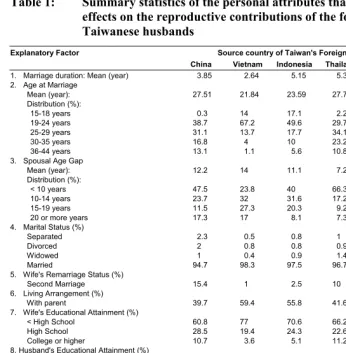
A few salient features of the five nationality groups can be seen from the summary statistics of our chosen explanatory factors (Table 1).
Table 1: Summary statistics of the personal attributes that have systematic effects on the reproductive contributions of the foreign wives of Taiwanese husbands
Explanatory Factor Source country of Taiwan's Foreign Wives
China Vietnam Indonesia Thailand Philippines All Five
1. Marriage duration: Mean (year) 3.85 2.64 5.15 5.38 6.51 3.73 2. Age at Marriage
Mean (year): 27.51 21.84 23.59 27.77 26.3 25.3 Distribution (%):
15-18 years 0.3 14 17.1 2.2 1.7 6.5 19-24 years 38.7 67.2 49.6 29.7 37.2 48.4 25-29 years 31.1 13.7 17.7 34.1 38 24.4 30-35 years 16.8 4 10 23.2 17.9 12.3 36-44 years 13.1 1.1 5.6 10.8 5.2 8.3 3. Spousal Age Gap
Mean (year): 12.2 14 11.1 7.2 7.1 12.4 Distribution (%):
< 10 years 47.5 23.8 40 66.3 65.3 40.2 10-14 years 23.7 32 31.6 17.2 19.1 26.9 15-19 years 11.5 27.3 20.3 9.2 10.1 17.3 20 or more years 17.3 17 8.1 7.3 5.6 15.6 4. Marital Status (%)
Separated 2.3 0.5 0.8 1 0.9 1.5
Divorced 2 0.8 0.8 0.9 0.8 1.4
Widowed 1 0.4 0.9 1.4 1.4 0.8
Married 94.7 98.3 97.5 96.7 96.9 96.2 5. Wife's Remarriage Status (%)
Second Marriage 15.4 1 2.5 10 1.5 9.1 6. Living Arrangement (%)
With parent 39.7 59.4 55.8 41.6 45.5 47.8 7. Wife's Educational Attainment (%)
< High School 60.8 77 70.6 66.2 33 66.4 High School 28.5 19.4 24.3 22.6 27.8 25.1 College or higher 10.7 3.6 5.1 11.2 39.3 8.5 8. Husband's Educational Attainment (%)
< High School 46.2 55.6 61.5 49.1 45.7 50.9 High School 38.3 37.5 33.9 36.4 30.9 37.3 College or University or higher 15.5 6.9 4.6 14.6 23.5 11.8 9. Husband's Veteran Status (%)
Veteran 12.4 1.7 1.9 5 2.4 7.5
10. Wife's Employment Status (%)
Fixed Job 14.4 16.4 22.1 33.1 30.6 16.7 11. Husband's Employment Status (%)
Fixed Job 69.3 81.2 78.5 80.2 79 74.5 12. Husband's Health Status (%)
Disabled 9 9.7 10.5 6.6 9.3 9.4
13. Place of Residence (%)
Metropolitan area 46.8 34.6 22.4 37 34.2 39.7 Sample size (person) 78777 44879 17377 3181 3493 147707
Note: The percentages are computed across the categories of each personal attribute.
• Vietnamese and Indonesian wives tended to get married at much younger ages than their Chinese, Thai, and Filipina counterparts. The mean age at marriage was 21.8 for those from Vietnam and 23.6 for those from Indonesia, compared with 27.5 for those from China, 27.8 for those from Thailand, and 26.3 for those from the Philippines. Beneath this large difference in mean age at marriage was the fact that the proportion getting married at the very young ages of 15-18 was 14.0% for those from Vietnam and 17.1% for those from Indonesia, compared with less than 3% for those from each of the three remaining countries. The very young Vietnamese wives were mainly daughters of desperately poor parents who married them off to Taiwanese men as soon as possible to overcome economic hardship via initial bride price and subsequence remittances (Nguyen and Tran 2010). The low mean marriage age of Indonesian wives was related to the fact that the family systems of Indonesia were characterized by early age at marriage that had not been lengthened very much by the influence of modernization (Jones 2001). Based on the data of the 1997 Indonesian Family Life Survey, Buttenheim and Nobles (2009) found that the average age at first marriage for females was only 18.2 years.
• The foreign wives from all five major source countries had very large and very different average spousal age gaps, ranging from 7.1 and 7.2 years for those from the Philippines and Thailand to 12.2 and 14.0 years for those from China and Vietnam. These values were greater than the corresponding values of all first marriages (2.7 years) and all remarriages (6.1 years) that took place in Taiwan in 2008 (MOI 2009).
• Second marriage involved much higher proportions of Chinese and Thai wives (15.4% and 10.0%) than Vietnamese, Indonesian, and Filipina wives (1.0%, 2.5%, and 1.5%).
• While the propensity to co-reside with the husband’s parent(s) was quite high for all five foreign nationalities, Vietnamese and Indonesian wives were much more prone to co-residing with parents than were their Chinese, Thai, and Filipina counterparts. The co-residing proportion was 59.4% for Vietnamese wives and 55.8% for Indonesian wives, compared with 39.7%, 41.6%, and 45.7% for their Chinese, Thai, and Filipina counterparts, respectively. For reference Lin (2009) found from Taiwan’s 2002 "National Survey on Knowledge, Attitude and Practice of Health Promotion" that 38% of currently married women in the 20-44 age group in Taiwan co-resided with their husbands’ parents or their own parents.
compared with only 3.6% for the Vietnamese and 5.1% for the Indonesians. For reference Lin (2009) showed that 29% of Taiwan’s currently married women in the 20-44 age group in 2002 had more than 12 years of education.
• Among the five source countries, husband’s educational attainment was positively correlated with wife’s educational attainment.
• Chinese wives were more prone to marrying veterans (12.4%) than were those of the other nationalities: 5.0% for the Thais, 2.4% for the Filipinas, and less than 2% for the Vietnamese and Indonesians.
• Thai and Filipina wives were much more likely to hold fixed jobs (33.1% and 30.6%) than were Chinese and Vietnamese wives (14.4% and 16.4%), while Indonesian wives were between these two extremes (22.1%). The very low proportion of Chinese wives holding fixed jobs was related to the fact that the government of Taiwan, being concerned with the negative impacts of a potentially large influx of labor across the Strait of Taiwan on the employment opportunities of low-skilled Taiwanese labor and probably on Taiwan's political independence from China, made it more difficult for Chinese wives to obtain a work permit, forcing many of them to work illegally in menial low-paying jobs (Tsao 2005).
5. Multivariate findings
We applied the multinomial logit model to each of the five nationality groups separately. In the model for the Vietnamese wives, we made the adjustment of merging the highest five categories of marriage duration (6, 7, 8, 9, and 10+) into one category (6+ years). The adjustment was due to the smallness of sample sizes in the highest four categories, which was in turn due to the very recent arrivals of the Vietnamese into Taiwan's marriage market. The predicted LTFR for the Vietnamese wives was also adjusted to be the Fi for
the case with the marriage duration being 6+ years.
In general, the explanatory variables with a t-ratio of less than 2.0 in magnitude were removed from the model, because the null hypothesis that in the context of other explanatory variables, the explanatory variables in question have no effect on the dependent variable, cannot be formally rejected. However, when a set of estimated coefficients associated with a substantive variable (e.g., the dummy variable representing husband’s high school educational attainment) showed a substantively sensible pattern, we chose to keep the whole set of the corresponding interactions in the model, even though one or two of the estimated coefficients in the set were associated with a t-ratio of less than 2.0 in magnitude.
Overall the nationality-specific models fitted the data quite well: the values of ρ2
reporting the specific findings of our multivariate analysis, we will focus on (1) the dependence of the predicted fertility rate on marriage duration and (2) the effects of other explanatory factors on the predictedLTFR and on the predicted Probability of Lifetime Childlessness (i.e., P'i0 for individuals with the highest marriage duration). Lifetime
childlessness should be of particular concern, because it could worsen the likelihood of marriage breakup (Kim 2010) and weaken foreign wives' long-term commitment and sense of belonging to the host society. The estimated coefficients are all shown in our working paper (Liaw, Lin, and Liu 2009).
5.1. The effects of marriage duration on the predicted fertility rate
In the model for each of the five nationality groups of the foreign wives, we computed the predicted fertility rate for each category of marriage duration, while constraining the values of all the dummy variables representing other explanatory factors (Xim) to zero.
The result is shown in Figure 3 and reveals the following main features.
First, similar to the pattern of the observed rates shown in Figure 1, we find that for each of the nationality groups, the predicted fertility rate increased sharply from 0 to 4 years and approached a plateau beyond 7 years. Second, the curves turned out to be amazingly smooth, despite the fact that we have not imposed any smooth mathematical function to represent the effect of marriage duration. These two features provide strong support for the assertion that marriage duration is much more important than marriage cohort in determining the reproductive outcome.
Third, the fertility rate started at a higher level for the Filipina wives than for those of the other nationalities. This feature suggests that the Filipina wives were more prone to entering Taiwan as foreign workers and to having sexual relationships with their Taiwanese husband before the marriage was formally arranged.
Fourth, for marriage duration of three or more years, the predicted fertility rates showed a clear three-way contrast: (1) a relatively high level for the wives from Indonesia and the Philippines, (2) an intermediate level for the wives from Vietnam, and (3) a relatively low level for the wives from Thailand and China. This contrast corresponded to a large extent to the relative fertility levels in the source countries. We found in the 2003 World Population Data Sheet of the PRB that among these five source countries, the TFRs were the highest in the Philippines (3.5) and Indonesia (2.6), and the lowest in Thailand (1.7) and China (1.7), while being intermediate in Vietnam (2.3).17
This finding suggests that somehow the fertility levels of Taiwan’s foreign wives were partially affected by the prevailing fertility levels of the source countries.
Fifth, for the foreign wives from China, the predicted LTFR of the reference group (1.85) turned out to be substantially higher than the corresponding observed LTFR (1.40) shown in Figure 1. To gain further insight into this finding, it is useful to see how the reproductive outcomes of the wives of different source countries were subject to the effects of the other explanatory factors.
Figure 3: Predicted fertility rates of the reference groups of Taiwan’s foreign wives from the top five source countries: by marriage duration
5.2. Effects of explanatory factors on the predicted lifetime fertility rate
To quantify the effects of an explanatory factor (e.g., spousal age gap) on the predicted
LTFR, we proceed in the following two steps. First, in the model for each nationality, we let the dummy variable for representing the highest marriage duration be 1 and let all other dummy variables representing other marriage durations and all other explanatory factors (Xim) be 0. This specification is called the "reference specification" and yields the
predicted LTFR for the "reference group" of each nationality: 1.85 for the Chinese, 1.71 for the Vietnamese, 2.09 for the Indonesians, 1.85 for the Thais, and 2.03 for the Filipinas. These values are shown in the first row in Table 2.
Second, the effects of the explanatory factor in question are shown as the differences in the predicted LTFR from the corresponding value of the reference group. For example the effect of lengthening the spousal age gap from "less than 10 years" to "10-14 years" would result in a decrease by 0.04 children per woman for the Chinese. To find this effect from the model for the Chinese, we modify the "reference specification" by letting the dummy variable representing the "10-14 years" category be 1, so that the model can generate the predicted LTFR for this category, which turns out to be 1.81 children per woman. The effect in question is then represented by the difference of this value from the predicted LTFR of the "reference group." Similarly to find the effect of lengthening spousal age gap to "15-19 years," we modify the "reference specification" by letting the dummy variable representing the "15-19 years" category be 1, so that the model can generate the predicted LTFR for this category, which turns out to be 1.70 children per woman for the Chinese. The effect in question is then represented by the difference of this value from the predicted LTFR of the "reference group," which turns out to be -0.15 children per woman.
Table 2: Effects of explanatory factors on the lifetime fertility rates of the foreign wives of Taiwanese husbands: based on the application of a multinomial logit model to the micro data of the 2003 census of foreign spouses
Explanatory Factor Source Country
China Vietnam Indonesia Thailand Philippines
Reference Group 1.85 1.71 2.09 1.85 2.03
1. Age at Marriage (ref.= 19-24)
15-18 years -0.23 -0.06 ---- 0.26 ---- 25-29 years -0.12 -0.10 -0.09 -0.16 -0.10
30-35 years -0.37 -0.26 -0.36 -0.35 -0.32
36-44 years -1.09 -0.85 -1.25 -1.06 -0.89
2. Spousal Age Gap (ref.= less than 10 yrs)
10-14 years -0.04 ---- ---- ---- -0.01 15-19 years -0.15 -0.03 ---- -0.11 ---- 20 or more years -0.37 -0.19 -0.15 -0.26 -0.37
3. Marital Status (ref.= Married)
Separated -0.92 -0.54 -0.33 -0.26 -0.09 Divorced -0.33 -0.08 -0.08 ---- ----
Widowed -0.11 ---- ---- ---- ----
4. Wife's Remarriage Status (ref.= other)
2nd Marriage -0.39 -0.22 -0.20 -0.50 -0.11 5. Living Arrangement (ref.= other)
With Parent 0.07 0.08 0.06 0.21 0.09 6. Wife's Education (ref.= less than High Sch.)
High School -0.04 ---- ---- ---- ---- College or University or higher -0.13 ---- ---- ---- 0.03 7. Husband's Education (ref.= less than High Sch.)
High School -0.05 -0.03 -0.11 ---- ---- College or University or higher -0.11 -0.01 -0.20 ---- ---- 8. Husband's Veteran Status (ref.= other)
Veteran -0.07 -0.02 -0.12 -0.41 ---- 9. Wife's Employment Status (ref.= other)
Fixed Job -0.03 -0.21 -0.09 -0.15 -0.20
10. Husband's Employment Status (ref.= other)
Fixed Job 0.02 0.06 -0.01 0.06 -0.03
11. Husband's Health Status (ref.= Able)
Disabled -0.02 -0.06 -0.05 ---- -0.03 12. Residence (ref.= other)
Metropolitan Area -0.08 -0.07 -0.04 -0.12 -0.17 Maximum Achievable LTFR 1.93 1.85 2.14 2.09 2.14
Note: The effects with a magnitude of less than 0.20 children per woman are considered to be modest. The effects that are not modest are highlighted in the table.
effect for the Indonesians and the Filipinas. The deficits for the Chinese and Vietnamese wives required further investigation, because they were inconsistent with the simple idea that longer exposure to the risk of pregnancy tends to result in higher LTFR.
The negative effects of spousal age gap up to 15-19 years on LTFR turned out to be either modest or nonexistent for the wives from each of the five source countries, with the largest effect being only 0.15 children for the Chinese. The negative effects of having the longest age gap of 20+ years were moderate for the Chinese (by 0.37 children), the Filipinas (by 0.37 children) and the Thais (by 0.26 children) but were modest for the Vietnamese (by 0.19 children) and the Indonesians (by 0.15 children). In short, spousal age gap had little effect on LTFR, except when it was very large. Note that we chose to let the reference category be "less than 10 years," after we had found that the differences among the "< -5," "-5 to -1," "0 to 4," and "5 to 9" categories did not have any significant effect.
With respect to the effects of marital status on LTFR, widowhood had only a modest negative effect on the Chinese (by 0.11 children) and no effect on all Southeast Asian nationalities. The negative effect of being divorced was moderate for the Chinese (by 0.33 children), modest for the Vietnamese and the Indonesians (both by 0.08 children) and nonexistent for the Thais and Filipinas. For the wives from each of the five source countries, the negative effect of being separated was greater than those of being divorced and widowed. It was very strong for the Chinese (by 0.92 children), rather strong for the Vietnamese (by 0.54 children), moderate for the Indonesians (by 0.33 children) and the Thais (by 0.26 children), and modest for the Filipinas (by 0.09 children). It is likely that fake marriages were more prevalent among the separated than among those of other marital statuses.
The current marriage being the second marriage indeed had a negative effect on the
LTFR of every nationality. It was rather strong for the Chinese (by 0.39 children) and the Thais (by 0.50 children), moderate for the Vietnamese (by 0.22 children) and the Indonesians (by 0.20 children), and modest for the Filipinas (by 0.11 children).
Living with parent had the expected positive effect on the LTFR of every nationality. However the effects were not strong. It was moderate for the Thais (by 0.21 children) and modest for the Chinese (by 0.07 children), the Vietnamese (by 0.08 children), the Indonesians (by 0.06 children), and the Filipinas (by 0.09 children).
The effects of wife’s educational attainment on LTFR were very modest and mostly nonexistent. It had no effect on the Vietnamese, the Indonesians, and the Thais. The expected negative effects could only be detected for the Chinese (by 0.04 children for achieving high school graduation, and by an additional 0.09 children for achieving a college degree). In the case of the Filipinas, the achievement of a college degree was somehow associated with an increase by 0.03 children.
husbands had achieved college or higher education, relative to those with less than high school education. This moderate reduction in LTFR resulted mainly from a shift of a probability (10%) from the three-child alternative primarily to the two-child alternative and secondarily to one-child alternative. It had no effect on the probability of being childless. In other words the reduction resulted mainly from a compression of reproduction towards the ideal family size of 2 children.
Except for the Thais, the expected negative effects of being the wife of a veteran on
LTFR were mostly modest or nonexistent. They were modest for the Chinese (by 0.08 children), the Vietnamese (by 0.02 children) and the Indonesians (by 0.12 children), and nonexistent for the Filipinas. For the Thais, the effect was a rather large reduction by 0.41 children, which resulted mainly from decreases in the probabilities of having two children (by 17%) and three children (by 7%) and increases in the probabilities of having one child (by 13%) and no child (by 11%). Essentially, the decrease resulted from a downward shift away from the ideal family size of 2 children.
With respect to wife’s employment status, having a fixed job had a negative effect on the LTFR of the wives from each of the five source countries. The effect was moderate for the Vietnamese (by 0.21 children) and the Filipinas (by 0.20 children) and modest for the Thais (by 0.15 children), the Indonesians (by 0.09 children) and the Chinese (by 0.03 children). In the case of the Vietnamese and Filipinas, the moderate decrease in LTFR
resulted mainly from a shift of probability from the two-child alternative to the one-child and childless alternatives.
With respect to husband’s employment status, having a fixed job had very modest and somewhat inconsistent effects on LTFR. It had positive effects on the Chinese (by 0.02 children), the Vietnamese (by 0.06 children), and the Thais (also by 0.06 children). It had negative effects on the Indonesians (by 0.01 children) and the Filipinas (by 0.03 children). The increase in LTFR for the Vietnamese resulted mainly from a shift of probability from the one-child alternative to the two-child alternative, whereas the increase in LTFR for the Thais resulted mainly from a shift of probability from the no-child alternative to the two-child alternative. It is worth noting that underneath the near zero effects on LTFR for the Chinese and the Indonesians was a clear compression of probability towards the two-child alternative (by 5%) from both sides. In other words,
having a husband with a fixed job enhanced the ability to achieve the two-child ideal family size but had little effect on the fertility level.
Having a disabled husband had no effect on the LTFR of the Thais and only reduced the LTFR of the wives from the other four source countries to a modest extent: by 0.06 children for the Vietnamese, 0.05 children for the Indonesians, 0.03 children for the Filipinas, and 0.02 children for the Chinese. In the case of the Vietnamese and Indonesians, the decrease in LTFR resulted mainly from a shift of probability from the two-child alternative to the one-child alternative.
0.04 children for the Indonesians to 0.12 children for the Thais and the Filipinas. The decrease for the Thais resulted mainly from shifting probability from the three-child alternative to all three lower alternatives, whereas the decrease for the Filipinas resulted mainly from shifting probability from the two-child alternative to the two lower alternatives.
It is now clear that the main reasons for the observed LTFR of Chinese wives (1.40 children) to be much lower than those of the wives of other nationalities are the following: their ages at marriage were relatively advanced; they were more prone to being separated or divorced; their spousal age gaps were relatively high; their current marriages were more likely to be their second; they were less likely to live with the husband’s parents; and they were more prone to marrying veterans (see Table 1).
To the extent that these explanatory factors are subject to policy interventions, and to the extent that raising the lifetime fertility of foreign wives towards the replacement level is desirable, the above findings suggest that the effects of the intervention are likely to differ systematically among the five source countries. For example, a policy designed to reduce the rates of separation and divorce would have a greater fertility-enhancing effect on Chinese wives than on Southeast Asian wives. In contrast, a policy designed to reduce the burden on working wives would have a greater fertility-enhancing effect on Southeast Asian wives than on Chinese wives.
5.3. Effects of explanatory factors on the predicted probability of lifetime childlessness
The steps for quantifying the effects of explanatory factors on the predicted probability of lifetime childlessness is the same as those used in quantifying the effects on the predicted
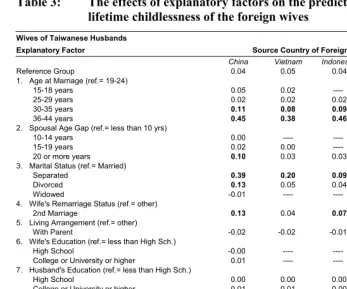
LTFR. In Table 3, we see that the predicted probability of lifetime childlessness of the reference group of each nationality was not high: 4% for the wives from China, Indonesia, and Philippines, 5% for those from Vietnam, and 8% for those from Thailand.
With the minor exception of the 15-18 age group, age at marriage had an increasingly strong positive effect on the risk of lifetime childlessness: the increase in the predicted probability of lifetime childlessness was modest for the 25-29 age group (ranging from 1% for the Thais to 3% for the Filipinas), moderate for the 30-35 age group (ranging from 7% for the Thais to 11% for the Chinese), and very large for the 36-44 age group (ranging from 34% for the Filipinas to 46% for the Indonesians).
Over a wide range up to 19 years, spousal age gap had either no effect or a modest effect on the risk of lifetime childlessness. The effect of having the largest age gap of 20+ years became moderate for the Chinese (10%), the Thais (13%), and the Filipinas (10%) but remained modest for the Vietnamese (3%) and the Indonesians (3%).
With respect to marital status, being separated increased the predicted probability of lifetime childlessness for every nationality, with the effect being very strong for the Chinese (39%), rather strong for the Vietnamese (20%), moderate for the Thais (13%) and Indonesians (9%), and modest for the Filipinas (4%). The effect of being divorced was much weaker than the effect of being separated. Its effect was moderate for the Chinese (13%), modest for the Vietnamese (5%) and Indonesians (4%), and zero for the Thais and the Filipinas. The effect of being widowed was trivial or non-existent. The current marriage being the second marriage had a positive effect on the predicted probability of lifetime childlessness for every nationality: it was moderate for the Chinese (13%), the Thais (13%) and Indonesians (7%), and modest for the Filipinas (5%) and Vietnamese (4%).
Table 3: The effects of explanatory factors on the predicted probability of lifetime childlessness of the foreign wives
Wives of Taiwanese Husbands
Explanatory Factor Source Country of Foreign Wives
China Vietnam Indonesia Thailand Philippines
Reference Group 0.04 0.05 0.04 0.08 0.04
1. Age at Marriage (ref.= 19-24)
15-18 years 0.05 0.02 ---- -0.04 ----
25-29 years 0.02 0.02 0.02 0.01 0.03
30-35 years 0.11 0.08 0.09 0.07 0.08
36-44 years 0.45 0.38 0.46 0.42 0.34
2. Spousal Age Gap (ref.= less than 10 yrs)
10-14 years 0.00 ---- ---- ---- 0.01
15-19 years 0.02 0.00 ---- 0.06 ----
20 or more years 0.10 0.03 0.03 0.13 0.10
3. Marital Status (ref.= Married)
Separated 0.39 0.20 0.09 0.13 0.04
Divorced 0.13 0.05 0.04 ---- ----
Widowed -0.01 ---- ---- ---- ----
4. Wife's Remarriage Status (ref.= other)
2nd Marriage 0.13 0.04 0.07 0.13 0.05
5. Living Arrangement (ref.= other)
With Parent -0.02 -0.02 -0.01 -0.05 -0.02 6. Wife's Education (ref.= less than High Sch.)
High School -0.00 ---- ---- ---- ---- College or University or higher 0.01 ---- ---- ---- -0.02 7. Husband's Education (ref.= less than High Sch.)
High School 0.00 0.00 0.00 ---- ---- College or University or higher 0.01 0.01 0.00 ---- ---- 8. Husband's Veteran Status (ref.= other)
Veteran 0.02 0.01 0.03 0.11 ----
9. Wife's Employment Status (ref.= other)
Fixed Job 0.01 0.06 0.03 0.07 0.06
10. Husband's Employment Status (ref.= other)
Fixed Job -0.01 -0.01 -0.01 -0.03 0.00 11. Husband's Health Status (ref.= Able)
Disabled 0.01 0.02 0.01 ---- 0.01
12. Residence (ref.= other)
Metropolitan Areas 0.02 0.01 0.01 0.02 0.02
Note: The effects with a magnitude of less than 0.06 (or 6%) are considered to be modest. The effects that are not modest are highlighted.
Of particular interest is the finding that both wife's and husband's educational attainments had practically no effect on the predicted probability of lifetime childlessness. However, the effects of having a fixed job differed by gender, though the effects were mostly modest. Wives with a fixed job were somewhat more likely to be childless (by 7% for the Thais, 6% for the Vietnamese and Filipinas, 3% for the Indonesians, and 1% for the Chinese), whereas having a husband with a fixed job reduced the probability of childlessness slightly (by 3% or less).
increase moderately by marrying in the mid-30s, having a very large spousal age gap of 20+ years, having the divorced marital status (for the Chinese only), having the current marriage be the second marriage, marrying a veteran (for the Thais only), and having a fixed job. Educational attainment had practically no effect on the probability of lifetime childlessness.
6. Contextualization of the empirical findings
As late as 1970, around the time when western European countries started to enter into the Second Demographic Transition towards the entrenchment of sub-replacement fertility levels, the TFR of Taiwan was still at a high level of 4.0, which was even higher than the TFRs of Australia, Canada, and the United States at the peaks of their post-World War II baby-booms (Romaniuc 1984; McDonald 2000c). Rapid economic growth and successful promotion of a popular family planning program through the 1970s helped the rapid transition of Taiwan’s TFR to the replacement level in 1983 (Chang, Freedman, and Sun 1987; Sun 2001). Several developments since the 1980s helped set the context for an entrenched sub-replacement fertility level that is important for understanding the reproductive performances of both native-born and foreign wives in Taiwan.
One of these developments was a rapid progress towards gender-equality in individual-oriented institutions (especially the education system), accompanied by the slow progress of gender-equality in family-oriented institutions (McDonald 2000a, 2000b, 2007; Yang and Tsai 2007). This development has not only helped raise the opportunity cost of having children but also made the lives of married women stressful and exhausting. Consequently, more women were motivated to postpone, or even to abstain from, marriage and childbearing.
Another development was the progressive entrenchment of neo-liberalism. Motivated by profit maximization and threatened by market competition, businesses in Taiwan have reduced the job security and real wages of their workers, especially the new entrants and those without sophisticated skills. Young adults became increasingly pessimistic about their ability to have a steady income sufficient to sustain the expenses of a household. The entrenchment of neo-liberalism has also made it impossible for the allocation of sizable public funds to child benefits and to childcare and maternal or paternal leave programs.