DEMOGRAPHIC RESEARCH
VOLUME 31, ARTICLE 17, PAGES 497
−
510
PUBLISHED 26 AUGUST 2014
http://www.demographic-research.org/Volumes/Vol31/17/ DOI: 10.4054/DemRes.2014.31.17
Descriptive Finding
Age patterns of racial/ethnic/nativity differences
in disability and physical functioning in the
United States
Jennifer Melvin
Robert Hummer
Irma Elo
Neil Mehta
©2014 Jennifer Melvin et al.
This open-access work is published under the terms of the Creative Commons Attribution NonCommercial License 2.0 Germany, which permits use, reproduction & distribution in any medium for non-commercial purposes, provided the original author(s) and source are given credit.
1 Introduction 498
2 Conceptual framework 499
3 Data and method 499
4 Results 500
5 Discussion and conclusion 503
6 Acknowledgements 505
Age patterns of racial/ethnic/nativity differences in disability and
physical functioning in the United States
Jennifer Melvin1 Robert Hummer2
Irma Elo3 Neil Mehta4
Abstract
BACKGROUND
Rapid population aging and increasing racial/ethnic and immigrant/native diversity make a broad documentation of U.S. health patterns during both mid- and late life particularly important.
OBJECTIVE
We aim to better understand age- and gender-specific racial/ethnic and nativity differences in physical functioning and disability among adults aged 50 and above.
METHODS
We aggregate 14 years of data from the National Health Interview Survey and calculate age- and gender-specific proportions of physical functioning and two types of disability for each population subgroup.
RESULTS
Middle-aged foreign-born individuals in nearly every subgroup exhibit lower proportions of functional limitations and disability than U.S.-born whites. This pattern of immigrant advantage is generally reversed in later life. Moreover, most U.S.-born minority groups have significantly higher levels of functional limitations and disability than U.S.-born whites in both mid- and late life.
1 The University of Texas at Austin, U.S.A. E-Mail: [email protected]. 2 The University of Texas at Austin, U.S.A.
CONCLUSIONS
Higher levels of functional limitations and disability among U.S.-born minority groups and immigrant populations in older adulthood pose serious challenges for health providers and policymakers in a rapidly diversifying and aging population.
1. Introduction
By 2030, the number of older immigrants living in the United States is expected to have increased by 40 percent (Arias 2010). U.S.-born racial/ethnic minority groups will also continue to grow and make up an increasing share of the older population (Vincent and Velkoff 2010). These shifts will change the demographic structure of the elderly population and influence future population health patterns. Indeed, levels of poor physical functioning and disability are higher for older-aged blacks and Hispanics compared to the majority non-Hispanic white population (Cantu et al. 2013; Hummer et al. 2013; Kelley-Moore and Ferraro 2004; Manton, Gu, and Lamb 2006; Mehta, Sudharsanan, and Elo 2013). Recent research also documents increases in disability for adults in midlife; this increase may be more prevalent for minority groups (Freedman et al. 2013; Martin and Schoeni 2013).
At the same time, most studies of U.S. immigrants show favorable levels of health in comparison to U.S.-born whites (Akresh and Frank 2008; Singh and Siahpush 2001, 2002), a pattern known as the healthy immigrant effect. However, at older ages this pattern seems to reverse, with higher disability rates among a number of foreign-born groups compared to U.S.-born whites (Haas, Krueger, and Rohlfsen 2012; Dallo, Booza, and Nguyen 2013). Foreign-born Asians are the only group that appears to retain favorable health outcomes into older age (Cho and Hummer 2001; Fuller-Thomson et al. 2011; De Souza and Fuller-Fuller-Thomson 2013). In contrast, foreign-born Hispanics exhibit the greatest disability burden of any large U.S. subgroup (Hayward et al. 2014).
groups that encompass both mid- and late life. As a result, we provide a thorough documentation of older adult physical health differences in the U.S.
2. Conceptual framework
The conceptualization of the disability process (Verbrugge and Jette 1994) first involves the loss of physical functioning, such as the ability to walk, climb stairs, and lift heavy objects. These functional limitations (FLs) progress into finding it difficult or impossible to perform personal care activities, such as bathing or getting around within the home (activities of daily living: ADLs) and then into finding it difficult or impossible to perform more complex household tasks, such as shopping for groceries or paying bills (instrumental activities of daily living: IADLs). FLs become disabilities when individuals find it difficult or impossible to perform activities that affect their expected social roles (Altman 2001; Crimmins 2004).
Racial/ethnic and nativity differences in functioning and disability in mid- and late life are of crucial importance because they highlight the physical consequences of social inequality in U.S. society (Hummer et al. 2013). These inequalities result in differing heath trajectories in mid- and late life across groups. Such health inequalities not only lead to pain, suffering, and frustration for the affected individuals and groups, but are also hard on caregivers and costly for families and governments (Lynch, Brown, and Taylor 2009). As groups who have been historically discriminated against and who continue to occupy the lower socioeconomic strata of U.S. society, it is crucial that researchers document both racial/ethnic and immigrant/native differences in older adult health outcomes (Mehta, Sudharsanan, and Elo 2013; Treas and Batalova 2009).
3. Data and methods
Questionnaire. After deleting respondents with missing data, our final sample size was 319,893 for the analysis of ADLs/IADLs and 144,975 for the analysis of FLs.
We constructed a measure of FLs based on individuals’ responses to items that assess their ability (without special equipment) to stoop/kneel, stand for two hours, walk three blocks, climb 10 stairs, sit for two hours, carry 10 pounds, grasp objects, reach overhead, and push large objects. Respondents who answered “very difficult” or “cannot do at all” to one or more of these items were coded as having an FL. ADL disabilities consist of eating, bathing, dressing, and getting around inside the home. IADLs include everyday household chores, doing necessary business, shopping, or getting around for other purposes. Respondents who needed help with one or more of these items were considered to have an ADL or IADL limitation, respectively.
We include age categories that allow for reasonable cell sizes and that encompass midlife (50–64) and later life (65–74, 75–84, 85+). The racial/ethnic groups we include are Mexican Americans, Puerto Ricans, Cuban Americans, Other Hispanics, non-Hispanic Asian Americans, non-non-Hispanic blacks, and non-non-Hispanic whites. Each racial/ethnic group is further subdivided by nativity. Because there were only a small number of U.S.-born Cubans, this group was included with U.S.-born Other Hispanics. Those who reported multiple races, Native American, or unknown race were omitted.
Analytically, we document the proportion of individuals with an FL, ADL, and IADL, respectively, by race/ethnicity/nativity. All analyses are conducted separately by age group and gender. U.S.-born whites are the reference category for statistical tests. The analyses are weighted to account for the complex NHIS survey design and IHIS variance estimation variables are used to pool multiple years of data into a single file.
4. Results
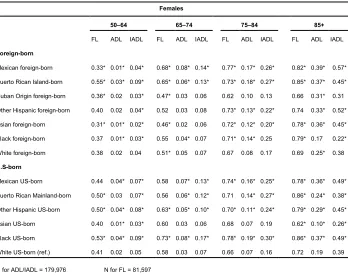
foreign-born groups (with the exception of Cubans) exhibit this pattern of significantly lower (at ages 50–64) and then significantly higher (generally at ages 65 and above) levels of disability and functional limitations than U.S.-born whites. Clearly, the healthy immigrant effect for midlife foreign-born adults is not evident in later life.
Turning to the U.S.-born minority groups, black, Mexican American, and Other Hispanic females have substantially higher levels of disability and FLs in comparison to U.S.-born whites during midlife. Only U.S.-born Asian Americans have health profiles comparable to U.S.-born white women. At the older ages, U.S.-born minority group women, with the exception of Asian Americans, continue to exhibit higher levels of disability and FLs than U.S.-born whites.
Table 1: Proportion reporting functional limitations (FL), limitations in activities of daily living (ADL), and limitations in instrumental activities of daily living (IADL), by race/ethnicity/nativity among U.S. females by age group, 1998–2011
Females
50–64 65–74 75–84 85+
FL ADL IADL FL ADL IADL FL ADL IADL FL ADL IADL
Foreign-born
Mexican foreign-born 0.33* 0.01* 0.04* 0.68* 0.08* 0.14* 0.77* 0.17* 0.26* 0.82* 0.39* 0.57*
Puerto Rican Island-born 0.55* 0.03* 0.09* 0.65* 0.06* 0.13* 0.73* 0.18* 0.27* 0.85* 0.37* 0.45*
Cuban Origin foreign-born 0.36* 0.02 0.03* 0.47* 0.03 0.06 0.62 0.10 0.13 0.66 0.31* 0.31
Other Hispanic foreign-born 0.40 0.02 0.04* 0.52 0.03 0.08 0.73* 0.13* 0.22* 0.74 0.33* 0.52*
Asian foreign-born 0.31* 0.01* 0.02* 0.46* 0.02 0.06 0.72* 0.12* 0.20* 0.78* 0.36* 0.45*
Black foreign-born 0.37 0.01* 0.03* 0.55 0.04* 0.07 0.71* 0.14* 0.25 0.79* 0.17 0.22*
White foreign-born 0.38 0.02 0.04 0.51* 0.05 0.07 0.67 0.08 0.17 0.69 0.25* 0.38
U.S-born
Mexican US-born 0.44 0.04* 0.07* 0.58 0.07* 0.13* 0.74* 0.16* 0.25* 0.78* 0.36* 0.49*
Puerto Rican Mainland-born 0.50* 0.03 0.07* 0.56 0.06* 0.12* 0.71 0.14* 0.27* 0.86* 0.24* 0.38*
Other Hispanic US-born 0.50* 0.04* 0.08* 0.63* 0.05* 0.10* 0.70* 0.11* 0.24* 0.79* 0.29* 0.45*
Asian US-born 0.40 0.01* 0.03* 0.60 0.03 0.06 0.68 0.07 0.19 0.62* 0.10* 0.26*
Black US-born 0.53* 0.04* 0.09* 0.73* 0.08* 0.17* 0.78* 0.19* 0.30* 0.86* 0.37* 0.49*
White US-born (ref.) 0.41 0.02 0.05 0.58 0.03 0.07 0.66 0.07 0.16 0.72 0.19 0.39
N for ADL/IADL = 179,976 N for FL = 81,597
* Indicates that proportion differs from US-born whites in the same age and gender group (p < .05).
The key patterns for men (Table 2) are quite similar to those for women. Foreign-born Mexican, Cuban, Other Hispanic, Asian, and black men at ages 50–64 have lower levels of FLs, ADL disability, and IADL disability compared to U.S.-born white men. One clear example is foreign-born Mexican Americans: they have a lower proportion of FLs (.24), a comparable proportion of ADL disability (.01), and a lower proportion of IADL disability (.02) than those of U.S.-born white men (.33, .01, and .03, respectively). As with women, the only exception is island-born Puerto Rican men. In contrast, U.S.-born minority men (except Asian Americans) exhibit higher proportions of FLs, ADL disability, and IADL disability than U.S.-born whites.
Table 2: Proportion reporting functional limitations (FL), limitations in activities of daily living (ADL), and limitations in instrumental activities of daily living (IADL), by race/ethnicity/nativity among males by age group, 1998–2011
Males
50–64 65–74 75–84 85+
FL ADL IADL FL ADL IADL FL ADL IADL FL ADL IADL
Foreign-born
Mexican foreign-born 0.24* 0.01 0.02* 0.44* 0.03 0.06* 0.63* 0.14* 0.21* 0.78* 0.31* 0.47*
Puerto Rican Island-born 0.42* 0.03* 0.05* 0.43* 0.05* 0.08* 0.72* 0.14* 0.23* 0.81* 0.25* 0.39*
Cuban Origin foreign-born 0.23* 0.01 0.02* 0.32* 0.02 0.04 0.57 0.11* 0.13 0.64 0.33* 0.37*
Other Hispanic foreign-born 0.25* 0.01 0.01* 0.35 0.03 0.06* 0.62* 0.13* 0.16* 0.71* 0.21* 0.35*
Asian foreign-born 0.18* 0.01 0.01* 0.33* 0.02 0.03* 0.54 0.05 0.12 0.70 0.31* 0.43*
Black foreign-born 0.24* 0.01 0.03 0.41* 0.04* 0.05 0.57 0.11* 0.17* 0.74* 0.26* 0.18
White foreign-born 0.29 0.02 0.02 0.33 0.03 0.05 0.53 0.07 0.11 0.69 0.16 0.25
U.S-born
Mexican US-born 0.41* 0.02* 0.05* 0.43* 0.04* 0.07* 0.62* 0.10* 0.18* 0.74* 0.23* 0.36*
Puerto Rican Mainland-born 0.38* 0.01 0.04 0.42* 0.03 0.06* 0.61* 0.12* 0.17* 0.70* 0.17 0.38*
Other Hispanic US-born 0.39* 0.02* 0.04 0.51* 0.03* 0.05* 0.63* 0.09* 0.13* 0.73* 0.27* 0.33*
Asian US-born 0.22* 0.01 0.02* 0.42 0.01 0.03 0.54 0.06 0.19* 0.69 0.18 0.28
Black US-born 0.41* 0.03* 0.06* 0.46* 0.05* 0.08* 0.72* 0.15* 0.27* 0.79* 0.31* 0.36*
White US-born (ref.) 0.33 0.01 0.03 0.39 0.02 0.06* 0.55 0.05 0.09 0.67 0.14 0.25
N for ADL/IADL = 139,917 N for FL = 63,378
* Indicates that proportion differs from US-born whites in the same age and gender group (p < .05).
As with the pattern for women, immigrant similarities/advantages for men relative to U.S.-born whites at ages 50–64 largely disappear and, with the exception of foreign-born Cubans, become disadvantages at ages 65 and above. At ages 75 and above, foreign-born Mexican men have much higher proportions of ADL/IADL disability and FLs than U.S.-born white men. In addition, at ages 65 and above, all U.S.-born minority groups except Asians have substantially higher proportions of disability and FLs than U.S.-born whites.
5. Discussion and conclusion
Our findings provide evidence consistent with the healthy immigrant effect for both males and females in midlife (Akresh and Frank 2008). Relative to U.S.-born whites, foreign-born Mexicans, Cubans, Other Hispanics, Asians, blacks, and whites all have comparable and in some cases lower proportions of FLs and ADL/IADL disability. Middle-aged immigrants may not yet demonstrate the negative health effects caused by many years of physically demanding work (Toussaint-Comeau 2006). At the same time, island-born Puerto Ricans displayed worse health outcomes than U.S.-born whites; Puerto Ricans may be less selected for good health since they are U.S. citizens and can more easily migrate to the mainland than other groups.
Our evidence also illustrates that the more positive health profiles of immigrants relative to U.S.-born non-Hispanic whites in midlife extends to ages 65–74 only for female and male Cuban, Asian, and white immigrants. The relatively comparable health between foreign-born blacks and U.S.-born whites in early late life is consistent with other research (Hamilton and Hummer 2012); however, at the oldest ages (75–84, 85+), the health of black immigrants is significantly worse than that of U.S.-born whites across all three outcomes. The health advantage of the Cuban foreign-born group is quite likely due to their favorable socioeconomic status relative to other immigrant groups. The 1960s cohort of Cuban immigrants was largely middle or upper-middle class and experienced successful assimilation into U.S. society (Telles and Ortiz 2008; Tienda and Mitchell 2006). These socioeconomic advantages relative to other immigrant groups have likely translated to positive health outcomes in late life.
also indicate that, by the oldest ages (85+), every foreign-born group (except Cubans) has higher proportions of FLs and ADL/IADL disability than U.S.-born whites, in direct contrast to the healthy immigrant effect.
Interestingly, both foreign- and U.S.-born Asian Americans exhibited considerably better health than most groups; however, only the U.S.-born Asians exhibited health comparable to that of non-Hispanic whites at the oldest ages. Foreign-born Asian Americans reported similar or better health than whites until ages 75–84, at which point foreign-born Asian men exhibited worse health than white males on all three measures and Asian women had a higher level of ADL disability. These results are consistent with earlier studies that suggest the foreign-born Asian health advantage may not extend into late life (Markides et al. 2007; Mutchler, Prakash, and Burr 2007). In part, this may be due to the heterogeneity of this group. Asians who migrate to the U.S. as refugees or for family reunification may be less positively health-selected and/or may be older at the time of migration than most immigrants.
Our results also revealed that most U.S.-born minority groups – in particular blacks, Puerto Ricans, Mexican Americans, and Other Hispanics – were characterized by poorer health than U.S.-born whites in all age groups. Prior studies suggest that socioeconomic disadvantages among these populations play an important part in their poorer health relative to whites (Hummer, Benjamin, and Rogers 2004, Hummer et al. 2013). These wide differences in health across racial/ethnic groups illustrate that the U.S. has a considerable way to go to achieve health equality.
In spite of its strengths, our study has limitations. Prior studies have shown that some national origin differences in disability are related to age patterns of immigration (Elo, Mehta, and Huang 2011), a measure not available in the NHIS. Second, the NHIS does not include individuals who live in institutions (mainly nursing homes). The percentage of older adults in nursing homes is higher among whites (3.2%) and blacks (4.2%) than Hispanics (1.8%) or Asians (1.4%) (Feng et al. 2011). Thus estimates could be higher if nursing home residents were included. Finally, our data do not allow for an understanding of why there are such wide subgroup differences and why such differences vary by age. Patterns of immigrant selectivity, type of visa, selective out-migration, and the life course accumulation of socioeconomic resources may impact upon these health differences.
6. Acknowledgments
We gratefully acknowledge financial support for this research provided by the MacArthur Foundation Research Network on an Aging Society: John W. Rowe, Columbia University (Chair), and by infrastructural research support (5 R24 HD042849) from the Eunice Kennedy Shriver National Institute of Child Health and Human Development to the Population Research Center at the University of Texas at Austin. We also thank the National Center for Health Statistics and the Minnesota Population Center at the University of Minnesota for making the data available for this paper and Dustin Brown, Joseph Lariscy, Jay Olshansky, and Mark Hayward for helpful advice.
References
Akresh, I.R. and Frank, R. (2008). Health Selection among New Immigrants. American Journal of Public Health 98(4): 2058–2064. doi:10.2105/AJPH.2006.100974. Altman, B. (2001). Disability, Definitions, Models, Classification Schemes, and
Applications. In: Albrecht, G.L., Seelman, K.D., and Bury, M. (eds.). Handbook of Disability Studies. Thousand Oaks, CA: Sage Publications: 97–120.
doi:10.4135/9781412976251.n4.
Arias, E. (2010). United States Life Tables by Hispanic Origin. National Center for Health Statistics.
Cantu, P.A., Hayward, M.D., Hummer, R.A., and Chiu, C.T. (2013). New Estimates of Racial/Ethnic Differences in Life Expectancy with Chronic Morbidity and Functional Loss: Evidence from the National Health Interview Survey. Journal of Cross-cultural Gerontology 28(3): 283–297. doi:10.1007/s10823-013-9206-5. Cho, Y. and Hummer, R.A. (2001). Disability Status Differentials across Fifteen Asian
and Pacific Islander Groups and the Effect of Nativity and Duration of Residence in the U.S. Social Biology 48: 171–195.
Crimmins, E.M. (2004). Trends in the Health of the Elderly. Annual Review of Public Health 25: 79–98. doi:10.1146/annurev.publhealth.25.102802.124401.
Dallo, F.J., Booza, J., and Nguyen, N.D. (2013). Functional Limitations and Nativity Status Among Older Arab, Asian, Black, Hispanic, and White Americans.
Journal of Immigrant and Minority Health 15(6): 1011–1022.
De Souza, L.R. and Fuller-Thomson, E. (2013). Acculturation and Disability Rates Among Filipino-Americans. Journal of Immigrant and Minority Health 15(3): 462–471. doi:10.1007/s10903-012-9708-1.
Elo, I.T., Mehta, N.K., and Huang, C. (2011). Disability Among Native-born and Foreign-born Blacks in the United States. Demography 48: 241–265.
doi:10.1007/s13524-010-0008-x.
Feng, Z., Fennell, M.L., Tyler, D.A., Clark, M., and Mor, V. (2011). Growth of Racial and Ethnic Minorities in US Nursing Homes driven by Demographics and Possible Disparities in Options. Health Affairs 30(7): 1358–1365.
Freedman, V.A., Spillman, B.C., Andreski, P.M., Cornman, J.C., Crimmins, E.M., Kramarow, E., and Lubitz, J. (2013). Trends in Late-Life Activity Limitations in the United States: An Update From Five National Surveys. Demography 50(2): 661–671. doi:10.1007/s13524-012-0167-z.
Fuller-Thomson, E., Brennenstuhl, S., and Hurd, M. (2011). Comparison of disability rates among older adults in aggregated and separate Asian American/Pacific Islander subpopulations. American Journal of Public Health 101(1): 94–100.
doi:10.2105/AJPH.2009.176784.
Haas, S.A., Krueger, P.M., and Rohlfsen, L. (2012). Race/ethnic and nativity disparities in later life physical performance: the role of health and socioeconomic status over the life course. The Journals of Gerontology Series B: Psychological Sciences and Social Sciences 67(2): 238–248. doi:10.1093/geronb/gbr155. Hamilton, T.G. and Hummer, R.A. (2012). Immigration and the Health of U.S. Black
Adults: Does Country of Origin Matter? Social Science and Medicine 73: 1551– 1560. doi:10.1016/j.socscimed.2011.07.026.
Hayward, M.D., Hummer R.A., Chiu, C.T., Gonzales, C., and Wong, R. (2014). Does the Hispanic Paradox in Mortality Extend to Disability? Population Research and Policy Review 33: 81–96. doi:10.1007/s11113-013-9312-7.
Hummer, R.A., Benjamins, M.R., and Rogers, R.G. (2004). Racial and Ethnic Disparities in Health and Mortality among the U.S. Elderly Population. In: Anderson, N.B., Bulatao, R.A., and Cohen, B. (eds.).Critical Perspectives On Racial And Ethnic Differences In Health In Late Life. Washington, DC: National Academic Press: 53–94.
Hummer, R.A., Melvin J.E., Sheehan, C., and Wang, Y. (2013). Race/Ethnicity, Mortality and Longevity. In: Whitfield, K.B. and Baker, T.A. (eds.). Handbook of Minority Aging. New York, NY: Springer Publishers: 131–151.
Kelley-Moore, J.A. and Ferraro, K.F. (2004). The Black/White Disability Gap: Persistent Inequality in Later Life? The Journals of Gerontology Series B: Psychological Sciences and Social Sciences 59(1): S34–S43.
doi:10.1093/geronb/59.1.S34.
Manton, K.G., Gu, X., and Lamb V.L. (2006). Change in Chronic Disability from 1982 to 2004/2005 as Measured by Long-Term Changes in Function and Health in the U.S. Elderly Population. Proceedings of the National Academy of Sciences
103(48): 18374–18379. doi:10.1073/pnas.0608483103.
Markides, K.S., Eschbach, K., Ray, L.A., and Peek, M.K. (2007). Census Disability Rates Among Older People by Race/Ethnicity and Type of Hispanic Origin. In: Angel, J.L. and Whitfield, K.E. (eds.). The Health of Aging Hispanics. NY: Springer Publishers: 26–39. doi:10.1007/978-0-387-47208-9_3.
Martin, L.G. and Schoeni, R.F. (2013). Trends in Disability and Related Chronic Conditions among the Forty-and-over Population: 1997–2010. Disability and Health Journal 7(1): S4–S14. doi:10.1016/j.dhjo.2013.06.007.
Mehta, N.K., Sudharsanan, N., and Elo, I.T. (2013). Race/ethnicity and Disability among Older Americans. In: Whitfield, K. and Baker, T. (eds.). Handbook of Minority Aging. NY: Springer Publishers: 111–129.
Minnesota Population Center, and State Health Access Data Assistance Center (2012).
Integrated Health Interview Series: Version 5.0. Minneapolis: University of Minnesota.
Mutchler, J.E., Prakash, A., and Burr J.A. (2007). The Demography of Disability and the Effects of Immigrant History: Older Asians in the United States.
Demography 44(2): 251–263. doi:10.1353/dem.2007.0015.
Singh, G.K. and Siahpush, M. (2001). All-Cause and Cause-Specific Mortality of Immigrants and Native Born in the United States. American Journal of Public Health 91(3): 392–399. doi:10.2105/AJPH.91.3.392.
Singh, G.K. and Siahpush, M. (2002). Ethnic-Immigrant Differentials in Health Behaviors, Morbidity, and Cause-Specific Mortality in the United States: An Analysis of Two National Data Bases. Human Biology 74(1): 83–109.
doi:10.1353/hub.2002.0011.
Telles, E.E. and Ortiz, V. (2008). Generations of Exclusion: Mexican Americans, Assimilation, and Race. NY: Russell Sage Foundation.
Tienda, M. and Mitchell, F. (2006). Multiple Origins, Uncertain Destinies: Hispanics and the Future of America. Washington, DC: National Academies Press.
Treas, J. and Batalova, J. (2009). Immigrants and Aging. In: Uhlenberg, P. (ed.).
International Handbook of Population Aging. NY: Springer Publishers: 365– 394. doi:10.1007/978-1-4020-8356-3_16.
Verbrugge, L.M. and Jette, A.M. (1994). The Disablement Process. Social Science & Medicine 38(4):1–14. doi:10.1016/0277-9536(94)90294-1.