On Bayesian Approach to Grillage Optimization
Jonas Mockus
1, Rimantas Beleviius
2, Dmitrij Šešok
3,
Juozas Kaunas
4, Darius Mainas
51
Department of Information Systems,
2,3,4,5
Department of Engineering Mechanics,
Faculty of Fundamental Sciences, Vilnius Gediminas Technical University Saultekio av. 11, LT – 10223 Vilnius, Lithuania
e-mail: [email protected], [email protected],[email protected],
[email protected],[email protected]
http://dx.doi.org/10.5755/j01.itc.41.4.1670
Abstract. In this paper, a new simplified version of the Bayesian Approach to coordinate global optimization (BAcoor) is compared with the well-known algorithms. BAcoor is a method of multi-dimensional optimization by applying a sequence of one-dimensional global optimizers starting from the best points obtained by previous one-dimensional optimization. The globality of one-dimension search is controlled by the only parameter. The new element is that observation points are defined by explicit formulas. In other similar methods this is performed by some numerical techniques that minimize the risk functions. The efficiency of suggested method is investigated and compared with other methods by solving a real-life civil engineering global optimization problem of pile placement schemes in grillage-type foundations. This problem is a good benchmark, because the minimal value of the objective function is known so the optimization error can be defined exactly.
Keywords: global optimization; finite element method; genetic algorithms; optimization of grillages.
1. Introduction
In this paper we suggest a new simplified algorithm BAcoor (Bayesian Approach to coordinate global optimization) performance of which is controlled by the only parameter, and compare it with other well-known algorithms. As the benchmark for the comparison, one particular engineering optimiza-tion problem, for which the global soluoptimiza-tion is known in advance, is chosen: optimization of pile placement schemes in grillage-type foundations. Grillage-type foundations (or simply “grillages”) are the most popu-lar and effective scheme of foundations. Grillages consist of supporting piles and connecting beams, and transfer the dead loadings from the erection together with effective loading to the ground. If the minimum required number of piles is known (and in case of homogeneous piles it can be simply obtained dividing the total loading by the carrying capacity of a pile), the optimal placement scheme is characterized by an even distribution of reactive forces arising in piles. This can be achieved choosing appropriate positions of all piles. Thus, optimal design of pile placement schemes under grillages is a specific problem of civil enginee-ring. However, it ideally suits for comparison of global optimization algorithms. First of all, the global
solution is known in advance, therefore we can estimate the achieved results. Secondly, our experien-ce shows that the objective function for practical grillage optimization problems has complex surface and possesses many local minima points. Moreover, usually the objective function is very sensitive to the positions of piles: even a small alteration of one position leads to a significant change of the objective function. All this makes the optimal design of pile placement schemes under grillages a difficult global optimization problem.
global optimization algorithms: modified random search meta-heuristics (genetic algorithms and simulated annealing), and local optimization combi-ned with random search. Ten practical grillages of small-to-medium scale (17 to 55 design variables) were optimized; data on these grillages were obtained from the Dutch design bureaus. In this paper we optimize again the same grillages with the suggested algorithm BAcoor and compare obtained results.
2. Optimization algorithm
2.1. Outline
The traditional numerical analysis considers optimization algorithms that guarantee some accuracy for all functions to be optimized. To limit maximal errors, one needs computational efforts that often increase exponentially with the size of the problem. This is the main disadvantage of this approach. This is the main reason to justify the heuristic methods which developed using the expert knowledge. This includes meta-heuristics such as Genetic Algorithm (GA) [6], Simulated Annealing (SA) [9], and Simplex [12].
The alternative is the average case analysis. Here an average error is not limited but is made as small as possible. The average is taken over a set of functions to be optimized. In [5, 10], the average case analysis is called the Bayesian Approach (BA).
The Bayesian Approach (BA) is defined by fixing a prior distribution P on a set of functions f(x) and by minimizing the Bayesian risk function R(x) which defines approximately the expected deviation of f(x)
from the global minimum at a fixed point x. The distribution P is considered as a stochastic model of
) (x
f , xRm, where f(x) might be a deterministic or a stochastic function. The objective of BA is to provide as small average error as possible while keeping convergence conditions.
2.2. Simplified Bayesian Approach
In [8, 15, 16], the Wiener process was used as a stochastic model when m 1 . In [10, 11], the simplified models were designed and the simple expression of R(x) was obtained by replacing the traditional Kolmogorov consistency conditions when
1 !
m . However, the simplified stochastic models [10, 11] can be preferable in one-dimensional cases, too, since they offer some computational advantages by providing explicit solutions and the Wiener model is just an approximation of actual functions f(x).
The aim of BA is to reduce the expected deviation. In addition, BA has some good asymptotic properties, too. It is shown in [10] that
2 1 * * ¸¸¹ · ¨¨© § H H f f d d a a
, no f. (1)
Here d* is a density of points xi around the global
optimum. da is an average density of xiin the feasible
area. fa is an average value of f (x) in this area. *
f is an average value of f (x) around the global minimum. H is the correction parameter, and n is a number of observations (function f (xi) evaluations). That means
that BA provides convergence to the global minimum for any continuous f (x) and a greater density of observations xi around the global optimum, if n is
large.
2.3. One-dimensional Optimization
If the number of variables m 1, then
n i i n i i ni z c
x x z x R d d d d 2 1 1 1 min min )
( . (2)
The minimum of the risk function R(x) is obtained at the point
n i i n i b x a n c z x x x d d d d 2 1 11 argmax min (3)
z
=
c
),
f(x
=
z
i n i n ii 1dmidn
.Here the maximum is reached at points
x
x
i*,1 ,...,
1 n
i satisfying conditions
n i i n i i c z x x c z x x 1 2 1 2 (4) 1 d d ii x x
x , x1 a, xn b,i 1,2,,n1. (5)
This way condition (3) is reduced to
) ( min arg * 1 1 1 i n i
n R x
x d d (6) here
n i i i i n i i c z x x z x R d d 2 * 1 1 * min )( . (7)
Fig.1 illustrates the simple case when n 5 and,
)
(
min
arg
* 6 iR
x
ix
, i 1,2,3,4.The points satisfying (3) are defined by conditions
1 2 2 1 1 2 2 1 1 2 v v v v ) X (X + X v X v = x+ i , (8) 1 2 2 1 1 2 2 1 1 2 v v v v ) X (X X v X v = xi , (9)
where v1 zicn , v2 zi1cn , X1 xi ,
1 2 xi
Figure 1. Illustrates the points of observations
i x,
5 , 4 , 3 , 2 , 1
i and the solutions
x
i*, i 1,2,3,4, x1 a,b
x5 , where a and b define the interval of feasible x.
The points satisfying both (3) and (4) are determined as follows
i i x
x* , if xi dxidxi1 (10.1)
i i x x* , if
1
d
d i i
i x x
x (10.2)
According to expression (1), large H defines global, nearly uniform search. Using small H , most of the observations are performed around global minima. The global convergence is provided at any H !0.
2.4. Coordinate Optimization (BAcoor)
The one-dimensional model is applied for coordinate optimization when x (xj, j 1,...,m). We start from some initial point x x(0) and apply one-dimensional search by this sequential procedure:
The first cycle of BAcoor is defined by these expressions:
)) 0 ( ),..., 0 ( , ( min arg ) 1
( 1 2
1
1 1 1
m b
x
a f x x x
x
d
d (11)
)) 0 ( ,..., ), 1 ( ( min arg ) 1
( 1 2
2
2 2 2
m b
x
a f x x x
x
d
d (12)
where ܽ ݔ ܾ are the feasible intervals. If some improvement is achieved, the second cycle starts in a similar way. The search stops if no improvement occurs.
The coordinate optimization converges to global minimum along each coordinate and is a convenient tool of visualization by providing a set of one-dimensional projections. However, to guarantee the global convergence, BAcoor should be repeated many times from different initial points x(0).
3. Idealizations and mathematical formulation of benchmark problem
The initial data for the grillage optimization problem are as follows:
x The geometrical scheme of connecting beams;
x Cross-section data of all beams (area, moments of inertia);
x Material data of all beams (material in one beam is treated as isotropic);
x Positions of immovable piles (if any);
x Maximum allowable reactive force at any pile (all piles are homogeneous);
x Minimum possible distance between adjacent piles;
x Vertical and two rotational stiffnesses (along the beam and normal to the beam) of pile;
x Loading data. Active forces can be applied in the form of concentrated loads and moments at any point on beam, or in the form of distributed trapezoidal loadings at any segment of beam.
The results of optimization are appropriate posi-tions of piles under connecting beams at which the reactive forces in piles do not exceed the carrying capacity of piles. In an ideal grillage, reactive forces at all piles are identical. Practically this is hardly feasi-ble, particularly when a designer introduces the so-called “immovable supports” that have to retain their positions and cannot change them during optimization process. Some technological constraints may also make the ideal scheme non-achievable, for example, the distance between adjacent piles cannot be too small due to the specific capacities of a pile driver. In the present work we do not consider the immovable supports and allow for a pile to take whatever position in the grillage, thus typically the piles are not placed at the joints of grillage. This fact confines the pile placement problem scope to a low-rise buildings without significant overturning moments due to horizontal thrust, e.g. due to earthquake loading or wind loads.
The objective function for minimization can be formulated in several alternative forms, e.g. the maximal vertical reactive force at a pile, the difference between the maximal and minimal reactive forces in the whole grillage, or the maximal difference between the reactive force and carrying capacity of a pile (for piles with different carrying capacities). We assume that the characteristics of all piles are equal and use the first form of objective function:
) ( min *
x f f
D
x (13)
where f(x) is a nonlinear objective function of
conti-nuous variables f :mo, m is the number of design parameters x defining positions of piles,
m
D is a feasible region of design parameters. No assumptions on unimodality are included into formulation of the problem. The maximal vertical reactive force at a pile is considered as the objective function:
) ( max ) (
,..., 1 F x
x
f i
N i a
(14)
where Na is the number of piles, Fi(x) is the
reactive force at the i-th pile.
variation of the design variable may correspond to a finite variation of the position of the pile in the physical space, what leads to discontinuity of the problem. One possibility to overcome this is to use multilevel optimization where the upper level combinatorial problem assigns piles to beams, while the lower level continuous problems aim to position the piles in the assigned beams. Another possibility is to divide search space avoiding jumps of piles from one beam to another and perform searches in such separate spaces. However we do not know what piles and how many piles to assign to particular connecting beams because sometimes very different topologies of placement schemes lead to close values of objective function. Thus, the parameterization that would not introduce discontinuities and lead to simpler optimiza-tion problem is not applicable to the problem.
One design parameter corresponds to a position of one pile in the one-dimensional construct(n Na). The backward transformation restores the positions of piles in the original beam structure of the grillage. The constraints for the design parameters are as follows:
L xi d
d
0 ,i 1,...,Na (15)
where xi is a design parameter defining the position of the i-th pile. L is the total length of all beams in the grillage. If the minimal possible distance G between adjacent piles is specified, there are additional constraints
G t j i x
x ,
i
z
j
(16)where xi are two-dimensional coordinates of piles
and xixj denotes the distance between piles. To
cope with this constraint, a penalty is included in the objective function.
A finite element program is used as a “black-box” routine to the optimization program for solution of direct problem to find reactive forces in the grillage. In the direct problem that is solved via finite element analysis, the connecting beams in the grillage are idealized as the beam elements, while the piles are treated as supports, i.e. finite element mesh nodes with given elastic boundary conditions. Since time of optimization crucially depends on time of solution of the direct problem, fast problem-oriented original FORTRAN programs with a special mesh pre-processor have been developed and used.
The beam elements have 2 nodes with 6 degrees of freedom each (3 displacements along the coordinate axes and 3 rotations about these axes). The expressions of structural matrices of element can be found in many textbooks on finite elements.
The main statics equation is
> @
K^ ` ^ `
u P (17)where
> @
K is the stiffness matrix of the ensemble of elements,^ `
u are the nodal displacements, and^ `
Pare the active forces.
The reactive forces at piles are available after obtaining the nodal displacements:
> @
¦
jj ij
i K u
F (18)
Sensitivity analysis may be used if an optimization algorithm requires information about derivatives.
4. Numerical results and discussion
The pile placement schemes of 10 practical grillages possessing from 17 to 55 piles (design variables) were optimized in [1] using 7 different optimization algorithms. Data for these problems (Appendix 1) are obtained from several Dutch design bureaus (courtesy of Consultancy W. F. O. B.V., Paauw B.V. Aannemingsbedrijf, Aannemingsbedrijf V. Dijk, Bouwtectuur West Friesland, Stabo Bouw B.V., Aannemingsbedrijf A. Tuin Den Helder and others) which use the professional software package
MatrixFrame (http://www.matrix-software.com/uk/
structuralengineering/matrixframe/index.html) for structural engineering. It is intended for an analysis and design of steel and concrete erections. All those problems chosen for comparison of algorithms have one common trait: the proportion between the total loading and the allowable reaction is such that the engineering solution (i.e., when the actual reactive forces do not exceed the allowable reaction at any pile) requires achieving almost the ideal solution.
In each algorithm the total number of objective function evaluations was the same: 5000. Three stochastic global optimization algorithms were investigated: the Modified Random Search (MRS) [1], Simulated Annealing (SA) [9], Genetic Algorithm (GA) [6]. In addition, three local methods with random initial points were regarded including the Simplex Method of Nelder & Mead (SM) [12] and the variable metric method NEWUOA [13]. 28 independent runs of each algorithm were launched. The current optimization routine of MatrixFrame was not capable to yield even a rational scheme of pile placement for the problems considered in this paper.
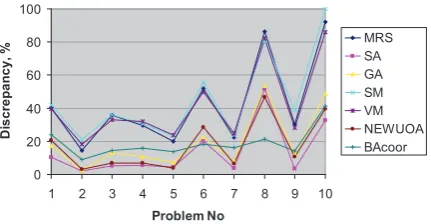
Figure 2. The best values of seven algorithms MRS,SA, GA, SM, VM, NEWUOA, and BAcoor found in 28 runs
normalized to Rideal (deviations in %).
0 20 40 60 80 100
1 2 3 4 5 6 7 8 9 10
Problem No
D
is
cr
epa
nc
y,
% MRSSA
In [1], only for two problems the engineering solution was achieved in 5000 objective function evaluations. However, in six problems the discrepancies between obtained and engineering solutions are 2.2 – 5.5 %.
Figure 2 illustrates the comparison of the new BAcoor algorithm with six well-known methods. The exact global solutions were not found. However, in seven examples, the deviations of obtained results from exact solutions do not exceed 5% and can be regarded as insignificant for engineering purposes. In three examples, the deviations of the best algorithms reach 20-47%. The differences of computing times were about 20-30 %.
Thus, the simulated annealing (SA) and NEWUOA outperform all the other algorithms in orderly problems; genetic algorithm (GA) is not far behind.
In this investigation ten pile placement schemes were optimized using BAcoor. To have a fair comparison of the results, objective functions were evaluated 5000 times, and 28 independent runs of the algorithm were performed. BAcoor has a clear advantage compared, for example, with GA: it has the only parameter H to be adjusted numerically to the particular problem. Thus, for the problems No 2 and 6 it was found that H 107, while for the remaining problems its favorable magnitude is 10-5. All numerical results of 28 independent experiments are rendered in Appendix 2.
Thus, BAcoor is less efficient than SA, GA, and NEWUOA, but outperforms the remaining algorithms. However, in the awkward problems No. 8 and 6, BAcoor achieves better solutions. In the most awkward problem No. 8, it reduces the deviation to 21% (the best deviation 38% of the remaining methods was achieved by NEWUOA). A closer view to the topologies of grillages No. 8 and 6 reveals that there the piles tend to group unevenly under few connecting beams while under some beams there are
Table 1. Summary of numerical results
any supporting piles. Possibly, BAcoor better copes with the problem of physical discontinuity mentioned in Section 3 of the paper. Generally, in 5000 evaluations of the objective function the satisfactory solution is not achieved for all problems; more evaluations or more independent runs of an algorithm from random starting points are needed.
Summing-up of numerical results is given in Table 1 which illustrates the advantages and disadvantages of BAcoor among other explored algorithms. Appendix 3 presents graphical schemes of best pile placement schemes found with BAcoor (piles shown in red) and found in [1] (shown in blue).
5. Conclusions
In some special cases, mainly for awkward schemes where distribution of piles is very uneven BAcoor outperforms all other explored optimization algorithms. Additional advantages of the algorithm are that it converges for any function, provides higher density of observations around the global minimum, and can be adjusted numerically to a problem by controlling the single parameter. However, in orderly pile placement schemes BAcoor yields inferior results as compared with well-known algorithms such as SA, GA, and NEWUOA. Thus, BAcoor can be regarded just as a new useful member in the family of global optimization algorithms.
Appendixes
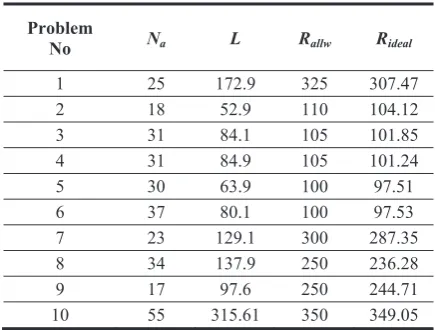
Appendix 1. Characteristics of problems.
Problem
No Na L Rallw Rideal
1 25 172.9 325 307.47
2 18 52.9 110 104.12
3 31 84.1 105 101.85
4 31 84.9 105 101.24
5 30 63.9 100 97.51
6 37 80.1 100 97.53
7 23 129.1 300 287.35
8 34 137.9 250 236.28
9 17 97.6 250 244.71
10 55 315.61 350 349.05
Experiment No
Best value found
Best value found in
[1]
Exact solution
Place of BAcoor among algorithms
1 381.39 339.30 307.47 4
2 113.47 106.36 104.12 4
3 116.43 107.25 101.85 4
4 117.16 106.80 101.24 4
5 110.91 101.05 97.51 4
6 115.45 117.26 97.53 1
7 333.77 298.11 287.35 4
8 286.22 346.94 236.28 1
9 278.86 253.00 244.71 4
Appendix type) Problem Experime 1 2 3 4 5 6 7 8 9 10 11 12 13 14 15 16 17 18 19 20 21 22 23 24 25 26 27 28 Appendi
x 2. Optimizatio
/ ent 1
422.70 422.32 381.39 411.51 419.50 407.47 385.21 400.56 404.12 422.51 431.72 396.67 416.00 393.81 388.31 414.56 423.10 397.76 510.10 441.61 401.82 398.30 398.01 396.72 390.79 406.33 398.35 420.52
ix 3. Best pile
G
on results for al
2 123.61 1 127.64 1 118.58 1 126.89 1 121.59 1 124.19 1 122.56 1 123.45 1 128.72 1 124.55 1 125.16 1 118.55 1 130.47 1 124.77 1 113.47 1 128.69 1 122.23 1 125.79 1 127.75 1 125.65 1 121.69 1 120.43 1 116.11 1 123.88 1 120.11 1 120.66 1 124.23 1 122.32 1 placement sch
Grillage No 1
ll 10 problems
3 4 33.91 124. 36.68 117. 18.47 122. 29.21 117. 24.84 124. 25.42 117. 27.16 119. 16.43 117. 25.83 121. 16.57 126. 21.27 119. 21.20 120. 23.06 125. 25.30 128. 21.12 120. 26.91 119. 32.96 127. 17.31 126. 21.49 123. 17.72 121. 24.77 120. 19.73 125. 23.01 120. 34.05 138. 28.47 119. 19.04 118. 24.96 179. 33.19 118.
hemes found w
in 28 independ
5 .90 118.51 .99 114.60 .26 119.83 .97 124.48 .83 122.89 .27 121.33 .01 122.10 .16 115.78 .94 114.57 .10 115.00 .63 116.25 .63 119.65 .22 114.87 .50 115.37 .59 123.66 .71 112.90 .90 117.11 .44 121.86 .33 113.98 .16 113.64 .37 118.53 .72 118.81 .15 120.08 .72 122.44 .40 122.44 .86 110.91 .64 113.51 .23 115.88
with BAcoor
dent numerical e
6 151.73 137.42 129.77 115.45 146.17 129.75 130.56 126.63 129.70 124.10 132.77 127.03 124.52 126.34 130.90 137.12 128.62 116.41 129.50 143.30 132.34 145.54 130.38 129.42 133.84 137.25 130.21 122.55
(in red color
experiments (th 7 370.92 49 383.00 34 362.67 51 344.09 39 362.18 46 355.68 36 364.51 33 353.76 45 370.59 38 354.68 28 341.41 36 336.15 52 360.39 35 339.22 35 352.88 41 365.99 31 352.85 33 350.32 44 357.69 51 362.40 44 345.41 30 372.29 35 352.97 34 353.85 40 341.34 42 333.77 31 348.91 33 352.10 37
) and found
Grillage
he best are high
8 9 95.55 310.9 43.94 297.1 16.54 316.0 92.20 339.1 64.57 301.7 64.42 304.5 30.03 301.0 50.64 303.9 82.95 317.0 86.22 308.7 62.97 335.9 21.20 307.8 53.70 306.7 59.17 324.9 12.61 308.6 15.30 314.5 36.78 340.0 43.44 291.9 11.52 321.8 43.02 331.8 06.27 326.4 58.19 308.2 44.70 313.1 00.11 310.5 22.53 303.3 16.98 309.5 37.62 278.8 72.81 298.1
d in [1] (in blu
e No 2
hlighted in bold
10 95 652.44 16 523.63 04 548.62 15 660.61 78 531.64 55 530.02 00 523.82 93 564.01 00 634.35 70 522.27 90 634.75 87 655.23 70 493.53 96 556.71 62 525.27 54 513.90 01 659.12 91 616.27 82 586.17 86 644.46 47 625.58 28 546.57 14 601.59 54 578.04 31 542.84 55 516.35 86 613.61 18 544.10
e color{).
Grill
Grill
Grill
lage No 3
lage No 5
lage No 7
Grillage No
Grillage No
Grillage No 4
6
Referen
[1] R. B S. Va grilla algor
2011
[2] R. B grilla
pean Struc Crac
[3] R. B Mult
Engi
http:/ [4] C. M Optim algor
envir
pp. 4 0241 [5] P. Di Deci 1988 4613 [6] D. E Optim Acad [7] K. N M. M minim found (4), 352X G nces
Beleviius, S. Iv alentinaviius. ages: experime rithms. Inform 1, Vol. 40, No. 2
Beleviius, S. V age-type found
n ECCOMAS ctures and Co cow, Poland 26
Beleviius, S. tilevel optimiza
ineering and M
//dx.doi.org/10 M. Chan,
mization of p rithms. Journ ronmental Eng
497-505, http 1(2009)135:4(49
iaconis. Bayesi ision Theory an 8, pp. 163-175 3-8768-8_20.
. Goldberg. G mization and demic Publisher N. Kim, S.-H.
M. Kim, H. S. mizing differe dations. In: Co
pp. 235-253 X(01)00002-7.
Grillage No 9
vanikovas, D. . Optimal place ental comparis
mation Techno 2, 123 - 132.
Valentinaviiu dations. Procee and IACM C oupled Problem -29 June, 2001 . Valentinavii ation of grillag
Management. 2 .1080/1392373
L. M. Zhang, pile groups us
al of Geote gineering. 200
p://dx.doi.org/10 97).
ian numerical a nd Related Top 5, http://dx.do
Genetic Algo d Machine
rs, Boston, MA Lee, K.-S. K Lee. Optimal p ential settleme
mputers and G
, http://dx.doi
Šešok, J. Žilin ement of piles i son of optimiz
ology and Co
us. Optimisatio
edings of 2nd Conference “S ms in Engineer
, 416-421. us, E. Michn ges. Journal of
2002, 8 (2), 98 0.2002.105312 , J. T. M sing hybrid g
chnical and 09, Vol. 135, N
0.1061/(ASCE)
analysis. In Stat ics, Springer V oi.org/10.1007/9
rithms in S Learning, K A, 1989, 432 p.
Kim, C.-K. C pile arrangeme ents in piled
Geotechnics. 200 i.org/10.1016/S nskas, in real zation ontrol. on of Euro-Solids, ring”, nevi. f Civil 8-103, 259. M. Ng. genetic Geo-No. 4, )1090-tistical Verlag, 978-1-earch, Kluwer hung, ent for d raft 01, 28 S0266-[ [9 [ [ [ [ [ [ [ R
8] H. J Kush maximum presence o
86: 97–100 9] N. Metrop M. N. Ros Calculation
Journal of
http://dx.d 10] J. Mockus
Kluwer A Boston, 19 94-009-09 11] J. Mockus
G. Reklait and Globa
shers, ISB ton, 1997, 12] J. A. Neld function m 308-313. 13] M. J. D. P
strained op
G., Roma, tion. Vol. 8 cations, Sp
14] L. C. Rees and Desig
Wiley & So
15] V. R. Šalte optimizatio
Vychislitel
Russian). 16] A. Torn, A
Verlag, Be 540-50871
Received May 2
Grillage N
hner. A new point of an arb of noise. Journa
0, http://dx.doi. polis, A. W. senbluth, E. T
ns by Fast
f Chemical Ph
oi.org/10.1063/ s. Bayesian app
Academic Pub
989, 270 p., h 09-0
s, W. Eddy, tis. Bayesian H al Optimizatio
BN 0-7923-432
416 p. er, R. Mead.( minimization. C
Powell, The NE ptimization with
M. (eds) Larg 83 of Nonconve pringer, 2006,2 se, W. M. Isenh
n of Shallow
ons, 2006, pp. 6 enis. On a on.Automatics lnayya Tekchn
A. Žilinskas.G erlin, 1989, 255
-6.
2012.
No 10
w method of bitrary multi-pe
al of Basic Eng
.org/10.1115/1. Rosenbluth, Teller. Equat
Computing M
Physics. 1953,
/1.1699114. proach to globa
blishers, Dord
http://dx.doi.or
A. Mockus, Heuristic Appro on. Kluwer Ac 27-1, Dordrech
(1965). A simp
Computer Jou
EWUOA softw thout derivative
ge-Scale Nonlin ex Optimization
255-296. hower, S.-T. W and Deep Fou 608.
method of
and Computer nika). 1971, (3
Global optimiza 5, http://dx.doi.
locating the eak curve in the
gineering. 1964,
3653121. A. H. Teller, tion of State Machines. The 21 (6): 1087,
al optimization.
drecht-London-
L. Mockus, ach to Discrete
cademic Publi-
ht-London-Bos-plex method for
rnal. 1965, 7:
ware for uncon-es.In: Di Pillo, near Optimiza-n aOptimiza-nd Its
Appli-Wang. Analysis undations. John
multi-extremal
rs (Avtomatika i 3): 33–38. (in