
The Journal of Threatened Taxa is dedicated to building evidence for conservation globally by publishing peer-reviewed articles online every month at a reasonably rapid rate at www.threatenedtaxa.org. All articles published in JoTT are registered under Creative Commons Attribution 4.0 International License unless otherwise mentioned. JoTT allows unrestricted use of articles in any medium, reproduction, and distribution by providing adequate credit to the authors and the source of publication.
OPEN ACCESS
www.threatenedtaxa.org
ISSN 0974-7907 (Online) | ISSN 0974-7893 (Print) Building evidence for conservation globally
Journal of Threatened Taxa
For Focus, Scope, Aims, Policies and Guidelines visit http://threatenedtaxa.org/index.php/JoTT/about/editorialPolicies#custom-0 For Article Submission Guidelines visit http://threatenedtaxa.org/index.php/JoTT/about/submissions#onlineSubmissions For Policies against Scientific Misconduct visit http://threatenedtaxa.org/index.php/JoTT/about/editorialPolicies#custom-2 For reprints contact <[email protected]>
Short Communications
Status survey and conservation of the House Sparrow
Passer domesticus (Aves: Passeriformes: Passeridae) through
public participation in Kannur, Kerala, India
R. Roshnath, C.P. Arjun, J. Ashli, D. Sethu & P. Gokul
26 July 2018 | Vol. 10 | No. 8 | Pages: 12098–12102 10.11609/jott.3528.10.8.12098-12102
Shor
t C
ommunica
tion
DOI: http://doi.org/10.11609/jott.3528.10.8.12098-12102
Editor: S. Subramanya, University of Agricultural Sciences, Bengaluru, India. Date of publication: 26 July 2018 (online & print) Manuscript details: Ms # 3528 | Received 29 May 2017 | Final received 04 July 2018 | Finally accepted 07 July 2018
Citation: Roshnath, R,. C.P. Arjun, J. Ashli, D. Sethu & P. Gokul (2018). Status survey and conservation of the House Sparrow Passer domesticus (Aves: Passeriformes: Passeridae) through public participation in Kannur, Kerala, India. Journal of Threatened Taxa 10(8): 12098–12102; http://doi.org/10.11609/jott.3528.10.8.12098-12102 Copyright: © Roshnath et al. 2018. Creative Commons Attribution 4.0 International License. JoTT allows unrestricted use of this article in any medium, reproduction and distribution by providing adequate credit to the authors and the source of publication.
Funding: The project was funded under the CSR program of Krishna Mines, Tirunelveli, Tamil Nadu. Competing interests: The authors declare no competing interests.
Acknowledgements: We are grateful to Krishna Mines super white for providing financial support for the “Save Sparrow Project”. We extend our sincere gratitude to D. Jayaprasad IFS (CCF, Northern Circle), P. Biju (ACF, Social Forestry, Kannur Division), C.V. Rajan, (DFO, Kannur) and all other staff of Kerala Forest & Wildlife Department for their support. We are thankful to C. Sashikumar (Ornithologist), Dr. Jafer Palot (Zoological Survey of India), and Praveen J. for the advice given; and special acknowledgment to C. Sunil Kumar (Mathrubhumi) for the press releases. We also show our gratitude to Dr. Aravind (HOD, Zoology Department, S.N. College, Kannur), Satheesh C.P., Sooraj Kodieri, Ranjith Narayanan, Riyas Mangad and Sajith for helping out with the survey.
Status survey and conservation of the House Sparrow
Passer domesticus (Aves: Passeriformes: Passeridae)
through public participation in Kannur, Kerala, India
R. Roshnath 1, C.P. Arjun 2, J. Ashli 3, D. Sethu 4& P. Gokul 5
1 Department of Animal Science, Central University of Kerala, Tejaswini Hills, Periye Post, Kasaragod,
Kerala 671316, India
2 National Institute of Advanced Studies, Indian Institute of Science Campus, Bengaluru, Karnataka 560012, India 2 Indian Institute of Information Technology and Management-Kerala, P.O. Karyavattom, Kazhakoottam,
Technopark Campus, Trivandrum, Kerala 695581, India
1,2,3,4,5 Malabar Awareness and Rescue Center for Wildlife, 3rd Floor, Lakshmi Complex, Opp. Koyili Hospital,
Kannur, Kerala 670004, India
1 [email protected], 2 [email protected] (corresponding author), 3 [email protected], 4 [email protected], 5 [email protected]
ISSN 0974-7907 (Online) ISSN 0974-7893 (Print)
OPEN ACCESS
House Sparrows Passer domesticus (here after sparrows) are one of the most widespread passerine species in the world facing a serious decline in their
Abstract: House Sparrows Passer domesticus are one of the most
widespread passerines in the world. A survey was conducted to find out their status in Kannur District, Kerala. The survey recorded 553 sparrows in 35 sites in the district. The perspectives of the public were recorded through a questionnaire survey and conservational inputs from the public were noted. Most of the respondents (47%) suggested the provision of nest boxes for the enhanced breeding of sparrows. Thus, our NGO along with the support of students, the public and the Kerala Forest Department, placed 100 nest boxes in various identified sparrow dwelling places in the district and it was found effective in the conservation of sparrows.
Keywords: Conservation, environment, House Sparrow, nest box,
threat.
population (Crick et al. 2002; Prowse 2002; Olsen et al. 2003; Robinson et al. 2005; Vincent 2005; Klok et al. 2006; Balmori & Hallberg 2007; Bohner & Witt 2007; De Laet & Summers-Smith 2007; Murgui & Macias 2010; Kekkonen et al. 2011). Similarly, there were reports of a population decline in India (Daniels 2008; Rajashekar & Venkatesha 2008; Bhattacharya et al. 2010; Dandapat et al. 2010; Ghosh et al. 2010; Khera et al. 2010; Dhanya 2011; Sethi & Vashisth 2013).
Journal of Threatened Taxa | www.threatenedtaxa.org | 26 July 2018 | 10(8): 12098–12102
Survey and conservation of House Sparrow Roshnath et al.
12099
as lack of old fashioned buildings and weedy gardens (Monika 2005), changes in agricultural practices, predators (Summers & Smith 2003; Vincent 2005; Shaw et al. 2011), competitions (Vincent 2005; Khera et al. 2010, Mason 2006), disease (Vincent 2005), environmental pollution (Chamberlain et al. 2005; Vincent 2005; Balmori & Hallberg 2007; Dhanya 2011), electromagnetic radiation (Balmori & Hallberg 2007), lack of insect availability, nest sites, substratum, nesting materials, food items and roosting sites (Chamberlain et al. 2005; Vincent 2005; Mason 2006; Bohner & Witt 2007; Klok et al. 2008; Dhanya 2011). Use of unleaded fuel results in methyl nitrite during combustion, which is harmful for soft-bodied insects, as they form the major diet for sparrow chicks. This was also suggested to be a threat for sparrows (Summer-Smith 2007).
Hopping near grocery shops, picking up fallen grains and clearing out insect pests, they were once common sights in our markets and urban areas. The birdwatchers and nature enthusiasts in the district were concerned about the decline in one of the commonest urban birds. Also, no studies in the population of sparrows were conducted in Kannur District. Hence this study was taken up by an NGO, the Malabar Awareness and Rescue Centre for Wildlife-Kannur, aimed at documenting
sparrow populations in the district, the threats faced, the perception of the public towards sparrow conservation and possible conservation action.
Materials and Methods
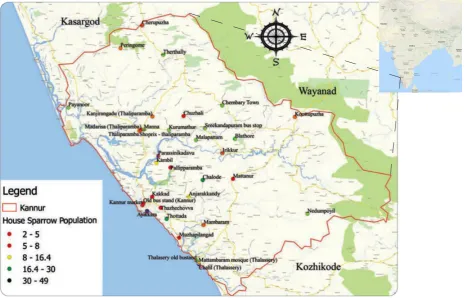
A press release was published in all leading newspapers in the district (with the details of the project and contact numbers of the volunteers) to identify the potential sparrow inhabiting areas in Kannur District (Fig. 1). The areas communicated by the respondents were visited during 08:00–11:00 hr and 15:00–18:00 hr and the numbers of sparrows sighted were recorded using point count method (Bibby et al. 1998) from March to July 2015.
An open-ended type questionnaire survey was done in markets, rural and urban towns in the district, targeting shop keepers, workers, and the local people. All the respondents were between 35–55 years old. The questionnaire survey was conducted in the local language (Malayalam).
Result and Discussion
Status of sparrows in Kannur District
A total of 35 sites were surveyed and 553 sparrows were recorded in Kannur District (Fig. 1). Compared to
urban towns, more number of sparrows were found in smaller towns and in rural areas as reported earlier. Among the 140 individuals interviewed 89% stated to have seen the sparrows earlier (in the past), but only 56% of the people stated to have seen them in the present. This indicated that 33% of the respondents had seen the sparrows earlier but not at present. Hence, this data suggested that there has been a decline in the populations of sparrows in the district.
Perspective of public regarding sparrows
Sparrows are generally believed to be useful to the public (Fig. 2). As major pest control agents, they pick up insects and worms (39%) from food grains; they clean the surroundings by pecking on thrown out food materials (21%) and maintain an ecological balance (15%). Hence, they were believed to play a vital role in maintaining the health of the ecosystem. Twenty percent of the respondents felt that sparrows have an aesthetic value due to their cheerfulness and tweeting sounds to make the surroundings lively, and some respondents (5%) believed that sparrows were a good omen when they nest in their shops. Only faecal droppings and accidental hits on fans were noted as a menace caused by the sparrows. Thus, people had different perspectives on the sparrows, in terms of economic, aesthetic, ecological and belief values.
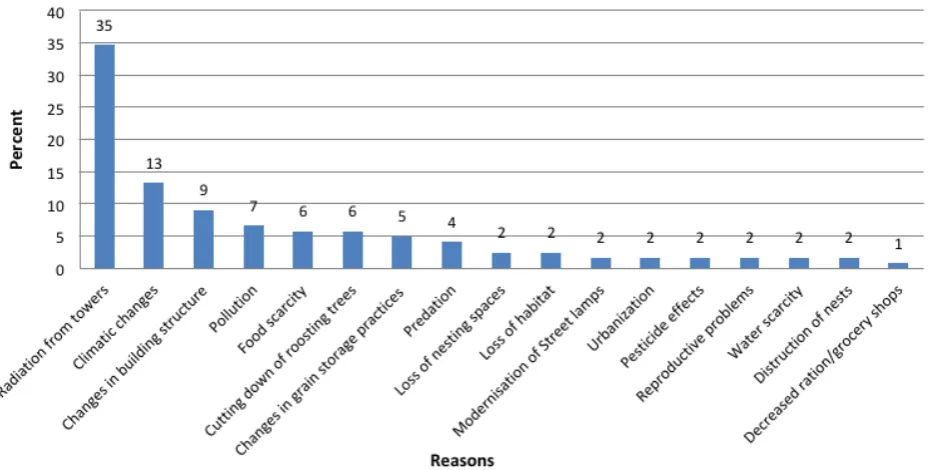
Different reasons were suggested by the public for the declining number of sparrows in the district (Fig. 3). Electromagnetic radiations from the mobile towers
were the most suggested reason (35%), even though no proper scientific validation is available in this context (Balmori & Hallberg 2007). Other important reasons were climatic changes and its associated temperature rise (13%) (Global warming is known to affect physiology in House Sparrows (Yom-Tov, 2001)), modernization of buildings (9%) leading to a lack of nesting spaces. Cutting down of roosting trees and plants (6%) in towns had also caused decline in the population of sparrows, as they are known to roost in small and medium sized trees (Dhanya & Azeez 2010). Natural reasons like predation and reproductive problems might also have affected the population. Changes in grain storage practices like plastic bagging of grains to minimize spilling out and spoilage, use of pesticides and chemicals in grains, pollution, decreased ration/grocery shops (which might have reduced food availability causing a scarcity of food
Figure 2. Percentage composition of suggested usefulness of sparrows
Journal of Threatened Taxa | www.threatenedtaxa.org | 26 July 2018 | 10(8): 12098–12102
Survey and conservation of House Sparrow Roshnath et al.
12101
for the birds), water scarcity, the destruction of nests and the loss of habitat and nesting spaces due to urbanization (Bokotey & Gorban 2005), had decreased the endurance of sparrows in towns. These were the other reasons suggested by the public in the questionnaire survey.
Various conservational plans were suggested by the respondents (Fig. 4) of which the provision of nest boxes (47%) were the most recommended suggestion to enhance sparrow population. Also, spaces for sparrow nesting have been thought of during modernisation of buildings; especially in towns (5%). Planting roosting trees (14%) of small heights of less than 5m are found to support and host good numbers of roosting sparrows (Dhanya & Azeez 2010). Provision for feeders with grains (11%) and water bath (5%) could also help to regain sparrow population. Other suggestions (13%) were to maintain eco-friendly and clean environments by minimizing pollution and by reduced use of pesticides. A section of respondents who believed mobile towers to be the major cause of the decline in the population, had suggested to minimize construction of mobile towers (5%) as well.
Efforts for conservation of sparrows
During the study, students and the public were involved in population assessment of sparrows in the district. Awareness programs were conducted in local colleges and schools to educate students about the importance of sparrows. Mass participation of public was assured by conducting sparrow photography competitions, during which the public had spent time to watch and observe sparrows in the city.
Sparrows are expected to build nests in any available places including nest-boxes (Shaw et al. 2008) and
Figure 4. Percent composition of public suggestions for sparrow conservation in Kannur
studies showed that artificial nest boxes can enhance the population of sparrows in urban and sub-urban areas (Chethan 2012). Hence, with the preliminary knowledge of the status of sparrows in the district and with the suggestion from the public, we decided to create and fix nest boxes for sparrow conservation. A total of 100 wooden nest boxes were fixed in identified sparrow inhabiting sites in the district, which later was found to be effective. Hence with this preliminary study, we were able to map out some of the sparrow population in the district and understand its status and potential threats. Moreover, the project had created a network of students and members of the public who stood for conservation of sparrows in the district. Furthermore, with the continuous support from stake holders, we could create a bigger network of public, students, shopkeepers, vegetable sellers, etc. who can be utilized to monitor the sparrow population. Along with provision of more nest boxes and by planting short roosting trees and maintaining urban gardens, sparrow population in the district could be enhanced.
References
Balmori, A. & O. Hallberg (2007). The urban decline of the House
Sparrow Passer domesticus; a possible link with electromagnetic radiations. Electromagnetic Biology and Medicine 26: 141–151; http://doi.org/10.1080/15368370701410558
Bhattacharya, R., R. Roy, S. Ghosh & A. Dey (2010). “Observations
on House Sparrow at Bandel, Hoogly”, Proceedings of National Seminar on Biodiversity, Water resource and Climate change issues, 10 March 2010, Department of Environmental Science, Kalyani University, 147–152.
Bibby, C., M. Jones & S. Marsden (1998). Expedition field techniques
bird surveys. Publisher Expedition Advisory Centre, Royal Geographic Society.
Bohner, J. & K. Witt. (2007). Distribution, abundance and dynamics
of the House Sparrow Passer domesticus in Berlin. International Studies on Sparrows 32: 15–33.
Bokotey, A.A & M.I. Gorban (2005). Numbers, distribution, and
ecology of the House Sparrow in Lvov (Ukraine). International Studies on Sparrow 30: 7–22.
Chamberlain, D.E., J.A. Vickery, D.E. Glue, R.A. Robinson, G.J. Conway, R.J.W. Woodburn & A.R. Cannon (2005). Annual and seasonal
changes in the use of garden feeders by birds in winter. Ibis 147: 563–575; http://doi.org/10.1111/j.1474-919x.2005.00430.x
Cramp, S., K.E.L. Simmons, D.C. Brooks, N.J. Collar, E. Dunn, R. Gillmor, P.A.D. Hollom, R. Hudson, E.M. Nicholson, M.A. Ogilvie, P.J.S. Olney, C.S. Roselaar, K.H. Voous, D.I.M. Wallace, J. Wattel & M.G. Wilson (1983). Handbook of the Birds of Europe, the Middle
East and North Africa. The Birds of the Western Palearctic. Oxford University Press, Oxford, UK.
Crick, H.Q.P., R.A. Robinson, G.F. Appleton, N.A. Clark & A.D. Rickard (2002). Investigation into the Causes of the Decline of Starlings
and House Sparrows in Great Britain. British Trust for Ornithology, Thetford, vii+307pp.
Dandapat, A., D. Banerjee & D. Chakraborty (2010). The case of the
disappearing House Sparrow. Veterinary World 3(2): 97–100.
Daniels, R.J.R. (2008). “Can we save the sparrow?” Current Science
Dhanya, R. (2011). Status and Ecology of House Sparrow Passer
domesticus along an urban to rural gradient in Coimbatore, India. PhD Dissertation. Bharathiar University 129pp.
Dhanya, R. & P.A. Azeez (2010). The House Sparrow Passer domesticus
population of Arakku township, Andhra Pradesh, India. Indian Birds 5(6): 180–181.
De Laet, J., & J.D. Summers-Smith (2007). The status of the urban
house sparrow Passer domesticus in north-western Europe: a review. Journal of Ornithology 148(2): 275–278; http://doi. org/10.1007/ s10336-007
Ghosh, S., K. Kim & R. Bhattacharya (2010). A survey on house
sparrow population decline at Bandel, West Bengal, India. Journal of Korean Earth Science Society 31(5): 448–453.
Kekkonen, J., P. Seppa, I. K., Hanski, H. Jensen, R.A. Väisänen & J.E. Brommer (2011). Low genetic differentiation in a sedentary bird:
house sparrow population genetics in a contiguous landscape. Heredity 106: 183–190; http://do.org/10.1038/hdy.2010.32
Khera, N., A. Das, Srivasthava & S. Jain (2010). Habitat- wise
distribution of the House Sparrow Passer domesticus in Delhi, India. Urban Ecosystem 13(1): 147–154; http://doi.org/10.1007/s11252-009-0109-8
Klok, C., R. Holtkamp, R.V. Apeldoorn, M.E. Visser & L. Hemerik (2006). Analysing population numbers of the House Sparrow in the
Netherland with a matrix model and suggestions for conservation measures. Acta Biotheoretica 54: 161–178; http://doi.org/10.1007/ s10441-006-7871-2
Mason, C.F. (2006). Avian species richness and numbers in the built
environment: can new housing developments be good for birds? Human Exploration and Biodiversity Conservation 15:2365– 2378; http://doi.org/10.1007/978-1-4020-5283-5
Monika, G. (2005). Preliminary Survey of House Sparrow (Passer
domesticus) in three Different Areas of Haridwar, Uttaranchal. MSc. Dissertation Gurukul Kangri University, Haridwar.
Murgui, E. & A. Macias (2010). Changes in the house sparrow Passer
domesticus population in Valencia (Spain) from 1998 to 2008. Bird Study 57: 281–288; http://doi.org/full/10.1080/000636510037167 62
Olsen, P., M. Weston, R. Cunningham & A. Silcocks (eds.) (2003).
The State of Australia’s Birds 2003. Supplement to Wingspan 13(4): 1–12.
Pineda, J., A. Herrera, M.T. Antonio & J. Aguirre (2013). Urban
models and their effects on immune system of house sparrow Passer domesticus populations in Central Spain. EOU2013UK - 9th Conference of the European Ornithologists’ Union.
Prowse, A. (2002). The urban decline of House Sparrow. British Birds
95: 143–146; http://doi.org/10.1080/15368370701410558
Rajashekar, S. & M.G. Venkatesha (2008). “Occurrence of house
sparrow, Passer domesticus indicus in and around Bangalore”. Current Science 94(4): 446–449.
Rao, R. (2000). A Field Study of The House Sparrow (Passer domesticus)
http://www.indianwildlifeclub.com/ResearchPapers/Field-Study-of-House Sparrow.aspx
Robinson, R.A., G.M. Siriwardena & H.Q.P. Crick (2005). Size and
trends of the House Sparrow Passer domesticus population in Great Britain. Ibis 147: 552–562; http://doi.org/10.1111/j.1474-919x.2005.00427.x
Shaw, L.M., D. Chamberlain & M. Evans (2008). The House Sparrow
Passer domesticus in urban areas: reviewing a possible link between post- decline distribution and human socioeconomic status. Journal of Ornithology 149: 293–299; http://doi.org/10.1007/s10336-008-0285-y
Shaw, L.M., D. Chamberlain & M. Evans (2008). The House Sparrow
Passer domesticus in urban areas: reviewing a possible link between post-decline distribution and human socioeconomic status. Journal of Ornithology 149(3): 293–299.
Summers-Smith, J.D. (2007). Is unleaded petrol a factor in urban
House Sparrow decline? British Birds 100(9): 558–559.
Vincent, K. (2005). Investigating the causes of the decline of the
urban House Sparrow Passer domesticus in Britain. PhD Thesis, De Montfort University, Leicester.
Yom-Tov, Y. (2001). Global warming and body mass decline in
Israeli passerine birds. Proceedings of the Royal Society B: Biological Sciences 268(1470): 947–952; http://doi.org/10.1098/ rspb.2001.1592
ISSN 0974-7907 (Online); ISSN 0974-7893 (Print)
July 2018 | Vol. 10 | No. 8 | Pages: 11999–12146 Date of Publication: 26 July 2018 (Online & Print)
DOI: 10.11609/jott.2018.10.8.11999-12146
www.threatenedtaxa.org
peer-reviewed articles online every month at a reasonably rapid rate at www.threatenedtaxa.org. All articles published in JoTT are registered under Creative Commons Attribution 4.0 International License
unless otherwise mentioned. JoTT allows unrestricted use of articles in any medium, reproduction, and distribution by providing adequate credit to the authors and the source of publication.
Communications
Habitat suitability and threat analysis of Greater One-horned Rhinoceros
Rhinoceros unicornis Linnaeus, 1758 (Mammalia: Perissodactyla:
Rhinocerotidae) in Rautahat District, Nepal
-- Saru Rimal, Hari Adhikari & Shankar Tripathi, Pp. 11999–12007
Camera-trapping survey to assess diversity, distribution and photographic capture rate of terrestrial mammals in the aftermath of the ethnopolitical conflict in Manas National Park, Assam, India
-- Dipankar Lahkar, M. Firoz Ahmed, Ramie H. Begum, Sunit Kumar Das, Bibhuti Prasad Lahkar, Hiranya K. Sarma & Abishek Harihar, Pp. 12008–12017
In plain sight: Bacular and noseleaf morphology supports distinct specific status of Roundleaf Bats Hipposiderospomona Andersen, 1918 and Hipposiderosgentilis Andersen, 1918 (Chiroptera: Hipposideridae) -- Bhargavi Srinivasulu & Chelmala Srinivasulu, Pp. 12018–12026
The amphibian diversity of selected agroecosystems in the southern Western Ghats, India
-- M.S. Syamili & P.O. Nameer, Pp. 12027–12034
Taxonomic status and additional description of White’s Stalked-eyed Fly
Cyrtodiopsis whitei (Curran, 1936) (Diptera: Diopsidae) from India with a key
to the allied species and note on its habitat
-- Basant Kumar Agarwala, Pp. 12035–12043
Community structure of benthic macroinvertebrate fauna of river Ichamati, India
-- Arnab Basu, Indrani Sarkar, Siddartha Datta & Sheela Roy, Pp. 12044–12055
Conservation status of Mascarene Amaranth Aerva congesta Balf.F. Ex Baker (Eudicots: Caryophyllales: Amaranthaceae): a Critically Endangered endemic herb of the Mascarenes, Indian Ocean
-- Kersley Bruno Pynee, David Harold Lorence & Poojanraj Khurun, Pp. 12056– 12063
Vegetative and reproductive phenology of Aquilaria malaccensis Lam. (Agarwood) in Cachar District, Assam, India
-- Birkhungur Borogayary, Ashesh Kumar Das & Arun Jyoti Nath, Pp. 12064– 12072
Conservation Application
Taking the first steps: Initial mapping of the human-wildlife interaction of the Mauritius Fruit Bat Pteropus niger (Mammalia: Chiroptera: Pteropodidae) in Mauritius by conservation organizations
-- Brandon P. Anthony, Vikash Tatayah & Deborah de Chazal, Pp. 12073–12081
Peer Commentary
The term human-wildlife conflict creates more problems than it resolves: better labels should be considered
-- Priya Davidar, Pp. 12082–12085
Short Communications
First photographic evidence of Snow Leopard Panthera uncia (Mammalia: Carnivora: Felidae) outside current protected areas network in Nepal Himalaya
-- Rinzin Phunjok Lama, Tashi R. Ghale, Madan K. Suwal, Rishi Ranabhat & Ganga Ram Regmi, Pp. 12086–12090
Small carnivores of Silent Valley National Park, Kerala, India
-- Devika Sanghamithra & P.O. Nameer, Pp. 12091–12097
Status survey and conservation of the House Sparrow Passer domesticus (Aves: Passeriformes: Passeridae) through public participation in Kannur, Kerala, India
-- R. Roshnath, C.P. Arjun, J. Ashli, D. Sethu & P. Gokul, Pp. 12098–12102
The ecology and distribution of percoid fish Dario neela from Wayanad in the Western Ghats of Kerala, India
-- Dencin Rons Thampy & C.P. Shaji, Pp. 12103–12107
A checklist of the ornamental fishes of Himachal Pradesh, the western Himalaya, India
-- Indu Sharma & Rani Dhanze, Pp. 12108–12116
Odonate diversity of Nalsarovar Bird Sanctuary - a Ramsar site in Gujarat, India
-- Darshana M. Rathod & B.M. Parasharya, Pp. 12117–12122
Root holoparasite Balanophora polyandra Griff. (Balanophoraceae) in eastern Himalaya (Sikkim, India): distribution, range, status and threats
-- Prem K. Chhetri, Alexander R. O’Neill & Bijoy Chhetri, Pp. 12123–12129
Notes
Transfer of Storena gujaratensis Tikader & Patel, 1975 to the genus
Suffasia Jocqué, 1991 (Araneae: Zodariidae)
-- Reshma Solanki, Manju Siliwal & Dolly Kumar, Pp. 12130–12132
Intraguild predation of green lacewing larvae (Neuroptera: Chrysopidae) on spider eggs and spiderlings
-- K.K. Srikumar, S. Smitha, B. Suresh Kumar & B. Radhakrishnan, Pp. 12133– 12136
Rediscovery, extended distribution and conservation assessment of
Cinnamomum goaense (Lauraceae) in the Western Ghats, India
-- M.P. Geethakumary, S. Deepu & A.G. Pandurangan, Pp. 12137–12139
Coltriciella dependens (Berk. & M.A. Curtis) Murrill, a new addition to
wood-rotting fungi of India
-- Ayangla S. Pongen, Kuno Chuzho, N.S.K. Harsh, M.S. Dkhar & Manoj Kumar, Pp. 12140–12143
Book Review
The need of conservation laws coherent with communities for complete success
-- S. Suresh Ramanan & Lalit Upadhyay, Pp. 12144–12145
Miscellaneous

![μ Aqua κ2O:O di μ phenylacetato κ4O:O′ bis[(1,10 phenanthroline κ2N,N′)(phenylacetato κO)cobalt(II)]](data:image/gif;base64,R0lGODlhAQABAIAAAP///wAAACH5BAEAAAAALAAAAAABAAEAAAICRAEAOw==)