Malaya Journal of Biosciences 2014, 1(1):24–30 ISSN 2348-6236 print /2348-3075 online
Production of polyhydroxyalkanoates using Bacillus subtilis 24 Copyright © 2013 MJB
RESEARCH ARTICLE
Open Access Full Text Article
Utilization of sugarcane molasses for the production of
polyhydroxyalkanoates using
Bacillus subtilis
Anjali Mohan Nair
1, Kanakalakshmi Annamalai
1, Seralathan Kamala Kannan
2and
Shanthi Kuppusamy
1*
1Department of Environmental Science, PSG College of Arts and Science, Coimbatore 641014, Tamil Nadu, India 2Division of Biotechnology, Advanced Institute of Environment and Bioscience, College of Environmental and
Bioresource Sciences, Chonbuk National University, Ik san-570752, South Korea. *For correspondence e-mail:[email protected]
Article Info: Received 18 Nov 2013; Revised: 28 Nov 2013; Accepted 09 Dec 2013
ABSTRACT
Batch cultures of Bacillus subtilis AMN1 was screened for the production of polyhydroxyalkanoate (PHA) using sucrose as a carbon source. In subsequent experiments, sugarcane molasses was used as renewable carbon source since it was rich in sucrose (50%), leading to develop a low cost process of PHA production. The maximum PHA production (2.09 g/100 mL) and dry cell weight (DCW) production (1.5g/100 mL) was
observed in the medium amended with 10% sugarcane molasses. The influence of pH on PHA production
was also evaluated. It was found that pH 7.0 yielded a maximum DCW of 1.89 g/100 mL and PHA of 1.39 g/100 mL. The UV spectral analysis of PHA showed the presence of ester group (CH3-COO) by recording a sharp
peak between 230240 nm. The Fourier transform infrared spectrum of the synthesized PHA showed a
transmission band at wave number 1726 cm-1 which is a characteristic of C=O stretching of carbonyl group of the polymer. The major compounds of PHA was detected and identified as aliphatic polymer esters using Gas chromatography mass spectrometry. The prominent peaks of proton and carbon Nuclear magnetic resonance spectra of the polymer depicted that it can be hydroxyl hexanoate.
Keywords: Bacillus subtilis, biopolymer, fermentation, PHA, sugarcane molasses.
1.
INTRODUCTION
The accumulation of petrochemical plastic wastes in the environment is a major problem as it takes several decades to decompose and also produces harmful toxins while degradation. In order to find alternative materials, researchers have identified fully biodegradable plastics, such as polyhydroxyalkanoate (PHA) from biotic communities. It has been established that material properties of PHA are similar to polypropylene [1]. The structure of PHA composed of 3-hydroxy fatty acids as shown in Figure.1. The value of n in the figure depends on the
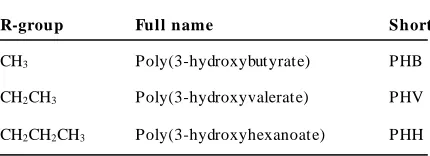
pendant group and the organisms in which the polymer is produced. The most common chemical structure of PHA is given in Table.1. Due to the similarity of chemical and physical properties with the conventional plastics, and full biodegradability, PHA constitutes one of the best alternatives for synthetic polymers replacement [2].
PHA is synthesized by both prokaryotic and eukaryotic organisms [3]. Plants and bacteria are mainly used for the large-scale production of PHA. However, plant cells can only cope <10% (w/w) of dry weight because >10% of dry weight retard
Malaya
Journal of
Biosciences
Anjali Mohan Nair et al., / Malaya Journal of Biosciences 2014, 1(1):2 4–30
Production of polyhydroxyalkanoates using Bacillus subtilis
25 growth and development rate of plants [4]. In
contrast, bacteria can accumulate PHA at levels as high as 90% (w/w) of the dry cell mass [5]. PHA accumulation in bacteria is a natural way to store carbon and energy, when nutrient levels are imbalanced or an excess amount of a nutrients are present in the environment [6]. The PHA is insoluble in water and thus the polymers are accumulated as intracellular granules inside the bacterial cells. It is beneficial for bacteria to store excess nutrients inside the cytoplasm, especially as bacteria physiological fitness is not affected [4].
Figure 1. Structure of P olyhydroxyalkanoate (PHA)
Table 1. Chemical structure of PHA
PHA has been commercially produced by fermentation process using several bacterial species such as Escherichia coli, Bacillus sp., Alcaligenes latus, and Ralstonia eutropha [7-9]. Although high yield (>75%) content was obtained in fermentation process, the production costs of PHA is still high when compared to synthetic polymers production. The best way to reduce the production costs is the utilization of low cost raw materials, such as industrial wastes, agriculture wastes and by-products as carbon source. Several low cost raw materials such as milk whey, starchy wastewater, agro-industrial oil waste, etc have been used as a carbon source for the production of PHA by fermentation techniques [10-12]. However, limited studies have been focused on the application of sugarcane molasses for PHA production using Bacillussubtilis. Thus, the objective of the present study was to (i) assess the potential of sugarcane molasses for PHA production using
Bacillus subtilis AMN1, (ii) characterization of synthesized PHA, and (iii) assess the experimental variables affecting PHA production.
2.
MATERIALS AND METHODS
2.1. Bacterial strain
The Bacillus subtilis AMN1 was collected from the Department of Environmental Science, PSG College of Arts and Science, Coimbatore, India. The culture was maintained in Luria Bertani (LB) agar (Hi media, India) slants at 4°C.
2.2. Screening for PHA production
The B. subtilis AMN1 was cultured in LB broth (50 mL) supplement with 0.5% (w/v) sucrose as carbon source. The flasks were incubated at 30°C for 48 h on an orbital shaker at 150 rpm. After incubation, the cells were stained with Sudan Black B according to Wei et al. (13). Briefly, a thin smear was made on a clean glass slide and heat fixed. This slide was initially flooded with 0.3% (w/v) Sudan Black B (in ethylene glycol) for 15-20 minutes, immersed in xylene, and blot dried with absorbent paper. Later, the smear was counter-stained with safranin (0.5% w/v) for 10 sec, rinsed with tap water, blot dried, and examined under a microscope.
2.3. Extraction and quantitative assay of PHA
PHA was extracted from B. subtilis AMN1 by hypochlorite method according to Slepecky and Law [14]. Briefly, the cells were separated by centrifugation at 6000 rpm for 5 min. The cell pellet was re-suspended in a volume of sodium hypochlorite equal to the original volume of medium. After 1 h incubation at 37°C, the lipid granules (PHA) were centrifuged and washed with water, acetone and ethanol. The polymer was dissolved by extraction with three small portions of boiling chloroform and the filtrate was used. The excess of chloroform was evaporated, and 10 mL of concentrated H2SO4 was added and heated in a water
bath (10 min at 100°C) to convert PHA into crotonic acid. PHA was determined as crotonic acid and quantified by spectrophotometry at 235 nm.
The LB broth was also used to calculate residual cell mass (RCM), dry cell weight (DCW) and PHA content. The cell pellet was dried to estimate the DCW in units of g/L. RCM was estimated by evaluating the difference between DCW and dry weight of extracted PHA. The RCM was calculated to determine the cellular weight and accumulation other than PHA. The percentage of intracellular PHA accumulation is estimated as the percentage composition of PHA present in the dry cell weight as follows:
R-group Full name Short
CH3 Poly(3-hydroxybutyrate) PHB
CH2CH3 Poly(3-hydroxyvalerate) PHV
Anjali Mohan Nair et al., / Malaya Journal of Biosciences 2014, 1(1):2 4–30
Production of polyhydroxyalkanoates using Bacillus subtilis
26 Residual cell mass (g/L) = DCW (g/L) – Dry weight
of extracted PHA (g/L) PHA accumulation (%) = [Dry weight of extracted PHA (g/L) × 100%] / DCW (g/L)
2.4. Carbon substrate and shake-flask fermentation
Sugarcane molasses were procured from the sugar industry and pre-treated to remove colorants. The mid-log phase culture (108 cells/mL) of the isolate
was aseptically inoculated in sugarcane molasses medium and flasks were incubated in a shaking incubator (150 rpm) at 30°C for 48 h. The PHA production was analyzed by monitoring the optimization parameters. Experimental variables considered were pH (3-11) and (ii) dosage of molasses (10-100%). The optimized condition of 10% molasses and pH 7.0 was used for mass production of PHA.
2.5. Characterization of PHA
The initial cell disruption was quantified with UV spectroscopy (14). The polyesters content of the cell and the composition of polyesters were determined by using Gas chromatography-mass spectrometry (GC/MS) analysis [15]. The Fourier transform infrared (FTIR) spectra was recorded on polymer films cast from chloroform solution on a spectrometer (Shimadzu, Model 8400S) in a diffuse reflectance mode at a resolution of 4 cm-1 in KBr pellets [9]. The structure and mole fractions of hydroxy alkanoates were investigated in 100MHz 1H nuclear magnetic resonance spectroscopy (NMR) (JEOL Ltd, Tokyo, Japan- spectrometer) and 13C
NMR spectra at 27°C on a CDCl3 solution of
polyester.
3.
RESULTS
3.1. Sudan Black B staining, PHA extraction and quantification
The PHA granules (dark colored) were observed inside the B. subtilis AMN1 and it indicates that bacteria were capable of PHA production. The bacterial DCW of 2.96 g/100mL produced a maximum biopolymer of 1.5 g/100mL at neutral pH range (7.0), with 0.5% sucrose as carbon source and 0.04% ammonium sulphate as nitrogen source.
3.2. Effect of molasses concentration and pH on DCW and PHA production
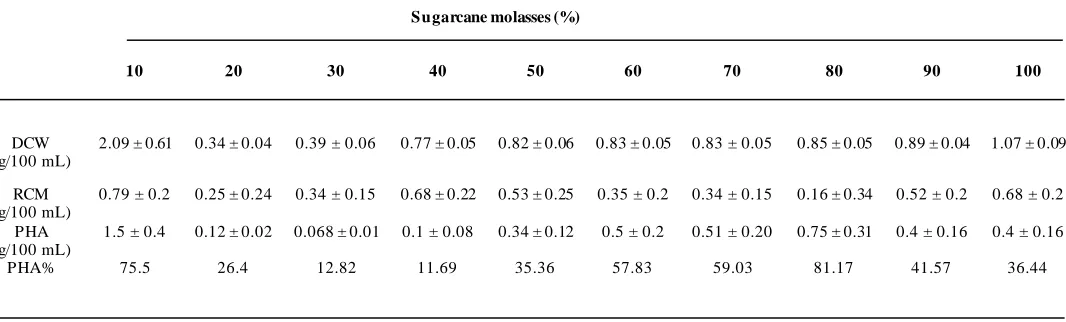
The effect substrate concentration on PHA production is shown in Table.2. It is evident from
results that maximum DCW and PHA production were observed only when 10% of molasses was amended in the medium. The DCW was 2.09 g/100 mL and PHA concentration was 1.5 g/100 ml. The percentage of PHA produced by using 10% sugarcane molasses was 75.5%. Similarly the effect of medium (molasses amended) pH on DCW and PHA production was recorded and the PHA production was observed according to increasing concentration of sugarcane molasses. The changes in pH from optimum value of 7.0 also showed a decrease in the production of PHA (Table.3).
3.2. Characterization of PHA
PHA granules extracted with the boiling chloroform method were dissolved in concentrated sulfuric acid and UV spectrum was recorded between 200 and 800 nm (Figure.2). The presence of PHA was confirmed by the presence of a peak obtained between 230 - 240 nm, which indicated the presence of ester group. The FTIR spectrum of the polymer sample was evaluated and the results are shown in Figure.3. The intense band at 1726.13 cm-1
represented the presence of aliphatic carbonyl (C=O) group of R-CO-A in PHA polymer and the band at about 1058.12 cm-1 characterizes the valence
vibration of the carboxylic group (COOH) [16]. The peak at 1177.12 cm-1 confirmed the carbonyl group
(C-O) stretching of the esters present in PHA [17]. Apart from these, the polymer also showed a sharp peak at 1400.49 cm-1 corresponding to alkanes (CH2)
groups and the band at 1636.8cm-1 is the
characteristic feature of the (C=O) of amide group, which absorbs even at lower frequency [18].
The structure and mole fractions of methanolysis product of polymer sample were analyzed using GC/MS and results are shown in Figure 4 and 5. By investigating the potential fragmentation patterns and the molecular mass of the fragments, the identities of specific peaks in mass spectra were correlated to that of carbonyl and hydroxyl ends of the corresponding alkanoates. In GC (Figure.4), the methyl ester derivative of PHA showed three characteristic peaks with retention time of 5.28, 7.616, and 9.873 min respectively. The results indicate that the compound is a hetero polymer of PHA. The peak obtained in mass spectrum at m/z 133 corresponds to that of polyhydroxyl hexanoate, and the peak at m/z 119 and 103 were rationalized to that of polyhydroxyl valarate and butyrate, respectively (Figure.5).
Malaya Journal of Biosciences 2014, 1(1):24–30 ISSN 2348-6236 print /2348-3075 online
Production of polyhydroxyalkanoates using Bacillus subtilis 27 Copyright © 2013 MJB
Table 2. Effect of molasses concentration on Dry cell weight (DCW), Residual cell m ass (RCM) and polyhydroxyalkanoate (PHA) production
Values shown are means (± SD).Data presented are representative of those obtained in independent experiments done in triplicates
Table 3. Effect of pH on Dry cell weight (DCW), Residual cell mass (RCM) and polyhydroxyalkanoate (PHA) production in a medium amended with sugarcane molasses (10%) as carbon source.
pH
3 5 7 9 11
DCW (g/100 mL) 0.42 ± 0.2 0.25 ± 0.05 1.89 ± 0.66 0.5 ± 0.56 0.15 ± 0.05
PHA (g/100 mL) 0.06 ± 0.01 0.07 ± 0.01 1.49 ± 0.08 0.08 ± 0.16 0.03 ± 0.16
RCM (g/100 mL) 0.41 ± 0.3 0.17 ± 0.18 1.39 ± 1.19 0.44 ± 0.22 0.13 ± 0.16
PHA % 2.38 32 83.59 12 13.33
Values shown are means (± SD).Data presented are representative of those obtained in independent experiments done in triplicates
Figure 2. UV visible spectrum of PHA produced from B. subtilis AMN1. T he peak at 230-240 nm confirms the presence of ester group in the polymer
Figure 3. FT IR spectra of PHA produced from B. subtilis AMN1 indicates the presence of several functional groups in the polymer.
Sugarcane molasses (%)
10 20 30 40 50 60 70 80 90 100
DCW (g/100 mL)
2.09 ± 0.61 0.34 ± 0.04 0.39 ± 0.06 0.77 ± 0.05 0.82 ± 0.06 0.83 ± 0.05 0.83 ± 0.05 0.85 ± 0.05 0.89 ± 0.04 1.07 ± 0.09
RCM (g/100 mL)
0.79 ± 0.2 0.25 ± 0.24 0.34 ± 0.15 0.68 ± 0.22 0.53 ± 0.25 0.35 ± 0.2 0.34 ± 0.15 0.16 ± 0.34 0.52 ± 0.2 0.68 ± 0.2
PHA (g/100 mL)
1.5 ± 0.4 0.12 ± 0.02 0.068 ± 0.01 0.1 ± 0.08 0.34 ± 0.12 0.5 ± 0.2 0.51 ± 0.20 0.75 ± 0.31 0.4 ± 0.16 0.4 ± 0.16
Malaya Journal of Biosciences 2014, 1(1):24–30 ISSN 2348-6236 print /2348-3075 online
Production of polyhydroxyalkanoates using Bacillus subtilis 28 Copyright © 2013 MJB
Figure 4. Gas chromatograph of PHA isolated from B. subtilis AMN1 shown the presence of methyl esters derivatives in the polymer.
Figure 5. Mass Spectrum of PHA produced from B. subtilis AMN1. T he peaks correspond to poly hydroxyl hexanoate, poly hydroxyl valarate and poly hydroxyl butyrate.
Figure 6. Carbon NMR (C13 NMR) spectra of PHA produced from B. subtilis AMN1. T he peaks indicate the presence of methyl, methylene, and carbonyl groups in the polymer.
183.43 ppm due to the presence of (CH3) methyl
group, (CH2) methylene group, and (CO) carbonyl
group, respectively. The results suggested that polymer could be an impure of polyhydroxy hexanoate. The H1 NMR scans were studied in the ∂
range of 0-14 ppm and the results are shown in Figure.7. On the ∂ scale of H1 NMR, simple
hydrocarbons protons tend to absorb in the region 0.53-1.5 ppm. This could be due to methyne group. The singlet for O-CH3 group is barely visible. The
sharp singlet at 1.5 ppm corresponds to that of methylene group (CH2) and the signal at 3.76 ppm
corresponds to CH3 methyl group.
Figure 7. H1 NMR spectra of PHA produced from B. subtilis
4.
DISCUSSION
PHA are synthesized and intracellularly accumulated as granules in many bacteria. Results of Sudan Black B staining revealed that isolate B. subtilis AMN1 were capable of producing PHA polymer. The results are consistent with previous studies reporting PHA production [9, 19]. To further validate the PHA production, chloroform extracted PHA was subjected to UV spectra analysis. The prominent peak for ester group in UV spectra confirmed the presence of PHA [20]. FTIR analysis permits spectrophotometric observation of PHA in the range of 450-4000 cm-1
Anjali Mohan Nair et al., / Malaya Journal of Biosciences 2014, 1(1):2 4–30
Production of polyhydroxyalkanoates using Bacillus subtilis
29 that of carbonyl and hydroxyl ends of the
corresponding alkanoates as described by Matias et al. [21]. The peaks of NMR were consistent with poly-3-alkanoates produced by Cupriavidus necator
[4].
Numerous studies reported that growth conditions highly influence the PHA production [22]. The growth conditions for PHA production in B. subtilis
AMN1 were similar to several bacilli that can synthesize and accumulate PHA as carbon and energy storage materials under limitation in nitrogen source [9]. The results of the optimization studies indicate that 10% molasses concentration and pH 7 was the optimum conditions for PHA production. Although, poor medium content and low cost substrate (sugarcane molasses) used in the study, the yield (83.59%) of PHA was superior to those in the previous published works. Bacillus megaterium
produced 29.7% of polyhydroxyalkonates in cassava starch amended medium [23]. The recombinant
Bacillus subtilis cultivated in hydrolyzed malt waste produced 15.3% (w/w dry cell) of polymers [24]. Several reasons may explain the high yield (83.59%) of PHA as compared with other studies; the constituents in sugarcane molasses may increase the synthesis rate of polymers. Alternatively, the environmental conditions and growth rate of the bacteria may increase the PHA yield. The high yield of PHA indicated the potential of the isolate and sugarcane molasses for mass production of PHA polymer.
5.
CONCLUSION
The results of this study indicate that B. subtilis
AMN1 strain cabable of producing known PHA using sugarcane molases with reasonable yeild. The use of sugarcane molasses can substantially reduce the substrate cost and in turn even provide value to the wastes generated by these industries, and can downsize the production costs. Moreover, the fermentation conditions reported in this study prevent the degredation of the PHA and pave a way for the use of B. subtilis AMN1 in commercial PHA production.
Conflict of Interest
The authors declare that they have no conflicts of interest.
Acknowledgement
The authors are grateful to Dr. S. Pattabhi, Professor and Head, Department of Environmental Science, P.S.G. Arts and Science College, for providing
laboratory facilities towards successful completion of this work.
References
1. Akaraonye E, Keshavarz T, Roy I (2010). Production of polyhydroxyalkanoates: the future green materials of choice. Journal of Chemical Technology and Biotechnology; 85:732-743.
2. Steinbuchel A, Valentin HE (1995). Diversity of bacterial polyhydroxyalkanoic acids.FEMS Microbiology Letters; 128:219-228.
3. Poirier, Y (2002). Polyhydroxyalkonate synthesis in plants as a tool for biotechnology and basic studies of lipid metabolism Progress in Lipid Research; 41(2):131-155.
4. Verlinden RA, Hill DJ, Kenward MA, Williams CD, Radecka I (2007). Bacterial synthesis of biodegradable polyhydroxyalkanoates. Journal of Applied Microbiology; 102:1437-1449.
5. Steinbuchel A, Lutke-Eversloh T (2003). Metabolic engineering and pathway construction for biotechnological production of relavant polyhydroxyalkanoates in microorganisms. Biochemical engineering journal; 16(2): 81-96.
6. Shang L, Jiang M, Chang HN (2003). Screening and evaluation of PHB producing strains from indigenous isolate.
Biotechnology Letter; 25:1415-1419.
7. Wang F, Lee SY (1997). Cloning of
Alcaligenes latus in PHA biosynthesis genes and the use of genes for enhanced PHA production. Applied and Environmental Microbiology; 63:3703-3706.
8. Lee KM, Gilmore DF (2005). Biodegradable Polymers in Clinical Use and Clinical Development. Process Biochemistry; 40:229-246.
9. Valappil SP, Peiris D, Langley GJ, Herniman JM, Boccaccini AR, Bucke C, Roy I (2007). Polyhydroxyalkanoate (PHA) biosynthesis from structurally unrelated carbon sources by a newly characterized Bacillus spp. Journal of Biotechnology; 127:475-487. 10. Thomas S, Visakh P M, Mathew AP (Eds.)
(2013). Advances in natural polymers: composites and Nanocomposites (Vol.18). Springer.
Anjali Mohan Nair et al., / Malaya Journal of Biosciences 2014, 1(1):2 4–30
Production of polyhydroxyalkanoates using Bacillus subtilis
30 substrates for PHA production by the new
strain Pseudomonas aeruginosa NCIB 40045: Effect of cultute conditions.
Biochemical engineering journal; 26(2): 159-167.
12. Bosco F, Chiampo F (2010). Production of polyhydroxyalcanotes (PHAs) using milk whey and dairy wastewater activated sludge: production of bioplastics using dairy residues. Journal of Bioscience and Bioengineering; 109(4):418-421.
13. Wei YH, Chen WC, Huang CK, Wu HS, Sun YM, Lo CW, Janarthanan OM (2011). Biodegradable and Biocompatible Biomaterial, PHA produced by indigenous vibrio sp. BM-1 isolated from marine environment. Marine drugs; 9(4):615-524. 14. Slepecky RA, Law JH (1960). A rapid
spectrophotometric assay of alpha, beta-unsturated acids and beta-hydroxy acids.
Analytical chemistry; 32(12): 1697-1699. 15. He W, Tian W, Zhang G, Chen GQ, Zhang Z
(1998). Production of novel polyhydroxyal- kanotes by Pseudomonas stutzeri 1317 from glucose and soyabean oil. FEMS Microbiology Letters; 169(1):45-49.
16. Nichols PD, Henson JM, Guckert JB, Nivens DE, White DC (1985). Fourier transform-infrared spectroscopic methods for microbial ecology: analysis of bacteria, bacteria-polymer mixtures and biofilms.
Journal of Microbiological Methods; 4:79-94.
17. Pachekoski WM, Dalmolin C, Agnelli JAM (2013). The influence of the industrial processing on the degradation of poly (hidroxybutyrate) PHB. Materials Research; 16 (2): 237-332.
18. Aarthi N, Ramana KV (2011). Exploration of polyhydroxyalkanoates production from rhizosphere soil bacteria. International Journal of Environmental Sciences; 1:744-756.
19. Van Hee P, Elumbaring AC, van der Lans RG, Van der Wielen LA (2006). Large-Scale Production of Poly (3-Hydroxyoctanoic Acid) by Pseudomonas putida GPo1 and a Simplified Downstream Process. Journal of Colloid and Interface Science; 297:595-606. 20. Santhanam A, Sasidharan S (2010).
Development of Bio-PORec system for polyhydroxyalkanoates (PHA) production and its storage in mixed cultures of palm oil mill effluent (POME). African Journal of Biotechnology; 9:3144-3150.
21. Matias F, Rodrigues MFA (2011). New PHA products using unrelated carbon sources.
Brazilian Journal of Microbiology; 42:1354-1363.
22. Yang YH, Brigham CJ, Budde CF, Boccazzi P, Willis LB, Hassan MA, Yusof ZA, Rha C, Sinskey AJ (2010). Optimization of growth media components for polyhydroxyalkanoa- te (PHA) production from organic acids by
Ralstonia eutropha. Applied Microbiology and Biotechnology; 87:2037-2045.
23. Krueger CL, Radetski CM, Bendia AG, Oliveira IM, Castro-Silva MA, Rambo CR, Antonio RV, Lima AOS (2012). Bioconversion of cassava starch by-product into Bacillus and related bacteria polyhydroxyalkanoates. Electronic Journal of Biotechnology; 15:1-13.
24. Law KH, Cheng YC, Leung YC, Lo WH, Chua H, Yu HF (2003). Bacillus subtilis as a potential producer of PHA. Biochemical