64
Glucagon-like Peptide 1 and Evidence Around
Diabetes Specific Nutrition
by Anshu Joshi, Sameer Rao, Ganesh Kadhe
Corresponding Author: Anshu Joshi, Abbott Healthcare Pvt Ltd, 15th Floor, Godrej BKC, Plot C-68,
‘G’ Block, BKC, Near MCA Club, Bandra (E), Mumbai-400051, Maharashtra, India
Abstract
There has been significant research and development in pharmaco-therapeutic molecules for management of type 2 diabetes mellitus (T2DM). Diabetes specific nutrition (DSN) intervention and newer hormonal therapies are gaining a lot of attention. (Particularly incretins, a group of metabolic hormones that stimulate a decrease in blood glucose levels.) Since incretins play an essential role in augmenting the post-prandial release of insulin, it is important to understand the science behind them and their modulation by DSN. The purpose of this article is to summarize the available science around one of the incretin hormones, glucagon-like peptide 1 (GLP-1). It is responsible for nearly half the insulin secreted after a meal. We focus on the role of nutrition, particularly diabetes-specific nutrition, in enhancing GLP-1 release, which has implications both for diabetes management and possibly for new methods of controlling obesity.
Literature published in PubMed, Google scholar and Embase were studied up to the end of August 2018. The key words of GLP-1, T2DM and Nutrients were used in different combinations.
It was found that some macronutrients, including complex carbohydrates, soluble fibre, proteins and high monounsaturated fatty acids augment GLP-1 secretion from intestinal L-cells. This may be attributed to insulin-trophic effects of DSN as well as its effects in causing deceleration in gastric emptying and reducing food intake. Hence, it was concluded that augmenting GLP-1 secretion in response to the intake of certain nutrients helps in modulating insulin secretion, achieving metabolic homeostasis, decelerating gastric emptying, and reducing food intake. DSN increases endogenous GLP-1 secretion which in turn improves insulin secretion and sensitivity. Thus, integrating DSN into mainstay diabetes management plans may result in better glycaemic and metabolic controls, particularly when GLP-1 based therapies are concurrently in use. Improved modulation of GLP-1 secretion by dietary means may provide better management and prevention of nutrition-related disorders like diabetes, obesity, liver disease and other metabolic diseases.
Key Words:
Type 2 Diabetes Mellitus (T2DM), Incretin, Glucagon-like Peptide-1 (GLP-1), Diabetes Specific Nutrition (DSN), obesity65
Introduction
Diabetes requires a holistic management approach, including a focus on nutrition, exercise, life style and medications. Research regularly updates the medication management, but research is infrequent when it comes to nutrition intervention. Every diabetic patient worries about their diet and thus diabetes-specific nutrition (DSN) should receive more attention from public health nutritionists. Literature regarding the scientific benefits of such nutrition is evolving. In this paper, we focus mainly on understanding the benefits of DSN on GLP-1 and how augmenting GLP-1 secretion benefits type 2 diabetes mellitus (T2DM) patients. The term “formula” is used in this paper, not to refer to an infant feeding product, but to a scientifically formulated nutrition supplement commonly used in the management of diabetes. This review does not relate to any specific product.
Context
Enteroendocrine cells (EEC) in the small intestine secrete various hormones like cholecystokinin, peptide YY (PYY) and glucagon-like peptide-1 (GLP-1). They play major roles in the regulation of food intake, gastric emptying and gastro-intestinal motility (Coate et al, 2014).
L cell sub-types of EEC are present over a substantial portion of the GI tract, starting in the proximal small intestine, and progressively increasing in density towards distal colon. L-cells secrete GLP-1 in response to nutrient intake. GLP-1 uses endocrine and neuronal routes to act on the pancreas and the central nervous system (Holst, 2007). GLP-1 is responsible for nearly half of post prandial insulin secretion (Cancelas et al, 2006).
Impaired secretion of GLP-1 adversely affects insulin resistance related diseases. GLP-1 based therapies (glucagon-like peptide-1 receptor agonists and dipeptidyl peptidase-IV inhibitors) are now well accepted in the management of T2DM.
Nutrition intervention has also been found to positively augment GLP-1 secretion and improve glycaemic and metabolic controls in T2DM patients. Nutrition modification now constitutes an important part of the holistic management of T2DM, alongside the pharmacologic intervention.
Here, we review the physiology of GLP-1 and the modulation of GLP-1 secretion by various macronutrients in the context of DSN in T2DM management.
Physiology of GLP-1
66
Only 10-15% of the newly secreted bioactive GLP-1 enters the systemic circulation (Deacon et al, 1996 and Hansen et al, 1999). Consequently, targeting GLP-1 receptors’ (GLP-1 R) activation with 1 analogues and increasing 1 half-life in the bloodstream by GLP-1Rs agonists and DPP-IV inhibitors respectively, has become an area of interest for T2DM and obesity management (Drucker et al, 2006 and Prasad-Reddy et al, 2015).
Functions of GLP-1
GLP-1 regulates secretion and sensitivity of insulin while suppressing glucagon secretion (Holst 2004). It plays a role in metabolic homeostasis, including stimulation of glucose-dependent insulin release; deceleration of gastric emptying, acid secretion, and food intake; and attenuation of blood sugar, non-esterified fatty acids, and postprandial triglyceride concentrations (Paniagua et al, 2007 and Dao et al, 2011). It also inhibits hepatic glucose production while stimulating glucose uptake in an insulin-dependent manner in both adipose tissue and muscles. Activation of GLP-1 receptors reduces the death of the pancreatic beta-cells that secrete insulin. GLP-1 can decrease endogenous glucose production under fasting conditions. It also promotes satiety through central mechanisms, thereby reducing postprandial glucose levels, and making it of interest in the context of obesity control.
Regulation of GLP-1 secretion
A complex neuroendocrine loop (proximal-distal endocrine loop), involving the enteric nervous system, vagus nerve and the duodenal hormone glucose-dependent insulin-tropic peptide (GIP) regulate GLP-1 secretion (Rocca et al, 1999). Plasma levels of GLP-1 increase rapidly after meals, suggesting the existence of a proximal gut signal regulating GLP-1 release from the small intestinal L cells (Rocca et al, 1999). Various factors like nutrition, surgical procedures, drugs and eating habits also influence GLP-1 secretion.
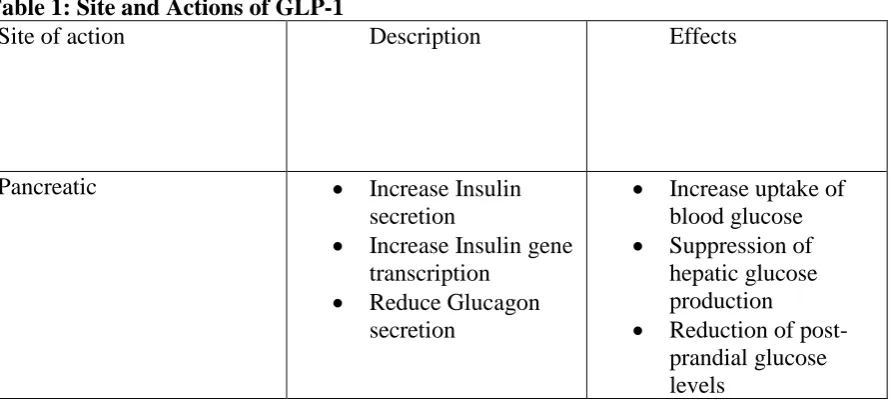
Table 1: Site and Actions of GLP-1
Site of action Description Effects
Pancreatic • Increase Insulin secretion
• Increase Insulin gene transcription
• Reduce Glucagon secretion
• Increase uptake of blood glucose • Suppression of
hepatic glucose production • Reduction of
67
Extra-Pancreatic • Incretin Effect • Increase
somatostatin secretion • Reduce smooth
muscle contractions in stomach and ileum
• Augment
endogenous Insulin secretion
• ‘Ileal brake’ phenomenon • Reduce gastric acid
secretion Central Nervous System • Activation of
anorexigenic POMC/CART*
neurons • Activation of
orexinergic NPY/ AgRP** neurons
• Increase satiety leading to reduction in food intake
* POMC/CART (Pro-opiomelanocortin/ Cocaine and Amphetamine-regulated transcript ** NPY/ AgRP (Neuropeptide Y/ Agouti-related peptide)
Methods--Evidence Acquisition
Various literature including original and review articles discussing the science of GLP-1 and influence of dietary macronutrients on the same were studied on popular scientific data bases like PubMed, Google Scholar and Embase published between 1965 up to end of August 2018. Literature was reviewed for contextual relevance. Randomised control trials (RCTs) evaluating role of DSN formula on endogenous GLP-1 secretion and consequent benefits were also reviewed.
Results
Nutrition and the regulation of GLP-1 secretion
Various nutrients cause GLP-1 and PYY release from ileum (Ripken et al, 2014). Delivery of ‘non/pre-digested’ macronutrients to the ileum activates satiety signals and decreases subsequent food intake in healthy volunteers (Van Avesaat et al, 2015). In humans, post-prandial blood concentrations of GLP-1 increase 2-4-fold in comparison to fasting levels. In the second hour after standard meals, GLP-1 concentrations start to decrease gradually until the next prandial episode. Neuroendocrine and nutritional factors influence the bi-phasic secretion of GLP-1. Phase 1, detectable 10-15 minutes after food ingestion, is mostly influenced by neuroendocrine factors and, to a lesser extent, by the interaction of nutrients with L-cells in the proximal small intestine. Conversely, phase 2 of GLP-1 secretion, occurring 30-60 minutes postprandially, is mostly influenced by the arrival of nutrients in the distal part of small intestine and colon (Nauk et al, 1996).
68
signals stimulate GLP-1 secretion even before the luminal contents reach the proximities of L cells (Alsalim et al, 2015). Digested nutrients trigger GLP-1 exocytosis from L-cells’ secretory granules. Modulation of GLP-1 secretion by digested nutrients may provide a novel nutritional alternative for better management and prevention of nutrition related disorders like diabetes, obesity, liver disease and other metabolic diseases (Zhou et al, 2008, Burcelin, 2005 and Brynes et al, 2000).
Role of carbohydrates
Parenteral vs Enteral Glucose
In normal subjects, insulin secretion is much higher after oral than IV glucose (Mcintyre et al, 1965 and Shapiro et al, 1987). The greater insulin response to oral glucose (the "incretin" effect) is due to release of gastrointestinal hormones that stimulate insulin secretion. Hermann et al found that basal GLP-1 levels remained unaltered after administration of 25 mg intra-venous glucose. However, the levels were raised after administration of 100 mg of oral glucose and showed a long-lasting plateau (300% above basal levels 90 minutes oral glucose consumption) (Herrmann et al, 1995).
Surgery results in a pathophysiological state similar to type 2 diabetes mellitus (T2DM) due to blunted stimulation of nonoxidative glucose disposal in the liver and skeletal muscles. Preoperative oral carbohydrate treatment is found to increase insulin-stimulated glucose uptake and significantly increase glucose oxidation, consequently attenuating the development of immediate postoperative insulin resistance (Soop et al, 2004).
Complex Carbohydrates
Glycaemic index (GI) and glycaemic load (GL) are recognised means to categorize foods based on glycaemia evoking potential of the carbohydrate composition. Studies have shown that metabolic parameters deteriorate more with higher GI and GL of a nutrition formula. Replacing high GI-carbohydrates with low-GI alternatives improves glycaemic control over long-term consumption (Devitt et al, 2012). Low GI DSN formula consumption resulted in higher endogenous GLP-1 secretion and better metabolic controls in comparison to conventional standard feeds.
Voss et al. (2008) found a lower area under the curve for glucose and insulin with DSN (low GI and GL) formula feeds in comparison with the standard formula feed. The adjusted GLP-1 concentration at 60 min was higher for the DSN formula compared with other diabetic formula and standard formula.
Soluble, fermentable fibre
69
colon over a period of 6 months also reduced body weight, abdominal fat and hepatic fat accumulation.
Thus, evidence supports that low GI complex carbohydrates along with soluble/fermentable fibre have beneficial effects in diabetes and obesity.
Role of proteins
In individuals with T2DM, ingested protein appears to increase insulin response to dietary carbohydrates without increasing plasma glucose concentrations (Laymann et al, 2008). Dietary intake of protein effectively improves the glycaemic response due to its ability to increase GLP-1 secretion (Olivos et al, 2014 and Raben et al, 2003). Chen et al (2009) tested the comparative efficacy of branched-chain amino acids (BCAAs) and dairy proteins in regulating satiety in human intestinal cell line (NCI-H716). They found that skimmed milk, casein, isoleucine and 2% leucine stimulated GLP-1 secretion by 1.6, 2.5, 2.6, and 4.7 - fold respectively. Milk-based products may therefore induce GLP-1 secretion due to their high content of BCAAs. Proteins stimulate GLP-1 release more than carbohydrates (Deacon et al, 1996).
Role of Lipids
Unsaturated long-chain fatty acids, are potent stimulators of GLP-1 release (Edfalk et al, 2008 and Hauge et al, 2015). Paniagua et al. (2007)found that ingestion of a Mediterranean diet rich in olive oil (high MUFA content) for 28 days in obese and T2DM adults resulted in significantly higher postprandial GLP-1 blood concentrations. With similar energy contents, diets richer in MUFAs or omega-3 polyunsaturated fatty acids (PUFAs) than saturated fats could increase endogenous GLP-1 secretion. This results in increased insulin secretion, insulin
sensitivity, β-cell proliferation, as well as improved glucose tolerance.
Role of artificial sweeteners
Non-nutritive sweeteners (acesulfame K, sucralose, neotame, saccharin, aspartame) affect the food intake and maintain diet palatability by delivering a sweet taste without adding calories or any glycaemic effect (Matte et al, 2009 and Pepino et al, 2011). Stimulation of enteroendocrine L cells in mice with high-potency sucralose induced GLP-1 secretion in a concentration-dependent manner (Margolskee et al, 2007). Jang et al, 2007 reported similar results when the effect of sucralose on human NCI-H716 enteroendocrine L cells was analysed. However, ingestion of aspartame or its constituent amino acids decreased GLP-1 secretion in human subjects (Hall et al, 2003). Recent findings from rat models showed diminished results in GLP-1 release during the oral glucose test in a saccharin-exposed group. Hence, sucralose has been found to favourably increase GLP 1 levels but the same is not the case with other artificial sweeteners like aspartame or saccharin.
GLP-1 challenges in T2DM
70
A disturbance has been seen in the normal diurnal GLP-1 level rhythm (maximum GLP-1 levels at 4:00 pm and minimums at 8:00 am and 8:00 pm) in overweight/obese subjects (Galindo Munoz et al, 2015). Obese adipose tissues are hypoxic and express hypoxia-inducible factor- (HIF-) 1𝛼𝛼. Deletion of this factor in adipocytes may improve glucose tolerance by enhancing insulin secretion through the GLP-1 pathway.
Endogenous (Diet induced) GLP-1 secretion in T2DM and Obesity
As a potential strategy to enhance GLP-1 actions, the metabolic effects of intravenous administration of GLP-1 analogues have been widely investigated. Patients with T2DM and obesity exhibited similar metabolic and appetite responses compared to healthy counterparts, when GLP-1 analogue was administered (Toft-Nielsen et al, 1999) indicating that GLP-1 secretion is hampered but not sensitivity to GLP-1’s action.
Consequently, targeting 1’s activation with 1R analogues and increasing the GLP-1 half-life in the bloodstream with DPP-4 inhibitors has become an area of interest for management of obesity and T2DM. Another relevant strategy to increase GLP-1 action is to augment its endogenous secretion through nutritional approaches.
DSN and GLP-1
One objective of nutritional intervention in T2DM is to ensure adequate endogenous GLP-1 secretion. Hence, DSN should ideally be a good blend of macronutrients known to augment endogenous GLP-1 secretion. As described above, low GI complex carbohydrates, casein, pre-biotic soluble fibre and high MUFAs could be the primary components of a DSN diet or formula. Devitt et al found that T2DM patients consuming DSN formula at breakfast had significantly higher median adjusted plasma GLP-1 (188 pmol/L/min) curves over time in comparison to the GLP-1 response after a conventional oat meal breakfast (40 pmol/L/min) (Devitt et al, 2012).
DSN such as meal replacements have been included as an integral part of the recently published Transcultural Nutrition Algorithm that advocates lifestyle modification as an adjunct to pharmacotherapy. Low GI and GL DSN formulae have been shown to exert better glycaemic control than standard formulae when used as a meal or calorie replacement or as a dietary supplement as part of overall nutritional management of diabetes (Elia et al, 2005). Tatti et al found significant reductions in HbA1c levels and body weight, and improvement of metabolic parameters like the serum lipid profile and blood pressure in T2DM obese patients consuming low GI DSN supplements as meal replacements (Tatti et al, 2009).
Conclusions
Complex carbohydrates, proteins, MUFAs and pre-biotic fibre augment GLP-1 secretion. Thus, including them in the diet represents a promising lifestyle strategy for T2DM management and may have implications for obesity control. The therapeutic potential of GLP-1 has already been established and it is successfully being used for blood glucose management in individuals with T2DM.
71 metabolic parameters in T2DM. Well-designed scientific trials (Devitt et al 2012 and Voss et al 2008) evaluating the impact of DSN formulae in promoting GLP-1 secretion and improving overall metabolic parameters have demonstrated favourable outcomes in T2DM patients.
The pharmacological action of various GLP-1 based therapies depend on the bioavailability of endogenous GLP-1 in the blood-stream. Combining the use of these drugs with a DSN diet or formula promoting endogenous GLP-1 secretion could augment action and efficacy of such therapies. Therefore, it would be worthwhile to investigate the relationship between DSN and the efficacy of GLP-1 based therapies in future studies.
Editor’s note: Anshu and his two co-authors all work for the Scientific and Medical Affairs Department of Abbott Nutrition. They stated when they declared when they submitted their paper that they had no conflicts of interest. I asked them fill in a detailed COI form and corresponded with them a few times on this issue. Their article uses the word “formula” but this does not refer to infant formula, but to those used in diabetes specific nutrition therapy. While Abbott produces such a formula, they say their paper does not relate to it and was not done to assist Abbott in improving it or designing any other product. When I wrote asking why Abbott would let them do such work unrelated to their commercial activities, they responded as follows: “We are free to take projects of academic interests, which help to propagate scientific concepts to broader community health care. Such projects are not necessarily meant for supporting Abbott Nutrition or any specific organisation. This is how Medical & Scientific Affairs department differ from the commercial counterparts in our organisation.”
References
Ahlkvist L, Vikman J, Pacini G, and Ahr´en B 2012. Synergism by individual macronutrients explains the marked early GLP-1 and islet hormone responses to mixed meal challenge in mice. Regulatory Peptides 178:29-35
Alsalim W, Omar B, Pacini G, Bizzotto R, Mari A, and Ahr´en B 2015 Incretin and islet hormone responses to meals of increasing size in healthy subjects. Journal of Clinical Endocrinology & Metabolism 100:561-8
Baggio LL, Drucker DJ 2007. Biology of incretins: GLP-1 and GIP. Gastroenterology 132(6):2131-57
Bradford B, Harvatine K, Allen M 2008. Dietary unsaturated fatty acids increase plasma glucagon-like peptide-1 and cholecystokinin and may decrease premeal ghrelin in lactating dairy cows. J Dairy Sci 91:1443–50.
Brynes AE, Edwards CM, Jadhav A, Ghatei MA, Bloom SR, Frost GS 2000. Diet-induced change in fatty acid composition of plasma triacylglycerols is not associated with change in glucagon-like peptide 1 or insulin sensitivity in people with type diabetes. American Journal of Clinical Nutrition 72:1111-8
72
Cancelas J, Prieto PG, Villanueva-Penacarrillo ML, Valverde I, Malaisse WJ 2006. Effects of an olive oil-enriched diet on glucagon-like peptide 1 release and intestinal content, plasma insulin concentration, glucose tolerance and pancreatic insulin content in an animal model of type 2 diabetes. Horm Metab Res 38:98–105
Cani PD, Daubioul CA, Reusens B, Remacle C, Catillon G, Delzenne NM 2005. Involvement of endogenous glucagon-like peptide-1(7-36) amide on glycaemia-lowering effect of oligo fructose in streptozotocin-treated rats. J Endocrinol 185:457–65.
Cani PD, Knauf C, Iglesias MA, Drucker DJ, Delzenne NM, Burcelin R 2006. Improvement of Glucose Tolerance and Hepatic Insulin Sensitivity by Oligo fructose Requires a Functional Glucagon-Like Peptide 1 Receptor. Diabetes 55:1484–90.
Cani PD, Neyrinck AM, Maton N, Delzenne NM 2005. Oligo fructose promotes satiety in rats fed a high-fat diet: involvement of glucagon-like Peptide-1. Obes Res 13:1000–7.
Chambers ES, Viardot A, Psichas A, Morrison DJ, Murphy KG, Zac-Varghese SEK, et al. 2015. Effects of targeted delivery of propionate to the human colon on appetite regulation, body weight maintenance and adiposity in overweight adults. Gut 64:1744–54.
Chen Q, Reimer RA 2009. Dairy protein and leucine alter GLP-1 release and mRNA of genes involved in intestinal lipid metabolism in vitro. Nutrition 25:340-9
Coate KC, Kliewer SA, Mangelsdorf DJ 2014. Snapshot: Hormones of the gastrointestinal tract. Cell 159:1478
Dao TMA, Waget A, Klopp P, Serino M, Vachoux C, Pechere L, et al. 2011. Resveratrol increases glucose induced GLP-1 secretion in mice: A mechanism which contributes to the glycaemic control. PloS One 6:20700.
Deacon CF, Pridal L, Klarskov L, Olesen M, Holst JJ 1996. Glucagon-like peptide 1 undergoes differential tissue-specific metabolism in the anesthetized pig. Am J Physiol Endocrinol Metab 271:458–64.
Devitt A, Jeffery Oliver S, Refaat Hegazi A, Mustad V 2012. Glycemia Targeted Specialized Nutrition (GTSN) improves postprandial glycemia and GLP-1 with similar appetitive responses compared to a healthful whole food breakfast in persons with type 2 diabetes: a randomized, controlled trial. Journal of Diabetes Research and Clinical Metabolism 13;1(1):20.
Drucker DJ, Nauck MA 2006. The incretin system: glucagon-like peptide-1 receptor agonists and dipeptidyl peptidase-4 inhibitors in type 2 diabetes. Lancet 368:1696–705.
Edfalk S, Steneberg P, Edlund H 2008. Gpr40 is expressed in enteroendocrine cells and mediates free fatty acid stimulation of incretin secretion. Diabetes 57:2280–7.
73
Galindo Munoz JS, Jimenez Rodrıguez D, Hernandez Morante JJ 2015. Diurnal rhythms of plasma GLP-1 levels in normal and overweight/obese subjects: lack of effect of weight loss. Journal of Physiology and Biochemistry 71:17-28
Hall W, Millward D, Rogers P, Morgan L 2003. Physiological mechanisms mediating aspartame-induced satiety. Physiol Behav 78:557–62
Hansen L, Deacon CF, Orskov C, Holst JJ 1999. Glucagon-like peptide-1-(7- 36) amide is transformed to glucagon-like peptide-1-(9-36) amide by dipeptidyl peptidase IV in the capillaries supplying the L cells of the porcine intestine. Endocrinology 140:5356–63.
Hauge M, Vestmar MA, Husted AS, Ekberg JP, Wright MJ, Di Salvo J, et al. 2015. GPR40 (FFAR1) - Combined Gs and Gq signaling in vitro is associated with robust incretin secretagogue action ex vivo and in vivo. Mol Metab 4:3–14.
Herrmann C, Goke R, Richter G, Fehmann HC, Arnold R, Goke B 1995. Glucagon-like peptide-1 and glucose dependent insulin releasing polypeptide plasma levels in response to nutrients. Digestion 56:117-24
Holst JJ 2004. Role of incretin hormones in the regulation of insulin secretion in diabetic and nondiabetic humans. AJP Endocrinol Metab 287:199–206.
Holst JJ 2007 The physiology of glucagon-like peptide 1. Physiol Rev 87:1409–39.
Jang HJ, Kokrashvili Z, Theodorakis MJ, Carlson OD, Kim BJ, Zhou J, et al. 2007. Gut-expressed gustducin and taste receptors regulate secretion of glucagon-like peptide-1. Sci Signal 104:15069.
Lastya A, Saraswati MR, Suastika K 2014. The low level of glucagon-like peptide-1 (glp-1) is a risk factor of type 2 diabetes mellitus. BMC research notes 7((glp-1):849.
Layman DK, Clifton P, Gannon MC, Krauss RM, Nuttall FQ 2008. Protein in optimal health: heart disease and type 2 diabetes. Am J Clin Nutr 87:1571–5
Margolskee RF, Dyer J, Kokrashvili Z, Salmon KSH, Ilegems E, Daly K, et al 2007. From the Cover: T1R3 and gustducin in gut sense sugars to regulate expression of Naþ-glucose cotransporter 1. Sci Signal 104:15075.
Mattes RD, Popkin BM 2009. Non-nutritive sweetener consumption in humans: Effects on appetite and food intake and their putative mechanisms. Am J Clin Nutr 89:1–14.
McIntyre N, Holdsworth CD, Turner DS 1965. Intestinal factors in the control of insulin secretion. J Clin Endocrinol Metab 25:1317-24
Nauck MA, Siemsglüss J, Orskov C, Holst JJ 1996. Release of glucagon-like peptide 1 (GLP-1 [7-36 amide]), gastric inhibitory polypeptide (GIP) and insulin in response to oral glucose after upper and lower intestinal resections. Z Gastroenterol 34:159–66.
74
suppressive effects of DPP-IV inhibition. The American Journal of Physiology, Regulatory Integrative and Comparative Physiology 306:157-63
Paniagua JA, de la Sacristana AG, S_anchez E, Romero I, Vidal-Puig A, Berral FJ, et al 2007. A MUFA-rich diet improves posprandial glucose, lipid and GLP-1 responses in insulin-resistant subjects. J Am Coll Nutr 26: 434–44.
Pepino MY, Bourne C. 2011. Non-nutritive sweeteners, energy balance and glucose homeostasis. Curr Opin Clin Nutr 14:391.
Plamboeck A, Holst J, Carr R, Deacon C 2005. Neutral endopeptidase 24.11 and dipeptidyl peptidase IV are both mediators of the degradation of glucagon-like peptide 1 in the anaesthetised pig. Diabetologia 48:1882–90.
Prasad-Reddy L, Isaacs D 2015. A clinical review of GLP-1 receptor agonists: efficacy and safety in diabetes and beyond. Drugs Context 4:212283.
Prigeon RL, Quddusi S, Paty B, D’Alessio DA 2003. Suppression of glucose production by GLP-1 independent of islet hormones: A novel extra pancreatic effect. Am J Physiol Endocrinol Metab 285:701–7.
Psichas A, Reimann F, Gribble FM 2015. Gut Chemosensing mechanisms. J Clin Invest 125:908–17.
Raben A, Agerholm-Larsen L, Flint A, Holst JJ, Astrup A 2003. Meals with similar energy densities but rich in protein, fat, carbohydrate, or alcohol have different effects on energy expenditure and substrate metabolism but not on appetite and energy intake. American Journal of Clinical Nutrition 77:91-100
Ripken D, Wielen Nvd, Wortelboer H, Meijerink J, Witkamp R, Hendriks H 2014. Stevia Glycoside Rebaudioside A Induces GLP-1 and PYY Release in a Porcine Ex Vivo Intestinal Model. J Agric Food Chem 62:8365–70.
Rocca AS, Brubaker PL 1999. Role of the vagus nerve in mediating proximal nutrient-induced glucagon-like peptide-1 secretion. Endocrinology 140: 1687–94
Shapiro ET, Tillil H, Miller MA, Frank BH, Galloway JA, Rubenstein AH, et al. 1987. Insulin secretion and clearance: comparison after oral and intravenous glucose. Diabetes 36: 1365-72
Singh AK 2015. “Glucagon-like peptide 1 and dysglycemia: conflict in incretin science,” Indian Journal of Endocrinology and Metabolism 19:182-7
Soop M, Nygren J, Thorell A, et al. 2004. Preoperative oral carbohydrate treatment attenuates endogenous glucose release 3 days after surgery. Clin Nutr 23: 733–41.
75 Toft-Nielsen MB, Madsbad S, Holst JJ 1999. Continuous subcutaneous infusion of glucagon-like peptide 1 lowers plasma glucose and reduces appetite in type 2 diabetic patients. Diabetes Care 22:1137–43.
Van Avesaat M, Troost FJ, Ripken D, Hendriks HF, Masclee AA 2015. Ileal brake activation: macronutrient-specific effects on eating behavior? Int J Obes (Lond) 39:235– 43.
Vilsboll T, Agerso H, Krarup T, Holst JJ 2003. Similar elimination rates of glucagon-like peptide-1 in obese type 2 diabetic patients and healthy subjects. Journal of Clinical Endocrinology and Metabolism 88:220-4
Vollmer K, Hoist JJ, Bailer B, et al. 2008. Predictors of incretin concentrations in subjects with normal, impaired, and diabetic glucose tolerance. Diabetes 57:678-87
Voss AC, Maki KC, Garvey WT, Hustead DS, Alish C, Fix B, et al. 2008. Effect of two carbohydrate-modified tube-feeding formulas on metabolic responses in patients with type 2 diabetes. Nutrition 24:990-7