This is an open access journal, and articles are distributed under the terms of the Creative Commons Attribution-Non Commercial-ShareAlike 4.0 License, which allows others to remix, tweak, and build upon the work non-commercially, as long as appropriate credit is given and the new creations are licensed under the identical terms.
© 2019 Journal of Advanced Pharmacy Education & Research | Published by SPER Publication
19
Cost-effectivity of standardized-herbal medicine for DHF
inpatients in a Primary Health Center
Zainal Arifin
1*, Tiana Milanda
2, Auliya A. Suwantika
1,31Department of Pharmacology and Clinical Pharmacy, Faculty of Pharmacy, Universitas Padjadjaran, Indonesia. 2Department of Biological Pharmacy, Faculty of Pharmacy, Universitas Padjadjaran. 3Center of Excellence in Higher Education for Pharmaceutical Care Innovation, Universitas Padjadjaran, Indonesia.
Correspondence: Zainal Arifin, Department of Pharmacology and Clinical Pharmacy, Faculty of Pharmacy, Universitas Padjadjaran, Indonesia. E-mail: [email protected]
ABSTRACT
Background: In Tanah Bumbu District, South Kalimantan, Indonesia, there was 59 dengue hemorrhagic fever (DHF) cases with one death occurring in 2016. For the treatment of DHF inpatients, at Simpang Empat Primary Health Center, the Standardized Herbal Medicines (SHM) are used in addition to WHO standards. Objective: determine cost-effectivity of SHM for DHF patients at Simpang Empat Primary Health Center. Methods: Data were collected retrospectively from the medical records of DHF in 2015. Data were divided into two: DHF patients treated according to WHO standard, and data on DHF patients treated according to WHO standard plus SHM. The Health Care Perspective is used to analyze the cost effectiveness. Results: Treatment using both the WHO standard and the SHM intervention, show that two kinds of therapy were effective in increasing platelet levels. However, the SHM intervention has a predominant position in the cost-effectivity table. Conclusion: The use of SHM in DHF therapy is not recommended as an alternative therapy because it shows higher cost than without SHM although both have similar effectivity in increasing platelet levels.
Keywords:Dengue Hemorrhagic Fever, Herbal, Cost effectivity.
Introduction
The dengue virus is a virus belonging to the Flavivirus group where the virus becomes a highly distributed pathogenic virus in (primarily) tropical countries. The dengue virus is divided into 4 types of serotypes, namely serotype DEN-1, DEN-2, DEN-3, and DEN-4. This virus shows the usual clinical symptoms of dengue fever, like flu, and in many cases it shows signs of bleeding associated with decreased platelets. This is called dengue hemorrhagic fever. [1]
The World Health Organization estimates the number of DHF sufferers in the range of 50 to 100 million people infected each year worldwide. In the past four decades, there have been only nine countries reported to have severe DHF infections. By 2014, the dengue virus has become an endemic disease in more than
one hundred countries, including those in Southeast Asia. Countries in Southeast Asia and the Asia-Pacific regions are areas of serious dengue infection. About a decade ago, Singapore recorded nearly ten thousand cases of dengue, in which 8 cases resulted in death. [2]
Countries in Southeast Asia reported that in 2010 more than 187 thousand dengue cases occurred, 8 of which belonged to the hyperendemic category infected by all types of serotypes. [3, 4] By the end of the year 2106 there was an 'explosion' of dengue fever cases of more than 291,000 cases in Asia, mostly inChina (27.9%), Singapore (27%), and Malaysia (15%). [5]
One of the areas in Southeast Asia infected with dengue hemorrhagic fever is Indonesia. Starting from 1968 DHF has spread to all of this archipelago country. [6, 7] It has been reported that Indonesia is a country with the highest cases in Southeast Asia, where in the period between 2001 and2011 an average of 94,564 cases with a range of 472 to 1446 people dying because of dengue.[8]
The patient's diagnosis is based on clinical symptoms, epidemiological data, and laboratory data. In laboratory tests, two methods are used in this diagnosis, called non-specific data including platelet counts, touniquet tests, liver function tests, and serum albumin concentrations; and there are also specific ways of virus isolation and serum antibody testing. Both can be used in the diagnosis of DHF. [9,10]
Access this article online
Website: www.japer.in E-ISSN: 2249-3379
How to cite this article: Zainal Arifin, Tiana Milanda, Auliya A. Suwantika.
Cost-effectivity of standardized-herbal medicine for DHF inpatients in a Primary Health Center. J Adv Pharm Edu Res 2019;9(4):19-23.
20 Journal of Advanced Pharmacy Education & Research | Oct-Dec 2019 | Vol 9 | Issue4
Thrombocyte values are the most crucial data to monitor patients with dengue infection. However, few studies have investigated this. Platelets are components of blood cells derived from haemopoetic tissue that are useful in the process of blood clotting. Blood clots will be inhibited when the platelet count decreases or increases. Reduced platelet values are at risk of causing bleeding. [11] Lack of platelet count (thrombocytopenia) occurs before the increase in hematocrit value. Platelets located
at ≤ 100,000 / mm3 will be found between the third and seventh
days. [6] Based on the WHO criteria, DHF diagnosis is established
when platelet thrombocytopenia occurs at ≤100.000 / mm3.[12] Dengue hemorrhagic fever (DHF) is an endemic disease that has struck almost all regions in Indonesia. Starting from Papua to the tip of Sumatra. Data obtained from the Directorate General of Disease Control and Environmental Health, in 2009 in South Kalimantan experienced Dengue Hemorrhagic cases of 29 cases per 100 thousand of the population.[13]
The use of herbal extracts has been widely used in Indonesia and the world for treatment. All over the world, the use of scientifically proven herbs in diseases of cardiovascular disorders, urinary tract infections, dyspepsia, and a number of other diseases. Similarly in Indonesia, a number of herbal extracts tested at Gondomanan Health Center, Yogyakarta showed effective herbal extract lowering high blood pressure, and against diabetes mellitus.[14]
Herbal extracts in some major hospitals have also been tested in a number of patients. The hospital tested guava leaf extract syrup on dengue hemorrhagic patients. The result was that there was a significant difference in platelet rise. Platelet recognition in patients with DHF can speed up the healing process. [15] One alternative to treating DHF is to consume herbal extracts. [16] The results of research in India, Sri Lanka, and Bangladesh show papaya leaf extract can be useful for dengue patients. Note that there are some herbs used to treat dengue, namely neem, echinacea, ipeka kuanha, and astragalus. [17]
But so far, studies related to guava and dengue hemorrhagic fever are limited to its effectivity in patient platelet uptake. However, there have been no study reports the cost effectivity research on the use of guava leaf extracts for dengue hemorrhagic patients.[15, 16]
The use of herbal extracts has been widely used in Indonesia and the world for treatment. Abroad, the use of scientifically proven herbs in diseases of cardiovascular disorders, urinary tract infections, dyspepsia and a number of other diseases. Similarly in Indonesia, a number of herbal extracts that were tested at Gondomanan Primary Health Center, Yogyakarta showed effective herbal extracts to treat a number of diseases.[14]
Material and Methods
This study uses non-experimental method using retrospective retrieval data. The effectivity of drug use and cost effectivity analysis was performed on DHF (inpatient) population from January to December 2015 at Simpang Empat Primary Health
Center, Tanah Bumbu District, with the following inclusion and exclusion criteria:
Inclusion Criteria:
1. Patients with DBD Grade I and II diagnosed under WHO criteria
2. DHF patients aged 5 to 45 years with complete clinical and laboratory data
Exclusion Criteria:
1. Patients with haematological disorders
2. Patients with heart and lung disease (Congenital heart disease, myocarditis, heart failure, bronchopneumonia, bronchial asthma, and others) 3. Patients receiving salicylic acid treatment
Data taken are data in medical records, patient prescriptions, and result of laboratory examinations. Data collection is done by medical record data, and laboratory, including:
1. Patient characteristics data include medical record number, gender, age, and nutritional status
2. Patient clinical data include primary diagnosis, length of hospitalization, patient follow-up, as well as patient laboratory examination results
3. Data of drug use include type, dosage and method of administration
4. Data on overall costs include medicines, measures, hospitalization, support and administration.
Data analysis was done by classifying the characteristics of research subjects and identifying the description of drug use, by:
1. Classifying Characteristics of Research Subjects a. Percentage of Sex
b. Percentage of Age c. Platelet Value
2. Identifying Drug Use Preview. The parameters observed in identifying the image of drug use include:
a. Type of drug given b. Rules of drug use c. Duration of drug use
d. Potential side effects that may appear Costs are calculated from the perspective of health system providers, where medical costs are the only cost component to be taken into account, which include:
1. Drug cost 2. Cost of action 3. Supporting costs 4. Inpatient costs 5. Administrative costs
6. Total cost of treatment is the sum of drug costs, action costs, supporting costs, inpatient costs, and administrative costs.
The normal value of platelets used as referrals to this treatment
Journal of Advanced Pharmacy Education & Research | Oct-Dec 2019 | Vol 9 | Issue4 21
Results and Discussion
The number of Dengue Hemorrhagic Fever patients admitted to the Simpang Empat Primary Health Center from January to December 2015 who fulfilled the inclusion criteria was 32 for the group using standardized herbal medicine and 4 for the group without using standardized herbal medicines. The length of patient care varies between 3 and 9 days. Divided by age range, that is, age 5-12 years as much as 42%, age 12-18 years 16% and age over 18 years 42%. By gender, 69% was male, and 31% female.
Dengue hemorrhagic patients treated at the Simpang Empat Primary Health Center usually come with high fever complaints up to 40 degrees Celsius, weakness, loss of appetite, and headaches. Others with symptoms of diarrhea, nausea and vomiting, and abdominal pains. Patients who come for later treatment vary by fever day, from day one from fever to day seven of fever. The management of these health centers is based on guidelines provided by the World Health Organization (WHO), which includes clinical diagnostic, laboratory, grade or severity of dengue hemorrhage, fluid therapy, and symptomatic medications.
South Kalimantan has been reported to have a high rate of dengue cases compared to the population. Population distribution due to incessant development of road infrastructure, causing also the mobility of the population in this province is very high. Dynamic population movements ultimately impact disease distribution, including dengue hemorrhagic fever. Dengue hemorrhagic fever is now spread evenly throughout the districts of South Kalimantan, including in Tanah Bumbu.
Tanah Bumbu residents are exposed to dengue virus infection every year. The highest occurrence generally occurs in January, February, March, October, November, and December. Visits of patients with dengue hemorrhagic fever to be treated at the Simpang Empat Primary Health Center are always high during this period.
Treatment of patients diagnosed with dengue hemorrhagic fever is performed using WHO standards, that is, patients are treated with adequate fluids, reducing symptomatic complaints, and monitoring signs of severity of bleeding or symptoms leading to dengue shock syndrome (DSS). Beside Treatment procedures using WHO standards, they are also given standardized herbal medicine. Standardized herbal medicine (SHM) used in the treatment of dengue hemorrhagic fever which contains guava extract and angkak (fermented red rice). This therapy has been aimed to accelerate the increase of platelet count of DHF patients. Clinical studies that have been done have shown that giving guava extract or combination with angkak is effective to increase platelets.
Based on clinical research related to guava effectivity and angkak
to DHF patients, a pharmacoeconomic analysis was conducted which aims to provide a consideration of the cost aspect in its
implementation. Thus, the provision of standardized herbal medicine is not only to justify the effectivity but also the resulting cost profile.
This study uses the perspective of health service delivery. Total costs are calculated using direct cost components including
administrative costs, doctor’s consultation fees, action fees,
treatment room fees, and laboratory examination fees. The total cost calculated is the cost of DHF treatment using the WHO treatment standard (group A) and the addition of Standard Herbal Medicines containing guava extract and angkak in addition to the treatment of DHF (group B).
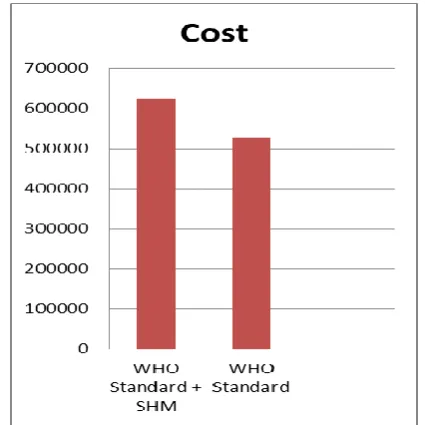
The results of the calculation of platelet elevation of dengue hemorrhagic patients at the Simpang Empat Primary Health Center on treatment according to WHO combined with SHM (A) and WHO Standard alone (B) showed a difference. By using independent t test the difference is not significant. Costs incurred by treatment A also resulted in no significant difference. Furthermore, the length of days of hospitalizationis also calculated. From the statistical test no significant differences was found between the 2 groups, either A or B.
Table 1 shows the steps in the cost-effectivity analysis of this study.In step 3 the effectivity value is equal to 1.This is because the therapy is considered effective when there is a rise in platelets in each patient data, either with therapy A or B. The average cost per patient was calculated by calculating the overall cost of treatment for the dengue fever during the 2015 period. Afterwards, the cost-effectivity ratio was obtained by comparing the total cost per patient with effectivity, either A or B. In step 5 the value of the cost-effectivity ratio is positioned into the cost-effectivity analysis table. It is apparent that if therapy A versus B then therapy A and B have the same effectivity, but B therapy will result in greater cost than therapy A. We refer to the Ministry of Health's pharmacoeconomic guidelines, that if an intervention has the same effectivity as a comparison, costs are greater, there is no need for incremental cost analysis (ICER).
Conclusion
The cost-effectivity analysis performed by comparing DHF treatment between therapy according to WHO standards and the addition of SHM shows that in the effectivity aspect of these two therapies is the same, but the cost is different. The total cost incurred in therapy with the addition of SHM is greater than without the addition of SHM. Based on this, it is not recommended to use SHM in DHF therapy at Simpang Empat Primary Health Center.
Acknowledgment
22 Journal of Advanced Pharmacy Education & Research | Oct-Dec 2019 | Vol 9 | Issue4
Funding
The research is funded by the Ministry of Health of the Republic of Indonesia in relation to the program of learning task of Civil Servant Health curriculum 2016-2018. This article’s publication
is supported by the United States Agency for International Development (USAID) through the Sustainable Higher Education Research Alliance (SHERA) Program for Universitas
Indonesia’s Scientific Modeling, Application, Research and Training for City-centered Innovation and Technology (SMART CITY) Project, Grant #AID-497-A-1600004, Sub Grant #IIE-00000078-UI-1.
Conflict of Interest
The authors state that there is no conflict of interest in the research, writing process, or publication of this study.
References
1. Pinheiro, F. P., & Corber, S. J. (1997). Global situation of
dengue and dengue haemorrhagic fever, and its emergence in the Americas. World health statistics quarterly, 50, 161-169.
2. Ministry of Health Singapore. (2004). dengue fever
reports.
3. Ferreira, G. L. (2012). Global dengue epidemiology
trends. Revista do Instituto de Medicina Tropical de São Paulo, 54, 5-6.
4. World Health Organization. (2012). Comprehensive
guidelines for prevention and control of dengue and
dengue haemorrhagic fever [Internet]. WHO Regional
Publication SEARO. 159-168. Available from:
http://scholar.google.com/scholar?hl=en&btnG=Search &q=intitle:Comprehensive+Guidelines+for+Prevention +and+Control+of+Dengue+and+Dengue+Haemorrhag ic+Fever#1
5. Oliveira, M. A. D., Ribeiro, H., & Castillo-Salgado, C.
(2013). Geospatial analysis applied to epidemiological studies of dengue: a systematic review. Revista Brasileira de
Epidemiologia, 16, 907-917. Available from:
http://www.scielo.br/scielo.php?script=sci_arttext&pid
=S1415-790X2013000400907&lng=en&nrm=iso&tlng=en
6. Karyanti, M. R., Uiterwaal, C. S., Kusriastuti, R.,
Hadinegoro, S. R., Rovers, M. M., Heesterbeek, H., ... & Bruijning-Verhagen, P. (2014). The changing incidence of dengue haemorrhagic fever in Indonesia: a 45-year
registry-based analysis. BMC infectious diseases, 14(1), 1–7.
7. Suwandono, A., Kosasih, H., Kusriastuti, R., Harun, S.,
Ma'roef, C., Wuryadi, S., ... & Blair, P. J. (2006). Four
dengue virus serotypes found circulating during an outbreak of dengue fever and dengue haemorrhagic fever in Jakarta, Indonesia, during 2004. Transactions of the Royal Society of Tropical Medicine and Hygiene, 100(9), 855-862.
8. World Health Organization. (2012). Global strategy for
dengue prevention and control 2012-2020. Available from:
http://scholar.google.com/scholar?hl=en&btnG=Search &q=intitle:Global+strategy+for+dengue+prevention+a nd+control#8
9. De Paula, S. O., & Fonseca, B. A. L. D. (2004). Dengue:
a review of the laboratory tests a clinician must know to achieve a correct diagnosis. Brazilian Journal of Infectious Diseases, 8(6), 390-398. Available from: www.bjid.com.br
10. Srichaikul, T., & Nimmannitya, S. (2000). Haematology in
dengue and dengue haemorrhagic fever. Best Practice & Research Clinical Haematology, 13(2), 261-276.
11. Sutedjo A. (2013). Buku saku mengenal penyakit melalui hasil
pemeriksaan laboratorium pengertian, nilai normal dan interpretasi. Ed. Revisi. Yogyakarta: Amara Books.
12. Suhendro, N. (2014). Buku Ajar Ilmu Penyakit Dalam. VI.
Jakarta: Interna Publishing. 539-548.
13. Depkes, RI. (2005). Pencegahan Dan Pemberantasan
Demam Berdarah Dengue Di Indonesia. ke-tiga.
Departemen Kesehatan, editor. Jakarta: Departemen
Kesehatan RI. 25-43.
14. Febriyanti, R.M, Maesaroh, I., Supriyatna, Sukandar H.,
Maelaningsih, F.S. (2014). Pharmacoeconomics Analysis
of Scientification of Anti-hypertensive, Anti
hyperglycemic, Anti hpercholesterolemic, and Anti
hyperuricemic Jamu. 1, 39–46.
15. Soegijanto, S. A. M. S., Azhali, M. S., Alan, R., Anggraini,
R. R., & Dian, D. (2010). Uji klinik multisenter sirup ekstrak daun jambu biji pada penderita demam berdarah dengue. J Med, 23(1), 5-10.
16. Muharni, S., Almahdy, A. & Martini, R.D. (2013). Effect
of the use of supplements Psidii folium extract
(psidiumguajavalinn.) and red fermented rice
(Monascuspurpureus) in increase of thrombocytes at dengue hemorrhagic fever (DHF) science in the installation of disease in hospital dr. M. DjamilPadan. Penelit Farm
Indones [Internet]. 1(2), 57–61. Available from:
https://ejournal.unri.ac.id/index.php/FPFI/article/vie w/1247
17. Mehboob, M., Nouroz, F., & Noreen, S. (2015). Natural
and Herbal Remedies for Dengue Prevention. 2(2):44–7.
18. Kementerian Kesehatan Republik Indonesia. (2013).
Direktorat Jenderal Bina Kefarmasiandan Alat Kesehatan.
Pedoman Penerapan Kajian Farmakoekonomi.
Journal of Advanced Pharmacy Education & Research | Oct-Dec 2019 | Vol 9 | Issue4 23
Figure 1.Age range of dengue hemorrhagic patients at
Simpang Empat Primary Health Center, Tanah Bumbu
Table 1. The stages of cost effectivity determination (adopted from the Ministry of Health's
Pharmacoeconomics Guidelines[18])
Step Analysis
I
Comparing the cost and effectivity of two types of dengue hemorrhagic therapy (DHF) between WHO standard therapy use
with WHO standard therapy plus SHM
II
Comparing: A. WHO standard dengue therapy B. WHO + SHM standard dengue therapy
III The results of the effectivity calculation between A and B are the same i.e. 1.
IV Average cost of treatment A = IDR 540,000 Average cost of treatment B = IDR 652,000
V
a. The cost-effectivity ratio (CER)
REB A = Rp. 540.000 / 1 = Rp. 540,000 REB B = Rp. 652.000 / 1 = Rp. 672.375
b. Position of cost-effectivity alternatives A and B
c. The ratio of cost-effectiveness analysis is not necessary in this study
VI Interpretation:
Between treatment A and B should be selected treatment A
Figure 2.Comparison of Platelet Level using WHO Standard
+ SHM and WHO standard only
Figure 3.Comparison Cost Therapy between WHO Standard
+ SHM and WHO standard only
Figure 4.Comparison Length of DHF Therapy between WHO