University of New Orleans University of New Orleans
ScholarWorks@UNO
ScholarWorks@UNO
University of New Orleans Theses and
Dissertations Dissertations and Theses
Summer 8-13-2014
Analysis and Detection of Heap-based Malwares Using
Analysis and Detection of Heap-based Malwares Using
Introspection in a Virtualized Environment
Introspection in a Virtualized Environment
Salman Javaid
Computer Sciences, [email protected]
Follow this and additional works at: https://scholarworks.uno.edu/td
Part of the Computer and Systems Architecture Commons
Recommended Citation Recommended Citation
Javaid, Salman, "Analysis and Detection of Heap-based Malwares Using Introspection in a Virtualized Environment" (2014). University of New Orleans Theses and Dissertations. 1875.
https://scholarworks.uno.edu/td/1875
This Thesis is protected by copyright and/or related rights. It has been brought to you by ScholarWorks@UNO with permission from the rights-holder(s). You are free to use this Thesis in any way that is permitted by the copyright and related rights legislation that applies to your use. For other uses you need to obtain permission from the rights-holder(s) directly, unless additional rights are indicated by a Creative Commons license in the record and/or on the work itself.
Analysis and Detection of Heap-based Malwares Using Introspection in a Virtualized Environment
A Thesis
Submitted to the Graduate Faculty of the University of New Orleans
in partial fulllment of the requirements for the degree of
Master of Science in
Computer Sciences with Concentration in Information Assurance
by Salman Javaid
B.S. Punjab University Lahore Pakistan, 1999
M.S. National University of Science and Technology Islamabad Pakistan, 2004
c
Funding
Acknowledgements
I would like to thank my parents, without whom my life would not be possible. I would like to thank my brother for guiding me throughout my education. I would also like to thank my adviser and my thesis committee
:-• Dr. Golden Richard, III Adviser • Dr. Vassil Roussev
• Dr. Irfan Ahmed
Contents
List of Tables . . . ix
List of Figures . . . x
Abstract . . . xi
1 Introduction 1 1.1 Heap Spraying . . . 2
1.1.1 Heap Spray Techniques . . . 2
1.1.2 Just In Time (JIT) Spraying . . . 5
1.1.3 Heap Feng Shui . . . 6
1.2 Operating System based Security . . . 7
1.2.1 Data Execution Prevention (DEP) . . . 8
1.2.2 Address Space Layout Randomization (ASLR) . . . 8
1.2.3 Status of DEP and ASLR in Third Party Applications . . . 10
1.3 Virtual Machine Architecture . . . 10
1.3.1 Virtual Machine Monitor . . . 10
1.3.2 VMM Implementation . . . 12
1.3.3 Virtual Machine Introspection . . . 13
1.3.4 LibVMI . . . 13
1.4 Contributions . . . 16
1.5 Organization . . . 17
2 Related Work 18
2.1 Miscellaneous Work . . . 18
2.1.1 Heap Inspector . . . 19
2.1.2 JSAND . . . 19
2.1.3 BuBBles . . . 19
2.2 Nozzle . . . 20
2.3 Zozzle . . . 22
2.4 Rozzle . . . 23
3 Heap-base Malware Detection 25 3.1 Introduction to Atomizer . . . 25
3.2 Atomizer Architecture . . . 26
3.3 Atomizer Implementation . . . 28
3.3.1 Process Information Extraction . . . 29
3.3.2 Heap Extractor . . . 30
3.3.3 Swapped Heap Page Extractor . . . 30
3.3.4 Heap Analysis Module . . . 32
3.4 Atomizer Evaluation . . . 32
3.4.1 Experimental Settings . . . 32
3.4.2 Malware Detection . . . 33
3.4.3 Experimental Performance Analysis . . . 34
3.4.4 Conclusion . . . 35
4 Conclusion 37
Bibliography 40
List of Tables
List of Figures
1.1 Typical Heap Spray . . . 3
1.2 Typical Heap Spray Code . . . 3
1.3 Architecture of two basic types of Virtual Machine Monitors . . . 11
1.4 Virtual Machine Introspection . . . 14
2.1 Basic Nozzle Architecture . . . 21
3.1 Atomizer Architecture . . . 27
Abstract
Malware detection and analysis is a major part of computer security. There is an arm race between security experts and malware developers to develop various techniques to secure computer systems and to nd ways to circumvent these security methods. In recent years process heap-based attacks have increased signicantly. These attacks exploit the system under attack via the heap, typically by using a heap spraying attack. The main drawback with existing techniques is that they either consume too many resources or are complicated to implement. Our work in this thesis focuses on new methods which ooads process heap analysis for guest Virtual Machines (VM) to the privileged domain using Virtual Machine Introspection (VMI) in a Cloud environment. VMI provides us with a seamless, non-intrusive and invisible (to malwares) way of observing the memory and state of VMs without raising red ags for the malwares.
Chapter 1
Introduction
In this chapter we will discuss the motivations behind this research. The primary incentive behind this research was to ameliorate the spread of heap spray which has reached to an epidemic proportion. Heap sprays are mostly used to evade various security mechanisms being deployed out there, especially at operating system (OS) and hardware level. Most exploits use some sort of venerability in the application or the OS to revert or overwrite some pointers. Controlling these overwritten pointers is much dicult now, as many se-curity mechanism like DEP and ASLR are being deployed. Heap spray is being used by malware developer as a landing platform for various vulnerabilities especially in commonly used applications like Web Browsers and PDF viewers to bypass these security measures and increasing the probability of the malwares to work.
1.1 Heap Spraying
The goal of any attack is to get the targeted computer to run exploit code supplied by the attacker. To achieve this, two things must happen:
1. The code must end up on the computer. 2. The computer must run that code.
Attackers achieve these goals by using various method and techniques. The earliest type of memory exploit took advantage of buer-stack overows. Attackers found ways to over-write a buer on the stack and used that vulnerability to change or insert program code to make the program jump to instructions provided by the attacker. Stack-overow attacks diminished in eectiveness as programming languages evolved to prevent buer overows. Memory exploits then focused on heap-based overows, in which, instead of placing instruc-tions on the stack, attackers found ways to insert them into the program's heap. Nowadays, heap-based exploits are more dicult to achieve. Operating systems such as Windows Vista and on-wards use a technique called Address-based Layout Randomization(ASLR) [65] in which the base address of the code, the heap, and the stack change each time the program runs. This prevents attackers from reliably predicting target addresses for code locations, and if there is one copy of the exploit code in a large heap, it's akin to nding the proverbial needle in a haystack.
1.1.1 Heap Spray Techniques
Heap spraying circumvents these challenges by allocating, or "spraying," multiple copies of exploit code to increase the odds of nding a copy in the heap. The attacker can allocate hundreds of thousands of copies of exploit code into the heap. All that's needed is for one random program jump to land on one copy of such code, and a successful attack begins.
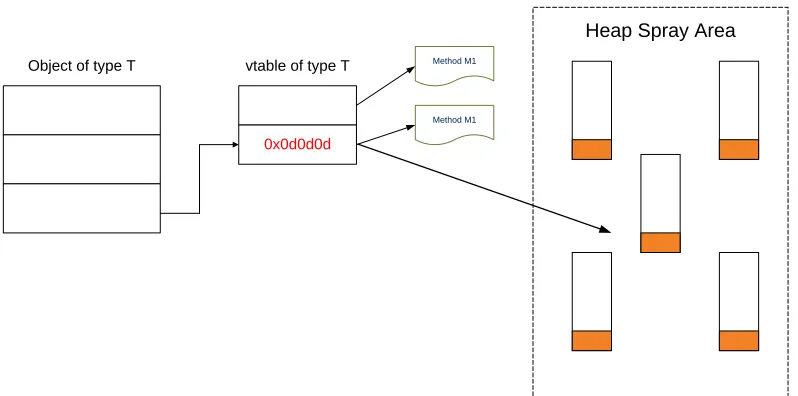
0x0d0d0d
Method M1
Method M1
Heap Spray Area
Object of type T vtable of type T
Figure 1.1: Typical Heap Spray
1 <SCRIPT language=" t ext / j a v a s c r i p t "> 2
3 s h e l l c o d e = unescape ( "%u4343%u4343% . . . " ) ; 4
5 oneblock = unescape ( "%u0D0D%u0D0D" ) ; 6
7 var f u l l b l o c k = oneblock ; 8
9 while ( f u l l b l o c k . length < 0 x40000 ) { 10 f u l l b l o c k += f u l l b l o c k ;
11 } 12
13 prayContainer = new Array ( ) ; 14
15 for ( i =0; i <1000; i++) {
16 sprayContainer [ i ] = f u l l b l o c k + s h e l l c o d e ; 17 }
18
19 </SCRIPT>
an attacker has corrupted a vtable method (M1) pointer to point to an incorrect address of their choosing. At the same time, we assume that the attacker has been able, through entirely legal methods, to allocate objects with contents of their choosing on the heap. Heap spraying relies on then populating the heap with a large number of objects containing the attacker's code, assigning the vtable exploit to jump to an arbitrary address in the heap, and relying on luck that the jump will land inside one of their objects. To increase the likelihood that the attack will succeed, attackers usually structure their objects to contain an initial NOP sled (indicated in white) followed by the code that implements the exploit (commonly referred to as shellcode, indicated with shading). Any jump that lands in the NOP sled will eventually transfer control to the shellcode.
1.1.2 Just In Time (JIT) Spraying
One of the newest and most popular exploitation techniques to bypass both ASLR and DEP security protections is JIT memory spraying. There are two general reasons why JIT spraying is a very useful exploitation method. Firstly, the code generated by the JIT compiler is stored in memory marked as executable. This should be obvious because otherwise JIT compiler would be unable to work correctly on systems shipped with the DEP feature. Evidently, if the attacker's code is generated by JIT engine it will also reside in the executable area. In other words, DEP is not involved in the protection of code emitted by the JIT compiler. This is a very useful method since the memory was not marked as executable in prior approaches like normal heap spraying. The second reason JIT spraying is powerful is that attacker's code location can be predicted correctly [35] so at this point ASLR is also no longer a big threat for the attacker.
Just-In-Time compilation converts code at runtime; typically from bytecode into ma-chine code. By doing this, an interpreted program's performance greatly improves. The JIT spraying method "forces" the JIT compiler to produce a lot of executable pages with embedded attacker's code. In order to write the code to specic location, the JIT compiler must rst mark the destination memory as writable. Since multiple generated code chunks may reside on the same memory page, the JIT compiler marks the entire page as RWX (ReadableWritable-Executable). These permissions are necessary because a dierent chunk of memory residing on the same page may be executed asynchronously (for example by a dif-ferent thread), resulting in access violation if the requested memory page was not executable at that moment. After the code is written the compiler marks the destination region as RX -readable and executable not writable anymore. In order to force the JIT compiler to generate code that includes shellcode data, attackers must make use of ActionScript operators.
results. For example, with the XOR operator, the attacker controls four bytes of every single instruction. In other cases the expression arguments do not provide precise and predictable control over the emitted code blocks. By supplying dierent arguments to the expression it is possible to change the contents of specied blocks and make them more dependable on attacker's arguments, but the XOR operator appears to be the best option for shellcode usage and that is probably why every known JIT shellcode makes use of this operator. Once the attacker is able to spray controlled executable instructions into the heap, the rest of the exploitation process goes the standard route. The main idea here is to spray the memory with instructions that include attacker's payload and then be able to transfer the execution there (like for example be able to point the instruction pointer (EIP) to the address of xor eax, IMM32 operand).
1.1.3 Heap Feng Shui
The exploitation of heap corruption vulnerabilities on the Windows platform has become increasingly more dicult since the introduction of XP SP2. Heap protection features such as safe unlinking and heap cookies have been successful in stopping most generic heap ex-ploitation techniques. Methods for bypassing the heap protection exist, but they require a great degree of control over the allocation patterns of the vulnerable application.
Heap Feng Shui [68] introduces a new technique for precise manipulation of the browser heap layout using specic sequences of JavaScript allocations. It uses JavaScript library HeapLib with functions for setting up the heap in a controlled state before triggering a heap corruption bug. This allows malware developers to exploit very dicult heap corruption vul-nerabilities with great reliability and precision.There are three main components of Internet Explorer that allocate memory typically corrupted by browser heap vulnerabilities.
• The rst one is the MSHTML.DLL library, responsible for managing memory for
memory is allocated from the default process heap and is freed when a page is closed or HTML elements are destroyed.
• The second component that manages memory is the JavaScript engine in JSCRIPT.DLL.
Memory for new JavaScript objects is allocated from a dedicated JavaScript heap, with the exception of strings, which are allocated from the default process heap. Unreferenced objects are destroyed by the garbage collector, which runs when the total memory consumption or the number of objects exceed a certain threshold. The garbage collector can also be triggered explicitly by calling the CollectGarbage() function.
• The nal component in most browser exploits is the ActiveX control that causes heap
corruption. Some ActiveX controls use a dedicated heap, but most allocate and corrupt memory on the default process heap.
An important observation is that all three components of Internet Explorer use the same default process heap. This means that allocating and freeing memory with JavaScript changes the layout of the heap used by MSHTML and ActiveX controls, and a heap corrup-tion bug in an ActiveX control can be used to overwrite memory allocated by the other two browser components.
1.2 Operating System based Security
1.2.1 Data Execution Prevention (DEP)
Buer overow attacks, in which an attacker forces a program or component to store mali-cious code in an area of memory not intended for it, are some of the most common exploits seen today. DEP is a Windows feature that enables the system to mark one or more pages of memory as non-executable. Marking memory regions as non-executable means that code cannot be run from that region of memory, which makes it harder for exploits involving buer overruns to succeed.
DEP was introduced in Windows XP SP2 and has been included in all subsequent re-leases of Windows desktop and server operating systems [18]. For application compatibility reasons, DEP is "opt-in" in Windows XP, Windows Vista, and Windows 7. DEP protects the operating system and core system les by default, but application developers or IT ad-ministrators must specically congure other programs to take advantage of DEP. DEP is "opt-out" in Windows Server operating systems, meaning that DEP is enabled by default for all programs unless specically disabled for a program.
1.2.2 Address Space Layout Randomization (ASLR)
In older versions of Windows (Windows XP and below), core processes tended to be loaded into predictable memory locations upon system start up. Some exploits work by targeting memory locations known to be associated with particular processes. ASLR randomizes the memory locations used by system les and other programs, making it much harder for an attacker to correctly guess the location of a given process. The combination of ASLR and DEP creates a fairly formidable barrier for attackers to overcome in order to achieve reliable code execution when exploiting vulnerabilities.
Table 1.1: DEP and ASLR Deployment Status (May 2008) Source [59] Application DEP (Win 7) DEP (Win XP) Full ASLR Flash Player N/A N/A NO Sun Java JRE NO NO NO Adobe Reader YES NO NO Mozilla Firefox NO NO NO Apple Quicktime NO NO NO VLC Media Player NO NO NO Apple iTunes NO NO NO Google Chrome N/A N/A N/A Shockwave Player N/A N/A NO
OpenOce.org NO NO NO Google Picasa NO NO NO Foxit Reader NO NO NO
Opera NO NO NO
Winamp NO NO NO RealPlayer NO NO NO Apple Safari NO NO NO
Table 1.2: DEP and ASLR Deployment Status (June 2010) Source [59] Application DEP (Win 7) DEP (Win XP) Full ASLR Flash Player N/A N/A YES Sun Java JRE NO NO NO Adobe Reader YES YES NO Mozilla Firefox YES YES NO Apple Quicktime NO NO NO VLC Media Player NO NO NO Apple iTunes YES NO NO Google Chrome YES YES YES Shockwave Player N/A N/A NO
1.2.3 Status of DEP and ASLR in Third Party Applications
The importance of DEP and ASLR can be judged by the fact that processor makers like Intel [14] and AMD [3] have adopted their processors to support them directly [59]. Various Operating Systems (OS) also adopted them slowly and now newest version of most of the major OS's out there support them in one way or another [59]. Third party applications were rather slow to adopt them. Table 1.1 and Table 1.2 show the pace of adaption of DEP and ASLR from 2008 to 2010 [59]. It shows that most of the major applications out there are still slow to adopt these security methods and still are vulnerable to the various malwares that were hindered by the these security methods. This tell us that it is really important for the security experts to develop various tools that look for malwares that exploit the vulnerabilities of these third party application to keep them from being exploited by malwares.
1.3 Virtual Machine Architecture
1.3.1 Virtual Machine Monitor
Hypervisor
Hardware
OS OS OS
Hypervisor
Operating System (OS)
OS OS OS
Hardware
Native (bare metal) Hosted
Type 1 Type 2
Figure 1.3: Architecture of two basic types of Virtual Machine Monitors
As Figure 1.3 shows, in a virtualized environment, a VMM provides the interface between each VM and the underlying physical hardware. The OS layer between a VMM and the physical hardware is optional, depending on which of the two major types of VM managers you choose. In a Type 1 system the VMM runs directly on the physical hardware, eliminating an abstraction layer and often improving eciency as a result. Examples of Type 1 systems include VMware ESX [29], XEN [31], and Microsoft Hyper-V [19]. In a type 2 system, the VMM uses an OS as an interface to the physical hardware. Type 2 systems include VMware Workstation [29], the QEMU [26] open source process emulator, KVM [15], Parallels [24], and Virtual PC/Server [28]. Type 2 systems rely on the underlying OS to provide hardware interaction and device drivers, and thus often have a wider range of physical hardware components to interact with.
VMMs like VMware have emerged that run a VMM concurrently with a commodity "host OS" such as Windows or Linux. In this setting, the virtual machine appears as simply another program running on the host operating system.
Despite a radical dierence from the users perspective, traditional and hosted VMMs dier little in implementation. In a hosted architecture the VMM merely leverages a third-party host OS to provide drivers, bootstrapping code, and other functionality common to VMMs and traditional operating systems, instead of being forced to implement all of its functionality from scratch. VMMs have traditionally been used for logical server partitioning, and are supported for a wide range of architectures; for example, the IBM xSeries (x86 servers), pSeries (Unix), zSeries (mainframes), and iSeries (AS/400) all have VMMs available. Recently, as hosted VMMs have appeared on the desktop, they have begun to discover other applications such as cross-platform development and testing.
1.3.2 VMM Implementation
Although the specics of a VMMs implementation are architecture-dependent, VMMs tend to rely on similar implementation techniques. Among these techniques is conguring the real machine so that virtual machines can safely and directly execute using the machine's CPU and memory. By doing this, VMMs can eciently run software in the virtual machines at speeds close to that achieved by running them on the bare hardware.
for each virtual machine that reects the VMs view of its address space. The VMM retains control of the real MMU, and maps each VMs physical memory in such a way that VMs do not share physical memory with each other, or with the VMM. Through this technique the VMM is able to create the illusion that each VM has its own address space that it fully controls. This also allows the VMM to isolate the VMs from one another and prevents them from accessing the memory of the VMM. In addition to virtualizing the CPU and memory, the VMM intercepts all input/output requests from VMs to virtual devices and maps them to the correct physical I/O device. For memory-mapped I/O, the VMM only allows a virtual machine to see and access the particular I/O devices it is permitted to use.
1.3.3 Virtual Machine Introspection
Virtual Machine Introspection (VMI) is a technique for externally monitoring the run time state of a system-level virtual machine. Monitors can be placed in another virtual machine, within the hypervisor, or within any other part of the virtualization architecture. For virtual machine introspection, the run time state can be dened broadly to include processor regis-ters, memory, disk, network, and any other hardware-level events. The introspection library we have used through out this work is the LibVMI [17]. Section 1.3.4 discuss in details the architecture and working of LibVMI library.
1.3.4 LibVMI
Hypervisor
Hardware
VCPU
CPU
Operating System and
User Apps VMI Tools
Introspection Application
Disk
Memory
HW EventsNetwork Events
CPU Registers
Hypervisr or Introspection Machine
User Virtual Machine
Figure 1.4: Virtual Machine Introspection
Xen or KVM). LibVMI also supports reading physical memory snapshots when saved as a le (like VMware snapshots). It also support memory analysis tools like Volatility [30] to directly access VMs memory but the performance is much slower that native libVMI based programs.
LibVMI architecture is based on six high-level requirements. In a general sense, these requirements can be seen as typical good programming guidelines, or good security guidelines. This is done to leverage known design principles in order to build a robust monitoring architecture. With this in mind following are the six requirements for monitoring VMs.
2. No modications to the VM or the target OS: Modications to the target OS (i.e., the OS being monitored) are problematic. The target OS can tamper with this code, and changes to the target OS may require access to the target OS source code, which is not always available. One of the key reasons why virtualization is attractive for monitoring is the isolation between VMs. Placing monitoring code within the same OS that is being monitored bypasses this isolation, negating this key benet. Therefore, this requirement encourages all monitoring code to remain in an isolated VM unless such a restriction makes it impossible for a monitor to gather the necessary information.
3. Small performance impact: An excessive performance impact can render a monitor-ing architecture worthless. This requirement ensures that the monitormonitor-ing architecture does not prevent the target OS from performing its intended functions. The perfor-mance impact is measured as any reduction in perforperfor-mance of an application caused by the monitoring software. Ideally this impact is both small and consistent, but some initialization costs may be required.
4. Rapid development of new monitors: New monitors may be needed to address new types of attacks. Furthermore, it is advantageous to keep the monitor code simple to limit the opportunity for introducing errors into the monitors. The monitoring architecture should provide APIs that are used to develop new monitors. Therefore, satisfaction of this requirement means that the APIs should be designed in a way that simplies the job of the monitor developer.
may not always be possible, the more information a monitor can view, the harder it is for an attacker to evade detection.
6. Target OS cannot tamper with monitors: If the target OS can tamper with the monitors, then the possibility exists for malicious code to tamper with the monitors. For this reason, all of the monitors should be isolated or protected from the target OS. This is related to requirement (2), above. However, here it is required that all monitor code, regardless of its location, be protected from attack. If all monitor code is in an isolated VM, then this is not dicult. If some monitor code must be placed outside of the TCB, then additional measures must be taken to protect that code. The extent of these measures will depend on the nature of the code being protected.
This implementation methodology provides an excellent platform for us to develop various malware analysis and detection tools. Although it doesn't fully provide all the aspects required for our research but served as an excellent starting point for us for development of various tools.
1.4 Contributions
This thesis research has been taken from the collaboration which contributed to the elds of malware analysis, computer forensics, Virtual Machine Introspection (VMI) and Cloud Computing.
• We have develop a robust platform Atomizer [45] to analyze the heap of a process
running inside a virtual machine in a Cloud environment.
• We developed a library to analyze pages that have been swapped out of the main
• In our collaboration we developed ModChecker [32] which is a unique and light weight
method to verify the integrity of the kernel modules by cross viewing similar virtual machines in a Cloud environment.
• In our collaboration we developed IDTChecker [33] which verify the integrity of
im-portant kernel structure like Interrupt Descriptor Table (IDT) to detect the presence of a malware entity.
• Several peer-reviewed research publications have resulted from this collaboration.
1.5 Organization
The organization of the rest of this work is as follows. Chapter 2 describes various publica-tions and works done related to our eld of heap-based malware analysis. After discussing some past works we are going to discuss our major work in heap-based malware analysis in the Chapter 3. Chapter 4 provides conclusions and some directions for future work.
1.6 Bibliographic Attributions
This thesis presents the work that was part of the following publication.
• Atomizer: A Fast, Scalable and Lightweight Heap Analyzer for Virtual Machines in
Chapter 2
Related Work
In this chapter we will describe, in detail, various works done in the eld of heap-based malware analysis. Various techniques have been used in many work of literature toward studying and mitigating the eects of the heap based malwares. We will provide a brief introduction of these works in this part of the dissertation. There has been a large volume of work published on heap spray detection. Most of the work focuses on JavaScript analysis and classifying web contents on the basis of dynamic and static features. This chapter covers the existing approaches and tools that are most related to our work. Section 2.1 describe various works in the eld of heap-based malware detection and analysis. Section 2.2, Section 2.3 and Section 2.4 describes some major works done by Microsoft [18] in the eld of heap-based malware detection and analysis.
2.1 Miscellaneous Work
2.1.1 Heap Inspector
LeMasters [51] demonstrates a simple Heap Inspector tool that visualizes heap sprayed NOP sleds by searching for byte patterns that resemble NOP instructions. It does so by injecting a DLL into the process that is being analyzed to create a gateway to the heap object. It further relies on the Windows API to gather the heap data. All this combined not only signicantly impacts the performance of the guest system, but also is detectable by malware.
2.1.2 JSAND
Cova et al. propose JSAND [37] that provides a framework to emulate JavaScript code and discover the key features that are most commonly found in malware. These features include code obfuscation, environment analysis techniques, and exploitation mechanisms. JSAND uses machine-learning techniques to establish the characteristics of normal JavaScript code and uses these characteristics to detect anomalous code [37]. JSAND is a nger printing tech-nique that can be evaded by a clever malware developer. Techtech-niques like time-based checks and exception handling described in [43] can be used to evade the emulation part of JSAND. Unlike Atomizer, JSAND relies heavily on emulation which can have many limitations [43].
2.1.3 BuBBles
by the application. These special interrupting values will cause the program to generate an exception when it is executed as an instruction. Because these special values interrupt the strings inside the memory of the application, the attacker can no longer depend on the nop sled or even the shellcode being intact. If these values were placed at xed locations, the attacker could attempt to bypass the code by inserting jumps over specic possible locations within the code. Such an attack however is unlikely, because the attacker does not know exactly where inside the shellcode control has been transferred. However, to make the attack even harder, the special interrupting values are placed at random locations inside the string. Since an attacker does not know at which locations in the string the special interrupting values are stored he cannot jump over them in his nop-shellcode. This lightweight approach thus makes heap-spraying attacks signicantly harder at very low cost.
2.2 Nozzle
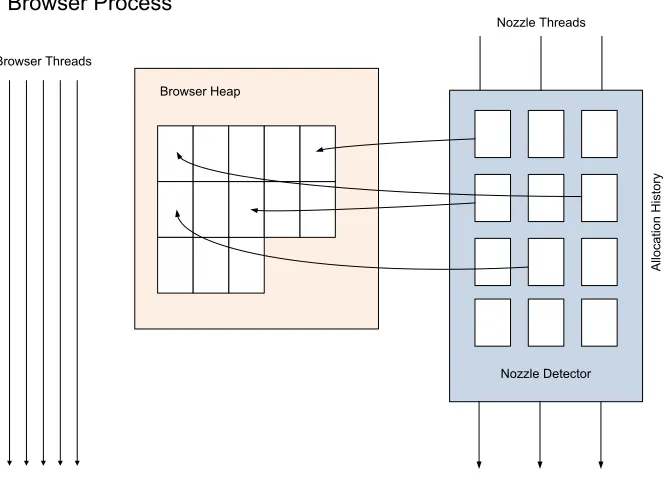
Working for Microsoft, Ratanaworabhan et al. proposed Nozzle [60] which performs static control ow analysis of parts of the heap, interpreting them as code segments to detect ma-licious content. Nozzle accomplishes that by intercepting common heap allocating function calls and gathering information about the heap, as well as its content. This technique is browser-specic and could potentially be detected by the attacker. As described by Nozzle, an attacker could time her heap sprays to avoid detection by this mechanism. Scanning heap objects via introspection requires no memory hooks and makes the entire guest operating system oblivious to heap analysis. Nozzle also poses a 10% overhead, which led to the de-velopment of an improved version of the programs called Zozzle [38]. The basic architecture of Nozzle is shown in gure 2.1.
Browser Threads
Browser Heap
Nozzle Threads
A
llo
ca
tio
n
H
is
to
ry
Nozzle Detector
Browser Process
Figure 2.1: Basic Nozzle Architecture
global "heap health". Its lightweight emulator scans heap allocated object data to identify validx86code sequences, disassembling the code and building a control ow graph. Because
2.3 Zozzle
Zozzle [38] was the next iteration after Nozzle in the work being done by Microsoft with regards to heap spray attacks. Zozzle is a low-overhead solution for detecting and prevent-ing JavaScript malware that is fast enough to be deployed in the browser. Its approach uses Bayesian classication of hierarchical features of the JavaScript abstract syntax tree to identify syntax elements that are highly predictive of malware. Zozzle is able to detect JavaScript malware through mostly static code analysis eectively. Zozzle has an extremely low false positive rate of 0.0003, which is less than one in quarter million. Despite this high accuracy, the Zozzle classier is very fast, with a throughput at over 1 MB of JavaScript code per second [38].
Zozzle is designed to perform static analysis of JavaScript code on a given site and quickly determine whether the code is malicious and includes an exploit. In order to be eective, the tool must be trained to recognize the elements that are common to malicious JavaScript, and the researchers behind it stress that it works best on de-obfuscated code. The Zozzle was trained by crawling millions of Web sites and using Nozzle, to process the URLs and see whether malware was present.
Zozzle is specically designed to detect and defend against heap-spraying exploits launched by malicious JavaScript found on Web sites. In many cases these days, that kind of exploit is hosted on a legitimate site that's been compromised and is being used as part of a drive-by download attack. Often, the code is hosted on a specic page for a day or even a few hours and then is taken down, either by the attacker or the site owner. it's been shown in [38] this, along with the multiple layers of obfuscation that attacker use to cloak JavaScript exploits, can make it dicult for automated tools to identify such malware with a high degree of accuracy.
consists of two parts: a context in which it appears (such as a loop, conditional, try/catch block, etc.) and the text (or some substring) of the AST node. For a given JavaScript context, it only track whether a feature appears or not, and not the number of occurrences. To eciently extract features from the AST, it traverses the tree from the root, pushing AST contexts onto a stack as it descends and popping them as it ascends. These features are then used in Zozzle to identify suspicious activity.
Zoozle was created to remove the main drawback in the Nozzle, that was it's heavy weight nature. Although Zozzle was faster than Nozzle but it still lack various feature [49] that allowed various malware to pass by it.
2.4 Rozzle
In recent years, attacks that exploit vulnerabilities in browsers and their associated plugins have increased signicantly. These attacks are often written in JavaScript and literally millions of URLs contain such malicious content.
While static and runtime methods for malware detection been proposed in the litera-ture [60] [38] [40], both on the client side, for just-in-time in-browser detection, as well as oine, crawler-based malware discovery, these approaches encounter the same fundamen-tal limitation. Web-based malware tends to be environment-specic, targeting a particular browser, often attacking specic versions of installed plugins. This targeting occurs because the malware exploits vulnerabilities in specic plugins and fail otherwise. As a result, a fundamental limitation for detecting a piece of malware is that malware is triggered infre-quently, only showing itself when the right environment is present. In fact, we observe that using current ngerprinting techniques, just about any piece of existing malware may be made virtually undetectable with the current generation of malware scanners.
Chapter 3
Heap-base Malware Detection
In this chapter we are going to discuss in detail our major contribution. We developed a robust tool to detect heap-based malwares using introspection in virtualized environment like Clouds. Section 3.1 discusses the Atomizer [45] which is a novel technique developed to detect malicious activities in the heap of a process.
3.1 Introduction to Atomizer
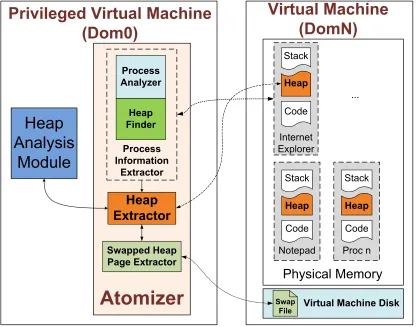
Atomizer which browses through the heaps of processes running inside VMs and looks for heap-based activities like heap spray. Atomizer runs on a privileged VM and uses VMI to access the heaps of the processes inside virtual machines running on a cloud server. Currently, only the heaps that are allocated by the operating system for the processes can be accessed by Atomizer. Application-generated heaps (e.g., those created by the Java Virtual Machine (JVM)) can also be examined by Atomizer, through available Atomizer APIs. Atomizer requires no changes to be made to virtual machine manager(VMM), VMs and the programs being monitored.
added. The most popular type of heap-based attacks are heap sprays [60], that's why in this chapter we are mainly focused on heap spray attacks, although Atomizer can also be used for detecting any heap-based attacks.
Heap Spraying techniques involve instructing client side languages such as JavaScript to allocate large blocks of heap memory (50-200MB) containing malicious shellcode and NOP sleds that "slide" into the shellcode. The nal piece of the puzzle relies on overwriting a function pointer to point to a random location within the large NOP sled heap object [2], which typically requires a separate exploit. Large blocks of heap spray can easily be detected by simple scans, however, newer and less intrusive heap spray attacks that more accurately manipulate the layout of the application heap layout increase reliability and precision, with-out the need for large blocks of heap spray. Techniques like Feng Shui Heap Spray [68] defragments and makes holes in the heap object to insure that the function pointer is readily available and positioned properly for smashing with a heap overow [39].
Techniques like JIT spraying [35] have been developed to bypass both ASLR and DEP. JIT spraying utilizes knowledge about a JIT compiler's architecture to spray the heap with executable code that can then be compiled by the JIT compiler. The JIT heap spray is constructed large enough to overwhelm and bypass ASLR. JIT spray uses return oriented programming (ROP) [61] gadgets to mark the heap pages as executable so that the contents of the pages can be executed. JIT spray uses a leaked pointer, which is essentially a random heap address, to jump to that location and follows the NOP sled down to the JIT shell code that is executed to exploit the system. Modern exploitation techniques, such JIT spraying, makes it even more important to look for malicious activities inside the heap of a process.
3.2 Atomizer Architecture
assume a typical cloud computing environment consisting of hardware, a VMM (or hyper-visor such as XEN [31]), guest VMs and a privileged VM (where Atomizer gains access the heap memory content using VM introspection). The reason behind the development of a real time out-of-VM heap spray analyzer as a proof of concept that ooading heap spray detection to the hypervisor has insignicant impact on the guest OS.
The rst component, Process Information Extractor, is responsible for determining the basic attributes of the process being monitored. These basic attributes of the process include the internal operating system structures that provide us with valuable information about the location of the process in physical memory. The location of the heap is extracted in the second step called Heap Finder. There might be various heaps in the process and the location of all of them are passed on to the next component, Heap Extractor.
Stack Code Internet Explorer
Virtual Machine
(DomN)
Process AnalyzerAtomizer
Privileged Virtual Machine
(Dom0)
Heap FinderHeap
Extractor
Heap
Analysis
Module
Information Process Extractor Heap Stack Code Notepad Heap ... Stack Code Proc n Heap Swapped Heap Page ExtractorPhysical Memory
SwapFile Virtual Machine Disk
The Heap Extractor component receives the physical memory locations of the heaps from the rst component of the Atomizer and extracts all the heap pages of the process. In a typical system some heap pages may be swapped out of physical memory for eciency, so the Atomizer architecture also has the capability to access pages that are currently swapped out. When the Heap Extractor module encounters a swapped heap page, it uses the Swapped Heap Page Module to access those pages. The Swapped Heap Page Extractor component of the Atomizer uses information about the guest OS' swapping architecture to access swapped pages.
The Atomizer is designed to work in a cloud environment to monitor multiple VMs run-ning in the environment using a single privileged system. The VMI interface provides access to the memory of all the VMs running on a single physical server. The Atomizer can browse through the heaps of all the processes running in these VMs with low performance impact, i.e., without using many of resources of the cloud server. The Atomizer has a modular design which allows adding support for various operating systems. The Heap Analysis Module part is also designed in such a way that adding additional modules to enhance heap analysis is very straightforward. In particular, the Heap Extractor module provides an application pro-grammable interface (API), allowing new heap analysis techniques to use the Heap Extractor API's to access heap memory. These API's can be used to detect any type of heap-based attacks.
3.3 Atomizer Implementation
3.3.1 Process Information Extraction
Windows operating systems maintain information about executing processes in Process En-vironment Block (PEB) structures. In this part of the implementation, Atomizer looks for memory address of the PEB structure of the process. It goes through known memory ad-dresses to locate the PEB structure using appropriate PEB signatures [62]. Once the location of the PEB structure is found the information regarding the process is extracted from it. That information includes the location of the heaps, number of heaps available and maxi-mum number of heaps allowed by the OS. This information is then forwarded to the next component of the Atomizer.
Algorithm 1 Heap Memory Browsing using VAD tree for i= 0x7F F D0000 to0x7F F DF000 do
if ((5 ==i+ 0xa4)&&(1 ==i+ 0xa8)) then
PEB =i
break; end if end for
HEAPNUM:=PEB + 0x88
HEAPADDRESS:= PEB + 0x090
heapCounter:= 0
while heapCounter< HEAPNUM do
HEAPNODE := HEAPADDRESS +(4∗heapCounter)
segmentCounter :=0
while segmentCounter <64 do
HEAPSEGMENT:=HEAPNODE + 0x58 + (4∗segmentCounter)
HEAPENTRY:= HEAPSEGMENT +0x20
while (HEAPENTRY +0x005)6= 0 do
HEAPSIZE :=HEAPENTRY
READ_MEMORY(HEAPENTRY, HEAPSIZE) HEAPENTRY :=HEAPENTRY + (HEAPSIZE * 8)
end while
segmentCounter++ end while
3.3.2 Heap Extractor
The Heap Extractor component of Atomizer provides the main facility for browsing through the heap of the process using the virtual address descriptors (VAD) obtained via introspec-tion. The memory manager in Windows maintains a set of VADs that describes the status of the process's address space [62]. To nd the VAD tree of a process being monitored, it uses the process environment block structure (PEB) information received from Process Informa-tion Extractor. Using this informaInforma-tion, it browse through all the heap nodes, heap segments, and heap entries in various heaps of a process. Algorithm 1 describes the algorithm used to browse through the entire heap. If a heap page entry is in the VAD tree and not in physical memory, than there is a possibility that the heap page has been swapped out of memory. As modern heap sprays do not require large amounts of NOP sleds, it is important that those heap pages are also examined. Details of how it access pages that are swapped out are provided in Section 3.3.3. Heap extractor can access the page memory both page by page and byte by byte. This facility has been provided to facilitate various algorithms that might perform better with either of these memory access methods. This implementation uses the page by page access method to extract one page at a time from the heap and send it to the Heap Analysis Module (discussed in Section 3.3.4).
3.3.3 Swapped Heap Page Extractor
When the Atomizer needs to access a swapped out page, it follows a procedure similar to that of the guest OS. We can describe this method as a two-step process where in the rst step, the Atomizer retrieves the page le number and the page oset and in the second step, it uses this information to obtain the value of the virtual address from the page le.
Algorithm 2 Simple NOP Sled Detection
NOPZ ← HASH-TABLE of NOPs/NOP-replacements
LIMIT ← 150
BUFFER ← Memory buer from Heap size=SIZE
SKIP← 1
index :=0
nops :=0
skipped:=0
while index <SIZE do
if NOPZ[ BUFFER[index++] ] then nops++
else if skipped <SKIP then
skipped++ else
nops :=0
end if
if nops == LIMIT then
NOP sled detected end if
end while
3.3.4 Heap Analysis Module
The heap memory received from the heap extractor can be analyzed in the Heap Analysis Module. Various algorithms may be used here to determine whether the heap of the process contains malicious contents or not. Some techniques like STRIDE [34] and ECL-Polynop [42] use sequential analysis of network packets to detect NOP sleds in network trac, rather than in the process heap itself. Using the same model in this implementation, I implemented a simple Polymorphic NOP detection algorithm to detect the presence of NOP sleds in the heap using sequential analysis of the heap data. This implementation uses the Atomizer architecture to sequentially go through the heap memory and compares each byte of data with a hash table of NOPs and NOP replacements. The algorithm keeps tracks of sequences of NOPs/NOP replacements found and if the length of these sequences are beyond a certain limit it raises a ag. The sequence limit used in our experiments was 150 NOPs. This limit was selected because it gave no false positives in our experiments. This simple NOP sled detection algorithm is depicted in the Algorithm 2. This module demonstrates that Atomizer architecture provides a simple way of implementing these kinds of algorithms in the heap analysis module to detect NOP sleds. The presence of NOP sleds typically means that malicious content is present in the heap.
3.4 Atomizer Evaluation
3.4.1 Experimental Settings
bit Window XP (SP2) installation to make sure that all VMs are identical. We also used the introspection library for VMI (libvmi-0.6) [17] and libguestfs [16] in all the experiments.
3.4.2 Malware Detection
To test the eectiveness of Atomizer was tested against various types of heap sprays com-monly found on the web, as well as some custom made heap spray programs.
Simple Heap Spray
The rst set of experiments involved the Skypher heap spray generator [9], an example of a simple heap spraying technique. Dierent variants of Skypher were tested on both Internet Explorer and Mozilla Firefox. Atomizer eectively detected the heap spray with no false positives. Atomizer was also tested against another known heap spray attack, Aurora [8]. This types of heap spray demonstrated some simple obfuscation techniques to hide the payload. The payload in Aurora was encrypted using the JavaScript libraries and decrypted at run time. The Atomizer detected the heap spray without any false positives.
Polymorphic NOP Sled Detection
kits like ADMutate [1], which contains the biggest public list of NOP replacements [42]. NOP sleds that might include unknown NOP replacements may not be detected by this im-plementation but newly discovered NOP replacements may potentially be added seamlessly to our hash table. This implementation successfully detected the polymorphic NOP sleds without any false positives.
Heap Feng Sui
The Atomizer was tested against a state of the art exploit, Heap Feng Shui [68]. Heap Feng Shui is a deterministic heap spray that reduces the amount of heap spraying required for the exploit. Heap Feng Shui uses the HeapLib (a JavaScript heap manipulation library) to defragment the heap so that it can align the heap nodes and consequently requires a smaller size of heap spray to execute the exploit. The Atomizer was able to detect this exploit which shows its eectiveness against state of the art exploits.
3.4.3 Experimental Performance Analysis
An experimental performance analysis of the Atomizer with respect to CPU resource utiliza-tion was done to determine the eect of heap spray detecutiliza-tion on the cloud environment. The main purpose of these experiments was to determine the CPU resources used by Atomizer. For performance evaluation purposes in these experiments, the Atomizer was allowed to con-tinue scanning the heap even after the heap spray block was found. For better performance the detector should be stopped when the rst sign of malicious activity is raised.
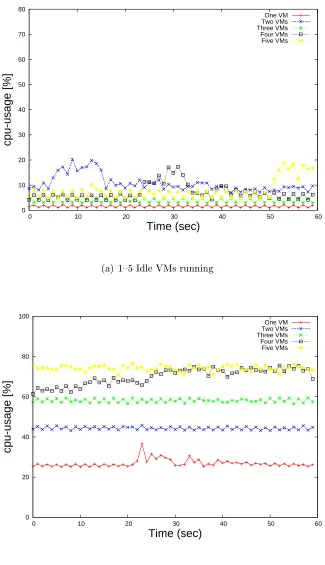
The Atomizer was run as a multi-process application to monitor all the virtual machines running on the server. The current multi-process implementation of Atomizer works around a lack of thread safety in the libVMI library, an issue that we are currently working to address. The Figure 3.2(b) shows the eect of Atomizer on the CPU. The Figure 3.2 shows the cumulative CPU usage of all the Virtual CPU's (VCPU) on the server (in this case there were eight VCPUs). This shows the overall eect of all the applications, including Atomizer and VMs on the CPU usage. Xentop [31] (the tool used in this experiment to measure the CPU usage) adds up the percentage of all the VCPUs available to the system. The rise in the CPU usage is due to the processing needed by the light load running on the VMs plus the eect of Atomizer. The multi-process nature of the Atomizer also exerts more load on CPU. This limitation can be removed by implementing a multi-threaded version of Atomizer, a project that we have currently underway. The average CPU load increased incrementally, that shows that Atomizer has acceptable performance and is scalable.
3.4.4 Conclusion
0 10 20 30 40 50 60 70 80
0 10 20 30 40 50 60
cpu-usage [%] Time (sec) One VM Two VMs Three VMs Four VMs Five VMs
(a) 15 Idle VMs running
0 20 40 60 80 100
0 10 20 30 40 50 60
cpu-usage [%] Time (sec) One VM Two VMs Three VMs Four VMs Five VMs
(b) 15 VMs with light load & Atomizer
Chapter 4
Conclusion
the malwares that are only specic to them. The large scale deployment of our tools is also a unique feature. As they are designed to monitor a Cloud environment they can be used to observe large number of VMs at the same time without putting unnecessary load on the Cloud Servers and with out making huge changes to the code. This provides a great feature for our tools to be deployed quite easily in an environment like Clouds, which was designed to use the physical power of the machines to the maximum by deploying large number of VMs at the same time. This also provided us with certain challenges that are not available in the non-virtualized environment. We had to look at the memory of the VMs as a whole and use various signatures to gure out where dierent applications were located (running in the memory) and then look for the heap and other memory area and structures in those applications. Inside the VMs this thing can bee done using system libraries directly which is considered as their weakness because the malware can detect the presence of these monitoring tools and possibly disable them, which is not possible in our scenario. This also give us more control over the analysis, that was not available inside the VMs.
Atomizer provides us with the capability to look through the heap of any type of process running inside the virtual machines. This is like a library which can be used to create tools, which are trying to detect malicious activity inside the heap. The dynamic nature of the heap is quite challenging for any tools to detect and analyze the heap directly. Most tools rely on indirect methods for the detection of heap-based malware. This can reduce the reliability of these tools to certain extant and makes it possible for malwares to detect the presence of a detection mechanism. Atomizer not only analyzes the whole heap but also checks for malicious activity in the heap pages that have been swapped out of the main memory. These features are unique to our tool and keep the false positive to the minimum.
Bibliography
[1] Admutate. http://www.pestpatrol.com/zks/pestinfo/a/admmutate.asp.
[2] Advanced heap spraying technique. http://www.blackhat.com/presentations/ bh-europe-07/Sotirov/Presentation/bh-eu-07-sotirov-apr19.pdf.
[3] Amd. http://www.amd.com/.
[4] C explorer. http://www.ntcore.com/exsuite.php.
[5] Data execution prevention. http://technet.microsoft.com/en-us/library/ cc738483.aspx.
[6] Digital signatures for kernel modules. http://msdn.microsoft.com/en-us/library/ bb530195.aspx.
[7] Hacking with linux kernel module. http://newdata.box.sk/raven/lkm.html.
[8] Heap spray exploit tutorial: Internet explorer use after free au-rora vulnerability. http://grey-corner.blogspot.com/2010/01/ heap-spray-exploit-tutorial-internet.html.
[9] Heap spray generator. http://skypher.com/SkyLined/heap_spray/small_heap_ spray_generator.html.
[10] Heavyload. http://www.jam-software.com/heavyload/.
[11] Hooking the kernel directly. http://www.codeproject.com/Articles/13677/ \Hooking-the-kernel-directly.
[12] Idtguard. http://www.msuiche.net/2006/12/10/idtguard-v01-december-2005-build/. [13] Inline hooking in windows. www.exploit-db.com/download_pdf/17802/.
[14] Intel. http://www.intel.com/.
[15] Kvm. http://www.linux-kvm.org/page/Main_Page/. [16] Libguestfs. http://libguestfs.org/.
[18] Microsoft. http://www.microsoft.com/.
[19] Microsoft hyper-v. http://www.microsoft.com/en-us/server-cloud/ hyper-v-server/default.aspx.
[20] Ollydbg. http://www.ollydbg.de/.
[21] Opdis. http://mkfs.github.com/content/opdis/. [22] Openssl. http://www.openssl.org/.
[23] Osr driver loader. http://www.osronline.com/article.cfm?article=157. [24] Parallels. http://www.parallels.com/.
[25] Peering inside the pe: A tour of the win32 portable executable le format. http: //msdn.microsoft.com/en-us/library/ms809762.aspx.
[26] Qemu. http://wiki.qemu.org/Main_Page.
[27] Sql slammer. http://www.sans.org/security-resources/malwarefaq/ ms-sql-exploit.php.
[28] Virtual pc. http://support.microsoft.com/kb/958559. [29] Vmware. http://www.vmware.com.
[30] Volatility. http://code.google.com/p/volatility/. [31] Xen. http://www.xen.org/.
[32] Irfan Ahmed, Aleksandar Zoranic, Salman Javaid, and Golden G. Richard III. Mod-checker: Kernel module integrity checking in the cloud environment. In ACM symposium on Applied computing, 4th International Workshop on Security in Cloud Computing (CloudSec '12), September 2012.
[33] Irfan Ahmed, Aleksandar Zoranic, Salman Javaid, Golden G. Richard III, and Vassil Roussev. Idtchecker: Rule-based integrity checking of interrupt descriptor tables in cloud environments. In Proceedings of the 9th IFIP WG 11.9, International Conference on Digital Forensics, Orlando, Florida, January 2013.
[34] Periklis Akritidis, Evangelos P. Markatos, Michalis Polychronakis, and Kostas G. Anag-nostakis. Stride: Polymorphic sled detection through instruction sequence analysis. In 20th IFIP International Information Security Conference (IFIP/SEC), Makuhari-Messe, Chiba, Japan, May 2005.
[35] Dion Blazakis. Interpreter exploitation: Pointer inference and JIT spraying. In BLACK HAT DC, Arlington, VA, US, January 2010.
[37] Marco Cova, Christopher Kruegel, and Giovanni Vigna. Detection and analysis of drive-by-download attacks and malicious javascript code. In International World Wide Web Conference, Raleigh, North Carolina, US, April 2010.
[38] Charles Curtsinger, Benjamin Livshits, Benjamin Zorn, and Christian Seifert. ZOZ-ZLE: Low-overhead mostly static javascript malware detection. In USENIX Security Symposium, San Francisco, California, US, August 2011.
[39] Mark Daniel, Jake Honoro, and Charlie Miller. Engineering heap overow exploitswith javascript. In WOOT: Proceedings of the 2nd conference on USENIX Workshop on oensive technologies, San Diego, California, US, 2008.
[40] Francesco Gadaleta, Yves Younan, and Wouter Joosen. Bubble: a javascript engine level countermeasure against heap-spraying attacks. In Proceedings of the Second in-ternational conference on Engineering Secure Software and Systems, ESSoS'10, pages 117, Berlin, Heidelberg, 2010. Springer-Verlag.
[41] T. Garnkel and M. Rosenblum. A virtual machine introspection based architecture for intrusion detection. In Symposium on Network and Distributed System Security (NDSS), Feb 2003.
[42] Yuri Gushin. http://www.ecl-labs.org/papers/ecl-poly.txt.
[43] Fraser Howard. Malware with your mocha? obfuscation and anti-emulation tricks in malicious javascript, September 2010. http://www.sophos.com/security/ technical-papers/malware_with_your_mocha.pdf.
[44] G. Hoglund J. Butler. Rootkits: Subverting the Windows Kernel. Addison-Wesley, Boston, 2005.
[45] Salman Javaid, Irfan Ahmed, Aleksandar Zoranic, and Golden G. Richard III. Atomizer: A fast, scalable and lightweight heap analyzer for virtual machines in a cloud environ-ment. In Proceedings of the 6th Layered Assurance Workshop (LAW'12), in conjunction with the 28th Annual Computer Security Applications Conference (ACSAC'12), Or-lando, Florida, December 2012.
[46] Kad. Handling interrupt descriptor table for fun and prot. http://www.phrack.org/ issues.html?issue=59&id=4&mode=txt.
[47] Kimmo Kasslin. Kernel malware: The attack from within. In 9th Annual Association of anti-Virus Asia Researchers Conference (AVAR), Auckland, New Zealand, December 2006.
[48] E. Kirda, S. Jha, and D. Balzarotti. Toward revealing kernel malware behavior in virtual execution environments. Lecture Notes in Computer Science, 5758:304325, 2009. [49] Clemens Kolbitsch, Benjamin Livshits, Benjamin Zorn, and Christian Seifert.
[50] Greg Kroah-Hartman. Signed kernel modules. Linux Journal, 117:4853, 2004.
[51] Aaron LeMaster. Heap spray detection with heap inspector. In Blackhat USA, Las Vegas, Nevada, US, 2011.
[52] Haifei Li and Guillaume Lovet. Adobe reader's custom memory man-agement: a heap of trouble. http://www.fortiguard.com/paper/ Adobe-Reader-s-Custom-Memory-Management-a-Heap-of-Trouble.
[53] Peter A. Loscocco, Perry W. Wilson, J. Aaron Pendergrass, and C. Durward McDonell. Linux kernel integrity measurement using contextual inspection. In ACM workshop on Scalable trusted computing, STC '07, pages 2129, New York, NY, USA, 2007.
[54] Kristis Makris and Kyung Dong Ryu. Dynamic and adaptive updates of non-quiescent subsystems in commodity operating system kernels. In EuroSys, pages 327340, Lisbon, Portugal, March 2007.
[55] P. Mell and T. Grance. The NIST denition of cloud computing. Technical report, National Institute of Standards and Technology, Information Technology Laboratory, 2007.
[56] mxatone and ivanlef0u. Stealth hooking : Another way to subvert the windows kernel. http://www.phrack.org/issues.html?issue=65&id=4.
[57] Walter Oney. Programming the Microsoft Windows Driver. Microsoft Press, New York, second edition edition, 2002.
[58] B.D. Payne, M.D.P. de Carbone, and Wenke Lee. Secure and exible monitoring of virtual machines. In Computer Security Applications Conference, 2007. ACSAC 2007. Twenty-Third Annual, pages 385397, 2007.
[59] Alin Rad Pop. Dep/aslr implementation progress in popular third-party windows ap-plications anti-emulation tricks in malicious javascript, June 2010. http://secunia. com/gfx/pdf/DEP_ASLR_2010_paper.pdf.
[60] Paruj Ratanaworabhan, Benjamin Livshits, and Benjamin Zorn. NOZZLE: A defense against heap-spraying code injection attacks. In USENIX Security Symposium, San Francisco, California, US, August 2009.
[61] Ryan Roemer, Erik Buchanan, Hovav Shacham, and Stefan Savage. Return-oriented programming: Systems, languages, and applications. ACM Trans. Inf. Syst. Secur., 15(1):2:12:34, March 2012.
[62] Mark E. Russinovich, David A. Solomon, and Alex Ionescu. Microsoft Windows inter-nals. Microsoft Press, fth edition, 2009.
[64] A. Seshadri, M. Luk, E. Shi, A. Perrig, L. van Doorn, and P. Khosla. Pioneer: verifying code integrity and enforcing untampered code execution on legacy systems. In Twentieth ACM Symposium on Operating Systems Principles, pages 116, 2005.
[65] Hovav Shacham, Matthew Page, Ben Pfa, Nagendra Modadugu, and Dan Boneh. On the eectiveness of address-space randomization. In ACM Conference on Computer and Communications Security, Washington, DC, US, October 2004.
[66] A. Silberschatz, P. B. Galvin, and G. Gagne. Operating System Concepts, 8th Edition. John Wiley and Sons, Inc., Hoboken, New Jersey, 2009.
[67] Skywing Skape. Bypassing patchguard on windows x64. http://uninformed.org/?v= 3&a=3&t=sumry.
![Table 1.1: DEP and ASLR Deployment Status (May 2008) Source [59]](https://thumb-us.123doks.com/thumbv2/123dok_us/8927871.1845859/20.612.126.484.440.704/table-dep-aslr-deployment-status-source.webp)