Islamic Republic of lr.ltl Spring 1372 May 1993
SCREENING FOR STARCH-HYDROLYSING
BACTERIA
RAZIEH YAZDANPARAST
From the Instilute of Biochemistry and Biophysics. Tehran University of Medical Sciences, Tehran, IsIWllic Republic of Irati.
ABSTRACT
Screening of3000 soil samples collected from cities of four different provinces of
Iran for starch-hydrolysing bacteria revealed that the nature is enriched with
Streptomyces species capable of producing amylolytic enzymes. Among the bacterial
isolates, one of the high starch-degrading strains was selected for further microbio
logical identification and also amylolytic enzyme(s) characterization. The purified
isolate, Streptomyces species strain R Y 48, produces almost four times more amylo
lytic enzyme(s) than
Bacilllls slIbtilis (PTCC
1254)
on agar plates. Based on the action
pattern of its amylolytic enzymes on the boiled maize starch, the purified species
possesses in the logphase an amylolytic activity which is different from the amylo
lytic activity of the stationary phase. The secreted amylolytic enzymes which are both
en do lytic type and show different activity bands on native polyacrylamide gel, act
independently on starch molecules.
M.lIRI, Vol
.7, No.1, 35-41,1993.
Keywords: Amylolytic enzymes, amylases. raw-starch. Streptomyces.
INTRODUCTION
Starch, as a major component of agricultural crops, is an important source for conversion into materials used mainly in foods. drinks. textiles, adhesives, and pharma ceutical industries. Enzymatic hydrolysis of poly sac char ides such as starch and glycogen into oligosaccharides or simple sugar constituents is achieved by different amylo lytic enzymes produced by a variety of microorganisms. Amylases (such as: �-amylase, �-I ,4-D-glucan gluconohydrolase, EC 3.2.1.3.) are among the most biotechnologic��ly applied runylolytic enzymes.'"
These: enzymes are isolated from a variety of microbial sources: �-amylase is produced mainly by Bacilllls slIbliiis, B. Amyloliqae/acicns, and Aspergillus oryzae: and glucoamylase is produced by Rhizopus species and Asperigillus niger.3•G
Regarding the fact that the enzymatic hydrolysis of native starch granules requires precooking of starch into a starch solution. the elimination of this energy-consuming step from the starch-processing steps is of great interest to
35
starch-processing industries. Achievement of this goal is sought in the replacement of the presently used enzymes with
(1)
mixed amylolytic enzyme system(s), and lor (2) raw- starch hydrolysing enzymes purified from new micro organisms. The significance of the first approach can be implied from the simultaneous action of bacterial <x-amy lase and fungal glucoamylase on starch molecules. It has been indicated by Fajii and co-workers tlmt tlle hydrolysis of starch molecules by combined action of �-mnylase and glucorunylase is almost twice as much as the sum of the corresponding actions of sale oc::-amylase and sale glucomnylmic systems.7•S This positive cooperativity be-t ween be-the be-two enzymes is explained be-to be due be-to be-the gradual substrate release for glucoamylase by the nmdom cndolytic splitting action of oc::-mnylase on starch mol ecules. Despite the more efficient hydrolysis of starch molecules by tht! mixed-enzyme system, the industrial application of this method is limited due to the end-product inactivation ofoc-mnylaseand glucoamylase. Therefore. it appears that the elimination of energy-consuming step (precooking) in starch-processing industries couldStarch-hydrolysing Bacteria
(B)
Fig. 1. Selective isolation of starch-hydrolysing bllctcrin by bail ing technique. Bacterial Colonies showing clear zones after naaling with Lugol's iodine solution arc counted as starch· hydrolysing microorganisms, A; Clear zones formed by B. SlIbliiis (a) and the purified strain
RY48 (b), B.
ably be achieved in the future by using a single enzyme
capable of hydrolysing raw-starch molecules or a mixed
enzyme system whose enzyme constituents are derived
from a single microorganism.
Our Imun research goal was to investigate the nature of
lrim for its bacteria capable of hydrolysing raw starch
molecules by their corresponding arnylolytic enzyme(s)
and further to characterize these enzymes for further aim
of e10ning the corrcsponding genes and ,malysing their
struCLUre for design of an efficient expression system oCthe
genes (or genetically engineered genes) in a suitable host
vector.
MATERIALS AND METHODS
Materials:
Bacterial oc-arnylase (695 units/mg solid),
mold glucoarnylase (6.3 units/mg solid), ,md maize sUlrch
were purchased from Sigma Chemical Co; acetone.
dinitrosalicylic acid, propan-2-I, and lactic acid were from
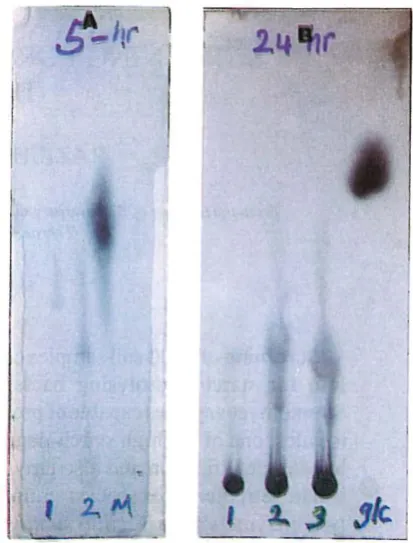
Fig. 2. Thin�layer chromatography of the products formed from starch solution in five hours (A) and twenty two hours (8). The action pattern of enzyme(s) present in 48-hour, 1; 120-hour, 2; and combined, 3; culture supernatants are shown along with reference compounds: 0.1% maltose (M) and 0.1% glucose (glc).
Aldrich. Silica gel plates (0.25 mm) were obtained from
MacHerey-Nagel Co. nutrient broth �U1d agar were from
Difco, and polyacrylamide. N.N-bisacrylarnide, TEMED,
and ammonium persulfate were purchased from Phannacia
ILKB.
All experiments were performed in glassware, [md
distilled water with conductivity of 4 to 5 was applied
throughout the investigation. All materials were applied
for the investigation without further purifications.
Microorganisms:
All bacteria were isolated from soil
samples which were collected from different areas of
Tehran. Karaj, Rasht, Ahvaz, and Babolsar.
Media:
The media used for the screeing were Medium
A (gil): nutrient agar. 30; maize sutrch, 2; agar, 15; and
medium B (gil): nutrient agar. 30; agar, 15. After
autoelaving toabout 40°C, autoelaved raw maize starch,
2,
was added to the solution. Enzyme production Medium
(gI
I) consisted of nutrient broth, 16; maize starch, 2.
Screening: Method I.One gram of each moist soil
sample was suspended in 3 ml sterile water, mixed, and
then streaked onto the plates of Medium A described
above. The plates were incubated at 37°C for 24 to 76
hours. Bacteria that formed large clear zones, in comparison
to the corresponding zone produced by
Bacil/lls slIbtilis(PTCC 1254) were further purified by plating on tile smne
plates until purified single colonies were obtained. Each of
the selected isolates were then spotted onto agar plates of
Medium B. The plates were incubated in a moist incubator
at 37"C for 120 hours. The bacteria which formed clear
zones of 2 mm or morc around lheir corresponding colonies
were selected for identification and furtiler studies.
Method 2.
We used the method described by Umesh
Kumar') with minor modifications for selective screening of
soil smnples. Raw. healthy pealed potato discs were buried
in very moist soil samples and kept at room tempemture
(27-28°C). After 48 hours of baiting. the discs were
supcrificially washed with sterile water and kept in sterilized
petri dishes in an incubator for 48 hours at 37°C. Potato
discs were then ground in sterile water and serial dilutions
of each potato disc were plated onto agar of Medium A and
kept in an incubator at 37°C. Furtherprocesses of purification
were the srune as
described in metitod
I.
Enzyme Production.
The purified microorganism of
interest was grown in 10 mL of enzyme production medium
for 24 hours at which was found to be the best tempemture
for growth. 2 mL of the inoculate was then tmnsferred to
100 mL of the SlOne medium and kept at 37°C up to 120
hours while shaking at 90 rpm. The broth was then centri
fuged at 3000 rpm for 20 min at 4°C. The supernatant was
used to determine the total protein content �U1d to assay for
nmyJolytic enzyme activities.
Protein Determination.
Protein content of the culture
supernatant was assayed using the method of Lowry'" with
bovine serum albumin as sk"Uldard.
Enzyme Activity.
The reaction mixture consisting of
400 � of a 2.S% (WN) maize starch solution in acetate
buffer (O.OS M sodium acetate
+0.05 M acetic acid.pH S.3)
and 200 � of tile culture superna!.1nt plus 1400 �L acetate
buffer. was incubated at 37°C for up to
6
hours and lor
overnight. Samples were taken at different time intcrvals.
After removal of residual starch granules by centrifugation
at 3000 rmp for 10 min. the reducing sugar liberated was
detennined by the dinitrosalicylicacid method Witil m�dtose
as the standard.
IIOne unit of sacchmifying activity was
defined as tile amount of enzyme which liberated
I
mg of
reducing suger in I hr under the assay conditions. After
6
hours. the remaining re..1ction mixture was centrifuged and
the supernatant was boiled for S min to deactivate the
enzymes and kept at 4°C for thin layer chromatography
examination of the products.
Thin Layer Chromatography (TLC).
S
�
of each
sample was spotted on silica gel plates and developed in tile
following solvent system: prop'm-2-OI: acetone: 1M lactic
acid (4:4:2). After completion of chromatography. tile
plates were sprayed with a reagent consisting of aniline (4
mL), diphenylmnine (4 g). acetone (200 mL) ,md 85%
H,PO, products appeared as blue spots on the white
background of the silica gel plates.
37
2
Fig. 3. Native polyacrylamide gel electrophoresis of the 48-hour (Lane 1) and 120-hour (Lane 2) culture supernatants of the purified microorganism. strain R Y 48. Non-denatured elcctrophorsis was achieved according to Lacks and Spnnghorn's technique. Jl Gel thickness, 1.5 mm.
Gel Electrophoresis.
Discontinuous native polyacrylrun
ide gel electrophoresis was achieved at SO rnA conS!.1nt
current according to the metilOd described by Laks and
Springhorn." The gel thickness W'L' I.S mm. The enzyme
b:mds were detected after electrophoresis using boiled
soluble maize starch as described in reference 13.
Semi· Identification of the Bacterial Isolates.
Cul
tural. morphological. and some of the biochemic�d charac
teri7
.
.
ations of the purified microorg;:misms were perfonned
according to Capuccino and Shennans Manual."
Bacilllls slIbtilis(PTCC 1254) and
Streptomyces rimoslIs(PTCC
1143) were used as references. The results were an:dysed
using "Bergey's Manual of Systematic Bacteriology.""
RESULTS
Screening for Starch Hydrolysing Bacteria
Resultsof burying potato discs in low-depth soil $lunples
to bait for starch-hydrolysing bacteria indicated the abun
d:mce of these microorganisms in top layers of soil. As
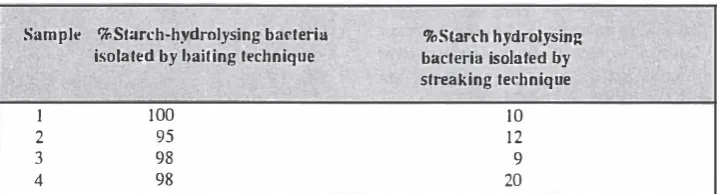
shown in Table I. baiting of soil srunples with potato discs
as a nutrient assisted the enrichment of s!.vch-hydrolysing
bacteria on the potnto discs and consequentiy their selec
tive isolation from soil in comparison to streaking method
of screening. As indicated in Fig. 1. almost all microbial
Starch-hydrolysing Bacteria
Table I. Occurrence of starch-hydrolysing bacteria in four soil samples* collected from Karnj. Bacteria were isolated by streaking (method 1) and bailing (method 2) techniques.
Sample %Slarch-hydrolysing bacteriu isolated by haiting technique
I 2 3 4
100 95 98 98
%Starch hydrolysing
bacterin isolated
by
streaking technique10 12 9 20
'" The soil samples have been collected from the lOp layer ground with a depth oflc.<;s than 5 centimeters.
Table II. Comparison of the
bIn
ratios of the purified amylolytic isolates to the corresponding ratio of B. sllblilis (PTCC 1254) in a time course investigation.Strain b/a
No.
24 hr 48 hr
72
hr 96hr 120 hrFY47 3.5 4.5 5.3 6.3
RY48 4.0 4.3 4.0 3.9
RYT6 2.7 3.5 3.6 3.7
RY34 2.7 3.3 4.8 3.6
B. sllbrilis 1.4 1.4 1.2 1.1
'" bIn = b, the diameter of the clear zone; n, the diameter of the bacterial colony, both quantities in centimeters.
colonies indicaled clear zones around Iheir corresponding colonies afler adding Lugo!'s iodine solution on !he plales. Using !he selective method of baiting, a total of3000 soil samples were screened primarily for starch-hydrolysing bacteria. Microorganisms which possesed the largest bla ratio [ratio of clear zone diameter (b) tocolony diameter (a)J were picked up for further investigation. Using this criteria, and Bacilllls SlIblilis
(PTCC 1254)
as the reference and under all identical growth conditions, five microorganisms were selected with bla ratio of more timn twice the bla ratio of B. SlIblilis in the first 96 hours of growlh (TableII). 111e
selected microbial species were then spOiled on agar plales of Medium B which contained raw maize starch granules and kept aI37'C
in a low-moist incubator for 96 to 120 hours. Using Lugo!'s iodine solution, it was shown timt :�I Ihe purified isolates are capable of producing a clear zone around their corresponding colonies (dala not shown). However, Ihe diameter of the clear zones were fromI
103
mm larger than the corresponding colonies' dimneters. In addition, the clear zones became apparent afler almost 48 hours of growth. 111is obserVaiion is in contrasl to the appearance of the clear zone around the colonies on agar plates of Medium A which usu:�ly appeared in the first 10 1015 hours of growth. One of the isolates. strain No. RY 48. which grows faster th:m the strainRY47
(TableII)
was selected for further slUdies.Characterization of the Isolated Microorganism, Strain RY48
Some of !he characleristics of strain
R Y 48
are shown in Table III. However, chemotaxonomical studies wilh the detennination of DNA base compositions, which were nol perfonned in the present work. are very necessary for definitive identifiCaiion of Ihis microorganism. Based on the phenotypic properties, tile isolaled microorganism belongs to !he genus Streptomycetes. Alihough definitive species identification has not been done yet, tentmively, we named tht: purified microorg,mism Streptomyces sp. slrainR Y 48.
Properties of Amylolytic Enzyme(s) Produced by Str:lin RY48
The action pallern of :unylase(s). produced by strain
RY48.
on maize starch solution showed thal lhe isolated strain possesses at le'L't two kinds of amylolytic activities.As shown in Fig. 2, in the first
48
hours of growth :menzyme is produced which hydrolyses starch molecules into oligasaccharides different from the major product(s) fanned from the 120-hourof the hydrolysates, the product of the lallerenzymaticactivily has higher molecular weights than the producl(S) of the fonner enzymic activity. Time
dependent hydrolysis of slarch molecules by
48
and120-hour cuilure supl!rnm:.mls showed that tilt! action pattern of
5,---,
5,---,
4
/
/
/
/
//.
/
/
/0
/
all
/
/
_--0
;//...-
;
4
®
/
/
I
I
I.
"
0/
/
/ / I .../
/
J://-'-''''''-
--- <>
/(I
�-�!_-__:''--___:!:__-___7-
...J
o 2 3 4 2
Rcnction lime, hr
3 4
Rcaclion lime, hr
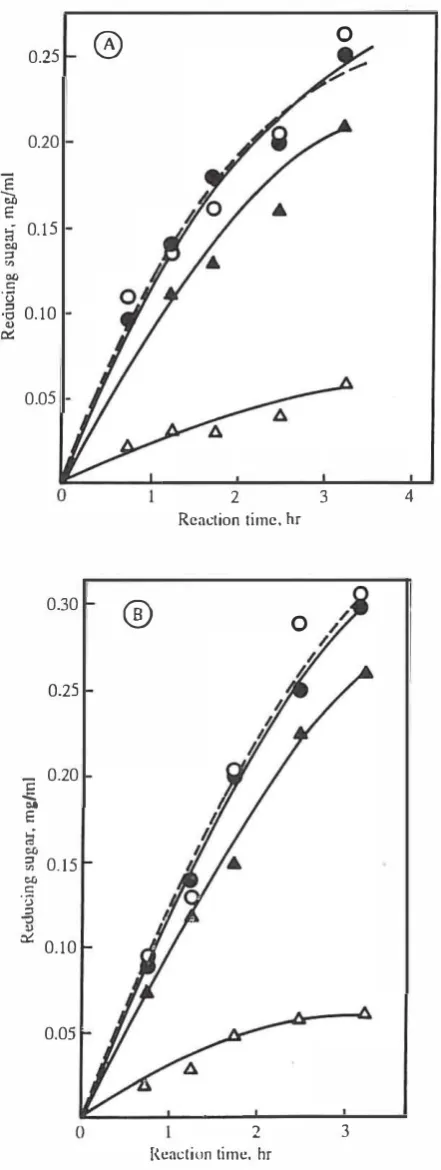
Fig. 4. Reducing sugar formation by Ihe mixed enzyme system of a.amylase (26 u/mL) and gJucoamyJasc (0.1 u/mL) in time course experiments at a starch concentration of 5 mglmL (A) and 10 mg/mL
(B).
Solid line = observed dat .. ,; broken line = calculuted dala.bOlh kinds of amylolytic activilies remained unchanged during 22 hours of reaclion and no significanl amounl of monosaccharides were detected in the reaction mixtures using
TLC
lechnique. TIlese observations indicaleIhal
both amylolytic activilies arc of endolylic type. It is inleresling 10 nole Ihe presence of two different clear zones on Ihe agar plale too (Fig. I b). This observation maysuppon Ihe exislance of al leasl two kinds of hydrolylic activities on starch molecules. Native polyacrylamide gel eleclrophoresis of Ihe 48- and 120-hour culture superna lanls followed by assaying for mnylolytic aClivities indi
cated differenl activity bands. As shown in Fig. 3, Ihe
120-hOllr culture supernatant is mainly enriched of labeled a as compared to U,e enzymes of the 48-hour-culture
superna-Table Ill. Phenotypic Charaterization of Strain RY48
Cultural Characteristics Nutrient agar colonies:
Nutrient agar slant S'lbouraud·dcxtrose
agar colonies
Nutrient broth
Morphological Characteristics
nat, yellowish, slightly more than ·moderate growth, wet
Oat. yellowish. moderate growth. wet
No growth
light turbidity. moderate growth
Mycelium forming on agar plate with 1015 of branches, fragile mycelium, broken easily
into irregular-size rods with slight agitation, non-spore forming. non-acid fast, Gram negative.
Biochemical Characteristics
VP - test MR - tesl Starch hydrolysis Cascin hydrolysis
Nitrate to Nitrite conversion Acid fonnation from glucose Acid formation from maltose Acid formation from galactose
'" VP test= Voges-Proskaucr test *>Ie MR tcst::: Methyl Red test
+
+
+ + +
39
Starch-hydrolysing Bacteria
0.25
0.20
{.
E;i 0.15
eo"
� eo � ·0
.g 0.10
�'"
0.05
o
0.
30
0.25
_
0.20
�"fa
E
;i
eoa 0.15
eo � 'G"
'E
0::0.10
0.05
o
o
®
2
3Reaction lime.
hr
o
2
Reactiun time. hr
o
4
3
Fig. 5. Reducing sugar formation by the culture supernatants of . 48-hour
(.6--6). 120-hour (.--.)
. and combinedsupernatants
(e
--.,
in lime-course experiments nl a starch concentration of 5 mglmL (A) and10
mg/mL (R); calculated da.a(0--0).
tant (bands a and b). 11.ese data funher suppon the fact that there are at least two kinds of mnylolytic enzymes respon sible for starch degradation.
Cooperative Actions of Amylolytic Enzymes of Strain RY48
Although detailed kinetic investigations of the amylo lytic enzymes produced by the purified strain R Y 48 awaits complete purification of the enzymes. we attempted to get some knowledge about the possible cooperativity which may ex.ist between the catalytic action of the enzymes in hydrolysing starch molecules. The hydrolysis of starch molecules by Bacilllls SlIbliiis ex-amylase and fungal glucoamylase were used as references. As shown in Fig. 4 . the mixed enzyme system of ex-amylase and glucoamylase at sllrrch concentration of
5
and 10 109! mL produced 36%and 1 1 % more reducing sugars. respectively. than the sum
of the sole action of ex-amylase and glucoamylase on s�'lfch solution under all identical experimental conditions. De spite this observation, our data does not suppon such a cooperativity (either positive or negative) between the amylolytic enzymes of strain RY 48. As shown in Fig.
5.
there is almost no difference in the amount of reducing sugar fonned by the mixed enzyme system (mixed 48- and 120-hour culture supernatants) and the sum of the indi vidual enzyme solutions. under all identical conditions. at starch concentrations of5
and10
ml/mL. These observa tions may preserve independent hydrolytic roles for the amylolytic enzymes of the purified strain RY48.DISCUSSION
On screening the top layer soil samples collected from different regions of Iran. it becmne clear that high-produc ing bacterial strains capable of hydrolysing starch mol ecules are widely distributed in nature. The high success in isolation of starch hydrolysing microorganisms from soil samples is largely dependent on the screening tcchniques applied for purification. As shown in Table I. baiting of top layer soil with raw POtato discs is an efficient technique for enrichment of soil samples with interested microorgan isms before the process of purification. in comparison to streaking .echniques in which purifications are achieved without enrichment of starch-hydrolysing microorgan isms. 111e purified starch-degrading bacteria were also capahle of hydrolysing raw starch granules of tl.eir me dium. However. this activity was not very strong and usually appe,rred after the second day of growtl. on agar plates. The best isolate in tl.is regard was found to be a Streptomyces which was tentatively nmned streptomyces Sp. strain 48 and was subjected to funlter investigation regarding the propenies of its amylolytic enzymes.
111eaction pattern ofthemnylolytic enzymes produced hy streptomyces strain R Y 48 on soluble starch solution
suggests that tIlt! excreted enzymes showed mainly two kinds of activitics in production of oligosaccharides from starch molecules. As shown in Fig. 2, the activity ''';s3ci ated with the 48-hour culture supernatant degmdes the starch molecules into oligosaccharidcs with molecular weights smaller than the molecular weights of the oligo saccharides produced by the amylolytic activity associ ated with the 120-hour culture supernatant. In addition. it should be mentioned that the enzymic hydrolysatesofboth kinds of culture supernatants did not contain simple sugars such as glucose 'Uld maltose as shown by TLC technique (Fig. 2). These observations suggest that the puriliedstrain produces mainly endolytic mnylolytic enzymes which enable the mciroorg'Ulism to degmde starch : .. _ . ,:Jles into oligosaccharides. However. as shown in Fig.
5.
the amylolytic activities associated with till: culture supcrna t:Ult or strain R Y48 degrade starch moiccules independent of each other. In other words. our daln did nol support Ihe cxislenceof posilivecoopcralivity between the two diffcr en! amylolytic activities, in comparison 10 tht! positive couperativity which exists between the mixed-enzyme syslcln of o:-amylase and glucoamyl"l"c. il"i shown in Fig. 4. Further investigation regarding the physical and chemi cal propertit.!s of tht.!se enzymes awaits complete purifica tion of the enzymes. Thcst.! investigations are in progress and will be described in subsequent reports.REFERENCES
1. PalmerTJ: Glucose syrups in food and drink. Process Biochem 10: t9-20. 1975.
2. Raugcl PJ: Lc marche des enzymcs. Biofutur 20: 29-34. 19M.
41
3. Ducroo P: Utilisation industielle des enzyme. Indust Aliment
Agric 99: 401-6. 1982.
4. Fogarthy WM. Kelly CT: Amylases. amyloglucosidases and related glucana.'ies. In: Rose AH. (cd.) EconomicMicrobiology. New York. 115-70.1980.
5. Sicard P: Applications industriclles des enzymes. In: Durand G. Monsan P. (cds). Les enzymes, Production el Utilizalion Imluslrielle. Gauthier-Villars, Pais, 121-64, 1982.
6. Fogarty WM: Microbial Enzymes and Biotechnology. New York: Applied Science Publishers, 1983.
7. Fujii M, Kawamura K: Synergistic action of a-amylase and glucoamylase on hydrolysis of starch. Biolcchnol Bioeng 27: 260-6. 1985.
8.Fuwa H. Takaya T, Sugimotu Y: In: Mechanisms of Saccharide Polymerization and Deploymerization. J.1. Marshall, (Ed.). Academic Press, New York, 1980.
9. Umesh-KumarS, RehenaF, Nand K: A baiting Icchnique for the isolation of bacteria producting starch-hydrolysing enzymes. Letters in Applied Microbial 8: 33-5, 1989.
10. Lowry OH, Rosebrough Nl. FaIT AI, Randall RJ: Protein measurement with Ihe folin phenol reagent. 1 Bioi Chern 193: 265-75.1951.
11. Bernfeld P: Amylases, C( and
p.
Method Enzymoll: 149-57. 1955.J 2. Hansen SA: Thin-layer chromatographic method for identifi
calion of oligosaccharides in st:lrch hydrolys:lIes. 1 Chrom
!O5: 388-90. 1975.
13. Lacks SA. Springhom S: Renaturation of enzymes after polyncryJamide gel electrophoresis in the presence of sotlium dodecy1 sulfate. J Bioi Chern 255: 7467-73, 1980.
14. Cappuccino lG, Shennan N: Microbiology: A Laboratory Manual. California: The Benjamin! Comlllingc's Publishing 1987.
15. Bergey's Manual orSystematic Bt.!ctcriology. Vo12, Baltimore: Williams anti Wilkins, 1986.