12
OPTIMIZATION OF PROCESSING PARAMETERS AND QUALITY ATTRIBUTES
OF FRIED COCOYAM CHIPS
Adeyanju J. A. *and AzeezB. R.
Department of Food Science and Engineering, LadokeAkintola University of Technology, P.M.B. 4000, Ogbomoso, Oyo State, Nigeria.
E-mail: [email protected]
ABSTRACT
The influence of frying temperature and time on the quality characteristics of deep-fat fried cocoyam chips was investigated using Central Composite Design (CCD) in Response Surface Methodology (RSM) consisting oftwo independent variables (frying temperature and time). The dependent variables were moisture content, oil content, colour, texture and shrinkage. The cocoyam tubers were cut into uniform slice of 3 mm thickness and fried at different temperature(150 – 190 oC) and time (5 – 9 minutes). Frying conditions significantly influenced all dependent variables at p<0.05. Coefficients of determination (R2) of the models ranged from 0.891 to 0.998 which indicated that the variables were adequately fitted to the regression equation and could highly predict the quality attributes of deep fried cocoyam chips. The optimum conditions werefrying temperature of 190 oCand frying time of
7.59 minutes. This gave 7.85% moisture content, 11.59% oil content, 63.81 colour, 5.32 N crispness and 13.14% shrinkage.
Keywords
: cocoyam, deep-frying, moisture loss, oil uptake, texture
INTRODUCTIONCocoyam (Colocasiaesculenta) is one of the tuber crops used mainly for human food. Nigeria is the world’s largest producer of cocoyam with an average production of 5,068,000 million tonnes which accounts for about 37% of total world output of cocoyam (FAO, 2007). It is a well-known food plant that has a long history of cultivation. Its corms are an important source of starch. Like many plants of the Araceaefamily, the cocoyam grows from the fleshy corm (tuber) that can be boiled, baked or mashed into a meal. The cormels are used for human consumption while the corms serve as planting material. The corms supply easily digestible starch and are known to contain substantial amounts of protein, vitamin C, thiamine, riboflavin and niacin (Niba, 2003). Despite being rich in starch, tropical root and tuber crops have remained underutilized, though starch from these crops could be used in different industrial applications (Wickramasingheet al., 2009).
Deep-fat frying is a process of cooking foods by totally immersing them in edible oils and fats at elevated temperature to induce fast dehydration (Patterson et al., 2004). It is a simultaneous heat and mass transfer process where moisture leaves the food in the form of vapour bubbles, while oil is absorbed simultaneously. It is often selected as a method of choice for creating unique flavour and texture in processed foods and results in modification of the physical, chemical and sensory characteristics of the food (Patterson et al., 2004). One of the most important quality changes during the process is the amount of oil retained inside the product, which is incompatible with current health trends. Several studies have shown that
oil is mainly retained in the crust region which mostly penetrates during the post-frying cooling period.
Response Surface Methodology (RSM) is a powerful mathematical model with a collection of statistical techniques wherein interactions between multiple process variables can be identified with fewer experimental trials (Bas et al., 2007). There are various advantages in using statistical methodologies in terms of rapid and reliable short listing of process conditions. Thus, RSM experimental design is an efficient approach to deal with a large number of variables.Optimization is a method used to improve the performance of a system which gives a high yield at low costs. It is a fundamental and frequently applied task for most engineering activities.
Information abounds on fried tuber crops like yam, potatoes and cocoyam (Sobukola, 2007; Troncosoet al., 2009; Akinluaet al., 2013). However, optimization of frying conditions in term of frying temperature and time on the quality characteristicsof cocoyam chips has not been done. Therefore, the objective of this study was to optimize frying conditions (temperature and time) for quality characteristics of cocoyam chips using RSM.
MATERIALS AND METHODS
Preparation of Samples
13
Experimental DesignThe RSM used in the present study is a Central Composite Design (CCD) involving two different factors. The two independent variables investigated in this experiment were frying temperature and frying time and the codes of those variables were X1 and X2, respectively while the dependent variables
were moisture content, oil content, colour, shrinkage and breaking force of fried cocoyam chips. Each independent variable had five levels which were -1.414, -1, 0, +1, and +1.414.Nine experimental combinations were generated and last treatment was repeated four times.
Deep-Frying Process
Frying process was carried out in deep-fat fryer of a commercial type (model MC-DF 1031, Cool Touch deep fryer, General Electric, Hong Kong, China). The fryer was filled with 1.5 L of oil and equipped with a 2 kW electric heater. Frying temperatureswere 150, 160, 170, 180 and 190°C while5, 6, 7, 8and 9min were frying times. The slices obtained were deep fried in heated vegetable oil in a regulated deep fryer until light crispy texture and unique aroma were developed.
Analytical Procedures Moisture content
Moisture content was determined using the AOAC (2005) method in which 5 g of each of the samples was weighed into a moisture dish and dried in hot air at 105 ºC for 1 hour. It was then cooled in desiccators, weighed and returned into the oven and the process was repeated until a constant weight was obtained.
Oil content
AOAC (2005) standard procedure and Soxhlet method were used for fat extraction and analysis. The dried samples were ground using Sumeet electric grinder. Approximately 5.0 g of each ground sample was used for fat extraction. The fat was extracted using petroleum ether in a Soxhlet extractor (SER 148, VelpScientifica, Usmate, Italy). The fat content was obtained on dry weight bases for each cocoyam chip sample as the ratio of mass of oil extracted to mass of dried samples.
Colour
The colour(colour difference) of cocoyam chips was measured with a colorimeter (Colour Tec-PCM, Hunterdon, NJ) and expressed as Hunter L (lightness), a (redness) and b (yellowness) values. Colour difference (Hunter ΔE) was calculated using Eq. (1) (Hunt 1991):
(ΔE) = [(L − Lref)2 + (a − aref)2 + (b − bref)2]1/2
(1) Where Lref, aref and brefwere the L, a, and b values of
fresh cocoyam slices, respectively.
Texture
Breaking force measurement of the chips was performed at room temperature (30±2 oC) by
employing puncture test, with slight modifications (Segniniet al., 1999). The measurements was performed by using a computer assisted TA-XT Plus Texture Analyzer (Stable Micro Systems, UK) with a 5 kg load cell. Fried cocoyam chips were mounted individually on a three point support, at a distance maintained at 15mm with punch diameter and cross-head speed of 2mm and 60mm/min, respectively. Each sample was compressed at a constant deformation rate of 10 mm/min., and readings were made using data logger. The highest value achieved upon fracturing the sample in the plot was used as the resistance to breakage (Force, ). The data obtained from texture profile analysis was used to determine the crispness values. Crispness was expressed as the force at significant break in the first bite.
Shrinkage
Shrinkage was determined by measuring the sample dimension before and after frying with a venier caliper. Measurements were made at different places on each sample. Shrinkage was expressed as the percentage change in thickness and diameter (Kawas and Moreira, 2001).
= −
× 100 Where do = Initial diameter of the sample and dt=
diameter of the sample after frying at time (t)
Statistical Analysis
Data were analyzed using Design Expert version 6.0.10 software package to generate regression equations and analysis of variance which was determined at 5% level of significance. Suitability of the models was determined by coefficients of determination (R2) and lack of fit test.
RESULTS AND DISCUSSION Moisture content
14
the responses;(Eq. 3) expressed functional relationship between moisture content and the independent variables. Lack of fit test for the model was non-significant at p<0.05. All the model terms were significant (p<0.05). The accuracy of the model waschecked by the determination of correlation coefficient, R2 value of 0.939.
MC = + 7.83 + 7.59E − 003X + 6.50E − 002X
(3)
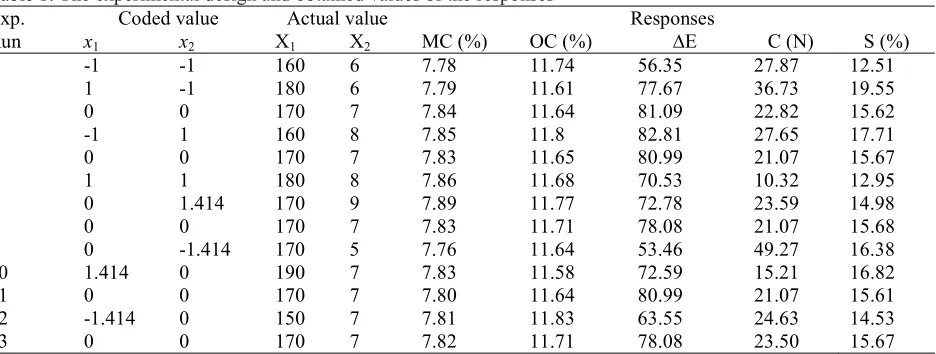
Figure 1: Contour plot of moisture content against frying temperature and time Table 1: The experimental design and obtained values of the responses
Exp.
Run x1 Coded value x2 XActual value 1 X2 MC (%) OC (%) Responses ∆E C (N) S (%)
1 -1 -1 160 6 7.78 11.74 56.35 27.87 12.51
2 1 -1 180 6 7.79 11.61 77.67 36.73 19.55
3 0 0 170 7 7.84 11.64 81.09 22.82 15.62
4 -1 1 160 8 7.85 11.8 82.81 27.65 17.71
5 0 0 170 7 7.83 11.65 80.99 21.07 15.67
6 1 1 180 8 7.86 11.68 70.53 10.32 12.95
7 0 1.414 170 9 7.89 11.77 72.78 23.59 14.98
8 0 0 170 7 7.83 11.71 78.08 21.07 15.68
9 0 -1.414 170 5 7.76 11.64 53.46 49.27 16.38 10 1.414 0 190 7 7.83 11.58 72.59 15.21 16.82
11 0 0 170 7 7.80 11.64 80.99 21.07 15.61
12 -1.414 0 150 7 7.81 11.83 63.55 24.63 14.53
13 0 0 170 7 7.82 11.71 78.08 23.50 15.67
Where; X1 =Frying temperature (°C), X2 = Frying time (min), MC = Moisture content (%),OC = Oil content (%), ∆E =
Colour difference, C = Crispness (N), S = Shrinkage
Oil content
The fat content obtained during deep-fat frying of cocoyam chips ranged from 11.58 to 11.83%
(Table 1). The effect of frying temperature and time on the oil content of cocoyam chips was significant at p<0.05. The fat contents of the cocoyam chips increased asfrying temperature and time increases. This increase in fat content coincided with the period of moisture evaporation from the cocoyam chips. When the chips were placed in hot oil, the free water was rapidly lost in form of bubbles. The final oil content of the chips is a function of time and the remaining moisture within the product, which increases with
decreasing temperature (Garayo and Moreira, 2002).
Figure 2 shows the contour plot of oil content as affected by frying temperature and time. The model equation showed a linear relationship (Eq. 4). The results show that the model is significant based on high F-value and lack of fit test for the model was non-significant at p<0.05.All the model terms were significant (p<0.05). The model accuracy was checked by the determination of correlation coefficient, R2
value of 0.891.
OC = + 11.69 − 0.12X + 0.068X
DESIGN-EXPERT Plot MC
A: Tem perat ure
B:
T
im
e
150.00 160.00 170.00 180.00 190.00
5.00 6.00 7.00 8.00 9.00
7.77715 7.80121 7.82526 7.84931 7.87336
15
Figure 2: Contour plot of oil content against frying temperature and time
Colour
The colourdifference (∆E)of fried cocoyam ranged from 53.46 to 82.81 (Table 1).The ∆Eof cocoyam chips increased gradually as the frying temperature and time increased. The changes in the colour of cocoyam chips is as a result of the Maillard reaction, which depends on the content of reducing sugars and amino acids or proteins at the surface, as well as temperature and time of frying (Krokidaet al., 2001). The model showed a quadratic relationship (Eq.
5). The relationship between the independent variables and colour intensity of cocoyam chips is shown as Fig. 4. Lack of fit test for the model was non-significant at p<0.05. All the model terms were significant (p<0.05). The accuracy of the model was checked by R2 value of
0.988.
∆E = + 79.60 + 4.52X + 9.66X − 11.83X −
16.79X − 33.60X X (5)
Figure 3: Contour plot of colour difference against frying temperature and time
Texture
The crispnessof cocoyam chips ranged between 10.32 and 49.27 N. As shown in Table 1, the breaking force of cocoyam chips was significantly (p<0.05) affected by frying temperature (X1) and frying
time (X2). Crispness increased as frying time increased
due to crust development (Moyano and Pedreschi, 2006). Crispness of chips is a very important factor that
determines the consumers’ acceptance (Setiadyet al., 2009). The peak compression force increased with increasing frying conditions. The result agreed with findings of Debnathet al. (2003) who reported that the hardness of fried chickpea flour-based snack increased at the lower moisture content of the pre-fried product.For cocoyam chips, a very crispy texture was expected since crispness was an indicator of freshness
DESIGN-EXPERT Plot OC
A: Tem perature
B:
T
im
e
150.00 160.00 170.00 180.00 190.00
5.00 6.00 7.00 8.00 9.00
11.5653 11.6288 11.6923
11.7558 11.8193
5 5 5 5 5
DESIGN-EXPERT Plot E
A: Tem perature
B:
T
im
e
150.00 160.00 170.00 180.00 190.00
5.00 6.00 7.00 8.00 9.00
17.6225 32.0425 46.4625
46.4625
60.8825
60.8825
75.3025
75.3025
16
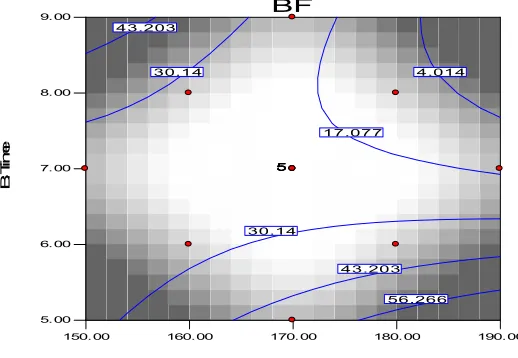
and high quality. The influence of frying temperature and time on the crispness of cocoyam chips is shown as Fig. 4. The quadratic model was appropriate for the crispness of cocoyam chips (Eq. 6). The model is significant based on high F-value, lack of fit test for the model was non-significant at p>0.05. All the model
terms were significant (p<0.05). The model accuracy was checked by the R2 value of 0.993.
C = + 22.07 − 4.55X − 13.00X − 1.95X +
14.57X − 26.19X X (6)
Figure 4: Contour plot of breaking force against frying temperature and time
Shrinkage
The shrinkage value ranged between 12.51 and 19.55 (Table 1). The degree of shrinkage was significantly (p<0.05) affected by the frying temperature and time. The relationship between diameter shrinkage and moisture loss during frying has been reported in the literature(Caixetaet al., 2002; Tran et al., 2007). However, the higher oil temperature caused the cocoyam chips surface to become rigid more rapidly and resulted in more resistance to the shrinkage (Garayo and Moreira, 2002). Contour plot of
shrinkage of cocoyam chips is shown as Fig. 5. The appropriate model for the shrinkage is 2FI (Eq. 7). The model is significant based on high F -value, lack of fit test for the model was non-significant at p>0.05. All the model terms were significant at p<0.05. The model accuracy was checked by the R2 value of 0.999. S = + 15.67 + 1.15X − 0.70X − 11.81X X
(7)
DESIGN-EXPERT Plot BF
A: Tem perature
B:
T
im
e
150.00 160.00 170.00 180.00 190.00
5.00 6.00 7.00 8.00 9.00
4.014
17.077
30.14 30.14
43.203 43.203
56.266 5
17
Figure 5: Contour plot of shrinkage against frying temperature and time
Optimization
The optimization of the deep-fat frying process was aimed at finding the levels of frying temperature and time, which could minimize the moisture content, oil content, breaking force and moderate colour. The optimum conditions obtained were frying temperature of 190 oC and frying time of
7.59 min when the moisture content, fat content,colour difference, crispness and shrinkage were 7.85%, 11.59%, 63.81, 5.32 N and 13.14%, respectively.
CONCLUSION
The quality characteristics of sliced cocoyam were influenced by frying temperature and time. The results obtained showed that moisture content, oil content, colour, crispness and shrinkage of cocoyam chips were significantly affected (p<0.05) by frying temperature and time. The optimal quality of fried cocoyam chips should possess a low moisture content, oil content and crispness as well as acceptable colour.
REFERENCES
Akinlua, O., Sobowale, S.S., Adebo, O.A. and Olatidoye, O.P. (2013). Studies on the characteristics of deep fried pretreated
cocoyam slices
(Xanthosomasagittifolium).Journal of Agriculture and Veterinary Sciences, 5(1),40 - 50.
AOAC, (2005). Official Methods of Analysis, 14th edition, Association of Official Analytical Chemists, Washington DC.
Bas, D., Ismail, H. and Boyaci, J. (2007). Modeling and optimization I: Usability of Response
Surface Methodology. Journal of Food Engineering, 78: 836 – 845.
Caixeta, A.T., Moreira, R. and Castell-Perez, M.E. (2002). Impingement drying of potato chips. Journal of Food Process Engineering, 25(1): 63 - 90.
Debnath, S., Bhat, K.K. and Rastogi, N.K. (2003). Effect of pre-drying on kinetics of moisture loss and oil uptake during deep fat frying of chickpea flour-based snack food. LWT - Food Science and Technology, 36: 91-98.
FAO, (2007). FAOSTAT Statistics Division of the Food and Agriculture Organization,
http://faostat.fao.org
Garayo, J., and Moreira, R.G. (2002). Vacuum frying of potato chips. Journal of Food Engineering, 55: 181-191.
Hunt, R.W.G. (1991). Measuring Colour, 2nd Ed., pp. 75–76, Ellis Horwood, New York, NY. Kawas, M.L. and Moreira, R.G. (2001). Characterisation of product quality attributes of tortilla chips during the frying process. Journal of Food Engineering, 47: 97-107.
Krokida, M.K., Oreopoulou, V., Maroulis, Z.B. and Marinoskouris, D. (2001). Colour changes during deep-fat frying. Journal of Food Engineering: 48, 219–225.
Moreira, R.G, Sun, X., and Chen, Y. (1997). Factors affecting oil uptake in tortilla chips in deep-fat
DESIGN-EXPERT Plot S
A: Tem perature
B:
T
im
e
150.00 160.00 170.00 180.00 190.00
5.00 6.00 7.00 8.00 9.00
7.73617
7.73617
12.0535
12.0535
16.3709 16.3709
20.6882 20.6882
25.0055 5
18
frying. Journal Food of Engineering, 31: 485– 98.
Moyano, P.C. and Pedreschi, F. (2006). Kinetics of oil uptake during frying of potato slices: Effect of pre-treatments. LWT-Food Science and Technology, 39: 285-291.
Niba, L.L. (2003). Processing effect on susceptibility of starch to digestion in some dietary starch sources. International Journal of Food Science and Nutrition, 54: 97-105.
Patterson, S.P., Phillips, R.D., Mc Watters, K.H., Hung, Y.C. and Chinnan, M.S. (2004). Fat reduction affects quality of fried cowpea paste. International Journal of Food Science and Technology, 39 (6): 681-693.
Segnini, S., Dejmek, P. and Oste, R. (1999). A low cost video technique for colour measurement sensitivity analysis. Food and Bioproducts Processing, 85(C3): 220-230.
Setiady, D., Tang, J., Younce, F., Swanson, B.A., Rasco, B.A. and Clary, C.D. (2009). Porocity,
colour, texture using microwave vacuum, heated air, and freeze drying. ASABE Applied Engineering in Agriculture, 25: 719-724. Sobukola, O.P. (2007). Influence of some processing
parameters on quality attributes and sorption kinetics of fried yam crisp. Ph.D Thesis, Tran, M.T.T., Chen, X.D., and Southern, C. (2007).
Reducing oil content of fried potato crisps considerably using a sweet pre-treatment technique. Journal of FoodEngineering, 80: 719-726.
Troncoso, E, Pedreschi, F. and Zuniga, R.N. (2009). Comparative study of physical and sensory properties of pre-treated potato slices during vacuum and atmospheric frying. LWT – Food Science and Technology, 42: 187 – 195. Wickramasinghe, H.A.M., Takigawa, S.,