TRANS Asian Research Journals
http://www.tarj.in 1
P u b l i s h e d b y : T R A N S A s i a n R e s e a r c h J o u r n a l s
TAJMMR:
T R A N S
A s i a n J o u r n a l o f
M a r k e t i n g & M a n a g e m e n t
R e s e a r c h
( A D o u b l e B l i n d R e f e r e e d & R e v i e we d I n t e r n a t i o n a l J o u r n a l )
CONFLICT MANAGEMENT
Monica Dahiya*; Himani Dahiya**
*Assistant Professor, Department of Commerce, College of Vocational Studies, University of Delhi, New Delhi, India.
**Assistant Professor, Department of Commerce, Shri Ram College of Commerce, University of Delhi, New Delhi, India.
INTRODUCTION
Conflict: “The process in which one party perceives that its interests are being opposed or negatively affected by another party.”
Functional (Constructive) conflict - serves the organization’s interest.
Dysfunctional conflict - threatens the organization’s interests.
Conflict is as unavoidable in a project or in an organization as change is. When team members of a project interact with each order during the course of their tasks and responsibilities, there is always a potential for conflict. In fact, it is impossible for people with diverse background, skills and norms to work together; make decisions, and meet their project goals and objectives without conflict. Project managers must identify and evaluate both positive and negative aspect of conflict and their effect on performance. They must learn how to stimulate conflict and thus use it to increase the performance of their team members.
VIEWS OF CONFLICT
TRANS Asian Research Journals
http://www.tarj.in 2
workers and management led people to conclude that conflict was always detrimental and should therefore be avoided.
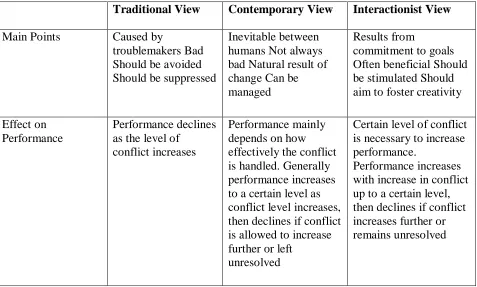
The behavioural or contemporary view, also known as the human relations view, emerged in the late 1940s and held way through the 1970s. It argues that conflict is natural and inevitable in all organizations and that it may have either a positive or a negative effect, depending on how the conflict is handled. Performance may increase with conflict, but only up to a certain level, and then decline if conflict is allowed to increase further or is left unresolved. This approach therefore says that conflict should be accepted.
The newest perspective, the interactionist view assumes that conflict is necessary to increase performance. While the behavioural approach accepts conflict, the interactionist view encourages conflict as it beliefs that a harmonious, peaceful and too-cooperative project organization is likely to become static, stagnant, and unable to respond to change and innovation. This approach encourages managers to maintain an appropriate level of conflict which is enough to keep projects viable, creative, and innovative.
TABLE 1- A COMPARISON OF CONFLICT VIEWS
Traditional View Contemporary View Interactionist View
Main Points Caused by
troublemakers Bad Should be avoided Should be suppressed
Inevitable between humans Not always bad Natural result of change Can be managed
Results from
commitment to goals Often beneficial Should be stimulated Should aim to foster creativity
Effect on Performance
Performance declines as the level of
conflict increases
Performance mainly depends on how effectively the conflict is handled. Generally performance increases to a certain level as conflict level increases, then declines if conflict is allowed to increase further or left
unresolved
Certain level of conflict is necessary to increase performance.
Performance increases with increase in conflict up to a certain level, then declines if conflict increases further or remains unresolved
CONFLICT IN PROJECTS
TRANS Asian Research Journals
http://www.tarj.in 3
change orders delays in delivery of critical components, and failure to execute instructions are all results of some type of communication breakdown. Project managers and their teams must also develop effective communication skills (especially listening skills) to resolve project conflicts. They must learn to create an atmosphere that encourages open communication in order to deal with conflict and gain team members’ acceptance of and commitment to project goals. In general, all potential conflict fits one of three categories:
I. Goal-oriented conflicts are associated with end results, performance specifications and criteria, priorities, and objectives.
2. Administrative conflicts refer to the management structure and philosophy and are mainly based on definition of roles and reporting relationships and on responsibilities and authority for tasks, functions, and decisions.
3. Interpersonal conflicts result from differences in work ethics, styles, egos, and personalities of the participants.
MANAGING CONFLICT IN PROJECTS
Because of the significant impact that conflict can have on project success, managing it well is one of the most important skills a project manager must possess .
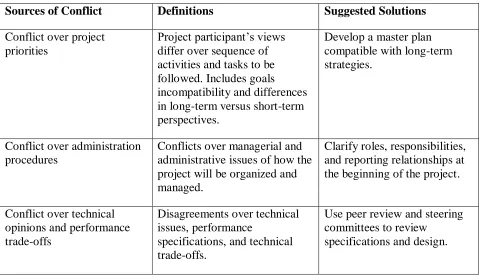
TABLE 2. PROJECT CONFLICTS AND RECOMMENDED SOLUTIONS.
Sources of Conflict Definitions Suggested Solutions
Conflict over project priorities
Project participant’s views differ over sequence of activities and tasks to be followed. Includes goals incompatibility and differences in long-term versus short-term perspectives.
Develop a master plan compatible with long-term strategies.
Conflict over administration procedures
Conflicts over managerial and administrative issues of how the project will be organized and managed.
Clarify roles, responsibilities, and reporting relationships at the beginning of the project.
Conflict over technical opinions and performance trade-offs
Disagreements over technical issues, performance
specifications, and technical trade-offs.
Use peer review and steering committees to review
TRANS Asian Research Journals
http://www.tarj.in 4
Conflict over human resources
Conflicts concerning staffing and allocation of project personnel and where to get them and how.
Develop a work breakdown structure and a corresponding responsibility matrix.
Conflict over cost and budget
Conflict over cost estimates from support areas regarding work breakdown structures and estimating techniques.
Develop overall budgets supported by detailed budget and cost estimates of
subproject tasks and activities.
Conflict over schedules Disagreements about the timing, sequencing, and scheduling of project related tasks and information system to prepare and monitor project schedules.
Develop an overall schedule that integrates schedules for subprojects with staffing and other life constraints.
Personality conflict Disagreements on interpersonal issues.
Emphasize team building and create an environment that emphasizes respect, diversity, and equality.
STIMULATING CONFLICT
The notion of stimulating conflict is difficult to accept because conflict traditionally has a negative view. There is evidence, however, that in some situations, an increase in conflict actually improves performance. Stimulating conflict is a proactive approach that aims at minimizing the impact of a negative conflict by the following ways:
Accept conflict as desirable on certain occasions. Conflict may result as the project manager insists on developing sufficient front-end planning with clear project priorities, scope definition, and administrative procedures. To a degree, conflicts at the front end should be viewed positively since a project manager’s opportunity to participate in setting the project’s budget and schedule is likely to decrease conflicts down the road.
Bring new individuals into an existing situation. Thoughtful questions and comments from newcomers or outsiders may provide a different and fresh perspective. They may encourage long-time team members to remove their blinders and think of new ways of doing things.
TRANS Asian Research Journals
http://www.tarj.in 5
Introduce programs designed to increase competition. A manager of projects may introduce competition to encourage task managers to accomplish their work packages ahead of schedule and under budget without compromising quality. Project managers must understand the difference between competition and conflict in order to get positive results
Introduce programmed conflict. Some project participants may be keen in pushing their ideas. Project managers should play devil’s advocate and use dialectical inquiry to develop and clarify opposing points of view.
RESOLVING STRUCTURAL CONFLICTS
Structural conflict resolution techniques focus on the structural aspects of the project organization (such as procedures, personnel, resources, and reporting relationships) that may be causing the conflict.
Procedural changes mainly refer to changing work procedures to avoid conflict. For instance, a project manager or technical expert on the team may evaluate and select a vendor for a technical contract. The purchasing department may then follow traditional departmental procedures, causing delays that may lead to conflict. Such disputes can be avoided by involving the purchasing department in the process of evaluating bids for complex technical contracts and thereby ensuring purchasing’s cooperation and prompt service when needed to expedite the contract.
Personnel changes involve transferring individuals into or out of the project in order to resolve personality conflicts. For example, a personality conflict between two high-performing technical experts may be reducing overall project output. If one of the experts is transferred to another project, both people are then able to make a significant and positive contribution to their projects and to the organization as a whole.
Authority changes clarify or alter line of authority and responsibility to reduce conflict. Such situations usually arise in matrix structures, where functional managers may exert their authority over personnel who have been assigned to a specific project manager for the duration of the project. Clarifying or changing authority lines or reporting relationships in such circumstances will reduce typical structural conflicts between the project manager and the functional manager.
Layout changes rearrange work space to resolve conflict. This becomes essential when two project teams harass or disturb each other continually. It may be effective to build a physical separation between them to eliminate interaction.
Resource changes involve increasing resources so that the disputing parties can each have what they need. For example, a conflict may develop between two project managers over the priorities for purchasing and accounting personnel. A manager of projects can resolve the conflicts by getting an authorization to hire separate accounting and purchasing personnel for each project so that both project managers get what they need.
TRANS Asian Research Journals
http://www.tarj.in 6
1)WITHDRAWING- involves avoiding, denying, giving up, pulling out, or retreating and as such constitutes a refusal to deal with the conflict by ignoring it as much as possible. This style is appropriate when a cooling-off period is needed to gain better understanding of the conflict situation and also when the other party is both unassertive and uncooperative. Withdrawal, a passive, stopgap way of handling conflict, generally fails to solve the problem.
2) SMOOTHING OR ACCOMMODATING- is an approach that emphasizes on the areas of
agreement while avoiding points of disagreement. It is appropriate to keep harmony and avoid outwardly conflictive situations. It works when the issues are more important than the personal positions and aspirations of the parties involved. Since smoothing tends to keep peace only in the short term, it fails to provide a permanent long-term solution to the undying conflict. Generally conflict reappears again in another form.
3) FORCING- implies the use of position power and dominance to resolve the conflict. It involves imposing one viewpoint at the expense of another and is characterized by a win-lose outcome in which one party overwhelms the other. Forcing is used when there is no common ground on which to bargain or negotiate and when both parties are uncooperative and strong willed.
4) COMPROMISING- is primarily bargaining: receiving something in exchange for something
else. It involves considering various issues, bargaining, using trade-off negotiations, and searching for solutions that bring some degree of satisfaction to both parties. Neither party wins, but both get some satisfaction out of the situation. Both may temporarily feel hurt because they had to give up something that was important to them, but compromising usually provides acceptable solutions.
5) COLLABORATING- is an effective technique to manage conflict when a project situation is
too important to be compromised. It involves incorporating multiple ideas and viewpoints from people with different perspectives. It offers a good opportunity to learn from others. Collaboration is not very effective when more than a few players are involved and their viewpoints are mutually exclusive.
Confronting or problem solving implies a direct confrontation, with disagreement addressed directly. Conflict is treated as a problem for which both parties are interested in finding a mutually acceptable solution. It involves pinpointing the issue and resolving it objectively by defining the problem, gathering necessary information, generating and analyzing alternatives, and selecting the best alternative under the circumstances.
FINDING THE BEST CONFLICT RESOLUTION APPROACH DEPENDS ON
• Type and relative importance of conflict
• Time pressure
• Position of the players involved
TRANS Asian Research Journals
http://www.tarj.in 7
Forcing, smoothing, and withdrawing techniques are generally not effective in resolving conflicts because they fail to deal with the real cause of the conflict. They may be appropriate when it is important to create a period of peace and harmony while the parties think about their next move. Techniques involving compromise are usually used in labour-management disputes, but they have some potential problems .For example, in compromising, each party gives up something, and neither gets exactly what it wants. Consequently, both parties may be unhappy with the final decision.
Under some circumstances, the best solution for managing project conflicts is the confronting/problem solving, or negotiation, mode. Since project management involves solving problems as the project progresses through its life cycle, this type of conflict management is very practical. This approach aims for a win-win strategy, which is best for both the project and the parties involved. It is important to bear in mind, however, that negotiation and confrontation take time. They simply cannot be managed in a rapid manners but instead require a significant commitment from the project manager in terms of time and willingness to allow all parties to air their grievances. Conflicts are managed effectively if they are resolved on a permanent basis.
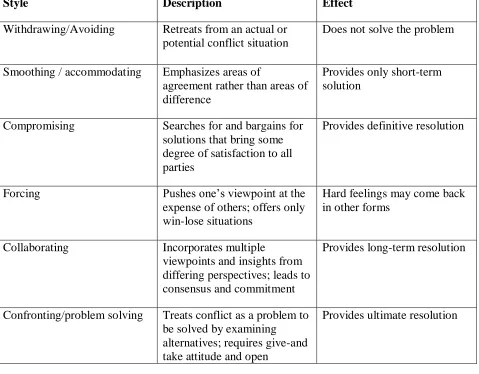
TABLE 3. CONFLICT MANAGEMENT STYLE
Style Description Effect
Withdrawing/Avoiding Retreats from an actual or potential conflict situation
Does not solve the problem
Smoothing / accommodating Emphasizes areas of
agreement rather than areas of difference
Provides only short-term solution
Compromising Searches for and bargains for solutions that bring some degree of satisfaction to all parties
Provides definitive resolution
Forcing Pushes one’s viewpoint at the expense of others; offers only win-lose situations
Hard feelings may come back in other forms
Collaborating Incorporates multiple
viewpoints and insights from differing perspectives; leads to consensus and commitment
Provides long-term resolution
Confronting/problem solving Treats conflict as a problem to be solved by examining
alternatives; requires give-and take attitude and open
TRANS Asian Research Journals
http://www.tarj.in 8
dialogue
STRATEGIES FOR MANAGING CONFLICT IN A PROJECT
1) PREPARING FOR CONFLICT
Realistic project managers know that conflict is a normal—and in some cases necessary—part of working in groups and teams. Preparing for conflict involves :
EXPECTING CONFLICT-The sources of conflict (schedules, priorities, human resources,
technical issues, administration, personality, and cost) will vary with the phases of the project. Moreover, the focus of conflict will vary with the attributes of the team and the project goals. With an experienced team, the focus of conflict is within the team itself. If the project goals are vague and loosely defined, the focus of the conflict will likely be between the team and upper management or between the project team and the client, or both. The project manager should analyze the reasons or sources of conflict and how they vary with the phases of the project cycle before taking any action.
PLANNING AHEAD TO HANDLE CONFLICT- After analyzing the sources, intensity, and
focus of conflict, project managers should plan how to deal with conflict. One of the planning tools is to develop a framework within which to view conflicts objectively by answering the following questions:
• Am I in or out? In this type of conflict, people are likely to ask themselves whether they belong to the team. They raise issues that are unimportant in themselves just to break the ice and initiate communication.
-• Where do I stand? (Am I up or down?) Are people at the top or at the bottom of a hierarchy? How will the group make decisions? How much responsibility does each team member have? How much authority, influence, and control does each individual on the project team have?
• Am I near or far? This question raises the issues of openness and affection. Team members must decide how close they want to get to each other without feeling stuck with them.
TRANS Asian Research Journals
http://www.tarj.in 9
prepare for stress management. Conflict can cause stress that varies in intensity, and if it is not managed in a timely manner; it can cause severe physiological and psychological problems.
2) FACING THE CONFLICT
Although conflict is disliked by most of us , it is inevitable. People wrongly hope that conflict will go away if it is ignored. In fact, conflict ignored is more likely to get worse, which can significantly reduce project performance. The best way to reduce conflict is to confront it by :
• Personally absorbed aggression
• Communication and listening effectively
• Counselling the teams to maximize the output
• Encouraging openness, emotional expression, and new ideas
• Serving as role models in planning, delegating, and so forth
• Minimizing potential conflict whenever possible
• Stimulating conflict to foster creativity and innovation
SURFACE THE REAL ISSUES-Conflicts that remain below the surface can have negative
impacts on a project in many ways, such as distorted or withheld information, slipped schedules, unplanned absences from project meetings, lack of initiative to solve problems, or not working together as a real team. A successful conflict manager should handle these burning issues gently but firmly.
• TREAT THE SURFACE ISSUE AS “REAL” TWO OR THREE TIMES- Project
managers should make every effort to address complaints or issues regardless of how trivial they may seem. They should encourage project personnel to bring the conflict into the open by themselves.
• MAKE THE CONFLICT VISIBLE TO OTHER PARTIES INVOLVED-Project managers
can do this by using effective communication techniques and planning and organizing aids such as responsibility matrices, which are quite effective in resolving conflicts over administrative aspects of project management such as procedures, task breakdowns, and assignments of responsibility and authority.
• GIVE AMPLE SUPPORT-support is very important in a work relationship. Most people
want to feel secure and worthwhile and receive encouragement, recognition, and praise.
3) RESOLVING THE CONFLICT
TRANS Asian Research Journals
http://www.tarj.in 10
all other stakeholders involved in a conflict situation must work together to achieve a win-win situation for everyone.
LOOK FOR WIN-WIN ALTERNATIVES-Of the interpersonal conflict resolution styles,
confronting (negotiating and problem solving) is the most effective approach because it starts with an understanding by both parties that they must search for solutions that satisfy everyone. This can be done in the following ways:
• DO THE DOABLE- Project managers must be able to evaluate the situation and spend their
efforts and energy in doing only whatever is really possible.
• BUILD ON EARLIER MARKET ANALYSES-Using the strategy of only doing the doable,
project managers should build on earlier analyses of situations to give some insight into the conditions that would meet the other party’s criteria for a win-win solution.
• USE THE ASSERTIVE MODEL- Build on the strengths of all parties while minimizing their
weaknesses. Building mutual understanding and trust will help in reaching a win-win solution.
• LOOK AT THINGS RIGHT SIDE UP-It is a mistake to assume that the person is the problem and therefore start attacking the person instead of the problem.
• AVOID CATASTROPHIZING-It leads to lower team morale and confidence, increased
frustration, and possibly project failure. Some common catastrophizing remarks are: “This is going to be a disaster.” “We will never get this done on time.” “This project is driving me crazy.” “I can’t stand the project structure.” Instead of catastrophizing, encourage project participants to be positive, and suggest solutions that are manageable and helpful.
• PICTURE THINGS GOING WELL- Visualize and imagine positive results. It is difficult to
move onto something better without knowing what “better” is. To develop a clear picture of “betters” the project manager should picture things going as he or she wants them to, enlist the support of others and try to get their commitment, and deal with obstacles positively (using a problem-solving approach).
• IDENTIFY PRIORITIES AND VERBALIZE THEM- Sometimes people compromise so
much in a conflict that no one wins, and everyone is dissatisfied. Successful project managers evaluate the priorities up front and identify the “must haves” and “nice to haves.” While resolving conflicts, he or she may compromise on “nice to haves” in order of importance. Project managers can rank priorities by asking which features would contribute most to project success and which features would contribute the least.
CUT YOUR LOSSES WHEN NECESSARY-Sometimes a project may have gotten too deep
TRANS Asian Research Journals
http://www.tarj.in 11
KEEP A MENTALFILE OF THINGS THAT DO NOT FIT THE OVERALL PURPOSE OF THE PROJECT- It is easy to see what you expect to see instead of what is real. Project participants may say something but act differently. Project managers must watch out for the degree of real commitment and interest in doing certain parts of a project. When words and behaviour do not match, behaviour should be believed more—even if it is the words you want to believe.
FOLIATE THE RULE OF TWO (OR THREE)-Successful project managers cut their losses
before costs skyrocket. They may not be able to recognize the inconsistency right away, but they should confront the situation and address it directly if it occurs a second or third time.
ESTABLISH A SYSTEM FOR CUTTING BACK INVESTMENT OF MONEY, TIME,
EFFORT, AND EGO-This follows the common management principle, “Plan your work, and
work your plan.” When something goes wrong in the project, people may go through the stages grief: denial, anger, bargaining, depression, stress, and—hopefully—acceptance. Project managers who become emotionally upset over losses on their projects are vulnerable to losing their self-esteem.
FORMULATE CONFLICT MANAGEMENT STRATEGIES-Conflict can be resolved or
kept under control by using a proactive approach that anticipates conflict and its impact. When using this approach, it is important to understand the project manager’s relationship with other project stakeholders with whom the manager usually interacts throughout the project life cycle. Project managers must establish good understanding, trust, and rapport with all the stakeholders with whom they interact to minimize the probability of conflict by the following ways:
MINIMIZING CONFLICT WITH SENIOR MANAGEMENT INVOLVES KNOWING
THEIR REQUIREMENTS- Project managers should put themselves in their boss’s shoes and
be sympathetic to the challenges, problems, and pressures of senior managers. It also helps to analyze the boss’s thinking patterns and to act in ways that are consistent with that pattern .Similarly; it pays to listen and look for verbal and nonverbal components of the boss’s message, just as a project manager might do with team members. It is important to take solutions as well as problems to the boss and explore alternatives and make recommendations. That makes the boss’s job easier. It is wise to keep the boss informed of progress and plans. That way he or she can act as a mentor, and the project manager can get better support.
MINIMIZING CONFLICT WITH PROJECT TEAM MEMBERS MEANS
DEVELOPING RAPPORT AND TRUST- Project managers can begin by discovering team
TRANS Asian Research Journals
http://www.tarj.in 12
MINIMIZING CONFLICT WITH A PROJECT MANAGERS PEERS INVOLVES
RESPECT- As with relationships with senior management, it is important to understand peers’
point of view, as well as their personal and professional goals. The best project managers look for ways to support peers’ objectives and find areas of mutual interest rather than conflict. Operating in this way establishes a cooperative atmosphere, where everyone realizes that they need each other to succeed. Cultivating informal communication channels can also create many advantages. Whereas formal combinations may be slow and cold, informal communications increase comfort level and understanding, which are important in solving problems.
MINIMIZING CONFLICT WITH CLIENT AND USERS INVOLVES MANY OF THE
SAME ELEMENT THAT APPLY TO OTHER PARTICIPANTS IN A PROJECT- The
key to working with clients is effective communication and prompt response to their needs and requests. It helps to be supportive of the client’s representatives, supplying them with necessary data and information so that they will also be inclined to help with issues that crop up throughout the project. Clients, like everyone else, hate surprises—unless they come in the form of good news. Effective project managers do not let problems build up. They tell clients what the problems are and what is being done to solve them. Informal relationships fostered through lunches, dinners, and sporting and social events allow everyone to develop a better understanding and a stronger interpersonal sense of each other. Formal relationships need attention too.
USE EFFECTIVE NEGOTIATION TO RESOLVE CONFLICT- Negotiation is a fact of
life in project environments where matrix structures necessitate that responsibility and authority are shared. Negotiation is the process of bargaining and reaching an agreement with project stakeholders concerning the transfer of resources, the generation of information, and the accomplishment of tasks. It is a persuasive process and is one of the’ most important skills needed to resolve conflicts and manage projects successfully
The two common methods of negotiation are soft and hard. Soft negotiators are friendly and make concessions readily to avoid conflict and the risk of spoiling future relationships. Hard negotiators, in contrast, take strong positions and try to win, even at the cost of relationships. A third type of negotiation, called principled negotiation, emphasizes deciding and resolving issues based on merits rather than on positions. It results in joint problem solving and often leads to a win-win situation.
APPRECIATE CULTURAL DIFFERENCES- In addition to the differences in skills and
TRANS Asian Research Journals
http://www.tarj.in 13
1. Power distance (how a particular culture deals with inequality)
2. Individualism versus collectivism (the role of the individual versus that of the group)
3. Masculinity-femininity (gender domination patterns)
4. Uncertainty avoidance (tolerance for ambiguity or uncertainty in the workplace)
5. Time horizon (long- or short-term orientation)
6. Attitude toward life (value system with respect to desire for material things)
Project participants must be aware of potential cultural differences and demonstrate respect for different cultures of their co-workers. Any failure to show respect and to appreciate culture differences may lead to serious conflicts.
CONCLUSION
Conflict can be healthy if it is managed effectively. Conflict management requires a combination of analytical and human skills. Every project participant/member should learn to resolve project conflicts effectively. Good conflict managers work at the source of conflict. To resolve it permanently, they must address the cause of the conflict and not just the symptoms of it. They size up possible clashes before “contact” is actually made and then prepare their action plans to handle potential trouble. They should concentrate on building an atmosphere designed to reduce destructive conflict and deal with routine frictions and minor differences before they become unmanageable. The key to resolving conflict with a positive outcome includes looking for a win-win situation, cutting losses when necessary, formulating proactive conflict management strategies, using effective negotiation and communication, and appreciating cultural differences among project stakeholders.