An
Evaluation of Framework of Synthesize on an
Adaptive E-Learning Guidance System Base on
Multiple Intelligence
Thongchai Kaewkiriya
1, 2, Nuttavee Utakrit
1, Sakchai Tangwannawit
1, and Monchai Tiantong
1 1 King Mongkut’s University of Technology North Bangkok/Faculty of Information Technology, Bangkok, Thailand2 Thai-Nichi Institute of Technology/Department of Information Technology, Bangkok, Thailand Email: [email protected], {Nuttaveeu, Sakchai, Monchai}@kmutnb.ac.th
Abstract—The objective of this paper consists of two sections. The first is to evaluate the framework of adaptive e-learning recommendation system based on Multiple Intelligence. The second of this paper was to synthesize on an adaptive e-learning recommendation System based on Multiple Intelligence and learner profile. This paper propose conceptual model of adaptive e-learning guidance system based on Multiple Intelligence. The concept framework divided into five modules. (1) We introduce rule base module. (2) We explain recommendation module for students. (3) We present the LMS module. (4) We present the adaptive module. (5) We describe the content module which is based on Multiple Intelligence. The process of evaluation consists of three steps. The first step define group of experts for evaluate framework. The second step create questionnaire for appropriate evaluation. The last step present the synthetic framework to experts for appropriate evaluation. The result from experts are very appropriate with the average score equal to 4.34/5 (S.D.=0.52).
Index Terms—e-learning, adaptive, multiple intelligence,
data mining, recommendation system, evaluation model
I. INTRODUCTION
Learning systems need to provide students with the skills to learn, together with the use of new technology. So, this educational method needs to find a way to motivate students, encourage creative thinking, and provide ways to learn comfortably at their own speeds. The condition of learning and teaching usually puts the focus on students as the first priority (student center) [1]. This results in students having the opportunity to learn effectively and achieving goals successfully. However, each student has different aptitudes. So, when a student lacks in certain fields, learning performance will not be as good as it should. There are also different ways to present learning and teaching such as using games as a medium of instruction [2], emphasis on project base learning [3], brain storming [4], activity base learning [5][6], and problem base learning [7][8][9].
However, from past research [1] focus is aimed at the
Manuscript received November 6, 2013; revised February 11, 2014.
teaching with emphasis on students as a priority with such exercises as, class discussions with instructor guidelines to students. Large general learning and teaching techniques have a significant limitation. Each student has different aptitudes, so, if learning and teaching focuses only on the general student, individual performance may not be as good as it should. In research [2] learning and teaching is archived using games as a medium. Teaching in this way is suitable for large groups of young learners because they are more interested in games at this age, but this approach is limited as students do not gain much from this type lessons plan. In research [3] learning and teaching uses a base of projects which will encourage each student to complete a major project. But, restrictions remain the same and lessons do not focus on individual’s aptitude and there are no guidelines for students who have trouble in learning. In research [4] learning and teaching is achieved by brainstorming. Students are engaged to problem solve in the classroom. This provides students with more opportunities to solve problems but restrictions remains the same as some students are left behind. From the following researches [5] [6] and [7] [8] [9] learning and teaching focused on activity base and problem base methods. The above five researches focused on activities working with large groups of learners all at the same level but limitations arise when some students start to fall behind and have trouble keeping up.
II. PREVIOUS WORK
From the above researches, the following restrictions have been observed; 1) Students do not get content matched to individual skill levels. 2) When students have learning trouble, the systems will not offer guidance for appropriate alternatives of learning to each student. Thus, effectiveness of the school is not as good as it should be. Further research above also found that e-learning lessons for students presented the same trend of not considering students who have different learning speeds.
and failed to consider students with problems during study. In research [12] the presentation of learning and teaching by using Multiple Intelligences in four parts was put forward. The limitation was that no evaluation of the students who had problems was conducted. In research [13], the application of Multiple Intelligences with hypermedia was investigated which showed promising results.
The above researches proposed methods suitable for general students but failed to offer lesson content to those who slowly fall behind, [14] presented a conceptual framework of an online project based learning system with a learner guidance system based on Multiple Intelligence analysis. But again, lesson content was not customizable to the aptitude of the students, and focus on learning the project only.
From the problems discovered in previous researches, this research presents a conceptual model of an adaptive e-learning guidance system based on Multiple Intelligence. Each student will benefit from a lesson which fits their individual aptitude. According to the analysis of Multiple Intelligences, this part will act as an instructor in the class by synthesizing a new learning model, and then develop the next lesson accordingly. This will support each person with maximum consideration for skill level and learning speed. The E-learning lessons will be prepared according to 3 different patterns of Multiple Intelligences. Each student will receive a lesson that matches their aptitude. In addition, the system will automatically guide the learning style of each student. The author of this paper hopes that this framework will promote the synthesis of the academic student learning and aid future researchers.
III. BACKGROUND
A.Multiple Intelligences Theory
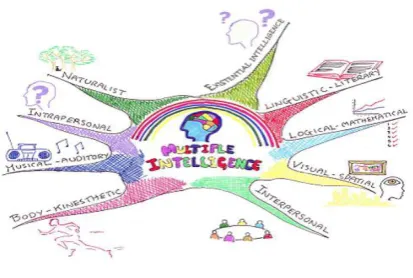
Dr. HowardGardnerfromHarvard UniversityUSA who is thefounder of the theory of Multiple Intelligences [15], said that each student has different learning methods, teachers and parents need to realize and recognize the value of the difference. They found that students have learning natures and abilities to learn in order to continue the activities to fulfill their potential. Humancognitive abilities by multiple intelligences theory is divided into nine areas: (1) Verbal/Linguistic Intelligent (2) Logical/Mathematical Intelligent (3) Musical/Rhythmic Intelligent (4)Body/Kinesthetic Intelligent (5) Visual/Spatial Intelligent (6) Interpersonal Intelligent (7) Intrapersonal Intelligent (8) Naturalist Intelligence (9) Existential Intelligence.
Considering all nine areas, it has been discovered that many have a different dominant intellectual parts. The most important thing is that all areas are stimulated to encourage development. In addition, some dominated areas can be used to help weaker parts. The Multiple Intelligence model is depicted in Fig. 1.
Figure 1.Multiple intelligence model
The Multiple Intelligence theory is divided into 3 groups. 1) Analytic group, this group focuses on analysis and the thinking processes. The analytic group consists of 3 parts; Logical-mathematic intelligence, Musical intelligence, Naturalist intelligence. 2) Introspective group, this group focuses on imagination and understanding. The introspective group consists of 3 parts; Intrapersonal intelligence, spatial intelligence, and Existential intelligence. 3) Interactive group, this group focuses on communication and interactive. The interactive group consists of 3 parts; Linguistic intelligence, Interpersonal intelligence, and kinesthetic intelligence.
B.Adaptive E-Learning
The process of adaptive e-learning [16] is the evaluation process of students. After evaluation, it will adjust the process of the appropriate learning to the students. From the past, adaptive e-learning can be found in many forms such as [17] which presented an adaptive e-learning system for secondary education based on student activities. [14] Presented adaptive e-learning by using project base learning which also showed promising results.
In addition, [18] presented the design of adaptive E-Learning systems based on student's learning styles. Such research is focused on the student’s learning styles as the priority. The system adaptively is based on two learning style models, which are VAK and Felder. The limitations of this research is the adaptive learning style of VAK as it does not support students with learning aptitude that are different from the VAK style model.
IV. CONCEPTUAL MODEL
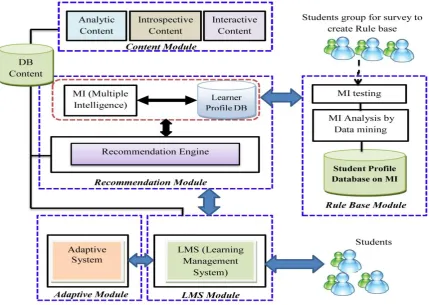
Fig. 2 shows the framework of an adaptive e-Learning guidance system which consists of 5 modules.
A.Rule Base Module
experts and past research. 2) Surveyed sample group of 3,500 students from Thai Nichi Institute of Technology. 3) Result of the analysis survey creates a Rule base which
can use 3 methods of analysis to compare the accuracy (Decision Tree C4.5, Neural Network, Association rule). The most accurate is then chosen.
Figure 2.Framework for adaptive e-learning guidance system
B.Recommendation Module
The recommendation module is the module that’s responsible for the guideline to each student and which lesson content they should receive such as analytic, introspective, or interactive content. This is achieved by using the student’s learning profile to match with the Rule base module and Rule base of the Multiple Intelligence’s analysis. After that, it will load the lesson content matched to the student’s learning profile from content module. Data will be sent to the LMS module to display the results of that student.
C.LMS Module
The LMS module is the module that’s responsible for the medium between the students and the entire system since the part of LMS module will connect to all modules as follows; 1) LMS module is connected to the Recommendation module and Rule base module in order to send data of the learner profile when the student logs in. The next process is mapping with the Rule base module. The Recommendation module then sends the data content back to the LMS Module so the student can begin. 2) LMS module is connected to the adaptive module in order to send the guideline to the student which is adapted to student’s capability. For example, the students who
achieve high test scores during the class will be guided to continue studying. If the student fails, the adaptive system will guide them to restart the study. 3) The LMS module is connected to the content module in order to retrieve content and forward it to the student for learning. Moreover, the LMS module will be responsible for managing learning and teaching of students and also teachers.
D.Adaptive Module
The adaptive module is a module that improves learning during the class appropriately. The process of the learning module determines the status of the students by testing between classes. When the test result passes through the criterion, the adaptive module will guide the students to continue studying with other chapters. In the case of a failed test result, the system will guide the students to review the lesson again. The criterion is based on the average score of all students who entered the system.
E.Content Module
students that prefer communication skills and interaction with others.
F.Example Process for Framework Working
The process begins when the students log into the system which then takes the data inputted from the learning profile of gender, year of studying, and GPA to be matched with the rule of data’s classification from the Rule base module which is then stored as the learner profile in the Database of learners. The next process, the recommendation module is responsible for forwarding the content that matches the students’ aptitudes from the content module and guides the student. During studying, the students will be tested, when the students pass the criterion, the adaptive module will guide to the next study lesson. If the student fails the criterion, the adaptive module will guide to review again, students cannot study further until the test is past.
V. FRAMEWORK EVALUATION
This paper is used to evaluate models by experts. Model evaluation’s processes from the expert consist of the following 3 steps.
A.Step 1 Define Group of Experts
Researcher defined group of experts to evaluate the quality of model. Experts that evaluated model were teachers who graduated from the PhD of computer field, Educational Technology or related fields. Teaching experience was not less than 10 years in the university. Experts are selected in model evaluation which will selected specific 5 people.
B.Step 2 Create Questionnaire
We created questionnaire as rating scale of 5 levels in order to determine the appropriate of synthetic model. There are 6 questionnaires as following; 1) the appropriateness of the MI Rule Base Module 2) the appropriateness of Recommendation Module 3) the appropriateness of the LMS Module 4) the appropriateness of Adaptive Module 5) the appropriateness of the teaching process by analyzing the MI and 6) the appropriateness of overall synthetic model and other suggestion from experts.
C.Step 3 Present the Synthetic Framework to Experts
We has proposed the synthetic model to 5 experts by interviewing each expert. Then, experts answered questionnaires about the appropriateness of synthetic model and obtain various suggestions from experts.
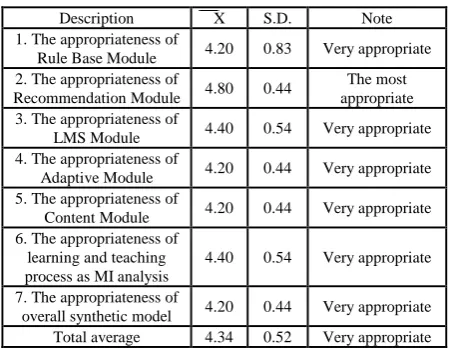
VI. THE RESULT OF FRAMEWORK EVALUATION The result of synthetic from 5 experts and equipments from this research is the questionnaire as rating scale of 5 levels. The total score of the questionnaire was 25 points and found that every module is appropriate in very good level with the average value of 4.34 and standard deviation equal to 0.52.
The analysis of various components within module, and found that 1) Recommendation Module is the most
appropriate, the average equals to 4.80. 2) The appropriate of all synthetic model and the appropriate of Rule base Module is 4.20 (very appropriate). 3) Adaptive Module is 4.20. 4) LMS Module is 4.40. The appropriate of overall models equal to 4.20. The result of overall evaluations have shown in below Table I.
TABLE I. THE EVALUATE RESULT FROM EXPERTS
Description X S.D. Note 1. The appropriateness of
Rule Base Module 4.20 0.83 Very appropriate 2. The appropriateness of
Recommendation Module 4.80 0.44
The most appropriate 3. The appropriateness of
LMS Module 4.40 0.54 Very appropriate 4. The appropriateness of
Adaptive Module 4.20 0.44 Very appropriate 5. The appropriateness of
Content Module 4.20 0.44 Very appropriate 6. The appropriateness of
learning and teaching process as MI analysis
4.40 0.54 Very appropriate
7. The appropriateness of
overall synthetic model 4.20 0.44 Very appropriate Total average 4.34 0.52 Very appropriate
The evaluate result from experts by using the interview without structure has found that experts has some related comments of synthetic model are very appropriate with the average score equal to 4.34 (S.D.=0.52). So, we conclude that the synthesized framework is suitable to be applied to students who have the aptitude in different multiple intelligences. This research proposes only a framework. For the next step, we will develop the synthetic model and trial to the student group to find student’s achievement in the future
VII. CONCLUSION
The objective of this research was to synthesize an adaptive e-learning recommendation system based on Multiple Intelligence. The conceptual model was divided into 4 sections; 1) The Rule base section separates the form of students’ learning into 3 patterns from the aptitude of Multiple Intelligences. 2) The Recommendation module introduces students to detailed content which matches their aptitude. This module will match with Rules from the Adaptive module. 3) The LMS module for learning and teaching. 4) The Adaptive module automatically sends the instructions to the students who need assistance. 5) The Content module stores contents of Multiple Intelligences approaches which consists of three types 1) Analytic content 2) Introspective content 3) Interactive content. The result of evaluation are very appropriate with the average score equal to 4.34/5 (S.D.=0.52).
REFERENCES
[1] Student-centered learning. [Online]. Available: http://en.wikipedia.org/wiki/ Student- center_le
King Mongkut Institute of Technology Ladkrabang, Thailand, vol. 2, pp. 1-15, 2006.
[3] P. Polkacha and M. Tiantong, “A conceptual framework of an online project based learning model with intelligence knowledge management and using KWL plus for assessment,” NCCIT, pp. 734-739, 2011.
[4] S. T. Yuan and Y. C. Chen, “Semantic ideation learning for agent-based E-brainstorming,” IEEE Trans, vol. 20, no. 2, pp. 261-275, Feb 2008.
[5] A. Qiao, L. Sun, and N. Wang, “The design of web-based learning activities a case study on learning activities design from Mainland China,” in Proc. ICCSIT IEEE, 2009, pp. 126-129.
[6] K. Duangkaew and S. Tangwannawit, “Adaptive presentation of activities learning system based on multiple intelligences,” NCCIT’,
pp. 343-348, 2011.
[7] F. Aruan, S. Prihatmanto, and H. Kuspriyanto, “The designing and implementation of a problem based learning in collaborative virtual environments using MMOG Technology,” ICSET IEEE, pp. 1-7, 2012.
[8] S. Teemuangsai, “The development of a model of collaborative problem-based learning with scaffolding via computer network,” Ph.D. dissertation, Dept. Com. Ed., Kmutnv Univ., Bkk, Thailand, 2009.
[9] S. Saiboonruen, “A conceptual framework of an online simulation problem based learning with scaffolding system,” NCCIT, pp. 656-661, 2011.
[10] S. Tangwannawit, N. Sureerattanan, and M. Tiantong, “Multiple intelligences learning activities model in e-learning environment,”
Special Issue of the International Journal of the Computer, the
Internet and Management, vol. 16, no. Sp3, pp. 25.1-25.4, 2008.
[11] S. Tangwannawit, “Learning activities model in e-learning environment with the development of different multiple intelligences learners,” Ph.D. dissertation, Dept. Com. Ed., Kmutnb Univ, Bkk, Thailand, 2010.
[12] D. Kelly and B. Tangney, “On the dynamic multiple intelligence informed personalization of the learning environment,” Ph.D. dissertation, Dept. Com. Sci., Dublin Univ, Ireland, 2005. [13] B. Dara-Abrams. Web technologies for multi-intelligent. [Online].
Available: http://www.brainjolt.com/
[14] S. Siksen and M. Tiantong, “A conceptual framework of an online project based learning system with a learner guidance system base on multiple intelligence analysis,” NCCIT, pp. 699-703, 2011. [15] B. S. Gardner and S. J. Korth, “A framework for learning to work in
teams,” Journal of Education for Business, vol. 74, no. 1, 1998. [16] Adaptive e-Learning. [Online]. Available:
http://en.wikipedia.org/wiki/ Adaptive_learning
[17] T. Sofija and M. Cveta, “Adaptive E-learning system in secondary education,” International Journal of Emerging Technologies in
Learning, vol. 7, pp. 36-41, 2012.
[18] S. H. Dwi, “The design of adaptive E-learning system based on student’s learning styles,” International Journal of Computer
Science and Information Technologies, vol. 2, no. 5, pp.
2350-2353, 2011.
Thongchai Kaewkiriya, was born in Singburi
Provi n c e, Th a i la n d on January 10, 1978. Graduated with a Bachelor Degree in Computer Technology and Electronic telecommunication Engineering from King Mongkut' s University of Technology North Bangkok, Thailand in 2000 and Pathumwan Institute of Technology Bangkok, Thailand in 2006. Also graduated with a Master Degree in Electrical and Information Engineering from King Mongkut's University of Technology Thonburi, Thailand in 2005. He worked as a Lecturer in the Faculty of Information Technology while looking after the Information and Communication’s center at Thai-Nichi Institute of Technology, Thailand.
Asst. Prof. Nuttavee Utrakit,received a Doctoral
degree from Edith Cowan University (ECU), Australia, in 2006 in Information Technology. He works as a lecturer and a researcher at the D e p a r t m e n t o f In f o r m a t i o n Te c h n o l o g y Management, Faculty of Information Technology, King Mongkut’s University of Technology North Bangkok (KMUTNB), Thailand. He is also a member of the Applied Information Systems Research Division (AIS) at KMUTNB.
Sakchai Tangwannawit, Ph.D., Professional
education: B.S. (Computer Education), M.S. (Information Technology), and Ph.D. (Computer Education) from King Mongkut’s University of Te c h n ology Nort h B a n gk ok (KM UTNB ), Bangkok, Thailand. He has been working as a lecturer for more than 10 years in the field of Information Technology in the Faculty of Information Technology, KMUTNB.
Monchai Tiantong, TechEd.D., Professional