ECONOMICS OF ENGINEERING DECISIONS
Integrating Safety, Environmental and Quality Risks for Project Management
Using a FMEA Method
Sai X. Zeng
1, Chun M. Tam
2, Vivian W. Y. Tam
31Antai School of Management, Shanghai Jiaotong University Shanghai 200052, China
e-mail: [email protected]
2College of Science and Engineering, City University of Hong Kong Kowloon, Hong Kong
e-mail: [email protected]
3School of Engineering, University of Western Sydney Locked Bag 1797, Penrith South DC, NSW 1797, Australia e-mail: [email protected]
In recent years, many construction firms have implemented various management systems, including OHSAS 18001 for occupational health and safety (OHS) management, ISO 14001 for environmental management and ISO 9001 for quality management. With increasing interests from construction firms in implementing an integrated management system (IMS) which combines OHSAS 18001, ISO 14001 and ISO 9001, it is timely to assess, manage and control the risks resulted from OHS, environment and quality issues under this new integrated scheme.
In this study, the Failure Modes and Effects Analysis (FMEA) is employed to analyze risk management for OHS, environment and quality management under an IMS in a local case study in China. FMEA is known to be a systematic procedure for the analysis of a system to identify the potential failure modes, and their causes and effects on system performance in engineering management. The analysis is performed at the early stage of a system so that removal or mitigation of the failure mode is most cost effective method. On the basis of risk priority numbers calculated from occurrence, severity, and detection of potential risks, twenty potential risk factors are graded, and their levels of acceptability are determined. The acceptability of risks is defined into four scenarios: acceptable, moderate, undesirable, and unacceptable.
The findings indicate that five major potential risks, including “Roof related falls”, “Elevator shaft falls”, “Holes in flooring on construction site”, “Hit by falling objects”, and “Run over by operating equipment”, are graded to be unacceptable. These events are considered the most risky in construction.
In practice, these unacceptable risks can be minimized through prevention or protection. The main goal of risk management is to keep the risks at an acceptable level by maintaining the tolerable risks and following the programs in moving unacceptable risks to an acceptable level. Risk management must involve risk mitigation measures so as to fulfill OHS, environmental and quality management programs, leading to a reduction of risk levels. All these are designed to avoid accidents, incidents, injury, or
occupational diseases. In the event of an accident that has already occurred, a necessary part of risk management is the management of crisis for minimizing losses/impacts.
Accordingly, measures for risk management for the twenty potential risk factors of OHS, environment and quality are recommended. It is revealed that training programs are prioritized to be the most effective measures in integrated risk management. Effective training helps personnel carry out various activities, establish a positive safety attitude, and integrate safety with environmental and quality goals. Comparing to other countries, training is believed to have a significant role in the construction industry of China due to the fact that the percentage of construction workers being trained is very low.
This paper then proposes a methodology for contractors who implement the management system to integrate risk management in the pursuit of continuous improvement in project management. To achieve that, an integrated risk management is tied with a Deming’s cycle (Plan-Do-Check-Act) (P-D-C-A), in which it is necessary to add audits and management review for attaining continuous improvement.
Keywords: risk, risk management, project management, failure modes and effects analysis, construction.
Introduction
with these separate management systems and to align them with organizational strategies (Zeng et al., 2007). Hence, increasing interests from construction firms have begun to implement an integrated management system (IMS) (Labodova, 2004; Molina-Azorin et al., 2009). For achieving continuous improvement in implementing an IMS, the pre-requisite is to manage and control the potential risks of OHS, environment and quality issues (Low & Tan, 2005; Zeng et al., 2007).
Failures, in general referring to the state or condition of not meeting a desirable or intended objective, are the cause for OHS, environmental and quality problems (Zavadskas & Vaidogas, 2008). Failure Modes and Effects Analysis (FMEA), which has been extensively applied in manufacturing (Tay & Lim, 2006; Teng & Ho, 1996), is a methodology for analyzing potential risk problems so that actions can be taken to overcome them (Gandhi & Agrawal, 1992).
This paper aims to use FMEA to identify potential failure modes, determine their effects, and develop actions for mitigating risks from the perspectives of OHS, environment and quality in construction. Ultimately, a methodology designed for integrating risk management in the pursuit of continuous improvement is targeted. A local case study is also used to show the application of the FMEA. This study can help the construction industry in identifying potential risk problems in implementing IMS.
Literature Review
Risk management in construction
There are different factors affecting safety risk in construction (Choudhry & Fang, 2008; Melia et al., 2008). Using association rule mining, Liao & Perng (2008) identified the characteristics of occupational injuries in the construction industry. In addition to general factors, several factors related to weather conditions were analyzed. The results showed that there are some patterns of occupational injuries in the construction industry; e.g. the effect of rain on the occurrence of fatalities is of great significance.
Moreover, researchers have consistently explored approaches to improve risk management (Suddle, 2009). Yi and Langford (2006) introduced the concept of combined effect of different risk factors to the accidents on construction sites. They analyzed the result of accident history and provided information about vulnerable situations. In addition, they presented a theory of safety planning method which estimates risk distribution of a project and helps safety managers to estimate situations of concentrated risk and reschedule it when it is necessary. Baradan and Usman (2006) developed an approach for occupational risk analysis based on defining risk fundamentally as the product of probability (frequency) and severity, and using the risk plane concept to evaluate and rank trades in terms of nonfatal injury rates. A parameter named the index of relative risk was used for fatality rate based ranking, and the results separately obtained from these analyses were integrated into a combined risk score for arriving at the final rankings. The findings of the study indicated that ironworkers and roofers were the highest risk trades.
Komljenovic et al. (2008) developed an approach
based on a holistic risk management concept. This concept can be used in OHS to help judge the tolerability of risk and aid in choosing between potential risk-reduction and risk avoidance measures. A structured risk management approach also enhances and encourages the identification of greater opportunities for continuous improvement. From the decision-maker’s perspective, some of the principal benefits of risk management and risk analysis in this field include: (a) systematic identification of potential hazards; (b) quantitative risk statements or ranking; and (c) evaluation of possible modifications to reduce risk. Ale et al. (2008) proposed an occupational risk model (ORM) for a project to reduce and control occupational risk. With this model, authorities, industries and experts can evaluate the occupational risks for individual workers, for companies and for projects. The project has four major parts: assembly and analysis of accident and exposure data, generalization of these data into a logical risk model, deriving improvement measures and their costs and developing an optimizer that supports cost effective risk reduction strategies. An integrated management system for OHS, environment and quality
Research Methodology
In this study, Failure Modes and Effects Analysis (FMEA) is employed to analyze risk management for OHS, environment and quality management under an IMS in construction. The FMEA is known to be a systematic procedure for the analysis of a system to identify the potential failure modes, and their causes and effects on system performance (Gandhi and Agrawal, 1992). The analysis is performed at the early stage of a system so that removal or mitigation of the failure mode is the most cost effective (Stamatis, 1995).
An important index in the FMEA is Risk Priority Number (RPN), which is the product of occurrence (O), severity (S) and detection (D) ratings as shown in equation (1) (Tay & Lim, 2006):
RPN= O × S × D (1)
where O is the “occurrence of failure” indicating the probability that the failure mode will occur as a result of a specific cause; S the “severity”, an assessment of the seriousness of the effect of the potential failure mode on the process when it has occurred; and D the probability that a potential failure will be detected.
Risk factor with a high RPN will need to be thoroughly investigated. In general, these three items are estimated by experts in accordance with a scale based on commonly agreed evaluation criteria (Stamatis, 1995). As the RPN is a measure of the risk of failures, it can be used to rank failures and to prioritize actions. Actions will be taken according to the priority given to the failure that is ranked by RPN.
The FMEA procedure is summarized as follows (Tay & Lim, 2006; Teng & Ho, 1996):
(1) Define the scale table of Severity, Occurrence, and Detection.
(2) Study intent, purpose, goal, and objective of a product/process; generally, it is identified by interaction among components/process flow diagrams followed by a task analysis.
(3) Identify potential failures of product/process; this includes problems, concerns, and opportunity of improvement.
(4) Identify consequence of failures to other components/next processes, operation, customers and government regulations.
(5) Identify potential root causes of potential failures. (6) First level method/procedure to detect/prevent failures of product/process.
(7) Severity rating: rank the seriousness of the effect of the potential failures.
(8) Occurrence rating: estimation of the frequency for a potential cause of failures.
(9) Detection rating: likelihood of the process control
to detect a specific root cause of a failure.
(10) RPN calculation: product of the three inputs rating; severity, occurrence, detection.
(11) Correction. It may need to go back to Step (2) if necessary.
Case study
Project background
A local case study employing FMEA in integrating risk management for OHS, environment and quality improvement to an industrial building construction project is presented in this section. The studied project was constructed by a famous contractor in China, which has implemented an IMS for three years with consistent good performance in OHS, environmental and quality management. The project locates in the Jingqiao Development Zone of Shanghai, one of the biggest industrial buildings in the zone. The total building area is about 42,000 m2, including
a two-storey industrial building with a size of 210 m long and 100 m wide. The main structural frame of the building is made of light steel structures.
In construction, the FMEA was used to analyze the integration of risk management at the start of each construction stage. In this study, the stage of main frame construction was selected as an illustrative example. The contractor had assigned a team of experts in the management of the FMEA process. The team consisted of ten experts, including a client representative, a project manager, four OHS engineers, three quality engineers, and a design engineer. They are the personnel who regularly supervise the construction activities on site. Therefore, they could provide suitable knowledge contributing to the case study. The potential failure modes listed in the FMEA report include the failures at different stages of construction. The FMEA team worked together to gather the required information for completing the FMEA report (Gandhi & Agrawal, 1992; Tay & Lim, 2006).
Results and analysis
The FMEA is focused on assessing the risks of OHS, environment and quality management in construction, which is based on three aspects, including “occurrence of failure” (indicating risk/probability that failure mode will occur as a result of a specific cause), “severity” (referring to an assessment of the seriousness of the effect of the potential failure mode in the process when it has occurred) (Baradan & Usman, 2006), and “detection” (referring to the probability that a potential failure will be detected) (Tay & Lim, 2006). The explanation on the occurrence of failure, severity, and detection for OHS, quality and environmental risks is tabulated in Table 1.
Table 1 Explanation on occurrence, severity, and detection for potential risks
Items OHS risks Environmental risks Quality risks
Occurrence The probability of accidents and dangerous events on OHS
The probability of hazardous events to the environment
The probability of failure on quality
Severity Seriousness of the effect of accidents and dangerous events on OHS
Seriousness of the effect of hazardous events to the environment
Seriousness of the effect of failure on quality
Detection The probability that accidents and dangerous
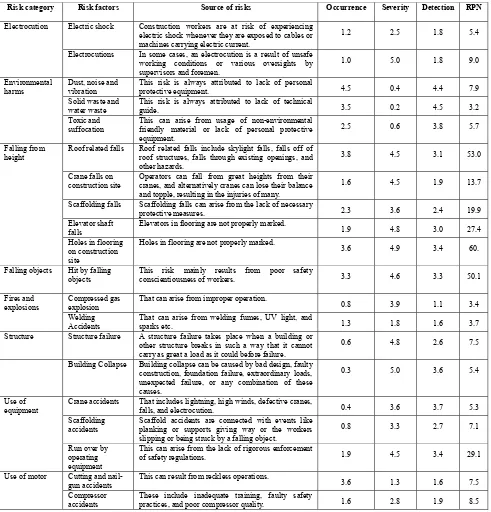
It is necessary for the FMEA experts to list the potential risks according to characteristics of the specified construction stage and the studied construction site (Goossens & Cooke, 1997). Twenty potential risks were
identified, including falls from roofs and roofing structures, electrocutions, holes in flooring, construction debris accidents, lift accidents, fires and explosions (see Table 2).
Table 2 Assessment of risks for OHS, environment and quality in construction
Risk category Risk factors Source of risks Occurrence Severity Detection RPN
Electric shock Construction workers are at risk of experiencing electric shock whenever they are exposed to cables or machines carrying electric current.
1.2 2.5 1.8 5.4
Electrocution
Electrocutions In some cases, an electrocution is a result of unsafe working conditions or various oversights by supervisors and foremen.
1.0 5.0 1.8 9.0
Dust, noise and vibration
This risk is always attributed to lack of personal
protective equipment. 4.5 0.4 4.4 7.9
Solid waste and water waste
This risk is always attributed to lack of technical
guide. 3.5 0.2 4.5 3.2
Environmental harms
Toxic and suffocation
This can arise from usage of non-environmental friendly material or lack of personal protective equipment.
2.5 0.6 3.8 5.7
Roof related falls Roof related falls include skylight falls, falls off of roof structures, falls through existing openings, and other hazards.
3.8 4.5 3.1 53.0
Crane falls on construction site
Operators can fall from great heights from their cranes, and alternatively cranes can lose their balance and topple, resulting in the injuries of many.
1.6 4.5 1.9 13.7
Scaffolding falls Scaffolding falls can arise from the lack of necessary
protective measures. 2.3 3.6 2.4 19.9
Elevator shaft falls
Elevators in flooring are not properly marked.
1.9 4.8 3.0 27.4
Falling from height
Holes in flooring on construction site
Holes in flooring are not properly marked.
3.6 4.9 3.4 60.
Falling objects Hit by falling objects
This risk mainly results from poor safety
conscientiousness of workers. 3.3 4.6 3.3 50.1
Compressed gas explosion
That can arise from improper operation.
0.8 3.9 1.1 3.4
Fires and explosions
Welding Accidents
That can arise from welding fumes, UV light, and
sparks etc. 1.3 1.8 1.6 3.7
Structure Structure failure A structure failure takes place when a building or other structure breaks in such a way that it cannot carry as great a load as it could before failure.
0.6 4.8 2.6 7.5
Building Collapse Building collapse can be caused by bad design, faulty construction, foundation failure, extraordinary loads, unexpected failure, or any combination of these causes.
0.3 5.0 3.6 5.4
Crane accidents That includes lightning, high winds, defective cranes,
falls, and electrocution. 0.4 3.6 3.7 5.3
Scaffolding
accidents Scaffold accidents are connected with events like planking or supports giving way or the workers slipping or being struck by a falling object.
0.8 3.3 2.7 7.1
Use of equipment
Run over by operating equipment
This can arise from the lack of rigorous enforcement
of safety regulations. 1.9 4.5 3.4 29.1
Cutting and nail-gun accidents
This can result from reckless operations.
3.6 1.3 1.6 7.5
Use of motor
Compressor accidents
These include inadequate training, faulty safety
practices, and poor compressor quality. 1.6 2.8 1.9 8.5
For assessing risks of OHS, environmental and quality, a five-point Likert-type scale is employed, in which ‘5’ represents the most possible in occurrence (most serious in severity and most detectable) and 1 is the least. The team members of FMEA were requested to provide their scales on evaluation of occurrence, severity, and detection for potential risks, which were averaged for calculating RPN.
The results were shown in Table 2.
Table 3 Grade of risks for OHS, environment and quality in construction
Grade of risks Consequence RPN Acceptability
V Catastrophic 27<RPN unacceptable
IV Critical 8<RPN≤27 undesirable
III Significant 3.375<RPN≤8 moderate
II Low significant 1<RPN≤3.375 acceptable
I Insignificant 1
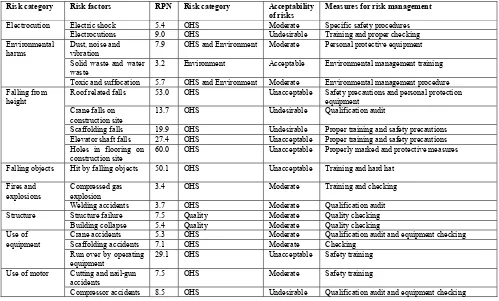
In this study, the acceptability of twenty potential risks of OHS, environment and quality is shown in Table 4.
Table 4 Acceptability of risks and measures for risk management
Risk category Risk factors RPN Risk category Acceptability of risks
Measures for risk management
Electric shock 5.4 OHS Moderate Specific safety procedures
Electrocution
Electrocutions 9.0 OHS Undesirable Training and proper checking
Dust, noise and vibration
7.9 OHS and Environment Moderate Personal protective equipment
Solid waste and water waste
3.2 Environment Acceptable Environmental management training Environmental
harms
Toxic and suffocation 5.7 OHS and Environment Moderate Environmental management procedure Roof related falls 53.0 OHS Unacceptable Safety precautions and personal protection
equipment Crane falls on
construction site 13.7 OHS Undesirable Qualification audit
Scaffolding falls 19.9 OHS Undesirable Proper training and safety precautions Elevator shaft falls 27.4 OHS Unacceptable Proper training and safety precautions Falling from
height
Holes in flooring on construction site
60.0 OHS Unacceptable Properly marked and protective measures
Falling objects Hit by falling objects 50.1 OHS Unacceptable Training and hard hat
Compressed gas explosion
3.4 OHS Moderate Training and checking
Fires and explosions
Welding accidents 3.7 OHS Moderate Qualification audit
Structure failure 7.5 Quality Moderate Quality checking
Structure
Building collapse 5.4 Quality Moderate Quality checking
Crane accidents 5.3 OHS Moderate Qualification audit and equipment checking
Scaffolding accidents 7.1 OHS Moderate Checking
Use of equipment
Run over by operating equipment
29.1 OHS Unacceptable Safety training
Cutting and nail-gun accidents
7.5 OHS Moderate Safety training
Use of motor
Compressor accidents 8.5 OHS Undesirable Qualification audit and equipment checking
In Table 4, it is indicated that five major potential risks, including “Roof related falls”, “Elevator shaft falls”, “Holes in flooring on construction site”, “Hit by falling objects”, and “Run over by operating equipment”, are graded to be unacceptable. In construction, these events are considered as the most risky (Kines et al., 2007; Zayed et al., 2008). Tam et al. (2004) found that falls from height represented the major severe injury problem, which was associated with different equipment and different tasks among different occupational groups in the construction process.
In practice, these unacceptable risks can be minimized through prevention or protection. The main goal of risk management is to keep risks at an acceptable level by maintaining the tolerable risks and following the programs in moving unacceptable risks to an acceptable level (Kutsch & Hall, 2009; Zou et al., 2007). Risk management must involve risk mitigation measures so as to fulfill OHS, environmental and quality management programs, leading to a reduction of risk levels (Labodova, 2004). All these are designed to avoid accidents, incidents, injury, or
occupational diseases. In the event of an accident that has already occurred, a necessary part of risk management is the management of crisis for minimizing of losses/impacts. Accordingly, measures for risk management for the twenty potential risk factors of OHS, environment and quality are listed in Table 4.
Discussions
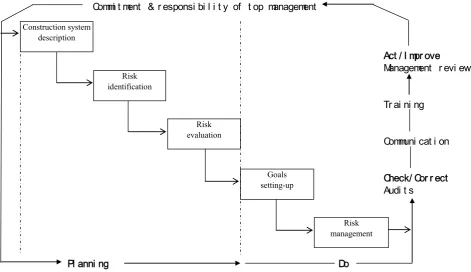
In implementing the integrated risk management system, the pursuit of continuous improvement in OHS, environment and quality is considered to be an important issue. To achieve that, an integrated risk management is
tied in with Deming’s cycle (Plan-Do-Check-Act) (P-D-C-A) as shown in Figure 1, in which it is necessary to add audits and management review for attaining continuous improvement (Labodova, 2004).
Commi t ment & r esponsi bi l i t y of t op management
Act / I mpr ove Management r evi ew
Tr ai ni ng
Communi cat i on
Check/ Cor r ect Audi t s
Pl anni ng Do
Construction system description
Risk identification
Risk evaluation
Goals setting-up
Risk management
Figure 1. A P-D-C-A cycle for integrating risk management
For contractors implementing OHSAS 18001 for OHS management, ISO 14001 for environmental management and ISO 9001 for quality management in parallel, many duplicated management tasks for each system are demanded. For example, both ISO 9001 and ISO 14001 require all working procedures to be traceable and auditable. To meet the requirements, each management system demands a lot of documentation, written procedures, checking, control forms and other paperwork. In practice, it has been proven to be difficult to deal with separate management systems covering OHS, environment and quality and to ensure their alignments with organizational strategies (Zeng et al., 2008).
Hence it is believed that an integrated risk management system could avoid duplication of effort and reduce resource inputs. In the P-D-C-A cycle of integrating risk management (see Figure 1), “planning” includes construction system description, risk identification, and risk evaluation, embracing OHS, environmental and quality risks. The “planning” in integrated risk management will be more comprehensive than in a “single” system. In the “do” process of P-D-C-A cycle, it is included goals setting and risk management. Compared to risk management under separate management systems, the combined risk management will save time and effort, which avoids analyzing the same risk several times with a different scope of assessment (Labodova, 2004). For example, the risk “dust, noise and vibration” is concerned
with environmental management and OHS management. A PDCA-approach governing the aspects of OHS, environment, quality can identify a consistent with clear priorities, series of key risks (e.g. grade of risks IV and V) in construction, making it easy to focus upon the important areas (Kines et al., 2007).
successfully be implemented and to properly work, the top management must continuously pursue for improvement. Therefore, it is necessary to plan for the implementation of an IMS with a P-D-C-A approach in the early stage of projects. An effective and efficient implementation can then be achieved.
Conclusions
To improve OHS, environmental and quality performance, construction firms have started implementing various management systems, including OHSAS 18001, ISO 14001 and ISO 9001. In practice, it has been proven to be difficult to deal with separate management systems covering OHS, environment, and quality and to ensure their alignments with organizational strategies. For achieving continuous improvement in implementing an IMS, it is essential to manage and control risks of OHS, environment and quality. Using FMEA, this paper identified and evaluated twenty potential risk factors from OHS, environment and quality for an industrial building construction project. The acceptability of risks is graded into four scenarios, including acceptable, moderate, undesirable, and unacceptable. A local case study was conducted. The findings revealed that five potential risks, including “Holes in flooring on construction site”, “Hit by falling objects”, “Run over by operating equipment”, “Elevator shaft falls”, and “Scaffolding falls” are graded to
be unacceptable. Moreover, it is more important to pursue for continuous improvement for OHS, environment and quality improvement in implementing an integrated risk management. Compared to two or three separate risk management systems, the combined risk management with a Plan-Do-Check-Act cycle can save time and effort, as it avoids analyzing the same risk factor several times with a different scope of assessment.
There are some limitations in the research of this paper. The method of Failure Modes and Effects Analysis was a focus in integrating OHS, environment and quality risks in this paper. The issue of quality of construction and the process to achieve the required quality has only been lightly touched upon although there must be many important quality issues waiting to be discussed.
Acknowledgements
The authors are greatly acknowledged to the two anonymous reviewers for their valuable comments. This study is supported by the National Natural Science Foundation of China (No. 70772067), the Program for New Century Excellent Talents in University of Ministry of Education of China (No. NCET-06-410), the Shuguang Planning of Shanghai Education Development Foundation (No. 06SG17) and Research Center on Metropolitan Regions of China.
References
Ale, B. J. M., Baksteen, H., Bellamy, L. J., Bloemhof, A., Goossens, L., Hale, A., Mud., M. L., Oh, J. I. H., Papazoglou, I. A., Post, J., & Whiston, J. Y. (2008). Quantifying occupational risk: The development of an occupational risk model.
Safety Science, 46(2), 176-185.
Arditi, D., Lee, D., & Polat, G. (2007). Fatal accidents in nighttime vs. daytime highway construction work zones. Journal of Safety Research, 38(4), 399-405.
Baradan, S., & Usman, M. A. (2006). Comparative injury and fatality risk analysis of building trade. Journal of Construction Engineering and Management, ASCE, 132(5), 533-539.
Carter, G., & Smith, S. D. (2006). Safety hazard identification on construction projects. Journal of Construction Engineering and Management, ASCE, 132(2), 197-205.
Chen, Z., Li, H., & Jong, J. (2004). An integrative methodology for environmental management in construction.
Automation in Construction, 13(5), 621-628.
Choudhry, R. M. & Fang, D. P. (2008). Why operatives engage in unsafe work behavior: Investigating factors on construction sites. Safety Science, 46(4), 566-584.
Gandhi, O. P. & Agrawal, V. P. (1992). FMEA-A diagraph and matrix approach. Reliability Engineering & System Safety,
35(2), 147-158.
Goossens, L. H. J. & Cooke, P. M. (1997). Applications of some risk assessment techniques: formal expert judgment and accident sequence precursors. Safety Science, 26(1/2), 35-47.
Jha, K. N., & Iyer, K. C. (2006). Critical factors affecting quality performance in construction projects. Total Quality Management & Business Excellence, 17(9), 1155-1170.
Kines, P., Spangenberg, S., & Dyreborg, J. (2007). Prioritizing occupational injury prevention in the construction industry: injury severity or absence? Journal of Safety Research, 38(1), 53-58.
Komljenovic, D., Groves, W. A., & Kecojevia, V. L. (2008). Injuries in US mining operations-A preliminary risk analysis. Safety Science, 46(5), 792-801.
Kutsch, E., & Hall, M. (2009). Deliberate ignorance in project risk management. International Journal of Project Management. In press.
Liao, C. W., & Perng, Y. H. (2008). Data mining for occupational injuries in the Taiwan construction industry. Safety Science, 46(7), 1091-1102.
Loushine, T. W., Hoonakker, P. T., Carayon, P. & Smith, M. J. (2006). Quality and safety management in construction.
Total Quality Management & Business Excellence, 17(9), 1171-1212.
Low, S. P. & Tan, J. H. K. (2005). Integrated ISO 9001 quality management system and ISO 14001 environmental management system for contractors. Journal of Construction Engineering and Management, ASCE, 131(11), 1241-1244.
Low, S. P., & Teo, J. A. (2004). Implementing total quality management in construction firms. Journal of Management in Engineering, ASCE, 20(1), 8-15.
Melia, J. L., Mearns, K., Silva, S. A., & Lima, M. L. (2008). Safety climate responses and the perceived risk of accidents in the construction industry. Safety Science, 46(6), 949-958.
Molina-Azorin, J. F., Tari, J. J., Claver-Cortes, E., & Lopez-Gamero, M. D. (2009). Quality management, environmental management and firm performance: A review of empirical studies and issues of integration. International Journal of Management Review, 11(2):197-222.
Stamatis, D. H. (1995). Failure Mode and Effect Analysis: FMEA from theory to execution. ASQC Quality Press, Milwaukee, WI.
Suddle, S. (2009). The weighted risk analysis. Safety Science, 47(5), 668-679.
Tam, C. M., Zeng, S. X., & Deng, Z. M. (2004). Identifying elements of poor construction safety management in China. Safety Science, 42(7), 569-586.
Tay, K. M. & Lim, C. P. (2006). Fuzzy FMEA with a guided rules reduction system for prioritization of failures.
International Journal of Quality & Reliability Management, 23(8), 1047-1066.
Teng, S. H. & Ho, S. Y. (1996). Failure mode and effects analysis: An integrated approach for product design and process control. International Journal of Quality & Reliability Management, 13(5), 8-26.
Wyk, R. V., Bowan, P., & Akintoye, A. (2008). Project risk management practice: The case of South African utility company. International Journal of Project Management, 26(2), 149-163.
Yi, K. J. & Langford, D. (2006). Scheduling-based risk estimation and safety planning for construction projects. Journal of Construction Engineering and Management, ASCE, 132(6), 626-635.
Zavadskas, E. K., & Vaidogas, E. R. (2008). Bayesian reasoning in managerial decisions on the choice of equipment for the prevention of industrial accidents. Inzinerine Ekonomika-Engineering Economic(5), 32-40.
Zayed, T., Amer, M. & Pan, J. Y. (2008). Assessing risk and uncertainty inherent in Chinese highway projects using AHP.
International Journal of Project Management, 26(4), 408-419.
Zeng, J. H., An, M. & Smith, N. J. (2007). Application of fuzzy based decision making methodology to construction project risk assessment. International Journal of Project Management, 25(6), 589-600.
Zeng S. X., Shi, J. J. & Lou, G. X. (2007). A synergetic model for implementing an integrated management system: an empirical study in China. Journal of Cleaner Production, 15(18), 1760-1767.
Zeng, S. X., Tam, C. M., Deng, Z. M. & Tam, Vivian W. Y. (2003). ISO 14000 and the construction industry: Survey in China. Journal of Management in Engineering, ASCE, 19(3), 107-115.
Zeng, S. X., Tam, Vivian W. Y. & Tam, C. M. (2008). Towards occupational health and safety systems in the construction industry in China. Safety Science, 46(8), 1155-1168.
Zou, P. X. W., Zhang, G. M. & Wang, J. Y. (2007). Understanding the key risks in construction projects in China.
International Journal of Project Management, 26(6), 601-614.
S. X. Zeng, C. M. Tam, Vivian W. Y. Tam
Pagal FMEA metodą saugumo, aplinkos ir kokybės rizikos integravimas projektų valdyme
Santrauka
Statyba laikoma viena iš pavojingiausių pramonės šakų visame pasaulyje dėl savo ypatingo pobūdžio. Tradiciškai saugumas ir kokybė statyboje yra visada susiję su liūdnomis pasekmėmis. Pastaraisiais metais ši pramonės šaka susiduria su visuomenės spaudimu dėl aplinkos apsaugos, užterštumo ir statybos keliamų pavojų.
Šiuo metu daugelis statybos firmųįdiegėįvairias valdymo sistemas, įskaitant OHSAS 18001, valdyti, ISO 14001 aplinkai valdyti ir ISO 9001 kokybei valdyti. Susidomėta integruota valdymo sistema (IVS), kuri sujungia OHSAS 18001, ISO 14001 ir ISO 9001, nes svarbu įvertinti, valdyti ir kontroliuoti riziką, kurią sukelia darbinė sveikata ir saugumas, aplinka ir kokybė.
Šiame tyrime taikoma nesėkmių formų ir poveikio analizė (FMEA), norint nustatyti rizikos valdymo galimybes pagal IVS, statybose. Nesėkmių
formų ir poveikio analizė (NFPA) yra sisteminė procedūra, analizuojanti galimas nesėkmių formas ir jų priežastis bei poveikį inžinerinėms valdymo sistemoms. Analizė atliekama esant ankstyvajai sistemos stadijai tam, kad nesėkmių pobūdis būtų pašalintas efektyviausiai. Kartu nustatomas pastovus gerėjimo procesas pagal sudarytą metodologiją, kaip integruotai valdyti riziką.
turintis aukštą RPS, turi būti labai kruopščiai ištirtas. Šiuos tris duomenis ekspertai apskaičiuoja pagal bendrai susitartus vertinimo kriterijus. Kadangi RPS yra nesėkmių rizika, jis gali būti panaudotas suskirstant nesėkmingus įvykius pagal jų svarbą. Veiksmų imamasi pagal šį suskirstymą.
Šiame straipsnyje pateiktas atskirų atvejų tyrimas pagal NFPA integruojant darbines sveikatos, aplinkos ir kokybės gerinimo valdymą statybos pramonėje. Tyrimas buvo atliktas žymaus Kinijos konstruktoriaus projektuotame statybos objekte. Šis konstruktorius per trejus metus įdiegė integruoto valdymo sistemą (IVS) pagal gerai veikiančią sveikatingumo, aplinkos ir kokybės valdymo sistemą. Šiame tyrime vadovas pasirinko ekspertų grupę, kuri vadovavo NFPA procesui. Šis procesas buvo stebimas ir vertinamas nuolatos, todėl buvo galima pritaikyti reikiamas žinias ir priemones esant įvairioms šio metodo taikymo stadijoms. Visa NFPA grupė dirbo kartu ir rinko informaciją reikalingą bendrai ataskaitai apie rezultatus.
Remiantis rizikos prioritetų duomenimis, nustatyta dvidešimt rizikos veiksnių ir jų lygių. Rizikos atvejų priimtinumas suskirstytas į keturis scenarijus: priimtinas, švelnesnis, nepageidaujamas ir nepriimtinas.
Rezultatai rodo, kad penki pagrindiniai rizikos atvejai, įskaitant ir „stogo kritimus“, „lifto kritimą“, „skyles grindyse ir statybinėse konstrukcijose“, „smūgius krintant įvairiems objektams“ ir „sužeidimus įrengimais“, laikomi nepriimtinais. Buvo pasiūlytos priemonės, kaip valdyti riziką sveikatingumo, aplinkos ir kokybės srityse. Nustatyta, kad efektyviausios priemonės yra integruoto rizikos valdymo apmokymo programos. Efektyvus mokymas padeda darbuotojams geriau vykdyti įvairią veiklą, susidaryti teigiamą požiūrįį saugumą ir integruoti jį su aplinkos ir kokybės siekimo tikslais. Tikima, kad Kinijoje mokymas turėtųįgyti didesnį mastą nei kitose šalyse.
Šiame straipsnyje pateikta metodologija, skirta statybinėms organizacijoms, kurios diegia valdymo sistemas, integruojančias rizikos valdymą į
bendrus projektus. Tam integruotas rizikos valdymas siejamas su Demingo ciklu (Planuok – Daryk – Tikrink – Veik), kuriame būtina atlikti auditą ir
įvertinti valdymą norint pasiekti pagerėjimo.
Kiekvienoje sistemoje rizikai integruotai valdyti reikalinga plėtoti daugelį užduočių. Pavyzdžiui, tiek ISO 9001, tiek ISO 14001 sistemoms reikalinga, kad būtų stebimos atskiros procedūros ir atliekamas jų auditas. Kiekvienoje valdymo sistemoje turi būti atlikta daugybė dokumentų, registravimo, tikrinimo ir kitų procedūrų. Buvo pastebėta, kad sunku atskirai įvertinti sveikatingumo, aplinkos ir kokybės valdymo sistemas ir užtikrinti organizacijos strategijų efektyvumą.
Tikėtina, kad integruotoji valdymo sistema gali padėti išvengti pastangų švaistymo, dubliavimo ir sumažinti resursų panaudojimą. Integruoto rizikos valdymo planavimas yra visapusiškesnis negu atskiros sistemos numatymas. Cikle Daryk planuojami tikslai, susiję su rizikos valdymu. Bendrai valdant riziką sutaupomas laikas ir pastangos, nes nereikia tą patį rizikos atvejį analizuoti kelis kartus ir nuolat jį vertinti. Pavyzdžiui, rizika, susijusi su dulkėmis, triukšmu ir vibracija, priklauso aplinkos ir sveikatos valdymo sritims. Sveikatos, aplinkos ir kokybės valdymo aspektai ir jų prioritetų išskyrimas padeda sukoncentruoti dėmesį ir veiksmus į svarbiausias sritis.
Cikle Planuok – Daryk – Tikrink – Veik pagrindinių vadybininkų pasišventimas ir atsakomybė yra labai svarbūs veiksniai. Atsakingi vadovai turi asmeniškai atsakyti už organizacijos tikslų vykdymą, planavimo efektyvumą, darbuotojų motyvaciją ir atlyginimo sistemą. Vadovai turi būti atsakingi už integruoto valdymo procesus ir priemones jam įgyvendinti. Siekiant šio tikslo, ypač svarbu, kad vadovai diegiant sistemą matytų, kad ji nuolatos, nepertraukiamai tobulinama, efektyviai planuojama ir įgyvendinama, nes tik taip ši sistema gali įgyti pranašumą.
Raktažodžiai: rizika, rizikos valdymas, projekto valdymas, nesėkmių formų ir poveikio analizė, statyba.