Volume 2006, Article ID 53807, Pages1–12 DOI 10.1155/ASP/2006/53807
Quantization Noise Shaping on
Arbitrary Frame Expansions
Petros T. Boufounos and Alan V. Oppenheim
Digital Signal Processing Group, Massachusetts Institute of Technology, 77 Massachusetts Avenue, Room 36-615, Cambridge, MA 02139, USA
Received 2 October 2004; Revised 10 June 2005; Accepted 12 July 2005
Quantization noise shaping is commonly used in oversampled A/D and D/A converters with uniform sampling. This paper consid-ers quantization noise shaping for arbitrary finite frame expansions based on generalizing the view of first-order classical ovconsid-ersam- oversam-pled noise shaping as a compensation of the quantization error through projections. Two levels of generalization are developed, one a special case of the other, and two different cost models are proposed to evaluate the quantizer structures. Within our framework, the synthesis frame vectors are assumed given, and the computational complexity is in the initial determination of frame vector ordering, carried out off-line as part of the quantizer design. We consider the extension of the results to infinite shift-invariant frames and consider in particular filtering and oversampled filter banks.
Copyright © 2006 P. T. Boufounos and A. V. Oppenheim. This is an open access article distributed under the Creative Commons Attribution License, which permits unrestricted use, distribution, and reproduction in any medium, provided the original work is properly cited.
1. INTRODUCTION
Quantization methods for frame expansions have received considerable attention in the last few years. Simple scalar quantization applied independently on each frame expan-sion coefficient, followed by linear reconstruction is well known to be suboptimal [1,2]. Several algorithms have been proposed that improve performance although with signifi-cant complexity either at the quantizer [3] or in the recon-struction method [3,4]. More recently, frame quantization methods inspired by uniform oversampled noise shaping (re-ferred to generically as Sigma-Delta noise shaping) have been proposed for finite uniform frames [5, 6] and for frames generated by oversampled filterbanks [7]. In [5,6] the error due to the quantization of each expansion coefficient is sub-tracted from the next coefficient. The method is algorithmi-cally similar to classical first-order noise shaping and uses a quantity called frame variation to determine the optimal or-dering of frame vectors such that the quantization error is re-duced. In [7] higher-order noise shaping is extended to over-sampled filterbanks using a predictive approach. That solu-tion performs higher-order noise shaping, where the error is filtered and subtracted from the subsequent frame coeffi -cients.
In this paper we view noise shaping as compensation of the error resulting from quantizing each frame expansion
coefficient through a projection onto the space defined by another synthesis frame vector. This requires only knowl-edge of the synthesis frame set and a prespecified order-ing and pairorder-ing for the frame vectors. Instead of attempt-ing a purely algorithmic generalization, we incorporate the use of projections and explore the issue of frame vector or-dering. Our method improves the average quantization error even if the frame vector ordering is not optimal. However, we also demonstrate the benefits from determining the op-timal ordering. The theoretical framework we present pro-vides a design method for noise shaping quantizers under the cost functions presented. The generalization we propose im-proves the error in reconstruction due to quantization even for nonredundant frame expansions (i.e., a basis set) when the frame vectors are nonorthogonal. This paper elaborates and expands on [8].
InSection 2we present a brief summary of frame rep-resentations to establish notation and we describe classi-cal first-order Sigma-Delta quantizers in the terminology of frames. InSection 3we propose two generalizations, which we refer to as the sequential quantizer and the tree quan-tizer, both assuming a known ordering of the frame vectors.
Section 5we determine the optimal ordering of coefficients assuming the cost measures inSection 4and show that for Sigma-Delta noise shaping, the natural (time-sequential) or-dering is optimal. We also show that for finite frames the de-termination of frame vector ordering can be formulated in terms of known problems in graph theory.
InSection 6we consider cases where the projection is re-stricted and the connection to the work in [5,6]. Further-more, we examine the natural extension to the case of higher-order quantization.Section 7presents experimental results on finite frames that verify and validate the theoretical ones. InSection 8we discuss infinite frame expansions. We apply the results to infinite shift invariant frames, and view filtering and classical noise shaping as an example. We also consider the case of reconstruction filterbanks, and how our work re-lates to [7].
2. CONCEPTS AND BACKGROUND
In this section we present a brief summary of frame expan-sions to establish notation, and we describe oversampling in the context of frames.
2.1. Frame representation and quantization
A vectorxin a spaceWof finite dimensionNis represented with the finite frame expansion:
x=
M
k=1
akfk, ak=
x,fk. (1)
The space W is spanned by both sets: the synthesis frame vectors {fk, k = 1,. . .,M}, and the analysis frame vectors
{fk,k=1,. . .,M}. This condition ensures thatM≥N.
De-tails on the relationships of the analysis and synthesis vectors can be found in a variety of texts such as [1,9]. The ratio r =M/Nis referred to as theredundancyof the frame. The equations above hold for infinite-dimensional frames, with an additional constraint that ensures the sum converges for allxwith finite length. An analysis frame is referred to as uni-formif all the frame vectors have the same magnitude, that is,
fk = flfor allkandl. Similarly, a synthesis frame is uni-form iffk = flfor allkandl.
The coefficientsak above are scalar, continuous quanti-ties. In order to digitally process, store, or transmit them, they need to be quantized. The simplest quantization strat-egy, which we call direct scalar quantization, is to quantize each one individually toak =Q(ak)=ak+ek, whereQ(·) denotes the quantization function andekthe quantization er-ror for each coefficient. The total additive error vector from this strategy is equal to
E =
M
k=1
ekfk. (2)
It is easy to show that if the frame forms an orthonormal basis, then direct scalar quantization is optimal in terms of minimizing the error magnitude. However, this is not the
al + al Q(·) al −
−++
cel−1 c·z−1 el
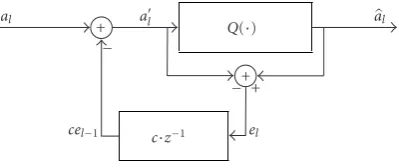
Figure1: Traditional first-order noise shaping quantizer.
case for all other frame expansions [1–7,10]. Noise shaping is one of the possible strategies to reduce the error magnitude. In order to generalize noise shaping to arbitrary frame ex-pansions, we first present traditional oversampling and noise shaping formulated in frame terms.
2.2. Sigma-Delta noise shaping
Oversampling in time of bandlimited signals is a well-studied class of frame expansions. A signal x[n] orx(t) is upsam-pled or oversamupsam-pled to produce a sequenceak. In the termi-nology of frames, the upsampling operation is a frame ex-pansion in whichfk[n] = rfk[n]= sinc(π(n−k)/r), with sinc(x)=sin(x)/x. The sequenceakis the corresponding or-dered sequence of frame coefficients:
ak=
x[n],fk[n]=
n
x[n] sinc
π(n−k)
r
,
x[n]=
k
akfk[n]=
k
ak1
r sinc
π(n−k)
r
. (3)
Similarly for oversampled continuous time signals,
ak=
x(t),fk(t)=
+∞
−∞x(t)
r
Tsinc
πt
T −
πk r
,
x(t)=
k
akfk(t)=
k
aksinc
πt
T −
πk r
,
(4)
whereTis the Nyquist sampling period forx(t).
Sigma-Delta quantizers can be represented in a num-ber of equivalent forms [10]. The representation shown in
Figure 1 most directly represents the view that we extend to general frame expansions. Performance of Sigma-Delta quantizers is sometimes analyzed using an additive white noise model for the quantization error [10]. Based on this model it is straightforward to show that the in-band quanti-zation noise power is minimized when the scaling coefficient cis chosen to bec=sinc(π/r).1
We view the process inFigure 1as an iterative process of coefficient quantization followed by error projection. The quantizer in the figure quantizesaltoal=al+el. Consider
xl[n], such that the coefficients up toal−1 have been
quan-tized andel−1 has already been scaled bycand subtracted
fromalto produceal:
xl[n]=
l−1
k=−∞
akfk[n] +alfl[n] +
+∞
k=l+1
akfk[n]
=xl+1[n] +el fl[n]−c·fl+1[n]
.
(5)
The incremental errorel(fl[n]−c·fl+1[n]) at thelth iteration
of (5) is minimized if we pickcsuch thatc·fl+1[n] is the
projection offl[n] ontofl+1[n]:
c=
fl[n],fl+1[n] fl+1[n]2 =sinc
π r
. (6)
This choice ofcprojects tofl+1[n] the error due to
quantiz-ingaland compensates for this error by modifyingal+1. Note
that the optimal choice ofcin (6) is the same as the optimal choice ofcunder the additive white noise model for quanti-zation.
Minimizing the incremental error is not necessarily opti-mal in terms of minimizing the overall quantization error. It is, however, optimal in terms of the two cost functions which we describe inSection 4. Before we examine these cost func-tions we generalize first-order noise shaping to general frame expansions.
3. NOISE SHAPING ON FRAMES
In this section we propose two generalizations of the dis-cussion of Section 2.2to arbitrary finite-frame representa-tions of length M. Throughout the discussion in this sec-tion we assume the ordering of the synthesis frame vectors
(f1,. . .,fM), and correspondingly the ordering of the
synthe-sis coefficients (a1,. . .,aM) has already been determined. We examine the ordering of the frame vectors in
Section 5. However, we should emphasize that the execu-tion of the algorithm and the ordering of the frame vectors are distinct issues. The optimal ordering can be determined once, off-line, in the design phase. The ordering only de-pends on the properties of the synthesis frame, not the data or the analysis frame.
3.1. Single-coefficient quantization
To illustrate our approach, we consider quantizing the first coefficienta1 toa1 =a1+e1, withe1denoting the additive
quantization error. Equation (1) then becomes
x=a1f1+
M
k=2
akfk−e1f1
=a1f1+a2f2+
M
k=3
akfk−e1c1,2f2−e1 f1−c1,2f2
.
(7)
As in (5), the norm ofe1(f1−c1,2f2) is minimized ifc1,2f2is
the projection off1ontof2:
c1,2f2=
f1,u2
u2=
f1, f2 f2
f2 f2
=⇒c1,2=
f1,u2
f2 =
f1,f2 f2
2 ,
(8)
whereuk = fk/fkare unit vectors in the direction of the synthesis vectors. Next, we incorporate the term−e1c1,2f2in
the expansion by updatinga2:
a2=a2−e1c1,2. (9)
After the projection, the residual error is equal toe1(f1− c1,2f2). To simplify this expression, we definer1,2 to be the
direction of the residual error, ande1c1,2to be the error
am-plitude:
r1,2=
f1−c1,2f2 f1−c1,2f2,
c1,2=f1−c1,2f2=
f1,r1,2
.
(10)
Thus, the residual error ise1f1,r1,2r1,2=e1c1,2r1,2. We refer
toc1,2as theerror coefficientfor this pair of vectors.
Substituting the above, (7) becomes
x=a1f1+a2f2+
M
k=3
akfk−e1c1,2r1,2. (11)
Equation (11) can be viewed as decomposing e1f1 into the
direct sum (e1c1,2f2)⊕(e1c1,2r1,2) and compensating only for
the first term of this sum. The componente1c1,2r1,2is the final
quantization error after one step is completed.
Note that for any pair of frame vectors the corresponding error coefficientck,l is always positive. Also, if we assume a uniform synthesis frame, there is a symmetry in the terms we defined, that is,ck,l=cl,kandck,l=cl,k, for any pairk=l.
3.2. Sequential noise shaping quantizer
The process inSection 3.1is iterated by quantizing the next (updated) coefficient until all the coefficients have been quantized. Specifically, the procedure continues as shown in
Algorithm 1. We refer to this procedure as thesequential first-order noise shaping quantizer.
Every iteration of the sequential quantization contributes ekck,k+1rk,k+1to the total quantization error, where
rk,l=
fk−ck,lfl fk−ck,lfl
, (12)
ck,l=fk−ck,lfl. (13)
Since the frame expansion is finite, we cannot compensate for the quantization error of the last stepeMfM. Thus, the total error vector is
E=
M−1
k=1
(1) Quantize coefficientkby settingak=Q(ak).
(2) Compute the errorek=ak−ak.
(3) Update the next coefficientak+1toak+1=ak+1−ekck,k+1,
where
ck,l=
fk,fl
fl2 . (15)
(4) Increasekand iterate from step (1) until all the coefficients have been quantized.
Algorithm1
Note thatck,lrk,lis the residual from the projection offk ontofl, and therefore it has magnitude less than or equal to
fk. Specifically, for allkandl,
ck,l≤fk, (16)
with equality holding if and only iffkis orthogonal tofl. Fur-thermore note that sinceck,lis the magnitude of a vector, it is always nonnegative.
3.3. The tree noise shaping quantizer
The sequential quantizer can be generalized by relaxing the sequence of error assignments: again, we assume that the co-efficients have been preordered and that the ordering defines the sequence in which coefficients are quantized. In this gen-eralization, we associate with each ordered frame vector fk
another, not necessarily adjacent, frame vectorflkfurther in
the sequence (and, therefore, for which the corresponding coefficient has not yet been quantized) to which the error is projected using (9). With this more general approach some frame vectors can be used to compensate for more than one quantized coefficient.
In terms of theAlgorithm 1, step (3) changes to
(3) updatealktoalk=alk−ekck,lk, whereck,l= fk,fl/fl2,
andlk> k.
The constraint lk > k ensures thatalk is further in the
se-quence thanak. For finite frames, this defines a tree, in which every node is a frame vector or associated coefficient. If a co-efficientak uses coefficient alk to compensate for the error,
thenakis a direct child ofalkin that tree. The root of the tree
is the last coefficient to be quantized,aM.
We refer to this as thetreenoise shaping quantizer. The sequential quantizer is, of course, a special case of the tree quantizer wherelk=k+ 1.
The resulting expression forxis given by
x=
M
k=1
akfk−
M−1
k=1
ekck,lkrk,lk−eMfM
=x−
M−1
k=1
ekck,lkrk,lk−eMfMuM,
(17)
wherexis the quantized version ofxafter noise shaping, and theekare the quantization errors in the coefficientsafterthe corrections from the previous iterations have been applied to ak. Thus, the total error of the process is
E=
M−1
k=1
ekck,lkrk,lk+eMfM. (18)
4. ERROR MODELS AND ANALYSIS
In order to compare and design quantizers, we need to be able to compare the magnitude of the error in each. How-ever, the error terms ek in (2), (14), and (18) are data de-pendent in a very nonlinear way. Furthermore, due to the er-ror projection and propagation performed in noise shaping, the coefficients being quantized at every step are different for the different quantization strategy. Therefore, for eachk,ekis different among (2), (14), and (18), making the precise anal-ysis and comparison even harder. In order to compare quan-tizer designs we need to evaluate them using cost functions that are independent of the data.
To simplify the problem further, we focus on cost mea-sures for which the incremental cost at each step is indepen-dent of the whole path and the data. We refer to these as incrementalcost functions. In this section we examine two such models, one stochastic and one deterministic. The first cost function is based on the white noise model for quanti-zation, while the second provides a guaranteed upper bound for the error. Note that for the rest of this development we as-sume linear quantization, withΔdenoting the interval spac-ing of the linear quantizer. We also assume that the quantizer is properly scaled to avoid overflow.
4.1. Additive noise model
The first cost function assumes the additive uniform white noise model for quantization error to determine the expected energy of the errorE{E2}. An additive noise model has
previously been applied to other frame expansions [3,7]. Its assumptions are often inaccurate, and it only attempts to describe average behavior, with no guarantees on perfor-mance comparisons or improvements for individual realiza-tions. However it can often lead to important insights on the behavior of the quantizer.
In this model all the error coefficients ek are assumed white and identically distributed, with varianceΔ2/12, where Δis the interval spacing of the quantizer. They are also as-sumed to be uncorrelated with the quantized coefficients. Thus, all error components contribute additively to the er-ror power, resulting in
EE2=Δ2
12
M
k=1 fk2
, (19)
EE2=Δ2
12 M−1
k=1
c2
k,k+1+fM2
, (20)
EE2=Δ2
12 M−1
k=1
c2
k,lk+fM 2
for the direct, the sequential, and the tree quantizer, respec-tively.
4.2. Error magnitude upper bound
As an alternative to the cost function inSection 4.1, we also consider an upper bound for the error magnitude. For any set of vectorsui,
kuk ≤
kuk, with equality only if all vectors are collinear, in the same direction. This leads to the following upper bound on the error
E ≤ Δ
2
M
k=1
fk, (22)
E ≤ Δ
2 M−1
k=1
ck,k+1+fM
, (23)
E ≤ Δ
2 M−1
k=1
ck,lk+fM
, (24)
for direct, sequential, and tree quantization, respectively. The vectorrM−1,lM−1 is by construction orthogonal tofM and therk,lkare never collinear, making the bound very loose.
Thus, a noise shaping quantizer can be expected in general to perform better than what the bound suggests. Still, for the purposes of this discussion we treat this upper bound as a cost function and we design the quantizer such that this cost function is minimized.
4.3. Analysis of the error models
To compare the average performance of direct coefficient quantization to the proposed noise shaping we only need to compare the magnitude of the right-hand side of (19) thru (21), and (22) thru (24) above. The cost of direct coeffi -cient quantization computed using (19) and (22) does not change, even if the order in which the coefficients are quan-tized changes. Therefore, we can assume that the ordering of the synthesis frame vectors and the associated coefficients is given, and compare the three strategies. In this section we show that for any frame vector ordering, the proposed noise shaping strategies reduce both the average error power, and the worst-case error magnitude, as described using the pro-posed functions, compared to direct scalar quantization.
When comparing the cost functions using inequalities, the multiplicative termsΔ2/12 andΔ/2, common in all
equa-tions, are eliminated, because they do not affect the mono-tonicity. Similarly, the latter holds for the final additive term
fM2andfM, which also exists in all equations and does not affect the monotonicity of the comparison. To summa-rize, we need to compare the following quantities:
M−1
k=1 fk2,
M−1
k=1
c2
k,k+1,
M−1
k=1
c2
k,lk, (25)
in terms of the average error power, and
M−1
k=1
fk, M−1
k=1
ck,k+1,
M−1
k=1
ck,lk, (26)
in terms of the guaranteed worst-case performance. These correspond to direct coefficient quantization, sequential noise shaping, and tree noise shaping, respectively.
Using (16) it is easy to show that both noise shaping methods have lower cost than direct coefficient quantization for any frame vector ordering. Furthermore, we can always picklk =k+ 1, and, therefore, the tree noise shaping quan-tizer can always achieve the cost of the sequential quanquan-tizer. Therefore, we can always findlk such that the comparison above becomes
M−1
k=1 fk2
≥
M−1
k=1
c2
k,k+1≥
M−1
k=1
c2
k,lk,
M−1
k=1
fk≥M−1
k=1
ck,k+1≥
M−1
k=1
ck,lk.
(27)
The relationships above hold with equality if and only if allthe pairs (fk,fk+1) and (fk,flk) are orthogonal. Otherwise
the comparison with direct coefficient quantization results in a strict inequality. In other words, noise shaping improves the quantization cost compared to direct coefficient quantization even if the frame is not redundant, as long as the frame is not an orthogonal basis.2Note that the coefficientsc
k,lare 0 if the frame is an orthogonal basis. Therefore, the feedback terms ekck,lkin step (3) of the algorithms described inSection 3are
equal to 0. In this case, the strategies inSection 3reduce to direct coefficient quantization, which can be shown to be the optimal scalar quantization strategy for orthogonal basis ex-pansions.
We can also determine a lower bound for the cost, in-dependent of the frame vector ordering, by picking jk = arg minl
k=kck,lk. This does not necessarily satisfy the
con-strainjk> kofSection 3.3, therefore the lower bound cannot always be met. However, if a quantizer can meet it, it is the minimum cost first-order noise shaping quantizer, indepen-dent of the frame vector ordering, for both cost functions.
The inequalities presented in this section are summarized below.
For given frame ordering,jk=arg minlk=kck,lkand some
{lk> k},
M
k=1
ck,jk≤
M−1
k=1
ck,lk+fM≤
M−1
k=1
ck,k+1+fM≤
M
k=1 fk,
M
k=1
c2
k,jk≤
M−1
k=1
c2
k,lk+fM 2
≤
M−1
k=1
c2
k,k+1+fM 2
≤
M
k=1 fk2,
(28)
where the lower and upper bounds are independent of the frame vector ordering.
f1
f2
f3
f5 f4
c2,3
c1,2
c3,4
c4,5 (a)
f1
f2
f3
f5 f4
c3,2
c2,1
c4,3
c5,4 (b)
f1
f2
f3
f5 f4
c2,3
c1,3
c3,4
c5,4 (c)
f1
f2
f3
f5 f4
c3,2
c1,3
c4,3
c5,2
(d)
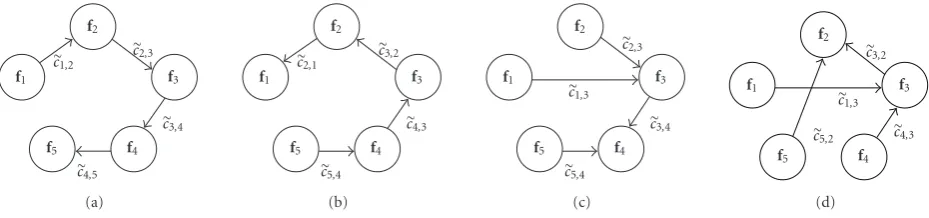
Figure2: Examples of graph representations of first-order noise shaping quantizers on a frame with five frame vectors. Note that the weights shown represent the upper bound of the quantization error. To represent the average error power, the weights should be squared.
In the discussion above we showed that the proposed noise shaping reduces the average and the upper bound of the quantization error for all frame expansions. The strate-gies above degenerate to direct coefficient quantization if the frame is an orthogonal basis. These results hold without any assumptions on the frame, or the ordering of the frame vec-tors and the corresponding coefficients. Finally, we derived a lower bound for the cost of a first-order noise shaping quan-tizer. In the next section we examine how to determine the optimal ordering and pairing of the frame vectors.
5. FIRST-ORDER QUANTIZER DESIGN
As indicated earlier, an essential issue in first-order quantizer design based on the strategies outlined in this paper is deter-mining the ordering of the frame vectors. The optimal order-ing depends on the specific set of synthesis frame vectors, but not on the specific signal. Consequently, the quantizer design (i.e., the frame vector ordering) is carried out off-line and the quantizer implementation is a sequence of projections based on the ordering chosen for either the sequential or tree quan-tizer.
5.1. Simple design strategies
An obvious design strategy is to determine an ordering and pairing of the coefficients such that the quantization of ev-ery coefficientakis compensated as much as possible by the coefficientalk. This can be achieved by settinglk = jk, with jk=arg minlk=kck,lk, as defined for the lower bounds of (28).
When this strategy is possible to implement, that is,jk> k, it results in the optimal ordering and pairing under both cost models we discussed, since it meets the lower bound for the quantization cost.
This corresponds to how a traditional Sigma-Delta quan-tizer works. When an expansion coefficient is quantized, the coefficients that can compensate for most of the error are the ones most adjacent. This implies that the time sequential dering of the oversampling frame vectors is the optimal or-dering for first-order noise shaping (another optimal order-ing is the time-reversed, i.e., the anticausal version). We ex-amine this further inSection 8.1.
Unfortunately, for certain frames, this optimal pairing might not be feasible. Still, it suggests a heuristic for a good coefficient pairing: at every stepk, the error from quantizing coefficientakis compensated using the coefficientalkthat can
compensate for most of the error, picking from all the frame vectors whose corresponding coefficients have not yet been quantized. This is achieved by setting lk = arg minl>kck,l. This, in general is not an optimal strategy, but an imple-mentable heuristic. Optimal designs are slightly more in-volved and we discuss these next.
5.2. Quantization graphs and optimal quantizers
FromSection 3.3it is clear that a tree quantizer can be repre-sented as a graph—specifically, a tree—in which all the nodes of the graph are coefficients to be quantized. Similarly for a sequential quantizer, which is a special case of the tree quan-tizer, the graph is a linear path passing through all the nodes ak in the correct sequence. In both cases, the graphs have edges (k,lk), pairing coefficient ak to coefficient alk if and
only if the quantization of coefficientakassigns the error to the coefficientalk.
Figure 2shows four examples of graph representations of first-order noise shaping quantizers on a frame with five frame vectors. Figures 2(a)and 2(b) demonstrate two se-quential quantizers ordering the frame vectors in their nat-ural and their reverse order, respectively. In addition, Figures
2(c)and2(d)demonstrate two general tree quantizers for the same frame.
In the figure a weight is assigned to each edge. The cost of each quantizer is proportional to the total weight of the graph with the addition of the cost of the final term. For a uniform frame the magnitude of the final term is the same, independent of which coefficient is quantized last. Therefore it is eliminated when comparing the cost of quantizer designs on the same frame. Thus, designing the optimal quantizer corresponds to determining the graph with the minimum weight.
We define a graph that has the frame vectors as nodes
V = {f1,. . .,fM}and the edges have weightw(k,l)=c2k,lor
call this graph thequantization error assignment graph. On this graph, any acyclic path that visits all the nodes—also known as a Hamiltonian path—defines a first order sequen-tial quantizer. Similarly, any tree that visits all the nodes— also known as a spanning tree—defines a tree quantizer.
The minimum cost Hamiltonian path defines the opti-mal sequential quantizer. This can be determined by solving thetraveling salesman problem (TSP). The TSP is of course NP-complete in general, but has been extensively studied in the literature [11]. Similarly, the optimal tree quantizer is de-fined by the solution of theminimum spanning treeproblem. This is also a well-studied problem, solvable in polynomial time [11]. Since any path is also a tree, if the minimum span-ning tree is a Hamiltonian path, then it is also the solution to the traveling salesman problem. The results are easy to ex-tend to nonuniform frames.
We should note that, in general, the optimal ordering and pairing depend on which of the two cost functions we choose to optimize for. Furthermore, we should reemphasize that this optimization is performed once, off-line, at the design stage of the quantizer. Therefore, the computational cost of solving these problems does not affect the complexity of the resulting quantizer.
6. FURTHER GENERALIZATIONS
In this section we consider two further generalizations. In
Section 6.1we examine the case for which the product term is restricted. InSection 6.2we consider the case of noise shap-ing usshap-ing more than one vector for compensation. Although a combination of the two is possible, we do not consider it in this paper.
6.1. Projection restrictions
The development in this paper uses the product ekck,lk to
compensate for the error in quantizing coefficientak using coefficientalk. Implementation restrictions often do not
al-low for this product to be computed to a satisfactory preci-sion. For example, typical Sigma-Delta converters eliminate this product altogether by settingc = 1. In such cases, the analysis using projections breaks down. Still, the intuition and approach remains applicable.
The restriction we consider is one on the product: the coefficientsck,lk are restricted to be in a discrete set A =
{α1,. . .,αK}. Requiring the coefficient to be an integer power
of 2 or to be only±1 are examples of such constraints. In this case we use again the algorithms ofSection 3, withck,lnow chosen to be the coefficient inAclosest to achieving a pro-jection, that is, withck,lspecified as
ck,l=arg minc∈Afk−cfl. (29)
As in the unrestricted case, the residual error isek(fk−ck,lfl)= ekck,lrk,lwithrk,landck,ldefined as in (12) and (13), respec-tively.
To apply either of the error models inSection 4, we use the newcl,lk, as computed above. However, in this case,
cer-tain coefficient orderings and pairings might increase the
overall error. A pairing offkwithflkimproves the cost if and
only if
fk−ck,l
kflk≤fk⇐⇒ck,lk≤fk, (30)
which is no longer guaranteed to hold. Thus, the strategies described inSection 5.1need a minor modification: we only allow the compensation to take place if (30) holds. Similarly, in terms of the graphical model ofSection 5.2, we only allow an edge in the graph if (30) holds. Still, the optimal sequen-tial quantizer is the solution to the TSP problem, and the op-timal tree quantizer is the solution to the minimum spanning tree problem on that graph—which might now have missing edges.
The main implication of missing edges is that, depending on the frame we operate on, the graph might have discon-nected components. In this case we should solve the traveling salesman problem or the minimum spanning tree on every component. Also, it is possible that, although we are operat-ing on an oversampled frame, noise shapoperat-ing is not beneficial due to the constraints. The simplest way to fix this is to always allow the choiceck,lk=0 in the setA. This ensures that (30)
is always met, and therefore the graph stays connected. Thus, whenever noise shaping is not beneficial, the algorithms will pickck,lk=0 as the compensation coefficient, which is
equiv-alent to no noise shaping. We should note that the choice of the setAmatters. The denser the set is, the better the approx-imation of the projection. Thus the resulting error is smaller. An interesting special case corresponds to removing the multiplication from the feedback loop by settingA= {1}. As we mentioned before, this is a common design choice in tra-ditional Sigma-Delta converters. Furthermore, it is the case examined in [5,6], in which the issue of the optimal permu-tation is addressed in terms of the frame variation. The frame variation is defined in [5] motivated by the triangle inequal-ity, as is the upper bound model ofSection 4.2. In that work it is also shown that incorrect frame vector ordering might in-crease the overall error, compared to direct coefficient quan-tization.
In this case the compensation is improving the cost if and only iffk−flk<fk. The rest of the development remains
the same: we need to solve the traveling salesman problem or the minimum spanning tree problem on a possibly dis-connected graph. In the example we present inSection 7, the natural frame ordering becomes optimal using our cost mod-els, yielding the same results as the frame variation criterion suggested in [5,6]. InSection 8.1we show that when applied to classical first-order noise shaping, this restriction does not affect the optimal frame ordering and does not impact sig-nificantly the error power.
6.2. Higher-order quantization
develop the quantization strategy and the error modeling for a given ordering of the coefficients.
The goal of higher-order noise shaping is to compensate for quantization of each coefficient using more than one co-efficient. There are several possible implementations of a tra-ditional higher-order Sigma-Delta quantizer. All have a com-mon property; the quantization error is in effect modified by apth-order filter, typically with a transfer function of the form
He(z)= 1−z−1
p
(31)
and equivalently an impulse response
he[n]=δ[n]−
p
i=1
ciδ[n−i]. (32)
Thus, every error coefficientekadditively contributes a term of the formek(fk−
p
i=1cifk+i) to the output error. In order to minimize the magnitude of this contribution we need to choose thecisuch that
p
i=1cifk+iis the projection offkto the space spanned by{fk+1,. . .,fk+p}. Using (31) as the system function is often preferred for implementation simplicity but it is not the optimal choice. This design choice is similar to eliminating the product inFigure 1. As with first-order noise shaping, it is straightforward to generalize this to arbitrary frames.
Given a frame vector ordering, we consider the quanti-zation of coefficientak toak = ak+ek. This error is to be compensated using coefficientsal1toalp, with all theli > k.
Thus, we project the vector−ekfkto the spaceSk, defined by the vectorsfl1,. . .,flp. The essential part of this development
is to determine a set of coefficients that multiply the errorek in order to project it to the appropriate space.
To perform this projection we view the set{fl |l∈Sk} as the reconstruction frame forSk, whereSk= {l1,. . .,lp}is the set of the indices of all the vectors that we use for com-pensation of coefficientak. Ensuring that for allj≥k,k /∈Sj guarantees that once a coefficient is quantized, it is not mod-ified again.
Extending the first-order quantizer notation, we denote the coefficients that perform the projection by ck,l,Sk. It is
straightforward to show that these coefficients perform a projection if and only if they satisfy the following equation:
⎡ ⎢ ⎢ ⎢ ⎢ ⎣
fl1,fl1 fl1,fl2
· · · fl1,flp
fl2,fl1 fl2,flp
· · · fl1,flp
..
. . .. ...
flp,fl1 flp,fl2
· · · flp,flp
⎤ ⎥ ⎥ ⎥ ⎥ ⎦ ⎡ ⎢ ⎢ ⎢ ⎢ ⎣
ck,l1,Sk
ck,l2,Sk
.. .
ck,lp,Sk
⎤ ⎥ ⎥ ⎥ ⎥ ⎦
=
⎡ ⎢ ⎢ ⎢ ⎢ ⎣
fl1,fk
fl2,fk
.. .
flp,fk
⎤ ⎥ ⎥ ⎥ ⎥ ⎦.
(33)
If the frame{fl | l ∈ Sk}is redundant, the coefficients are not unique. One option for the solution above would be to use the pseudoinverse of the matrix. This is equivalent to
computing the inner product offk with the dual frame of
{fl | l ∈ Sk} inSk, which we denote by{φSlk | l ∈ Sk}:
ck,l,Sk= fk,φ
Sk
l . The projection is equal to
PSk −ekfk
= −ek
l∈Sk
ck,l,Skfl. (34)
Consistent withSection 3, we change step (3) ofAlgorithm 1
to
(3) update{al |l∈Sk}toal =al−ekck,l,Sk, whereck,l,Sk
satisfy (33).
Similarly, the residual is−ekck,Skrk,Sk, where
ck,Sk=
fk−
l∈Sk
ck,l,Skfl
,
rk,Sk= fk−
l∈Skck,l,Skfl fk−
l∈Skck,l,Skfl .
(35)
This corresponds to expressingekfkas the direct sum of the vectors ekck,Skrk,Sk⊕ek
l∈Skck,l,Sfl, and compensating only
for the second part of this sum. Note thatck,Sk andrk,Skare
the same independent of whether we use the pseudoinverse to solve (33) or any other left inverse.
The modification to the equations for the total error and the corresponding cost functions are straightforward:
E=
M
k=1
ekck,Skrk,Sk, (36)
EE2=Δ2
12 M
k=1
c2
k,Sk, (37)
E ≤ Δ
2 M
k=1
ck,Sk. (38)
WhenSk= {lk}fork < M, this collapses to a tree quantizer.
Similarly, whenSk= {k+1}, the structure becomes a sequen-tial quantizer. Since the tree quantizer is a special case of the higher-order quantizer, it is straightforward to show that for a given frame vector ordering a higher-order quantizer can always achieve the cost of a tree quantizer. Note thatSMis al-ways empty, and, thereforecM,SM= fM, which is consistent
with the cost analysis for the first-order quantizers.
For appropriately ordered finite frames inNdimensions, the firstM−Nerror coefficientsck,Sk can be forced to zero
with anNth or highorder quantizer. In this case, the er-ror coefficients determining the cost of the quantizer are the remainingNones—the error becomesMk=M−N+1ekck,Skrk,Sk,
with the corresponding cost functions modified accordingly. One way to achieve that function is to use all the unquantized coefficients to compensate for the quantization of coefficient akby settingSk = {(k+ 1),. . .,M}and ordering the vectors such that the lastN frame vectors span the space. Another way to achieve this cost function is discussed as an example in next section.
7. EXPERIMENTAL RESULTS
To validate the theoretical results we presented above, in this section we consider the same example as was included in [5,6]. We use the tight frame consisting of the 7th roots of unity to expand randomly selected vectors inR2, uniformly
distributed inside the unit circle. The frame expansion is quantized usingΔ=1/4, and the vectors are reconstructed using the corresponding synthesis frame. The frame vectors and the coefficients relevant to quantization are given by
fn=
cos
2πn
7
, sin
2πn 7
,
fn=
2 7cos
2πn
7
,2 7sin
2πn
7
,
ck,l=cos
2π(k−l) 7
,
ck,l= 2
7 sin
2π(k−l) 7
.
(39)
For this frame the natural ordering is suboptimal given the criteria we propose. An optimal ordering of the frame vectors is (f1,f4,f7,f3,f6,f2,f5), and we refer to it as such for
the remainder of this section, in contrast to the natural frame vector ordering. A sequential quantizer with this optimal or-dering meets the lower bound for the cost under both cost functions we propose. Thus, it is an optimal first-order noise shaping quantizer for both cost functions. We compare this strategy to the one proposed in [5,6] and also explored as a special case of Section 6.1. Under that strategy, there is no projection performed, just error propagation. Therefore, based on the frame variation as described in [5,6], the nat-ural frame ordering is the best ordering to implement that strategy.
In the simulations, we also examine the performance of higher-order quantization, as described inSection 6.2. Since we operate on a two-dimensional frame, a second-order quantizer can perfectly compensate for the quantization of all but the last two expansion coefficients. Therefore, all the er-ror coefficients of (36) are 0, except for the last two. A third-order or higher quantizer should not be able to improve the quantization cost. However, the ordering of frame vectors is still important, since the angle between the last two frame vectors to be quantized affects the error, and should be as small as possible.
To visualize the results we plot the distribution of the re-construction error magnitude. InFigure 3(a)we consider the case of direct coefficient quantization. Figures3(b)and3(c)
correspond to noise shaping using the natural and the opti-mal frame ordering, respectively, and the method proposed in [5,6], that is, without projecting the error. Figures3(d),
3(e), and3(f)use the projection method we propose using the natural frame ordering, and first-, second-, and third-order projections, respectively. Finally, Figures3(g)and3(h)
demonstrate first- and second-order noise shaping results, respectively, using projections on the optimal frame order-ing. For clarity of the legend we do not plot the third-order results; they are almost identical to the second-order case. On all the plots we indicate with dotted and dash-dotted lines
the average and maximum reconstruction error, respectively, and with dashed and solid lines the average and maximum error, as determined using the cost functions ofSection 4.3
The results show that the projection method results in smaller error, even using the natural frame ordering. As ex-pected, the results using the optimal frame vector ordering are the best among the simulations we performed. The sim-ulations also confirm that inR2, noise shaping provides no
benefit beyond second order and that the frame vector order-ing affects the error even in higher-order noise shaping, as predicted by the analysis. It is evident that the upper bound model is loose, as expected. The error average, on the other hand, is surprisingly close to the simulation mean, although it usually overestimates it.
Our results were similar for a variety of frame expansions on different dimensions, redundancy values, vector order-ings, and noise shaping orders, including oblique bases (i.e., nonredundant frame expansions), validating the theory de-veloped in the previous sections.
8. EXTENSIONS TO INFINITE FRAMES
When extending the results above to frames with a countably infinite numbers of synthesis frame vectors, we letM → ∞
and modify (14), (20), and (23) to reflect an error rate cor-responding to average error per frame vector, or equivalently per expansion coefficient. AsM → ∞, the effect of the last term on the error rate tends to zero. Consequently in consid-ering the error rate we replace (14), (20), and (23) by
E= lim M→∞
1 M
M−1
k=0
ekck,k+1rk,k+1, (40)
EE2= lim
M→∞
1 M
Δ2
12 M−1
k=0
c2
k,k+1
, (41)
E ≤ lim M→∞
1 M
Δ 2
M−1
k=0
ck,k+1
, (42)
respectively, where (·) denotes rate, and the frame vectors are indexed inN. Similar modifications are straightforward for the cases of tree4and higher-order quantizers, and for any
countably infinite indexing of the frame vectors. At the de-sign stage, the choice of frame should be such to ensure con-vergence of the cost functions. In the remaining of this sec-tion we expand further on shift invariant frames, where con-vergence of the cost functions is straightforward to demon-strate.
3In some parts of the figure, the lines are out of the axis bounds. For com-pleteness, we list the results here: (a) estimated max=0.25, (b) estimated max=0.22, (c) estimated max=0.45, simulation max=0.27, (d) esti-mated max=0.20.
0 0.05 0.1 0.15 0
0.01 0.02 0.03 0.04
R
elati
ve
fr
equency
Error magnitude (a)
0 0.05 0.1 0.15 0
0.01 0.02 0.03 0.04
R
elati
ve
fr
equency
Error magnitude (b)
0 0.05 0.1 0.15 0
0.01 0.02 0.03 0.04
R
elati
ve
fr
equency
Error magnitude (c)
0 0.05 0.1 0.15 0
0.01 0.02 0.03 0.04
R
elati
ve
fr
equency
Error magnitude (d)
0 0.05 0.1 0.15 0
0.01 0.02 0.03 0.04
R
elati
ve
fr
equency
Error magnitude (e)
0 0.05 0.1 0.15 0
0.01 0.02 0.03 0.04
R
elati
ve
fr
equency
Error magnitude (f)
0 0.05 0.1 0.15 0
0.01 0.02 0.03 0.04
R
elati
ve
fr
equency
Error magnitude (g)
0 0.05 0.1 0.15 0
0.01 0.02 0.03 0.04
R
elati
ve
fr
equency
Error magnitude (h)
Simulation mean Simulation max Estimated mean Estimated max
Figure3: Histogram of the reconstruction error under (a) direct coefficient quantization, (b) natural ordering and error propagation with-out projections, (c) optimal ordering and error propagation withwith-out projections. In the second row, natural ordering using projections, with (d) first-, (e) second-, and (f) third-order error propagation. In the third row, optimal ordering using projections, with (g) first- and (h) second-order error propagation (the third-order results are similar to the second-order ones but are not displayed for clarity of the legend).
8.1. Infinite shift invariant frames
We define infinite shift invariant reconstruction frames as in-finite framesfkfor which the inner product between frame vectors fk,fl is a function only of the index difference k−l. Consistent with traditional signal processing termi-nology, we define this as the autocorrelation of the frame: Rm= fk,fk+m. Shift invariance implies that the reconstruc-tion frame is uniform, withfk2= fk,fk =R0.
An example of such a frame is an LTI system: consider a signalx[n] that is quantized tox[n] and filtered to pro-duce y[n]= kx[k]h[n−k]. We consider the coefficients
x[k] to be a frame expansion ofy[n], whereh[n−k] are the reconstruction frame vectorsfk. We rewrite the convolution equation as
y[n]=
k
x[k]h[n−k]=
k
x[k]fk[n], (43)
wherefk[n]=h[n−k]. Equivalently, we may considerx[n] to be quantized, converted to continuous time impulses, and then filtered to producey(t)=kx[k]h(t−kT). We desire to minimize the quantization cost after filtering, compared to the signalsy[n]=kx[k]h[n−k] andy(t)=
For the remainder of this section we only discuss the discrete-time version of the problem since the continuous time development is identical. The corresponding frame au-tocorrelation functions areRm=Rhh[m]=
mh[n]h[n−m] in the discrete-time case andRm =Rhh(mT)=
h(t)h(t−
mT)dtin the continuous-time case. A special case of this setup is the oversampling frame, in whichh(t) orh[n] is the ideal lowpass filter used for the reconstruction, andRm = sinc(πm/r), whereris the oversampling ratio.
8.2. First-order noise shaping
Given a shift invariant frame, it is straightforward to deter-mine the coefficientsck,l andck,l that are important for the design of a first-order quantizer. These coefficients are also shift invariant, so we denote them using cm = ck,k+m and
cm = ck,k+m. Combining (15) and (13) fromSection 3and the definition ofRm above, we compute the relevant coeffi -cients:
cm=c−m=Rm
R0
,
cm=c−m=
R0 1−cm2
.
(44)
For every coefficientakof the frame expansion and cor-responding frame vector fk, the vector that minimizes the projection error is the vector fk±mo, where mo > 0
mini-mizescm, or, equivalently, maximizes|cm|, that is,|Rm|. By symmetry, for any suchmo,−mo is also a minimum. Due to the shift invariance of the frame,mo is the same for all frame vectors. Projecting tofk+mo orfk−mo generates a path
with no loops, and therefore the optimal tree quantizer path, as long as the direction is consistent for all the coefficients. Whenmo =1, the optimal tree quantizer is also an optimal sequential quantizer. The optimality holds under both the additive noise model and the error upper bound model.
In the case of filtering, the noise shaping implementa-tion is shown inFigure 4, withHf(z) = cmoz−mo. It is easy
to show that for the special case of the oversampling frame mo=1, confirming that the time sequential ordering of the frame vectors is optimal for the given frame.
8.3. Higher-order noise shaping
As discussed in Section 6.2, determining the optimal or-dering for higher-order quantization is not straightforward. Therefore, in this section we consider higher-order noise shaping for the natural frame ordering, assuming that when ak is quantized, the next p coefficients, ak+1,. . .,ak+p, are used for compensation by updating them to
ak+l=ak+l−ekcl, l=1,. . .,p. (45)
The coefficientscl projectfk onto the spaceSk defined
by{fk+1,. . .,fk+p}. Because of the shift invariance property,
these coefficients are independent ofk. Shift invariance also
x[n] x[n]
Q(·) x[n] h[n] y[n] −
+
++ −
Hf(z) e[n]
Figure4: Noise shaping quantizer, followed by filtering.
Table1: Gain in dB in in-band noise power comparingpth-order classical noise shaping withpth-order noise shaping using projec-tions.
r=2 r=4 r=8 r=16 r=32 r=64 p=1 0.9 0.2 0.1 0.0 0.0 0.0 p=2 4.5 3.8 3.6 3.5 3.5 3.5 p=3 9.1 8.2 8.0 8.0 8.0 8.0 p=4 14.0 13.1 12.9 12.8 12.8 12.8
simplifies (33): ⎡ ⎢ ⎢ ⎢ ⎢ ⎣
R0 R1 · · · Rp−1 R1 R0 · · · Rp−2
..
. . .. ...
Rp−1 · · · R0 ⎤ ⎥ ⎥ ⎥ ⎥ ⎦ ⎡ ⎢ ⎢ ⎢ ⎢ ⎣
c1
c2
.. .
cp
⎤ ⎥ ⎥ ⎥ ⎥
⎦=
⎡ ⎢ ⎢ ⎢ ⎢ ⎣
R1
R2
.. .
Rp
⎤ ⎥ ⎥ ⎥ ⎥
⎦, (46)
withRmbeing the frame autocorrelation function. There are several options for solving this equation, including the Levin-son recursion.
The implementation for higher-order noise shaping be-fore filtering is shown inFigure 4, withHf(z)=
p
l=1clz−l, where thecl solve (46). The feedback filter implements the projection and the coefficient update described in (45).
For the special case of the oversampling frame,Table 1
demonstrates the benefit of adjusting the feedback loop to perform a projection. The table reports the approximate dB gain in reconstruction error energy using the solution to (46) compared to the classical feedback loop implied by (31). For example, for oversampling ratios greater than 8 and third-order noise shaping, there is an 8 dB gain in implementing the projection method. The gain figures in the table are cal-culated using the additive noise model of quantization.
The applications in this section can be extended for frames generated by oversampled filterbanks, a case exten-sively studied in [7]. In that work, the problem is posed in terms of prediction with quantization of the prediction er-ror. Motivated by that work, we determined the solution to the filterbank problem using the projective approach. Setting up and solving for the compensation coefficients using (33) in Section 6.2corresponds exactly to solving [7, (21)], the solution to that setup under the white noise assumption.
improvements compared to scalar coefficient quantization. On the other hand, it is not straightforward to use our ap-proach to analyze and compensate for colored additive noise, as described in [7].
ACKNOWLEDGMENTS
We express our thanks to the anonymous reviewers for their insightful and helpful comments during the review process. This work was supported in part by participation in the Advanced Sensors Collaborative Technology Alliance (CTA) sponsored by the US Army Research Laboratory under Co-operative Agreement DAAD19-01-2-008, the Texas Instru-ments Leadership University Consortium Program, BAE Sys-tems Inc., and MIT Lincoln Laboratory. The views expressed are those of the authors and do not reflect the official policy or position of the US government.
REFERENCES
[1] I. Daubechies,Ten Lectures on Wavelets, CBMS-NSF Regional Conference Series in Applied Mathematics, SIAM, Philadel-phia, Pa, USA, 1992.
[2] Z. Cvetkovic and M. Vetterli, “Overcomplete expansions and robustness,” inProceedings of IEEE-SP International Sympo-sium on Time-Frequency and Time-Scale Analysis, pp. 325–328, Paris, France, June 1996.
[3] V. K. Goyal, M. Vetterli, and N. T. Thao, “Quantized overcom-plete expansions inRN : analysis, synthesis, and algorithms,” IEEE Transactions on Information Theory, vol. 44, no. 1, pp. 16–31, 1998.
[4] N. T. Thao and M. Vetterli, “Reduction of the MSE inR-times oversampled A/D conversionO(1/R) toO(1/R2),”IEEE Trans-actions on Signal Processing, vol. 42, no. 1, pp. 200–203, 1994. [5] J. J. Benedetto, A. M. Powell, and ¨O. Yilmaz,
“Sigma-Delta (Δ) quantization and finite frames,” to appear in IEEE Transactions on Information Theory, available at:
http://www.math.umd.edu/∼jjb/ffsd.pdf.
[6] J. J. Benedetto, ¨O. Yilmaz, and A. M. Powell, “Sigma-delta quantization and finite frames,” inProceedings of IEEE Inter-national Conference on Acoustics, Speech, and Signal Processing (ICASSP ’04), vol. 3, pp. 937–940, Montreal, Quebec, Canada, May 2004.
[7] H. Bolcskei and F. Hlawatsch, “Noise reduction in oversam-pled filter banks using predictive quantization,”IEEE Transac-tions on Information Theory, vol. 47, no. 1, pp. 155–172, 2001. [8] P. T. Boufounos and A. V. Oppenheim, “Quantization noise shaping on arbitrary frame expansion,” inProceedings of IEEE International Conference on Acoustics, Speech, and Signal Pro-cessing (ICASSP ’05), vol. 4, pp. 205–208, Philadelphia, Pa, USA, March 2005.
[9] G. Strang and T. Nguyen,Wavelets and Filter Banks, Wellesley-Cambridge Press, Wellesley, Mass, USA, 1996.
[10] J. C. Candy and G. C. Temes, Eds.,Oversampling Delta-Sigma Data Converters: Theory, Design and Simulation, IEEE Press, New York, NY, USA, 1992.
[11] T. H. Cormen, C. E. Leiserson, R. L. Rivest, and C. Stein, In-troduction to Algorithms, MIT Press, Cambridge, Mass, USA, 2nd edition, 2001.
Petros T. Boufounoscompleted his under-graduate and under-graduate studies in the Mas-sachusetts Institute of Technology (MIT) and received the S.B. degree in economics in 2000, the S.B. and M.E. degrees in electrical engineering and computer science (EECS) in 2002, and the Sc.D. degree in EECS in 2006. He is currently with the MIT Digi-tal Signal Processing Group doing research in the area of robust signal representations
using frame expansions. His research interests include signal pro-cessing, data representations, frame theory, and machine learn-ing applied to signal processlearn-ing. Petros has received the Ernst A. Guillemin Master Thesis Award for his work on DNA sequencing, and the Harold E. Hazen Award for Teaching Excellence, both from the MIT EECS Department. He has been a MIT Presidential Fellow, and is a Member of the Eta Kappa Nu Electrical Engineering Honor Society, and Phi Beta Kappa, the National Academic Honor Society for excellence in the liberal learning of the arts and sciences at the undergraduate level.
Alan V. Oppenheimreceived the S.B. and S.M. degrees in 1961 and the S.D. degree in 1964, all in electrical engineering, from the Massachusetts Institute of Technology. He is also the recipient of an Honorary Doc-torate degree from Tel Aviv University. In 1964, Dr. Oppenheim joined the faculty at MIT, where he is currently Ford Professor of Engineering and a MacVicar Faculty Fellow. Since 1967 he has been affiliated with MIT