Volume 2008, Article ID 459586,13pages doi:10.1155/2008/459586
Research Article
Sequential and Adaptive Learning Algorithms
for M-Estimation
Guang Deng
Department of Electronic Engineering, Faculty of Science, Technology and Engineering, La Trobe University, Bundoora, VIC 3086, Australia
Correspondence should be addressed to Guang Deng,[email protected]
Received 1 October 2007; Revised 9 January 2008; Accepted 1 April 2008
Recommended by Sergios Theodoridis
The M-estimate of a linear observation model has many important engineering applications such as identifying a linear system under non-Gaussian noise. Batch algorithms based on the EM algorithm or the iterative reweighted least squares algorithm have been widely adopted. In recent years, several sequential algorithms have been proposed. In this paper, we propose a family of sequential algorithms based on the Bayesian formulation of the problem. The basic idea is that in each step we use a Gaussian approximation for the posterior and a quadratic approximation for the log-likelihood function. The maximum a posteriori (MAP) estimation leads naturally to algorithms similar to the recursive least squares (RLSs) algorithm. We discuss the quality of the estimate, issues related to the initialization and estimation of parameters, and robustness of the proposed algorithm. We then develop LMS-type algorithms by replacing the covariance matrix with a scaled identity matrix under the constraint that the determinant of the covariance matrix is preserved. We have proposed two LMS-type algorithms which are effective and low-cost replacement of RLS-type of algorithms working under Gaussian and impulsive noise, respectively. Numerical examples show that the performance of the proposed algorithms are very competitive to that of other recently published algorithms.
Copyright © 2008 Guang Deng. This is an open access article distributed under the Creative Commons Attribution License, which permits unrestricted use, distribution, and reproduction in any medium, provided the original work is properly cited.
1. INTRODUCTION
We consider a robust estimation problem for a linear obser-vation model:
y=xTw+r, (1)
wherewis the impulse response to be estimated,{y,x}is the known training data and the noiserfollows an independent and identical distribution (i.i.d.). Given a set of training data
{yk,xk}k=1:n, the maximum likelihood estimation (MLE) of
wleads to the following problem:
wn=arg min w
n
k=1
ρrk, (2)
whereρ(rk)= −logp(yk |w) is the negative log likelihood function. The M-estimate of a linear model can also be expressed as the above MLE problem when those well-developed penalty functions [1, 2] are regarded as gen-eralized negative log-likelihood function. This is a robust
regression problem. The solution not only is an essential data analysis tool [3,4], but also has many practical engineering applications such as in system identification, where the noise model is heavy tailed [5].
algorithm[10]. Other published works include robust LMS-type algorithms [11–13].
Bayesian learning has been a powerful tool for developing sequential learning algorithms. The problem is formulated as a maximum a posteriori (MAP) estimate problem.The basic idea is to break the sequential learning problem into two major steps [14]. In the update step, an approximate of the posterior at timen−1 is used to obtain the new posterior at timen. In the approximation step, this new posterior is approximated by using a particular parametric distribution family. There are many well-documented techniques such as Laplace method [15] and Fisher scoring [16]. The variational Bayesian method has also been studied [17,18].
In a recent paper [19], we address this problem from a Bayesian perspective and develop RLS-type and LMS-type of sequential learning algorithms. The development is based on using a Laplace approximation of the posterior and solving the maximum a posteriori (MAP) estimate problem by using the MM algorithm [20]. The development of the algorithm is quite complicated. The RLS-type of algorithm is further simplified as an LMS-type algorithm by treating the covariance matrix as being fixed. This has significantly reduced the computational complexity at the cost of degraded performance.
There are two major motivations of this work which is clearly an extension of our previous work [19]. Our first motivation is to follow the same problem formulation as in [19] and to explore an alternative and simpler approach to develop sequential M-estimate algorithms. More specifically, at each iteration, we use Gaussian approximation for the likelihood and the prior. As such, we can determine a close form solution of an MAP estimate sequentially when a set of new training data is available. This MAP estimate is in the similar form as that of an RLS algorithm. Our second motivation is to extend the RLS-type algorithm to the LMS-type algorithm with an adaptive step size. It is well established that a learning algorithm with adaptive step size usually outperforms those with fixed step size in terms of faster initial learning rate and lower steady state [21]. Therefore, instead of treating the covariance as being fixed, as in our previous work, we propose to use a scaled identity matrix to approximate the covariance matrix. The approximation is subject to preserving the determinant of the covariance matrix. As such, instead of updating the covariance, the scaling factor is updated. The update of the impulse response and the scaling factor thus constitute an LMS-type algorithm with an adaptive step size. A major contribution of this work is thus the development of new sequential and adaptive learning algorithms. Another major contribution is that performance of proposed LMS-type of algorithms is very close to that of the RLS-type counterpart.
Since this work is an extension of our previous work in which a survey of related works and Bayesian sequential learning have already been briefly discussed, in this paper, for brevity purpose, we have omitted the presentation of an extensive literature survey. Interested readers can refer to [19] and references therein for more information. The rest of this paper is organized as follows. InSection 2, we present the development of the proposed algorithm including a
subopti-mal solution. We show that the proposed algorithm consists of an approximation step and a minimization step which lead to the update of the covariance matrix and impulse response, respectively. We also discuss the quality of the estimate, issues related to the initialization and estimation of parameters, and the relationship of the proposed algorithms with those of our previous work. InSection 3, we first develop the general LMS-type of algorithm. We then present three specific algorithms, discuss their stability conditions and parameter initiation. InSection 4, we present three numerical examples. The first one evaluates the performance of the proposed RLS-type of algorithms, while the second and the third evaluate the performance of the proposed LMS-type of algorithms under Gaussian and impulsive noise conditions, respectively. A summary of this paper is presented inSection 5.
2. DEVELOPMENT OF THE ALGORITHM
2.1. Problem formulation
From the Bayesian perspective, after receiving n sets of training dataDn = {yk,xk}|k=1:n,the log posterior for the linear observation model (1) is given by
logp(w|Dn)=
n
k=1
logp(rk) + logp(w|H) +c, (3)
where p(w | H) is the prior before receiving any training data andH represents the model assumption. Throughout this paper, we use “c” to represent a constant. The MAP estimate ofwis given by
wn=arg min w
−logpw|Dn. (4)
Since the original M-estimation problem (2) can be regarded as a maximum likelihood estimation problem, in order to apply the above Bayesian approach, in this paper we attempt to solve the following problem:
wn=arg min w
n
k=1
ρ(rk) +1 2λw
Tw
. (5)
This is essentially a constrained MLE problem:
wn=arg min w
n
k=1
ρ(rk), subject to1 2w
Tw≤d. (6)
Using the Lagrange multiplier method, the constrained MLE problem can be recasted as (5), where λ is the Lagrange multiplier and is related to the constantd. We can see that bothdandλcan be regarded as regularization parameters which are used to control the model complexity. Bayesian [22] and non-Bayesian [23] approaches have been developed to determine regularization parameters.
A0 = λ−1I whereIis an identity matrix. Therefore, in this paper we develop a sequential M-estimation algorithm by solving an MAP problem which is equivalent to a constrained MLE problem.
Since we frequently use the three variablesrn,en, anden, we define them as follows:rn=yn−xT
nw,en=yn−xnTwn−1, anden = yn−xT
nwn, wherewn−1andwnare the estimates ofwat timen−1 andn, respectively. We can see thatrnis the additive noise at timen, andenandenare the modelling errors due to usingwn−1andwnas the impulse response at timen, respectively.
2.2. The proposed RLS-type algorithms
To develop a sequential algorithm, we rewrite (3) as follows:
logpw|Dn=logprn+ logpw|Dn−1
+c, (7)
where the term logp(w | Dn−1) is the log posterior at time (n−1) and is also the log prior at timen. The term logp(rn)=logp(yn|w) is the log-likelihood function. The basic idea of the proposed sequential algorithm is that an approximated log posterior is formed by replacing the log prior logp(w|Dn−1) with its quadratic approximation. The negative of the approximated log posterior is then minimized to obtain a new estimate.
To illustrate the idea, we start our development from the beginning stage of the learning process. Since the exact prior distribution for w is usually unknown, we use a Gaussian distribution with zero meanw0 = 0 and covarianceA0 = λ−1Ias an approximation. The negative log prior−logp(w|
H) is approximated byJ0(w)
J0(w)= 1
2(w−w0) T
A−01(w−w0) +c. (8)
When the first set of training dataD1= {y1,x1}is received, the negative log likelihood is−logp(y1|w)=ρ(r1) and the negative log posterior with the approximated prior, denoted byP1(w)= −logp(w|D1), can be written as
P1(w)=ρ(r1) +J0(w) +c. (9)
This is the approximation step. In the minimization step, we determine the minimizer ofP1(w), denoted byw1, by solving the equation∇P1(w1)=0.
We then determine a quadratic approximation ofP1(w) aroundw1through the Taylor-series expansion:
P1(w)=P1(w1) +1
2(w−w1) T
A−1
1 (w−w1) +· · ·, (10)
where P1(w1) is a constant, A−11 = ∇∇P1(w)|w=w1 is the Hessian evaluated at w = w1, and the linear term [∇P1(w1)]T(w−w1) is zero since∇P1(w1)= 0. Ignoring higher-order terms, we have the quadratic approximation for
P1(w) as follows:
J1(w)= 1
2(w−w1) TA−1
1 (w−w1) +c. (11)
This is equivalent to using a Gaussian distribution to approximate the posterior distribution p(w | D1) with mean w1 and covariance A1. In Bayesian learning, this is well-known technique called Laplace approximation [15]. In optimization theory [24], a local quadratic approximation of the objective function is frequently used.
When we receive the second set of training data, we form the negative log posterior, denotedP2(w)= −logp(w|D2), by replacingP1(w) withJ1(w) as follows:
P2(w)=ρ(r2) +J1(w) +c. (12)
The minimization step results in an optimal estimatew2. Continuing this process and following the same proce-dure, at time n, we use a quadratic approximation for
Pn−1(w) and form an approximation of the negative log posterior as
Pn(w)=ρ(rn) +1
2(w−wn−1) T
A−n−11(w−wn−1) +c, (13)
where wn−1 is optimal estimate at time n−1 and is the minimizer ofPn−1(w). The MAP estimate at timen, denoted bywn, satisfies the following equation:
∇Pn(wn)= −ψenxn+A−n−11
wn−wn−1
=0, (14)
whereψ(t)=ρ(t) anden=yn−xT
nwn. Note that,rnin (13) is replaced byenin (14) becausewis replaced bywn. From (14), it is easy to show that
wn=wn−1+ψ
enAn−1xn. (15) Sincewndepends onψ(en), we need to determineen. Left-multiplying (15) byxT
n, then using the definition ofen, we can show that
en=en−ψenxT
nAn−1xn, (16) where en = yn−xT
nwn−1. Once we have determined en from (16), we can calculateψ(en) and substitute it into (15). We show in Appendix A that the solution of (16) has the following properties: when en = 0, en = 0, when en=/0,
|en|<|en|and sign(en)=sign(en).
Next, we determine a quadratic approximation forPn(w) aroundwn. This is equivalent to approximating the posterior p(w|Dn) by a Gaussian distribution with meanwnand the covariance matrixAn:
A−n1= ∇∇Pn(w)|w=wn =ϕ(en)xnxTn+A−n−11,
(17)
whereϕ(t)=ρ(t). Using a matrix inverse formula, we have the update of the covariance matrix forϕ(en)>0 as follows:
An=An−1− An−1xnx T nAn−1 1/ϕ(en) +xT
nAn−1xn.
(18)
Ifϕ(en)=0, then we haveAn=An−1.
Table1: A list of some commonly used penalty functions and their first and second derivatives, denoted byρ(x),ψ(x)=ρ(x) andϕ(x)= ρ(x), respectively.
ρ(x) ψ(x)=ρ(x) ϕ(x)=ρ(x)
L2 ρ(x)=
x2
2σ2 ψ(x)=
x
σ2 ϕ(x)=
1 σ2
Huber ρ(x)=
⎧ ⎪ ⎪ ⎪ ⎨ ⎪ ⎪ ⎪ ⎩ 1 2 x2
σ2, |
x σ| ≤ν
ν|xσ| −12ν2, |x
σ| ≥ν ϕ(x)= ⎧ ⎪ ⎪ ⎪ ⎨ ⎪ ⎪ ⎪ ⎩ x
σ2, |
x σ| ≤ν
ν
σsign(x), | x σ| ≥ν ϕ(x)= ⎧ ⎪ ⎪ ⎪ ⎨ ⎪ ⎪ ⎪ ⎩ 1 σ2, |
x σ| ≤ν
0, |xσ| ≥ν
Fair ρ(x)=σ2x
σ
−log
1 +x σ
ψ(x)= x
1 +|x/σ| ϕ(x)=
1 +x σ
−2
fixed-point iteration algorithm to find a solution. This would add a significant computational cost to proposed algorithm. An alternative way is to seek a closed form solution by using a quadratic approximation of the penalty functionρ(rn) as follows:
ρ(rn)=ρen+ψenrn−en+1 2ϕ
enr−en2. (19)
As such, the cost functionPn(w) is approximated by
Pn(w)=ρ(rn) +1 2
w−wn−1 T
A−n−11
w−wn−1
. (20)
InAppendix B, we show that the optimal estimate and the update of the covariance matrix are given by
wn=wn−1+
ψ(en)An−1xn 1 +ϕ(en)xT
nAn−1xn, (21)
An=An−1−
An−1xnxTnAn−1 1/ϕ(en) +xT
nAn−1xn
, (22)
respectively. Comparing (15) with (21), we can see that using the quadratic approximation for ρ(rn) results in an approximation of ψ(en) by ψ(en)/(1 +ϕ(en)xT
nAn−1xn). Comparing (18) with (22), we can see that the only change due to the approximation is replacingϕ(en) byϕ(en).
In summary, the proposed sequential algorithm for a particular penalty function can be developed as follows. Suppose at timen, we havewn−1,An−1and the training data. We have two approaches here. If we can solve (16) foren, then we can calculatewnusing (15) and updateAnusing (18). On the other hand, if there is no close form solution forenor the solution is very complicated, then we can use (21) and (22).
2.3. Specific algorithms
In this section, we present three examples of the proposed algorithm using three commonly used penalty functions. These penalty functions and their first and second derivatives
are listed inTable 1. These functions are shown inFigure 1. We also discuss the robustness of these algorithms. To simplify discussion, we use (21) and (22) for the algorithm development.
2.3.1. TheL2penalty function
We can easily see that by substituting ψ(x) = x/σ2 and ϕ(x) = 1/σ2 into (21) and (22), we have an RLS-type of algorithm [19]:
wn=wn−1+ en
An−1xn σ2+xT
nAn−1xn, (23)
An=An−1−An−1xnx T nAn−1 σ2+xT
nAn−1xn.
(24)
When σ2 = 1, this reduced to a recursive least squares algorithm [27]. One can easily see that the update of the impulse response is proportional to|en|. As such, it is not robust against impulsive noise which leads to a large value of
|en|and thus a large unnecessary adjustment.
We note that we have used an approximate approach to derive (23) and (24). This is only used for the simplification of the presentation. In fact, for an L2 penalty function (23) and (24) can be directly derive from (15) and (18), respectively. The results are exactly the same as (23) and (24).
2.3.2. Huber’s penalty function
By substituting the respective terms ofϕ(en) andψ(en) into (21) and (22), we have the following:
wn= ⎧ ⎪ ⎪ ⎪ ⎨ ⎪ ⎪ ⎪ ⎩
wn−1+ enAn−1xn σ2+xT
nAn−1xn
, |en| ≤λH
wn−1+ ν
σ sign(en)An−1xn, |en|> λH,
(25)
An= ⎧ ⎪ ⎨ ⎪ ⎩
An−1−
An−1xnxTnAn−1 σ2+xT
nAn−1xn, |en| ≤λH
An−1, |en|> λH,
−1 −0.5 0 0.5 1 0.5
0.4
0.2
0
ρ(x)
L2
Fair Huber
(a)
−1 −0.5 0 0.5 1
1
0.5
0
−0.5
−1
ρ(x)
L2
Fair Huber
(b)
−1 −0.5 0 0.5 1
1.2
0.8
0.3
−0.2
ρ(x)
L2
Fair Huber
(c)
Figure1: The three penalty functions and their first and second derivatives. We setσ=1 andν=0.5 when plotting these functions.
whereλH =νσ. Comparing (25) with (23), we can see that when|en| ≤ λH they are the same. However, when|en| > λH,indicating a possible case of outlier, (25) only uses the sign information to avoid making large misadjustment. For the update of the covariance matrix, when|en| ≤ λH, it is the same as (24). However, when|en| > λH, no update is performed.
2.3.3. The fair penalty function
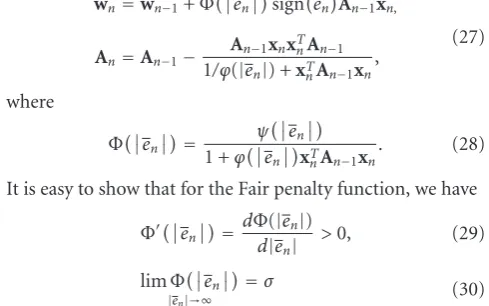
We note that for the Fair penalty function, we haveψ(en)=
ψ(|en|)sign(en) and ϕ(|en|) = ϕ(en). Substituting the respective values ofψ(en) andϕ(en) into (21) and (22), we have the following two update equations:
wn=wn−1+Φensign
enAn−1xn,
An=An−1−
An−1xnxTnAn−1 1/ϕ(|en|) +xT
nAn−1xn,
(27)
where
Φen= ψen
1 +ϕenxT nAn−1xn.
(28)
It is easy to show that for the Fair penalty function, we have
Φen= dΦ(|en|)
d|en| >0, (29)
limΦen
|en|→∞
=σ (30)
Therefore, the value ofΦ(|en|) is increasing in|en|and is bounded by σ. As a result, the learning algorithm avoids making large misadjustment when|en|is large. In addition, the update for the covariance is controlled by the term 1/ϕ(|en|) which is increasing in |en|. Thus the amount of adjustment decreases as|en|increases.
2.4. Discussions
2.4.1. Properties of the estimate
Since in each step a Gaussian approximation is used for the posterior, it is an essential requirement that A−1
n must be positive definite. We show that this requirement is indeed satisfied. Referring to (17) and using the fact that ϕ(rn) is nonnegative for the penalty functions considered [see
Table 1] and thatA−1
0 is positive definite, we can see that the inverse of the covariance matrixA−1
1 = ∇∇P1(w)|w=w1 is positive definite. Using mathematical induction, it is easy to prove thatA−1
n = ∇∇Pn(w)|w=wnis positive definite.
In the same way, we can prove that the Hessian of the objective function given by
∇∇Pn(w)=ϕ(rn)xnxTn+A−n−11 (31) is also positive definite. Thus the objective function is strictly convex and the solutionwnis a global minimum.
Another interesting question is: does the estimate improve due to the new data {yn,xn}? To answer this question, we can study the determinant of the precision matrix which is defined as|Bn| = |A−n1|. The basic idea is that for a univariate Gaussian, the precision is the inverse of the variance. A smaller variance is equivalent to a larger precision which implies a better estimate. From (17), we can write
Bn=A−n1
=ϕenxnxTn+A−n−11
=Bn−11 +ϕ
enxT nAn−1xn
,
(32)
Table2: The update equations of three RLS-type algorithms.
Proposed wn=wn−1+
ψ(en)An−1xn
1 +ϕ(en)xTnAn−1xn A −1
n =A−n−11+ϕ(en)xnxTn
H∞[26] w
n=wn−1+ An−1xn
1 +xT nAn−1xn
A−1
n =A−n−11+xnxTn−γ2sI
RLS [10] wn=wn−1+
An−1xn λ+xT
nAn−1xn A
−1
n =λA−n−11+xnxTn(λ≤1)
|A+xyT| = |A|(1 +yTA−1x). Since xT
nAn−1xn > 0 and ϕ(en)≥0 [seeTable 1], we have|Bn| ≥ |Bn−1|. It means that the precision of the current estimate due to the new training data is better than or at least as good as that of the previous estimate. We note that when we use the update (18) for the covariance matrix, the above discussion is still valid.
2.4.2. Parameter initialization and estimation
The proposed algorithm starts with a Gaussian approxima-tion of the prior. We can simply set the prior mean as zero
w0 = 0and set the prior covariance asA0 =λ−1I, whereI is an identity matrix andλ is set to a small value to reflect the uncertainty about the true prior distribution. In our simulations, we setλ=0.01. For the robust penalty functions listed in Table 1, σ is a scaling parameter. We propose a simple online algorithm to estimateσas follows:
σn=βσn−1+ (1−β) min
3σn−1,en, (33)
whereβ= 0.95 in our simulations. The function min[a,b] takes the smaller value of the two inputs as the output. It makes the estimate ofσnrobust to outliers.
It should be noted that for a 0.95 asymptotic efficiency on the standard normal distribution, the optimal value forσcan be found in [2]. In addition, for Huber’s penalty function, the additional parameter νis set to ν = 2.69σ for a 0.95 asymptotic efficiency on the normal distribution [2].
2.4.3. Connection with the one-step MM algorithm [19]
Since the RLS-type of algorithm [see (21) and (22)] is derived from the same problem formulation as that in our previous work [19] and is based on different approximations, it is interesting to compare the results. For easy reference, we recall that in [19] we definedρ(x)= −f(t) wheret=x2/2σ2. It is easy to show that
ψ(x)=ρ(x)= −x
σ2f(t), (34)
ϕ(x)=ρ(x)= −1
σ2
2t f(t) +f(t). (35)
For easy reference, we reproduce (40) and (44) in [19] as follows:
wn=wn−1+ en
An−1xn τ+xT
nAn−1xn
, (36)
An=An−1−An−1xnx T nAn−1 κτ+xT
nAn−1xn
, (37)
whereτ = −σ2/ f(tn),κτ = −σ2/[f(tn) + 2tnf(tn)], and
tn=e2n/(2σ2). Substituting (34) into (36), we have the RLS-type algorithm which is the one-step MM algorithm in terms ofψ(en) as the following:
wn=wn−1+ en
An−1xn en/ψ(en) +xT
nAn−1xn, (38)
An=An−1− An−1xnx T nAn−1 1/ψ(en) +xT
nAn−1xn.
(39)
We can easily see that (39) is exactly the same as (22). To compare (38) with (21), we rewrite (21) as follows:
wn=wn−1+ enAn−1xn en/ψen+enϕen/ψenxT
nAn−1xn. (40)
It is clear that (40) has an extra termenϕ(en)/ψ(en) compared to (38). The value of this term depends on the penalty function. For theL2penalty function, this term equals to one.
2.4.4. Connections with other RLS-type algorithms
We briefly comment on the connections of the proposed algorithm with that based on theH∞ framework (see [26, Problem 2]) and the classical RLS algorithm with a forgetting factor [10]. For easy reference, the update equations for these algorithms are listed in Table 2. Comparing these algorithms, we can see that a major difference is in the way
A−1
n is updated. The robustness of the proposed algorithm is provided by the scaling factor ϕ(en) which controls the “amount” of update. Please refer toFigure 1for a graphical representation of this function. For theH∞-based algorithm, an adaptively calculated quantity γ2
current modelling error. It is now clear that the termϕ(en) and the termλplay a very different role in their respective algorithms.
It should be noted that by using the Bayesian approach, it is quite easy to introduce the forgetting factor into the proposed algorithm. Using the forgetting factor, the tracking performance of the proposed algorithm can be controlled. Since the development has been reported in our previous work [19], we do not discuss it in detail in this paper. A further interesting point is the interpretation of the matrix An. For theL2 penalty function, An can be called the covariance matrix. But for the Huber and fair penalty function, its interpretation is less clear. However, when we use a Gaussian distribution to approximate the posterior, we can still regard it as a covariance matrix of the Gaussian.
3. EXTENSION TO LMS-TYPE OF ALGORITHMS
3.1. General algorithm
For the RLS-type algorithms, a major contribution to the computational cost is the update of the covariance matrix. To reduce the cost, a key idea is to approximate the covariance matrix An in each iteration by An = αnI, where αn is a positive scalar and I is an identity matrix of suitable dimension. In this paper, we propose an approximation under the constraint of preserving the determinant, that is,
|An| = |An|. Since the determinant of the covariance matrix is an indication of the precision of the estimate, preserving the determinant thus permits passing on information about the quality of the estimate at timento the next iteration. As such, we have|An| =αMn,whereMis the length of the impulse response. The task of updatingAnbecomes updatingαn.
From (17) and using a matrix identity|A+xyT| = |A|(1+
yTA−1x), we can see that A−1
n =A−n−111 +ϕ
enxT nAn−1xn
. (41)
[Here we assume that the size of the matrixAand the sizes of the two vectorsxandy are properly defined]. Suppose, at time n−1,we have the approximation An−1 = αn−1I. Substituting this approximation into the left-hand side of (41), we have
A−1
n ≈ A−n−111 +ϕ
enxTnAn−1xn
=α−M n−1
1 +αn−1ϕ
enxT nxn
.
(42)
Substituting|A−1
n | =α−nMinto (42), we have the following: 1
αn ≈ 1 αn−1
1 +αn−1ϕ
enxT nxn
1/M
. (43)
Using a further approximation (1 +x)1/M ≈ 1 +x/M to simply (43), we derive the update rule forαnas follows:
1 αn =
1 αn−1
+ϕenx T nxn
M . (44)
ReplacingAn−1 in (21) byαn−1I, we have the update of the estimate
wn=wn−1+
ψenxn 1/αn−1+ϕ
enxT
nxn. (45)
Equations (44) and (45) can be regarded as the LMS-type of algorithm with an adaptive step size.
In [28], a stability condition for a class of LMS-type of algorithm is established as follows. The system is stable when
|en| < θ|en| (0 < θ < 1) is satisfied. We will use this condition to discuss the stability of the proposed algorithms inSection 3.2.
We point out that in developing the above update scheme for 1/αn, we have assumed that w is fixed. As such, the update rule cannot cope with a sudden change ofw since 1/αnis increasing withn. This is inherent problem with the problem formulation. A systematic way to deal with it is to reformulate the problem to allow a time varyingwby using a state space model. Another way is to detect the change ofw
and reset 1/αnto its default value accordingly.
3.2. Specific algorithms
Specific algorithms for the three penalty functions can be developed by substituting ψ(en) and ϕ(en) into (44) and (45). We note that theL2penalty function can be regarded a special case of the penalty functions used in the M-estimate. The discussion of robustness is very similar to that presented inSection 2.3and is omitted. Details of the algorithms are described below.
3.2.1. TheL2penalty function
Substitutingψ(en) =en/σ2andϕ(en)= 1/σ2 into (45), we have
wn=wn−1+ enxn μn−1+xTnxn
, (46)
whereμn−1=σ2/αn−1. From (44), we have
1 αn =
1 αn−1
+x T nxn
σ2M, (47)
which can be rewritten as follows:
μn=μn−1+x T nxn
M . (48)
The proposed algorithm is thus given by (46) and (48). A very attractive property of this algorithm is that it has no parameters. We only need to set the initial value ofμ0which can be set to zero (i.e.,α0→∞) reflecting our assumption that the prior distribution ofwis flat.
The stability of this algorithm can be established by noting that
en= μn−1
μn−1+xTnxnen.
(49)
3.2.2. Huber’s penalty function
In a similar way, we obtain the update for wn and μn as follows:
wn= ⎧ ⎪ ⎪ ⎪ ⎪ ⎨ ⎪ ⎪ ⎪ ⎪ ⎩
wn−1+ enxn μn−1+xnTxn
, |en| ≤λH
wn−1+ νσ
μn−1sign(en)
xn, |en|> λH,
(50)
μn=
⎧ ⎨ ⎩
μn−1+xTnxn/M, |en| ≤λH μn−1, |en|> λH
(51)
where λH = νσ. The stability of the algorithm can be established by noting that when|en| ≤λH, we have
en= μn−1 μn−1+xTnxnen.
(52)
which is the same as theL2case. One the other hand, when
|en| > λH, we can easily show that sign(en) = sign(en). As such, from (50) we have foren=/ 0
en=en− νσ
μn−1
signenxT nxn
=en
1− νσ
μn−1en
xTnxn
.
(53)
Since sign(en)=sign(en), we have 0≤1−(νσ/μn−1|en|)xTnxn <1. Thus the stability condition is also satisfied.
3.2.3. The fair penalty function
For the Fair penalty function, we defineφ(t)=1 +|t|/σ. We haveψ(t) =t/φ(t) andϕ(t) =1/φ2(t). Using (45), we can write
wn=wn−1+enxn
kF , (54)
where kF = φ(en)/αn−1 +xTnxn/φ(en). The update for the precision is given by
1 αn =
1 αn−1
+ 1
φ2(en)
xT nxn
M . (55)
A potential problem is that the algorithm may be unstable in that the stability condition|en|< θ|en|may not be satisfied. This is because
|en| =δF|en|, (56)
whereδF= |1−xT
nxn/kF|. We can easily see that whenxTnxn> 2kF, we haveδF>1 which leads to an unstable system.
To solve the potential instability problem, we propose to replacekFin (54) bykwhich is defined as
k=
⎧ ⎪ ⎨ ⎪ ⎩
kF, kF> 1 2x
T nxn
kG, otherwise, (57)
wherekG=1/αn−1+xTnxn. We note thatkGcan be regarded as a special case ofkFwhenφ(en)=1. Whenk=kG,we can show thatδF = |1−xT
nxn/kG| < 1. As a result, the system is stable. On the other hand, whenk = kF (implyingkF > (1/2)xT
nxn), we can show thatδF= |1−xTnxn/kF|<1 which also leads to a stable system.
3.3. Initialization and estimation of parameters
In actual implementation, we can set μ0 = 0 which corresponds to setting α0→∞. In the Bayesian perspective, this sets a uniform prior for w, which represents the uncertainty aboutw before receiving any training data. To enhance the learning speed of this algorithm, we shrink the value of μn in the first N iterations, that is, μn =
β(μn−1+ (1/φ2(en))(xnTxn/M)), where 0< β <1. An intuitive justification is thatμnis an approximation of the precision of the estimate. In theL2penalty function case,μnis scaled by the unknown but assumed constant noise variance. Due to the nature of the approximation that ignores the higher order terms, the precision is overly estimated. A natural idea is to scale the estimated precisionμn. In simulations, we find thatβ=0.9 andN=8Mlead to improved learning speed.
For the Huber and the fair penalty functions, it is necessary to estimate the scaling parameter σ. We use a simple online algorithm to estimateσas follows:
σn=γσn−1+ (1−γ)en, (58)
where γ = 0.95 in our simulations. In addition, for Huber’s penalty function, the additional parameterνis set toν=2.69σfor a 0.95 asymptotic efficiency on the normal distribution [2].
4. NUMERICAL EXAMPLES
4.1. General simulation setup
To use the proposed algorithms to identify the linear observation model of (1), at thenth iteration we generate a zero mean Gaussian random vectorxnof size (M×1) as the input vector. The variance of this random vector is 1. We then generate the noise and calculate the output of the systemyn. The performance of an algorithm is measured by h(n)= w−wn 22which is a function ofnand is called the learning curve. Each learning curve is the result of averaging 50-run of the program using the same additive noise. The purpose is to average out possible effect of the random input vectorxn. The result is then plotted in the log scale, that is, 10 log10[h(n)], whereh(n) is the averaged learning curve.
4.2. Performance of the proposed RLS algorithms
0 500 1000 1500 2000 2500 3000 3500 4000 20
15 10 5 0 −5 −10 −15 −20
Figure2: Noise signal used in simulations.
is simulated in Matlab by: rn = 0.1∗randn(4000,1) + 5∗randn(4000,1).∗(abs(randn(4000,1) > T)). The thre-sholdT controls the percentage of impulsive noise. In our experiments, we setT=2.5 which correspond to about 1.2% of impulsive noise. A typical case for the noise used in our simulation is shown inFigure 2
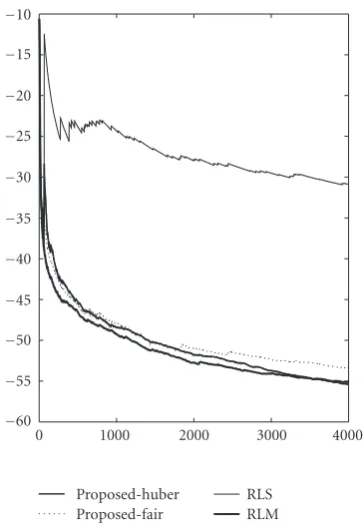
Since the proposed algorithms using Huber and fair penalty functions are similar to the RLS algorithm, we com-pare their learning performance with that of the RLS and a recently published RLM algorithm [8] using suggested values of parameters. Simulation results are shown in Figure 3. We observe from simulation results that the learning curves of proposed algorithms are very close to that of the RLM algorithm and are significantly better than that of the RLS algorithm which is not robust to non-Gaussian noise. The performance of the proposed algorithm in this paper is also very closed to that of our previous work [19] and the comparison results are not presented for brevity.
4.3. Performance of proposed LMS type of algorithms
We first compare the performance of our proposed LMS-type of algorithms using the fair and Huber penalty functions to a recently published robust LMS algorithm (called the CAF algorithm in this paper) using the suggested settings of parameters [13]. The CAF algorithm adaptively combines the NLMS and the signed NLMS algorithms. As a bench mark, we also include simulation results using the RLM algorithm which is computationally more demanding than any LMS type of algorithms. The noise used is similar to that described inSection 4.2. We have tested these algorithms with three different length of impulse responses M =
10, 100, 512. In each simulation, the impulse response is generated as a zero-mean Gaussian random (M×1) vector with standard deviation of 1. Simulation results are shown in
Figure 4.
From this figure, we can see that the performance of the two proposed algorithms is consistently better than that of the CAF algorithm. The performance of the proposed algorithm with the fair penalty function is also better than that with the Huber penalty function. When the length of the impulse response is moderate, the performance of the proposed algorithm with the fair penalty function is very close to that of the RLM algorithm. The latter has a notable
0 1000 2000 3000 4000
−10 −15 −20 −25 −30 −35 −40 −45 −50 −55 −60
Proposed-huber Proposed-fair
RLS RLM
Figure3: A comparison of learning curves for different RLS-type algorithms.
faster learning rate than the former when the length is 512. Therefore, the proposed algorithm with the fair penalty function can be a low computational-cost replacement of the RLM algorithm for identifying an unknown linear system with moderate length.
×104
0 2 4 6 8
0
−20
−40
−60
−80
Steady state responseM=10
(a)
×103
0 1 2 3 4 5
0 −10 −20 −30 −40 −50 −60
Transient responseM=10
(b)
×104
0 2 4 6 8
0
−20
−40
−60
−80
Steady state responseM=100
(c)
×103
0 2 4 6 8 10
0 −10 −20 −30 −40 −50 −60
Transient responseM=100
(d)
×104
0 2 4 6 8
0
−20
−40
−60
−80
Steady state responseM=512
RLM Proposed-fair
CAF
Proposed-huber (e)
RLM Proposed-fair
CAF
Proposed-huber 0
−10 −20 −30 −40 −50 −60
Transient responseM=512
×103
0 2 4 6 8 10
(f)
×103
0 1 2 3 4 5
10 0 −10 −20 −30 −40 −50
Steady state responseM=10
(a)
×102
0 2 4 6 8 10
10 0 −10 −20 −30 −40
Transient responseM=10
(b)
×104
0 2 4 6 8 10
20
0
−20
−40
−60
Steady state responseM=100
(c)
×103
0 2 4 6 8 10
10 0 −10 −20 −30 −40 −50
Transient responseM=100
(d)
RLS Proposed VSS-NLMS 0
−10 −20 −30 −40 −50 −60
Steady state responseM=512
×104
0 2 4 6 8 10
(e)
RLS Proposed VSS-NLMS 0
−10 −20 −30 −40 −50
Transient responseM=512
×103
0 2 4 6 8 10
(f)
proposed algorithm does. Comparing with the VSS-NLMS algorithm, the performance of the proposed algorithm is consistently better. Therefore, the proposed algorithm can be a low computational-cost replacement for the RLS algorithm for learning an unknown linear system of moderate length.
5. CONCLUSION
In this paper, we develop a general sequential algorithm for the M-estimate of a linear observation model. Our development is based on formulating the problem from a Bayesian perspective and using a Gaussian approximation for the posterior and likelihood function in each learning step. The sequential algorithm is then developed by determining a maximum a posteriori (MAP) estimate when a new set of training data is received. The Gaussian approximation leads naturally to a quadratic objective function and the MAP estimate is an RLS-type algorithm. We have discussed the quality of the estimate, issues related to the initialization and estimation of parameters, and the relationship of the proposed algorithm with those of previous work. Motivated by reducing computational cost of the RLS-type algorithm, we develop a family of LMS-type algorithms by replacing the covariance matrix with a scaled identity matrix. Instead of updating the covariance matrix, we update the scalar which is set to preserve the determinant of the covariance matrix. Simulation results show that the learning performance of the proposed algorithms is competitive to that of some recently published algorithms. In particular, the performance of proposed LMS-type algorithms has been shown to be very close to that of their respective RLS-type algorithms. Thus they can be replacements for RLS-type of algorithms at a relatively low computational cost.
APPENDICES
A. PROPERTIES OFe
Let us consider the solution to the following equation:
x=a−bψ(x). (A.1)
Comparing it to (16), we can see thatx = en,a =en,b = xT
nAn−1xn (b > 0) andψ(x) = ρ(x). We note that for the penalty functionsρ(x) used for M-estimation, we have the following:ψ(−x) = −ψ(x),ψ(0) =0 andψ(|x|) ≥ 0. Let x0be a solution of (A.1).We can easily see that whena=0 the solution isx0 = 0. Whena /=0, we can rewrite (A.1) as follows:
|x0| = sign(a)
sign(x0)|a| −bψ
(|x0|). (A.2)
The solution x0 must satisfy two conditions: sign(a) = sign(x0) and|a|> bψ(|x0|). These two conditions imply that
|x0|<|a|which is same as|en|<|en|.
B. DERIVATION OF EQUATIONS(21)AND(22)
Substituting (19) into (20) and taking the first derivative, we have
∇Pn(w)=ψen) +ϕenrn−enxn+A−n−11(w−wn−1). (B.1)
The update forwnis then determined by solving∇Pn(w)= 0 as follows:
wn=wn−1+
ψen+ϕenen−enAn−1xn, (B.2) where we have replacedrn= yn−xT
nwbyen= yn−xTnwn. Left multiplying both sides of the above equation byxT
n, then subtracting both sides byyn, we obtain
en=en− ψ
enxT
nAn−1xn 1 +ϕenxT
nAn−1xn.
(B.3)
Substituteeninto (B.2), we have the update forwngiven by (21). The update of the covariance matrixAngiven by (22) can be determined by usingA−1
n = ∇∇Pn(w)|w=wn, where ∇∇Pn(w) is given by
∇∇Pn(w)=ϕenxnxTn+A−n−11. (B.4)
REFERENCES
[1] P. J. Huber,Robust Statistics, John Wiley & Sons, New York, NY, USA, 1981.
[2] W. J. J. Rey,Introduction to Robust and Quasi-Robust Statistical Methods, Springer, Berlin, Germany, 1983.
[3] K. Lange and J. S. Sinsheimer, “Normal/independent distribu-tions and their applicadistribu-tions in robust regression,”Journal of Computational and Graphical Statistics, vol. 2, no. 2, pp. 175– 198, 1993.
[4] A. Gelman, H. B. Carlin, H. S. Stern, and D. B. Rubin,Bayesian Data Analysis, Chapman & Hall/CRC, Boca Raton, Fla, USA, 2004.
[5] S. A. Kassam and H. V. Poor, “Robust techniques for signal proecssing: a survey,”Proceedings of the IEEE, vol. 73, no. 3, pp. 433–481, 1985.
[6] P. Petrus, “Robust Huber adaptive filter,”IEEE Transactions on Signal Processing, vol. 47, no. 4, pp. 1129–1133, 1999. [7] K. L. Boyer, M. J. Mirza, and G. Ganguly, “Robust sequential
estimator: a general approach and its application to surface organization in range data,” IEEE Transactions on Pattern Analysis and Machine Intelligence, vol. 16, no. 10, pp. 987– 1001, 1994.
[8] S.-C. Chan and Y.-X. Zou, “A recursive least M-estimate algorithm for robust adaptive filtering in impulsive noise: fast algorithm and convergence performance analysis,”IEEE Transactions on Signal Processing, vol. 52, no. 4, pp. 975–991, 2004.
[9] D. S. Pham and A. M. Zoubir, “A sequential algorithm for robust parameter estimation,”IEEE Signal Processing Letters, vol. 12, no. 1, pp. 21–24, 2005.
[10] S. Haykin,Adaptive Filter Theory, Prentice-Hall, Englewood Cliffs, NJ, USA, 4th edition, 2002.
[12] J. Chambers and A. Avlonitis, “A robust mixed-norm adaptive filter algorithm,”IEEE Signal Processing Letters, vol. 4, no. 2, pp. 46–48, 1997.
[13] J. Arenas-Garc´ıa and A. R. Figueiras-Vidal, “Adaptive combi-nation of normalised filters for robust system identification,”
Electronics Letters, vol. 41, no. 15, pp. 874–875, 2005. [14] M. Opper, “A Bayesian approach to online learning,” inOnline
Learning in Neural Networks, D. Saad, Ed., pp. 363–378, Cambridge University Press, Cambridge, UK, 1998.
[15] D. J. C. MacKay,Information Theory, Inference and Learning Algorithms, Cambridge University Press, Cambridge, UK, 2003.
[16] T. Briegel and V. Tresp, “Robust neural network regression for offline and online learning,” inAdvances in Neural Information Processing Systems 12, T. K. Leen, K.-R. Muller, and S. A. Solla, Eds., pp. 407–413, MIT Press, Cambridge, Mass, USA, 2000. [17] Z. Ghahramani and M. J. Beal, “Propagation algorithms
for variational Bayesian learning,” in Advances in Neural Information Processing Systems, T. K. Leen, T. Dietterich, and V. Tresp, Eds., vol. 13, pp. 507–513, MIT Press, Cambridge, Mass, USA, 2001.
[18] A. Honkela and H. Valpola, “Online variational Bayesian learning,” inProceedings of the 4th International Symposium on Independent Component Analysis and Blind Signal Separation (ICA ’03), pp. 803–808, Nara, Japan, April 2003.
[19] G. Deng, “Robust sequential learning algorithms for linear observation models,”IEEE Transactions on Signal Processing, vol. 55, no. 6, pp. 2472–2485, 2007.
[20] D. R. Hunter and K. Lange, “A tutorial on MM algorithms,”
American Statistician, vol. 58, no. 1, pp. 30–37, 2004. [21] H.-C. Shin, A. H. Sayed, and W.-J. Song, “Variable step-size
nlms and affine projection algorithms,”IEEE Signal Processing Letters, vol. 11, no. 2, pp. 132–135, 2004.
[22] D. J. C. Mackay, “Bayesian interpolation,” Neural Computa-tion, vol. 4, no. 3, pp. 415–447, 1992.
[23] M. J. L. Orr, “Recent advances in radial basis function networks,” 1999,http://www.anc.ed.ac.uk/#mjo/papers/recad .ps.gz.
[24] S. Boyd and L. Vandenberghe, Convex Optimization, Cam-bridge University Press, CamCam-bridge, UK, 2004.
[25] M. T. Heath, Scientific Computing: An Introductory Survey, McGraw-Hill, New York, NY, USA, 2nd edition, 2002. [26] B. Hassibi and T. Kailath, “Adaptive filtering with an h-infinity
criterion,” inProceedings of the 28th Asilomar Conference on Signals, Systems and Computers (ACSSC ’94, pp. 1483–1487, Pacific Grove, Calif, USA, October-November 1994.
[27] S. M. Kay,Fundamentals of Statistical Signal Processing Estima-tion Theory, Prentice-Hall, Englewood Cliffs, NJ, USA, 1993. [28] S. C. Douglas and M. Rupp, “A posteriori update for adaptive