ISSN(Online): 2319-8753 ISSN (Print): 2347-6710
I
nternational
J
ournal of
I
nnovative
R
esearch in
S
cience,
E
ngineering and
T
echnology
(A High Impact Factor & UGC Approved Journal)
Website: www.ijirset.com
Vol. 6, Issue 8, August 2017
Advances in MIMO Techniques used in Wireless
Network Systems
Sukhreet Kaur1, Dr. Amita Soni2
PG Student, Department of Electronics and Communication, PEC University of Technology, Chandigarh, India 1
Professor, Department of Electronics and Communication, PEC University of Technology, Chandigarh, India 2
ABSTRACT: Dead spots are everywhere. Even a weak Wi-Fi connection is sufficient to surf the Internet or transfer data. But if distance and obstacles consume too much bandwidth from a network, video images will start to stutter and buffer and eventually break up. Video causes this problem on range and higher speed. The cure for the problem, is an innovation called MIMO, acronym for Multiple Input, Multiple Output. This new technology, utilize a large number of antennas to send multiple signals as a way to significantly increase the speed and range of a wireless network. In test experiments, it is found that MIMO nearly quadruples the speed and provided superior range. Multiple-Input / Multiple Output (MIMO) technology has emerged in the last decade as an extremely superior means of increasing the through-put and performance of wireless communication systems. Research on this relatively new technology has penetrated in a substantial way many fields, ranging from signal processing to information / communication theory to wireless propagation. Equally importantly, MIMO technology has created its way into current and next generation communica-tion standards and systems. In this paper, I will provide an overview of MIMO systems, starting with the fundamentals of capacity, basic transceiver architectures and various latest techniques that can be used to optimise MIMO system.
KEYWORDS: MIMO, Diversity, Spatial Multiplexing, STBC, OFDM, Beamforming
I. INTRODUCTION
MIMO (Multiple Input Multiple Output) is a smart antenna technology which includes multiple antennas at the source end and multiple antennas at the user end. The antennas at both ends of the communications network are united to minimize errors and optimize data speed. MIMO is one of the establishing smart antenna technology, the others being SIMO (single input, multiple output) and MISO (multiple input, single output). High demand for data rate, large net-work capacity, error and delay free transmission and coverage are the basic instigations of every wireless communica-tion network as users demand for data usage soars. In convencommunica-tional wireless systems, a single antenna is used at both ends and gives rise to multipath losses. When an electromagnetic field (EM field) collides with obstacles such as hills, canyons, buildings, and utility wires, the wave fronts are scattered, and so they take many paths to reach the user end. The delayed arrival of scattered parts of the signal causes problems such as fading, cut-out, and intermittent reception. All these problems cause reduction in high data rates and increase in error rates. MIMO System eliminates this trouble caused by multipath effects and instead takes its benefit. MIMO takes advantage of multipath propagation effects to enhance network capacity, increase range and improve reliability. MIMO fulfil all these demand without additional bandwidth without extra consumption of transmit power thus providing high data rates and better quality of service. In other sections of this paper, we will look atMIMO System model, MIMO capacity and further its optimisation tech-niques.
II. RELATED WORK
ISSN(Online): 2319-8753 ISSN (Print): 2347-6710
I
nternational
J
ournal of
I
nnovative
R
esearch in
S
cience,
E
ngineering and
T
echnology
(A High Impact Factor & UGC Approved Journal)
Website: www.ijirset.com
Vol. 6, Issue 8, August 2017
tennas makes channel estimation in MIMO-OFDM systems a challenging task. There are two methods being followed for channel estimation are data-aided approach and blind estimation approach. In former, the channel estimation basi-cally depends on some known data, which is known both at the terminals of system, such as training sequences or pilot data. In latter, the estimation depends only on the data received, without any knowledge oftransmitted sequence. The trade-off is the accuracy versus the overhead. More bandwidth is required in a data-aided approach than in a blind ap-proach, but it can achieve a better channel estimation accuracy.
Recent studies show that many companies are involved in the development of new MIMO platform on a large scale. National Instruments headquartered in Austin, Texas are developing MIMO Application Framework which provides the hardware and software assistance required so that beamforming techniques can be explored at not just the MIMO base station, but also at the multi-antenna User Equipment’s to further optimize the overall system performance of 5G networks.
Various MIMO techniques are STBCs (Space Time Block Codes) dependent and contributes a big part in LTE Ad-vanced System development. The author Nidhi Sharma in her paper [14] designed a STBC for multi used MIMO Sys-tem containing two users transmitting independently.The transmission matrix is designed with the basis of maximizing coding gain for the two users. Further, the proposed STBC enables independent decoding of symbols of both the users. A pair-wise maximum likelihood (ML) decoder for the proposed STBC is also derived. And the performance of the proposed STBC as compared with the existing work is significantly better.
There are many research papers published on MIMO systems, reflecting the perception that MIMO technology is seen
as one of the most promising research areas of radio and wireless communication today.
III. MIMO SYSTEMS
A. MIMO Basic Model
MIMO Systems consist of xM transmitters and yN receivers as shown in Fig.1below to transmit a signal at destination as shown in the above figure where MIMO channel may be represented as [xM x yN] Matrix. The transmitted beams pass through channel matrix and are decoded at the receiver side to obtain the real information. There are four configu-rations of wireless network Systems that are:
1. SISO (Single Input Single Output) 2. SIMO (Single Input Multiple Output) 3. MISO (Multiple Input Single Output) 4. MIMO (Multiple Input Multiple Output)
Out of the for configurations, MIMO offers the best performance.
ISSN(Online): 2319-8753 ISSN (Print): 2347-6710
I
nternational
J
ournal of
I
nnovative
R
esearch in
S
cience,
E
ngineering and
T
echnology
(A High Impact Factor & UGC Approved Journal)
Website: www.ijirset.com
Vol. 6, Issue 8, August 2017
B. MIMO Channel Model
The MIMO system model is described by the following equation:
r = Hs + n (1)
where r is received signal, s is the transmitted signal, H is the Channel Matrix and n is the noise.
In a conventional wireless system, the receiver and transmitter do not communicate in a full duplex mode that is the receiver does not acknowledge the transmitter about channel feedback. The receiver alone figures out the channel in-formation and decodes the sent signal streams. This is called open loop MIMO System.
Most current wireless standards allocate a limited feedback channel between the handset and Base Transceiver Station (BTS) that is transmitter and receiver. The information in the form of feedback helps us to detect and correct errors and potentially simplify the receiver architecture. These systems are called closed-loop MIMO systems.
Spatial diversity, also known as space diversity, is wireless diversity schemes that uses two or more than two antennas to improve the quality and reliability of a wireless link.
Channel estimation plays very essential role in MIMO Systems as through it we can calculate delays, phase, attenuation and several other factors of each path between transmitting and receiving antenna and hence maximize the efficiency and performance of MIMO Systems.
Fig.2 Graph Plot between Capacity and SNR
C. Channel Capacity in MIMO
Capacity is a performance measure for digital communication systems. It is the maximum rate of transmission for which a reliable communication can be established. If the transmission rate is larger than the capacity, the system breaks down and the receiver makes decoding errors with a non-negligible probability. Capacity is considered as the basic fundamental tool to measure the performance of MIMO systems and it also serves in practical system as a guide to properly design the transmitted signals as well as the processing of the received signals. The notion for channel ca-pacity was given by Shannon and is called Shannon’s formula. Increase in number of transmitting and receiving anten-nas increases SNR and hence increases the Capacity of MIMO Systems.Capacity of the MIMO systems increases line-arly as it is directly proportional to the number of antennas used and SNR as shown in Fig.2 above while there is a logarithmic increase for SISO, SIMO and MISO system.
Expression for Capacity of SISO system is given as:
ISSN(Online): 2319-8753 ISSN (Print): 2347-6710
I
nternational
J
ournal of
I
nnovative
R
esearch in
S
cience,
E
ngineering and
T
echnology
(A High Impact Factor & UGC Approved Journal)
Website: www.ijirset.com
Vol. 6, Issue 8, August 2017
Where C is the Capacity of the system, B is the bandwidth and S/N is Signal to Noise Ratio.
MIMO has higher capacity as compared to other systems. The MIMO capacity is given by:
MIMO = 2(1+ / ) (3)
Where C is the channel capacity, B is used bandwidth, S/N is known as signal to noise ratio. Mt is the number of an-tennas that are used at the transmitter side and Mr is the number of anan-tennas that are used at receiver side.
Channel capacity can be enhanced by using more optimized techniques and higher order of modulation schemes but needs better SNR, due to this phenomenon a balance exists between the data rate and the allowable error rate, SNR and power as higher order modulation requires more power and hence more expensive system. So, there is a tradeoff be-tween SNR and channel capacity.
IV. ADVANCES IN MIMO OPTIMIZATION TECHNIQUES
The world is going digital day by day and the demand for digital data communication such as HD video streaming, web browsing and other machine to machine communication tasks due to internet of things (IoT) are on the increase gradu-ally. These applications require high data rate to deliver them and without increase in bandwidth which is a costly and scarce resource constant. Also in order for existing cellular system operators to compete in the mobile data market with new competing technologies such as 3Gpp, LTE, 5G, HSPA+ and WIMAX etc especially in the future blooming IoT market and to save their investment a cost-effective way is to utilize the MIMO antenna system to obtain the needed high data rates and high capacity. Many open and closed diversity schemes are being used in 3Gpp Project of Ad-vanced LTE’ like transmit diversity and multiplexing.The schemes employed in LTE again differ slightly between the uplink and downlink. The reason for this is to keep the cost of terminals low. MIMO technology will serve as a major piece of LTE’s promise to significantly boost data rates and improve overall system capacity as it is generally accepted by new- generation wireless networks. However, MIMO also portrays a new challenge for network operators. Earlier cellular networks generally provide the best service under line-of-sight conditions. MIMO flourishes under rich scatter-ing conditions, where signals bounce around the environment. Under rich scatterscatter-ing surroundscatter-ings, signals from differ-ent Transmitters take many multiple paths to reach the user end at differdiffer-ent times with delays. In order to fulfil prom-ised and sufficient throughputs in LTE systems, operators must enhance their networks’ multipath conditions for MIMO, focussing both rich scattering conditions and high SNR for each multipath signal. This procedure requires pre-cise and specific calculation of these multipath conditions in order to gain the best performance under the prevailing surroundings without wasting any time on guesswork. With exact measurements, however, an optimized and more so-phisticated MIMO system can lead to large throughput gains in data rates and capacity without spending extra money on adding spectrum
To improve the performance of MIMO System, its data rate has to be increased and error rate has to be decreased. Some of the latest techniques used with MIMO Systems are:
A. MIMO Beamforming Smart Antennas- Beamforming is a decade old technique but continually being refined and used. Beamforming technique can be used with any antenna system not only with the MIMO system which creates the required antenna directive pattern to improve overall performance and reduce interference in MIMO Systems. These smart antennas can be adjusted according to required output and existing conditions.Smart anten-nas can be divided into two types:
1. Phased array systems: Phased array systems are switched and have a number of pre-defined patterns - the one that is needed is being switched as per the direction required.
2. Adaptive array systems (AAS): In this system, antenna use adaptive beamforming and it has an infinite number of patterns and can be set to the pre-requirements in real time.
MIMO beamforming techniques that uses phased array systems take decision on the direction of the incoming signal with the help of whole system and then switch in the most suitable beam. This is something of an agreement because the fixed beam is somewhat unlikely to replicate exactly the required direction.
ISSN(Online): 2319-8753 ISSN (Print): 2347-6710
I
nternational
J
ournal of
I
nnovative
R
esearch in
S
cience,
E
ngineering and
T
echnology
(A High Impact Factor & UGC Approved Journal)
Website: www.ijirset.com
Vol. 6, Issue 8, August 2017
B. MASSIVE (Very Large) MIMO
In SU-MIMO, the data of a single user is transmitted simultaneously on several parallel data streams (All streams to one user). In MU-MIMO, the individual streams are assigned to various users (Larger diversity gain than single user MIMO).
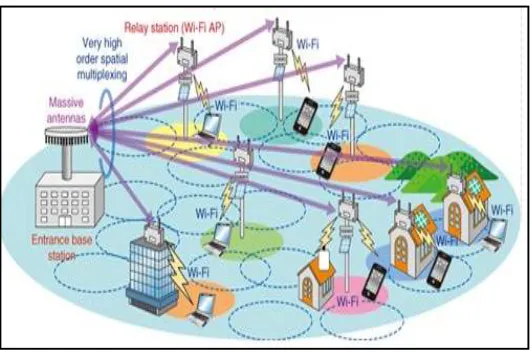
Massive MIMO is deployment of a large array of antennas at BS (Base station) where are a large number of users are served simultaneously. It serves as a big platform as it includes massive antennas, entrance base station, relay stations, Wi-Fi points, routers, sources and users as shown in Fig. 3.
Fig 3. Massive MIMO
Multiple-antenna (MIMO) technology is being widely used and has been integrated into wireless broadband stan-dards like LTE and Wi-Fi. Basically, its benefits are huge spectral efficiency and high reliability, high energy effi-ciency mainly due to a large array of antennas. It is different from MU-MIMO in conventional cellular systems.
Wireless Communication suffers from attenuation in signal strength and Interference between users and MIMO is well Known solution against it. Massive MIMO promises additional advantage over standard solutions.
Massive MIMO operates in two modes: TDD (Time Division Duplex) and FDD (Frequency Division Duplex)
For channel state estimation in Massive MIMO, a pilot signal is needed but there are two problems that are: 1. One, optimal downlink pilots should be mutually orthogonal between the antennas. This means that the quantity of
time frequency resources required for downlink pilot’s increase with the increase in number of antennas, so a mas-sive MIMO system would need up to a hundred times more such resources than in a conventional system.
2. Two, the number of channel responses that each terminal must estimate is also proportional to the number of base station antennas. Hence, hundred times more uplink resources are needed than in traditional system.
The solution is to operate in TDD mode which rely on reciprocity between the uplink and downlink channels. TDD operation is better than FDD in Massive MIMO because of the effect called ‘pilot contamination’ that is the channel estimate obtained in a given cell will be contaminated by pilots transmitted by users in other cells.The Pilot signals
from resources are used for synchronization, equalization and also to estimate the channel state information.
More antennas increase the coverage probability, but more number of BSs lead to proportional increase in the area spectral efficiency. If the cell radius will be decreased, the data rate will increase and the users can be increased. Be-cause this Be-causes the pilot contamination to decrease. Massive MIMO system uses spatial-division multiplexing such a way that the different data streams occupy the same frequencies and time.
ISSN(Online): 2319-8753 ISSN (Print): 2347-6710
I
nternational
J
ournal of
I
nnovative
R
esearch in
S
cience,
E
ngineering and
T
echnology
(A High Impact Factor & UGC Approved Journal)
Website: www.ijirset.com
Vol. 6, Issue 8, August 2017
processing can be performed locally at each antenna, this in turn allows a decentralized architecture for the antenna array, which lends great flexibility to the system.
For example, if half the antennas are lost from a lightning strike, the remaining antennas do exactly what they did be-fore. Likewise, during period of less demand, some antennas can be put into sleep mode for better energy efficiency, without affecting the operations of the others.
C. MIMO-OFDM
MIMO-OFDM is acombination of two widely used technologies in order to increase overall system performance of wireless networks. It stands for Multiple Input Multiple Output- Orthogonal Frequency Division Multiplexing. MIMO holds the potential of transmitting information using frequency spectrum efficiently and improving link reliability over the channel. The wireless channel constitutes an aggressive propagation channel, which undergoes fading (caused by destructive addition of multipath components) and interference from other users. Multiple antennas at both sides that are source and destination utilising spatial diversity are employed not only to eliminate interference and obtain high throughput but also to achieve spatial multiplexing gain due to multiple propagation effects leading to spectral effi-ciency as well as link reliability. This gain is achieved with simultaneous transmission of independent data streams in the same frequency spectrum. The receiver exploits the delays in the spatial signals induced by the MIMO channel on the data multiplexed without any additional power consumption to differentiate the different signals, hence achieving a capacity gain. Multiple antennas at both sides reduce co channel interference and thus improve cellular capacity and mobile communication. Since MIMO systems uses multiple antennas, it is preferably used in broadband networks that undergoes fading losses due to many reasons like diffraction through obstacles, noise in the channel etc which causes ISI (Inter Symbol Interference) at a particular frequency at which the signals are sent. Now, here comes the role of OFDM as OFDM turns the frequency selective fading channel into a set of parallel flat fading channels which helps in coping with the ISI.
Nowadays, MIMO-OFDM is the most dominating junction and an attractive solution for the future wireless networks MIMO-OFDM is a key technology for next-generation cellular communications (3GPP-LTE, WiMAX, IMT-Advanced) as well as wireless LAN, wireless PAN, and broadcasting. OFDM is very amenable to spatial diversity where each sub-carrier easily combines with different antenna obtaining flat channel over each sub-carrier and also LOS (Line of Sight) is not necessary.
Fig.4 Basic MIMO-OFDM System
In a MIMO-OFDM system as shown in Fig.4 above having N subcarriers, the individual data streams are first passed through the OFDM modulators which perform an IFFT (Inverse Fast Fourier Transform) on blocks of length N further leading to a parallel-to-serial conversion. A cyclic prefix (CP) of length greater than length of a sample containing a replica of the last Lcp samples of the parallel-to-serial converted output of the N-point IFFT is then prepended. The
re-sulting OFDM symbols of length N + Lcp are released simultaneously from the individual transmitting antennas. The
ISSN(Online): 2319-8753 ISSN (Print): 2347-6710
I
nternational
J
ournal of
I
nnovative
R
esearch in
S
cience,
E
ngineering and
T
echnology
(A High Impact Factor & UGC Approved Journal)
Website: www.ijirset.com
Vol. 6, Issue 8, August 2017
being greater or equal than the length of the discrete-time baseband channel impulse response (i.e. Lcp≥ L) ensures that
the frequency-selective MIMO fading channel surely decouples into a set of parallel frequency-flat MIMO fading channels.
D. STBCs (Space Time Block Codes)
Space-time block coding is a technique used by MIMO systems to support multiple copies of a data stream to traverse across a number of antennas and to use the various received versions of the data to improve link reli-ability of data-transfer.
Space-time coding unites together all the versions of the received signal in an optimal way to recover as much information from each of them as possible.
Space time block coding uses spacial and temporal diversity making MIMO System capable to achieve rele-vant gains in overall performance.
Space-time coding helps to reimburse for the channel problems such as fading and thermal noise. Although there is lay-off in the data, some copies may arrive less damaged at the receiver side.
When using space-time block coding, the data stream is encoded in blocks before transmission. These data blocks are then deployed with the multiple antennas (which are spaced apart to decorrelate the transmission paths) and the data is also spaced across time.
A space time block code is usually expressed as a matrix Smn as shown in Fig.5 below where rows represent
time slots and columns represent a single antenna's transmissions over time.
Fig.5 STBC Matrix Representation
In this matrix, Smn is the modulated symbol which is required to be transmitted in time slot m from antenna n.
There are T time slots and nT transmit antennas as well as nR receive antennas. This block is generally taken to be of 'length' T.
1. MIMO Alamouti coding
A particularly dignified scheme for coding of MIMO system was prospered by ‘Alamouti’. The codes associated with it are frequently called MIMO Alamouti codes.
The MIMO Alamouti scheme is an insightful transmit diversity scheme designed for two transmit antennas that does not require any knowledge of transmit channel. The MIMO Alamouti code is a simple space time block code that was developed in 1998.
2. Differential space time block code
ISSN(Online): 2319-8753 ISSN (Print): 2347-6710
I
nternational
J
ournal of
I
nnovative
R
esearch in
S
cience,
E
ngineering and
T
echnology
(A High Impact Factor & UGC Approved Journal)
Website: www.ijirset.com
Vol. 6, Issue 8, August 2017
V. CONCLUSION
In this paper, MIMO system, its capacity and channel estimation and also a few out of many techniques have been dis-cussed which are being used nowadays for enhancement of capacity and data rate of MIMO system and thereby, opti-mizing overall performance of MIMO System.The use of multiple antennas on both the transmitter and receiver side of a communication link have shown to greatly improve the spectral e ciency of both fixed and wireless systems. There
are many research papers published on MIMO systems, reflecting the perception that MIMO technology is seen as one
of the most promising research areas of radio and wireless communication today. In the future, it is expected that sev-eral antennas will be included in many laptop computers or mobile devices as lots of research work is being done in these areas. Usage of multiple antennas on large scale will decrease the prices of such devices, which, in turn, can make the technology available to wider range of users.
REFERENCES
[1] Olabode B. Idowu-Bismark*, Augustus E. Ibhaze, A. A. Atayero, “Mimo Optimization Techniques and Their Application in Maximizing Throughput for 3GPP HSPA+”, Journal of Wireless Networking and Communications 2017, 7(1): 1-8
[2] Swati Kumari, Rabindranath Bera, Sourav Dhar, “Enhancement of Traffic Capacity at High Data Rate using MIMO Technology”, International Journal of Scientific & Engineering Research, Volume 6, Issue 2, February -2015
[3] Bengt Holter, “On the capacity of the mimo channel”, unpublished.
[4] Sreco plavel, Saso Tomazic, Tornaz Javornik Gorazd Kandus, “MIMO: Wireless Communications”, Encyclopedia of Wireless and Mobile Com-munications DOI: 10.1081/E-EWMC-120043484@2008
[5] V.Hindumathi, Dr.K.Ramalingareddy, “Enhancement of High Data Rates in Wireless Communication Networks Using MIMO-OFDM Technol-ogy”, International Journal of Engineering Research & Technology (IJERT) Vol. 1 Issue 5, July - 2012
[6] Helmut Bölcskei, Eth Zurich, “ Mimo- ofdm wireless systems: basics, perspectives, and challenges”, IEEE Wireless Communications • August 2006 1536-1284/06
[7] Ian Poole “MIMO Space Time Block Coding and Alamouti Codes”, unpublished
[8] Ian Poole “MIMO antenna & MIMO beamforming development” http://www.radio-electronics.com/info/antennas/mimo/antenna-beamforming.php, unpublished
[9] S. Catreux, P. F. Driessen, L. J. Greenstein, “Attainable throughput of an interference-limitedmultiple-input multiple-output (MIMO) cellularsys-tem,” IEEE Transactions on Communications,49(8):1307—1311, Aug. 2001.
[10] David Gesbert, Stephen Hanly, Howard Huang, Shlomo Shamai Shitz, Osvaldo Simeone, and Wei Yu,“Multi-Cell MIMO Cooperative Net-works: A NewLook at Interference”, ieee journal on selected areas in communications, vol. 28, no. 9, december 2010
[11] Nimay Ch. Giri1, Anwesha Sahoo2, J. R. Swain3, P. Kumar4, A. Nayak5, P. Debogoswami, “Capacity & Performance Comparison of SISO and MIMO System for Next Generation Network (NGN)”, International Journal of Advanced Research in Computer Engineering & Technology (IJAR-CET) Volume 3 Issue 9, September 2014
[12] Farhan Khalid, Joachim Speidel, “Advances in MIMO Techniques for Mobile Communications—A Survey, Int. J. Communications, Network and System Sciences, 2010, 3, 213-252
[13] Geetali Bhosle, Prof.S.D. Patil2, “A Review of Channel Estimation of MIMO-OFDM”,2017 IJESC,Volume 7 Issue No.5
[14] Nidhi Sharma, “Space Time Block Code for Next Generation Multi-user MIMO Systems”, 9th International Conference on Future Networks