DOI: 10.1534/genetics.109.104794
Temperature-Sensitive Mutations Made Easy: Generating Conditional
Mutations by Using Temperature-Sensitive Inteins That Function
Within Different Temperature Ranges
Guihong Tan,
1Ming Chen,
1Christopher Foote and Change Tan
2Division of Biological Sciences, Bond Life Sciences Center, University of Missouri, Columbia, Missouri 65211-7310 Manuscript received May 5, 2009
Accepted for publication June 29, 2009
ABSTRACT
Reversible and easy to use, temperature-sensitive (TS) mutations are powerful tools for studying gene function. However, TS alleles are rare and difficult to generate and identify, and this has limited their use in most multicellular organisms. We have generated and characterized 41 intein switches, temperature-sensitive Sce VMA mutations that splice only at the permissive temperatures to generate intact host proteins. At non-permissive temperatures, they fail to splice, resulting in a loss of function of the proteins in which they reside. By inserting an intein switch into a protein of interest, one can turn on and off the activities of the engineered protein with a simple temperature shift. The 41 TS inteins function in five different temperature ranges, with permissive temperatures ranging from 18°to 30°. This collection makes it possible to choose a TS-intein switch according to the optimal growth temperature of an organism or to suit a special experimental design.
L
OSS-OF-FUNCTION phenotypes provide critical insights into gene functions. Conventional gene-targeting techniques generate loss-of-function mutations by permanently deleting the specific gene of interest or by rendering it nonfunctional. However, this strategy falls short for two groups of genes: essential genes and pleiotropic genes. Essential genes are required for viability and account for about a quarter of the genes in various organisms, including mice, flies, worms, and yeast (Miklosand Rubin1996). Pleiotropic genes, to which the vast majority of genes belong, function at multiple times and/or multiple places during the life cycle of an organism.In contrast to conventional gene knockouts, heat-sensitive mutations, traditionally known as temperature-sensitive (TS) mutations, are powerful tools for studying the functions ofallgenes. Much of our understanding of the fundamental aspects of cell division has relied on the analysis of TS mutations in yeast (Pringle1975). In Drosophila melanogaster, the use of a TS allele of Notch allowed its various spatial and temporal functions to be defined (Shellenbargerand Mohler1978; Presente et al.2001; Costaet al. 2005). TS mutations are func-tional at low (permissive) temperatures, yet nonfunc-tional at high (nonpermissive) temperatures, and thus a rise in temperature quickly ablates protein function.
This approach is intrinsically specific; only the protein that is engineered to be conditional is targeted under nonpermissive temperatures. In addition, TS mutations are versatile and convenient to use. However, the scarcity of TS alleles and the difficulty of generating and iden-tifying them have limited their use (Suzukiet al.1971; Harrisand Pringle1991), especially in multicellular organisms.
We previously described a method that utilizes a con-ditionally splicing intein, an intein switch, to generate TS mutations (Zeidleret al.2004). An intein is a self-excising stretch of amino acids, which is removed during protein maturation (Hirata et al. 1990; Kane et al. 1990). An intein switch splices itself only at permissive temperatures to generate an intact host protein (Figure 1A). At nonpermissive temperatures, it fails to splice and remains within the host protein, leading to the inacti-vation of that protein. Intein splicing, also known as protein splicing, is a post-translational process in which the intein is precisely excised from a nascent protein precursor, and the two flanking sequences (N and C exteins) are ligated together through a normal peptide bond (Evansand Xu2002; Anrakuet al.2005; Perler 2005). Thus, no intein footprint is left behind after pro-tein splicing; that is, whatever allele a host propro-tein possesses, be it wild type, dominant negative or consti-tutively active, the same allele will be generated after splicing. Furthermore, protein splicing is a self-catalytic reaction that does not require any exogenous proteins, cofactors, or energy sources. This makes protein splicing applicable to any organism, and the naturally occurring inteins found in unicellular organisms can be used in multicellular organisms.
Supporting information is available online athttp://www.genetics.org/ cgi/content/full/genetics.109.104794/DC1.
1These authors contributed equally to this work.
2Corresponding author:University of Missouri, 340b Life Sciences Center, 1201 E. Rollins Rd., Columbia, MO 65211-7310.
E-mail: [email protected]
The first generation of TS inteins was generated by random mutagenesis of wild-typeSaccharomyces cerevisiae vacuolar membrane ATPase intein (Sce VMA) (Zeidler et al.2004). These TS inteins have been used in bacteria, yeast, flies, and zebrafish (Zeidleret al.2004; Lianget al. 2007; S. Holley, personal communication) to condi-tionally control protein activities, demonstrating the generality of this approach. However, these TS inteins have not been fully characterized. More importantly, 30°, the nonpermissive temperature of the first-genera-tion TS inteins is too high for long-term incubafirst-genera-tion of certain organisms. For example, a temperature of 30°is stressful forD. melanogaster, and long-term incubation at 30° greatly reduces its fertility and life span. In addi-tion, different organisms have different optimal growth temperatures. These concerns prompted us to generate TS-intein alleles that function at a variety of temperature ranges.
We have generated a large collection of new TS-intein alleles by mutagenizing one of the first-generation TS-intein alleles, F19 (originally known as TS19). To facili-tate the application of the TS inteins, we characterized both the first- and the second-generation TS inteins. A total of 41 (35 newly generated) TS-intein alleles were retained after characterization. They were classified into five groups according to their permissive temperatures— group I: 18°; group II: 22°; group III: 25°; group IV: 28°; and group V: 30°. All 41 alleles spliced in a temperature-dependent manner in the two host pro-teins tested. The alleles with higher permissive temper-atures were able to splice at higher tempertemper-atures, and the vast majority behaved in the same way in both host proteins. Time-course studies of the splicing of group II to group V TS inteins showed that significant splicing occurred within 1–2 hr at 18°. This expanded and characterized collection of TS inteins makes it possible to choose a TS-intein switch on the basis of the optimal growth temperature of an organism or tailored to a specific experimental design. These TS-intein alleles can be used to confer temperature sensitivity on proteins in a variety of organisms, thus facilitating the functional annotation of genomes.
MATERIALS AND METHODS
Yeast strains and culturing: Yeast strains used in this experiment were S. cerevisiae FY760 (MATa ura3-52 trp1D63 leu2D1 gal4DTLEU2 his3D200 lys2-128D) (Zeidleret al.2004)
andS. cerevisiaeFY761 (MATaura3-52 trp1D63 leu2D1 gal4DT LEU2 his3D200 lys2-128DSce VMAD), which was derived from FY760 by deletion of Sce VMA and mutation of the Sce VMA homing site (changed from catcatctatgtcgggtgcggagaaagagg taatgaatggc to catcatttacgtcggttgtggtgagaggggaaacgagatggc; new bases are in boldface).
Yeast transformation was performed as described in Gietz
and Woods(2002). Yeast dilution assays were eightfold dilution
series on uracil drop-out synthetic media with 2% dextrose (SD-Ura) or with 2% galactose (SG-Ura). Plates were incubated at the indicated temperatures and examined after 3–6 days.
Plasmids and mutagenesis:Plasmids pS5-Gal4 and pU-Gal4 have been reported previously (Zeidleret al.2004). Plasmid
p972 (Pinsonet al.1998) was a gift from B. Daignan-Fornier
(Institut de Biochimie et Genetique Cellulaires), and pFA6a-GFP(S65T)-kanMX6 (Wach et al. 1997) was a gift from F.
Winston (Harvard Medical School).
Intein mutagenesis was done by low-fidelity PCR as de-scribed in Cadwell and Joyce (1992) using ExTaq DNA
polymerase (TaKaRa), template pU-Gal4-inteinF19, and the primers tgcgatatttgccgacttaaaaagcttaaatgctttgcca and acttggcg cacttcggtttttctttggagcaattatggac. The PCR products were in-corporated intoGAL4(between bases 60 and 61) by gap repair in yeast as described in Raymondet al.(1999) and Zeidler
et al.(2004) and screened on SG-Ura plates at 18°. About 3000 clones were picked and resuspended in 400ml water, and 2ml were dotted onto each of two sets of SG-Ura plates. One set was incubated at 18°and the other at 30°. The colonies containing a candidate of the TS-intein allele grew at 18°but not at 30°. Plasmids were recovered from yeast cultures as described in Hoffmanand Winston(1987) and transformed into
Escher-ichia coliTop10 (Invitrogen) by electroporation.
To transfer TS inteins from pS5 to pU, TS intein andGAL4 were released byXhoI andBamHI from the pS-Gal4 intein and ligated with pU-Gal4 digested with the same enzymes. To transfer TS inteins from the pS5-Gal4 intein to p416-Met25 [originally described in Mumberget al.(1994); the one we
used was derived from p972 (Pinsonet al.1998)], Gal4 inteins
were released from the pS5-Gal4 intein byKpnI digestion, T4 DNA polymerase blunting, and BamHI digestion and were then ligated with p416-Met25 that had been digested with EcoRI, blunted with T4 DNA polymerase, and digested with BamHI. p416-Met25-eGFP inteins, into which intein was in-corporated into eGFP after amino acid 108, were constructed by gap repair in yeast as described in the supporting in-formation,Figure S1. K108A T109C was introduced into eGFP as described in Buskirk et al. (2004). p416-Met25 BasGFP
inteins were constructed via a three-way ligation by combining a 2-kb BamHI–XbaI PCR fragment containing eGFP inteins (wild type, dead, or TS4), with a 2.5-kbXbaI–SalI fragment containing theBAS1coding region excised from p972 (Pinson
et al.1998) and the 5.4-kbBamHI–SalI fragment containing the plasmid backbone (met25 promoter, ampicillin resistance gene, andURA3gene) from p972. The oligonucleotides used to generate the GFP intein 2-kbBamHI–XbaI PCR fragment were attggatccgcggccgcgaattcatgtctttaattaacagtaaaggagaa and tgtgtaccgtacctacttgatatgtttagatcttga.
Protein expression and extraction: Yeast carrying a p416-Met25-Gal4 intein or p416-Met25-eGFP intein was cultured in uracil drop-out synthetic media with 2% dextrose and 400mm
methionine (SD-Ura1Met) until 0.6 OD, spun down, washed twice with doubly distilled water, and then resuspended in SD-Ura-Met media (0.7 OD) to induce transcription. After 30 min incubation at 30°, sterile 1003methione was added to a final concentration of 400mmto stop transcription. The yeast
cul-tures were then separated into 1-ml aliquots in 1.5-ml Eppendorf tubes. These tubes were incubated at different temperatures to allow for intein splicing.
Yeast proteins were extracted with glass beads and Thorner buffer [8 murea, 5% SDS, 50 mm Tris–HCl (pH 6.8), 5%
b-mercaptoethanol] (Sambrooket al.1989) containing
well as to inactivate endogenous protease activity. After 2 min at 70°, the samples were vortexed at high speed for 4 min, and the tubes were transferred back to the 70°for 5 more minutes to denature the proteins. After that, the debris was spun down for 2 min at 13,200 rpm (Eppendorf, centrifuge 5415D), and the supernatant was transferred to a fresh tube. The proteins were then stored at 80° until they were analyzed by Western blotting.
Western blotting: Western blot analyses were carried out using standard methods (Sambrook et al. 1989). Antibody
dilutions were 1:4000 in PBS with 0.1%Tween for anti-GFP (Sigma G1544); 1:5000 for both anti-Gal4p (Sigma G9293) and anti-rabbit IgG HRP-conjugated antibody (Invitrogen G21234). The membranes were developed with enhanced chemiluminescence reagent (Pierce #32106) and imaged with the Fujifilm LAS-3000 imaging system.
Time course:To study the kinetics of intein splicing, 1 ml of yeast cells expressing a BasGFP intein (from the p416-Met25-BasGFP intein, where the intein is located at the same position in eGFP as in eGFP alone) or an eGFP intein (from the p416-Met25-eGFP intein) was harvested at different time points, lysed, and analyzed by Western blotting using anti-GFP antibody. For the BasGFP intein, transcription induction was performed at the same temperatures as the splicing temper-atures. For the GFP intein, all transcription induction was performed at 30°. Western blots were quantified with ImageJ (http://rsbweb.nih.gov/ij/). Microsoft Excel was used to perform linear regression and to calculate splicing halftime, assuming that the splicing is a first-order reaction.
RESULTS
Generation of TS-intein alleles that function within different temperature ranges: New TS-intein alleles were generated by mutagenizing F19 and screening for the abilities of their GAL4 fusions to rescue the growth ofGAL4-deleted yeast strain FY760 on galactose media at various temperatures (outlined in Figure 1B). Briefly:
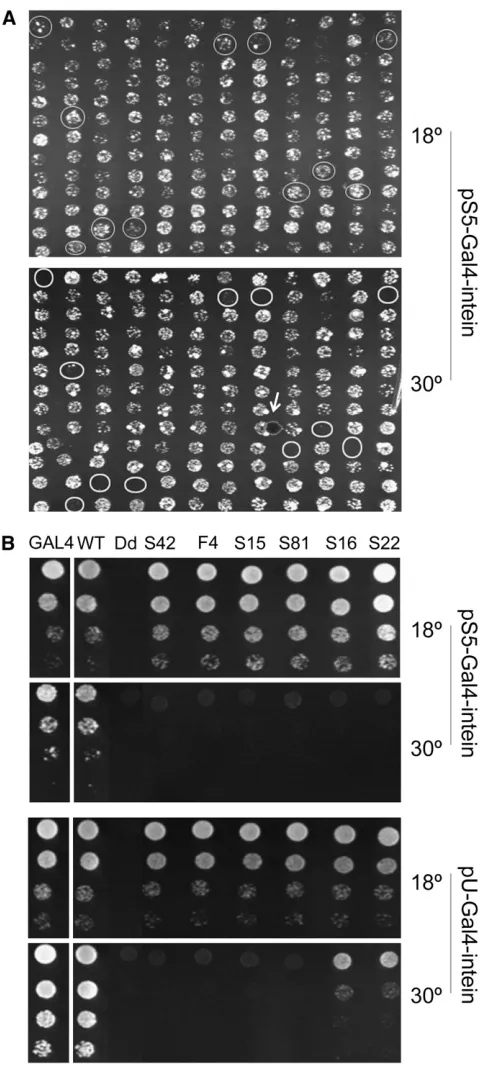
Step 1:To generate and screen for intein mutations that were able to splice at 18°. F19 was mutagenized by low-fidelity PCR. In each PCR primer, 30 bp ofGAL4 sequence that flanks the intein insertion site was included so that the mutated intein could be cloned intoGAL4by homologous recombination in yeast (Raymondet al. 1999; Zeidleret al.2004). The PCR products were cotransformed with linearized pS5-Gal4 into FY760. pS5 is a low-copy-number (one or two copies per yeast cell) yeast–bacteria shuttle vector, which ensures that only one intein allele exists in each yeast clone. The transformants were plated on uracil drop-out syn-thetic media with 2% galactose (SG-Ura) and cultured at 18°to select for successful recombination and func-tional Gal4p. Since the only carbon source for yeast growth was galactose, whose metabolism requires functional Gal4p, only yeast containing pS5-Gal4 with intein mutations that spliced at 18°were able to grow. Step 2: To screen for mutations that made yeast growth temperature dependent. About 3000 colonies were picked and plated, in duplicates, onto two sets of SG-Ura plates. One set was incubated at 18°, and the other
at 30° (Figure 2A and data not shown). We then screened for colonies that would grow at 18°but not at 30°and found 148 such colonies.
Step 3: To determine whether the candidates were truly TS. Yeast dilution assays were performed, in which serial 1:8 dilutions of yeast were arrayed onto plates, with the highest concentration at 0.1 OD (optical density at 600 nm), and the growth of yeast was monitored. Fifty-seven were discarded at this step either because they grew at 30°, albeit more weakly than at 18°, or because they grew only weakly at 18°.
Step 4:To eliminate TS alleles with leaky splicing at 30°. The 91 confirmed TS-intein alleles were transferred from the pS5 vector into the high-copy-number (20
Figure1.—Generation and characterization of TS inteins.
plasmids/yeast cell on average) vector pU and ana-lyzed with the yeast dilution assay. Since more Gal4-intein transcript and protein were produced in yeast carrying multiple copies of the pU-Gal4 intein than in yeast with one or two copies of the pS5-Gal4 intein, the leakiness of TS-intein splicing at nonpermissive tem-peratures was amplified when expressed in the pU vector (Figure 2B and data not shown). For example, all the TS-intein alleles in Figure 2B behaved similarly in pS5, allowing the yeast transformed with them to grow well at 18°but not at 30°. However, in pU, alleles
S16 and S22 enabled their host yeast to grow at 30°, and thus were discarded. Forty-two alleles were elim-inated at this step because of leaky splicing at 30°. Step 5:To eliminate duplicate TS alleles. The remaining 49
alleles were sequenced, and 40 unique alleles were identified (Figure S2). No obvious pattern of muta-tions emerged from the analysis of the primary peptide sequences of these TS-intein alleles.
The 9 first-generation TS-intein alleles were also inc-luded in the pU-yeast dilution assay at step 4 and were further characterized together with the newly generated alleles (Figure 1B). The first- and the second-generation TS-intein alleles were distinguished by their prefixes: ‘‘F’’ for first and ‘‘S’’ for second (Figure 2B and Figure 3). F17, similar to S16, allowed its host yeast to grow at 30°, although not as well as yeast with wild-type intein, and thus was not further characterized. On the basis of this dilution assay, 48 alleles were retained, of which 7 were not included in further analyses due to cloning prob-lems. This resulted in a total of 41 TS-intein alleles, 35 of which were newly generated.
Intein alleles function in five different temperature ranges:To distinguish the optimal functioning temper-atures for the various TS inteins, we tested their ability to support the growth of yeast strain FY761 transformed with pU-Gal4 TS inteins at more refined temperatures. FY761 was derived from FY760 by deleting its genomic Sce VMA and by mutating the Sce VMA homing site (G. Tan and C. Tan, unpublished results). FY761 was used to avoid the occasional interference of the endog-enous genomic Sce VMA.
As expected, yeast with any of the 41 pU-Gal4 TS inteins grew equally well on glucose media (Figure 3, the first column). In contrast, on galactose media, yeast grew at the temperatures determined by the intein alleles that they carried (from the second column onward). Yeast with wild-type intein (inteinWT) grew at all temperatures;
those with dead intein (inteinDd), which is unable
to splice from its host protein, did not grow at any temperature; and the TS inteins conferred temperature-dependent growth. The 41 TS-intein alleles differed in
Figure2.—Identification of TS inteins that splice only in a
their ability to support the galactose-dependent growth of FY761 at different temperatures and were classified into five groups. Yeast with group I TS inteins grew well at 18°but not at.22°; those with group II grew at#22°, but not .25°; those with group III grew at#25°, but not
.28°; those with group IV grew at#28°, but not.30°; and those with group V grew at#30°, but not.32°. Thus
the permissive temperatures for groups I–V are 18°, 22°, 25°, 28°, and 30°, respectively. Note that the transition from one group to its neighbor is gradual, and within each group, the alleles are ordered top to bottom, with the bottom ones better able to support growth at a given temperature. Note also that all but one of the first-generation TS-intein alleles belong to groups IV and V.
Figure3.—Growth profiles of yeast FY761 transformed with different pU-Gal4 intein alleles. From top to bottom, intein alleles
Thus, we have expanded the temperature range at which a TS intein can be used.
For convenience, we have given each TS-intein allele a three-digit identification number. The first digit repre-sents the group to which a TS-intein allele belongs, while the last two digits represent its position in the group. For example, the ID number for S79, the 10th member of group II, is 210.
TS-intein splicing in Gal4p: To determine whether the observed yeast growth profiles accurately reflected the splicing of the TS inteins, we transferred the Gal4-TS intein into the protein expression vector p416-Met25, which has a methionine-suppressive Met25 promoter (Mumberg et al. 1994), and assessed protein splicing directly by Western blotting (Figure 4 and Figure 5). As outlined in Figure 4, yeast carrying p416-Met25-Gal4 inteins were grown in methionine-containing media to 0.6 OD, shifted to methionine-free media to induce transcription for a fixed period of time, and then sepa-rated into aliquots that were incubated at different tem-peratures. For group I TS inteins and the first eight alleles of group II, yeast were incubated at 10°, 15°, 20°, and 25°; for the last four alleles of group II and all of groups III, IV, and V, yeast were incubated at 20°, 25°, 30°, and 35°. As with any other chemical reaction, the intein splicing rate varies with temperature, so splicing was allowed to proceed for different times at different temperatures. After preliminary testing, we decided to use 4 hr at 10°and 15°, 2 hr at 20°and 25°, and 1 hr at 30°
and 35°.
Figure 4.—Protocol for protein expression and assessing
splicing. Yeast was first grown in the presence of methionine to the desired log-phase density and then placed in methio-nine-free media to induce transcription. Half an hour later, methionine was added to stop transcription. The yeast cul-tures were then divided and incubated at various tempera-tures for protein splicing. The results were analyzed by Western blotting.
Figure 5.—Western blot of Gal4-intein splicing. (A)
To stop splicing, yeast cells were lysed under dena-turing conditions, and the resulting lysates were ana-lyzed by Western blotting. Lysates of equal amounts of yeast were loaded in each lane. Note that the Western blots did not detect intein splicingper se, but a combi-nation of intein splicing and several other processes, including the translation and degradation of Gal4-TS-intein RNA, as well as degradation of the fusion proteins and the splicing products (see Time-course analysis of eGFP-intein splicingbelow). Nonetheless, at the permis-sive temperature, spliced Gal4p is generated through protein splicing, and the concentration of the spliced product directly reflects how efficiently the functional host protein is produced from a particular Gal4-TS-intein fusion. Therefore, the relative levels of spliced Gal4p (bottom band in each panel in Figure 5) com-pared with its unspliced precursor protein (top band in each panel in Figure 5) were used to estimate how efficiently the TS-intein splices from its host protein.
As expected, all intein alleles spliced in a temperature-dependent manner (Figure 5). For intein alleles 101–202, splicing could be detected at 10°and 15°but not$20°
(Figure 5, A and B). For alleles 203–207, weak splicing could be detected at 20°(Figure 5B). For alleles 208–308, splicing at 20°is obvious (Figure 5, B and C). For groups IV and V (Figure 5, D and E), significant splicing oc-curred at 25°. From allele 407 onward, weak splicing at
30° could be detected. No splicing was detected for inteinDdat any temperature, while inteinWTspliced at all
temperatures (Figure 5F). The abilities of the TS-intein alleles with higher permissive temperatures to splice at higher temperatures demonstrate that the temperature-dependent yeast growth accurately reflects the splicing ability of the TS intein within the organism.
We noted that the temperatures at which the spliced form could be detected by Western blotting were lower than the permissive temperatures defined by the growth profiles. For example, for intein504(Figure 5E),
signifi-cant splicing was observed at 20°and 25°, but not at 30°, while the yeast grew at a temperature as high as 30°
(Figure 3). This discrepancy may have two explanations. First, the splicing durations for the two assays are different—encompassing several days for the yeast growth assay, but only a few hours (varying from 1 to 4 hr) for the Western blot analysis. The other possible explanation is that there is a sensitivity difference be-tween the two assay methods; much less of the func-tional Gal4p might be needed for growth than for visualization via Western blot detection.
TS-intein splicing in eGFP: To determine the effects of host protein context on TS-intein splicing, we analyzed TS-intein splicing with enhanced green fluorescent pro-tein (eGFP) (Figure 6 andFigure S3). The images of the Gal4-TS-intein alleles in Figure 6 were derived from the
Figure6.—Comparison of the splicing of
same Western blot as in Figure 5. Not surprisingly, TS inteins spliced in a temperature-sensitive manner within the new host protein eGFP. The same trend of splicing efficiency was observed in eGFP as was seen in Gal4p. It is remarkable that, for most intein alleles, the switching on/off temperatures were the same for Gal4p as for eGFP (Figure 6, A–E). There are, however, some exceptions. For example, eGFP-TS inteins 202, 207, and 411 barely spliced (Figure S3) while the corresponding Gal4 fusions spliced readily at their permissive temperatures (Figure 5). Interestingly, eGFP-TS intein103 spliced at
temper-atures as high as 22° (Figure S3), whereas we did not observe any Gal4-TS intein103 splicing at 20° or yeast
growth at 22°(Figure 6A and Figure 3), suggesting that some alleles splice in a host-protein-dependent manner. Therefore, for each specific protein, one may need to test several TS-intein alleles. Fortunately, we have identified many alleles and the vast majority of these behaved identically in both host proteins.
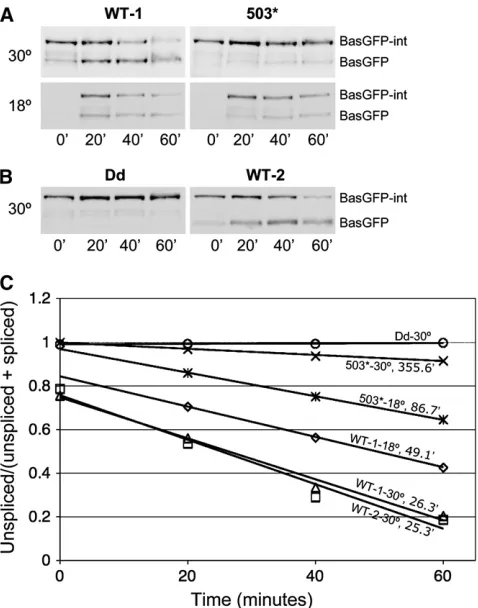
Time-course analysis of eGFP-intein splicing: To further compare the intein alleles, we analyzed the rate of intein splicing from eGFP and from BasGFP (Figure 7 andFigure S4). BasGFP is an eGFP fusion ofbas1, a gene involved in histidine synthesis (Pinson et al. 1998). Several conclusions can be drawn from the time-course analyses of BasGFP-TS intein splicing:
1. The rate of intein splicing changes with temperature. For example, the halftime (time at which the con-centration of the unspliced product equals that of the spliced product) of inteinWTsplicing was 49 min at
18°and,30 min at 30°(Figure 7, A and C).
2. Intein splicing is reproducible; the time courses of inteinWTsplicing performed on two different dates
are essentially the same (Figure 7C; also compare WT-1 at 30°in Figure 7A and WT-2 at 30°in Figure 7B). 3. TS inteins splice from BasGFP at a rate slower than
inteinWTdoes. For example, at 18°the halftime was
49 min for inteinWTand 87 min for intein503(Figure
7, A and C). The time-course analyses of eGFP-TS intein splicing show that different TS-intein alleles spliced at different rates and that significant splicing occurred within 1–2 hr at 18°for group II through group V TS inteins (Figure S4).
As previously mentioned, the Western blot assays assess the aggregate effects of protein splicing, RNA turn-over, translation, and protein degradation. The total effect of RNA turnover, translation, and unspliced pro-tein degradation can be appreciated by examining the protein levels of Bas-GFP-inteinDd, which is unable to
splice (Figure 7B, left). The decrease in the levels of BasGFP, after the initial increase, even with the contin-uous addition of BasGFP resulting from the ongoing splicing, is the result of the turnover of the spliced prod-uct (Figure 7B, right; compare lane 3 to lane 4).
Consistent with the intein splicing characteristics from within Gal4p and eGFP, inteinDd did not splice
from its host protein BasGFP (Figure 7, B and C), and inteinWT spliced from BasGFP at both 18° and 30°
(Figure 7, A–C). And while intein503 spliced from
BasGFP readily at 18°, it did so only slightly at 30°
(Figure 7, A and C).
DISCUSSION
Conventional methods for producing TS alleles use chemical mutagens to generate random mutations in a host organism. Following mutagenesis, a large number
Figure7.—Time course of intein splicing in BasGFP.
of progeny are screened for a desired TS phenotype, and the gene responsible for the phenotype is identified. This approach has a number of drawbacks for functional genomics in that the process is labor intensive, and not all proteins can be mutated to temperature sensitivity (Suzuki et al. 1971; Harris and Pringle 1991). In addition, this approach is feasible only in organisms in which a large number of progeny can be screened.
A number of in vitro mutagenesis approaches have been developed to generate TS alleles for a particular gene of interest. One approach is to clone the gene of interest and randomly mutagenize it via low-fidelity PCR. The mutagenized DNA is then introduced into a host organism and screened in the context of a null background. The frequency of generating TS alleles using this approach is quite low and therefore also requires screening a large number of progeny. A more direct technique is to replace charged amino acid clusters with alanines (Wertmanet al.1992). Applying this approach to the actin gene ofS. cerevisiaeresulted in 44% of the generated mutations being TS in vivo. In contrast, another approach modifies buried hydropho-bic cores within a protein (Chakshusmathiet al.2004). The second method was applied to the yeastGAL4gene, and several TS alleles were generated. In comparison, Chakshusmathi et al.(2004) also mutagenizedGAL4 via low-fidelity PCR. Over 20,000 transformants were obtained, but none was TS. Thus the efficiency of di-rectly mutating charged amino acid clusters or hydro-phobic cores to yield a TS allele is much greater than that of random mutagenesis. However, it is not practical to generate TS mutations for a large number of proteins by individually cloning and mutagenizing each gene.
A more general method for creating TS alleles for genomewide application in S. cerevisiae uses a degron (Dohmenet al.1994; Kanemakiet al.2003; Dohmenand Varshavsky2005). At 37°, the degron, and whatever it is fused to, are targeted for degradation via a ubiquitin-mediated ‘‘N-end rule’’ pathway that recognizes aber-rantly folded proteins. At permissive temperatures, the degron does not activate the N-end rule pathway, and the fusion protein is not targeted for degradation. Kanemakiet al.(2003) tagged 103 essential yeast genes with the degron, of which 60% behaved in a tempera-ture-sensitive manner. Application of this approach to multicellular eukaryotes has met with limited success (Levyet al.1999; Lindneret al.2002). Furthermore, the inactivating temperature, 37°, is too high for many organisms, including D. melanogaster, to survive long enough for phenotypic analysis.
Temperature-sensitive activities of the host proteins of GyrA intein and recA intein were reported previously (Derbyshireet al.1997; Adamand Perler2002). The GyrA intein variants represent true splicing mutants; however, the splicing of the GyrA intein requires specific residues at the N extein, making it unsuitable as a gen-eral tool for controlling the activities of other proteins
(Telenti et al. 1997; Southworth et al. 1999). With respect to the recA intein variants, it is unclear if they are true TS alleles (Hiragaet al.2005). We chose Sce VMA to make our TS-intein switch because Sce VMA splices itself efficiently from many ectopic locations (Hirata et al. 1990; Kane et al. 1990; Chong et al. 1998). As a proof of principle, TS inteins have been successfully used in bacteria, yeast, D. melanogaster, and zebrafish (Zeidler et al. 2004; Liang et al. 2007; S. Holley, personal communication) to conditionally control protein activities. However, the first-generation TS inteins were limited in that the number of alleles was small, and most of them had relatively high permissive temperatures.
We have generated a large collection of new TS-intein alleles with a broad range of temperatures at which the TS intein can be used. The classification, splicing analysis, and studies of the splicing kinetics of both the old and the newly generated TS-intein alleles have provided a guide-line for one to choose the most appropriate intein switch. Sce VMA splices efficiently when inserted directly up-stream of a cysteine residue in the host protein. Thus, these intein switches can be used with wild type, as well as constitutively active or dominant-negative forms of a protein as long as they contain cysteine residues or a cysteine residue can be added without affecting the function of the protein. Researchers will be able to choose intein(s) that function at an optimal temperature for their specific application. Note that each target protein folds in a unique manner, and thus the specific intein insertion site may affect subsequent excision. It might therefore be necessary to try different insertion sites to generate a TS-intein allele that excises properly. This can also be addressed by inserting different intein alleles with the same permissive temperature and by assessing for a TS phenotype because some may excise more favorably than others from a particular insertion site. On a related note, it is possible that certain regions of a specific host protein can tolerate a large insertion; consequently, at the nonpermissive temperature, the inserted TS intein may generate only a hypomorphic allele or may have no effect on the activity of the host protein. Thus it may be necessary to assess multiple insertion sites and different intein alleles to generate a TS protein that is nonfunctional at the nonpermissive temperature. Our collection of a family of TS-intein switches that function at distinct temperatures constitutes a new toolbox for the generation of TS mutations tailored either for the growth requirements of one’s particular organism or for experimental conditions.
LITERATURE CITED
Adam, E., and F. B. Perler, 2002 Development of a positive genetic
selection system for inhibition of protein splicing using mycobac-terial inteins in Escherichia coli DNA gyrase subunit A. J. Mol. Microbiol. Biotechnol.4:479–487.
Anraku, Y., R. Mizutaniand Y. Satow, 2005 Protein splicing: its
discovery and structural insight into novel chemical mechanisms. IUBMB Life57:563–574.
Buskirk, A. R., Y. C. Ong, Z. J. Gartnerand D. R. Liu, 2004 Directed
evolution of ligand dependence: small-molecule-activated pro-tein splicing. Proc. Natl. Acad. Sci. USA101:10505–10510. Cadwell, R. C., and G. F. Joyce, 1992 Randomization of genes by
PCR mutagenesis. PCR Methods Appl.2:28–33.
Chakshusmathi, G., K. Mondal, G. S. Lakshmi, G. Singh, A. Roy et al., 2004 Design of temperature-sensitive mutants solely from amino acid sequence. Proc. Natl. Acad. Sci. USA 101: 7925–7930.
Chong, S., K. S. Williams, C. Wotkowicz and M. Q. Xu,
1998 Modulation of protein splicing of the Saccharomyces cere-visiae vacuolar membrane ATPase intein. J. Biol. Chem. 273: 10567–10577.
Costa, R. M., C. Drewand A. J. Silva, 2005 Notch to remember.
Trends Neurosci.28:429–435.
Derbyshire, V., D. W. Wood, W. Wu, J. T. Dansereau, J. Z. Dalgaard et al., 1997 Genetic definition of a protein-splicing domain: functional mini-inteins support structure predictions and a model for intein evolution. Proc. Natl. Acad. Sci USA 94: 11466–11471.
Dohmen, R. J., and A. Varshavsky, 2005 Heat-inducible degron
and the making of conditional mutants. Methods Enzymol. 399:799–822.
Dohmen, R. J., P. Wuand A. Varshavsky, 1994 Heat-inducible
de-gron: a method for constructing temperature-sensitive mutants. Science263:1273–1276.
Evans, T. J. T., and M. Q. Xu, 2002 Mechanistic and kinetic
consid-erations of protein splicing. Chem. Rev.102:4869–4884. Gietz, R. D., and R. A. Woods, 2002 Transformation of yeast by
lith-ium acetate/single-stranded carrier DNA/polyethylene glycol method. Methods Enzymol.350:87–96.
Harris, S. D., and J. R. Pringle, 1991 Genetic analysis of Saccharo-myces cerevisiaechromosome I: on the role of mutagen specificity in delimiting the set of genes identifiable using temperature-sensitive-lethal mutations. Genetics127:279–285.
Hiraga, K., V. Derbyshire, J. T. Dansereau, P. VanRoeyand M.
Belfort, 2005 Minimization and stabilization of the
Mycobac-terium tuberculosis recA intein. J. Mol. Biol.354:916–926. Hirata, R., Y. Ohsumk, A. Nakano, H. Kawasaki, K. Suzukiet al.,
1990 Molecular structure of a gene, VMA1, encoding the cata-lytic subunit of H(1)-translocating adenosine triphosphatase from vacuolar membranes of Saccharomyces cerevisiae. J. Biol. Chem.265:6726–6733.
Hoffman, C. S., and F. Winston, 1987 A ten-minute DNA
prepara-tion from yeast efficiently releases autonomous plasmids for transformation of Escherichia coli. Gene57:267–272. Kane, P. M., C. T. Yamashiro, D. F. Wolczyk, N. Neff, M. Goebl
et al., 1990 Protein splicing converts the yeast TFP1 gene prod-uct to the 69-kD subunit of the vacuolar H(1)-adenosine triphos-phatase. Science250:651–657.
Kanemaki, M., A. Sanchez-Diaz, A. Gambus and K. Labib,
2003 Functional proteomic identification of DNA replication proteins by induced proteolysis in vivo. Nature423:720–724.
Levy, F., J. A. Johnstonand A. Varshavsky, 1999 Analysis of a
con-ditional degradation signal in yeast and mammalian cells. Eur. J. Biochem.259:244–252.
Liang, R., X. Liu, J. Liu, Q. Ren, P. Lianget al., 2007 A T7-expression
system under temperature control could create temperature-sensitive phenotype of target gene in Escherichia coli. J. Microbiol. Methods68:497–506.
Lindner, K., J. Gregan, S. Montgomery and S. E. Kearsey,
2002 Essential role of MCM proteins in premeiotic DNA repli-cation. Mol. Biol. Cell13:435–444.
Miklos, G. L., and G. M. Rubin, 1996 The role of the genome
pro-ject in determining gene function: insights from model organ-isms. Cell86:521–529.
Mumberg, D., R. Mullerand M. Funk, 1994 Regulatable promoters
of Saccharomyces cerevisiae: comparison of transcriptional activ-ity and their use for heterologous expression. Nucleic Acids Res. 22:5767–5768.
Perler, F. B., 2005 Protein splicing mechanisms and applications.
IUBMB Life57:469–476.
Pinson, B., I. Sagot, F. Borne, O. S. Gabrielsenand B. Daignan
-Fornier, 1998 Mutations in the yeast Myb-like protein Bas1p
resulting in discrimination between promoters in vivo but not in vitro. Nucleic Acids Res.26:3977–3985.
Presente, A., A. Andresand J. S. Nye, 2001 Requirement of Notch
in adulthood for neurological function and longevity. Neurore-port12:3321–3325.
Pringle, J. R., 1975 Induction, selection, and experimental uses of
temperature-sensitive and other conditional mutants of yeast. Methods Cell Biol.12:233–272.
Raymond, C. K., T. A. Pownderand S. L. Sexson, 1999 General
method for plasmid construction using homologous recombina-tion. Biotechniques26:134–138, 140–131.
Sambrook, J., E. F. Fritshand T. Maniatis, 1989 Molecular Cloning: A Laboratory Manual.Cold Spring Harbor Laboratory Press, NY. Shellenbarger, D. L., and J. D. Mohler, 1978
Temperature-sensitive periods and autonomy of pleiotropic effects of l(1)Nts1, a conditional notch lethal in Drosophila. Dev. Biol.62:432–446. Southworth, M. W., K. Amaya, T. C. Evans, M. Q. Xuand F. B.
Perler, 1999 Purification of proteins fused to either the amino
or carboxy terminus of the Mycobacterium xenopi gyrase A intein. Biotechniques27:110–114, 116, 118–120.
Suzuki, D. T., T. Grigliattiand R. Williamson, 1971
Temperature-sensitive mutations in Drosophila melanogaster. VII. A mutation (para-ts) causing reversible adult paralysis. Proc. Natl. Acad. Sci. USA68:890–893.
Telenti, A., M. Southworth, F. Alcaide, S. Daugelat, W. R.
Jacobs, Jr.et al., 1997 The Mycobacterium xenopi GyrA
pro-tein splicing element: characterization of a minimal inpro-tein. J. Bacteriol.179:6378–6382.
Wach, A., A. Brachat, C. Alberti-Segui, C. Rebischung and P.
Philippsen, 1997 Heterologous HIS3 marker and GFP reporter
modules for PCR-targeting in Saccharomyces cerevisiae. Yeast13: 1065–1075.
Wertman, K. F., D. G. Drubinand D. Botstein, 1992 Systematic
mu-tational analysis of the yeast ACT1 gene. Genetics132:337–350. Zeidler, M. P., C. Tan, Y. Bellaiche, S. Cherry, S. Haderet al.,
2004 Temperature-sensitive control of protein activity by condi-tionally splicing inteins. Nat. Biotechnol.22:871–876.
Supporting Information
http://www.genetics.org/cgi/content/full/genetics.109.104794/DC1
Temperature-Sensitive Mutations Made Easy: Generating
Conditional Mutations by Using Temperature-Sensitive Inteins
That Function Within Different Temperature Ranges
Guihong Tan, Ming Chen, Christopher Foote and Change Tan
G. Tan et al.
2 SI
FIGURE S1.—Construction of p416-Met25-eGFP-intein. p416-Met25-eGFP-intein was constructed via four piece homologous recombination in yeast. eGFP-intein was generated with three separate parts: eGFP-N, intein, and eGFP-C, which were obtained by high fidelity PCR (PhusionTM Hot Start High-fidelity DNA Polymerase, FINNZYMES) with pFA6a-GFP(S65T)-KanMx6 and
pU-Gal4-inteins as templates. Each primer contains a 30 bp overlap with its adjacent fragment, so that homologous
recombination can occur. The three PCR products were gel-purified and co-transformed with EcoRI-digested p416-Met25 into yeast strain FY760. Positive clones were selected using uracil drop-out selective medium (SD-Ura) at 30º. Normal-sized colonies from each transformation were picked to recover the plasmids with the desired fusions. Primers (“f” for forward, “r” for reverse) used are:
eGFP-N: f-tagatacaattctattacccccatccatactgcaaagatgaacagtaaaggagaagaac and r-gtagttcccgtcatctttgaa;
eGFP-C: f-cgtgctgaagtcaagtttgaag and
G. Tan et al. 3 SI
G. Tan et al.
4 SI
FIGURE S3.—Western blot of eGFP-intein splicing. (A) Group I. (B) Group II. (C) Group III. (D) Group IV. (E) Group V. A
G. Tan et al. 5 SI G. Tanet al. 5 SI
FIGURE S4.—Different TS-intein alleles splice at different rates. Time course analyses show that different intein alleles have different splicing kinetics. For example, a significant amount of the spliced product of intein410 could not be detected until 80
minutes, while considerable splicing of intein503 was observed at 60 minutes. Nonetheless, significant splicing could be detected for
all the alleles tested after two hours’ splicing at 18º. It is worth noting that, unlike with BasGFP, where the transcription induction was carried out at the same temperature as the splicing reactions, the 30 minute transcription induction for the eGFP fusions was performed at 30º. Fusion protein translation occured as soon as the mRNA was synthesized. Although little splicing could occur at
30º for any of the TS-inteins tested, splicing of wild type intein did occur readily at this temperature. Therefore, splicing of