Effect of Flyash on the Strength
Characteristics of Lithomargic Soil Treated
With Lime and Sodium Salts
H.N.Ramesh1, Nanda H.S2, Phalachandra H. M.3
Professor, Department of Civil Engineering, University Visveshvarayya College of Engineering, Bangalore University
Bengaluru, India1
Principal, Bangalore Technological Institute (VT University), Bengaluru, India2
Research Scholar, Department of Civil Engineering, Anjuman Institute of Technology and Management, Bhatkal,
Karnataka, India3
ABSTRACT: Lithomargic(Shedi) soil is a non expansive dispersive soil having Kaolinite structure, available abundantly along western coastal belt of India from Malbar of Kerala to Ratnagiri in Maharastra. Lithomargic soil also known as Shedi soil(local name) is considered to be weak soil when it is wet or saturated. Hence construction on this type of soil is more expensive requiring special designs. Soil Stabilization process is the acceptable and economical solution to this problem. In this investigation an attempt is made to utilize locally available Udupi Power Corporation Limited (UPCL) flyash for the improvement of strength and durability of shedi soil used for constructions. The research work involves study of compaction characteristics of Shedi soil stabilized with UPCL fly ash and additives such as lime and sodium salts. The percentages of fly ash added to the shedi soil, as percentage of dry soil mass are in the range of 10 to 50%. The soil maximum dry density is found to decrease, while the optimum water content increases with increase in the fly ash content. The results obtained illustrate that 35% addition of fly ash by weight gives optimum unconfined compressive strength after 90 days of curing. Further investigations are done by adding 1 to 6% lime to the optimum soil-fly ash mixture. It was found that inclusion of lime can significantly enhance the UCS values of stabilized shedi soil. Fly ash particles present in the shedi soil- fly ash mix react with lime to produce cementing compounds. Further, to the optimum soil-fly ash mix one percent of sodium salts such as NaCl and NaOH was added separately to find the effect of these salts on the geotechnical properties of the stabilized soil. The addition of sodium salts content with optimum fly ash in the soil for various curing periods results in increase in the strength ratio for the mix by 2 – 4 folds. This may be due to the formation of cementitious hydrated calcium hydro silicates by pozzolonic reaction which improves the strength values of shedi soil.
KEYWORDS: Optimum, Fly ash, Shedi, Stabilisation, Unconfined, Lithomargic.
I. INTRODUCTION
Industrial wastes in large quantity are being produced mainly from thermal power plant and steel manufacturing industry. Utilization of these by-products in the constructional activities is gaining momentum. By-products such as ‘Slag’ and ‘Fly ash’ are now effectively utilised in the cement production. Even then, the production of these by-products is greater than consumption. Because of its pozzolanic properties, flyash can be used for the stabilization of weaker soil. By utilizing fly ash in bulk for the civil engineering applications, it can be effectively disposed, thus avoiding environmental pollution.
process by incorporating suitable ingredients. The Lithomargic soil or shedi soil is abundantly available throughout the western coast of India and is considered to be weak soil as it loses its greater part of strength when saturated. This investigation focuses on the stabilization of shedi soil using fly ash and sodium salts with lime as stabilizing ingredient, also being used as catalyst to enhance the strength further.
II. RELATEDWORK
Lime is an advantageous material used during stabilization of soils beneath roads and other construction projects. Lime can substantially increase the stability, impermeability and load bearing capacity of the sub-soil. Lime has been added to clay soil to improve the physical properties for centuries.[1-4]. As only minimum percentage of lime is required to make the mixture effective, thorough mixing and maximum compaction is required to be done to make the stabilization effective. However it is not suitable for sulphate bearing clay soils. Use of industrial by-products such as fly ash and Ground Granulated Blast furnace Slag (GGBS)have been successfully tried for stabilization of various types of soils in recent past[5-7]. Lime- fly ash mixture improved the consistency, shrinkage and unconfined compressive strength of wide variety of soils (8). Along with these major ingredients certain additives like sodium salts , gypsum, lime in small quantity were used for stabilization of weaker and expansive soils[9-10]. Gyanen et.al.studied the effect of fly ash on the strength properties of black cotton expansive soil [11]. Their investigation shows that the peak strength attained by fine fly ash mixtures was 25% more when compared to coarse fly ash. Investigation on the effect of addition of NaCl on shadi soil carried out by Manjunath et.al reveals that the Maximum Dry Density(MDD) and Bearing Strength value increases with addition of small percentage of NaCl.(12). Very few have done some investigative work on the stabilization of Lithomargic soil using flyash. Present study involves experimental investigation of stabilizing Lithomargic soil using UPCL fly ash along with 1 to 6% lime and also with 1% of sodium salts.
III.MATERIALSANDTHEIRPROPERTIES
A. MATERIALS USED IN THE PRESENT WORK
Ingredients used for the stabilization of Lithomargic soil are UPCL fly ash, lime and sodium salts. Their availability and properties are mentioned below;
i. Lithomargic soil
Lithomargic soil or shedi soil was collected from a depth of 1-1.50m below natural ground level near national high way side of Bhatkal, Karnataka, India. The soil was air dried for 6 days, pulverized manually and sieved through 425 micron before being used for experimental investigation. The physical and index properties of soil are listed in Table.1.The soil is classified as silty sand of MI group as per Indian Standard Classification System .
ii. UPCL fly ash
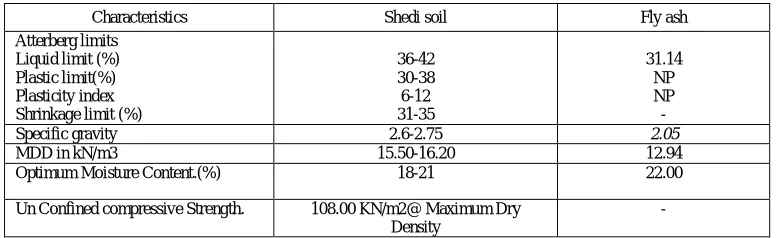
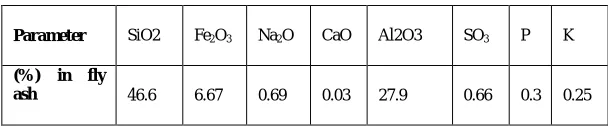
UPCL flyash was procured from Udupi Power corporation Limited plant, Nandikur Udupi. The properties of UPCL fly ash are given in table 1. The material may be classified as low compressible inorganic silt (ML).Table.2 gives the Chemical composition of fly ash used for stabilization.
Table 1 Propertiesof shedi soil and UPCL fly ash
Characteristics Shedi soil Fly ash
Atterberg limits Liquid limit (%) Plastic limit(%) Plasticity index Shrinkage limit (%)
36-42 30-38 6-12 31-35
31.14 NP NP -
Specific gravity 2.6-2.75 2.05
MDD in kN/m3 15.50-16.20 12.94
Optimum Moisture Content.(%) 18-21 22.00
Un Confined compressive Strength. 108.00 KN/m2@ Maximum Dry Density
Table.2 Chemical composition of UPCL fly ash used.
iii. Lime
Commercially available pure quicklime was used in the investigation. This quicklime was thoroughly mixed and hydrated with water when added to the soil. Chemical properties of Quick lime are given in Table 3.
Table 3 Chemical composition of lime used
iv. Sodium salts
Sodium chloride(NaCl) and sodium hydroxide (NaOH) of standard quality and 100% purity were procured from Vasavi Chemicals, Bangalore.
IV. METHODOLOGY ADOPTED
A. COMPACTION CHARACTERISTICS
Mini compaction test equipment developed by Sreedharan and Shivapullaiah [13] were used to determine the compaction characteristics of the shedi soil and shedi soil with various ingredients such as UPCL fly ash, lime and sodium salts.
B. UNCONFINED COMPRESSION STRENGTH
To ascertain the compressive strength of the stabilized soil, unconfined compressive strength test was carried out as per standard procedure mentioned in IS:2720 (part 10)-1991, for lithomargic soil treated with varying percentage(5-50%) of UPCL fly ash. Further, UCS test specimens were prepared by adding lime to soil- UPCL fly ash (optimum )mix, in the range of 1-6% to find the optimum percentage of lime which gives maximum value of UCS. The test samples were prepared for their maximum dry density and optimum moisture content adopting static compaction. Initially, after preparing a set of three specimens before curing of stabilized mix, samples were tested to record the immediate strength. The specimens were moist-cured for various curing periods (7,30 and 90 days) keeping the specimens in desiccators to maintain the water content of samples. To prevent loss of moisture, water was sprinkled at regular intervals.
V. EXPERIMENTAL RESULTS AND DISCUSSION
A. EFFECT OF UPCL FLY ASH ON THE COMPACTION CHARACTERISTICS
The compaction characteristics of stabilized shedi soil with various stabilizing additives are shown in Fig.1. Addition of UPCL flyash to shedi soil decreases the maximum density of the stabilized soil however OMC increases gradually. The increase of MDD with the increase of percentage of UPCL fly ash is due to lower specific gravity of UPCL fly ash compared to that of shedi soil. Shedi soil treated with 35% fly ash and 1% NaOH gives the maximum value of MDD compared to shedi soil stabilized with other ingredients.
Parameter SiO2 Fe2O3 Na2O CaO Al2O3 SO3 P K
(%) in fly
ash 46.6 6.67 0.69 0.03 27.9 0.66 0.3 0.25
Parameter Sio2 Fe2
O3 SO2 Cao Mgo Al2O3 pH
(%)in lime
Fig.1 Density to water content relationship of Shedi soil with additives.
Table 4 shows the compaction characteristic of Lime-shedi soil mix for different proportions of lime. Here the MDD decreases with increase in percentage of lime in shedi soil and OMC increases marginally due to presence of finer particles of lime.
Table 4 Compaction characteristics of Lime-stabilized Shedi soil.
B. EFFECT OF UPCL FLY ASH ON STRENGTH OF SHEDI SOILS
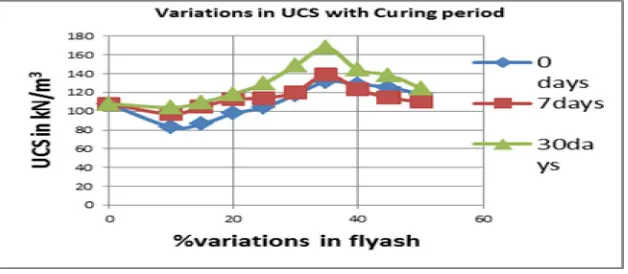
A series of strength tests were carried out for different proportions of UPCL flyash at different curing periods. Fig.2 shows the variation of UCS values for different proportions of soil-UPCL flyash mixture and for various curing periods.
Fig. 2 Variation of UCCS with the UPCL fly ash content for different days of curing.
Strength of UPCL fly ash stabilized soil increases with increase in UPCL flyash percentage up to 35% for curing period of 30 days and 35% of UPCL flyash is considered to be optimum percentage for the stabilization of shedi soil. The strength ratio for this combination is observed to be 1.35 for curing period of 90 days. Strength ratio is defined as
Mixture Maximum Dry Density(kN/m3) Optimum Moisture Content(%)
Shedi soil (SS) 15.60 20.00
SS+1% Lime 15.49 22.40
SS+2% Lime 15.36 22.60
SS+3% Lime 15.21 22.85
SS+4% Lime 15.02 23.00
SS+5% Lime 14.74 24.25
the ratio of strength of stabilised soil mixture at any stage of curing with strength of the soil matrix at immediate testing of the same combinations [15]
.
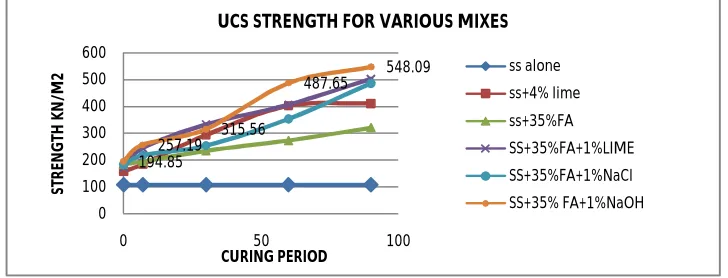
Increase in UCS value was observed for the soil- lime mix which is about 3.80 times compared to the strength of shedi soil alone.Table 5 and Fig.3, show the UCS values of stabilized shedi soil mixes with different ingredients. Significant increase in UCS value was found for shedi soil -UPCL fly ash and lime mixture after 90 days of curing period, compared to shedi soil UPCL fly ash mixture. The strength value for 90 days curing period of shedi soil-optimum UPCL flyash-lime mixture was observed to be 502.67 kPa. The strength is increased by 4.65 times compared to shedi soil alone and as seen from Table 6, strength ratio for this combination is observed to be 2.91. Increase in strength may be due to formation of cementitious hydrated calcium silicates by the reaction of UPCL flyash with lime.
Table 5 Variation in UCS value of stabilized soil for Different curing periods
It is observed that the addition of 1% Sodium salts to the shedi soil and optimum flyash mix further enhances the UCS values. Unconfined compressive strength for Shedi soil- optimum flyash-1% NaCl mix is 486.82 kPa after 90 days of curing periods and the strength ratio is observed to be 2.66 as seen in Table 6. Increase in strength is more predominant for Shedi soil- optimum flyash-1% NaOH mix for various curing periods as seen in Table 5 and Fig.3.
Fig. 3 Variation of UCS of stabilized shedi soil with the UPCL Fly ash and other additives for different days of curing.
Salinity induced due to addition of Sodium Chloride affects physical properties of soil causing fine particles binding together into aggregates. This flocculation process brings out modification in engineering properties of the soil. More NaCl concentration results in soil dispersion causing modification of soil structure and reduction in hydraulic
194.85257.19
315.56
487.65 548.09
0 100 200 300 400 500 600
0 50 100
ST
R
EN
GT
H
K
N
/M
2
CURING PERIOD
UCS STRENGTH FOR VARIOUS MIXES
ss alone ss+4% lime
ss+35%FA
SS+35%FA+1%LIME SS+35%FA+1%NaCl
SS+35% FA+1%NaOH
Unconfined Compressive Strength of stabilized Shedi Soil(SS) for different curing periods in kPa
Days 0 day 7days 30days 60days 90days
Shedi soil alone 108.00 108.00 108.00 108.00 108.00
SS + 4%.Lime 157.66 184.81 293.55 402.40 410.80
SS + 35% FA 184.21 194.34 234.96 273.45 321.14
SS + 35% FA+ 1% Lime. 172.97 244.26 332.75 406.75 502.67
SS + 35% FA+ 1% NaCl 182.76 218.43 253.69 354.00 486.82
conductivity. Addition of 1% NaOH to shedi soil – optimum fly ash mix proved to be most effective way to enhance the strength which in this case is 5 fold compared to shedi soil alone. This may be due to improvement in soil moisture content, increase in soil particle cohesion and water-proofing of soil.
Table.6 Strength ratios for various stabilized mix of shedi soil
VI. CONCLUSION
Soil stabilization using UPCL fly ash is found to be advantageous means for improving the engineering properties of shedi soil. Addition of small quantity of lime to optimum UPCL fly ash soil mixture further enhances the strength of stabilized shedi soil. Based on present experimental investigation following conclusions are drawn:
1. Increase of UPCL fly ash content in the soil decreases the maximum dry density of stabilized soil and optimum moisture content increases. This is due to the effect of replacement of soil by UPCL flyash of lower specific gravity. 2. The unconfined compressive strength of shedi soil and UPCL flyash mixtures increases with increase in UPCL flyash percentage and curing. 35% of UPCL flyash addition is found to be optimum, which gives the strength of 321.14 kPa after 90 days of curing.
3. Addition of 1% of lime to optimum UPCL Flyash-soil mixture predominantly increases the strength further. 4. Addition of sodium salts such as NaCl and NaOH at 1% further increases the UCS values.
5. NaOH proved to be predominant additive for fly ash stabilized soil mixture. Addition of 1% of salt to optimum flyash- shedi soil mix gives the strength ratio of 2.81 for 90 days of curing. This is due to the prolonged curing of the mixture during which the hydration of excess silicates and calcium forms the C-S-H gel thereby making fly ash a more useful pozzolanic material.
From the present study, it has been concluded that UPCL fly ash, lime and sodium salts can be effectively used in the stabilization of shedi soils.
REFERENCES
1.Sivapullaiah, P.V., Ramesh,H.N. and Sridharan, A, (1992).“Effect of Sulphate on the Physical properties of lime stabilized Kaolinitic soils”, Clay Research,Vol.11, No.1, pp.27-32.
2.Prakash, K., Sridharan, A., and Rao, S.M.(1989). “Lime addition and curing effects on the Index and compaction characteristics of a montmorillonitic soil”, Geotechnical Engineering, Vol.20,pp.39-47.
3.Sivapullaiah, P.V., Sridharan, A and BhaskarRaju,K.V. (2000). “Role of amount and type of clay in the lime stabilization of soils”, Journal of Ground improvement, Thomas Telford services Ltd.,Vol.4, pp.37-45.
4.Muthuram, M., Pandian,N.S. and Nagaraj, T.S.(1996). “Stabilization of high water content soils using lime”, Proc.Indian Geotechnical conference, pp. 391-394.
5..Sivapullaiah,P.V., Prashanth, J.P. and Sridharan, A, (1996),” “Effect of Fly ash on the index properties of black cotton soil and foundations”, Japanese Geotechnical society. Vol 36.No.1.pp.97-103.
6..K.V.Manjunath,L.Govindaraju and P.V.Shivapullaiah (2011), “ Blast furnace slag for bulk geotechnical applications”,Proc. of Indian Geo Technical conference, Kochi (Paper No.H-098).
7. Ashish Kumar Pathak, Dr. V. Pandey,KrishnaMurari, J.P. Singh.(2014),”Soil stabilisation Using Ground Granulated Blast Furnace Slag”,Int. Journal of Engineering Research and Applications (IJERA), Vol. 4, Issue 5 (version 2), May 2014,pp. 164-171.
Unconfined Compressive Strength of Shedi Soil(SS) +Opt.UPCL FLY ASH mix for different curing periods in kPa
Days 7days 30days 60days 90days Shedi soil + 4% Lime
1.17 1.86 2.55 2.61 Shedi soil +35% UPCL Fly ash
1.05 1.27 1.48 1.74 Shedi soil + 35% UPCL Fly ash+ 1% Lime.
1.41 1.92 2.35 2.91 Shedi soil + 35% UPCL Fly ash+ 1% NaCl
1.20 1.39 1.92 2.66 Shedi soil + 35% UPCL Fly ash+ 1% NaOH
8..Charan,H.D.,Ohri, M.L. and Punmia. B.C.(1994)” Use of Lime-fly ash in the stabilization of dune sand”, Highway research bulletin, No.50,pp55-65.
9.Paul Hughes & Stephen Glendinning (2004), “ Deep dry mix ground improvement of a soft peaty clay using blast furnace slag & red gypsum “ Quarterly Journal of Engg. Geology & Hydrogeology, Vol.37, Issue 3, pp 205-216.
10. Sridevi G and Sreerama Rao A (2014), “Efficiency of GGBS Stabilized soil cushions with and Without lime in pavements “Intenationa Journal of Emerging Technology in Computational and Applied Sciences (IJETCAS), Vol.14-549,pp 141-147.
11. Gyanen Takhelmayum,Savitha.A.L and Krishna Gudi (2013), “ Laboratory study on soil stabilization using Fly ash mixtures” International Journal of Engineering Science and Innovative Technology (IJESIT),Vol.2,pp 477-482.
12. R. Manjunath,K.S.Vinay, R. Raghu, Varun Raj, Vibhish(2012), “Stabilization of Lithomargic clay using Sodium Chloride salt” Proceedings of International conference on Advances in Architecture and Civil Engineering (AARCV 2012), 21st-23rd June 2012,pp384-386.
13..Sridharan,A. and Sivapullaiah, P.V. (2005). “Mini Compaction Test apparatus for fine grained soils”, Geotechnical testing journal,28(.3), pp.240-246.
14. IS-2720 (part 10)-1991, “ Metods of tests for soils; determination of Unconfined Compression Strength”, Bureau of Indian Standards, New Delhi.