ISSN(Online) : 2319-8753 ISSN (Print) : 2347-6710
I
nternational
J
ournal of
I
nnovative
R
esearch in
S
cience,
E
ngineering and
T
echnology
(An ISO 3297: 2007 Certified Organization)
Vol. 5, Issue 5, May 2016
Study on Mechanical Properties of Geo
Polymer Concrete Using Different Source
Material
[1]
Akib S. Dadu, [2]Yamini J. Patel, [3]Vipul H.Vyas
[1]
M.Tech Structural Engineer, CSPIT, Gujarat, India [2]
Assistant Professor, VGEC- Chandkheda, Gujarat and PhD scholar, CSPIT (CHARUSAT University, Gujarat) ,
India [3]
Assistant professor, CSPIT, Gujarat, India
ABSTRACT: The demand of concrete is increasing day by day and Cement is used for satisfying the need of development of infrastructure facilities, 1 tone cement production generates 1 tone CO2, which adversely affect the environment. In order to reduce the use of OPC and CO2 generation, the new generation concrete has been developed such as GEOPOLYMER CONCRETE. It uses Fly ash, Ground granulated blast furnace slag (GGBFS), Rice Husk Ash and Alkaline Solution as their Binding Materials. This paper presents the laboratory tests conducted to investigate the mechanical properties of geopolymer concrete. The experiments were conducted at different curing temperature of 60°C, 70°C and ambient temperature using different source material such as Fly ash, GGBFS, and rice husk ash. Different mixes were design with Rice Husk Ash as 25 %, 50 %, and 75 % of total binder. The alkaline solution used for present study is sodium silicate and sodium hydroxide solution. The compressive strength and split tensile strength have been determined at different curing period of 3,7,28 Days .The results show that Geopolymer concrete with 100 % GGBFS gains maximum strength. Up to replacement of 25 % of RHA achieves required strength. Increase in the mechanical properties as increase in the temperature.
KEYWORDS: Geopolymer concrete, Fly Ash, GGBFS (Ground granulated blast furnace slag), RHA (Rice Husk
Ash), Sodium silicate, Sodium Hydroxide.
I. INTRODUCTION
As a result of booming infrastructural development around the world, the demand for cement production is also increased. Ordinary Portland Cement (OPC) is mainly used as a cementations material for the concrete production. Nowadays, concrete industry is known to be the major consumer of natural resources, such as water, sand and aggregates, and manufacturing Portland cement also requires large amounts of each of them. As a result, the energy consumption for the cement production is high. It is estimated that the production of cement will increase from 1.5 billion tons in 1995 to 2.2 billion tons in 2010 [4]. For manufacturing each tone of the Portland cement about 1.5 tons of raw materials is needed [5]. The production of 1 tone ordinary Portland cement consumes 4GJ energy and produces about 1 tons of carbon dioxide (CO2) to the atmosphere [6] which leads to environmental pollution. To reduce the environmental pollution and excess embodied energy utilization, the alternative solution is Geo-polymer concrete.
ISSN(Online) : 2319-8753 ISSN (Print) : 2347-6710
I
nternational
J
ournal of
I
nnovative
R
esearch in
S
cience,
E
ngineering and
T
echnology
(An ISO 3297: 2007 Certified Organization)
Vol. 5, Issue 5, May 2016
materials such as fly ash, silica fume, slag, rice-husk ash, red mud, etc could be used as source materials. The alkaline liquids are from soluble alkali metals that are usually sodium or potassium based. The most common alkaline liquid used in geo-polymerization is a combination of sodium hydroxide (NaOH) or potassium hydroxide (KOH) and sodium silicate or potassium silicate. Till now most of the research has been conducted on fly ash based geopolymer and in this study, industrial wastes such as ground granulated blast furnace slag (GGBS) and agro waste as rice husk ash (RHA) are used as a source materials to prepare geopolymer concrete.
II. MATERIALS USED
A. Fly Ash
Fly ash (FA) is a by-product of the combustion of pulverized coal in thermal power plants. It is a fine grained, powdery and glassy particulate material that is collected from the exhaust gases by electrostatic precipitators or bag filters. When pulverised coal is burnt to generate heat, the residue contains 80 per cent fly ash and 20 per cent bottom ash. The size of particles is largely dependent on the type of dust collection equipment. Diameter of fly ash particles ranges from less than 1 μm–150 μm. It is generally finer than Portland cement.
Figure 1- Fly Ash
B. Ground granulated blast furnace slag (GGBS)
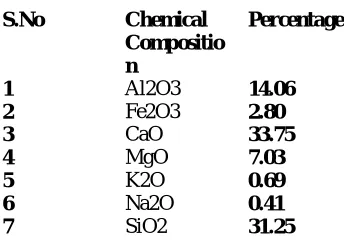
Geopolymer concrete is produced by activating alumino-silicate based source material with an alkaline solution. Ground granulated blast furnace slags are used as one of the source material for geopolymer binder. GGBS was obtained from JSW cements limited. Bellari, Karnataka. It was given to Laboratory for testing. Table1 shows the Chemical composition of GGBS.
Table 1- Properties of GGBFS
S.No Chemical
Compositio n
Percentage
1 Al2O3 14.06
2 Fe2O3 2.80
3 CaO 33.75
4 MgO 7.03
5 K2O 0.69
6 Na2O 0.41
ISSN(Online) : 2319-8753 ISSN (Print) : 2347-6710
I
nternational
J
ournal of
I
nnovative
R
esearch in
S
cience,
E
ngineering and
T
echnology
(An ISO 3297: 2007 Certified Organization)
Vol. 5, Issue 5, May 2016
Figure 2- GGBFS
C. Rice husk ash (RHA)
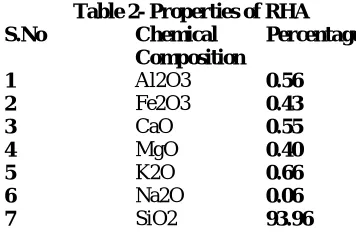
Rice husk ash (RHA) is a by-product from the burning of rice husk. The rice husk ash is a highly siliceous material that can be used as an admixture in concrete if the rice husk is burnt in a specific manner. The available Rice husk ash is black in colour as it contains unburnt carbon. Chemical composition of black Rice husk ash is shown in Table 2.
Table 2- Properties of RHA
S.No Chemical
Composition
Percentage
1 Al2O3 0.56
2 Fe2O3 0.43
3 CaO 0.55
4 MgO 0.40
5 K2O 0.66
6 Na2O 0.06
7 SiO2 93.96
D. Alkaline activator solution
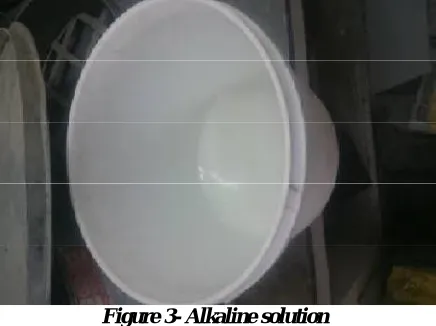
A combination of sodium hydroxide solution (NaOH) and sodium silicate and sodium hydroxide were used as alkaline activator solution. The sodium hydroxide solution was prepared by dissolving the sodium hydroxide solids, in the form of pellets in distilled water. In order to avoid the effect of unknown contaminants in the mixing water, the sodium hydroxide pellets were dissolved in distilled water.
ISSN(Online) : 2319-8753 ISSN (Print) : 2347-6710
I
nternational
J
ournal of
I
nnovative
R
esearch in
S
cience,
E
ngineering and
T
echnology
(An ISO 3297: 2007 Certified Organization)
Vol. 5, Issue 5, May 2016
Figure 3- Alkaline solution E. Fine Aggregates
Natural river sand conforming to Zone II as per IS 383 (1987) [7], with a fineness modulus of 3.45 and a specific gravity of 2.6, was used.
F. Coarse Aggregates
Crushed granite coarse aggregate conforming to IS: 383 (1987) [7] was used. Coarse aggregate of size 20 mm and below with a specific gravity of 2.87, and fineness modulus of 8.14 was used. The aggregates were tested as per IS 2386 (1963) [8].
G. Super plasticizer
Master Glenium Sky 8784 super plasticizer made by BASF was added to the mixture to improve the workability of fresh concrete.
H. Water
Extra water is added to increase the workability of the concrete.
III. MIX PROPORTIONS
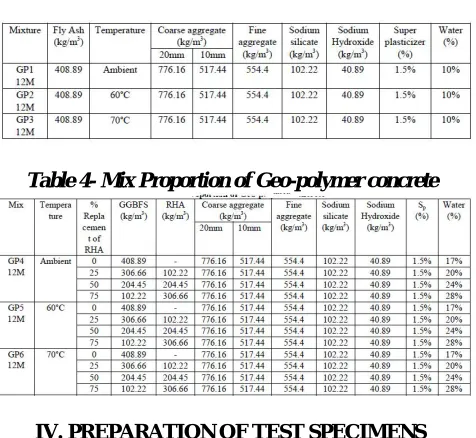
Since no code provisions are available for the mix design of geopolymer concrete, the density of geopolymer concrete was assumed to be 2400 kg/m3, and other calculations were made based on the density of concrete as per the design proposed by Lloyd and Rangan (2010) [14]. The combined total volume occupied by the coarse and fine aggregates was assumed to be77 %. The alkaline liquid to binder ratio was taken to be 0.35. The target strength of 30 MPa was fixed as for a regular strength concrete. The mix proportions are given in table 3 and table 4.
ISSN(Online) : 2319-8753 ISSN (Print) : 2347-6710
I
nternational
J
ournal of
I
nnovative
R
esearch in
S
cience,
E
ngineering and
T
echnology
(An ISO 3297: 2007 Certified Organization)
Vol. 5, Issue 5, May 2016
Table 3- Control mix of Fly Ash
Table 4- Mix Proportion of Geo-polymer concrete
IV. PREPARATION OF TEST SPECIMENS
The materials for the mixes were weighed and first mixed in dry condition for 3-4 minutes. Then the alkaline solution, which is a combination of sodium hydroxide and sodium silicate, and the super-plasticizer, were added to the dry mix. Extra water in the quantity of about 10 % by weight of the Fly Ash and 17% by weight of GGBFS was added to improve the workability. The mixing was continued for about 6-8 minutes. After casting, the moulds were placed in the oven where they were dried at 60°C and 70°C for 24 hours and ambient room temperature. Then the specimens were taken out and removed from their moulds. Then the specimens were taken out and allowed to cure at room temperature until the day of testing.
V. TESTS CONDUCTED
A. Compressive strength (MPa) test
The compressive strength of the geopolymer concrete was tested as per IS 516:1959 [9]. Cube specimens 150 mm in size were cast for each proportion and tested for their compressive strength at the ages of 3, 7 and 28 days. All the specimens were tested using the Compression Testing Machine (CTM) 2000 kN in capacity under a uniform rate of loading of 140 kg/cm2/min until failure, and the ultimate load at failure was registered to enable calculation of compressive strength.
B. Split tensile strength (MPa) test
The split tensile strength test was carried out as per IS 5816:1999 [15]. Cylindrical concrete specimens 150 mm in diameter and 300 mm in height were cast. The specimens were then tested to determine the splitting tensile strength using a Universal Testing Machine (UTM) at the ages of 3, 7 and 28 days.
VI. RESULTS AND DISCUSSION
A. Compressive strength (MPa)
ISSN(Online) : 2319-8753 ISSN (Print) : 2347-6710
I
nternational
J
ournal of
I
nnovative
R
esearch in
S
cience,
E
ngineering and
T
echnology
(An ISO 3297: 2007 Certified Organization)
Vol. 5, Issue 5, May 2016
Table 5- Compressive strength of Geopolymer concrete
Material molarity Temperature Compressive strength 3 Days 7 Days 28 Days Fly
Ash
12M Ambi ent
24.5 64
30.90 9
35.562
Fly Ash
12M 60°C 30.3 45
36.17 6
42.166
Fly Ash
12M 70°C 33.9 87
39.18 3
45.296
The Comparison of strength for Geopolymer concrete at 3,7, and 28 days and different temperature various like ambient room temperature ,60°C and 70°C as shown in figure 4.
As shown in figure 4 that Compressive strength values of Geopolymer concrete using Fly ash. In Graph it is shows that when temperature increase compressive strength of Geopolymer concrete increase.
Figure 4- Compressive strength values of Geopolymer concrete
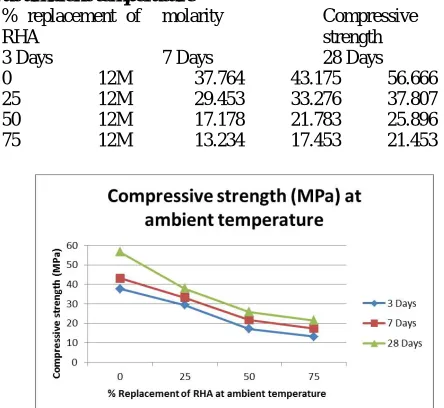
Table 6-Compressive strength at ambient temperature
% replacement of RHA
molarity Compressive strength 3 Days 7 Days 28 Days 0 12M 37.764 43.175 56.666 25 12M 29.453 33.276 37.807 50 12M 17.178 21.783 25.896 75 12M 13.234 17.453 21.453
ISSN(Online) : 2319-8753 ISSN (Print) : 2347-6710
I
nternational
J
ournal of
I
nnovative
R
esearch in
S
cience,
E
ngineering and
T
echnology
(An ISO 3297: 2007 Certified Organization)
Vol. 5, Issue 5, May 2016
As shown in figure 5 that % replacement of RHA at ambient temperature. It is observed that when increase % replacement of RHA, The compressive strength of Geopolyymer concrete decrease.
Table 7- Compressive strength at 60°C
% replacement of RHA
Molarity Compressive strength 3 Days 7 Days 28 Days 0 12M 44.342 54.962 71.333 25 12M 31.276 35.276 40.667 50 12M 19.178 24.783 29.896 75 12M 15.234 20.453 23.453
As shown in figure 7 that Compressive strength values of Geopolymer concrete of replacement of RHA with GGBFS In Graph it is shows that when Replacement of RHA increase the compressive strength of Geopolymer concrete decrease.
Figure 6- Compressive strength at 60°C
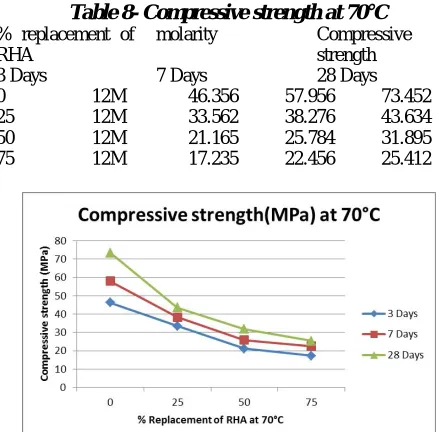
Table 8- Compressive strength at 70°C
% replacement of RHA
molarity Compressive strength 3 Days 7 Days 28 Days 0 12M 46.356 57.956 73.452 25 12M 33.562 38.276 43.634 50 12M 21.165 25.784 31.895 75 12M 17.235 22.456 25.412
ISSN(Online) : 2319-8753 ISSN (Print) : 2347-6710
I
nternational
J
ournal of
I
nnovative
R
esearch in
S
cience,
E
ngineering and
T
echnology
(An ISO 3297: 2007 Certified Organization)
Vol. 5, Issue 5, May 2016
Figure 5,6,7 shows that the % replacement of RHA at different temperature like ambient room temperature, 60°C and 70°C.It is observed that when % replacement of RHA increase there are decrease in compressive strength of Geopolymer concrete. It is also observed that when temperature increase there are increase in compressive strength of Geopolymer concrete.
B. Split Tensile strength(MPa)
The split tensile strength test was carried out as per IS 5816:1999 [15]. Cylindrical concrete specimens 150 mm in diameter and 300 mm in height were cast. The specimens were then tested to determine the splitting tensile strength using a Universal Testing Machine (UTM) at the ages of 3, 7 and 28 days.
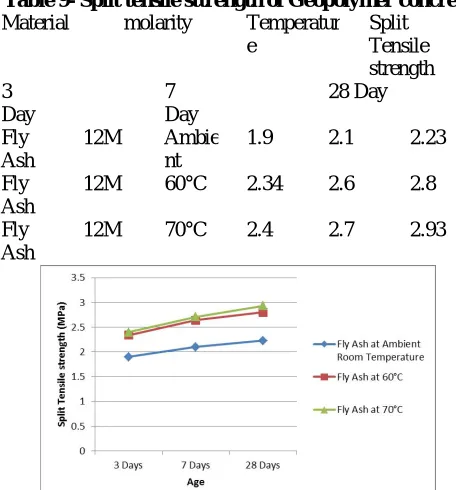
Table 9- Split tensile sttrength of Geopolymer concrete Material molarity Temperatur
e
Split Tensile strength 3
Day
7 Day
28 Day
Fly Ash
12M Ambie nt
1.9 2.1 2.23
Fly Ash
12M 60°C 2.34 2.6 2.8
Fly Ash
12M 70°C 2.4 2.7 2.93
Figure 8- Split tensile strength value of Geopolymer concrete
As shown in figure 8 that Split tensile strength values of Geopolymer concrete using Fly ash. In Graph it is shows that when temperature increase split tensile strength of Geopolymer concrete increase.
Table 10- Split tensile strength at ambient temperature
% replacement of RHA
molarity Split tensile strength
ISSN(Online) : 2319-8753 ISSN (Print) : 2347-6710
I
nternational
J
ournal of
I
nnovative
R
esearch in
S
cience,
E
ngineering and
T
echnology
(An ISO 3297: 2007 Certified Organization)
Vol. 5, Issue 5, May 2016
Figure 9- Split tensile strength at ambient temperature
As shown in figure 9 that % replacement of RHA at ambient temperature. It is observed that when increase % replacement of RHA, The split tensile strength of Geopolyymer concrete decrease.
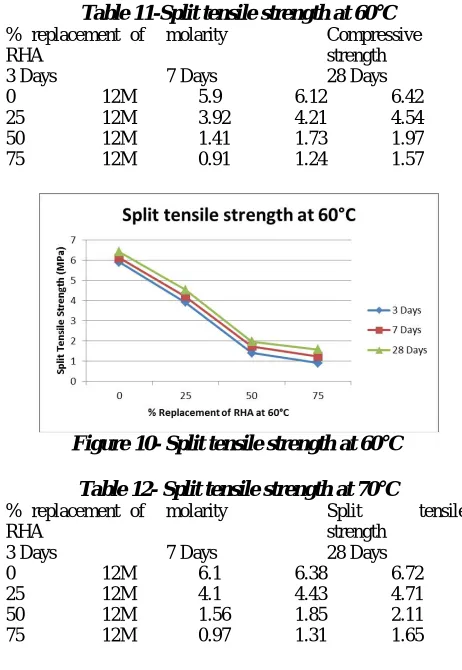
Table 11-Split tensile strength at 60°C
% replacement of RHA
molarity Compressive strength 3 Days 7 Days 28 Days 0 12M 5.9 6.12 6.42 25 12M 3.92 4.21 4.54 50 12M 1.41 1.73 1.97 75 12M 0.91 1.24 1.57
Figure 10- Split tensile strength at 60°C
Table 12- Split tensile strength at 70°C
% replacement of RHA
molarity Split tensile strength
ISSN(Online) : 2319-8753 ISSN (Print) : 2347-6710
I
nternational
J
ournal of
I
nnovative
R
esearch in
S
cience,
E
ngineering and
T
echnology
(An ISO 3297: 2007 Certified Organization)
Vol. 5, Issue 5, May 2016
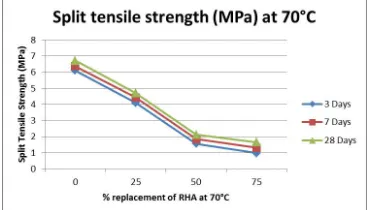
Figure 11-Split tensile strength at 70°C
Figure 9,10,11 shows that the % replacement of RHA at different temperature like ambient room temperature, 60°C and 70°C.It is observed that when % replacement of RHA increase there are decrease in split tensile strength of Geopolymer concrete. It is also observed that when temperature increase there are increase in split tensile strength of Geopolymer concrete.
VII. CONCLUSION
The experimental results show that it is possible to produce geopolymer concrete of substantial strength and durability using GGBS and RHA. The following conclusions can also be derived from the present study:
-The addition of RHA beyond 25 % had a retarding effect on the compressive strength. At up to 25 % replacement, the target strength was surpassed and compressive strength as high as 41 MPa was reached at 28 days. The split tensile strength is trend similar to that of the compressive strength with respect to the RHA proportion.
-The addition of RHA beyond 25 % is not beneficial for geopolymer concrete. The 50 % RHA replaced specimens neither achieved significant strength
-It is also observed that when temperature increase both compressive and tensile strength of Geopolymer concrete increase.
-The GGBS based geopolymer concrete gives higher strength.
-The Geo-polymer concrete was a good workable mix. High early strength was obtained in the Geo-polymer concrete mix.
REFERENCES
[1] Joseph Davidovits, ‘Development of Very Early High Strength Cement’, Journal of Materials Education, Vol. 16, pp. 91-139,1994
[2] Mohd Mustafa Al Bakri, Mohammed H, Kamarudin H, Khairul Niza I and Zarina Y. (2011), ‘Review on fly ash-based geopolymer concrete without Portland Cement’ Journal of Engineering and Technology Research Vol. 3(1), pp. 1-4.
[3] Zhang, M.H. and Mohan, M.V. (1996).‘High Performance Concrete Incorporating Rice Husk Ash as a Supplementary Cementing Material. ACI Materials Journal. Vol. 93(6): pp. 629-636.
[4] Malhotra, V. M, ‘Making Concrete "Greener" With Fly Ash. ACI Concrete International, pp. 61-66,1999
[5] McCaffery, R, ‘Climate Change and the Cement Industry’, Global Cement and Lime Magazine (Environment Special Issue), pp. 15-19,2002 [6] Mehta, P. K.,‘Reducing the Environmental Impact of Concrete’, ACI Concrete International, Vol 23 (10): pp. 61-66,2001
[7] IS: 383 (1987). Specification for coarse and fine aggregate from natural sources for concrete, 8th Reprint October 1991, Bureau of Indian Standards, New Delhi.
[8] IS: 2386 (Part 3) (1963). Methods of testing for aggregates for concrete, Specific Gravity, Density, Absorption and Organic Impurities, Bureau of Indian Standards, New Delhi.
[9] IS: 516 (1959). Methods of test for strength of concrete, Amendment No. 2, Reprint 1993, Bureau of Indian Standards, New Delhi.
[10] Detphan. S, and Chindaprasirt, P (2009), ‘Preparation of fly ash and rice husk ash geopolymer’ International Journal of Minerals, Metallurgy and Materials.,Vol. 16, Issue 6, pp. 720-726.
[11] Joseph Davidovits, (1994), ‘Development of Very Early High Strength Cement’, Journal of Materials Education, Vol. 16, pp. 91-139.
[12] American Society for Testing and Materials, ASTM C 430, Standard Test Method for Fineness of Hydraulic Cement by the 45 μm (No. 325) sieve, Section 4: Construction, USA, 1993, 223-225.
ISSN(Online) : 2319-8753 ISSN (Print) : 2347-6710
I
nternational
J
ournal of
I
nnovative
R
esearch in
S
cience,
E
ngineering and
T
echnology
(An ISO 3297: 2007 Certified Organization)
Vol. 5, Issue 5, May 2016
[14] Lloyd, N.A., Rangan, B.V.: Geopolymer Concrete with Fly Ash, Second International Conference on Sustainable Construction Materials and Technologies, Ancona, Italy, Vol. 3, pp. 1493-1504, 2010.