Transactions of the 17th International Conference on Structural Mechanics in Reactor Technology (SMiRT 17) Prague, Czech Republic, August 17 –22, 2003
Paper # G01-1
NESC Benchmark Tests to Support Improved Structural Integrity Assessment
R. Rintamaa1), N. Taylor2)
1) VTT Industrial Systems, Finland
2) European Commission Joint Research Centre, Institute for Energy, The Netherlands
ABSTRACT
Large-scale experimental benchmarks have a key role to play in ensuring the reliability of structural integrity assessment procedures for safety-critical reactor components. Such experiments must be carefully designed and performed under closely monitored conditions. Furthermore they must be open to extensive assessment and peer review to establish their validity. The Network for Evaluating Structural Components (NESC) was set up to address this need. It brings together about thirty organizations representing key utilities, manufacturers and R&D organizations. Over the last 10 years the network has coordinated a series of international projects based around large-scale benchmark tests. The NESC-I spinning cylinder test and the NESC-II PTS test series were completed in 2000 and 2002 respectively, and the full results are publicly available. Two further projects are now at a well-advanced stage. In the NESC-III a bending test will be performed in mid-2003 on a full-scale safe-end dissimilar weld assembly, containing a simulated weld defect. The materials and fracture analyses are being complemented by a round-robin trial for non-destructive inspection techniques on a separate assembly. NESC-IV is an experimental/analytical program to develop validated analysis methods for transferring fracture toughness data generated on standard test specimens to shallow flaws in reactor pressure vessel welds subject to biaxial loading in the lower-transition temperature region. The test series was completed in 2001 at ORNL in the US, and the results are now being evaluated
KEY WORDS: structural integrity, fracture mechanics, fracture toughness, master curve, ageing, RPV, dissimilar welds, thermal fatigue
INTRODUCTION
The Network for Evaluation of Structural Components (NESC)1 promotes better integration of multi-disciplinary
structural assessment procedures used to assure the continued safe and efficient operation of European nuclear power plants. NESC brings together some 30 operators, manufacturers, regulators, service companies and R&D organisations in large-scale experimental projects with an issue on structural integrity assessment. The NESC network is operated by the European Commission's Joint Research Centre (JRC) as part of a family of European networks comprising AMES (Ageing Materials Evaluation Studies), ENIQ (European Network for Inspection and Qualification), NET (European Network for ) and the recently launched AMALIA . In the Commission’s 6th Framework Programme, these form part of
the JRC’s SAFELIFE action. Its overall objectives are:
to create an international network to undertake collaborative projects capable of validating the entire structural integrity process.
to work towards best practice and the harmonisation of international standards.
to improve codes and standards for structural integrity assessment and to transfer the technology to industrial applications.
To manage the technical activities NESC uses a project and task group (TG) structure. The network projects are generally focussed on large-scale experimental activities capable of being benchmarks. A strong multi-disciplinary element is aimed for, combining various aspects of structural integrity assessment, in particular inspection, materials characterisation, fracture mechanics and instrumentation. Two projects have been completed (NESC-I: spinning cylinder PTS test [1] and NESC-II: PTS tests on cylinders with shallow cracks [2]), two are running (NESC-III: test on a dissimilar weld pipe assembly and NESC-IV: biaxial beam tests), while the NESC-Thermal Fatigue project is presently in the launch phase. The technical details are described in the main section of the paper. The network maintains the following series of Task Groups:
TG1: Inspection/Non-Destructive Evaluation TG2: Material Properties
TG3: Structural Analysis
1 R. Rintamaa was NESC Network Chairman for 1999-2003; N. Taylor is the NESC Network Manager and D.
TG4: Instrumentation and residual stresses TG5: Evaluation
TG6: Residual Stress Analysis
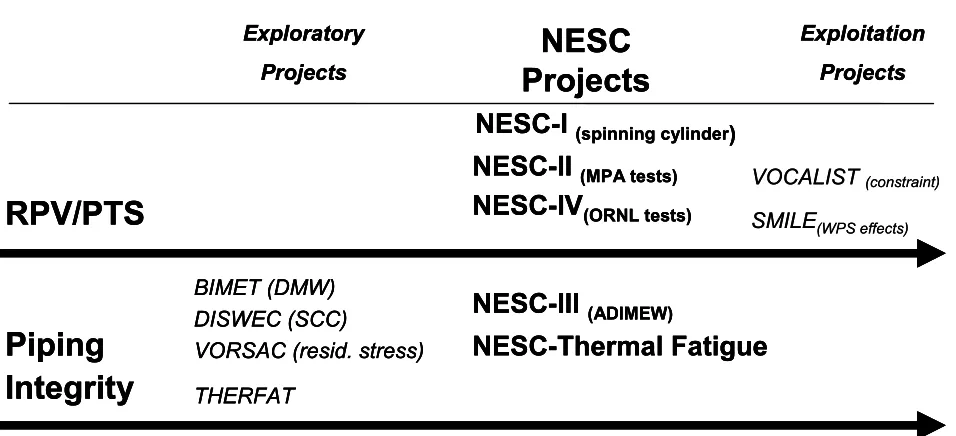
These groups can be different for each project, and they report to the Network Steering Committee, which is the overall decision-making body, representing the key Network partners and with an elected Chairman. The JRC is operating agent, supporting the Steering Committee and the organisation of the network and its projects. It also contributes its own R&D expertise for experimental and theoretical work. NESC projects and actions are supported primarily through so-called “in-kind” contributions, whereby participating organisations contribute work and are then entitled to have access to the contributions of others to any given project. In particular it takes advantage of large scale tests funded by national organisations. Members have also benefited from the Shared Cost Actions (SCA’s) of the European Commission’s Research Framework Programmes to sponsor activities. In many cases these small dedicated research projects have been pilot or seed projects for subsequent larger Network supported actions. In other cases they are used to exploit further the results of major Network projects where some important open questions remain. For NESC the relationship between the application fields and the various types of activity is shown in Fig. 1.
NESC membership is essentially European based, although a special exception was made to include American participation because of the high level contribution anticipated and because of the traditional strong links between the European nuclear industry and research laboratories in the area of plant component structural integrity. In the last years a strong effort has been made to encourage participation from those Eastern European states who are considered as applicants for European Union membership in the near future. Although this action is clearly limited to those countries with a nuclear industry, NESC now has active participation from partners in the Czech Republic and Hungary.
Since its launch NESC has been highly successful in generating top-class R&D in structural integrity assessment for critical components in light water reactors. However to identify and satisfy future R&D needs, the network’s strategy is being updated, but with the intention to maintain a focus on large-scale benchmarks capable of validating inter-disciplinary assessment procedures. This process also considers the new priorities of the Commission’s 6th
Framework Programme to strengthen the European Research Area and the integration of the JRC’s networking activities under the SAFELIFE umbrella.
BENCHMARKS FOR REACTOR PRESSURE VESSELS FLAW ASSESSMENT
Detection and integrity assessment of flaws or defects in the reactor pressure vessel (RPV) of light water reactors is key part of the overall plant safety assessment. While regulators, utilities and plant manufacturers have developed effective procedures to address this issue, a policy of continuous development is required to ensure that safety margins are maintained as plants accumulate many years of service. Further the reliability of advanced techniques needs to be rigorously checked. Indeed this was driving force behind the launch of the first NESC project in 1993, and the network has continued work in this area with the NESC-II and NESC-IV projects. The main features of these tests and their role benchmarks is summarised in the following sections.
Fig. 1. Overview of NESC Network Projects and associated Shared Cost Action Projects supported by DG-RTD. VOCALIST (constraint)
SMILE(WPS effects)
Exploratory Projects
NESC
Projects
Exploitation ProjectsNESC-I
(spinning cylinder)NESC-II
(MPA tests)NESC-IV
(ORNL tests)NESC-III
(ADIMEW)NESC-Thermal Fatigue
BIMET (DMW) DISWEC (SCC)
VORSAC (resid. stress)
THERFAT
RPV/PTS
Piping
Integrity
VOCALIST (constraint)
SMILE(WPS effects)
Exploratory Projects
NESC
Projects
Exploitation ProjectsNESC-I
(spinning cylinder)NESC-II
(MPA tests)NESC-IV
(ORNL tests)NESC-III
(ADIMEW)NESC-Thermal Fatigue
BIMET (DMW) DISWEC (SCC)
VORSAC (resid. stress)
THERFAT
RPV/PTS
Piping
Integrity
Exploratory ProjectsNESC
Projects
Exploitation ProjectsNESC-I
(spinning cylinder)NESC-II
(MPA tests)NESC-IV
(ORNL tests)NESC-III
(ADIMEW)NESC-Thermal Fatigue
BIMET (DMW) DISWEC (SCC)
VORSAC (resid. stress)
THERFAT
RPV/PTS
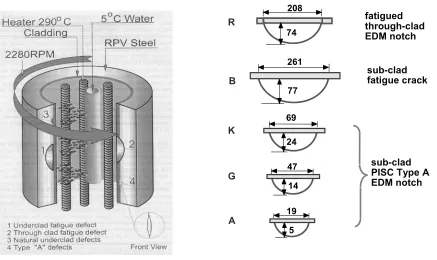
Fig. 2 NESC-I component and the principal defects considered in the fracture assessment.
NESC-I Spinning Cylinder Test
The first NESC project centered on a simulated PTS (pressurised thermal shock) experiment, conducted using a unique spinning cylinder system (Fig. 2) at AEA Technology, UK. The experiment was designed to simulate selected conditions associated with an ageing, flawed RPV subjected to severe PTS loading. The principal aim was to validate the combination of non-destructive inspection, materials characterisation and structural mechanics assessment procedures for evaluating the integrity of such an aged structure containing postulated flaws. The test piece itself consisted of an internally clad, 7 tonne steel cylinder into which a total of 18 defects, differing widely in fabrication method, size and location, were introduced. Details of the defects were withheld from the inspection teams and fracture analysts in the pre-test phase. The specimen was subject to mechanical loads due to high-speed rotation and thermal shock loads resulting from a cold water quench directed at the inner surface of the heated cylinder. The test was successfully performed in March 1997 and realised the planned cleavage run-and-arrest event in the large through-clad defect. In the case of the large sub-clad defect no cleavage occurred, although it was found to have grown along the entire initial crack front. These results provided a dramatic demonstration of the capability of degraded RPV steel containing large defects to withstand a very severe PTS transient.
In terms of the structural analysis procedures, refined analyses using detailed 3-D finite element modelling of the critical defect allowed accurate prediction of the actual time of the cleavage event in the transient and its location, as well as a precise estimate of the extent of prior ductile tearing. The greatest source of uncertainty in the assessment process proved to be variability in the material toughness data, linked to the intrinsically statistical nature of cleavage in the transition range. Statistical representation of actual fracture toughness data, in particular the master curve approach, has proved most instructive in interpreting the test results. The project results have been extensively reported [1,3,4,5,6] and substantial documentation include the so-called Problem Definition Document [7] which provides full details of the loads, materials, defects and test results are available via the NESC web site (http://safelife.jrc.nl/nesc/) or the JRC’s On-line Data Information Site (http://odin.jrc.nl/ne/).
An example of the usefulness of this test as benchmark is given by the NESC study [8] of fracture assessments of the defects using several national codes: ASME XI (USA), R6 (UK), BS PD6493:1991 (UK), SKIFS 1994:1 (Sweden), KTA (Germany), and RCCM/RSEM (France). All the assessments predicted very small allowable defect depths, in the range 1 mm to 9 mm deep (Table 1). This contrasts with behaviour during the test, in which only limited crack growth took place from defects over 70 mm deep. The conservatism in code assessments springs from a combination of the methods used to estimate crack driving force, the defect model adopted, and the assumed fracture toughness response. The detailed information available for NESC-I allowed analysis of these aspects, with the following outcomes:
( )
R
B
K
G
A
fatigued through-clad EDM notch
sub-clad fatigue crack
sub-clad PISC Type A EDM notch
208
74
261
77
69
24
47
14
19
Code Limiting defect depth
R6 1.8 mm (maximum depth point)
6.8 mm (surface point) SKIFS 1994:1 1.2 mm (normal/upset rules)
5.7 mm (emergency/faulted rules)
KTA 3 mm (no warm pre-stress effect)
9 mm (warm pre-stress allowed)
14 mm (without safety factors, no warm pre-stress effect) ASME Section XI 1.2 mm (ASME KIC curve)
1.5 mm (NESC-1 KJC data)
BS PD6493:1991 2 mm
RCCM/RSEM approach <1 mm
Table 1: Limiting flaw sizes from NESC-1 failure avoidance assessments [8].
Excess pessimism in predictions of crack driving force can be minimised by use of an appropriate defect model (through-clad for surface defects, sub-clad for buried defects), and by taking account of secondary stress relaxation in estimates of crack driving force.
Fracture toughness curves based upon the traditional ASME approach with safety factors are very pessimistic for the NESC-I material, whereas a statistical lower bound based upon the Master Curve provides a much better description of the material behaviour.
Assessments should take proper account of differing material zones such as the cladding and HAZ where suitable fracture toughness data exists.
NESC-II MPA Stuttgart PTS Tests
The NESC-II project on “Brittle crack initiation, propagation and arrest of shallow cracks in a clad vessel under PTS loading” was the second major project of the Network for Evaluating Structural Components. The focus on shallow cracks presented a distinct challenge from NESC-I and indeed defects of this type, with depths approximately equal to the combined clad and HAZ thickness, typically dominate the assumed flaw distributions in probabilistic safety assessments. Two large-scale tests were conducted using the special facility developed at MPA Stuttgart. The test pieces were thick-walled cylinders of outer diameter 800 mm and wall thickness 190 mm, fabricated in a 17 MoV 8 4 mod steel with a two-layer austenitic cladding on the internal surface. The base material was heat-treated to produce a low toughness, high transition temperature condition (characterised by To of 66oC and a low upper-shelf Charpy energy
of approximately 70 J). The first experiment was performed in March 1999 using the NP2 test piece, containing a fully circumferential sub-clad defect with a depth of 8 mm. It produced a crack growth and arrest event; with a maximum extension of approximately 15 mm. Post-test metallography however revealed that the growth mode was intergranular. The second test was performed in September 1999 using the NP1 test piece, containing two shallow semi-elliptical through-clad defects of depth 21 mm and length 60 mm. Although the planned loading transient was achieved, no growth occurred. The results of the two tests underline the conservatism of existing defect assessment procedures for shallow RPV flaws and indicate the resistance of even degraded material containing simulated flaws to severe thermal shock loading. As with NESC-I, it was found that code-based assessment routes predicted a limiting defect size one order of magnitude below that used. The project final report [2] is now available publicly on the NESC website, together with a comprehensive problem statement with details of loads, materials properties database and defect sizes. The fracture analyses performed using both simplified engineering methods and detailed cracked-body finite element analyses provide a set of reference crack driving force curves through the transients at the critical positions on the defects, although assessment of actual safety margins is precluded.
NESC-IV
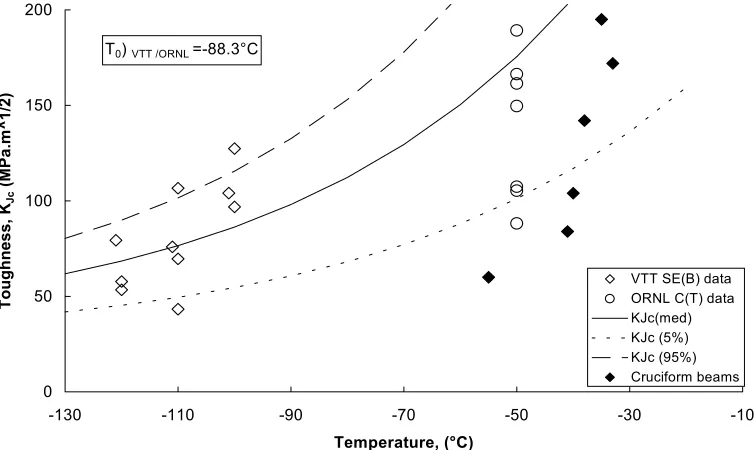
have contributed with extensive materials characterisation testing, using standard C(T) 25 mm specimen geometry as well as 10x10 mm SE(B) bend bars, as well as pre-test calculations to select an appropriate test temperature in the lower transition region. Fig. 4 shows the provisional results for the cruciform beam tests (the KJ values at fracture have to be
confirmed) together with the data from standard fracture testing. Detailed post-test fracture analyses are now in progress, and are being performed in close collaboration with the Vocalist shared cost action project (Validation of Constraint Based Methodology in Structural Integrity) [11]. In particular it is intended that the results will contribute to the Vocalist Best Practice Handbook [12]. As in the case of the NESC-I and II tests, it is intended that full details of the test conditions and results be made available publicly as reference cases to promote development and validation of fracture assessment models, as well as for training purposes.
.
Fig. 3 The ORNL cruciform beam design used for the NESC-IV tests, showing detail of the implanted defect.
Fig. 4 Comparison the NESC-IV cruciform beam test data with the Master Curve determined for the weld. T0) VTT /ORNL =-88.3°C
0 50 100 150 200
-130 -110 -90 -70 -50 -30 -10
Temperature, (°C)
Toughness, K
Jc
(MPa.m^1/2)
PRIMARY CIRCUIT PIPING
Recently the network’s attention has expanded to cover also assessment of defects in primary cooling piping, addressing two main issues: assessment of defects at dissimilar welds and thermal fatigue.
NESC-III: Dissimilar Weld Integrity
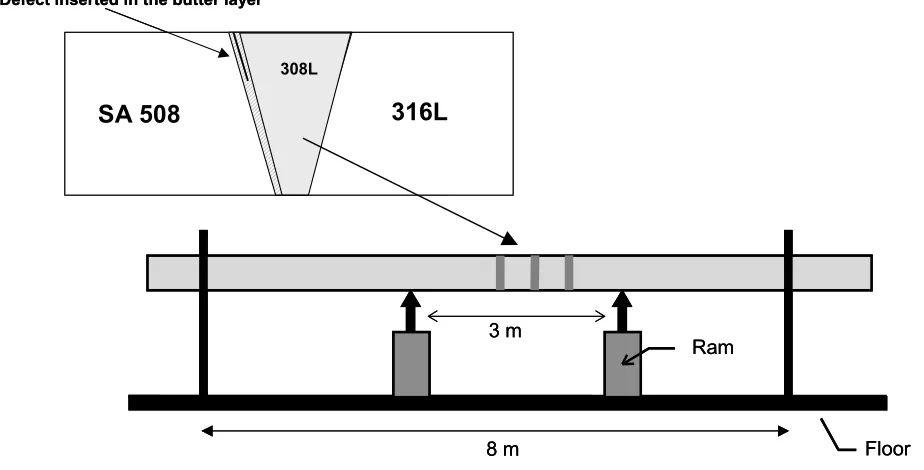
Dissimilar welds between ferritic and austenitic steels are well-know as providing a challenge to structural integrity assessment procedures and interest has been heightened by recent incidences of cracking at such location. For fracture analysis the complexity of the problem results from the prevailing mixed-mode loading conditions, the variation in material constitutive equations across the weld zone, and the presence of large residual stress field. During 1996-1999 a group of NESC members carried out an EC sponsored project called BIMET [13]. The two benchmark 4-point bend pipe tests were conducted at room temperature on a nominal 6" piping assembly, containing a ferritic to stainless steel (A508 308/309SS 304SS) dissimilar weld. This lead to a new project launched at the end of year 2000 looking at full-scale version of a similar dissimilar weld (16” diameter pipe, wall thickness 55 mm, A508 308/309SS 316SS material combination). EDF will perform a four-point bending test to fracture at 300oC by (Fig. 5). The crucial funding of the
test, including construction of the test assembly, some limited materials testing, residual stress measurement and the test design analysis is being part-financed through the EC ADIMEW shared cost action [14]. From this basis, the NESC-III project extends the overall scope and inter-disciplinarity of the study through Network contribution-in-kind support.
The objectives of NESC-III are as follows:
Quantify the accuracy of structural integrity assessment procedures for defect-containing, dissimilar metal welds. Participate in the design and evaluation of a unique large-scale test to determine the actual behaviour of a defect in a dissimilar weld of industrial scale.
Address critical issues including: inspection performance, laboratory-scale fracture testing on welds and potential benefits of advanced fracture modeling
Use the results to promote best practice and the harmonization of international standards.
A feature of the activity will be an inspection trial to evaluate performance evaluation of NDE techniques for detecting and sizing defects in piping dissimilar welds and to relate these to the overall structural integrity process. For this purpose the JRC has fabricated a separate dissimilar weld assembly containing two welds (one with 308 filler and one with IN182) and a range of defects that have relevance to current issues on operational plant. The network is also providing complimentary materials testing and fracture analysis calculations, a round robin on finite element techniques for predicting residual stress distributions, peer-review and recommendations for improved codes and standards. Under this arrangement the participants will have access to the ADIMEW documentation on a confidential basis.
Framatome completed fabrication of the ADIMEW test assembly to full nuclear specifications in 2002. The JRC has inserted by means of electro-discharge machining (EDM) a straight defect to approximately 1/3 wall thickness in the first butter layer parallel to the fusion line and at a distance of approximately 1.5mm (Fig. 6). The test itself will take place at EDF’s Les Renardières R&D centre in mid-2003.
Fig. 5 – Schematic of the Adimew test on a dissimilar weld assembly being used as a NESC-III benchmark.
3 m
8 m Floor
Ram 3 m
8 m Floor
Ram
SA 508
3
)316L
308L Defect inserted in the butter layer
SA 508
3
)316L
Fig. 6 Insertion of a precision simulated crack in the Adimew dissimilar weld component.
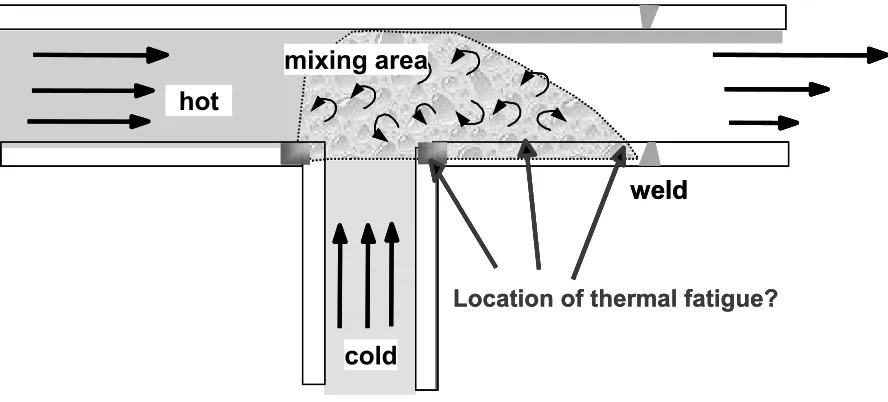
Fig. 7. Schematic of one cause of thermal fatigue at a piping tee-connections
NESC Thermal Fatigue
Thermal fatigue due to mixing and stratification is a recurring problem in LWR plants, as evident at both European and international level. Over last ten years a series of incidents have been reported in the US, Japan and in the EU involving the formation of minor cracks and/or leaks in safety critical components. In addition to safety concerns, the economic impact is also significant. As a result a number of initiatives are in progress at European and international level. For instance the EC-sponsored THERFAT project, which is associated to NESC, aims to assess the fatigue significance of turbulent thermal stratification and mixing effects in austenitic piping system tee-connections (Fig. 7). To complement these activities, a group of utilities and R&D organisations have come together under the NESC umbrella to develop a European thermal fatigue assessment procedure. An important aspect of this work will be the selection and collation of a series of validation cases or benchmarks, covering both industrial examples and R&D features tests.
cold
hot
mixing area
weld
Location of thermal fatigue?
cold
hot
mixing area
weld
CONCLUSIONS
In ensuring the reliability of structural analysis assessment procedures for safety-critical reactor components, large-scale experimental benchmarks have a key role to play. Such experiments must be carefully designed and performed under closely monitored conditions. Furthermore they must be open to extensive assessment and peer review to establish their validity. The NESC Network projects address this need. Full information is now publicly available for the NESC-I spinning cylinder test. The results of the NESC-II PTS test series are now being evaluated by the network. Two new projects have also been launched: NESC-III (bending test on a dissimilar weld pipe assembly) and NESC-IV (biaxial bending tests on defect-containing beams). Together, all these tests provide important benchmarks for validating structural assessment procedures, for evaluating the potential of advanced methods and for training analysts new to the field
ACKNOWLEDGEMENTS
The authors greatly acknowledge the contributions from all the Network partners, in particular Stering Committee members and their organisations, as well as the support from the Joint Research Centre of the European Commission,
REFERENCES
1. Bass B.R, J. Wintle, R. Hurst and N. Taylor, NESC-1 Project Overview, European Commission, EN 19051 2. Stumpfrock, L, Swan, D.I., Siegele, D. Taylor, N., Nilsson, K.F., Minnebo, P., NESC-II Final Report - Brittle
Crack Initiation, Propagation And Arrest Of Shallow Cracks In A Clad Vessel Under Pts Loading , NESCMAN (02) 07, Report EUR 20696 EN, March 2003
3. Murgatroyd, R., Eriksen, B., Lemaitre, P.M.V., Houghton, R., NESC I Inspection Task Group. Final Report. Part I. Analysis of the Inspection Results from the Pre- and Post-Test Round Robin Trials, EUR 19653/I/EN (2000) 4. Rintamaa, R., Wallin, K., Ehrnsten, U., NESC I Spinning Cylinder Project: Consistency of Fracture Assessment
Criteria, EUR 19637/EN (2000)
5. Bass, R., Faidy, C., Murgatroyd, R., NESC I Spinning Cylinder Project. Effects of Cladding, EC - EUR 19633/EN (2000)
6. Lidbury, D., Sherry, A, NESC-I Spinning Cylinder Project: Effects of Constraint. Assessment of Shallow Crack Effect , EUR 19647/EN (2000)
7. NESC-I Post-Test Data Sheet, NESC DOC ETF (01) 01
8. Smith, M.C. “Code Based Failure Avoidance Assessments Of The NESC-I Large Scale Pressurised Thermal Shock Experiment”, Proc. ASME PVP Conf., Vancouver, 2002
9. Lidbury D. et al, VOCALIST – An International Programme For The Validation Of Constraint Based Methodology In Structural Integrity, Proc. ICONE 9, paper 722
10. Taylor, N. & Bass, B.R, Overview Of NESC-IV Cruciform Specimen Test Results, ASME PVP Conference, August 2002, Vancouver, Canada
11. Bass, B. R., McAfee, W. J., Williams, P. T., and Pennell, W. E., “Fracture Assessment of Shallow-Flaw Cruciform Beams tested under Uniaxial and Biaxial Loading Conditions,” Nuclear Engineering and Design, Vol. 188, No. 3, 1999, pp. 259-288.
12. Nilsson, K.F. et al, “Validation Of Constarint-Based Methodology In Structural Integriity: Best Practice Handbook”, Proc. ASME PVP 2002, August 2002
13. Faidy C. et al, Structural integrity of bi-metallic components program (BIMET): fracture testing of bi-metallic welds, Proc. ICONE 8, 2000
![Table 1: Limiting flaw sizes from NESC-1 failure avoidance assessments [8].](https://thumb-us.123doks.com/thumbv2/123dok_us/1599680.1197581/4.595.112.486.69.264/table-limiting-flaw-sizes-nesc-failure-avoidance-assessments.webp)