yinted in Gnat Britain © The Company of Biologists Limited 1984
ACCLIMATION OF THE EURYHALINE TOAD BUFO
VIRIDIS TO HYPEROSMOTIC SOLUTION (NaCl, UREA
AND MANNITOL)
BY U. KATZ, G. DEGANI AND S. GABBAY
Department of Biology, The Technion-Israel Institute of Technology, Haifa, Israel
Accepted 13 September 1983
SUMMARY
1. Bufo viridis were acclimated to hyperosmotic solutions of NaCl, urea or mannitol.
2. The toads could not be acclimated to mannitol solutions of osmotic strength higher than 300 mosmol kg"1 H2O, but could be acclimated easily to NaCl and urea higher than 500 mosmol kg"1 H2O.
3. Water uptake diminished under mannitol acclimation while the ap-parent osmotic permeability under NaCl and urea acclimation increased.
4. Urea and sodium influx across the isolated skin changed inversely upon hyperosmotic acclimation, but they did not seem to depend on one another.
5. The adaptational advantages of the observed changes are discussed.
INTRODUCTION
Urea appears to play a critical role in adaptation of amphibians to a terrestrial environment (Bentley, 1966; McClanahan, 1967; Degani, Silankove & Shkolnik, 1981), and in adaptation of euryhaline species to high salinities (see Balinsky, 1981 for a recent review). However, little is known about the physiological mechanisms of urea retention and accumulation under changing environmental conditions. Bufo viridis, which is a terrestrial anuran, is one of the most adaptable species (Stoicovici & Pora, 1951; Gordon, 1962; Tercafs & Shoeffeniels, 1962; Katz, 1973a). We have studied the acclimation of this species to hyperosmotic solutions of NaCl, urea or mannitol. We found that the urea and sodium transport pathways, and the cutaneous water permeability, responded selectively to the various acclimation solutions, such as to reduce sodium entry and to enhance urea accumulation.
MATERIALS AND METHODS
Toads of both sexes were collected in Israel at the same locality (Maale-Ephraim) and were kept in the laboratory at 21 °C. They were acclimated to the hyperosmotic solutions by keeping them for 3-4 days in a concentration of 200 mosmol kg"1 H2O fer each solution before being transferred to the 400 mosmol kg"1 H2O solutions. The
toads were kept at least 10 days in the experimental solutions, which were replaced" daily, and they were not fed during the experimental period. Water uptake was determined from the weight change of individually caged toads (Katz, 1974) to the nearest 0-01 g. Surface area was calculated from the empirical equation A(cmz) = W6'3 X 6 3 (W = weight in grams). Blood was collected from the heart immediately after decapitation, into heparinized polyethylene tubes. The blood was centrifuged, the haematocrit was determined and the plasma was used for chemical analyses. Samples were taken from the liver, sartorius muscle, heart and the skin. They were blotted on Whatman No. 2 filter-paper and dried to constant weight at 90 °C. Osmolal-ity was determined on 50-/il samples with a semimicro osmometer (Knauer, Berlin). Chloride was titrated with a Radiometer CMT 10 chloridometer. Sodium and potassium were determined by flame photometry and urea was determined according to the method of Foster & Hochholzer (1972). Urea fluxes were measured using 14 C-urea for pieces of abdominal skin (A = 3-14cm2) mounted in Perspex chambers. Sodium transport was estimated from the short-circuit current (IK), which was measured by a voltage clamp device. The solution in the in vitro studies had the following composition (mmol I"1): NaCl, 115; KC1, 3; CaCk , 1; MgSCs , 0-5; man-nitol, 25; urea, 5; Tris, 0 5 ; glucose, 0-5; osmolality 270mosmolkg~1 H2O; pH, 8 0 ; High osmolality solution (530 mosmol kg"1) had in addition 285 mmol I"1 of man-nitol. Syntocinon was from Sandoz and amiloride from Merck, Sharp & Dohme. Student's (-test was used for statistical analysis.
RESULTS
While acclimation of the toads to NaCl and urea solutions was easy and eventually they could be kept for over 2 weeks at 500 mosmol kg"1 H2O without mortality, weight loss and mortality occurred in the mannitol solution, beginning at osmolalities higher than 300 mosmol kg"1 H2O. We therefore chose to study the acclimation to 400 mosmol kg"l H2O for all three solutes. During the course of acclimation through 200 mosmol kg"1 H2O to 400 mosmol kg"1 H2O the change in weight of toads in the urea solution was scarcely different from that of toads in tap water (Fig. 1). In 200 mosmol kg"1 H2O NaCl solution the toads gained some weight (up to 5 %); there was a rapid loss upon transfer to 400 mosmol kg"1 H2O which was regained in the following 3—4 days. In mannitol, high mortality occurred and some 50 % of the toads died at an osmolality of 400 mosmol kg"1 H2O. They lost some 15 % of their initial weight upon transfer from 200 mosmol kg"1 H2O into the 400 mosmol kg"1 H2O solution which they did not recover. Addition of NaCl (25 mmol I"1) did not improve the ability of the toads to acclimate in 400 mosmol kg"1 H2O mannitol.
Water uptake, which was some lgl00cm~2h~' in water-acclimated toads, was drastically reduced in the mannitol-acclimated group. Water uptake in the NaCl-acclimated toads was quite similar to that for urea acclimation, ranging from 1/3 to 1/2 of the rate in water-acclimated toads (Fig. 2). Toads drank occasionally under both the urea and NaCl acclimation conditions. However, this was irregular and was not quantified.
Hyperosmotic acclimation in a toad
405
- 200 mosmol kg"' -*•m -for NaCl, urea
and mannitol
400 mosmol kg • for NaCl, urea
and mannitol
Mannitol
11
Fig. 1. Time course of the relative weight change of toads (Bufb viridis) during acclimation to various solutes. Four to six toads weighing about 45 g each were pooled and weighed together, o, NaCl; • , urea, A , mannitol. (x x) Shows the weight of toads which were maintained in tap water. (Penicillin and streptomycin were added to the urea solution to prevent bacterial development.)
^ 1-5
s
s
0-5
H2O NaCl Urea
Acclimation condition
Mannitol
Fig. 2. In vivo water uptake of toads (Bufo viridis) which were acclimated to 400 mosmol kg ' H2O
of various solutes for 10-14 days. Water uptake was determined in the solution of acclimation under each condition. The water uptake of the 'NaCl' and 'urea' groups do not differ from one another. However, they differ significantly from the 'H2O' group ( /3> 0 0 5 ) and the mannitol group
and lowest in the 'mannitol' group (Table 1). The 'urea' group had the lowest concentration of NaCl in the plasma. It should be pointed out here that the osmolality and the composition of the blood of the toads in all groups was different in the summer as compared with the winter. The osmolality may become as much as
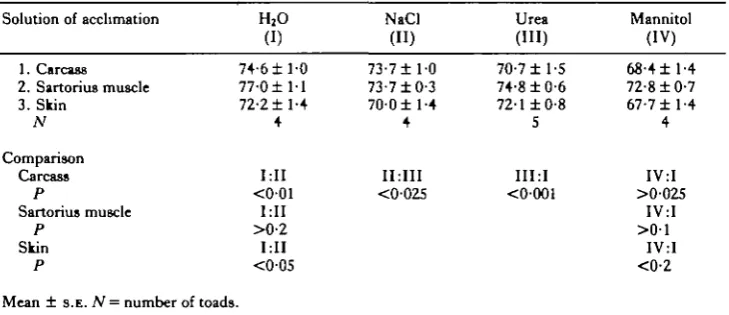
[image:4.451.47.412.429.586.2]100 mosmol kg"1 H2O higher in the summer of which over 50 % could be attributed to urea. This observation substantiates earlier observations (Katz, 1973a). The haematocrit of the blood, which increased by some 25 % in the 'NaCl' and 'urea' groups was more than doubled in mannitol (Table 1), as a result of considerable water loss under this condition. This loss was also reflected in the water content of the tissues and carcasses of the toads of the various groups (Table 2). The water content of the carcass was determined after removing the fat bodies and the gonads. The toads which had been kept in mannitol were dehydrated considerably when compared to all other groups.
Table 1. Composition of the plasma o/Bufo viridis which were maintained in tap water or acclimated to NaCl, urea and mannitol solutions of 400 mosmol kg'1H2O
Solution of acclimation
Haematocrit (%) Osmolality (mosmol kg"1)
Na+ (mmoll"1)
K+ (mmoll"1) Cl" (mmoll"1)
Urea (mmoll"1)
N 26 284 119 4 100 30
Mean ± s.E. N = number of toads. H2O
•7± 1-4 ± 5 ± 5 ± 0-5 ±10 ± 4 4 NaCl
38-5 ± 8-5 494 170 4 157 125 ±12 ± 5 ± 0-5 ± 7 ± 8 5 36 440 U4 4 108 155 Urea •8± 5-4 ±14 ± 7 ± 0-5 ± 5 ± 8 5 Manni 59-: 404 131 6 120 75 )± ± ± ± ± ± 4 itol 5-0 11 6 2 8 7
Table 2. Water content (percent of fresh weight) of the carcass, sartorius muscle and the skin o/Bufo viridis under acclimation to various solutes at 400mosmolkg~' H2O
Solution of acclimation
1. Carcass 2. Sartorius muscle 3. Skin N Comparison Carcass P Sartorius muscle P Skin P
Mean ± s.t.. N = number of
H2O
(I) 74-6 ±1-0 7 7 0 ± 1 1 72-2 ±1-4 4 MI <001 MI >0-2 MI <005 toads. NaCl (") 73-7± 10 73-7 ±0-3 700 ±1-4 4 IMII <0-025 Urea (HI) 70-7 ±1-5 74-8 ±0-6 72-1 ±0-8 5 III :I <0O01 Mannitol (IV) 68-4±l-4 72-8 ±0-7 67-7 ± 1-4
4
IV:I >0025
IV:I > 0 1
IV:I <0-2
Hyperosmotic acclimation in a toad
407
Table 3. Urea influx across isolated abdominal skin o/Bufo viridis which mere main-tained in tap water or acclimated in 400mosmolkg~' H2O of either NaCl, urea or
mannitol
Solution of acclimation Influx (^molcm"2h"')
N
Comparison
P
H2O
(I) 19-0 ± 7
6 I:III >0-2 The bathing solutions contained 5 mmol I"1 Mean ± s.E. N = number of toads.
NaCl (II) •6 187-1 ±71-9
6 II:IV >0-05 urea on both sides.
[image:5.451.43.413.305.436.2]Urea (HI) 27-3 ±5-2 9 Mannitol (IV) 73-3 ±22-5 9 IV:I <001
Table 4. Electrical properties and amiloride-blockable stimulated (syntocinon lOOmUml'1) short-circuit current of isolated abdominal skin o/Bufo viridis which were maintained in tap water or acclimated in 400mosmolkg~' H2O of either NaCl,
urea or mannitol
Solution of acclimation H2O
(I) NaCl (II) Urea (III) Mannitol (IV) PD (mV)
kOiAcm"2) R (Ocm2)
Amiloride-blockable Na transport (flAcm"2)
N
Comparison
P
8-2 ± 4-3 -4-6 ± 1-5 1215 ±379
11-0 ± 6-5 -0-5 ± 0-3 20531 ±8162
201 ± 6 0 -9-8 ± 3-7 2459 ± 407
0 1 ± 0-9 -2-8 ± 0-9 3806 ±1184
12-0 ± 4
1:11 <0-001
3-0 0-9 ±
4 0-4 <0005 20-8 ± 5 111:1 >005
3-6 2-4 ±
3 0-6
<0-001
Mean ± s.E. N = number of toads.
DISCUSSION
The present study shows that B. viridis, which is an extremely euryhaline toad, cannot be acclimated readily to mannitol solutions at osmolalities higher than 300 mosmolkg"1 H2O. It can acclimate easily, however, in urea and NaCl solutions at osmolalities higher even than 500mosmolkg~' H2O. In fact, this species can be acclimated to NaCl solutions up to 800mosmolkg~' (Katz, 1973a) and tolerates severe dehydrating conditions (Degani et al. 1981). The high haematocrit and the reduced water content of the tissues in the mannitol-acclimated group indicate that the toads were considerably dehydrated.
The most significant difference between the three acclimation groups is found in the rate of water uptake across the skin. The rate in tap water was about twice that in urea- and NaCl-acclimated toads, and about 10 times that in mannitol-acclimated toads.
Since the osmotic gradient across the skin differed little between the three acclima-tion groups, it follows that the apparent osmotic permeability (Posm) of the skin in the NaCl- and urea-acclimated toads had increased considerably, this was suggested earlier on the basis of in vitro studies (Katz & Weissberg, 1971; Katz, 19736). In the mannitol-acclimated toads, on the other hand, the Potm had been greatly reduced, as was observed previously in toads acclimated to 230mosmolkg~' sucrose (Katz, 19736).
The osmolality and the composition of the plasma in the three acclimation groups were somewhat different from one another. This suggests different osmoregulatory capacities of the toads in the isosmolar solutions of the various solutes. Plasma osmol-ality was highest in the NaCl-acclimated toads and lowest under mannitol acclima-tion. This was also reflected in the differential changes of the concentrations of electrolytes and urea in the plasma. Similar results were obtained by Funkhouser & Goldstein (1973), and by Schrock, Bauer, Merkle & Hanke (1980) mXenopus laevis acclimated in mannitol solutions isosmotic to the blood or 300mosmolkg~1 H2O.
Hyperostnotic acclimation in a toad 409
{unpublished observations). The changes in these transport pathways are of adapta-tional advantage in terms of the response to environmental challenge. The urea uptake mechanism is induced under hyperosmotic stress, but not in a urea-rich environment, while sodium uptake is blocked in an environment which is rich in NaCl.
The kidney should contribute significantly to osmoregulation under changing en-vironmental conditions, and we have observed differences in the volume and com-position of the urine under the various acclimation conditions.
We have found in this study that Bufo viridis can be acclimated to great increases in the osmolalities of the external environment if these increases are brought about by NaCl or urea. However, the toad is unable to deal with external hypertonicity when this is produced by an impermeant solute like mannitol. This is apparently because the necessary osmoregulatory mechanisms fail to increase and maintain the blood osmolality hypertonic to the external solution.
We wish to thank Mrs J. Hoffman and the editors for helpful advice on the manuscript. This research was supported by the basic Research Fund of the Israel Academy of Sciences and Humanities to GD.
R E F E R E N C E S
BALINSKY, J. B. (1981). Adaptation of nitrogen metabolism to hyperosmotic environment in amphibia. J. exp. Zool. 215, 335-350.
BENTLEY, P. J. (1966). Adaptations of amphibia to arid environments. Science, N.Y. 152, 619—623. DECANI, G., SILANKOVE, N. St SHKOLNIK, A. (1981). Osmotic and urea concentration of blood plasma in
burrowing green toads. Israel J. Zool. 30, 96.
FOSTER, L. B. & HOCHHOLZER, J. M. (1972). A single-reagent manual method for directly determining urea nitrogen in serum. CHn. Chem. 17, 921-925.
FUNKHOUSER, D. & GOLDSTEIN, L. (1973). Urea response to pure osmotic stress in the aquatic toad Xenopus
laevis.Am.J. Physiol. 224, 524-529.
GORDON, M. W. (1962). Osmotic regulation in the green toad (Bufo viridis). J. exp. Biol. 39, 261-270. KATZ, U. (1973a). Studies on the adaptation of the toad Bufo viridis to high salinities: oxygen consumption,
plasma concentration and water content of the tissues. J. exp. Biol. 58, 785—7%.
KATZ, U. (19736). Cellular adaptations to hypertonic solutions in amphibians adapted to high salinities. Ph.D. thesis. The Hebrew University, Jerusalem, 109 pp.
KATZ, U. (1974). A simple and accurate method for the study of water movement across amphibian Am.J. biol.
Education 8, 18-19.
KATZ, U., GARCIA-ROMEU, F., MASONI, A. & ISAIA, J. (1981). Active transport of urea across the skin of the euryhaline toad Bufo viridis. Pflugers Arch. ges. Physiol. 390, 299-300.
KATZ, U. & WEISSBERC, J. (1971). Role of skin and neurohypophyseal hormones in the adaptation of the toad Bufo viridis to high salinities. Nature, Land. 232, 344—345.
MCBEAN, R. L. & GOLDSTEIN, L. (1970a). Renal function during osmotic stress in the aquatic toad Xenopus
laevis.Am.J. Physiol. 219, 1115-1123.
MCBEAN, R. L. & GOLDSTEIN, L. (19706). Accelerated synthesis of urea in Xenopus laevis during osmotic stress. Am.J. Physiol. 219, 1124-1130.
MCCLANAHAN, L. (1967). Adaptations of the spadefoot toad, Scaphiopus couchi, to desert environments. Comp. Biochem. Physiol. 20, 73-99.
SCHROCK, H., BAUER, O., MERKLE, S. & HANKE, W. (1980). Cell volume regulation in juveniles of Xenopus laevis in hypertonic mannitol solution. Comp. Biochem. Physiol. 65A, 159—165.
STOICOVICI, F. & PORA, E. A. (1951). Compartarea la variatinui de salinitate. NotaXXX: Influenta variatiunilar de salinitate sia factorului ecologic osupra supravietuirii si mediului interior la Bufo viridis in diferitele periodae ale anului. Acad. Rep. Pop. Romane, Fil. Cluj. 2, 159-219.