Ranking of Delay Factors in Construction
Project Using AHP and VIKOR
Multi-Attribute Decision Making Method
Shubham Sharma1, Mukesh Pandey2, Sohit Agrawal3
PG Scholar, Department of Civil Engineering, ITM University, Gwalior, Madhya Pradesh, India1
Professor & Head, Department of Civil Engineering, ITM University, Gwalior, Madhya Pradesh, India 2
Assistance Professor, Department of Civil Engineering, ITM University, Gwalior, Madhya Pradesh, India 3
ABSTRACT: Delay is a very common problem which comes when we are working on schedule work like projects especially buildings construction project. The complexity of modern construction project invites delay and delay becomes the greatest problem of all time. Due to poor management and inflexibility of projects, the project required more time and money than the scheduled time and budget of the project. So, the aim of this paper is to find out the factors which create more problem and probably more responsible for the delay. For this, a survey is conducted for the delay factors which is derived from the literature survey which was later on investigated by one of the methods of MCDM i.e. VIKOR which combine with AHP that give ranking to the different categories/factors. This paper will help for future recommendation to minimize the effect of these factors in construction.
KEYWORDS:Construction Projects, Delay, MCDM, VIKOR, delay Factors.
I. INTRODUCTION
“Delay” this word can be said by the various department or management when the project is not to be completed on time or completion date is to be extended. This all can be happen if the inadequate and improper preparation of work is done before starting the project. Delay will also lead the factor of cost overrun. The extension of the project duration will affect the quality of construction adversely.
The aim of the construction schedule before starting of any construction project is to produce a good quality of construction work in specified time period. The process of monitoring and to fulfil the demand of every one is a difficult task. Owner and the contractor both knew that their time is money so for this corrective measures should be taken to avoid delays.
Planning and scheduling are the main key factor in construction. Leading to the success in the construction is critical as the competition is increasing in the construction. The critical key factor should be to control the success factors. As the project success and fails is independently on its management process. The Construction industry is a risky business as so many people working for money so; there is a chance of failure so companies have to consider all the parameters which can direct affect on the success.
II. AIM AND PURPOSE FOR THE STUDY
As the construction play an important role in the GDP (Gross Domestic Product) of various countries, so it is important to finish it on time, but even after all your efforts, some factors put it behind the scheduled time. So the main purpose of this research is:
1. To find out the factors causing delay and common sub-factors in them. 2. Investigate and give ranking to that entire factor by the method of MCDM.
3. So by ranking better future recommendation can be taken to minimize effects of those factors.
III. CRITICAL FACTOR AND SUB-FACTORS CAUSING DELAY
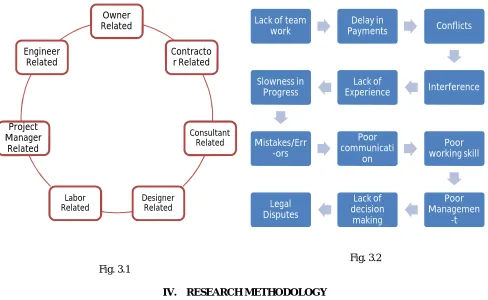
To determine the critical categories and common factors in them causing the delay in construction, a literature survey is conducted from various research papers and research of the researchers. Total 7 no. of categories were found and 12 no. of common sub-factors which are listed below:
Fig. 3.1 shows the cycle of 7 no. of categories which are responsible for delays. Fig. 3.2 shows the total no. of 12 no. of common factors in those 7 no. of categories.
Fig. 3.2 Fig. 3.1
IV. RESEARCH METHODOLOGY
The methodology applied in this paper to calculate the data and give ranking to all those categories is VIKOR. In this
were later on used by VIKOR to give ranking to all those categories. VIKOR and AHP both are MCDM methods.
MCDM is an agent looks into for immediate and straight forward research to assess multi choices for basic leadership. VIKOR alongside AHP is utilized as a multi-characteristic basic leadership technique
.
1
VIKOR METHODOLOGYVIKOR is utilized to take care of a choice issue with clashing and with various units’ criteria. In this, it is accepted that we can bargain while the clashing outcome is there. The individual who is taking care of the issue needs an outcome which is close or closes near the perfect arrangement and offer to position to options.
VIKOR is created by Serafim Opricovic in his Ph.D. in 1979. VIKOR is named from Visekriterijumska Optimizacija I Kompromisno Resenje that implies multi-criteria improvement bargain arrangement. Positioning given by VIKOR is closeness to PIS and farness from NIS
.
2.
AHP METHODOLOGYAHP is (Analytical Hierarchy Process) which was developed by Thomas L. Saaty in 1970 based on mathematics and psychology. AHP generally convert the data in hierarchy model or uses a multi-level hierarchy structure of objectives (matrix form) which is used to calculate the weights, which was later on used to evaluate the data.
AHP is a gathering strategy for settling on a complex choice, as the history of AHP informs the peruses of asset distribution, meeting and different occasions or issue important to the specialist. AHP is an instrument that finds the reasonable option when issue includes numerous choice issues.
AHP will calculate the weights & VIKOR will determine the best and worst values, which will all combine for further calculation in VIKOR to give ranking to the categories/alternatives.
V. DATA ANALYSIS
The process of Data analysis includes the four steps, they are:
1. Find out the best and worst values. i.e. (Fi* and Fi-), where Fi*=Max. Fij and Fi-=Min. Fij in Benefit situation and opposite in cost situation.
2. Find out the value of Si and Ri, where Si is the summation of the Wj(Fi*-Fij/Fi*-Fi-) and j=1…..n Ri is the maximum value max.j(Fi*-Fij/Fi*-Fi-).
3. Find out the value of Qi, where
“Qi=v(Si-S*/S--S*)+(1-v)(Ri-R*/R--R*)”.
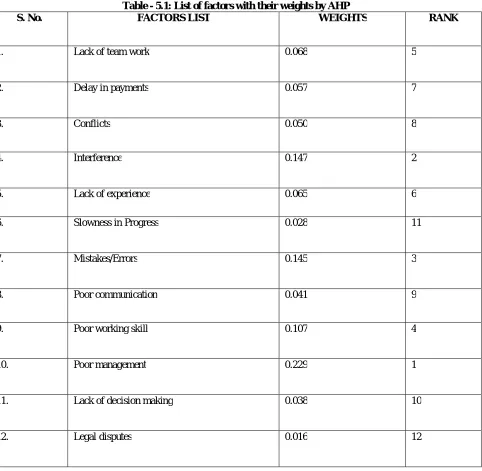
The data collect from the survey is analyzed first by AHP for weights and then by VIKOR for ranking, they are:
Table - 5.1: List of factors with their weights by AHP
S. No. FACTORS LIST WEIGHTS RANK
1. Lack of team work 0.068 5
2. Delay in payments 0.057 7
3. Conflicts 0.050 8
4. Interference 0.147 2
5. Lack of experience 0.065 6
6. Slowness in Progress 0.028 11
7. Mistakes/Errors 0.145 3
8. Poor communication 0.041 9
9. Poor working skill 0.107 4
10. Poor management 0.229 1
11. Lack of decision making 0.038 10
12. Legal disputes 0.016 12
Table -5.2: List of Categories with their Score and Rank
Delay Categories List Qi Rank
Owner Related 0.720 5
Contractor Related 0.971 7
Consultant Related 0 1
Designer Related 0.290 2
Labor Related 0.392 3
Project manager Related 0.931 6
Engineer Related 0.555 4
Table -5.2 contains the delay categories with their score in Qi list and ranked according to their score.
Fig -5.1 Qi values after final evaluation of VIKOR
Fig -5.1 shows the graph of the categories with their values after final evaluation of VIKOR.
VI. CONCLUSION
There are several methods for evaluating and compare the factors and categories. In this study 7 categories with their 12 common factors rated against delays in the construction projects, the data was collected and analyzed by the multi-criteria decision-making method VIKOR along with AHP and the conclusion comes out from this study is that consultant is the one which is more responsible followed by the designer, labor, engineer, owner, project manager and last contractor.
0 0.1 0.2 0.3 0.4 0.5 0.6 0.7 0.8 0.9 1
Owner Contractor Consultant Designer Labor Project manager
engineer
Qi values after final evaluation of VIKOR
If we look at the perspective of this ranking consultant is the one who is mainly appointed by the owner for advice on the various aspects that mean the decision make by owner is completely reliable on consultant advice. So all this concludes that if you want to made construction delay free proper care and management should be made so the project can run efficiently.
REFERENCES
[1] Bhadoria Swadesh Singh, Sohit Agrawal, Vaishant Gupta, and Mukesh Kumar Pandey, "Impact of Delayness on Construction Project", International Research Journal of Engineering and Technology, Volume 3, Issue 11, pp. 542-546, 2016.
[2] Kaaoser Md. Masud, Md. Mamunur Rashid, and Sharif Ahmed. "Selecting a Material for Electroplating Process Using AHP and VIKOR Multi-Attribute Decision Making Method."International Conference on Industrial Engineering and Operations Management, January 7-9, pp. 834-841, 2014.
[3] CETIN Emre IPEKCI and H. Hande CETI, "Using VIKOR Method for Analyzing of Qualification Levels and Transition to Employment of Europeon Union and Candidate Countries", The Online Journal of Science and Technology, Volume 6, Issue 2, pp. 99-102, 2016.
[4] Salunkhe Ashwini Arun and Rahul S. Patil, "Identification of Critical Construction Delay Factors", International Journal of Latest Trends in Engineering and Technology,Volume 3, Issue 4, pp.256-261, 2014.
[5] R Dinesh Kumar, Causes and Effect of Delay in Indian Construction Project, International Research Journal of Engineering and Technology, Volume 3, Issue 4, pp. 1831-1837, 2016.
[6] Taha Ghada, Mohamed Badawy, and Omar EL Nawawy, A Model for Evaluation of Delay in Construction Project, International Journal of Inovative Research in Science, Engineering and Technology, Volume 5, Issue 3, pp 3021-3028, 2016.
[7] Perera N. and Sutrisha M., The use of AHP in the Analysis of Delay Claims in Construction Project in UAE, The Built & Human Environment Review, Volume 3, Issue 1,pp: 47-48, 2010.
[8] MUHAMMED MUFAZZAL HOSSEN, SUNKOO KANG and JONGHYUN KIM, Construction Schedule Delay Risk Assessment by using Combined AHP and RII Methodology for International NPP Project, ELSEVIER, pp: 362-369, 2015.
[9] Anil Upadhyay, Himanshu Agrawal, Hanish Jain,A study contractor related delay factors in construction, International Research Journal of Engineering & Technology, Volume 3, Issue 8, pp: 1162-1164, 2016.
[10] Nashwan AI-Emad, Sasitharan Nagapan, Identification of delay factors in Mecca’s construction expert prespective”, International journal of sustainable construction engineering and technology, Volume 6, Issue2, pp: 16-25, 2015.