Soil Stabilization Using Polypropylene Fiber
Materials
Muske Srujan Teja1
Assistant Professor, Department of Civil Engineering, Mahaveer Institute of Science and Technology,
Hyderabad India1
ABSTRACT: The main objective of this study is to investigate the use of polypropylene fibre materials in geotechnical applications and to evaluate the effects of polypropylene fibres on shear strength of unsaturated soil by carrying out direct shear tests and unconfined compression tests on two different soil samples. The results obtained are compared for the samples and inferences are drawn towards the usability and effectiveness of fibre reinforcement at various percentages (0, 0.05, 0.015, and 0.025) as a replacement for deep foundation or raft foundation, as a cost effective approach.
KEYWORDS: polypropylene fiber, direct shear test, unconfined compression test, fiber reinforcement
I. INTRODUCTION
For any land based structure, the foundation is very important and has to be strong to support the entire structure. In order for the foundation to be strong, the soil around it plays a very critical role. So, to work with soils, we need to have proper knowledge about their properties and factors which affect their behaviour. The process of soil stabilization helps to achieve the required properties in a soil needed for the construction work. In India, the modern era of soil stabilization began in early 1970’s, with a general shortage of petroleum and aggregates, it became necessary for the engineers to look at means to improve soil other than replacing the poor soil at the building site. Soil stabilization was used but due to the use of obsolete methods and also due to the absence of proper technique, soil stabilization lost favour. In recent times, with the increase in the demand for infrastructure, raw materials and fuel, soil stabilization has started to take a new shape. With the availability of better research, materials and equipment, it is emerging as a popular and cost effective method for soil improvement. Here, in this project, soil stabilization has been done with the help of randomly distributed polypropylene fibers obtained from waste materials. The improvement in the shear strength parameters has been stressed upon and comparative studies have been carried out using different methods of shear resistance measurement. It is very expensive to replace the inferior soil entirely soil and hence, soil stabilization is the thing to look for in these cases
It improves the strength of the soil, thus, increasing the soil bearing capacity.
It is more economical both in terms of cost and energy to increase the bearing capacity of the soil rather than going for deep foundation or raft foundation.
It is also used to provide more stability to the soil in slopes or other such places. Sometimes soil stabilization is also used to prevent soil erosion or formation of dust, which is very useful especially in dry and arid weather.
II. METHODS
.
Mechanical method of Stabilization In this procedure, soils of different gradations are mixed together to obtain the desired property in the soil. This may be done at the site or at some other place from where it can be transported easily. The final mixture is then compacted by the usual methods to get the required density.
It refers to the addition of manufactured products into the soil, which in proper quantities enhances the quality of the soil. Materials such as cement, lime, bitumen, fly ash etc. are used as chemical additives. Sometimes different fibers are also used as reinforcements in the soil. The addition of these fibers takes place by two methods;
a) Oriented fiber reinforcement
The fibers are arranged in some order and all the fibers are placed in the same orientation. The fibers are laid layer by layer in this type of orientation. Continuous fibers in the form of sheets, strips or bars etc. are used systematically in this type of arrangement.
b) Random fiber reinforcement
This arrangement has discrete fibers distributed randomly in the soil mass. The mixing is done until the soil and the reinforcement form a more or less homogeneous mixture. Materials used in this type of reinforcements are generally derived from paper, nylon, metals or other materials having varied physical properties. Randomly distributed fibers have some advantages over the systematically distributed fibers. Somehow this way of reinforcement is similar to addition of admixtures such as cement, lime etc. Besides being easy to add and mix, this method also offers strength isotropy, decreases chance of potential weak planes which occur in the other case and provides ductility to the of soil.
MATERIALS
A) Sample1 B) Sample 2
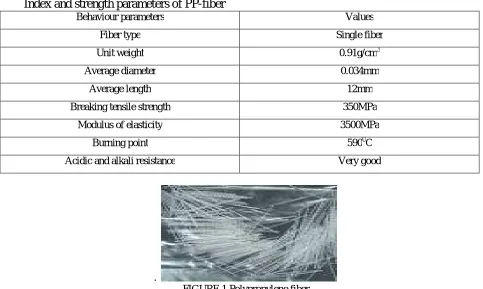
C) Reinforcement material (polypropylene fiber)
Index and strength parameters of PP-fiber
Behaviour parameters Values
Fiber type Single fiber
Unit weight 0.91g/cm3
Average diameter 0.034mm
Average length 12mm
Breaking tensile strength 350MPa
Modulus of elasticity 3500MPa
Burning point 5900C
Acidic and alkali resistance Very good
.
Preparation of samples
Following steps are carried out while mixing the fiber to the soil
All the soil samples are compacted at their respective maximum dry density (MDD) and optimum moisture content (OMC), corresponding tothe standard proctorcompaction tests
Content of fiber in the soils is here in decided by the following equation
Where
ƥ
f=
ρf=ratio of fiber content
Wf= weight of the fiber W = weight of the air-dried soil
The different values adopted in the present study for the percentage of fiber reinforcement are 0, 0.05, 0.15, and 0.25
In the preparation of samples, if fiber is not used then, the air dried soil was mixed with an amount of water that depends on the OMC of the soil.
If fiber reinforcement was used, the adopted content of fibers was first mixed into the air dried soil in small increments by hand, making sure that all the fibers were mixed thoroughly, so that a fairly homogenous mixture is obtained, and then the required water was added.
III. RESULT AND DISCUSSION
RESULTS
Soil sample
Sample 1
Sample 2
Specific gravity G
2.72
2.60
Coefficient of
uniformity
1.462
1.362
Liquid limit LL
28.90
43.91
Plastic limit PL
22.58
19.56
Direct shear test
Sample ID
Unreinforced 0.05% of
reinforcement
0.15% of
reinforcement
0.25% of
reinforcement
Sample1 C(kg/cm
2)
0.325
0.3575
0.3747
0.3887
Ø
47.72
o48.101
o48.245
o48.357
oSample
2
C(kg/cm
2)
0.315
0.4732
0.504
0.5375
Ø
27.28
o29.02
o29.95
o32
oUnconfined compression test
Sample ID
Unreinforced 0.05% of
reinforcement
0.15% of
reinforcement
0.25% of
reinforcement
Sample 1(MPa)
0.0562
0.0631
0.0637
0.0643Sample 2(MPa)
0.0692
0.0938
0.0965
0.1037
DISCUSSION
Inferences from Direct Shear Test
Soil sample-1
Cohesion value increases from 0.325 kg/cm2 to 0.3887 kg/cm2, a net 19.6% The increment graph shows a gradual decline in slope.
The angle of internal friction increases from 47.72 to 48.483 degrees, a net1.59%
OMC %
12.6
17.02
MDD (g/cc)
1.91
1.96
Direct shear without
reinforcement
C= 0.325kg/cm
2C=0.31513kg/cm
2Ø=47.72
oØ=27.28
oUnconfined
compression test
The increment in shear strength of soil due to reinforcement is marginal
Soil sample-2
Cohesion value increases from 0.3513kg/cm2 to 0.5375kg/cm2, a net 53.0% The increment graph for cohesion shows a gradual decline in slope.
The angle of internal friction increases from 27.82 to 32degrees, a net 15.02%
The increment graph for φ shows a variation in slope-alternate rise and fall.
The increment in shear strength of soil due to reinforcement is substantial
Comparison of cohesion values between soil sample-1 and soil sample-2
Comparison of Ø values between soil sample-1 and soil sample-2
0 5 10 15 20 25 30 35 40
1 2 3
c
oh
e
ion
reinforcement%
0 1 2 3 4 5 6 7 8
1 2 3
an
gl
e
Inferences from Unconfined Compression Test Sample -1
UCS value increases from 0.0643 MPa to 0.0562MPa, a net 14.4%.
The slope of increment graph is continuously decreasing with an initially steep slope. Soil sample-2
UCS value increases from 0.0692 MPato 0.1037 MPa, a net 49.8%. The slope of the increment graph varies with alternate rise and fall.
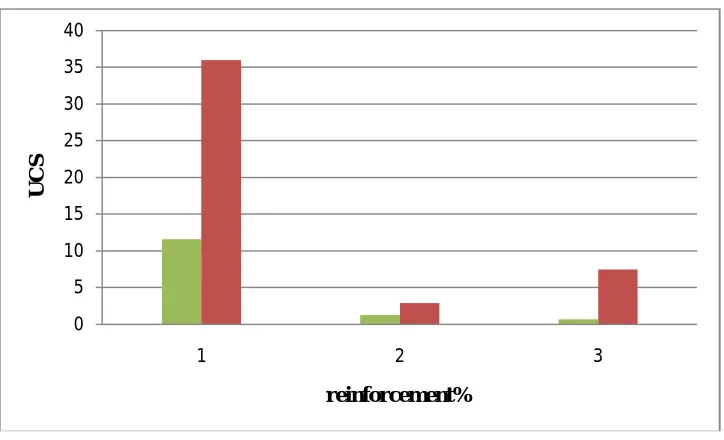
Comparison between soil sample-1 and soil sample-2 for UCS
IV. CONCLUSIONS
On the basis of present experimental study, the following conclusions are drawn:.
1. Based on direct shear test on soil sample1, with fiber reinforcement of 0.05%, 0.15% and 0.25%, the increase in cohesion was found to be 10%, 4.8% and 3.73% respectively (illustrated in figure25). The increase in the internal angle of friction (Ø) was found to be 0.8%, 0.31% and 0. 47% respectively. Since the net increase in the values of c and Ø were observed to be19.6%, from 0.325 kg/cm2 to 0.3887 kg/cm2and 1.59%, from 47.72 to 48.483 degrees respectively, for such a soil, randomly distributed polypropylene fiber reinforcement is not recommended.
2. The results from the UCS test for soil sample1 are also similar, for reinforcements of 0.05%, 0.15% and 0.25%, the increase in unconfined compressive strength from the initial value are 11.68%, 1.26% and 0.62% respectively. This increment is not substantial and applying it for soils similar to soil sample1 is not effective. 3. The shear strength parameters of soil sample2were determined by direct shear test. The increase in the value
of cohesion for fiber reinforcement of 0.05%, 0.15% and 0.25% are 34.7%, 6.09% and 7.07% respectively. Figure illustrates that the increase in the internal angle of friction (Ø) was found to be 0.8%, 0.31% and 0. 47%
respectively. Thus, a net increase in the values of c and φ were observed to be 53%, from 0.3513 kg/cm2to
0.5375 kg/cm2and 15.02%, from 27.82 to 32 degrees. Therefore, the use of polypropylene fiber as reinforcement for soils like soil sample-2 is recommended.
4. On comparing the results from UCS test of soil sample-2, it is found that the values of unconfined compressive strength show a net increment of 49.8% from 0.0692 MPa to 0.1037 MPa. This also supports the previous conclusion that use of polypropylene fibers for reinforcing soils like soil sample-2 is recommended.
0 5 10 15 20 25 30 35 40
1 2 3
U
C
S
5. Overall it can be concluded that fiber reinforced soil can be considered to be good ground improvement technique specially in engineering projects on weak soils where it can act as a substitute to deep/raft foundations, reducing the cost as well as energy.
REFERENCES
1. A. Naeini and S. M. Sadjadi,(2008) ,” Effect of Waste Polymer Materials on Shear Strength of Unsaturated Clays”, EJGE Journal, Vol 13, Bund k,(1-12).
2. Yetimoglu, T., Inanir, M., Inanir, O.E., 2005. A study on bearingcapacity of randomly distributed fiber-reinforced sand fills overlying soft clay. Geotextiles and Geomembranes 23 (2), 174–183.
3. Chaosheng Tang, Bin Shi, Wei Gao, Fengjun Chen, Yi Cai, 2006. Strength and mechanical behavior of short polypropylene fiber reinforced and cement stabilized clayey soil. Geotextiles and Geomembranes 25 (2007) 194–202.
4. Mahmood R. Abdi, Ali Parsapajouh, and Mohammad A. Arjomand,(2008),” Effects of Random Fiber Inclusion on Consolidation, Hydraulic Conductivity, Swelling, Shrinkage Limit and Desiccation Cracking of Clays”, International Journal of Civil Engineering, Vol. 6, No. 4, (284-292).
5. The need for soil stabilization, April 9, 2011 by Ana[online] Available at: <http://www.contracostalandscaping.com/the-need-for-soil stabilization/>
6. Methods of soil stabilization, December 24, 2010 [online] Available at:http://www.engineeringtraining.tpub.com/14070/css/14070_424.htm 7. Ground Improvement Techniques, December 18, 2008 [online] Available at: < http://www.engineeringcivil.com>
8. Das B.M, 1992, Fundamentals of Soil Dynamics, Elsevier
BIOGRAPHY