IJEDR1602174
International Journal of Engineering Development and Research (www.ijedr.org)997
Effect of Hybrid Fibers on The Properties of Class C
and Class F Fly Ash Based Concrete
1
Patel Monalisa Vinodbhai,
2Farhan Vahora
1Student ME Structure, 2Asst. Professor 1Civil Engineering Dept.,
1LJ Institute of Engineering and Technology, Ahmedabad
________________________________________________________________________________________________________ Abstract - The infrastructure needs of our country is increasing day by day and with concrete is a main constituent of construction material in a significant portion of this infra-structural system. It is necessary to enhance its characteristics by means of strength and durability. It is also reasonable to compensate concrete in the form of using waste materials and saves in cost by the use of admixtures such as fly ash, silica fume, etc. as partial replacement of cement. Fiber reinforcement is commonly used to provide toughness and ductility to brittle cementitious matrices. Reinforcement of concrete with a single type of fiber may improve the desired properties to a limited level. A composite is termed as hybrid, if two or more types of fibers are rationally combined to produce a composite that derives benefits from each of the individual fibers and exhibits a synergetic response. The composite matrix that is obtained by combining cement, Fly ash, aggregates and more than one type of fibres is known as “Hybrid Fiber reinforced concrete”. The fiber in the cement fly ash based matrix act s as crack- arresters, which restrict the growth of micro cracks and prevent these from enlarging under load. The experimental work has carried out to study the comparison between hybrid fiber reinforced concrete with class ‘c’ fly ash (20% replacement of cement) and hybrid fiber reinforced concrete with class `F’ fly ash (20% of replacement of cement). A M30 Grade of concrete mixture were designed. This study reports the feasibility of use of steel fibers and palm fibers with class C and class F fly ash content on structural properties such as cube compressive strength, cylinder split tensile strength, and beam flexural strength test.
Index Terms – hybrid fiber, class C flyash, class F flyash, palm fiber, steel fiber
________________________________________________________________________________________________________
I. INTRODUCTION
Concrete is very strong in compression but weak in tension. As a Concrete is a relatively brittle material, when subjected to normal stresses and impact loads. The tensile strength of concrete is less due to widening of micro-cracks existing in concrete subjected to tensile stress. Due to presence of fiber, the micro-cracks are arrested. The introduction of fibers is generally taken as a solution to develop concrete in view of enhancing its flexural and tensile strength.
Fly ash is the fine powder major waste material produced from many thermal power plants. The disposal of fly ash is the one of the major issue for environmentalists as dumping of fly ash as a waste material may cause severe environmental problem.
Therefore, the utilization of fly ash as a low cost mineral admixture in concrete instead of dumping it as a waste material can have great beneficial effects. It can be used particularly in mass concrete applications where main emphasis is to control the thermal expansion due to heat of hydration of cement paste and it also helps in reducing thermal and shrinkage cracking of concrete at early ages. The replacement of cement with fly ash in concrete also helps to conserve energy.
II. MATERIAL SPECIFICATION CEMENT
Cement acts as a binding agent for materials. Cement as applied in Civil Engineering Industry is produced by calcining at high temperature. It is admixture of calcareous, siliceous, aluminous substances and crushing the clinkers to a fine powder. Cement is the most expensive materials in concrete and it is available in different forms. When cement is mixed with water, a chemical reaction takes place as a result of which the cement paste sets and hardens to atone mass. Depending upon the chemical compositions, setting and hardening properties, cement can be broadly divided into following categories.
FINE AGGREGATE
Locally available sand passed through 4.75mm IS sieve is used. The specific gravity of 2.75 and fineness modulus of 3.338 are used as fine aggregate. The loose and compacted bulk density values of sand are 1094and 1162 kg/m3 respectively, the water absorption of 1.538%.
COARSE AGGREGATE
IJEDR1602174
International Journal of Engineering Development and Research (www.ijedr.org)998
WATERWater to be used in the concrete work should have following properties. It should be free from injurious amount of soils.
It should be free from injurious amount of acids, alkalis or other organic or inorganic impurities.
It should be free from iron, vegetable matter or any other type of substances, which are likely to have adverse effect on concrete or reinforcement.
It should be fit for drinking purposes.
FLY ASH
“The finely divided residue that results from the combustion of ground or powdered coal and that is transported by fuel gases from the combustion zone to the particle removal system”
Class C –SiO2+ Al2O3+ Fe2O3≥ 50% Class F –SiO2+ Al2O3+ Fe2O3≥ 70%
STEEL FIBRE
There are numbers of different types of steel fibers with different commercial names. Basically, steel fibers can be categorized into four groups depending on the manufacturing process: cut wire, silt sheet, melt extract, and mill cut. It can also be classified in to its shape various notation were previously used to nominate the specific type of steel fibre but in this dissertation the following notation are use.
III. OBJECTIVE OF WORK
In all, the project is having following overall objective. Reducing the cement content which reduces the costs. Improving workability.
To compare the characteristic strength of Hybrid fiber reinforced concrete with class C fly ash and Hybrid fiber reinforced concrete with class F fly ash.
IV. EXPERIMENTAL WORK MIX DESIGN
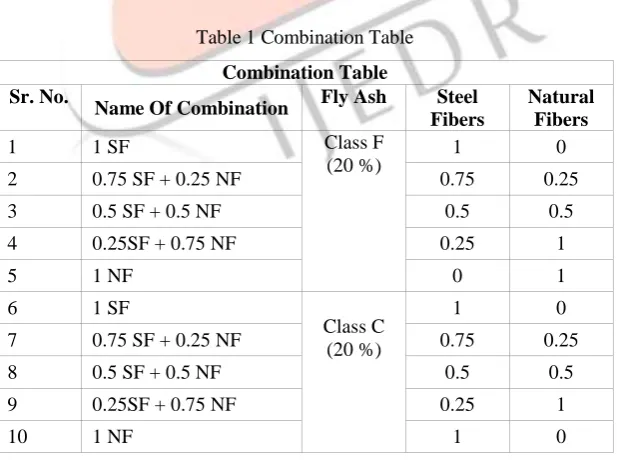
The proportions for normal mix of M25 Normal Mix are 1:1.68:3.34 with water cement ratio of 0.48. In the present study, method for mix design is the Indian Standard Method. The mix design involves the calculation of the amount of cement, fine aggregate and coarse aggregate in addition to other related parameters dependent on the properties of constituent material. The modifications are made and quantities of constituent materials used to cast Hybrid Fiber Reinforced concrete. Finally, complete content and organizational editing before formatting. Please take note of the following items when proofreading spelling and grammar. For purpose of research Total 11 combinations were prepared, listed in below table. Total
Table 1 Combination Table Combination Table Sr. No.
Name Of Combination Fly Ash Steel Fibers
Natural Fibers
1 1 SF Class F
(20 %)
1 0
2 0.75 SF + 0.25 NF 0.75 0.25
3 0.5 SF + 0.5 NF 0.5 0.5
4 0.25SF + 0.75 NF 0.25 1
5 1 NF 0 1
6 1 SF
Class C (20 %)
1 0
7 0.75 SF + 0.25 NF 0.75 0.25
8 0.5 SF + 0.5 NF 0.5 0.5
9 0.25SF + 0.75 NF 0.25 1
10 1 NF 1 0
BATCHING, MIXING AND CASTING
IJEDR1602174
International Journal of Engineering Development and Research (www.ijedr.org)999
category of different percentage of fiber in hybrid composite. Vibration was given to the cube moulds using table vibrator. The top surface of the specimen was leveled and finished. After 24 hours the specimens were demoulded and were transferred to curing tank where in they were allowed to cure for 7 & 28 days. The entire specimen was tested in the Structural Engineering laboratory of L J Institute of Engineering And Technology, Ahmedabad.WORKABILITY TEST
Workability is carried out by conducting the slump test and compaction factor test as per I.S. 1199-1959 on ordinary concrete and fiber reinforced concrete
COMPRESSIVE STRENGTH TEST
The compressive strength of concrete is one of the most important properties of concrete in most structural applications. For compressive strength test, cube specimens of dimensions 150 x 150 x 150 mm were cast for M25 grade of concrete. After curing, these cubes were tested on Compression Testing machine as per I.S. 516- 1959. The failure load was noted. In each category two cubes were tested and their average value is reported. The compressive strength was calculated as follows, Compressive strength (MPa) = Failure load / cross sectional area.
FLEXURAL STRENGTH TEST
For flexural strength test, beam specimens of dimension 150x150x700 mm were cast. The specimens were demoulded after 24 hours of casting and were transferred to curing tank wherein they were allowed to cure for 28 days. These flexural strength specimens were tested under two-point loading as per I.S. 516-1959, over an effective span of 600 mm divided into three equal parts and rest on Flexural testing machine. The load is normally increased & failure load is noted at cracking of beam specimen. In each category, two beams were tested and their average value is reported. The flexural strength was calculated as follows. Flexural strength (MPa) = (P x L) / (b x d2), Where, P = Failure load, L = Centre to centre distance between the support = 600 mm, b = width of Specimen=150 mm, d = depth of specimen= 150 mm.
TENSILE STRENGTH TEST
For tensile strength test, cylinder specimens of dimension 150 mm diameter and 300 mm length were cast. The specimens were demoulded after 24 hours of casting and were transferred to curing tank wherein they were allowed to cure for 28 days. These specimens were tested under compression testing machine. In each category, three cylinders were tested and their average value is r1eported. Tensile strength was calculated as follows as split tensile strength: Tensile strength (MPa) = 2P / π DL, Where, P = failure load, D = diameter of cylinder, L = length of cylinder.
V. EXPERIMENTAL RESULTS
0
Results of Compressive Test, Flexural Strength, Split Tensile Test Slump Test are presented in Bar form.
IJEDR1602174
International Journal of Engineering Development and Research (www.ijedr.org)1000
Split Tensile Strength Comparison between class C and class F flyash of different combinations of Steel and Palm Fibers Slump Test and Compaction factor comparison between different combinations of fibers and replacement of 20% flayash of twodifferent types. CONCLUSIONS
• Based on results we can conclude that workability of concrete with following replacement of fly ash with cement by 20% is increasing.
• With replacement of fly ash class C and F, Natural and steel fiber is replaced in range of 1% with various proportion. Maximum workable concrete obtained with class F fly ash and 0.5 % SF and 0.5% NF.
• Maximum compressive strength is obtained with 1% SF and class F fly ash, while 0.5% SF+0.5%NF gives strength equivalent to normal concrete. Maximum increase in strength is 39% for 28 days’ strength.
• Same replacement gives lower split tensile strength for 28 days compare to normal concrete.
• Also, flexural strength for combination 0.5% SF+0.5% NF with 20% of fly ash class F, is obtained much higher compare to normal concrete.
• It is recommended to use 0.5% SF+0.5%NF with class F fly ash for maximum flexural strength & to use 1% SF with class F fly ash for maximum compressive strength.
• It is not recommended to use any of research combination for split tensile strength.
ACKNOWLEDGMENT
I would like to express my deepest gratitude to Mr. Farhan Vahora (Asst. prof, L.J.I.E.T. Ahmedabad) without his encouragement and guidance this paper would not have materialized.
REFERENCES
[1] Mahyuddin Ramli and Eather Thanoon Dawood, Effects of palm on the mechanical properties of lightweight concrete crushed brick. American Journal of Engineering and Applied sciences 3 (2): 489-493, 2010.
[2] S. Mustafa and O.I. Yaman, Hybrid fiber reinforced self-compacting concrete with a high volume coarse fly ash, Construction Building Materials 21 (2007), pp. 150–156.
[3] A. Sivakumar, Manu santhanam. Mechanical properties of high strength concrete with metallic and non-metallic fibers. Cement Concrete Research 2006; 29:603-608.
[4]. Balaguru, P. (1994). Contribution of fibers to crack reduction of cement composites during the initial and final setting period. ACI Materials Journal. V. 91, No. 3, May-June, 280-288.
[5]. A. M. Neville, Properties of Concrete, 4th edition, 1995.
[6] Eethar Thanon Dawood, Mahyuddin Ramli, Development of high strength flowable mortar with hybrid fibre. Construction and Building Materials 24 (2010) 1043–1050.
[7]. Mohammed Alias Yusof, Norazman Mohamad Nor, Muhamad Fauzi Muhamad Zain,Ng Choy Peng, Ariffin Ismail, Risby Mohd Sohaimi and Ahmad Mujahid Ahmad Zaidi(2011) ‘Mechanical Properties Of Hybrid Steel Fibre Reinforced Concrete With Different Aspect Ratio’ Australian Journal Of Basic And Applied Sciences, Vol.5,No.7,Pp.159-166.
[8]. Muthuswamy, K.R. and Thirugnanam, G.S. (2010), ‘Flexural Behaviour Of High Performance Hybrid Fibre Reinforced Concrete Beams’, Proceedings Of The Seventh Structural Engineering Convention (SEC 2010), Annamalai University, Annamalainagar, Tamil Nadu, India, 08 – 10 December 2010, 1192- 1201.