International Journal of Women’s Health
Dove
press
O r I g I n a l r e s e a r c H
open access to scientific and medical research
Open access Full Text article
Knowledge about cervical cancer screening and
its practice among female health care workers
in southern ethiopia: a cross-sectional study
Dubale Dulla1
Deresse Daka2
negash Wakgari1
1school of nursing and Midwifery, 2Department of Medical science,
college of Medicine and Health sciences, Hawassa University, Hawassa, ethiopia
Background: Cervical cancer remains a major cause of morbidity and mortality among the women in the world. Early screening for cervical cancer is a key intervention in reduction of maternal deaths. Health care workers have a significant contribution to improve cervical cancer screening practice among women. Hence, this study aimed to assess the knowledge and practice of cervical cancer screening among female health care workers in southern Ethiopia.
Methods: Institution-based cross-sectional study was conducted during March and April, 2015. All hospitals in Hawassa city administration and Sidama zone were purposively selected. A simple random sampling technique was used to draw the health centers. After proportional allocations to their respective health facilities, a total of 367 female health workers were selected by simple random sampling technique. A structured and pretested questionnaire was used to collect the data. Data were entered to SPSS version 20.0 for further analysis. Logistic regression analyses were used to see the association of different variables.
Results: Out of the total respondents, 319 (86.9%) had a good level of knowledge on cervi-cal cancer. Similarly, a majority of them, 329 (89.6%), 321 (87.5%), and 295 (80.4%), knew about the risk factors, symptoms, and outcomes of cervical cancer, respectively. More than two thirds of the respondents, 283 (77.1%), knew that there is a procedure used to detect pre-malignant cervical lesions and 138 (37.6%) of them mentioned visual inspection with acetic acid as a screening method. In this study, only 42 (11.4%) of the respondents were screened for cervical cancer (confidence interval [CI]: 8.7, 13.9). Being a physician (adjusted odds ratio [AOR] =0.12, 95% CI: 0.02, 0.79) and working in a cervical cancer screening center (AOR =0.14, 95% CI: 0.03, 0.68) had a lower odds of cervical cancer screening practices.
Conclusions: Significant numbers of health care workers were knowledgeable on cervical cancer. Cervical cancer screening among health care workers in southern Ethiopia was found to be low. Being a physician and working in a screening center had lower odds of cervical cancer screening practice. In spite of having adequate knowledge on cervical cancer the reasons for low practice of cervical cancer screening among health care workers needs to be investigated.
Keywords: cervical cancer, health care workers, southern Ethiopia
Background
Globally, cervical cancer is the third most frequent cancer among women.1 Each year,
an estimated half million new cases are diagnosed with ~275,000 deaths in 2008 alone.2–5 Low-resource countries account for 85% of the cases, yet very little is spent
in preventing and treating cervical cancers.1–3 Similarly, it is the most common and
most lethal cancer among the women of sub-Saharan Africa.6 A considerable
reduc-tion in cervical cancer incidence and deaths has been achieved in developed countries
correspondence: negash Wakgari school of nursing and Midwifery, college of Medicine and Health sciences, Hawassa University, Hawassa, ethiopia email [email protected]
Journal name: International Journal of Women’s Health Article Designation: Original Research
Year: 2017 Volume: 9
Running head verso: Dulla et al
Running head recto: Knowledge about cervical cancer screening DOI: http://dx.doi.org/10.2147/IJWH.S132202
International Journal of Women's Health downloaded from https://www.dovepress.com/ by 118.70.13.36 on 23-Aug-2020
For personal use only.
Number of times this article has been viewed
This article was published in the following Dove Press journal: International Journal of Women’s Health
Dovepress
Dulla et al
with effective strategies for cervical cancer screening and treatment programs.7–9 However, this has not been possible in
most resource-limited countries, mainly because systematic screening is rarely performed.10–13
In Ethiopia, cervical cancer ranks as the most frequent cancer among women and cause for 4,732 deaths annually.1,14–16
Among the general population, ~33.6% of women are esti-mated to harbor cervical human papilloma virus (HPV) infection at a given time.2,16 Despite this fact, very few
health workers receive cervical cancer screening services in Ethiopia.13,17–19 Besides, there is an obvious need among
female health care providers for training about cervical cancer etiology, risk factors, and prevention techniques.13,19
Cervical cancer screening has been consistently shown to be effective in reducing the incidence rate or the occur-rence of new cervical cancer cases and mortality from cervical cancer.2 However, cervical screening attendance
rates are still far from satisfactory in many countries.3–5,13
Perhaps, cervical cancer screening facilities are limited because of poor infrastructure, staff, poor knowledge about cervical cancer, and illiteracy; the uptake of cervical cancer screening is poor among women who live in the places where the screening facilities are available.13,19,20–27
Chal-lenges of cervical cancer screening in developing countries include limited access to health services and laboratories, no screening programs, limited or nonexistent awareness among populations and health workers, and poor referral and follow up.2,13,28–30
Data regarding having a poor attitude toward cervical cancer screening among health care providers were reported in Ethiopia.13,19 Health care workers were anticipated to be
knowledgeable about cervical cancer screening compared to non-health care workers and consequently to persuade cervical cancer screening among women.13,29–35 The primary
screening method adopted by the Government of Ethiopia is the visual inspection with acetic acid applied to the cervix by health care providers. An accurate diagnosis depends on the ability of the provider to visualize the cervix properly and differentiate between cervical lesions.36 Moreover, in order
to advance preventive practice for cervical cancer, health care workers should be knowledgeable and improve their personal conformity with the recommended practice.13,31 For
instance, antenatal care education by health care providers was suggested as a means of improving knowledge and uptake of cervical cancer screening services.30 Hence, this
study aimed to assess the level of knowledge about cervical cancer screening and its practice among female health care workers in southern Ethiopia.
Methods
study setting and population
The study was carried out among female health workers in the Sidama zone from March 15 to April 15, 2015. Sidama zone is the largest zone in the state covering 6,972.1 square kilometers with a total population of 3,019,442. The zone has 21 woreda (districts). The capital of the zone, Hawassa city, is located 275 kilometers to the south of Addis Ababa (capital of the country) and it is the regional capital of the state. In the zone, there are four governmental hospitals and 107 public health centers. Hawassa city administration, the capital city of the state, and Sidama zone contain two hospitals and nine health centers. The numbers of health professionals working in the public health facilities in the state are 228 medical doctors (general practitioners and specialists), 1,280 midwives, 1,331 health officers, 8,756 nurses, and 8,051 health extension workers. All female health workers comprising doctors, nurses, midwives, pharmacy technicians, pharmacists, and medical labora-tory technicians and technologists, aged between 15 and 65 years, and employed in the Sidama zone were considered as the source population, while those who were employed in the selected health institution were considered as the study population.
study design
An institution-based cross-sectional study design was con-ducted to assess the level of knowledge about cervical cancer screening and its practice among female health care workers in southern Ethiopia.
sample size and sampling procedure
The sample size was calculated using single population proportion formula, n = (z(α/2))2 p (1-p)/d2, by considering the
following assumptions: n = sample size, z = standard normal deviate set at 1.96 (for 95% confidence level), d = desired degree of accuracy (0.05), and p = proportion of cervical cancer screening practice =34.6% from previous study.32
Hence, the total sample size with 10% nonresponse rate became 382.
A simple random sampling technique was employed to select ten health centers among 116 public health centers in the Sidama zone and Hawassa city administration. All hospitals in the Sidama zone and Hawassa city adminis-tration were purposively included in the study. The total numbers of female health care workers in each group of professions (namely doctors, nurses, midwives, pharmacists and pharmacy technicians, medical laboratory technologists,
International Journal of Women's Health downloaded from https://www.dovepress.com/ by 118.70.13.36 on 23-Aug-2020
Dovepress Knowledge about cervical cancer screening
and technicians) in these 16 health institutions during the study period was 1,342 (data obtained from each institution by principal investigator via preliminary survey). Then, the sample was allocated to the selected health institutions proportional to the number of female health workers in the respective health institutions. Finally, a simple random sampling technique was used to select a total of 382 female health care workers.
Data collection instruments
A pretested and structured self-administered question-naire was used for data collection. The collected data were checked for completeness and consistency by the investigator and supervisor. Different relevant literature was reviewed to develop the tool that addresses the objective of the study.2,5,11–13,22–39 The instrument was pretested on 40 study
participants who were working in other health facilities that were not part of the actual study. Findings from the pretest were used to modify the instrument in terms of clarifying the questions. The questionnaire was designed to obtain information on the sociodemographic, reproductive, and professional characteristics of the respondents, knowledge about cervical cancer, and health workers’ cervical cancer screening history. Knowledge about cervical cancer was measured by using 12 knowledge questions about risk factors, symptoms, treatments, and outcomes of cervical cancer. To produce a more objective assessment of knowledge about cervical cancer, a scoring method was devised and a knowl-edge score for each participant was obtained by summing up the score for correct responses given to the selected ques-tions in the questionnaire. A score of mean value or above ($6) to these questions was considered as a good level of knowledge, otherwise lower scores were taken as poor level of knowledge. Five BSc nurses facilitated the data collection process. They were given 1 day training before the actual work, about the aim of the study, procedures, and data col-lection techniques.
Data processing and analysis
The collected questionnaire was checked manually for its completeness, coded, and entered into Epi-Info version 3.5.4 statistical package, then exported to SPSS version 20.0 for further analysis. Descriptive and summary statistics were done. Both bivariate and multivariate logistic regression analyses were used to determine the association of each independent variable with the dependent variable. Variables significant in bivariate analysis (P-value #0.2) were entered into a multivariate logistic regression model to adjust the
effects of confounders on the outcome variable. Odds ratios with their 95% confidence intervals (CIs) were computed to identify the presence and strength of association, and statistical significance was declared if P,0.05.
Results
sociodemographic characteristics of
the respondents
A total of 367 health care workers were included in the study with a response rate of 96.1%. The mean age of the respondents was 28.2 years (standard deviation =6.4). Regarding ethnicity, 118 (32.2%) of them were Sidama and more than half, 196 (53.3%), of them were protestant religion followers. One hundred eighty-one (49.3%) of them were married. Nearly two thirds, 225 (61.3%) and 237 (64.6%), of them were nurses by profession and work-ing in the hospital, respectively. Two hundred fifty-seven (70%) and 304 (82.8%) of the respondents had a diploma and working experience of 1–5 years, respectively. One hundred seventy-one (46.6%) of the partners were govern-ment employed and only 78 (21.3%) of them had a BSc. The majority, 266 (72.5%), of the respondents had an income of more than 2,000 birr (Table 1).
reproductive health history of the
respondents
The mean and minimum age at first menstruation of the respondents was 14.2 and 9 years, respectively. Similarly, the mean and minimum age at first sexual intercourse was 19.1 and 12 years, respectively. More than half, 196 (53.4%), of them had first sexual contact at age of 19 years and above. About half, 180 (49%), of the study participants were nulliparous woman. Regarding their circumcision status, the majority of the respondents, 271 (73.8%), and most of their partners, 337 (91.8%), were circumcised. All respondents who participated in the study had never smoked cigarettes. The majority, 317 (86.4%), of them did not have multiple sexual partners. In addition, 73 (19.9%) of the respondents had used combined oral contraceptive pills (Table 2).
Knowledge about cervical cancer
Three hundred nineteen (86.9%) health workers had a good level of knowledge on cervical cancer. Most of the respondents, 341 (92.9%), had heard about cervical cancer. Regarding the source of information about cervical cancer, 232 (63.2%) had heard from school/college, 107 (29.2%) from news/media, 80 (21.8%) from friends/colleagues,
International Journal of Women's Health downloaded from https://www.dovepress.com/ by 118.70.13.36 on 23-Aug-2020
Dovepress
Dulla et al
and 40 (10.9%) from brochures/posters, while six (1.6%) of them had heard from a religious institution. Most of the respondents, 353 (96.2%), knew that cervical cancer was not communicable. Similarly, 299 (81.5%) and 140 (38.1%) of them knew that cervical cancer was preventable and were aware of its prevention methods, respectively. More than half, 207 (56.4%), of them knew that avoiding multiple sexual partners prevents cervical cancer. In addition, 223 (60.8%) and 133 (36.2%) of them knew that early screen-ing and vaccination for HPV could prevent cervical cancer, while 291 (79.3%) and 271 (73.8%) of them stated using holy water and praying to god as the prevention methods. A significant number of the respondents, 296 (80.7%), knew that cervical cancer was curable at an early stage. Likewise, a majority of the respondents, 329 (89.6%), 321 (87.5%), and 295 (80.4%), knew about the risk factors, symptoms, and outcomes of cervical cancer, respectively. Among the listed outcomes of untreated cervical cancer, 287 (78.2%) were death, 188 (51.2%) bleeding, and 185 (50.4%) chronic illness, while 210 (57.2%) of the respondents knew about cervical cancer treatments.
Knowledge about cervical cancer
screening and its practice
More than two thirds of the respondents, 283 (77.1%), knew that there was a procedure used to detect premalignant
Table 1 sociodemographic characteristics of respondents, sidama zone, southern ethiopia, 2016 (n=367)
Variables Frequency Percentage
Age in years
18–24 104 28.3
25 and more 263 71.7
Ethnicity
sidama 118 32.2
amhara 84 22.9
Oromo 71 19.3
gurage 44 12
Wolaita 27 7.4
Others* 23 6.2
Religion
Protestant 196 53.3
Orthodox 154 42
Muslim 12 3.3
catholic 5 1.4
Marital status
single 154 42
Married 181 49.3
cohabitation 6 1.6
separated 13 3.5
Divorced 8 2.2
Widowed 5 1.4
Health facilities
Health center 130 35.4
Hospital 237 64.6
Profession
nurse 215 58.6
Midwife 68 18.5
laboratory 36 9.8
Pharmacy 20 5.4
Physician 18 4.9
Health officer 10 2.8
Qualification level
Diploma 257 70
Bsc 102 27.8
Msc and above 8 2.2
Experience (years)
1–5 304 82.8
6–10 44 12
11 or more 19 5.2
Partner’s occupation
government employed 171 46.6
self-employed 11 3.0
Partner’s education level
Unable to write and read 3 0.8
elementary (1–8) 2 0.5
Junior (9–12) 4 1.1
Diploma 47 12.8
Bsc 78 21.3
Masters and above 50 13.6
Income
,1,000 birr 9 2.5
1,000–2,000 birr 92 25.0
.2,000 birr 266 72.5
Note: *Kambata, Hadiya, Tigre.
Table 2 reproductive health history of the respondents, sidama zone, southern ethiopia, 2016 (n=367)
Variables Frequency Percentage
Age at first sexual contact (years)
12–18 171 46.6
19 and more 196 53.4
Circumcision status
circumcised 271 73.8
not circumcised 96 26.2
Partner circumcision status
circumcised 337 91.8
not circumcised 30 8.2
Cigarette smoking
Yes 367 100
no 0 0
Multiple sexual partners
Yes 50 13.6
no 317 86.4
Ever used contraceptive methods
Yes 203 55.3
no 164 44.7
Contraceptive methods ever used
combined oral contraceptive 73 19.9
Injectable 63 17.2
Implants 46 12.5
Intrauterine devices 18 4.9
Progesterone-only pills 3 0.8
International Journal of Women's Health downloaded from https://www.dovepress.com/ by 118.70.13.36 on 23-Aug-2020
Dovepress Knowledge about cervical cancer screening
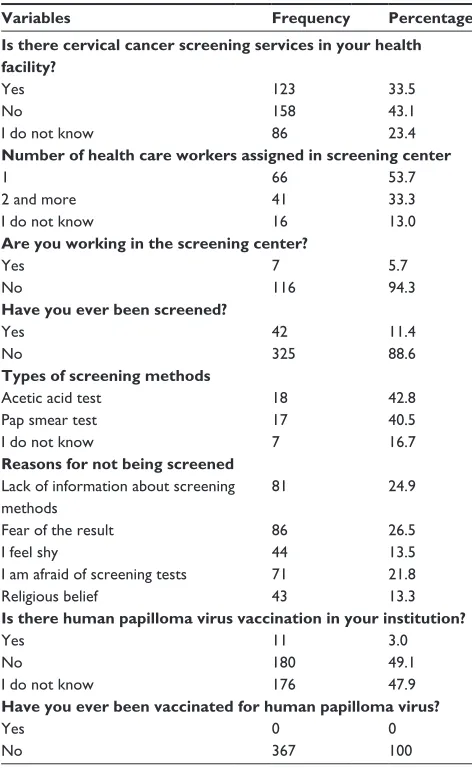
cervical lesions. One hundred thirty-eight (37.6%) of them mentioned visual inspection with acetic acid as a screening method. Similarly, 113 (30.8%) of them mentioned pap smear as a screening method. More than half, 196 (53.4%), of the respondents said that women aged between 36 and 60 years were more likely to be affected by cervical cancer than others. In addition, 63 (17.2%), 17 (4.6%), 16 (4.4%), and 17 (4.6%) of them said that women aged between 26 and 35, 19 and 25, 15 and 18, and .60 years were more likely to be affected by cervical cancer than others. However, 58 (15.8%) of them did not know which age group was more likely to be affected. Regarding the eligibility criteria for cervical cancer screening, 247 (67.3%) of the respondents said that all women aged .21 years should be screened, while 161 (43.9%) of them said that commercial sex workers should be screened. Two hundred twenty-five (61.3%) of them stated that all older women should be screened. A majority of the respondents, 306 (83.4%), knew that the cervical cancer screening test was used to check the health of the cells of the cervix. Regarding the cervical cancer screening services, 158 (43.1%) of the respondents stated that there was no cervical cancer screening test in their institution. A majority of the health care workers, 325 (88.6%), were not screened for cervical cancer. Among those who were screened for cervical cancer, acetic acid test accounted for 18 (42.8%). The result of the screening was negative among all screened respondents. Among reasons for not having screened for cer-vical cancer, fear of the result and lack of information about cervical cancer screening constituted a significant percentage. One hundred eighty (49.1%) of the respondents stated that no vaccination for HPV was available in their institution, and all study respondents were not vaccinated (Table 3).
Factors associated with cervical cancer
screening
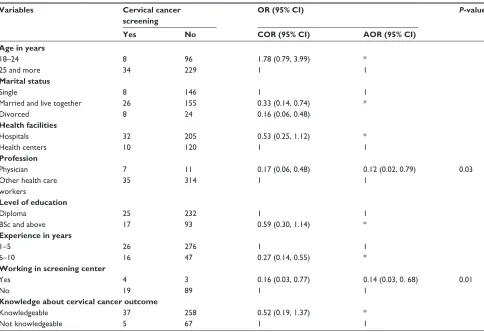
In bivariate analysis the factors found to be significantly associated with cervical cancer screening practices were marital status, age, profession, experience, level of education, knowledge about cervical cancer outcome, type of health institution, and working in cervical cancer screening centers. However, in multiple logistic regression analysis, type of profession and working in cervical cancer screening center were significantly associated with cervical cancer screening practices. Those who were physicians were 88% less likely to be screened for cervical cancer than other health care workers (adjusted odds ratio [AOR] =0.12, 95% CI: 0.02, 0.79). Similarly, those who were working in cervical cancer screening centers were 86% less likely to be screened for
cervical cancer than their counterparts (AOR =0.14, 95% CI: 0.03, 0.68; Table 4).
Discussion
In this study, 319 (86.9%) of the health workers had a good level of knowledge on cervical cancer (CI: 83.9, 89.6). This finding is in line with the study carried out in eastern India (88.8%).35 However, the current finding is lower than that of
the study conducted in Sokoto, Nigeria (98.6%),22 and higher
than that of the studies conducted in Turkey (63.9%),37 rural
India (26.7%),38 Cotedivoire (55.7%),26 Tanzania (46%),24
and South Nigeria (90.5%).39 These differences might be
due to differences in types of health care workers involved in the study, and place and time of the study, which might be explained by the difference in the level of knowledge about cervical cancer. For instance, in the study conducted in Turkey and rural India, only nurses, and in the study of
Table 3 cervical cancer screening services among health care workers, sidama zone, southern ethiopia, 2016 (n=367)
Variables Frequency Percentage
Is there cervical cancer screening services in your health facility?
Yes 123 33.5
no 158 43.1
I do not know 86 23.4
Number of health care workers assigned in screening center
1 66 53.7
2 and more 41 33.3
I do not know 16 13.0
Are you working in the screening center?
Yes 7 5.7
no 116 94.3
Have you ever been screened?
Yes 42 11.4
no 325 88.6
Types of screening methods
acetic acid test 18 42.8
Pap smear test 17 40.5
I do not know 7 16.7
Reasons for not being screened lack of information about screening methods
81 24.9
Fear of the result 86 26.5
I feel shy 44 13.5
I am afraid of screening tests 71 21.8
religious belief 43 13.3
Is there human papilloma virus vaccination in your institution?
Yes 11 3.0
no 180 49.1
I do not know 176 47.9
Have you ever been vaccinated for human papilloma virus?
Yes 0 0
no 367 100
International Journal of Women's Health downloaded from https://www.dovepress.com/ by 118.70.13.36 on 23-Aug-2020
Dovepress
Dulla et al
Cotedivoire, only midwives and health care workers were involved in the study, while different health care workers were involved in our study.
The finding of this study reported that only 42 (11.4%) of the respondents were screened for cervical cancer (CI: 8.7, 13.9). This finding is consistent with the finding of the studies in eastern India (11.6%),35 Korea (13%),25
and Ethiopia (10.7%).13 The current finding is higher than
that of the finding in Haiti (4%),40 rural India (7%),38 and
Ibadan, Nigeria (6.8%);3 however, it is lower than that of the
study carried out among staff nurses in teaching hospitals of India (20%),33 Cotedivoire (18.4%),26 Tanzania (15.4%),24
South Nigeria (27.8%),39 Maiduguri, Nigeria (23.3%),12 and
Baghdad city (18.8%).28 A possible reason for this difference
might be difference in sociodemographic characteristics of the respondents, which could be explained by the different levels of knowledge and attitude toward cervical cancer screening practices among the respondents. Similarly, time and place of the study is also another possible explanation for this difference.
In the present study, type of health profession was significantly associated with cervical cancer screen-ing. Those who were physicians were less likely to be screened for cervical cancer than other health care work-ers. This might be due to the fact that most physicians who participated in this study were general practitioners with less working experience relative to other health sciences. Consequently, probability to be screened for cervical cancer might be more likely for those who had more working experience. In addition, working in a screen-ing center was also significantly associated with cervical cancer screening. Those who were working in a screening center were less likely to be screened for cervical cancer than their counterparts. In the context of Ethiopia, cervi-cal cancer screening was often performed by physicians. Consequently, those physicians might have felt shy to be screened by their friends, and fear of a positive result could also be possible. Moreover, a belief about self-care, as well as being negligent, and fear of pain would be additional explanations. Likewise, lack of trust and confidence could
Table 4 Bivariate and multivariate analyses of factors associated with cervical cancer screening practices among health care workers, southern ethiopia, 2016 (n=367)
Variables Cervical cancer screening
OR (95% CI) P-value
Yes No COR (95% CI) AOR (95% CI)
Age in years
18–24 8 96 1.78 (0.79, 3.99) *
25 and more 34 229 1 1
Marital status
single 8 146 1 1
Married and live together 26 155 0.33 (0.14, 0.74) *
Divorced 8 24 0.16 (0.06, 0.48)
Health facilities
Hospitals 32 205 0.53 (0.25, 1.12) *
Health centers 10 120 1 1
Profession
Physician 7 11 0.17 (0.06, 0.48) 0.12 (0.02, 0.79) 0.03
Other health care workers
35 314 1 1
Level of education
Diploma 25 232 1 1
Bsc and above 17 93 0.59 (0.30, 1.14) *
Experience in years
1–5 26 276 1 1
6–10 16 47 0.27 (0.14, 0.55) *
Working in screening center
Yes 4 3 0.16 (0.03, 0.77) 0.14 (0.03, 0. 68) 0.01
no 19 89 1 1
Knowledge about cervical cancer outcome
Knowledgeable 37 258 0.52 (0.19, 1.37) *
not knowledgeable 5 67 1 1
Note: *Not significant in multivariate logistic regression.
Abbreviations: AOR, adjusted odds ratio; COR, crude odds ratio; CI, confidence interval; OR, odds ratio.
International Journal of Women's Health downloaded from https://www.dovepress.com/ by 118.70.13.36 on 23-Aug-2020
Dovepress Knowledge about cervical cancer screening
also be another possible reason, where these providers may partially know the service providers.
As a cross-sectional study requires respondents to remember information retrospectively, recall and social desirability bias are the potential limitations of this study. However, numerous scientific procedures have been employed to minimize the possible effects. To reduce the social desirability bias, for instance, the details about the aim of the study were shared with the respondents. In addi-tion, procedures such as supervision and pretest of the data collection tool were utilized.
Conclusions
A significant number of health care workers were knowledge-able on cervical cancer. Cervical cancer screening among health care workers in southern Ethiopia was found to be low. Being a physician and working in a screening center had lower odds of cervical cancer screening practice. Hence, in spite of having adequate knowledge on cervical cancer, the reasons for the low practice of cervical cancer screening among health care workers needs to be investigated.
Declarations
ethics approval and consent to
participate
Ethical approval was obtained from the Hawassa University Institutional Review Board Committee. A permission letter was granted from the Southern Nation, Nationality and People Regional Health Bureau to respective health institu-tions. Written consent was obtained from each participant prior to data collection. After informing each respondent about the aim and purpose of the study, participants were asked for their voluntary participation. Those respondents were assured they could withdraw from the study anytime if they felt unhappy. They were also informed that all data obtained from them would be kept confidential by using codes instead of any personal identifiers.
Acknowledgments
We are grateful to the Hawassa University for technical and financial support. We would also like to thank the Sidama zonal health department for their guidance and support during the data collection process.
All data and materials in this manuscript could be deposited in publicly available repositories.
Author contributions
All authors contributed toward data analysis, drafting and critically revising the paper and agree to be accountable for all aspects of the work.
Disclosure
The authors report no conflicts of interest in this work.
References
1. ICO Information Centre on HPV and Cancer, HPV Information Center. Human Papilloma virus and related diseases report. Worldwide; 2016.
2. Jemal A, Bray F, Forman D, et al. Cancer burden in Africa and
oppor-tunities for prevention. Cancer. 2012;118(18):4372–4384.
3. Ayinde OA, Omigbodun AO. Knowledge, attitude and practices related to prevention of cancer of the cervix among female health workers in Ibadan. J Obstet Gynaecol. 2003;23(1):59–62.
4. Arbyn M, Castellsague X, de Sanjosé S, et al. Worldwide burden of cervical cancer in 2008. Ann Oncol. 2011;22(12):2675–2686. 5. Obeidat BR, Amarin ZO, Alzagahal L. Awareness, practice and
atti-tude to cervical papanicolaou smear among female health care work-ers in Jordan. Eur J Cancer Care (Engl). 2012;21(3):372–376. 6. Iliyasu Z, Anubakar IS, Aliyu MH, Galadananci HS. Cervical cancer
risk perception and predictors of human papillioma virus vaccine acceptance among female university students in northern Nigeria.
J Obstet Gynecol. 2010;30(8):817–862.
7. Roland KB, Soman A, Benard VB, Saraiya M. Human Papilloma virus and popaniicoloaou tests screening interval recommendations in the United States. Am J Obstet Gynecol. 2011;205(5):447.e1–e8. 8. Quinn M, Babb P, Jones J, Allen E. Effect of screening on incidence
of and mortality from cancer of cervix in England: evaluation based on routinely collected statistics. BMJ. 1999;318(7188):904–908. 9. Willoughby BJ, Faulkner K, Stamp EC, Whitaker CJ. A descriptive
study of the decline in cervical screening coverage rates in the North East and Yorkshire and the Humber regions of the UK from 1995 to 2005. J Public Health (Oxf). 2006;28(4):355–360.
10. Franco EL. Persistent HPV infection and cervical cancer risk: is the scientific rationale for changing the screening paradigm enough? JNCI
J Natl Cancer Inst. 2010;102(19):1451–1453.
11. Lataifeh Z, Amari N, Khader Y. A Survey of knowledge and attitude of Jordanian obstetricians and gynecologists to cervical cancer screening.
Eur J Cancer Care. 2009;29(8):757–760.
12. Audu BM, EL-Nafaty AU, Khalil M, Otubu JA. Knowledge and attitude to cervical cancer screening among women in Maiduguri, Nigeria.
J Obstent Gynacol. 1999;19(3):295–297.
13. Gebreegziabher M, Asefa NG, Berhe S. Factors Affecting the Practices of Cervical Cancer Screening among Female Nurses at Public Health Institutions in Mekelle Town, Northern Ethiopia, 2014: a Cross-Sectional Study. J Cancer Res. 2016;(2016):7.
14. Bekele A, Baay M, Mekonnen Z, Suleman S, Chatterjee S. Human papillomavirus type distribution among women with cervical pathology – a study over 4 years at Jimma Hospital, southwest Ethiopia.
Trop Med Int Health. 2010;15(8):890–893.
15. Abate SA. Trends of cervical cancer in Ethiopia. Cervical Cancer. 2015;1(1):1–4.
16. Human papilloma virus and related cancers, summary report update. Available from: http://screening.iarc.fr/doc/Human%20Papilloma-virus%20and%20Related%20Cancers.pdf. Accessed September 23, 2010.
17. WHO, ICO: Human papilloma virus and related cancers in Ethiopia.
In Summary report; 2009.
18. Waktola EA, Mihret W, Bekele L. HPV and burden of cervical cancer in East Africa. Gynecol Oncol. 2005;99(3 Suppl 1):201–202.
International Journal of Women's Health downloaded from https://www.dovepress.com/ by 118.70.13.36 on 23-Aug-2020
International Journal of Women’s Health
Publish your work in this journal
Submit your manuscript here: http://www.dovepress.com/international-journal-of-womens-health-journal The International Journal of Women’s Health is an international,
peer-reviewed open-access journal publishing original research, reports, editorials, reviews and commentaries on all aspects of women’s healthcare including gynecology, obstetrics, and breast cancer. The manuscript management system is completely online and includes
a very quick and fair peer-review system, which is all easy to use. Visit http://www.dovepress.com/testimonials.php to read real quotes from published authors.
Dovepress
Dove
press
Dulla et al
19. Kress CM, Sharling L, Owen-smith AA, Desalegn D, Blumberg HM,
Goedken J. Knowledge, attitudes, and practices regarding cervical cancer and screening among Ethiopian health care workers. Int J
Womens Health. 2015;7:765–772.
20. Gakidou E, Nordhagen S, Obermeyer Z. Coverage of cervical cancer screening in 57 countries: low average levels and large inequalities.
PLoS Med. 2008;5(6):e132.
21. Jemal A, Bray F, Center MM, Ferlay J, Ward E, Forman D. Global cancer statistics. CA Cancer J Clin. 2011;61(2):69–90.
22. Oche MO, Kaoje AU, Gana G, Ango JT. Cancer of the cervix and cervical screening: current knowledge, attitude and practices of female health workers in Sokoto, Nigeria. Int J Med Med Sci. 2013;5(4): 184–190.
23. McCarey C, Pirek D, Tebeu PM, Boulvain M, Doh AS, Petignat P. Awareness of HPV and cervical cancer prevention among Cameroonian health care workers. BMC Womens Health. 2011;11:45.
24. Urasa M, Darj E. Knowledge of cervical cancer and screening practices of nurses at a regional hospital in Tanzania. Afr Health Sci. 2011; 11(1):48–57.
25. Tran NT, Taylor R, Choe SI, Pyo HS, Kim OS, So HC. Knowledge, Attitude and Practice (KAP) Concerning Cervical Cancer and Screening among Rural and Urban Female Healthcare Practitioners in the Demo-cratic People’s Republic of Korea. Asian Pac J Cancer Prev. 2011; 12(11):3023–3028.
26. Tchounga BK, Jaquet A, Coffie PA, et al. Cervical cancer prevention in reproductive health services: knowledge, attitudes and practices of midwives in Côte d’Ivoire, West Africa. BMC Health Serv Res. 2014; 14:165.
27. Savas HG, Taskin L. Determining nurse-midwives’ knowledge of the Pap-smear test and their rate of being tested in Turkey. Asian Pac J
Cancer Prev. 2011;12(5):1353–1360.
28. Rashied AM, Abbas IM. Barriers for up taking the Pap smear among nurse – midwives in Baghdad City Hospitals. Kufa J Nurs Sci. 2014; 4(3):1–12.
29. Ben-Natan M, Adir O. Screening for cervical cancer among Israeli lesbian women. Int Nurs Review. 2009;56(4):433–441.
30. Hyacinth HI, Adekeye OA, Ibeh JN, Osoba T. Cervical cancer and Pap smear awareness and utilization of Pap smear test among fed-eral civil servants in North Central Nigeria. PLoS One. 2012;7(10): e46583.
31. Antic LG, Djikanovic BS, Antic DZ, Aleksopulos HG, Trajkovic GZ. Differences in the level of knowledge on cervical cancer among health care students, midwives and patients in Serbia. Asian Pac J Cancer Prev. 2014;15(7):3011–3015.
32. Terefe Y, Gaym A. Knowledge, attitude and practice of screening for carcinoma of the cervix among reproductive health clients at three teaching hospitals, Addis Ababa, Ethiopia. Ethiopian J Reproductive
Health. 2008;2(1).
33. Goyal A, Vaishnav G, Shrivastava A, Verma R, Modi A. Knowledge, attitude and practices about cervical cancer and screening among nursing staff in a teaching hospital. Int J Med Sci Public Health. 2013; 2(2):249–253.
34. Amarin ZO, Badria LF, Obeidat BR. Attitudes and beliefs about cervi-cal smear testing in ever-married Jordanian women. Eastern Mediterr
Health J. 2008;14(2):389–397.
35. Thippeveeranna C, Mohan SS, Singh LR, Singh NN. Knowledge, attitude and practice of the Pap smear as a screening procedure among nurses in a tertiary hospital in north eastern India. Asian Pac J Cancer
Prev. 2013;14(2):849–852.
36. Olateju A. An Innovative Approach To Screening for Cervical Cancer in Ethiopia, 2017. Available from: http://pinkribbonredribbon. org/an-innovative-approach-to-screening-for-cervical-cancer-in-ethiopia/. Accessed March 9, 2017.
37. Ertem G. Awareness of cervical cancer risk factors and screening behavior among Nurses in a rural region of Turkey. Asian Pac J Cancer
Prev. 2009;10(5):735–738.
38. Shekhar S, Sharma C, Thakur S, Raina N. Cervical cancer screening: knowledge, attitude and practices among nursing staff in a tertiary level teaching institution of ural India. Asian Pac J Cancer Prev. 2013; 14(6):3641–3645.
39. Ekine AA, West OL, Gani O. Awareness of female health workers and non health workers on cervical cancer and cervical cancer screen-ing: south – south, Nigeria. Int J Med Sci Clin Inventions. 2015;2(2): 713–725.
40. Zahedi L, Sizemore E, Malcolm S, Grossniklaus E, Nwosu O. Knowl-edge, attitudes and practices regarding cervical cancer and screening among haitian health care workers. Int J Environ Res Public Health. 2014; 11(11):11541–11552.
International Journal of Women's Health downloaded from https://www.dovepress.com/ by 118.70.13.36 on 23-Aug-2020