R E S E A R C H
Open Access
A simple block diagonal precoding for multi-user
MIMO broadcast channels
Md Hashem Ali Khan, K M Cho, Moon Ho Lee
*and Jin-Gyun Chung
Abstract
The block diagonalization (BD) is a linear precoding technique for multi-user multi-input multi-output (MIMO) broadcast channels, which is able to completely eliminate the multi-user interference (MUI), but it is not computationally efficient. In this paper, we propose the block diagonal Jacket matrix decomposition, which is able not only to extend the conventional block diagonal channel decomposition but also to achieve the MIMO broadcast channel capacity. We also prove that the QR algorithm achieves the same sum rate as that of the conventional BD scheme. The complexity analysis shows that our proposal is more efficient than the conventional BD method in terms of the number of the required computation.
Keywords:Multi-user MIMO; Broadcast channel; Precoding; Block diagonalization; QR decomposition; Eigenvalue decomposition; Diagonal Jacket matrix
1 Introduction
Recently, the research of the capacity region of the multi-user multi-input multi-output (MIMO) broadcast channels (BC) has been of concern. It is well known that any algorithm requiring the eigenvalue decomposition (EVD) suffers from the high computational cost. In mo-bile wireless communication systems, in which MIMO technique is utilized, the channel characteristics may vary faster than the computation process of the precod-ing/decoding algorithm that is based on the EVD of the channel matrix that is changing instantaneously.
In [1], the authors proposed the MIMO channel pre-coding/decoding based on the Jacket matrix decompos-ition where we believe that the required computational complexity in obtaining diagonal-similar matrices is smaller than that required in the conventional EVD.
Definition 1LetJN≜{ai,j} be aN×Nmatrix; then, it is
called a Jacket matrix when J−1
N ¼N1 ai;j −1
n oT
, that is,
the inverse of the Jacket matrix can be determined by its element-wise inverse [2-3].
Definition 2LetAbe ann×nmatrix. If there exists a Jacket matrix J such that A=J ∑ J−,1where Σ is a diag-onal matrix, then we say thatAis a Jacket matrix similar
to the diagonal matrix ∑. Moreover, we say that A is a
Jacket diagonalizable [4].
Theorem 1A 4 × 4 matrixJ is a Jacket matrix similar to the diagonal matrix if and only ifJ has the following form:
J4¼
A ½ 2 ½ B2
C ½ 2 ½ A2
ð1Þ
i.e., the entries of the main diagonal of a matrix are equal. ProofRefer to [4] for the proof.
Multi-user diversity can significantly improve the per-formance of multiple antenna systems. The simplest ways to achieve the diversity gain in MIMO downlink commu-nications are the zero forcing (ZF)-based linear precoding approaches. In [5,6], it was shown that the maximum sum rate in the multi-user MIMO broadcast channels can be achieved by dirty paper coding (DPC). However, the high computational complexity of the DPC makes it difficult to implement in practical systems. A suboptimal strategy of the DPC [7], the Tomlinson-Harashima precoding (THP) algorithm which is based on nonlinear modulo operations, is still impractical due to its high complexity.
In linear processing systems, several practical precoding techniques have been proposed, typically as the channel inversion method [8,9] and the block diagonalization (BD) method [10]. The ZF channel inversion scheme [8] can suppress co-channel interference (CCI) completely for the case where all users employ a single antenna. However, its performance is degraded due to the effect of noise en-hancement. Although the minimum mean-squared error (MMSE) channel inversion method [8] overcomes the * Correspondence:[email protected]
Division of Electronics and Information Engineering, Chonbuk National University, Jeonju 561-756, Republic of Korea
drawback of the ZF, it is still confined to a single-receive antenna case. In the scenario where multiple antennas are located at both the mobile terminal and base station for each user, low-complexity BD methods have been pro-posed [8,11-13]. Moreover, the BD attempts to completely eliminate the multi-user interference (MUI) irrespective of the noise. The BD precoding has been proposed in [10] to improve the sum rate or reduce the transmitted power. A BD precoding algorithm has focused on how to imple-ment the BD precoding algorithms with less computa-tional complexity without the performance degradation. A low-complexity generalized ZF channel inversion (GZI) method has been proposed in [9] to equivalently imple-ment the first singular value decomposition (SVD) oper-ation of the original BD precoding, and a generalized MMSE channel inversion (GMI) method is also developed in [9] for the original regularized BD (RBD) precoding. Therefore, the performance of the BD scheme is poor at the low SNR regime, while preserving its good perform-ance at high SNR. With the purpose of improving the per-formance of the BD, an RBD scheme [14] is proposed. The QR/SVD techniques require only low complexity to equivalently implement the BD precoding algorithms. As an improvement of the BD precoding algorithms, a low-complexity lattice reduction-aided RBD (LC-RBD-LR)-type precoding algorithm has been proposed in [11,12] based on the QR decomposition scheme. However, the complexity of the RBD is too high, which is difficult to be implemented in practice. Owing to the SVD in the algo-rithm, the BD is not computationally efficient.
In this paper, we propose QR-based BD and Jacket matrix methods. We consider the channel matrix de-composition based on QR and Jacket matrices for the case where each user has multiple antennas. By using the QR decomposition to find the orthogonal complement,
the complexity of the SVD-BD can be reduced. As a new approach of the conventional BD scheme, the QR shows a significant improvement in computational complexity. In addition, we prove that the proposed QR algorithm has the same sum rate as the conventional BD scheme. We also discuss the block diagonal Jacket matrix decompos-ition because Jacket matrices are element-wise inverse matrices. Thus, we can calculate their complexity easily.
The rest of this paper is organized as follows. In Section 2, we describe the system model. In Section 3, we discuss the BD method. In Section 4, we analyze the block diagonal Jacket decomposition of an equivalent channel matrix. In Section 5, we perform the complexity analysis. Finally, we draw meaningful conclusions in Section 6.
2 System model
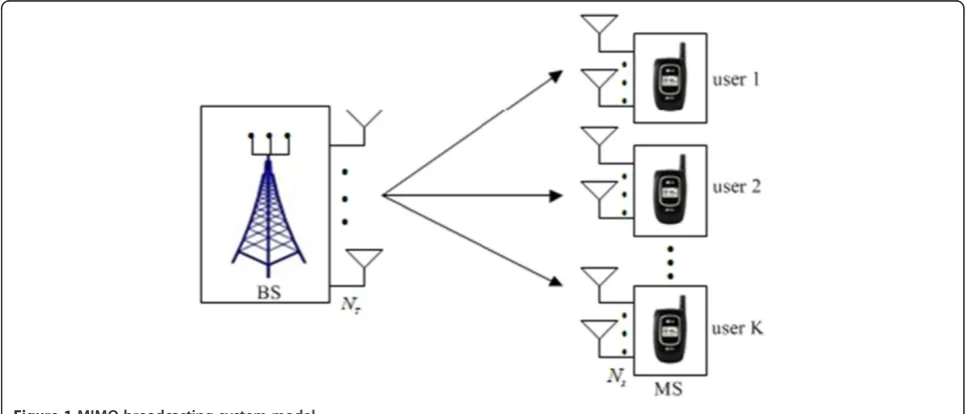
We consider the downlink MIMO broadcast channel base station (BS) toKmobile users as shown in Figure 1. The MIMO channel of each user is assumed to be flat fading with distribution CNð0;IÞ, where the BS has NT transmitter antennas, and each user has NRreceiver an-tennas. In this linear precoding scheme, the precoded signal vector for thek-th user can be written as
xk¼Tksk ð2Þ
The received signal for the k-th user can be
repre-sented as
yk¼Hk
XK j¼1
Tjxjþnk¼HkTkskþ XK j¼1;j≠k
HkTjsj
þnk; k¼1;⋯;K;
ð3Þ
wherekand jare user indices, Tk∈ℂNTNk is a
precod-ing vector for the user k, skrepresents the data symbol
vector, xk∈ℂNk1 is a transmit signal, H
k∈ℂNkNT is a MIMO channel matrix, and nk is a Gaussian noise with
zero mean and variance σ2. It is also assumed that all
signals are detectable andX K
k¼1
Nk≤NT.
Note that the precoding vectors are normalized to unity, i.e., ‖Tk‖2= 1 for k= 1,⋯, K. Furthermore, the power constraints are defined as tr(TkTkH)≤Pk, wherePk is the total transmission power. The power constraint corresponding to the BS applies to the transmitters of
k-th BS. Therefore, a sum rate maximization problem wik-th power constraints can be expressed as
max X
The aforementioned problem is categorized as a convex optimization problem. Thus, it can be solved optimally and efficiently by using the water filling algorithm, which is proposed for the multi-user transmit optimization for broadcast channels.
3 Block diagonalization method
In this section, we represent a novel BD method for multi-user MIMO systems. The BD algorithm is an ex-tension of the ZF method for multi-user MIMO systems where each user has multiple antennas. Each user's lin-ear precoder and receiver filter can be obtained by twice SVD operations [15–16].
3.1 Block diagonalization
The key idea of the BD algorithm is to employ the
precoding matrix Τ to suppress the MUI completely.
To eliminate all MUI, the following constraint is imposed.
~
HkTk¼0; k¼1;⋯;K ð5Þ
~
Hk is defined as the channel matrix for all users other
than the userk.
~
Hk¼ HT1⋯HTk−1HTkþ1⋯HTK
T
ð6Þ
By applying the SVD, the following value for the channel is obtained
whereΣkis the diagonal matrix of which the diagonal
ele-ments are non-negative singular values of H~k and its di-mension equals to the rank of H~k.Vk(0) contains vectors
corresponding to the zero singular values, and Vk(1)
con-sists of the singular vectors corresponding to nonzero sin-gular values. Thus,Vk(0)is an orthogonal basis for the null
space ofH~k. In order to maximize the achievable sum rate of the BD, the water filling algorithm can be additionally incorporated. Define the SVD ofH~kV~ð Þk0 as
Thus, we define the total precoding matrix as
TBD¼ V~ð Þ0
where Λ is a diagonal matrix of which the element λk
scales the power transmitted into each of columns of TBD
. To maximize the sum rate under a total power constraint at the BS, where the power allocation matrix is the solution to the following optimization, with TBD chosen in Equation9, the capacity of the BD [10,15] is
The optimal power-loading coefficients ofΛare deter-mined by using the water filling on the diagonal ele-ments ofΣ, assuming thatPkis a total power constraint. A summary of the BD algorithm [10] in Algorithm 1.
3.2 Proposed QR-based BD method
In this subsection, we propose an alternative method to
find vectors orthonormal to H~k based on the QR
de-composition. In order to compute the null space of H~k,
we define a QR decomposition ofH~kas
~
The pseudo inverse of the channel matrix Hk= [H1TH2T⋯HKT]T is Hk¼HHk HkHHk
−1
¼½H1H2⋯HK.
Then, we can show that
HkHk ¼
inter-user interference (IUI) constraint since it gets the
IUI to be zero. By defining H~j as H~j¼ HT1⋯HTj−1 h
HT
jþ1⋯HTK T
, it is shown that the zero IUI constraint is satisfied such as H~jHj¼0 . The QR decomposition of matrix. Thus, we get the precoding matrix as
TQR¼ Q1
where Ψ is a diagonal matrix of which the elements scale the power transmitted into each of columns of TQR
. The capacity of the QR-EVD is
CQR−EVD¼ max
The optimal power-loading coefficients ofΨare deter-mined by using the water filling on the diagonal ele-ments of⌢Σ, assuming thatPkis a total power constraint. Equation 10 and Equation 17 are the same as the
chan-nel capacity of the conventional BD and the QR-EVD decomposition (Algorithm 2).
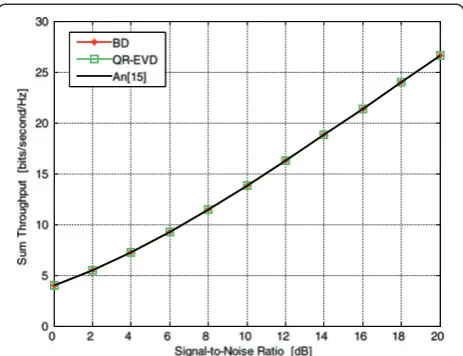
Figure 2 shows that the BD method has the same sum rate as the QR-EVD method and An's method [15] under condition that a MIMO broadcasting system con-sists of one base station and two users where the base station has four transmit antennas and each use has two receive antennas.
4 Block diagonal Jacket decomposition of an equivalent channel matrix
In this section, we introduce the block diagonal Jac-ket decomposition of an equivalent channel matrix.
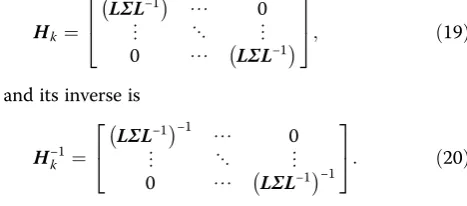
Assume that Hk is an NR×NT block diagonal matrix
given by
and its inverse is
H−1
The channel matrix is decomposed into parallel
single-input single-output subchannels. A special k×k Jacket
matrix called a diagonal Jacket matrix can be defined as follows:
Its inverse matrix is
J
Obviously, the unitary matrices can be considered as the Jacket matrices.
Let us denoteB2as a 2 × 2 block matrix in the main di-agonal ofHk[1,17]. Then, Equation 19 can be written as
Hk¼Ik=2⊗B2; ð23Þ
where
B2¼LΣL−1 ð24Þ
hence, we say that B2 can be decomposed by the EVD
using Jacket matrices. In other words, B2 is able to be
represented by
B2¼J2Σ2J−21: ð25Þ
In addition, it is shown thatHkis decomposed, which
has the diagonal form as
Hk¼Ik=2⊗B2¼Ik=2⊗ J2Σ2J−21
Thus, we can write
Hk¼JΣJ−1; ð27Þ
Note that the size of each block element in the diag-onal matrices (28), (29), and (30) is 2 × 2.
4.1 Eigenvalue decomposition of matrix of order 3
In this subsection, we introduce a class of matrices of order 3 that can be factorized into EVD forms through
Jacket matrices [1,17]. A 3 × 3 matrix A is a Jacket
matrix similar to a diagonal matrix Λif and only if such a matrix can be factorized into the form of an EVD such asA=J ΛJ−1. Consider a special matrix,A, of which the elements in the first row are arbitrary, whereas the ele-ments in the other rows are generated by cyclically shift-ing the previous row. One of its examples is given as follows.
The abovementioned matrix,A, can be decomposed as
follows:
Consider a matrix A6 that is able to be decomposed
via Jacket matrices as
A6¼A2⊗A3¼ðJ2⊗J3ÞðΛ2⊗Λ3ÞðJ2⊗J3Þ−1; ð33Þ
where⊗is the Kronecker product. Then, the EVD of Equation33is given as
A6¼ ab ab
In general, a matrix of order n (n= 2k× 31) can be decomposed via Jacket transform as follows:
An¼A2k3l ¼A2k⊗A3l
¼ J2kΛ2kJ−1 2k
⊗ J3lΛ3lJ−1 3l
¼ðJ2k⊗J3lÞðΛ2k⊗Λ3lÞ J2k⊗J3lÞ−1
ð35Þ
The diagonal mobile communication channel matrix is given by Equation 23, where
B2¼ cos45
0 −isin450
sin450 icos450
¼ 1ffiffiffi
2 p 1 −i
1 i
¼ 0:32510:8881þ0:3251i −0:32510:8881þ0:3251i
0:9659−0:2588i 0
0 −0:2588þ0:9659i
0:8881 0:3251−0:3251i −0:3251−0:3251i 0:8881
¼QΛQH:
ð36Þ
A 4 × 4 block wise Jacket matrix is
H4¼ ½ B02 ½ B0 2
¼ 1ffiffiffi
2 p
1 −i 0 0
1 i 0 0
0 0 1 −i
0 0 1 i
0 B B @
1 C C A
¼ 10 01
⊗ 1ffiffiffi
2
p 11 −ii
¼½ I2⊗½ B2:
ð37Þ
Then, the capacity of a MIMO wireless communica-tion system is given by
C¼ log2 det INRþ SNR
NT HkH
H k
bits=s=Hz ð38Þ
The channel matrix Hkis also able to be decomposed
by the EVD
Hk¼QΛQH: ð39Þ
Then, the EVD is obtained as
HkHH
k ¼QΣΣHQH ¼QΛQH; ð40Þ
where QQH=QHQ=IN, and Λ= dig(λ1, λ2,⋯, λK) with
its diagonal elements given as
λk¼ σ
2
k; ifk¼1;2;⋯;Kmin
0; ifk¼Kminþ1;⋯;K:
ð41Þ
It is shown that the MIMO system capacity can be written as
C¼X
K
k¼1
log2 1þSNR NT λk
bits=s=Hz: ð42Þ
Therefore, the EVD can be also applied to block diag-onal Jacket matrices.
5 Complexity analysis
In this section, we quantify the complexity of the QR-EVD decomposition algorithm and compare it with the conventional SVD-BD schemes. The complexities of the alternative methods are usually compared by the number of floating point operations. A flop is defined as real floating operations, i.e., real additions, multiplications, divisions, and so on. One complex addition and multipli-cation elaborate two and six flops, respectively.
Figure 3The required flops versus the number of transmit antennas,NT.
5.1 Complexity of matrix operations
For an m×n complex-valued matrix E ∈ ℂm × n, its
multiplication with anothern×pcomplex-valued matrix
D∈ℂn× p
, we use the total number of flops to measure the computational complexity of the existing algorithms [11,13,18,19]. We summarize the total flops needed for the matrix operations as below:
Multiplication ofm×nandn×pcomplex matrices is 8mnpflops.
When D=E∗, the complexity is reduced to 4nm (m+ 1) flops, where D is a diagonal or block diagonal matrix.
The flop count for the SVD of real-valued m×n (m≤n) matrices is 4m2n+ 8mn2+ 9n3. For complex-valued m×n (m≤n) matrices, we
approximate the flop count as 24mn2+ 48m2n+ 54m3 by treating every operation as the complex
multiplication.
The QR decomposition onEusing the Gram-Schmidt Orthogonalization (GSO) method takes 6 × 2m2n flops.
The water filling operation is 2m2+ 6mflops for the water filling overmeigenvalues [18].
5.2 Complexity analysis for BD methods
For the conventional SVD-BD method, obtaining the or-thogonal complementary basis Vk(0) requires K times of SVD operations [19]. Hence, we consider GSO or QR decomposition methods. To calculate all, H~kV~ð Þk0
re-quires K matrix multiplications while obtaining the sin-gular vectors V~ð Þk1 and the singular values λk require anotherKSVD operations. The water filling is needed to
find Pk. The square root of the real-valued diagonal
matrix Pk1/2 needs to be calculated and multiplied by
~ Vð Þ0
k and V 0
ð Þ
k , respectively. Those operations repeat K
times as well.
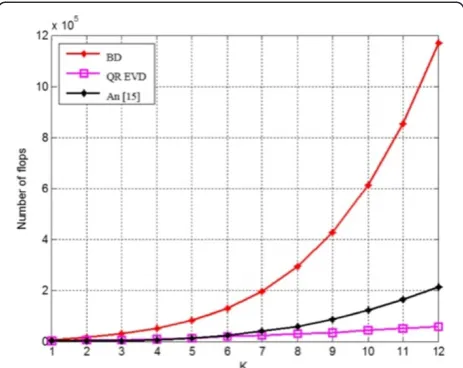
Based on the above analysis, two results of the SVD-BD and the QR decomposition are shown in Figures 2 and 3, respectively. Figure 3 shows the required number of flops according to the number of transmit antennas,
NT, where n= 2 and k= 2. Figure 4 shows the required
number of flops according to the number of users, K,
wherem= 24 andn= 2. From Figures 3 and 4, it is obvi-ous that the QR decomposition can significantly reduce the number of flops compared with the BD algorithm.
The larger values NT and K have, the less number of
-5 0 5 10 15 20 25
0 20 40 60 80 100 120
SNR[dB]
Capacity,C(bps/Hz)
Conventional EVD Jacket EVD
Figure 5Capacity versus SNR at different sizes of matrix.
Table 1 Complexity comparison
Method Computational complexity
SVD-BD 6K 9ððK−1ÞNkÞ3þ8ððK−1ÞNkÞ2NTþ4ðK−1ÞNkN2T
8KNkNT(NT−(K−1)Nk)
6K 9N3kþ8N2kðNT−ðK−1ÞNkÞ þ4NkðNT−ðK−1ÞNKÞ2
2K2Nk2+ 6KNk
KNkþ2KN2kþ8KNTðNT−ðK−1ÞNkÞNk
QR-BD 12K Kð −1Þ2N2kðNT−ðK−1ÞNk=3Þ
8KNkNT(NT−(K−1)Nk)
6K 9N3kþ8N2kðNT−ðK−1ÞNkÞ þ4NkðNT−ðK−1ÞNkÞ2
2K2Nk
2
+ 6KNk
flops the QR decomposition has. Figure 4 shows that the number of flops significantly decreases. In other words, the complexity highly declines.
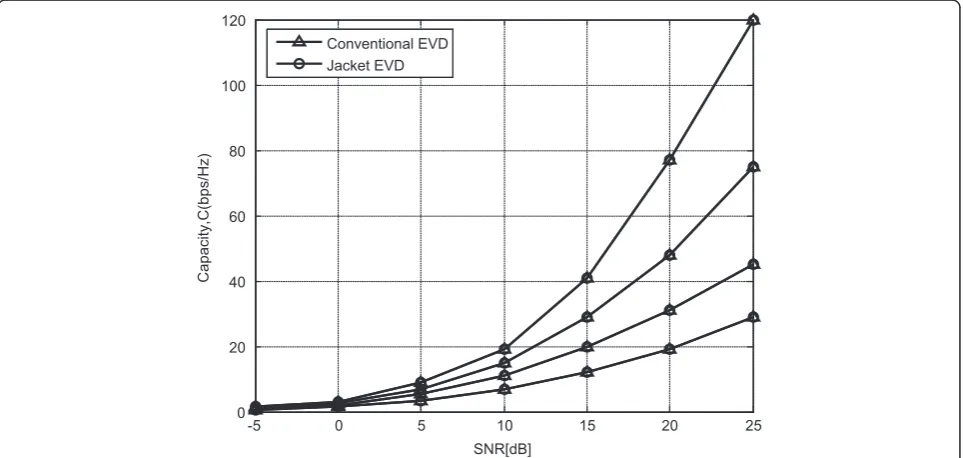
The channel in Equation 27 can be decomposed by Jacket matrices, which has the diagonal form, whereJis a unitary matrix. Therefore, Equations 8 and 15 are the same as Equation 27 becauseUandVare unitary matrices and a family of Jacket matrices, which are mathematically proved in the previous sections. Thus, the complexity ana-lysis of Jacket matrices are the same as that of the QR-EVD decomposition as shown in Table 1. The complexity of the conventional EVD method and Jacket-based EVD method increases as the respective sizes of their matrices increase, as shown in Figure 5. In addition, we compare the performance of the conventional-based EVD method and Jacket-based EVD method. Classes of these matrices, which are simply decomposed by the EVD based on Jacket transform, have been used to significantly reduce their computational complexity compared to the conventional EVD method.
6 Conclusion
In this paper, we propose the QR method to obtain the precoding matrix for MIMO broadcast downlink sys-tems. In addition, the QR scheme that of achieves the same sum capacity as the SVD-BD scheme. We show that the new method has the lower complexity than the conventional BD method through complexity analysis, and the efficiency improvement becomes significant when the base station or users have a large number of transmit antennas. These results also show that the QR decomposition algorithm requires much less ity than the conventional BD method. Thus, the complex-ity analysis of Jacket matrices is the same as that of the QR-EVD decomposition. We believe that the amount of computation required to obtain diagonal-similar matri-ces is much smaller than that of computation required in the conventional EVD. In addtion, by using the QR de-composition to find the orthogonal complement, it is shown that the complexity of the SVD-BD can be sig-nificantly reduced. In addition, we show that EVD can be extended to the high-order matrices. These properties may be used for Jacket matrices to be applied to signal processing, coding theory, and orthogonal code design. The EVD can be used in the information-theoretic ana-lysis of MIMO channels.
Competing interests
The authors declare that they have no competing interests.
Acknowledgements
This work was supported by the MEST 2012–002521 and Brain Korea 21 (BK21) Plus Project in 2014, National Research Foundation (NRF), Republic of Korea.
Received: 1 January 2014 Accepted: 24 May 2014 Published: 14 June 2014
References
1. MH Lee, MM Matalgah, W Song, Fast method for precoding and decoding of distributive multi-input multi-output channels in relay based decode-and-forward cooperative wireless networks. IET Commun4(2), 144–153 (2010)
2. MH Lee, A new reverse Jacket transform and its fast algorithm. IEEE Trans Circuits Syst II47(1), 39–47 (2000)
3. Z Chen, MH Lee, G Zeng, Fast cocyclic Jacket transform. IEEE Trans Signal Process56, 2143–2148 (2008)
4. MH Lee, NL Manev, XD Zhang, Jacket transform eigenvalue decomposition. Appl Math Comput198, 854–864 (2008)
5. H Weingarten, Y Steinberg, S Shamai, The capacity region of the Gaussian MIMO broadcast channel. IEEE Trans Inform Theory52(9), 3936–3964 (2006) 6. MHM Costa, Writing on dirty paper. IEEE Trans Inform Theory29, 439–441
(1983)
7. C Windpassinger, RFH Fischer, T Vencel, JB Huber, Precoding in
multiantenna and multiuser communications. IEEE Trans Wireless Commun 3(4), 1305–1315 (2004)
8. CB Peel, BM Hochwald, S AL, A vector perturbation technique for near-capacity multiantenna multiuser communication - part I: channel inversion and regularization. IEEE. Trans. Commun.53, 195–202 (2005)
9. H Sung, S Lee, I Lee, Generalized channel inversion methods for multiuser MIMO systems. IEEE Trans Commun57(11), 3489–3499 (2009)
10. QH Spencer, AL Swindlehurst, M Haardt, Zero-forcing method for downlink spatial multiplexing in multiuser MIMO channels. IEEE Trans Signal Processing 52(2), 461–471 (2004)
11. K Zu, RC de Lamare, Low-complexity lattice reduction-aided regularized block diagonalization for MU-MIMO systems. IEEE Commun Lett 16(6), 925–928 (2012)
12. K Zu, RC de Lamare, M Haardt, Generalized design of low-complexity block diagonalization type precoding algorithms for multiuser MIMO systems. IEEE Trans Commun61(10), 4232–4242 (2013)
13. Z Shen, R Chen, JG Andrews, RW Heath Jr, BL Evans, Low complexity user selection algorithms for multiuser MIMO systems with block diagonalization. IEEE Trans Signal Process54(9), 3658–3663 (2006)
14. V Stankovic, M Haardt, Generalized design of multiuser MIMO precoding matrices. IEEE Trans Wireless Commun7, 953–961 (2008)
15. J An, YA Liu, F Liu, An Efficient Block Diagonalization Method for Multiuser MIMO Downlink, in2nd International Conference on Consumer Electronics, Communications and Networks (CECNet), ed. by (China, 2012)
16. H Wang, L Li, L Song, X Gao, A linear precoding scheme for downlink multiuser MIMO precoding systems. IEEE Commun Lett15(6), 653–655 (2011)
17. MH Lee,Jacket Matrices - Construction and Its Application for Fast Cooperative Wireless Signal Processing(LAP LAMBERT Academic Publishing, Germany, 2012)
18. GH Golub, CF Van Load,Matrix Computations, 3rd edn. (The John Hopkisns University Press, Baltimore and London, 1996)
19. W Li, M Latva-aho, An efficient channel block diagonalization method for generalized zero forcing assisted MIMO broadcasting systems. IEEE Trans on Wireless Commun10(3), 739–744 (2011)
doi:10.1186/1687-1499-2014-95