R E S E A R C H
Open Access
Second-order numerical methods for the
tempered fractional diffusion equations
Zeshan Qiu
1and Xuenian Cao
1**Correspondence:[email protected] 1School of Mathematics and Computational Science, Hunan Key Laboratory for Computation and Simulation in Science and Engineering, Xiangtan University, Xiangtan, P.R. China
Abstract
In this paper, a class of second-order tempered difference operators for the left and right Riemann–Liouville tempered fractional derivatives is constructed. And a class of second-order numerical methods is presented for solving the space tempered fractional diffusion equations, where the space tempered fractional derivatives are evaluated by the proposed tempered difference operators, and in the time direction is discreted by the Crank–Nicolson method. Numerical schemes are proved to be unconditionally stable and convergent with orderO(h2+
τ
2). Numerical experimentsdemonstrate the effectiveness of the numerical schemes.
Keywords: Tempered fractional diffusion equations; Second-order tempered difference operators; Stability and convergence
1 Introduction
In recent years, many fractional models [1–18,21,22,24–27] with (tempered) fractional derivatives have been widely applied in many fields of science and technology, a lot of re-search results have been obtained. Among them, Li and Deng [14] constructed a class of second-order tempered weighted and shifted Grünwald difference operators (abbr. TWSGD) for the Riemann–Liouville tempered fractional derivatives, and then a class of second-order numerical schemes was proposed for solving a two-sided space tempered fractional diffusion equation. Numerical schemes are unconditionally stable and conver-gent with orderO(h2+τ2). Dehghan et al. [6] developed a high-order numerical scheme for the space-time tempered fractional diffusion-wave equation, the numerical scheme was proved to be unconditionally stable and convergent with orderO(h4+τ2). Qu and Liang [18] used the Crank–Nicolson method and TWSGD method [14] to solve a class of variable-coefficient tempered fractional diffusion equations and proved that the numer-ical schemes are unconditionally stable and convergent with orderO(h2+τ2). Yu et al. [24] extended quasi-compact discretizations to Riemann–Liouville tempered fractional derivatives and derived the numerical scheme for solving a tempered fractional diffusion equation. Yu et al. [25] constructed a numerical scheme for one-sided space tempered fractional diffusion equation, and the numerical scheme was shown to be stable and con-vergent with orderO(h3+τ).Çelik and Duman [2] solved the symmetric space tempered fractional diffusion equation by the finite element method and achieved convergence or-derO(h2+τ2). Zhang et al. [27] proposed a modified second-order Lubich tempered differ-ence operator for the Riemann–Liouville tempered fractional derivatives and constructed
a numerical scheme for solving the normalized Riesz space tempered fractional diffusion equation. The stability and convergence of the numerical scheme have been proved. Hu and Cao [12] combined the implicit midpoint method and the modified second-order Lu-bich tempered difference operator to derive a numerical scheme for solving the normal-ized Riesz space tempered fractional diffusion equation with a nonlinear source term and discussed the stability and convergence of the numerical scheme.
In this paper, we consider the following space tempered fractional diffusion equation [14]:
⎧ ⎪ ⎪ ⎨ ⎪ ⎪ ⎩
∂u(x,t)
∂t =l ∂–α,λu(x,t)
∂xα +r ∂+α,λu(x,t)
∂xα +f(x,t), (x,t)∈(a,b)×(0,T],
u(x, 0) =ϕ(x), x∈[a,b],
u(a,t) =ψl(t), u(b,t) =ψr(t), t∈[0,T],
(1)
where 1 <α< 2 andλ≥0,f(x,t) is the linear source term, diffusion coefficientslandrare nonnegative constants withl+r= 0, and ifl= 0, thenψl(t)≡0, ifr= 0, thenψr(t)≡0. The normalized left and right Riemann–Liouville tempered fractional derivatives∂–α,λu(x,t)
∂xα
and∂+α,λu(x,t)
∂xα are defined as follows [1,14]:
∂α,λ
– u(x,t)
∂xα =aD α,λ
x u(x,t) –λ α
u(x,t) –αλα–1∂u(x,t) ∂x ,
∂α,λ
+ u(x,t)
∂xα =xD α,λ
b u(x,t) –λ
αu(x,t) +αλα–1∂u(x,t)
∂x ,
here the left and right Riemann–Liouville tempered fractional derivativesaDαx,λu(x,t) and
xDαb,λu(x,t) are defined by
aDαx,λu(x,t) =
e–λx
Γ(2 –α)
∂2
∂x2
x
a
eλτu(τ,t) (x–τ)α–1dτ
,
xDαb,λu(x,t) =
eλx
Γ(2 –α)
∂2 ∂x2
b
x
e–λτu(τ,t) (τ–x)α–1 dτ
,
whereΓ(·) is the gamma function.
Obviously, whenλ= 0, the left and right Riemann–Liouville tempered fractional deriva-tives degenerate to the left and right Riemann–Liouville fractional derivaderiva-tives, respec-tively. Whenl=r= –2cos1(απ
2 ), the two-sided tempered fractional diffusion equation
de-generates to the normalized Riesz tempered fractional diffusion equation.
Considering these existing works in the literature, the aim of this paper is to try to give a class of new second-order tempered difference operators; then, using the Crank–Nicolson method and the proposed difference operators, to construct a class of second-order nu-merical methods for solving problem (1) and give the theoretical analysis of the numerical methods.
2 Second-order tempered difference operators
In this section, we first introduce a fractional Sobolev spaceSn+α
λ (R) defined as follows [27]:
Snλ+α(R) = νν∈L1(R), and
R
λ2+w2n+2ανˆ(w)dw<∞
, (2)
whereνˆ(w) =Rν(x)e–iwxdxis the Fourier transform ofν(x).
Lemma 2.1([27]) Letν(x)∈L1(R), 1 <α< 2,andλ≥0.Then the Fourier transforms of the left and right Riemann–Liouville tempered fractional derivatives are
F–∞Dαx,λν
(w) = (λ+iw)ανˆ(w)
and
FxDα+,∞λν
(w) = (λ–iw)ανˆ(w).
Lemma 2.2([1,14]) Let1 <α< 2,λ≥0,the shift number p is an integer,h is the step size,
ν(x)is defined on the bounded interval[a,b]and belongs to S2+α
λ (R)after zero extension
on the interval x∈(–∞,a)∪(b, +∞).The shifted Grünwald type difference operators are defined as follows:
Aαh,,pλν(x) = 1
hα
[x–ha]+p
k=0
wαke–(k–p)λhνx– (k–p)h– 1
hαGp(1)ν(x), (3)
ˆ
Aαh,,pλν(x) = 1
hα
[b–hx]+p
k=0
wαke–(k–p)λhνx+ (k–p)h– 1
hαGp(1)ν(x), (4)
then
Aαh,,pλν(x) =aDxα,λν(x) –λαν(x) +O(h), (5)
ˆ
Aαh,,pλν(x) =xDαb,λν(x) –λ
αν(x) +O(h), (6)
where wα
k= (–1)k(αk) (k≥0)denotes the normalized Grünwald weights,
Gp(s) =epλh1 –e–λhsα= +∞
k=0
wαke–(k–p)λhsk.
Meanwhile,denote
Wp(s) =eps
1 –e–s s
α
= 1 +
p–α 2
s+
p2
2 –
pα
2 +
α
6 +
α(α– 1) 8
s2+O|s|3
Lemma 2.3 Let1 <α< 2,λ≥0,the shift number p is an integer,h is the step size,ν(x)is
Proof Taking the Fourier transform on both sides of (7) and (8), we obtain
ˆ
φ(w) =FBˆαh,,pλν(w) –FxDα+∞,λν–λ
αν (w)
=(λ–iw)αWˆp
(λ–iw)h– 1–λαWˆp(λh) – 1νˆ(w),
and there exist two positive constantsCandCˆ such that
φ(w)≤Ch|λ+iw|α+1+h|λ|α+1νˆ(w),
φˆ(w)≤ ˆCh|λ–iw|α+1+h|λ|α+1νˆ(w).
Taking the inverse Fourier transform of φ(w) and utilizing known conditions ν(x)∈
S2+α
λ (R), we can obtain Bαh,,λpν(x) ––∞Dαx,λν(x) +λ
αν
(x)≤ 1 2π
R
φ(w)dw
≤Ch
R
|λ+iw|α+1+|λ|α+1νˆ(w)dw=O(h).
Similar provability
Bˆαh,,λpν(x)–xDα+∞,λν(x) +λαν(x)≤ 1 2π
R
φˆ(w)dw
≤ ˆCh
R
|λ–iw|α+1+|λ|α+1νˆ(w)dw=O(h).
The proof is completed.
Lemma 2.4 Let1 <α< 2,λ≥0,h is the step size,ν(x)is defined on the bounded interval
[a,b]and belongs to S2+α
λ (R)after zero extension on the interval x∈(–∞,a)∪(b, +∞).The
new second-order tempered difference operators are given as follows:
Chα,λν(x) =γ1Aαh,1,λν(x) +γ2Bαh,1,λν(x) +γ3Bαh,–1,λ ν(x)
= 1
hα
[x–ha]+1
k=0
γ1wαk+γ2wˆαk+γ3wˆαk–2
e–(k–1)λhνx– (k– 1)h
– 1
hα
γ1eλh
1 –e–λhα+γ2eλh
1 –e–2λh 2
α
+γ3e–λh
1 –e–2λh 2
α
ν(x)
= 1
hα
[x–ha]+1
k=0 gα
kν
x– (k– 1)h– 1
hαG˜1(1)ν(x), (11)
ˆ
Chα,λν(x) =γ1Aˆαh,1,λν(x) +γ2Bˆαh,1,λν(x) +γ3Bˆαh,–1,λ ν(x)
= 1
hα
[b–hx]+1
k=0
γ1wαk+γ2wˆαk+γ3wˆαk
e–(k–1)λhνx+ (k– 1)h
– 1
hα
γ1eλh
1 –e–λhα +γ2eλh
1 –e–2λh 2
+γ3e–λh
Proof Taking the Fourier transform on both sides of (11) and (12), we obtain
withs= (λ+iw)horλh,i2= –1.
FCˆhα,λν(w) =γ1F
ˆ
Aαh,1,λν(w) +γ2F
ˆ
Bαh,,1λν(w) +γ3F
ˆ
Bαh,–1,λν(w) = 1
hα
+∞
k=0
γ1wαk+γ2wˆαk+γ3wˆαk–2
e–(k–1)(λ–iw)hνˆ(w)
– 1
hα
γ1eλh
1 –e–λhα+γ2eλh
1 –e–2λh 2
α
+γ3e–λh
1 –e–2λh 2
α
ˆ
ν(w)
=eh(λ–iw)
γ1
1 –e–(λ–iw)h
h
α
+γ2
1 –e–2(λ–iw)h 2h
α
ˆ
ν(w)
+γ3e–h(λ–iw)
1 –e–2(λ–iw)h 2h
α
ˆ
ν(w) –
γ1eλh
1 –e–λh
h
α
+γ2eλh
1 –e–2λh 2h
α
+γ3e–λh
1 –e–2λh 2h
α
ˆ
ν(w) =(λ–iw)αW˜(λ–iw)h–λαW˜(λh)νˆ(w),
whereW˜(s) withs= (λ–iw)horλh,i2= –1. And then making
⎧ ⎨ ⎩
γ1+γ2+γ3= 1,
γ1(1 –α2) +γ2(1 –α) +γ3(–1 –α) = 0,
we get
γ1= 2α– 2
α +
4
αγ3, γ2=
2 –α α –
4 +α α γ3.
Denote
φ(w) =FChα,λν(w) –F–∞Dαx,λν–λαν(w)
=(λ+iw)αW˜(λ+iw)h– 1–λαW˜(λh) – 1νˆ(w),
ˆ
φ(w) =FChα,λν(w) –FxDα+,∞λν–λαν
(w)
=(λ–iw)αW˜(λ–iw)h– 1–λαW˜(λh) – 1νˆ(w),
and there exist two positive constantsCandCˆ such that
φ(w)≤Ch2|λ+iw|α+2+h2|λ|α+2νˆ(w),
Taking the inverse Fourier transform of φ(w) and utilizing known conditions ν(x)∈
S2+λα(R), we can obtain
Cαh,λν(x) ––∞Dxα,λν(x) +λαν(x)≤ 1 2π
R
φ(w)dw
≤Ch2
R
|λ+iw|α+2+|λ|α+2νˆ(w)dw
=Oh2.
Similar provability
Cˆαh,λν(x) –xDα+,∞λν(x) +λ
αν
(x)≤ 1 2π
R
φˆ(w)dw
≤ ˆCh2
R
|λ–iw|α+2+|λ|α+2νˆ(w)dw
=Oh2.
The proof is completed.
In this part, because of the selectivity ofγ3, a class of approximation operators with second-order accuracy for the Riemann–Liouville tempered fractional derivatives is given.
3 Numerical schemes
For the space interval [a,b] and the time interval [0,T], we choose the grid pointsxi=
a+ih, 0≤i≤N,tn=nτ, 0≤n≤M, whereh= (b–a)/Nis the space stepsize,τ=T/M denotes the time stepsize. The exact solution and numerical solution at the point (xi,tn) are denoted byun
i =u(xi,tn) andUin, respectively. Denotingtn+1/2= (tn+tn+1)/2,fin=f(xi,tn). In this paper,u(x,·) is defined on the bounded interval [a,b] andu(x,·) belongs toS2+α
λ (R) after zero extension on the intervalx∈(–∞,a)∪(b, +∞).
Using the Crank–Nicolson method to discrete time for problem (1) at point (xi,tn), we get
un+1 i –uni
τ =l
∂–α,λu
∂xα n+1/2
i +r
∂+α,λu
∂xα n+1/2
i
+fin+1/2+Oτ2,
1≤i≤N– 1, 0≤n≤M– 1. (15)
From Lemma2.4, we obtain
un+1 i –uni
τ =l
Cαh,λuni+1/2–αλα–1δxuni+1/2
+rCˆαh,λuin+1/2+αλα–1δxuni+1/2
+fin+1/2+Oτ2+h2, (16)
whereδxuni = uni+1–uni–1
2h ,u n+1/2
Rearrange (16) to get
uin+1–uni =τlChα,λuni+1/2+τrCˆhα,λuni+1/2–τ αλα–1(l–r)δxuni+1/2
+τfin+1/2+Oτ3+h2τ. (17)
Furthermore, (17) can be written as
uni+1–uni =τl 1 hα
i+1
k=0 gα
kuni–+1/2k+1–τ(l+r) 1
hαG˜(1)u n+1/2 i
+τr 1 hα
N–i+1
k=0
gkαuni++1/2k–1–τ αλα–1(l–r)u n+1/2 i+1 –uni–1+1/2
2h
+τfin+1/2+Oτ3+h2τ. (18)
Eliminating the local truncation error, we obtain the numerical scheme as follows:
Uin+1–Uin=τl 1 hα
i+1
k=0
gkαUin–+1/2k+1–τ(l+r)1
hαG˜(1)U n+1/2 i
+τr1 hα
N–i+1
k=0
gkαUin++1/2k–1–τ αλα–1(l–r)U n+1/2
i+1 –Uin–1+1/2 2h
+τfin+1/2. (19)
That is,
Uin+1=Uin+τl 1 hα
i+1
k=0 gα
k
Uin–k+1+Uin–+1k+1
2
–τ(l+r)1
hαG˜(1)
Un i +Uin+1
2 +τr
1
hα N–i+1
k=0 gα
k
Uin+k–1+Uin++1k–1
2
–τ αλα–1(l–r)U n+1
i+1 +Uin+1–Uin–1+1–Uin–1
4h +τf
n+1/2
i . (20)
Furthermore, the matrix form of (20) can be written as follows:
I–τ(lA+rA T)
2hα +
τ αλα–1(l–r)
4h B
Un+1=
I+τ(lA+rA T)
2hα
–τ αλ
α–1(l–r)
4h B
Un
whereUn= (Un
4 Stability and convergence of the numerical schemes
In order to analyze the stability and convergence of the numerical schemes, we give some lemmas.
Proof It is easy to know from the expression ofwα kthat
Combining (30) and (35), and if1–2α<γ3≤2–4α, then
Summarizing the above relationships, we find that if any one of the following three con-ditions is satisfied:
The proof is completed.
Theorem 4.1 If matrix A is defined by(22),then D=A+2AT is strictly diagonally dominant and negative definite.
Proof DenotingD=A+AT
Because the following relationships are established:
That is,
+∞
k=0 gα
k –G˜1(1) = 0. (36)
From Lemma4.2and (36), we know
N–1
j=1 di,j< 0,
–di,i> N–1
j=i
di,j, i= 1, 2, . . . ,N– 1.
Thus, matrixDis strictly diagonally dominant. Utilizing the Gershgorin theorem [23], we know that the eigenvalues of matrixDare all negative. That is, matrixDis negative definite.
The proof is completed.
Theorem 4.2 The numerical scheme(20)is unconditionally stable.
Proof DenotingM=τ(lA2+hrAαT)–τ αλ α–1(l–r)
4h B, then the matrix form (21) becomes
(I–M)Un+1= (I+M)Un+τFn+1/2. (37)
Letλ(M) represent the eigenvalue of matrixM, then the eigenvalue of matrix (I–M)–1(I+
M) is1+1–λλ((MM)). BecauseM+2MT =τ(l+r4)(hAα+AT)=τ2(lh+αr)D, from Lemma4.1and Theorem4.1, we knowλ(M) < 0, then|1–1+λλ((MM))|< 1. Thus the spectral radius of matrix (I–M)–1(I+M) is less than one.
The proof is completed.
Define Uh={u|u={ui}is a grid function defined on{xi=a+ih}Ni=1–1and u0= uN = 0}. And we define the corresponding discreteL2-normuL2= (h
N–1
i=1 u2i)1/2for all u∈Uh.
Lemma 4.3([14]) For matrix M in(37),there exists
(I–M)–12≤1, (I–M)–1(I+M)2≤1,
where · 2denotes2-norm(spectral norm).
Theorem 4.3 The numerical scheme(20)is convergent,i.e.,there is a constant C such that
enL
2≤C
τ2+h2, n= 1, 2, . . . ,M,
where en= (en
1,en2, . . . ,enN–1)T,eni =uni –Uin.
Proof The proof is similar [14]. Combining (18) and (19), we obtain
whereRn= (Rn
1,Rn2, . . . ,RnN–1)T, andRni =O(τ3+τh2) is the local truncation error. Equation (38) can be rewritten as
en+1= (I–M)–1(I+M)en+ (I–M)–1Rn.
By taking the Euclidean norm · 2at the same time on both sides of the upper form, we get
en2≤(I–M)–1(I+M)en–12+(I–M)–1Rn–12 ≤(I–M)–1(I+M)2en–12+(I–M)–12Rn–12.
Noting that · L2=h1/2 · 2and from Lemma4.3, we can get
enL
2≤(I–M)
–1(I+M) 2e
n–1
L2+(I–M)
–1 2R
n–1 L2
≤en–1L
2+R
n–1 L2.
Because the local truncation error is given as|Rki| ≤C(τ3+τh2), and noticing thate0 L2=
0, we have
enL
2≤e
n–1 L2+R
n–1 L2≤e
n–2 L2+R
n–2 L2+R
n–1 L2
≤e0L
2+
n–1
k=0
RkL
2≤C
τ2+h2.
The proof is completed.
5 Numerical experiments
The observation order is defined as
Order =log2
e
L2,h
eL2,h/2
.
We give four examples to verify the effectiveness of the numerical schemes and com-pare the numerical results of our method with those of the CN-TWSGD method [14] (max{(2–αα2)(+3α2α++2α–8),(1–
α)(α2+2α)
2(α2+3α+4)} ≤β3≤(2–α)(α
2+2α–3)
2(α2+3α+2) ,β1=α2 +β3,β2=2–2α– 2β3) for Exam-ple2.
Example1 ([14]) Consider the initial-boundary value problem of tempered fractional dif-fusion equation
⎧ ⎪ ⎪ ⎪ ⎪ ⎪ ⎨ ⎪ ⎪ ⎪ ⎪ ⎪ ⎩
∂u(x,t)
∂t = ∂α,λ
– u(x,t)
∂xα +e–λx+t((λα–αλα+ 1)x2+α
–ΓΓ(3+(3)α)x2+α(α+ 2)λα–1xα+1), (x,t)∈(0, 1)×(0, 1], u(0,t) = 0, u(1,t) =e–λ+t, t∈[0, 1],
u(x, 0) =e–λxx2+α, x∈[0, 1],
where 1 <α< 2.
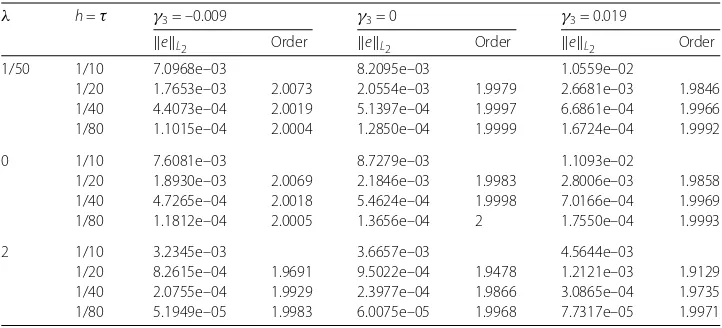
Choosing differentα,λ, andγ3, we use the proposed method to solve Example1, the errors and observation orders are displayed in Tables1,2, and3. From Tables1–3, we find that the numerical schemes are second-order accuracy both in time and space, which is a match with theoretical results.
Table 1 Errors and corresponding observation orders att= 1,α= 1.2
λ h=τ γ3= –0.065 γ3= 0 γ3= 0.046
eL2 Order eL2 Order eL2 Order
1/50 1/10 1.3091e–03 8.9048e–03 1.5872e–02
1/20 3.4456e–04 1.9257 2.2077e–03 2.0120 3.9986e–03 1.9889 1/40 8.8261e–05 1.9649 5.4891e–04 2.0079 9.9862e–04 2.0015 1/80 2.2181e–05 1.9925 1.3688e–04 2.0037 2.4933e–04 2.0019
0 1/10 5.4687e–03 1.3477e–02 1.9237e–02
1/20 1.2413e–03 2.1393 3.2862e–03 2.0360 4.7459e–03 2.0191 1/40 2.9794e–04 2.0588 8.1182e–04 2.0172 1.1770e–03 2.0116 1/80 7.3348e–05 2.0222 2.0193e–04 2.0073 2.9313e–04 2.0055
2 1/10 3.9639e–03 8.1213e–03 1.0887e–02
1/20 9.7650e–04 2.0212 2.1455e–03 1.9204 2.9861e–03 1.8663 1/40 2.4398e–04 2.0009 5.4410e–04 1.9794 7.6695e–04 1.9611 1/80 6.1112e–05 1.9972 1.3648e–04 1.9952 1.9300e–04 1.9905
Table 2 Errors and corresponding observation orders att= 1,α= 1.5
λ h=τ γ3= –0.142 γ3= 0 γ3= 0.333
eL2 Order eL2 Order eL2 Order
1/50 1/10 7.7227e–03 1.0465e–02 5.3286e–02
1/20 2.0245e–03 1.9315 2.6046e–03 2.0064 1.3526e–02 1.9780 1/40 5.1203e–04 1.9833 6.4995e–04 2.0027 3.3823e–03 1.9997 1/80 1.2836e–04 1.9960 1.6239e–04 2.0009 8.4480e–04 2.0013
0 1/10 5.7263e–03 1.1908e–02 5.3855e–02
1/20 1.5271e–03 1.9068 2.9592e–03 2.0087 1.3568e–02 1.9889 1/40 3.8755e–04 1.9783 7.3811e–04 2.0033 3.3854e–03 2.0028 1/80 9.7221e–05 1.9950 1.8439e–04 2.0011 8.4508e–04 2.0022
2 1/10 2.5444e–03 6.6079e–03 2.2144e–02
1/20 7.8955e–04 1.6882 1.7420e–03 1.9234 6.9946e–03 1.6626 1/40 2.0774e–04 1.9263 4.4145e–04 1.9804 1.8798e–03 1.8956 1/80 5.2509e–05 1.9841 1.1072e–04 1.9953 4.7865e–04 1.9735
Table 3 Errors and corresponding observation orders att= 1,α= 1.8
λ h=τ γ3= –0.009 γ3= 0 γ3= 0.019
eL2 Order eL2 Order eL2 Order
1/50 1/10 7.0968e–03 8.2095e–03 1.0559e–02
1/20 1.7653e–03 2.0073 2.0554e–03 1.9979 2.6681e–03 1.9846 1/40 4.4073e–04 2.0019 5.1397e–04 1.9997 6.6861e–04 1.9966 1/80 1.1015e–04 2.0004 1.2850e–04 1.9999 1.6724e–04 1.9992
0 1/10 7.6081e–03 8.7279e–03 1.1093e–02
1/20 1.8930e–03 2.0069 2.1846e–03 1.9983 2.8006e–03 1.9858 1/40 4.7265e–04 2.0018 5.4624e–04 1.9998 7.0166e–04 1.9969 1/80 1.1812e–04 2.0005 1.3656e–04 2 1.7550e–04 1.9993
2 1/10 3.2345e–03 3.6657e–03 4.5644e–03
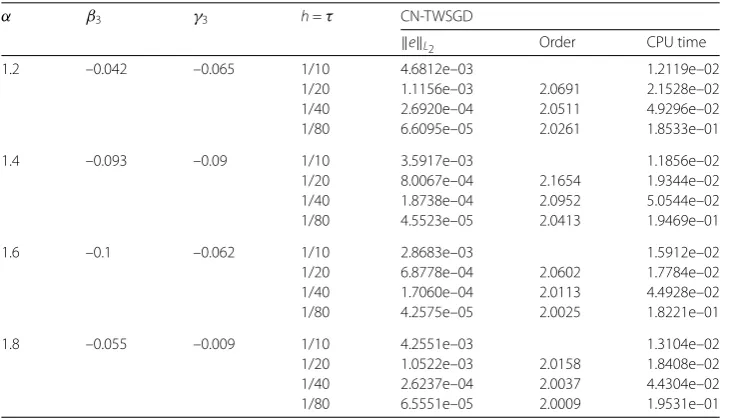
Table 4 Errors and corresponding observation orders att= 1,λ= 1/50
α β3 γ3 h=τ CN-TWSGD
eL2 Order CPU time
1.2 –0.042 –0.065 1/10 4.6812e–03 1.2119e–02
1/20 1.1156e–03 2.0691 2.1528e–02
1/40 2.6920e–04 2.0511 4.9296e–02
1/80 6.6095e–05 2.0261 1.8533e–01
1.4 –0.093 –0.09 1/10 3.5917e–03 1.1856e–02
1/20 8.0067e–04 2.1654 1.9344e–02
1/40 1.8738e–04 2.0952 5.0544e–02
1/80 4.5523e–05 2.0413 1.9469e–01
1.6 –0.1 –0.062 1/10 2.8683e–03 1.5912e–02
1/20 6.8778e–04 2.0602 1.7784e–02
1/40 1.7060e–04 2.0113 4.4928e–02
1/80 4.2575e–05 2.0025 1.8221e–01
1.8 –0.055 –0.009 1/10 4.2551e–03 1.3104e–02
1/20 1.0522e–03 2.0158 1.8408e–02
1/40 2.6237e–04 2.0037 4.4304e–02
1/80 6.5551e–05 2.0009 1.9531e–01
Example2 ([14]) Consider the initial-boundary value problem of tempered fractional dif-fusion equation
⎧ ⎪ ⎪ ⎪ ⎪ ⎪ ⎨ ⎪ ⎪ ⎪ ⎪ ⎪ ⎩
∂u(x,t)
∂t = ∂α+,λu(x,t)
∂xα +eλx+t((λα–αλα+ 1)(1 –x)2+α
–ΓΓ(3+(3)α)(1 –x)2+α(α+ 2)λα–1(1 –x)α+1), (x,t)∈(0, 1)×(0, 1],
u(0,t) =et, u(1,t) = 0, t∈[0, 1],
u(x, 0) =eλx(1 –x)2+α, x∈[0, 1],
where 1 <α< 2.
The exact solution isu(x,t) =eλx+t(1 –x)2+α.
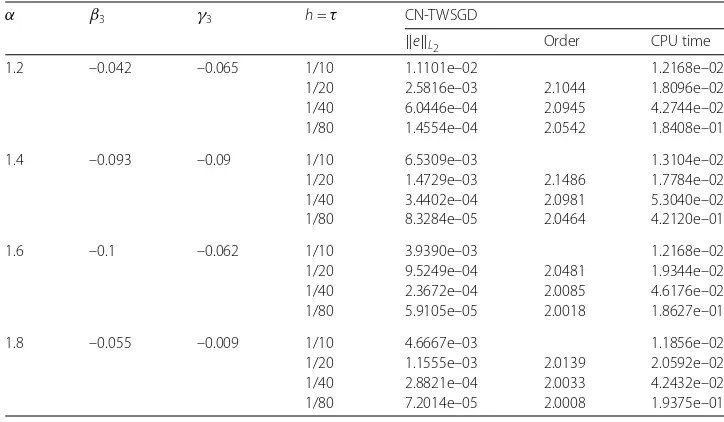
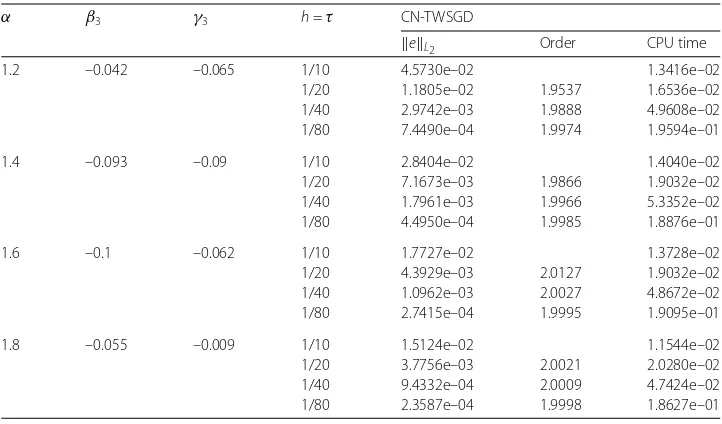
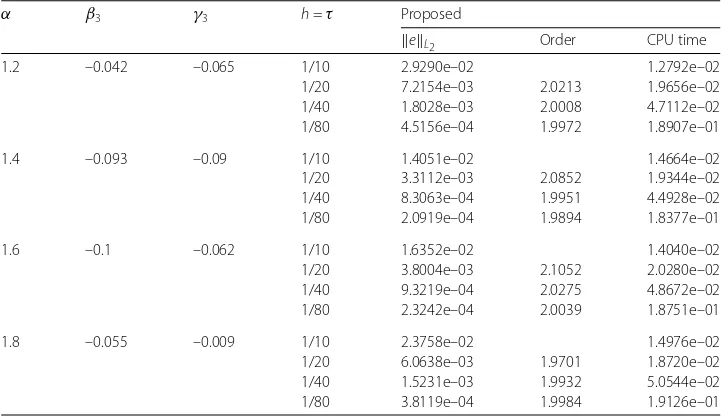
In order to compare the CN-TWSGD method with the proposed method in this paper, we choose differentα,λ,β3, andγ3 to solve Example2, the errors, observation orders, and CPU times are displayed in Tables4–9. From Tables4–9, we see that both the CN-TWSGD method and our method are effective.
Example3 (cf. [27]) Consider the initial-boundary value problem of tempered fractional diffusion equation
⎧ ⎪ ⎪ ⎨ ⎪ ⎪ ⎩
∂u(x,t)
∂t =l ∂–α,λu(x,t)
∂xα +r ∂+α,λu(x,t)
∂xα +f(x,t), (x,t)∈(0, 1)×(0, 1],
u(0,t) = 0, u(1,t) = 0, t∈[0, 1],
u(x, 0) =e–λxx4(1 –x)4, x∈[0, 1],
where 1 <α< 2,l= 1,r= 2, and the linear source term is
f(x,t) =αeαt–λxx4(1 –x)4–eαt
e–λx 4
k=0
(–1)4k Γ(5 +k)
Table 5 Errors and corresponding observation orders att= 1,λ= 1/50
α β3 γ3 h=τ Proposed
eL2 Order CPU time
1.2 –0.042 –0.065 1/10 1.3356e–03 1.5912e–02
1/20 3.5152e–04 1.9258 2.2152e–02
1/40 9.0044e–05 1.9649 4.8672e–02
1/80 2.2629e–05 1.9925 1.9594e–01
1.4 –0.093 –0.09 1/10 1.4612e–03 1.3728e–02
1/20 4.2047e–04 1.7971 1.9344e–02
1/40 1.0892e–04 1.9487 5.0856e–02
1/80 2.7456e–05 1.9881 2.0280e–01
1.6 –0.1 –0.062 1/10 2.2694e–03 1.2480e–02
1/20 5.0328e–04 2.1729 1.9656e–02
1/40 1.2209e–04 2.0434 5.0544e–02
1/80 3.0302e–05 2.0105 1.9313e–01
1.8 –0.055 –0.009 1/10 7.1897e–03 1.4664e–02
1/20 1.7878e–03 2.0077 2.2464e–02
1/40 4.4632e–04 2.0020 5.1480e–02
1/80 1.1154e–04 2.0005 2.0062e–01
Table 6 Errors and corresponding observation orders att= 1,λ= 0
α β3 γ3 h=τ CN-TWSGD
eL2 Order CPU time
1.2 –0.042 –0.065 1/10 1.1101e–02 1.2168e–02
1/20 2.5816e–03 2.1044 1.8096e–02
1/40 6.0446e–04 2.0945 4.2744e–02
1/80 1.4554e–04 2.0542 1.8408e–01
1.4 –0.093 –0.09 1/10 6.5309e–03 1.3104e–02
1/20 1.4729e–03 2.1486 1.7784e–02
1/40 3.4402e–04 2.0981 5.3040e–02
1/80 8.3284e–05 2.0464 4.2120e–01
1.6 –0.1 –0.062 1/10 3.9390e–03 1.2168e–02
1/20 9.5249e–04 2.0481 1.9344e–02
1/40 2.3672e–04 2.0085 4.6176e–02
1/80 5.9105e–05 2.0018 1.8627e–01
1.8 –0.055 –0.009 1/10 4.6667e–03 1.1856e–02
1/20 1.1555e–03 2.0139 2.0592e–02
1/40 2.8821e–04 2.0033 4.2432e–02
1/80 7.2014e–05 2.0008 1.9375e–01
+ 2eλ(x–2) +∞
i=0 (2λ)i
i! 4
k=0
(–1)4k Γ(5 +k+i)
Γ(5 +k+i–α)(1 –x) 4+k+i–α
– 3λαe–λxx4(1 –x)4+αλα–1e–λx–λx4(1 –x)4+ 4x–x23
(1 – 2x)
.
The exact solution isu(x,t) =eαt–λxx4(1 –x)4.
Table 7 Errors and corresponding observation orders att= 1,λ= 0
α β3 γ3 h=τ Proposed
eL2 Order CPU time
1.2 –0.042 –0.065 1/10 5.4687e–03 1.3728e–02
1/20 1.2413e–03 2.1393 2.2152e–02
1/40 2.9794e–04 2.0588 4.9608e–02
1/80 7.3348e–05 2.0222 1.9594e–01
1.4 –0.093 –0.09 1/10 1.4523e–03 1.3728e–02
1/20 2.8548e–04 2.3468 2.2776e–02
1/40 6.7785e–05 2.0744 4.8048e–02
1/80 1.6770e–05 2.0151 1.8876e–01
1.6 –0.1 –0.062 1/10 3.3311e–03 1.3104e–02
1/20 7.7293e–04 2.1076 1.9968e–02
1/40 1.8976e–04 2.0262 4.5240e–02
1/80 4.7234e–05 2.0063 1.9656e–01
1.8 –0.055 –0.009 1/10 7.5583e–03 1.4976e–02
1/20 1.8800e–03 2.0073 2.0904e–02
1/40 4.6938e–04 2.0019 4.8048e–02
1/80 1.1730e–04 2.0006 1.8970e–01
Table 8 Errors and corresponding observation orders att= 1,λ= 2
α β3 γ3 h=τ CN-TWSGD
eL2 Order CPU time
1.2 –0.042 –0.065 1/10 4.5730e–02 1.3416e–02
1/20 1.1805e–02 1.9537 1.6536e–02
1/40 2.9742e–03 1.9888 4.9608e–02
1/80 7.4490e–04 1.9974 1.9594e–01
1.4 –0.093 –0.09 1/10 2.8404e–02 1.4040e–02
1/20 7.1673e–03 1.9866 1.9032e–02
1/40 1.7961e–03 1.9966 5.3352e–02
1/80 4.4950e–04 1.9985 1.8876e–01
1.6 –0.1 –0.062 1/10 1.7727e–02 1.3728e–02
1/20 4.3929e–03 2.0127 1.9032e–02
1/40 1.0962e–03 2.0027 4.8672e–02
1/80 2.7415e–04 1.9995 1.9095e–01
1.8 –0.055 –0.009 1/10 1.5124e–02 1.1544e–02
1/20 3.7756e–03 2.0021 2.0280e–02
1/40 9.4332e–04 2.0009 4.7424e–02
1/80 2.3587e–04 1.9998 1.8627e–01
Example4 Consider the initial-boundary value problem of tempered fractional diffusion equation:
⎧ ⎪ ⎪ ⎨ ⎪ ⎪ ⎩
∂u(x,t)
∂t = ∂α–,λu(x,t)
∂xα + ∂+α,λu(x,t)
∂xα , (x,t)∈(0, 1)×(0, 1],
u(0,t) = 0, u(1,t) = 0, t∈[0, 1],
u(x, 0) =x2(1 –x)2, x∈[0, 1],
where 1 <α< 2.
Table 9 Errors and corresponding observation orders att= 1,λ= 2
α β3 γ3 h=τ Proposed
eL2 Order CPU time
1.2 –0.042 –0.065 1/10 2.9290e–02 1.2792e–02
1/20 7.2154e–03 2.0213 1.9656e–02
1/40 1.8028e–03 2.0008 4.7112e–02
1/80 4.5156e–04 1.9972 1.8907e–01
1.4 –0.093 –0.09 1/10 1.4051e–02 1.4664e–02
1/20 3.3112e–03 2.0852 1.9344e–02
1/40 8.3063e–04 1.9951 4.4928e–02
1/80 2.0919e–04 1.9894 1.8377e–01
1.6 –0.1 –0.062 1/10 1.6352e–02 1.4040e–02
1/20 3.8004e–03 2.1052 2.0280e–02
1/40 9.3219e–04 2.0275 4.8672e–02
1/80 2.3242e–04 2.0039 1.8751e–01
1.8 –0.055 –0.009 1/10 2.3758e–02 1.4976e–02
1/20 6.0638e–03 1.9701 1.8720e–02
1/40 1.5231e–03 1.9932 5.0544e–02
1/80 3.8119e–04 1.9984 1.9126e–01
Table 10 Errors and corresponding observation orders att= 1,γ3= 0
α h=τ λ= 1/50 λ= 0 λ= 2
eL2 Order eL2 Order eL2 Order
1.2 1/10 3.6036e–04 3.9643e–04 3.8557e–04
1/20 9.3836e–05 1.9412 9.8756e–05 2.0051 1.0825e–04 1.8326 1/40 2.4100e–05 1.9611 2.4944e–05 1.9852 2.7754e–05 1.9636 1/80 6.1263e–06 1.9759 6.2947e–06 1.9865 6.9556e–06 1.9964
1.5 1/10 4.8058e–04 4.9188e–04 2.3030e–04
1/20 1.2712e–04 1.9186 1.2939e–04 1.9266 6.1371e–05 1.9079 1/40 3.2771e–05 1.9557 3.3285e–05 1.9588 1.5816e–05 1.9562 1/80 8.3331e–06 1.9755 8.4560e–06 1.9768 4.0057e–06 1.9813
1.8 1/10 5.0678e–04 5.1402e–04 1.7371e–04
1/20 1.3156e–04 1.9456 1.3326e–04 1.9476 4.5103e–05 1.9454 1/40 3.3388e–05 1.9783 3.3800e–05 1.9791 1.1761e–05 1.9392 1/80 8.4106e–06 1.9890 8.5114e–06 1.9896 3.0136e–06 1.9645
Table 11 Errors and corresponding observation orders att= 1,γ3= 0
α h=τ λ= 2 λ= 3 λ= 5
eL2 Order eL2 Order eL2 Order
1.2 1/10 4.4064e–03 7.3432e–03 1.3289e–02
1/20 1.4170e–03 1.6368 2.3874e–03 1.6210 4.6713e–03 1.5083 1/40 4.4624e–04 1.6669 7.1388e–04 1.7417 1.3593e–03 1.7810 1/80 1.4351e–04 1.6367 2.1251e–04 1.7482 3.7612e–04 1.8536
1.5 1/10 2.7871e–04 6.9236e–04 2.1027e–03
1/20 9.6202e–05 1.5346 2.3030e–04 1.5880 7.2237e–04 1.5414 1/40 3.1225e–05 1.6234 7.2323e–05 1.6710 2.3189e–04 1.6393 1/80 1.0186e–05 1.6161 2.1899e–05 1.7236 6.6164e–05 1.8093
1.8 1/10 2.6714e–04 2.7940e–04 3.2526e–04
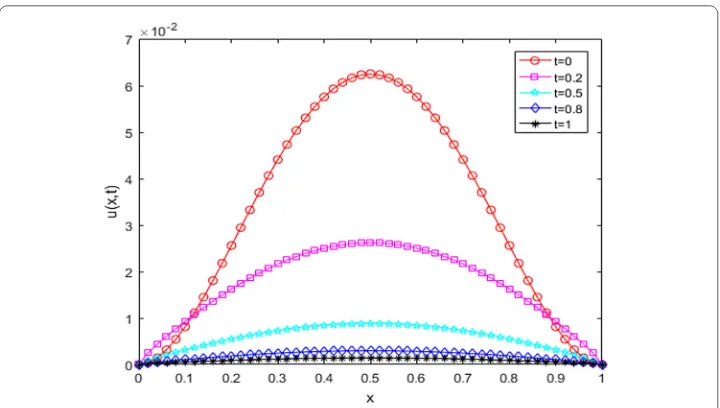
Figure 1 γ3= 0,α= 1.5,λ= 3, the change in particle concentrationu(x,t) at different times
Figure 2 γ3= 0,α= 1.5,λ= 0, the change in particle concentrationu(x,t) at different times
Table11. Figure1shows the particle concentration of the solution of the tempered frac-tional diffusion equation with α= 1.5 andλ= 3 at different times. Figure2 shows the particle concentration of the solution of the classical (λ= 0) fractional diffusion equa-tion withα= 1.5 at different times. It can be seen from Fig.1and Fig.2that the tem-pered fractional diffusion equation governs the transition densities, which become slower in progress.
6 Conclusion
diffusion equation. Numerical schemes are proved to be unconditionally stable and con-vergent theoretically and are verified to be effective by numerical experiments.
Acknowledgements
The authors would like to express their thanks to the anonymous referees for their valuable comments and suggestions.
Funding
This work is supported by the National Science Foundation of China (No. 11671343) and the Project of Scientific Research Fund of Hunan Provincial Science and Technology Department (No. 2018WK4006).
Availability of data and materials
The authors declare that all data and material in the paper are available and veritable.
Competing interests
The authors declare that they have no competing interests.
Authors’ contributions
Both authors contributed equally and significantly in writing this article. Both authors wrote, read, and approved the final manuscript.
Publisher’s Note
Springer Nature remains neutral with regard to jurisdictional claims in published maps and institutional affiliations.
Received: 18 May 2019 Accepted: 13 November 2019
References
1. Baeumer, B., Meerschaert, M.: Tempered stable Lévy motion and transient super-diffusion. J. Comput. Appl. Math. 233, 2438–2448 (2010)
2. Çelik, C., Duman, M.: Finite element method for a symmetric tempered fractional diffusion equation. Appl. Numer. Math.120, 270–286 (2017)
3. Dehghan, M., Abbaszadeh, M.: Spectral element technique for nonlinear fractional evolution equation, stability and convergence analysis. Appl. Numer. Math.119, 51–66 (2017)
4. Dehghan, M., Abbaszadeh, M.: An efficient technique based on finite difference/finite element method for solution of two-dimensional space/multi-time fractional Bloch–Torrey equations. Appl. Numer. Math.131, 190–206 (2018) 5. Dehghan, M., Abbaszadeh, M.: A finite difference/finite element technique with error estimate for space fractional
tempered diffusion-wave equation. Comput. Math. Appl.75, 2903–2914 (2018)
6. Dehghan, M., Abbaszadeh, M., Deng, W.: Fourth-order numerical method for the space-time tempered fractional diffusion-wave equation. Appl. Math. Lett.73, 120–127 (2017)
7. Dehghan, M., Manafian, J., Saadatmandi, A.: Solving nonlinear fractional partial differential equations using the homotopy analysis method. Numer. Methods Partial Differ. Equ.26(2), 448–479 (2010)
8. Deng, W., Zhang, Z.: Numerical schemes of the time tempered fractional Feynman–Kac equation. Comput. Math. Appl.73, 1063–1076 (2017)
9. Hanert, E., Piret, C.: A Chebyshev pseudospectral method to solve the space-time tempered fractional diffusion equation. SIAM J. Sci. Comput.36, A1797–A1812 (2014)
10. Heydari, M., Hooshmandasl, M., Ghaini, F., Cattani, C.: Wavelets method for the time fractional diffusion-wave equation. Phys. Lett. A379(3), 71–76 (2015)
11. Hooshmandasl, M., Heydari, M., Cattani, C.: Numerical solution of fractional sub-diffusion and time-fractional diffusion-wave equations via fractional-order Legendre functions. Eur. Phys. J. Plus131(8), 268 (2016) 12. Hu, D., Cao, X.: The implicit midpoint method for Riesz tempered fractional diffusion equation with a nonlinear
source term. Adv. Differ. Equ.2019, 66 (2019)
13. Hu, D., Cao, X.: A fourth-order compact ADI scheme for two-dimensional Riesz space fractional nonlinear reaction–diffusion equation. Int. J. Comput. Math. (2019).https://doi.org/10.1080/00207160.2019.1671587
14. Li, C., Deng, W.: High order schemes for the tempered fractional diffusion equations. Adv. Comput. Math.42, 543–572 (2016)
15. Meerschaert, M., Sabzikar, F.: Stochastic integration for tempered fractional Brownian motion. Stoch. Process. Appl. 124, 2363–2387 (2014)
16. Moghaddam, B., Machado, J., Babaei, A.: A computationally efficient method for tempered fractional differential equations with application. Comput. Appl. Math.37, 3657–3671 (2018)
17. Morgado, M., Rebelo, M.: Well-posedness and numerical approximation of tempered fractional terminal value problems. Fract. Calc. Appl. Anal.20, 1239–1262 (2017)
18. Qu, W., Liang, Y.: Stability and convergence of the Crank–Nicolson scheme for a class of variable-coefficient tempered fractional diffusion equations. Adv. Differ. Equ.2017, 108 (2017)
19. Quarteroni, A., Sacco, R., Saleri, F.: Numerical Mathematics. Springer, Berlin (2010)
20. Rall, L.: Perspectives on automatic differentiation: past, present, and future? In: Automatic Differentiation: Applications, Theory, and Implementations, pp. 1–14. Springer, Berlin (2006)
21. Sabzikar, F., Meerschaert, M., Chen, J.: Tempered fractional calculus. J. Comput. Phys.293, 14–28 (2015)
22. Sun, X., Zhao, F., Chen, S.: Numerical algorithms for the time-space tempered fractional Fokker–Planck equation. Adv. Differ. Equ.2017, 259 (2017)
24. Yu, Y., Deng, W., Wu, Y.: High-order quasi-compact difference schemes for fractional diffusion equations. Commun. Math. Sci.15, 1183–1209 (2017)
25. Yu, Y., Deng, W., Wu, Y., Wu, J.: Third order difference schemes (without using points outside of the domain) for one sided space tempered fractional partial differential equations. Appl. Numer. Math.112, 126–145 (2017)
26. Zhang, H., Liu, F., Turner, I., Chen, S.: The numerical simulation of the tempered fractional Black–Scholes equation for European double barrier option. Appl. Math. Model.40, 5819–5834 (2016)